Every successful interview starts with knowing what to expect. In this blog, we’ll take you through the top Radar Data Interpretation interview questions, breaking them down with expert tips to help you deliver impactful answers. Step into your next interview fully prepared and ready to succeed.
Questions Asked in Radar Data Interpretation Interview
Q 1. Explain the difference between Doppler and non-Doppler radar.
The core difference between Doppler and non-Doppler radar lies in their ability to measure the radial velocity of targets. Non-Doppler radar, also known as conventional radar, only measures the range and amplitude of reflected signals. Think of it like a simple snapshot – it tells you where something is, but not how fast it’s moving towards or away from you. In contrast, Doppler radar uses the Doppler effect – the change in frequency of a wave due to the relative motion between the source and the receiver – to measure the radial velocity. It’s like listening to a train whistle; as it approaches, the pitch is higher, and as it moves away, the pitch is lower. This frequency shift is precisely what Doppler radar measures to determine target speed.
For example, a non-Doppler weather radar will show you the location and intensity of precipitation, but a Doppler weather radar will additionally show you the speed and direction of the wind within the precipitation. This extra information is crucial for predicting severe weather events like tornadoes.
Q 2. Describe the different types of radar clutter and how to mitigate their effects.
Radar clutter refers to unwanted signals reflected from stationary or slowly moving objects that mask the desired targets. Several types exist:
- Ground clutter: Reflections from the ground, buildings, and terrain.
- Sea clutter: Reflections from the sea surface, influenced by waves and wind.
- Weather clutter: Reflections from precipitation like rain, snow, and hail.
- Biological clutter: Reflections from birds, insects, and other biological objects.
Mitigating clutter requires a multi-pronged approach:
- Spatial filtering: Utilizing the known spatial characteristics of clutter (e.g., ground clutter is typically located near the ground) to filter it out. Techniques like Moving Target Indication (MTI) are frequently used.
- Doppler filtering: Since clutter is usually slow-moving or stationary, Doppler processing can effectively separate moving targets from clutter by focusing on the frequency shifts of moving objects.
- Polarization diversity: Utilizing different polarizations of the transmitted signal to discriminate between clutter and target returns, as different objects may reflect differently depending on polarization.
- Clutter maps: Creating maps of known clutter sources to subtract or compensate for them during processing. This is particularly helpful for ground clutter in static environments.
The optimal strategy often involves combining these techniques for maximum effectiveness.
Q 3. How do you identify and interpret ground clutter in radar data?
Ground clutter in radar data appears as strong, relatively stationary returns close to the radar’s location. Its characteristics include:
- High amplitude: Typically stronger than returns from smaller, more distant targets.
- Low Doppler velocity: Minimal or zero velocity because the ground is generally stationary.
- Spatial consistency: Appears in consistent locations across successive scans unless the radar is moving.
Interpretation involves understanding the geographical context. For instance, a strong, consistent return near the elevation of a known mountain range is highly indicative of ground clutter. Advanced signal processing techniques, including MTI and clutter maps, assist in identification by suppressing the clutter signal while retaining target echoes. Visual inspection of the radar data, combined with knowledge of the terrain, is often crucial for accurate interpretation.
Q 4. What are the limitations of radar data in terms of range and resolution?
Radar data is subject to limitations in both range and resolution. Range limitations are determined by the radar’s power, the target’s radar cross-section (RCS), and the system’s sensitivity. A weaker signal from a distant target might fall below the noise floor, making detection impossible. This is often expressed as maximum unambiguous range.
Resolution refers to the ability to distinguish between closely spaced targets. Range resolution is determined by the pulse width of the transmitted signal; shorter pulses yield better range resolution. Azimuth resolution (ability to distinguish targets in different directions) is affected by the antenna beamwidth; narrower beams provide better azimuth resolution. Poor resolution can lead to overlapping targets in the radar image, making interpretation challenging. For example, two closely spaced aircraft might appear as a single target on a radar with poor resolution.
Q 5. Explain the concept of range ambiguity and how it’s resolved.
Range ambiguity arises when the pulse repetition frequency (PRF) is too low. The radar’s signal may return from a target after a second pulse is transmitted. The system then misinterprets the time delay, resulting in an incorrect range measurement. Imagine a runner completing a lap just as you start your stopwatch again; you’d record a shorter time than the actual lap time.
Resolving range ambiguity often involves using a higher PRF. However, increasing PRF reduces the maximum unambiguous range. A common solution is using multiple PRFs simultaneously. By combining data from different PRFs, one can resolve the ambiguity and determine the true range. This requires sophisticated signal processing algorithms to accurately correlate and interpret the data from different PRFs.
Q 6. How do you calibrate a radar system?
Radar system calibration involves ensuring the accuracy and consistency of the system’s measurements. This typically involves several steps:
- Receiver gain calibration: Ensuring the receiver amplifies signals consistently across the entire frequency range.
- Transmitter power calibration: Verifying the consistency of the transmitted power over time.
- Antenna gain calibration: Measuring the antenna’s radiation pattern and gain to correct for any inconsistencies.
- Range and Doppler calibration: Verifying the accuracy of range and Doppler measurements using known targets or calibration signals.
- System timing calibration: Ensuring precise synchronization of different components within the system.
Calibration techniques often use known targets with precise positions and velocities, or calibration signals, to check the system’s response. The calibration results are then used to correct the raw radar data, enhancing the accuracy and reliability of the final output.
Q 7. What are the different types of radar signal processing techniques?
Numerous signal processing techniques are used in radar data analysis. These techniques can be broadly classified into:
- Clutter rejection techniques: MTI, clutter maps, polarization diversity, adaptive filtering.
- Target detection and tracking techniques: Constant false alarm rate (CFAR) detectors, Kalman filtering, nearest neighbor tracking.
- Parameter estimation techniques: Techniques for estimating range, velocity, angle, and other target parameters. Maximum likelihood estimation is a common approach.
- Image processing techniques: Used to improve the visual representation of radar data, including filtering, segmentation, and feature extraction.
- Waveform design techniques: Optimize the transmitted waveforms for improved performance in specific applications. This is highly relevant to radar systems aiming for improved resolution and clutter mitigation capabilities.
The choice of signal processing techniques depends on the specific application and the nature of the radar data. For example, a weather radar will prioritize clutter rejection and parameter estimation of precipitation, while an air traffic control radar will focus on target detection and tracking.
Q 8. Describe the process of target detection and tracking in radar data.
Target detection and tracking in radar systems is a multi-step process. It begins with the radar emitting electromagnetic pulses. When these pulses encounter a target, a portion of the energy reflects back to the radar receiver. This reflected signal, or echo, contains information about the target. The process then involves several key steps:
- Signal Processing: The received signal is often weak and noisy. Sophisticated signal processing techniques, like matched filtering and pulse compression, are used to enhance the signal-to-noise ratio (SNR) and extract the relevant information from the raw data.
- Thresholding: A threshold is set to differentiate between noise and actual echoes. Echoes exceeding this threshold are considered potential targets. The threshold needs careful selection; too low, and we get numerous false alarms; too high, and we miss genuine targets.
- Detection: Once an echo surpasses the threshold, it is declared a detection. This indicates the presence of a potential target at a specific range and azimuth (direction).
- Tracking: After initial detection, tracking algorithms are used to follow the target’s movement over time. Common algorithms include Kalman filtering, which predicts the target’s future position based on its past trajectory. These algorithms effectively ‘smooth’ the sometimes erratic measurements from the raw radar data. Data association techniques match detections across consecutive scans, ensuring that the tracker is following the same target consistently.
Imagine trying to spot a bird in a noisy forest. The radar is like your eyes, the bird is the target, and the noise is the clutter (e.g., leaves, branches). Signal processing helps to filter the noise and make the bird easier to see. Thresholding decides how clearly you need to see the bird to declare its presence. Tracking ensures you keep your eyes on the bird as it flies, even if it momentarily disappears behind branches.
Q 9. Explain the concept of false alarms in radar systems and how to minimize them.
False alarms in radar systems occur when the receiver interprets noise or clutter as a real target. This can be due to several factors, including:
- Clutter: Reflections from the ground, sea, rain, or other environmental objects can mimic target echoes.
- Noise: Electronic noise in the receiver can exceed the set threshold, leading to false detections.
- Interference: Signals from other radar systems or sources can interfere with the radar’s operation.
Minimizing false alarms is crucial for radar system performance. Strategies include:
- Clutter Rejection Techniques: Moving Target Indication (MTI) filters are commonly used to eliminate stationary clutter. They exploit the Doppler effect—the change in frequency of a wave due to relative motion between the source and the observer—to differentiate between moving targets and stationary clutter.
- Adaptive Thresholding: Instead of using a fixed threshold, adaptive thresholding adjusts the threshold dynamically based on the current noise level. This approach is more robust to changing background conditions.
- Space-Time Adaptive Processing (STAP): STAP combines spatial and temporal filtering to suppress clutter and noise more effectively. It is especially helpful in dealing with complex clutter environments.
- Constant False Alarm Rate (CFAR) Detectors: These detectors aim to maintain a consistent false alarm rate irrespective of the clutter and noise levels. They adapt the threshold dynamically to ensure a consistent level of false detections.
For instance, a weather radar might be overwhelmed by strong ground clutter signals. Using MTI helps filter out these signals, showing only the moving weather phenomena. Similarly, an air traffic control radar needs very low false alarms to avoid directing pilots towards non-existent aircraft.
Q 10. How do you interpret radar data to determine the speed and direction of a target?
Determining a target’s speed and direction utilizes the Doppler effect. The radar transmits a signal with a known frequency. When this signal reflects off a moving target, its frequency shifts slightly. This frequency shift, or Doppler shift, is directly proportional to the target’s radial velocity (the component of velocity along the radar’s line of sight).
The formula for the Doppler shift (fd) is:
fd = 2 * v * fc / cwhere:
vis the radial velocity of the targetfcis the carrier frequency of the radar signalcis the speed of light
The sign of the Doppler shift indicates the direction of movement—a positive shift means the target is moving towards the radar, and a negative shift indicates movement away.
To determine the target’s direction, the azimuth angle (horizontal direction) and elevation angle (vertical direction) are measured using antenna position and beam steering. Combining the radial velocity (from the Doppler shift) and direction angles (from antenna positioning) provides a complete picture of the target’s motion in three dimensions. Note that the complete velocity vector requires multiple radar measurements or additional sensors, as radar solely provides radial velocity.
For example, a police radar gun measures the speed of a car by detecting the Doppler shift of the reflected radar signal. A weather radar uses Doppler shifts to determine wind speeds and directions in a storm.
Q 11. What are the key parameters used to characterize a radar signal?
Key parameters characterizing a radar signal are:
- Frequency (fc): The operating frequency of the radar transmitter, determining the wavelength and penetration capability. Higher frequencies offer better resolution but shorter range.
- Pulse Width (τ): The duration of each transmitted pulse, influencing range resolution. Shorter pulses provide better range resolution.
- Pulse Repetition Frequency (PRF): The number of pulses transmitted per second, affecting the maximum unambiguous range. A higher PRF allows tracking faster targets but limits the maximum range.
- Peak Power (Pt): The maximum power of the transmitted pulse, impacting the radar’s range. Higher peak power extends the range.
- Bandwidth (B): The range of frequencies within the transmitted pulse, affecting range resolution. Wider bandwidth means better resolution.
- Antenna Gain (G): A measure of the antenna’s ability to focus the transmitted power in a specific direction, impacting range and sensitivity.
- Signal-to-Noise Ratio (SNR): The ratio of the signal power to the noise power, determining the detectability of targets. Higher SNR means better detection capability.
- Doppler Shift: The change in frequency of the received signal due to the target’s motion, used to measure target velocity.
These parameters are interconnected and carefully chosen based on the specific application. For example, a long-range surveillance radar might prioritize peak power and a lower PRF, while a weather radar might focus on high PRF for detecting fast-moving weather systems.
Q 12. Explain the principles of Synthetic Aperture Radar (SAR).
Synthetic Aperture Radar (SAR) is a powerful remote sensing technique that generates high-resolution images of the Earth’s surface, regardless of weather or daylight conditions. Unlike traditional radar, which uses a physically large antenna, SAR creates a synthetically larger aperture (effective antenna size) by processing signals from multiple radar pulses acquired while the sensor moves along a trajectory. This allows for much finer spatial resolution than what would be achievable with a physically small antenna.
The basic principle involves coherently combining multiple radar signals obtained as the radar platform moves. The phase information of the returning echoes from each pulse is crucial. By carefully processing these phase differences, the radar effectively synthesizes a much larger antenna, leading to significantly improved angular resolution. This synthesized aperture allows achieving a resolution comparable to—or even exceeding—that achievable with optical sensors.
Think of it like this: imagine taking many photos of an object from slightly different angles as you move. By combining these photos, you can create a much sharper image than any single photo provides. SAR performs a similar function, combining radar signals over time to create very detailed images.
Q 13. What are the advantages and disadvantages of using SAR for remote sensing?
Advantages of SAR for remote sensing:
- All-weather capability: SAR can penetrate clouds and operate day or night, unlike optical sensors.
- High resolution: SAR can achieve very fine spatial resolution, providing detailed images of the Earth’s surface.
- Three-dimensional information: Techniques like Interferometric SAR (InSAR) can be used to extract elevation information and create digital elevation models (DEMs).
- Wide swath coverage: SAR systems can cover large areas efficiently.
- Penetration capability: Certain SAR frequencies can penetrate vegetation and even some shallow layers of the Earth’s surface.
Disadvantages of SAR for remote sensing:
- Cost: SAR systems are expensive to build and operate.
- Data processing: SAR data processing is computationally intensive and requires specialized software and expertise.
- Speckle noise: SAR images are often affected by speckle noise, a granular pattern that can obscure details.
- Geometric distortions: SAR images can suffer from geometric distortions due to the platform’s motion and the Earth’s curvature.
- Limited penetration: While SAR can penetrate some surfaces, its penetration capability is limited, and highly dense or conductive materials significantly attenuate the signal.
The choice to use SAR depends on the specific application and the trade-offs between cost, resolution, data processing requirements, and the need for all-weather or penetrating capabilities.
Q 14. Describe the applications of Ground Penetrating Radar (GPR).
Ground Penetrating Radar (GPR) uses high-frequency electromagnetic pulses to image subsurface features. It transmits radar pulses into the ground, and the reflected signals reveal information about the soil and underlying structures. The strength and timing of the reflected signals are analyzed to create a radargram, a visual representation of the subsurface.
GPR finds extensive use in various applications:
- Archaeology: Detecting buried archaeological features such as walls, foundations, and graves.
- Civil engineering: Locating underground utilities (pipes, cables), detecting voids or cracks in pavements and foundations, and assessing the integrity of structures.
- Environmental monitoring: Mapping soil layers, identifying contaminants, and characterizing groundwater flow.
- Forensic science: Locating buried objects or bodies.
- Glaciology: Studying ice thickness and internal structures.
The principles of GPR are similar to those of other radar systems, but the frequencies used are much higher (typically tens to hundreds of MHz), making it well-suited for detecting shallow subsurface features. The interpretation of GPR data requires experience and understanding of the geological and environmental conditions to accurately identify subsurface features from the radargrams.
Q 15. How do you interpret radar data from a weather radar system?
Interpreting weather radar data involves analyzing the reflectivity, velocity, and spectrum width of the radar echoes. Reflectivity represents the intensity of the returned signal, indicating the amount of precipitation or other targets in a given area. Higher reflectivity usually means heavier precipitation. Velocity data shows the movement of precipitation, indicating wind speed and direction. Spectrum width reflects the variability of Doppler velocities within a radar resolution volume, offering insights into turbulence and the structure of weather systems. Think of it like looking at a painting: reflectivity is the brightness, velocity is the direction of the brushstrokes, and spectrum width tells you how varied the paint application is.
For instance, a large area of high reflectivity with a consistent inward velocity pattern would suggest a strong thunderstorm. Conversely, low reflectivity across a wide area with variable velocities might indicate light rain with significant turbulence. We use specialized software to process raw radar data into images that display these parameters, allowing meteorologists to understand the current state and evolution of weather events.
Career Expert Tips:
- Ace those interviews! Prepare effectively by reviewing the Top 50 Most Common Interview Questions on ResumeGemini.
- Navigate your job search with confidence! Explore a wide range of Career Tips on ResumeGemini. Learn about common challenges and recommendations to overcome them.
- Craft the perfect resume! Master the Art of Resume Writing with ResumeGemini’s guide. Showcase your unique qualifications and achievements effectively.
- Don’t miss out on holiday savings! Build your dream resume with ResumeGemini’s ATS optimized templates.
Q 16. Explain the concept of radar cross-section (RCS) and its importance in target detection.
Radar cross-section (RCS) is a measure of how effectively a target reflects radar signals back to the transmitter. It’s essentially the target’s ‘radar visibility’. A larger RCS means a stronger return signal, making the target easier to detect. Think of it like shining a flashlight at objects: a large, reflective surface (like a mirror) will reflect more light (high RCS), while a small, dark object will barely reflect any (low RCS).
RCS is crucial for target detection because it dictates the signal-to-noise ratio (SNR). A high SNR means the target’s return signal is significantly stronger than the background noise, allowing for reliable detection. Factors affecting RCS include the target’s size, shape, material composition, and radar frequency. For example, a large metal aircraft will have a much higher RCS than a small bird.
Q 17. How do you analyze radar data to identify different types of weather phenomena?
Analyzing radar data to identify weather phenomena involves examining several parameters simultaneously. Reflectivity helps distinguish between different precipitation types (rain, snow, hail). High reflectivity with a narrow spectrum width typically indicates rain or snow, while high reflectivity with a broad spectrum width suggests hail. Velocity data reveals wind patterns associated with various weather systems – for example, the rotation within a tornado or the outflow from a thunderstorm.
Specific patterns can be indicative of certain phenomena: A hook echo in reflectivity often indicates a mesocyclone within a supercell thunderstorm, which is a serious indicator of potential tornadic activity. Lines of strong reflectivity with converging velocities can show the presence of a squall line. By combining these data and recognizing these characteristic patterns, we can accurately identify and classify different types of weather events, from simple rain showers to severe thunderstorms and even hurricanes.
Q 18. Explain the concept of polarization in radar systems.
Polarization in radar refers to the orientation of the electromagnetic wave’s electric field. Traditional radar uses linear polarization (horizontal or vertical), but dual-polarization radar transmits both horizontal and vertical pulses and receives the returns separately. This provides additional information about the shape and composition of hydrometeors (rain, snow, hail).
For example, comparing horizontal and vertical reflectivity helps differentiate between rain and hail. Hail tends to have a much larger horizontal reflectivity compared to its vertical reflectivity, owing to its shape. Differential reflectivity (ZDR) measures the difference between the two, offering a quantitative assessment of the hydrometeors’ shapes. Polarimetric radar significantly improves precipitation type identification and reduces false alarms.
Q 19. What are the different types of radar antennas and their characteristics?
Radar antennas come in various types, each with specific characteristics affecting performance and application.
- Parabolic reflector antennas: These are the most common type, using a parabolic dish to focus the transmitted energy into a beam. They offer good gain and directivity.
- Phased array antennas: These use multiple radiating elements controlled electronically to steer the beam without physically moving the antenna. This enables rapid scanning and electronic beam-steering, ideal for tracking multiple targets simultaneously.
- Horn antennas: Simpler and less directional than parabolic reflectors, these are often used in applications requiring a wider beam width.
The choice of antenna depends on the application. Weather radars often use parabolic reflectors for their relatively simple design and good performance. Airborne radars may prefer phased array antennas for their adaptability and speed of scanning.
Q 20. How does the radar frequency affect the performance of the system?
Radar frequency significantly influences system performance, particularly in terms of range, resolution, and attenuation. Higher frequencies offer better resolution (smaller detectable features) but suffer greater atmospheric attenuation, meaning the signal weakens more quickly with distance. Lower frequencies penetrate precipitation better and have a longer range, but resolution is reduced.
For example, weather radars operating in the S-band (around 2-4 GHz) offer a good balance between range and resolution, while X-band (around 8-12 GHz) radars offer higher resolution but are more susceptible to attenuation, especially in heavy rain. The selection of the optimal frequency is always a trade-off based on the specific application needs.
Q 21. What are the challenges of using radar data in complex environments?
Using radar data in complex environments presents several challenges.
- Clutter: Ground reflections (buildings, mountains) and other unwanted signals can mask real targets, requiring advanced signal processing techniques (clutter filtering) to remove these artifacts.
- Attenuation: Heavy precipitation or atmospheric conditions can significantly attenuate the radar signal, reducing range and accuracy.
- Multipath propagation: Signals reflecting off multiple surfaces can create interference, resulting in distorted or false returns.
- Ground cover effects: The type of ground (e.g., urban areas, forests) can affect the radar return, requiring careful calibration and consideration.
Addressing these challenges requires sophisticated algorithms, calibration techniques, and data fusion with other sensors to improve accuracy and reliability.
Q 22. Explain the principles of moving target indication (MTI).
Moving Target Indication (MTI) is a radar signal processing technique used to filter out stationary clutter and highlight moving targets. Imagine trying to spot a bird flying amongst a forest of trees – the trees are the clutter, and the bird is the moving target. MTI works by exploiting the Doppler effect, which causes a change in the frequency of the radar signal reflected by a moving object. Stationary objects reflect signals at the same frequency as transmitted, while moving objects reflect signals at a slightly different frequency due to their motion relative to the radar.
MTI typically involves comparing successive radar returns. A simple implementation might subtract the previous return from the current return. If the target is stationary, the difference will be zero or near zero, effectively canceling it out. However, a moving target will produce a non-zero difference, making it easily detectable. More sophisticated MTI techniques employ multiple delay lines and digital filtering to achieve better clutter rejection and improved sensitivity to moving targets.
For example, a weather radar uses MTI to isolate precipitation (moving targets) from the ground (clutter). Similarly, air traffic control radars employ MTI to differentiate between aircraft and stationary ground objects, ensuring clear detection and tracking of moving aircraft.
Q 23. Describe different methods for radar data fusion.
Radar data fusion combines data from multiple radar systems or sensors to create a more comprehensive and accurate picture than any single source could provide. Think of it like having multiple witnesses describe an event – combining their accounts provides a fuller understanding than any single account alone. Several methods exist, each with its strengths and weaknesses:
- Simple Averaging: This is the simplest method, where data from different sources are averaged together. While easy to implement, it’s less effective if the data sources have significantly different biases or noise levels.
- Weighted Averaging: This improves on simple averaging by assigning weights to each data source based on its reliability or accuracy. A more accurate sensor would receive a higher weight.
- Kalman Filtering: This powerful technique uses a probabilistic framework to combine data from multiple sources, accounting for uncertainties and noise. It’s particularly useful for tracking moving targets.
- Bayesian Fusion: This method uses Bayes’ theorem to update the probability of a target’s presence or characteristics based on data from different sensors. It is excellent for incorporating prior knowledge or beliefs.
The choice of method depends on factors like the accuracy and reliability of individual sensors, computational resources, and the specific application. For instance, in autonomous driving, Kalman filtering is frequently used to fuse data from multiple radars and cameras to accurately estimate the position and velocity of other vehicles.
Q 24. How do you interpret radar images to identify specific features or objects?
Interpreting radar images requires understanding the relationship between radar backscatter and the physical characteristics of the objects or features being imaged. The intensity of the reflected signal (measured in decibels, dB) represents the backscatter coefficient, which is influenced by factors like the object’s size, shape, material properties, and orientation relative to the radar. For example, a smooth surface, like calm water, generally reflects very little radar energy (low backscatter), resulting in a dark area on the image. Conversely, a rough surface, such as a forest, reflects a significant amount of energy (high backscatter), showing up as a bright area.
Identifying specific features involves analyzing various characteristics of the radar imagery, including:
- Intensity: As mentioned, the intensity directly relates to backscatter, aiding in distinguishing between different materials and objects.
- Texture: The spatial distribution of intensities provides information about the roughness and structure of the surface.
- Shape and Size: These features are crucial for identifying specific objects, like buildings, vehicles, or even individual trees.
- Polarization: Using different polarization combinations of the transmitted and received signals can reveal more about surface properties.
Experience and knowledge of the specific radar system and the environment being imaged are essential for accurate interpretation. For example, interpreting synthetic aperture radar (SAR) images of an urban area requires familiarity with typical backscatter signatures of buildings, roads, and vegetation.
Q 25. What are the common sources of error in radar measurements?
Radar measurements are susceptible to various errors, which can significantly impact the accuracy and reliability of the data. These errors can be broadly classified as:
- Systematic Errors: These errors are consistent and predictable, often stemming from biases in the radar system itself, such as calibration errors, antenna misalignment, or incorrect propagation model assumptions. For instance, a faulty antenna might consistently underestimate the range to a target.
- Random Errors: These errors are unpredictable and vary randomly from measurement to measurement. They are often caused by thermal noise in the receiver, atmospheric interference, or multipath propagation (signals reflecting off multiple surfaces before reaching the radar). The effect of random errors can be reduced by averaging multiple measurements.
- Clutter: As discussed before, clutter refers to unwanted radar returns from stationary objects such as ground, buildings, or vegetation. This can mask the presence of actual targets.
- Attenuation: The signal strength decreases with distance and also due to factors such as rain, fog, or atmospheric gases. This needs correction to accurately estimate target ranges and strengths.
Understanding these error sources is crucial for developing appropriate error correction and mitigation strategies.
Q 26. Explain how you would handle missing or corrupted data in a radar dataset.
Handling missing or corrupted data in a radar dataset is critical for maintaining the integrity and usefulness of the data. The approach depends on the extent and nature of the missing or corrupted data:
- Interpolation: For small gaps in the data, interpolation techniques, such as linear or spline interpolation, can be used to estimate the missing values. This assumes a smooth variation of the data between the known points.
- Inpainting: For larger areas of missing data, inpainting techniques, often used in image processing, can be employed. These techniques utilize surrounding data to reconstruct the missing parts of the image.
- Data Replacement: If a large portion of the dataset is corrupted, it might be necessary to replace the affected data with average values or data from similar time periods or locations. This approach needs careful consideration to avoid introducing significant biases.
- Outlier Rejection: Corrupted data points that are significantly different from their neighbors (outliers) can be identified and removed using statistical methods, before further processing.
The choice of method depends on the application and the amount of data missing or corrupted. It’s important to document the data handling methods employed to maintain transparency and understand the potential impact on the results.
Q 27. Describe your experience with specific radar data processing software.
Throughout my career, I have extensively used several radar data processing software packages. My expertise lies in using MATLAB, which offers powerful signal processing and image processing toolboxes that are perfectly suited for manipulating and analyzing radar data. I’ve utilized its functions for tasks including MTI filtering, clutter rejection, target detection, and image formation. In addition to MATLAB, I have experience with SARscape, a specialized software package for processing SAR imagery. SARscape is particularly valuable in its ability to perform advanced geocoding, interferometric processing, and polarimetric analysis. I’m also proficient in using Python with libraries like NumPy, SciPy, and Matplotlib for various radar data processing tasks. Python’s versatility and extensive libraries make it suitable for developing custom algorithms and workflows.
Q 28. Describe a challenging radar data interpretation problem you solved and how you approached it.
One challenging problem I encountered involved interpreting radar data collected during a severe weather event. The data was heavily contaminated with ground clutter and significant attenuation due to heavy rainfall. Standard MTI techniques were ineffective in isolating precipitation echoes from the intense ground clutter. My approach involved a multi-step strategy:
- Adaptive Clutter Filtering: Instead of using a fixed MTI filter, I implemented an adaptive filter that adjusted its parameters based on the local characteristics of the clutter. This approach improved clutter rejection significantly.
- Attenuation Correction: I developed a rainfall-dependent attenuation correction model using auxiliary weather radar data to compensate for signal losses due to rain. This model was calibrated to local atmospheric conditions.
- Polarimetric Analysis: I exploited the polarimetric information contained in the radar data, which provided additional clues to differentiate between precipitation and ground clutter. Specifically, I used polarimetric parameters such as differential reflectivity and linear depolarization ratio to enhance target detection.
By combining these techniques, I successfully extracted valuable information about the spatial structure and intensity of the precipitation, leading to more accurate weather forecasts and improved situational awareness during the emergency response. This experience highlighted the importance of using a combination of signal processing techniques and domain expertise to address complex radar data interpretation problems.
Key Topics to Learn for Radar Data Interpretation Interview
- Radar Principles: Understanding basic radar operation, including signal transmission, reflection, and reception. This forms the foundation for interpreting any data.
- Signal Processing Techniques: Familiarize yourself with techniques like pulse compression, clutter rejection, and Doppler processing. Knowing how these affect the final data is crucial.
- Data Representation & Formats: Mastering different data display formats (e.g., PPI, RHI) and understanding the meaning of various parameters (e.g., range, azimuth, velocity). This is essential for practical application.
- Weather Radar Interpretation: Learn to identify different weather phenomena (e.g., precipitation types, storm cells) from radar imagery. Practice analyzing reflectivity, velocity, and spectrum width data.
- Air Traffic Control Radar Interpretation: Understand how to interpret radar data for air traffic management, including target identification, tracking, and conflict resolution. Focus on practical implications and decision-making.
- Ground Penetrating Radar (GPR) Interpretation: If relevant to your target role, understand the principles and applications of GPR, including data processing and interpretation techniques for subsurface imaging.
- Error Analysis and Uncertainty: Learn to identify potential sources of error in radar data and understand the limitations of the technology. Being aware of uncertainties is crucial for accurate interpretation.
- Calibration and Validation: Understand the importance of radar calibration and data validation techniques to ensure accuracy and reliability of interpretations. This demonstrates a practical understanding of the process.
Next Steps
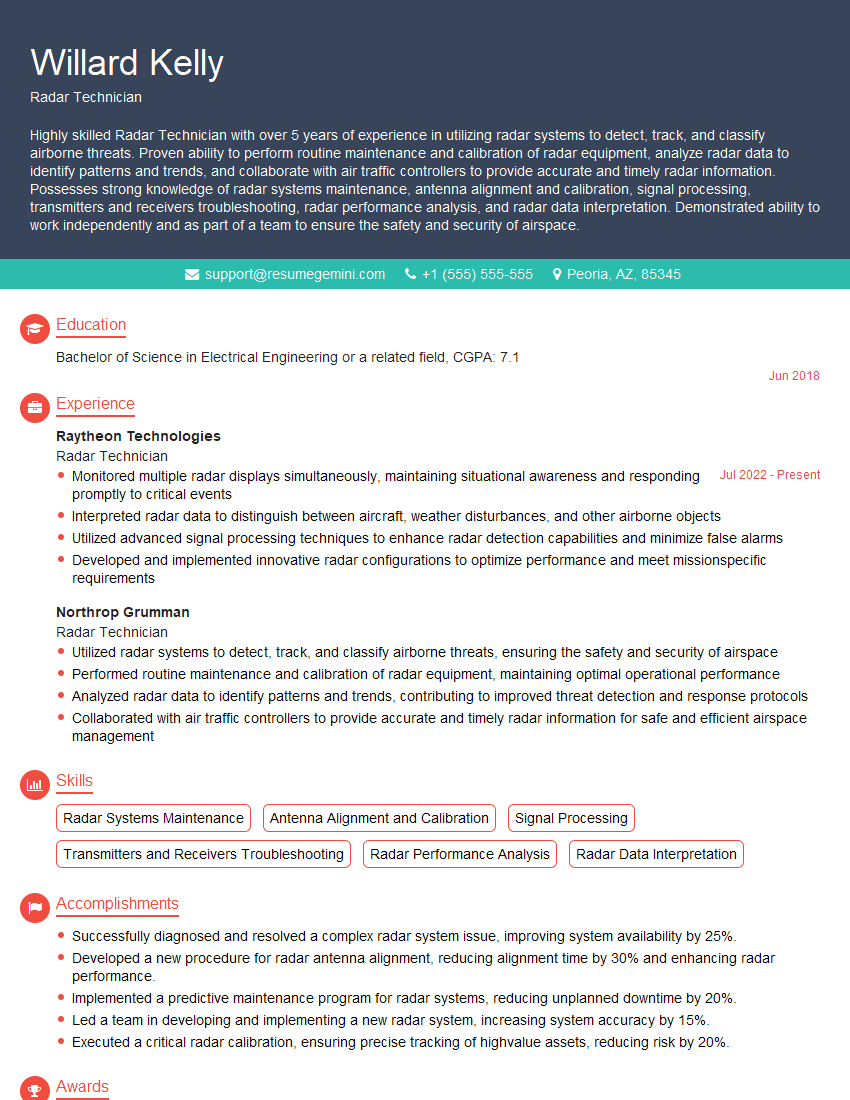
Mastering radar data interpretation significantly enhances your career prospects in fields like meteorology, aviation, geophysics, and defense. A strong understanding of this skillset is highly sought after and will open doors to exciting opportunities. To maximize your chances of landing your dream job, creating a compelling and ATS-friendly resume is key. ResumeGemini is a trusted resource to help you build a professional and effective resume that highlights your radar data interpretation expertise. Examples of resumes tailored to Radar Data Interpretation are available to guide you. Take the next step toward your career success today!

Explore more articles
Users Rating of Our Blogs
Share Your Experience
We value your feedback! Please rate our content and share your thoughts (optional).
What Readers Say About Our Blog
Really detailed insights and content, thank you for writing this detailed article.
IT gave me an insight and words to use and be able to think of examples