Interviews are more than just a Q&A session—they’re a chance to prove your worth. This blog dives into essential Riegl VUX-120 Laser Scanner interview questions and expert tips to help you align your answers with what hiring managers are looking for. Start preparing to shine!
Questions Asked in Riegl VUX-120 Laser Scanner Interview
Q 1. Explain the principle of operation of a Riegl VUX-120.
The Riegl VUX-120 operates on the principle of time-of-flight (ToF) LiDAR. It emits a laser pulse, and then precisely measures the time it takes for that pulse to reflect off a surface and return to the sensor. Knowing the speed of light, the scanner calculates the distance to the target. This process is repeated thousands of times per second, across a wide field of view, generating a dense point cloud representing the 3D surface of the scanned area. Think of it like a very sophisticated echolocation system, but instead of sound, it uses light.
The VUX-120 uses a phase-based measurement technique for enhanced precision. This involves analyzing the phase shift of the returning laser signal, providing sub-millimeter accuracy in distance measurement. This is a significant improvement over simpler ToF systems that only measure the pulse’s arrival time.
Q 2. Describe the different scanning modes available on the Riegl VUX-120.
The Riegl VUX-120 offers several scanning modes, each tailored to specific applications and environmental conditions. These modes primarily control the scan rate, the density of the point cloud, and the overall data acquisition time. Common modes include:
- High-speed mode: Prioritizes capturing data quickly, ideal for dynamic environments or large areas.
- High-density mode: Optimizes point cloud density, ensuring highly detailed surface representation. This is best for applications requiring fine-scale resolution, like architectural recording.
- Extended range mode: Extends the maximum measurement range of the system, enabling data collection from more distant targets. However, this might come at the cost of point density.
- Customizable modes: The VUX-120 allows for configuring specific scan parameters, including scan frequency, angular resolution, and laser intensity. This offers great flexibility for tailoring data acquisition to specific project requirements.
Selecting the appropriate mode depends entirely on the project goals. For example, a rapid scan of a large construction site might benefit from high-speed mode, whereas detailed scanning of a historical building would use high-density mode.
Q 3. What are the key specifications of the Riegl VUX-120 (e.g., range, accuracy, scan rate)?
Key specifications vary slightly depending on the specific VUX-120 configuration, but generally include:
- Range: Typically up to 1200 meters, though this can vary based on target reflectivity and atmospheric conditions.
- Accuracy: Sub-centimeter accuracy is achievable, often quoted as being within a few centimeters, depending on factors like distance to the target and environmental conditions. Internal calibration and precise atmospheric correction software are crucial for optimal accuracy.
- Scan Rate: Can reach very high rates, allowing for efficient data collection. Specific numbers depend on the chosen scanning mode, but rates of several hundred thousand points per second are typical.
- Field of View (FOV): The VUX-120 boasts a very wide FOV, allowing for extensive area coverage in a single scan. This accelerates data acquisition and reduces the need for multiple scans.
- Point Density: This is highly variable and depends on the chosen scanning mode and scan parameters but it can produce an exceptionally dense point cloud.
Q 4. How do you ensure accurate georeferencing of Riegl VUX-120 data?
Accurate georeferencing is paramount for integrating Riegl VUX-120 data into GIS systems and other spatial datasets. This is typically achieved through a combination of techniques:
- IMU (Inertial Measurement Unit): The VUX-120 often integrates an IMU that continuously measures the scanner’s orientation and position. This provides a real-time estimate of the scanner’s location during the scan, enabling accurate spatial registration of the point cloud.
- GNSS (Global Navigation Satellite System): Real-time kinematic (RTK) GNSS provides precise positional information to the scanner. Combining GNSS data with IMU data significantly enhances the accuracy of georeferencing.
- Ground Control Points (GCPs): Strategically placed GCPs with known coordinates are scanned to provide additional reference points. These are used to fine-tune the georeferencing process and compensate for any remaining errors in IMU and GNSS data.
- Post-Processing Software: Specialized software packages are used to process the IMU, GNSS, and GCP data together, refining the georeferencing of the point cloud. This process often involves complex algorithms that account for various error sources.
The accuracy of georeferencing directly impacts the usability and reliability of the resulting 3D model. Careful planning of GCP placement, maintaining stable GNSS signals, and using robust post-processing software are all crucial for optimal results.
Q 5. What are the common sources of error in Riegl VUX-120 data acquisition?
Several sources of error can affect the accuracy of Riegl VUX-120 data acquisition. These include:
- Atmospheric Effects: Temperature, humidity, and pressure variations affect the speed of light, introducing errors in distance measurements. Atmospheric correction models are used to mitigate this.
- Multipath Interference: Reflections of the laser pulse from multiple surfaces can lead to inaccurate range measurements. Sophisticated signal processing techniques help to reduce the impact of multipath.
- Sensor Noise: Electronic noise in the sensor can introduce small random errors into the measurements. This is usually handled through signal processing and filtering.
- IMU Errors: Inertial measurement units are prone to drift, meaning that their accuracy decreases over time. This drift is corrected using GCPs and GNSS data.
- GNSS Errors: Satellite availability and atmospheric conditions can affect the accuracy of GNSS measurements. RTK techniques mitigate this, but some error remains.
- Target Reflectivity: Highly reflective or absorptive surfaces can result in inaccurate or missing data points.
Understanding these error sources is critical for proper data processing and interpretation. Careful calibration, robust processing techniques, and consideration of environmental conditions are crucial for minimizing their impact.
Q 6. How do you address occlusion in point cloud data acquired with the Riegl VUX-120?
Occlusion, where one object blocks another from the scanner’s view, is a common problem in LiDAR data acquisition. Addressing it typically involves:
- Multiple Scan Positions: Acquiring data from multiple viewpoints can help to overcome occlusion. By scanning from different angles, previously hidden areas become visible.
- Data Fusion Techniques: Combining data from multiple scans taken from different positions can create a more complete point cloud. Specialized software aligns and integrates the scans to produce a comprehensive 3D model.
- Post-Processing Software: Software packages offer tools to fill in gaps caused by occlusion. These tools often rely on interpolation or extrapolation methods to estimate the geometry of occluded regions, however, the accuracy of these estimates is questionable.
Careful planning of scan positions is essential to minimize occlusion. For complex objects or environments, strategically positioning the scanner to obtain multiple views is critical for generating a complete and accurate 3D representation.
Q 7. Explain the process of data preprocessing for Riegl VUX-120 point clouds.
Preprocessing Riegl VUX-120 point clouds is a crucial step before further analysis or modeling. The process typically involves:
- Noise Filtering: Removing spurious data points caused by sensor noise or other artifacts. Various filtering techniques are available, such as statistical filtering or outlier removal.
- Registration: Aligning multiple scans to create a unified point cloud. This typically involves using IMU and GNSS data, along with potential GCPs.
- Georeferencing: Transforming the point cloud coordinates into a geodetic reference system (e.g., UTM). This involves accurately determining the location and orientation of the scanner during data acquisition.
- Classification: Categorizing points into different classes (e.g., ground, vegetation, buildings). This facilitates further analysis and simplifies the creation of digital terrain models (DTMs) or other derived products.
- Interpolation and Upsampling: Filling in gaps and increasing the point density, but this has limitations and often requires careful parameter selection to avoid introducing artifacts.
The choice of preprocessing steps and techniques depends on the specific application and the quality of the raw data. Using appropriate software packages designed for LiDAR data processing streamlines this crucial phase and ensures the accuracy of downstream analysis.
Q 8. What software packages are you proficient in for processing Riegl VUX-120 data?
I’m proficient in several software packages for processing Riegl VUX-120 data, each with its strengths. My go-to is RiPROCESS, Riegl’s proprietary software, as it offers seamless integration with the scanner’s data format and advanced processing tools. I also have extensive experience with RiSCAN PRO for data visualization and quality checks. For more advanced point cloud processing and 3D modeling, I utilize CloudCompare, known for its versatility and open-source nature, and PDAL (Point Data Abstraction Library) for large-scale data manipulation and filtering. Finally, I often integrate these with GIS software like ArcGIS Pro for geospatial analysis and product creation.
Q 9. Describe your experience with point cloud classification and filtering.
Point cloud classification and filtering are crucial steps in my workflow. I typically start with automated classification using algorithms within RiPROCESS or CloudCompare, categorizing points into ground, buildings, vegetation, etc. This often involves using algorithms like progressive TIN densification for ground classification. However, automated classification is rarely perfect. I then manually refine the classification using tools that allow me to interactively select and re-classify points based on their spatial context, intensity, and return number. Filtering involves removing noise and outliers, which can be done through statistical methods (e.g., removing points outside a specific standard deviation of the intensity), spatial filtering (removing isolated points), or by employing advanced techniques like moving average filtering. For example, I’ve used this process to effectively remove unwanted points from undergrowth during a bridge inspection project, improving the accuracy of the final 3D model significantly.
Q 10. How do you handle noise and outliers in Riegl VUX-120 data?
Noise and outliers in Riegl VUX-120 data are inevitable. My approach is multi-faceted. First, I carefully review the raw data for obvious errors or anomalies during the initial inspection in RiSCAN PRO, looking for patterns in the intensity values or unusual clustering. Statistical filtering, as mentioned earlier, plays a key role. I often utilize tools that allow me to set thresholds for intensity, return number, and point density to eliminate data points that fall outside these acceptable parameters. Spatial filtering methods, like removing isolated points or points that are too far from their neighbors, are also implemented. More advanced techniques, such as employing a median filter or a morphological filter, might be necessary for more complex noise patterns. For example, during a project involving a highly reflective surface like a glass building, I used a combination of intensity-based and spatial filtering to effectively remove spurious reflections that masked the actual building geometry.
Q 11. Explain your workflow for creating a 3D model from Riegl VUX-120 data.
My workflow for creating a 3D model from Riegl VUX-120 data is systematic and iterative. It begins with data preprocessing in RiPROCESS, including orientation, filtering, and classification. Next, I use RiPROCESS or CloudCompare to perform point cloud registration, aligning multiple scans to create a unified point cloud. The accuracy of this step is paramount. Following registration, I generate a Digital Terrain Model (DTM) from the classified ground points using tools like interpolation methods (e.g., kriging, inverse distance weighting). Then, I build a Digital Surface Model (DSM) from the entire point cloud. Subtracting the DTM from the DSM yields a Digital Elevation Model (DEM), showing the heights of features above the ground. Finally, I use meshing techniques (e.g., triangulated irregular networks or TINs) within CloudCompare or other specialized 3D modeling software to create a textured 3D model. I often use orthophotos generated from the point cloud for texturing, leading to a visually appealing and accurate 3D representation.
Q 12. Describe your experience with different point cloud registration techniques.
I’m experienced with various point cloud registration techniques, selecting the best approach based on the project requirements and data characteristics. Iterative Closest Point (ICP) is my most frequently used algorithm, known for its efficiency and accuracy, especially when dealing with overlapping scan data. For larger datasets or scans with significant misalignment, I often employ techniques like global registration, which utilizes landmark features (e.g., control points) to achieve initial alignment before refining with ICP. I also have experience with feature-based registration, identifying and matching distinctive features between scans, which can be particularly useful in challenging scenarios with minimal overlap. The selection depends heavily on the context. For instance, when scanning a large quarry where feature-based methods were difficult to apply, ICP paired with global registration methods proved highly effective.
Q 13. What are the limitations of the Riegl VUX-120?
While the Riegl VUX-120 is a powerful instrument, it does have limitations. Its range is not unlimited; accuracy decreases significantly at longer ranges. The scanner’s sensitivity to atmospheric conditions, particularly rain or fog, can impact data quality. Occlusion, where objects block the scanner’s line of sight, is a common issue, leading to data gaps in the resulting point cloud. Processing large datasets can be computationally intensive and time-consuming. Finally, the size and weight of the system restrict its accessibility in certain environments. Understanding these constraints is essential for proper planning and execution of any surveying project.
Q 14. How do you ensure the quality control of Riegl VUX-120 data?
Ensuring the quality control of Riegl VUX-120 data is critical. My quality control process begins even before data acquisition, involving meticulous planning, including selecting appropriate scan parameters (e.g., scan resolution, scan speed, scan angle) based on the project requirements. During data acquisition, I monitor real-time data quality checks to identify potential issues. After data acquisition, a rigorous post-processing quality control is undertaken, verifying the accuracy of registration, checking for outliers and noise, and assessing the completeness and consistency of the point cloud. I carefully review the classification results, checking for errors in automated classification. Finally, I perform visual inspections of the 3D model, identifying potential artifacts or inaccuracies. Detailed documentation of every stage is maintained as an auditable record. This multi-stage approach helps deliver consistently reliable and accurate results.
Q 15. Explain your experience with different types of LiDAR data formats.
My experience encompasses a wide range of LiDAR data formats, primarily focusing on those used with the Riegl VUX-120. This includes the Riegl’s proprietary .rxp format, which is a highly efficient binary format storing both point cloud data and system parameters. I’m also proficient in working with ASCII formats like LAS (LASer ASCII), which is an industry standard offering excellent interoperability with various processing software. Furthermore, I’ve worked extensively with point cloud formats like PLY (Polygon File Format) and XYZ, particularly when integrating LiDAR data with other geospatial datasets or using specific software packages that prefer these formats. Converting between these formats is a routine task for ensuring data compatibility and optimal processing workflow.
The choice of format often depends on the specific application and software used. For instance, .rxp files are ideal for initial data storage and preservation of all metadata from the Riegl system. However, for sharing and compatibility with other software, converting to LAS is often necessary. ASCII formats like XYZ are useful for simpler tasks or data visualization in less sophisticated software.
Career Expert Tips:
- Ace those interviews! Prepare effectively by reviewing the Top 50 Most Common Interview Questions on ResumeGemini.
- Navigate your job search with confidence! Explore a wide range of Career Tips on ResumeGemini. Learn about common challenges and recommendations to overcome them.
- Craft the perfect resume! Master the Art of Resume Writing with ResumeGemini’s guide. Showcase your unique qualifications and achievements effectively.
- Don’t miss out on holiday savings! Build your dream resume with ResumeGemini’s ATS optimized templates.
Q 16. Describe your experience with intensity data from the Riegl VUX-120.
The Riegl VUX-120 provides exceptionally rich intensity data. Intensity, in this context, represents the amount of energy reflected back to the scanner from a given target. This isn’t simply a measure of distance; it’s a complex signal reflecting surface material properties such as reflectivity, roughness, and angle of incidence. I’ve extensively utilized this intensity data for various applications, including material classification (e.g., distinguishing vegetation from building materials), feature extraction (detecting subtle changes in terrain or identifying objects obscured by foliage), and noise filtering (enhancing the quality of point clouds by removing less reliable measurements with low intensity).
For instance, in a recent project involving building facade analysis, higher intensity values helped differentiate concrete surfaces from glass windows, even though they were at similar distances from the scanner. Similarly, analyzing intensity variations in vegetation allowed us to classify different types of trees and undergrowth based on the unique reflectivity characteristics of their leaves and branches. I often use intensity data in combination with other attributes like RGB color information (if available) to achieve a more comprehensive understanding of the scene.
Q 17. How do you interpret intensity values in point cloud data?
Interpreting intensity values requires a nuanced understanding of the factors influencing the returned signal. It’s not a direct measure of anything in absolute terms, but rather a relative measure within the context of a single scan. The higher the intensity value, generally, the stronger the return signal, indicating a highly reflective surface, a direct hit (perpendicular to the surface), or a dense target. Lower values might indicate absorption by the material (e.g., dark-colored surfaces), a glancing angle of incidence, or low target density (like thin vegetation).
I often employ histogram analysis to understand the distribution of intensity values within a point cloud. This reveals common intensities and outliers, giving a better grasp of surface characteristics. For example, a bimodal histogram might indicate the presence of two distinctly different materials. Along with visual inspection of the point cloud, intensity data allows for informed decision making in filtering, classification, and other processing steps.
Q 18. How do you manage large point cloud datasets?
Managing large point cloud datasets from the Riegl VUX-120, often exceeding gigabytes in size, necessitates employing strategies for efficient storage, processing, and visualization. I leverage several techniques, including:
- Data partitioning: Dividing the point cloud into smaller, manageable tiles for processing and analysis. This reduces memory requirements and speeds up computations.
- Data compression: Using lossless compression algorithms (like LASzip) to significantly reduce file sizes without data loss, optimizing storage space and transfer times.
- Cloud-based storage: Utilizing cloud platforms such as AWS S3 or Azure Blob Storage to store and manage massive datasets efficiently, offering scalability and accessibility.
- Specialized software: Employing software like LAStools, PDAL, or cloud-based point cloud processing platforms designed to handle large datasets effectively. These tools provide optimized algorithms for filtering, classification, and other point cloud processing tasks.
Efficient management ensures the ability to work effectively with the immense data volumes and computational demands associated with high-resolution LiDAR point clouds.
Q 19. What are the best practices for storing and archiving Riegl VUX-120 data?
Best practices for storing and archiving Riegl VUX-120 data involve a multi-faceted approach focusing on data integrity, accessibility, and long-term preservation. This includes:
- Structured file system: Organizing data within a clear and consistent directory structure, including project name, date, scan information, and processed data derivatives.
- Metadata preservation: Ensuring all relevant metadata (system settings, GPS information, etc.) are meticulously stored and associated with the raw data. This is crucial for reproducibility and analysis.
- Regular backups: Implementing redundant backups on multiple storage media (e.g., local hard drives, network storage, and cloud storage) to mitigate data loss.
- Data format selection: Selecting appropriate data formats, such as .rxp for archival and LAS for sharing and interoperability.
- Data integrity checks: Implementing regular checksums or other verification procedures to detect data corruption.
- Version control: Tracking changes to processed data using version control systems, allowing for easy retrieval of previous processing steps.
Following these practices assures data longevity, facilitates collaboration, and promotes reliable, repeatable analysis.
Q 20. Explain your experience with different types of targets used in LiDAR surveying.
My experience encompasses various targets used in LiDAR surveying, each offering unique advantages and disadvantages. These include:
- Spherical targets: These are highly effective for accurate georeferencing and control, providing well-defined points for registration and coordinate transformation. However, they can be expensive and require precise placement.
- Retroreflective targets: These are designed to maximize the return signal, ensuring reliable detection even at long distances or with limited light. They are commonly used for checking accuracy and improving point cloud registration. They are generally more cost effective than spherical targets.
- Trihedral targets: These offer high reflectivity and are suitable for long-range applications. However, they are relatively large and may not be appropriate for all surveying projects.
- Natural targets: Using naturally occurring features like building corners or distinct terrain features. These reduce costs but require careful selection and may not always provide the same accuracy as specialized targets.
The selection of targets is a critical part of planning a LiDAR survey, based on the specific project goals, budget, and environmental considerations.
Q 21. Describe the advantages and disadvantages of using the Riegl VUX-120 compared to other LiDAR systems.
The Riegl VUX-120 is a high-end, versatile LiDAR system, but its advantages and disadvantages should be weighed against other systems based on specific project needs.
Advantages:
- High point density and accuracy: Provides extremely dense point clouds with high accuracy, crucial for detailed modeling and analysis.
- Wide swath width: Covers a significant area per scan, reducing survey time and cost.
- Multiple return capabilities: Captures multiple returns per laser pulse, providing comprehensive data even in dense vegetation or complex environments.
- High dynamic range: Handles a wide range of intensities, suitable for diverse environments and surface types.
Disadvantages:
- High cost: It’s a significant investment, making it suitable for large-scale projects or organizations with substantial resources.
- Complex operation: Requires specialized training and expertise for optimal operation and data processing.
- Data volume: Generates extremely large datasets requiring significant storage and processing capacity.
Compared to smaller, less expensive LiDAR systems, the VUX-120 excels in data quality and efficiency for large-scale projects. However, its cost and complexity must be considered. A smaller system may suffice for smaller scale applications where high-density point clouds aren’t a critical requirement.
Q 22. How do you plan a LiDAR survey using the Riegl VUX-120?
Planning a LiDAR survey with the Riegl VUX-120 involves meticulous preparation to ensure data quality and project success. It starts with a thorough understanding of the project objectives, defining the area of interest, and specifying the required accuracy and density of the point cloud. This understanding guides the choice of flight parameters like altitude, speed, and overlap.
Key Steps:
- Project Definition: Clearly define the project scope, deliverables (e.g., accuracy requirements, point cloud density), and budget.
- Site Reconnaissance: Conduct a thorough site visit to identify potential obstacles (vegetation, buildings, power lines), assess accessibility, and determine optimal flight paths. This often involves using imagery like Google Earth to plan routes in advance.
- Flight Planning Software: Employ specialized software (like Pix4D, RealityCapture, or Riegl’s own software) to design efficient flight paths, taking into account the scanner’s specifications (scan angle, swath width). This software helps optimize overlap to ensure complete coverage and accurate point cloud registration.
- Sensor Calibration: Verify the sensor’s internal calibration parameters are up-to-date and accurate. This ensures consistent and reliable data acquisition.
- GPS/IMU Setup: Ensure the proper configuration and calibration of the GPS and IMU (Inertial Measurement Unit) systems integrated with the VUX-120. This is crucial for accurate georeferencing.
- Post-Processing Plan: Determine the software and workflow for processing the raw LiDAR data into a usable point cloud. Consider aspects like point cloud classification, noise filtering, and georeferencing accuracy.
For example, in a recent bridge inspection project, careful flight planning with a high-density point cloud ensured we captured detailed surface textures and subtle structural defects, which were crucial for safety assessments.
Q 23. What safety precautions do you take when operating the Riegl VUX-120?
Safety is paramount when operating the Riegl VUX-120. It’s a high-precision instrument that requires careful handling and adherence to strict safety procedures. This includes both operational safety and the safety of those in the vicinity.
- Pre-Flight Checks: Thoroughly inspect the system before each flight, checking for any damage or loose connections. This is a checklist-driven process, ensuring nothing is overlooked.
- Flight Zone Security: Establish a secure flight zone, restricting access to unauthorized personnel. Clearly communicate the flight plan and safety procedures to everyone involved.
- UAS Regulations: Adhere strictly to all relevant drone regulations and airspace restrictions, including obtaining necessary permits.
- Weather Conditions: Never operate the system in adverse weather conditions (high winds, rain, fog). Poor weather can seriously impact data quality and safety.
- Personal Protective Equipment (PPE): Use appropriate PPE, including safety glasses and hearing protection, as the VUX-120 might generate some noise.
- Emergency Procedures: Develop and practice emergency procedures in case of system malfunction or unexpected events, including battery failure and loss of signal.
For instance, in a recent project near a busy highway, we meticulously planned the flight path to avoid any traffic interference and used visual observers to alert us of approaching vehicles or obstacles.
Q 24. Explain your experience with calibrating and maintaining the Riegl VUX-120.
Calibration and maintenance are crucial for ensuring the accuracy and reliability of the Riegl VUX-120. Calibration involves verifying the internal parameters of the scanner to ensure accurate measurements. Regular maintenance prevents issues and extends the lifespan of the equipment.
- Calibration Procedures: Riegl provides detailed calibration procedures, often requiring specialized equipment and software. This typically involves using a calibration target and performing rigorous geometric and radiometric checks.
- Frequency of Calibration: The frequency of calibration depends on usage, but regular checks are recommended. Post-major transportation or significant impacts require recalibration.
- Maintenance Tasks: Routine maintenance includes cleaning the lenses and sensors, checking for any signs of wear and tear, and keeping the system’s firmware updated. This may also include checking and replacing filters, and regularly backing up all system configurations.
- Riegl Support: Riegl offers excellent support and resources, including training materials and technical documentation, to aid in calibration and maintenance.
For example, I recently recalibrated a VUX-120 after its transportation to a new project site. This ensured we obtained accurate data despite the environmental shifts during transport. Consistent maintenance reduces the risk of unexpected errors and ensures the reliability of the collected data.
Q 25. Describe your experience with integrating Riegl VUX-120 data with other geospatial data sources.
Integrating Riegl VUX-120 data with other geospatial data sources is a common practice, enhancing the richness and context of the final product. This often involves using GIS software and various data formats.
- Data Formats: The Riegl VUX-120 typically outputs point cloud data in formats like LAS or LAX, easily integrable with most GIS software packages.
- Georeferencing: Accurate georeferencing is crucial for integration. The VUX-120’s IMU and GNSS data facilitate precise positioning of the point cloud within a geographic coordinate system.
- Software: Common GIS software (ArcGIS, QGIS) readily handles LAS/LAX files, allowing for overlaying and integration with other data layers (e.g., imagery, CAD drawings, vector data).
- Data Transformation: Sometimes, data transformations may be needed to align different datasets with varying coordinate systems and datums.
- Co-registration Techniques: Advanced co-registration techniques can refine the alignment between the LiDAR point cloud and other data sources, especially when using multiple datasets.
In a recent urban modeling project, we integrated the VUX-120 point cloud with high-resolution imagery and existing cadastral data to create a detailed 3D model of the city. This combined dataset allowed for accurate building modeling and infrastructure analysis.
Q 26. How do you troubleshoot common issues encountered during Riegl VUX-120 data acquisition?
Troubleshooting during data acquisition requires systematic investigation. Understanding potential issues and their causes is key to effective problem-solving.
- Data Gaps: Gaps in the point cloud can result from various issues like incorrect flight parameters, sensor malfunction, or obstructions. Revisiting the flight plan and checking for potential obstructions is a starting point.
- Low Point Density: Inadequate point density can be due to insufficient overlap or incorrect scanner settings. Adjusting the flight parameters (altitude, speed, scan angle) usually addresses this.
- Sensor Malfunction: Sensor malfunctions might require more in-depth investigation. Contacting Riegl support, performing system diagnostics, and possibly checking for physical damage are vital steps.
- Software Errors: Problems can arise from software glitches. Updating the firmware and software, as well as reviewing the acquisition settings to see if there is an error in the configurations, can resolve many issues.
For example, I once encountered unexpected data gaps in a forested area. After investigating, I realized the flight altitude was too high and adjusted it for a subsequent flight, successfully obtaining complete coverage.
Q 27. How would you approach a project requiring high-density point cloud data?
High-density point cloud data acquisition requires careful planning and execution. The Riegl VUX-120’s capabilities allow for high-density data capture, but optimization is crucial for efficiency and practicality.
- Flight Parameters: Lowering the flight altitude and possibly increasing the scan rate will increase the point density. However, this needs to be balanced against flight time and processing requirements.
- Overlap: Ensuring significant overlap between scan lines is essential for accurate data registration and high density. This requires careful planning using flight planning software.
- Post-Processing: Efficient post-processing workflows are vital for handling the large datasets. This may involve employing specialized software or hardware to manage the processing demands.
- Data Management: Efficient data management strategies are necessary for storage, organization, and archiving the high-volume point cloud data.
In a recent project demanding exceptionally high density, we opted for multiple flight passes at lower altitudes with higher overlap. The increased data volume required powerful processing resources and a streamlined post-processing workflow but yielded incredibly detailed results for precise modeling.
Q 28. Describe a challenging project involving the Riegl VUX-120 and how you overcame the challenges.
One challenging project involved surveying a large, complex industrial site with numerous obstacles and limited access points. The site included tall structures, dense vegetation, and restricted airspace.
Challenges:
- Obstructions: The numerous obstacles hampered direct flight paths, requiring careful flight planning and potentially multiple flight missions from different vantage points.
- Airspace Restrictions: Limited airspace necessitated meticulous coordination with air traffic control and adherence to strict regulations.
- Time Constraints: The project had a tight deadline, adding pressure to optimize data acquisition and processing.
Solutions:
- Phased Approach: We divided the project into smaller, manageable areas, enabling us to plan individual flight missions effectively, considering the obstacles in each area.
- Multiple Flight Paths: We employed multiple flight paths and altitudes to ensure complete data acquisition while navigating around obstructions.
- Coordination: Close communication and coordination with the client and relevant authorities were crucial for securing permissions and optimizing the flight plans.
- Efficient Post-processing: We used automated and efficient post-processing workflows to meet the tight deadlines, leveraging parallel processing to reduce overall time significantly.
By employing a well-structured approach and leveraging the Riegl VUX-120’s capabilities, we successfully completed the project, delivering high-quality data despite the initial challenges.
Key Topics to Learn for Riegl VUX-120 Laser Scanner Interview
- Hardware Components and Functionality: Understand the internal workings of the VUX-120, including its laser technology, IMU, GPS, and data acquisition systems. Be prepared to discuss their individual roles and how they interact.
- Data Acquisition and Processing: Familiarize yourself with the process of data acquisition, including scan parameters, positioning techniques (e.g., RTK GPS), and data file formats. Understand post-processing workflows, including data cleaning, registration, and point cloud manipulation.
- Software Proficiency: Demonstrate knowledge of Riegl’s processing software (RiSCAN PRO or similar) and your ability to work with point cloud data using relevant software packages (e.g., CloudCompare, ArcGIS). Discuss your experience with different processing techniques and workflows.
- Applications and Use Cases: Be ready to discuss real-world applications of the VUX-120, such as surveying, mining, forestry, or civil engineering. Prepare specific examples to showcase your understanding of the scanner’s capabilities in different contexts.
- Accuracy and Error Analysis: Understand the sources of error in LiDAR data acquisition and processing. Be able to discuss strategies for mitigating errors and assessing the accuracy of the resulting point cloud data.
- Safety Procedures and Best Practices: Demonstrate awareness of safety regulations and best practices for operating the VUX-120 and handling LiDAR data. Highlight any relevant experience and certifications.
- Troubleshooting and Problem-Solving: Be prepared to discuss common challenges encountered during data acquisition and processing, and your approach to troubleshooting and resolving those issues.
Next Steps
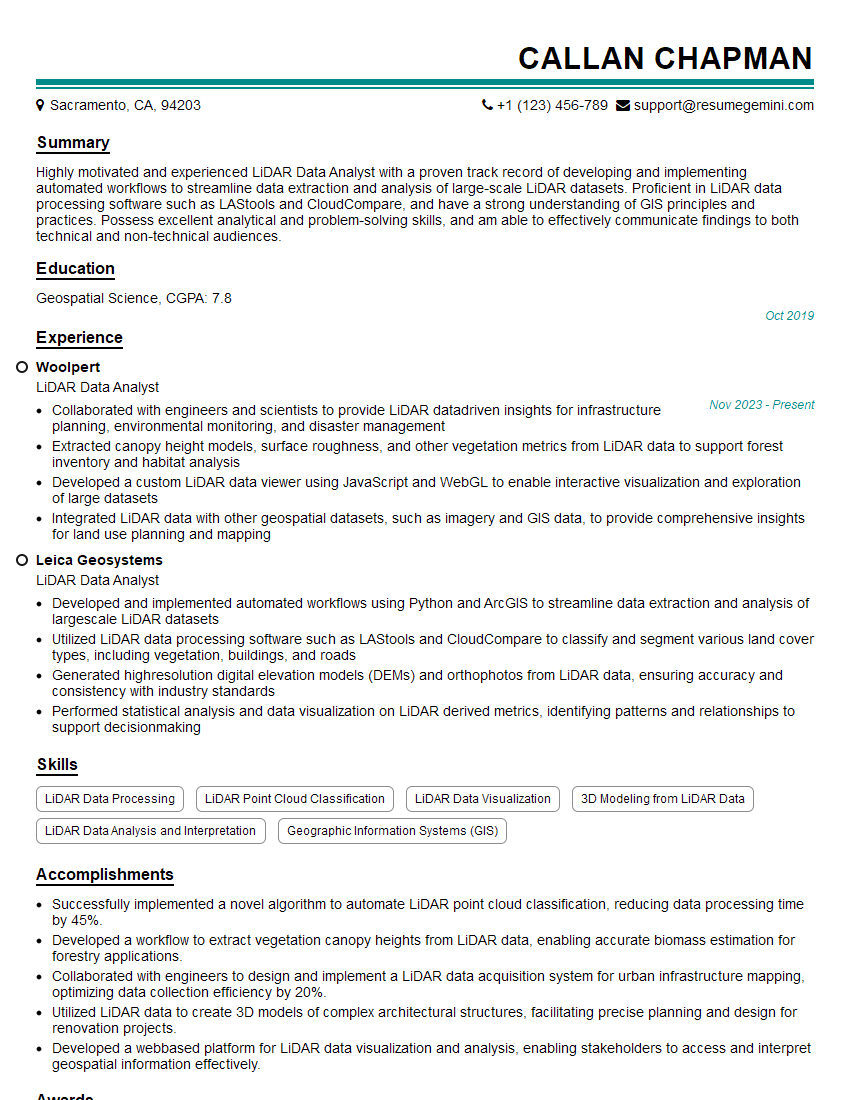
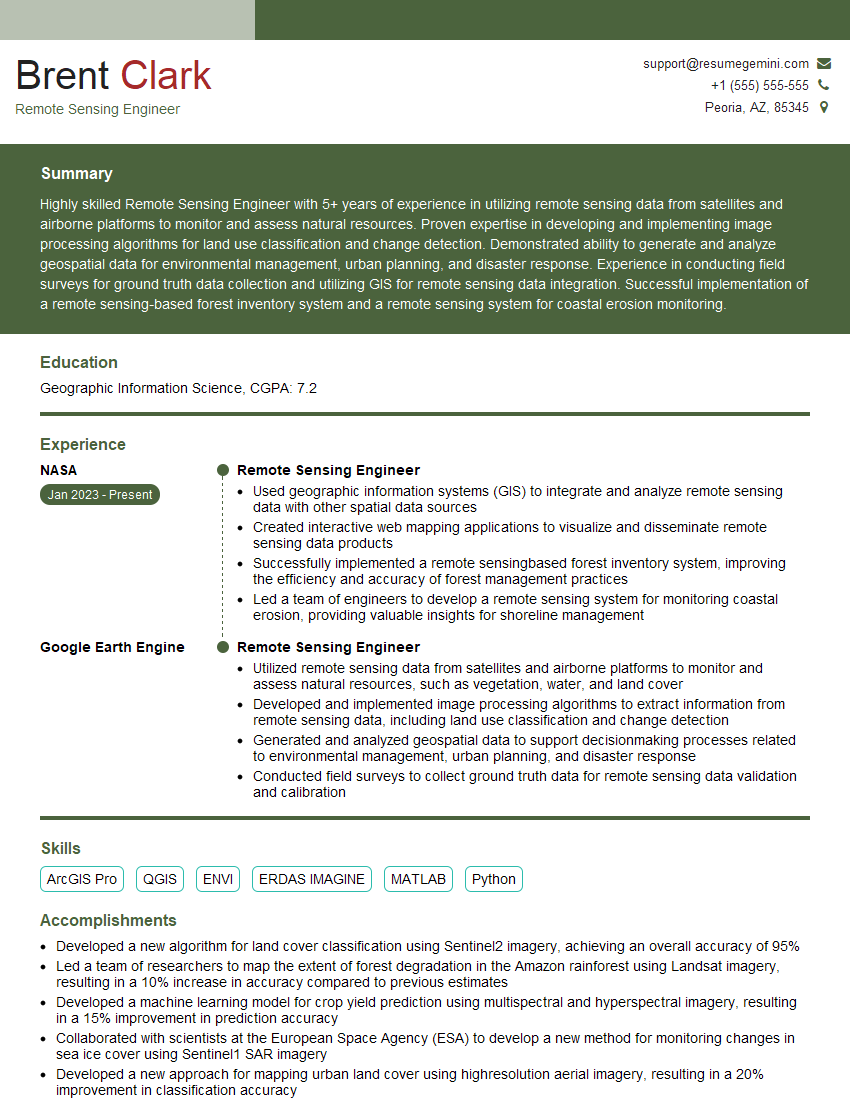
Mastering the Riegl VUX-120 Laser Scanner opens doors to exciting career opportunities in various high-growth industries. To maximize your job prospects, creating a strong, ATS-friendly resume is crucial. ResumeGemini is a trusted resource to help you build a professional resume that highlights your skills and experience effectively. Examples of resumes tailored to Riegl VUX-120 Laser Scanner expertise are available to help you craft a compelling application that showcases your capabilities.
Explore more articles
Users Rating of Our Blogs
Share Your Experience
We value your feedback! Please rate our content and share your thoughts (optional).
What Readers Say About Our Blog
Really detailed insights and content, thank you for writing this detailed article.
IT gave me an insight and words to use and be able to think of examples