Unlock your full potential by mastering the most common Sculpture and Carving interview questions. This blog offers a deep dive into the critical topics, ensuring you’re not only prepared to answer but to excel. With these insights, you’ll approach your interview with clarity and confidence.
Questions Asked in Sculpture and Carving Interview
Q 1. What sculpting materials are you most proficient with?
My expertise spans a range of sculpting materials, but I’m most proficient with stone (particularly marble and limestone), wood (both hardwoods and softwoods), and bronze. Each material presents unique challenges and rewards. Stone demands patience and precision due to its hardness and unforgiving nature. Wood, on the other hand, offers more flexibility in terms of carving techniques, but requires a deep understanding of its grain and potential weaknesses. Bronze, being a cast material, allows for greater complexity in form, but involves mastering the lost-wax casting process.
For example, I recently completed a life-size marble portrait, which required meticulous planning and a gradual subtractive process to avoid irreversible mistakes. A subsequent project involved a large-scale wood carving, where I utilized different tools to exploit the natural grain and achieve a specific texture.
Q 2. Describe your preferred carving techniques.
My preferred carving techniques are a blend of traditional and contemporary approaches. I often begin with a roughing-out stage, using larger tools like chisels and mallets to establish the overall form. This is followed by a refining stage, where I employ smaller tools, like gouges and rasps, to create finer details and textures. For stone, I typically use a point chisel to create sharp edges and a flat chisel for larger areas. In wood carving, I frequently utilize a variety of gouges, depending on the curve or detail I want to achieve.
I also incorporate modern techniques, such as using power tools for initial shaping in larger pieces, but always revert to hand tools for the finishing touches, ensuring a more nuanced and personal touch. Think of it as the conductor’s baton: while a power tool might get you through a large section of the score, the finesse and artistry comes from precise, hand-crafted movements.
Q 3. Explain the process of creating a maquette.
A maquette is a small-scale model of a larger sculpture, crucial for planning and refining the design before committing to the final material. Creating a maquette involves a series of steps: First, I develop preliminary sketches and drawings to explore various compositional possibilities. Then, I choose a suitable material, often clay or wax, to build a three-dimensional representation. This allows me to manipulate the form, adjust proportions, and evaluate the overall balance and flow of the piece. The maquette is then used to create a mold (if casting) or as a guide for the final sculpting process. It’s like a blueprint for a building, only in three dimensions, allowing for much more dynamic manipulation and adjustments along the way.
For instance, when working on a large-scale bronze equestrian statue, I started with a small clay maquette to perfect the horse’s anatomy and the rider’s pose before scaling it up and casting it in bronze.
Q 4. How do you ensure structural integrity in your sculptures?
Ensuring structural integrity is paramount, especially in large-scale sculptures. My approach involves several considerations: First, careful selection of materials is essential. For example, I choose stronger wood species for large wood carvings and select marble with minimal internal flaws for stone sculptures. Second, I employ sound construction techniques, like using internal supports or armatures, especially when working with fragile materials. Third, I often incorporate reinforcing elements, such as metal rods or pins, to strengthen vulnerable areas.
In the case of a towering stone sculpture, I might use internal steel supports within the stone to prevent cracks or breakage. The supports are carefully integrated, ensuring they are not visible in the final piece.
Q 5. What are your methods for surface finishing?
Surface finishing is as important as the sculpting process itself, as it significantly affects the final aesthetic and durability of the piece. My methods vary depending on the material: For stone, I use abrasives, starting with coarser grits and gradually moving to finer ones to achieve a smooth, polished surface. This is often followed by waxing or oiling to enhance the stone’s natural beauty and protect it from weathering.
For wood, I may use sandpaper, followed by several coats of varnish or shellac, depending on the desired finish. The choice of finish is crucial for protecting the wood from moisture and insects. Bronze requires different methods, such as sanding, patination (chemical processes to create various colors and textures), and polishing to achieve the desired look. Ultimately, the finish amplifies the artist’s vision and protects the art from the elements.
Q 6. Discuss your experience with different casting processes.
I have extensive experience with various casting processes, primarily lost-wax casting for bronze and investment casting for other metals. Lost-wax casting involves creating a wax model, making a mold around it, melting out the wax, and pouring molten metal into the resulting cavity. Investment casting is similar but uses a ceramic mold instead of a plaster one. Understanding the nuances of each process is crucial for achieving high-quality results, especially in terms of detail and surface finish.
For example, I recently used lost-wax casting for a complex bronze sculpture with intricate details. The process was meticulously managed to ensure accurate reproduction and a flawless final product. Each stage—wax modeling, mold making, metal pouring, and finishing—requires precision and expertise.
Q 7. How do you approach scaling a sculpture from a small model to a larger piece?
Scaling a sculpture from a small model to a larger piece is a complex process that requires precise calculations and attention to detail. I use a variety of methods, including point-to-point scaling using calipers and proportional dividers, as well as digital modeling and 3D printing techniques for complex forms. The key is to maintain the proportions and details consistently throughout the scaling process. This often involves creating a series of intermediate-sized models to ensure accuracy and manage the challenges associated with increasing the scale.
For instance, when enlarging a clay maquette for a monumental sculpture, I would use a combination of traditional and digital tools. The digital model would help in precise measurements and adjustments, while the traditional methods would allow for the subtle adjustments and textures crucial for the final result.
Q 8. How do you incorporate texture and form in your work?
Texture and form are inextricably linked in sculpture; they’re two sides of the same coin, defining the overall impact and meaning of the piece. Form refers to the three-dimensional shape and volume, while texture involves the surface qualities – its roughness, smoothness, grain, etc. I strive for a dynamic interplay between the two.
For example, in a figurative sculpture, I might carve smooth, flowing forms for the body’s curves to suggest grace and elegance. However, I might then introduce a rough, textured surface on the clothing to imply a feeling of worn fabric or to create a contrast with the smoother areas. Alternatively, I might use contrasting textures to suggest different materials, such as smooth polished stone for a figure’s skin juxtaposed with the rough, hewn texture of a rocky landscape forming the base.
My approach often involves planning the textural elements alongside the form during the initial design phase, considering how different textures can enhance or subvert the perceived form. I might use tools like rasps for larger textural areas and finer tools like chisels for detail work. The choice of tools, as well as the material itself, heavily influences the resulting texture.
Q 9. Describe your understanding of anatomical proportions (if applicable).
Understanding anatomical proportions is crucial for creating believable and impactful figurative sculptures. It’s not merely about getting the measurements exactly right, but about understanding the underlying structure and how the muscles, bones, and fat interact to create the overall form. I use anatomical references extensively, studying both classical anatomical drawings and modern anatomical texts, as well as observing the human body directly.
My approach involves a combination of direct observation and using proportional guides. I often start with a simplified armature or framework to establish the basic proportions and pose, then gradually refine the form by adding muscle mass and detailing surface anatomy. I use calipers to check proportions throughout the process, ensuring that the relationships between different body parts remain accurate and consistent. For instance, the head’s height is roughly one-eighth of the total body height, and the distance between the navel and the top of the head is about equal to the distance from the navel to the soles of the feet.
Understanding these fundamental proportions allows me to create a realistic, dynamic, and believable figure, even when stylizing or abstracting the form.
Q 10. Explain your approach to translating a 2D concept into a 3D sculpture.
Translating a 2D concept into a 3D sculpture is a multi-step process requiring careful planning and execution. It’s not a simple matter of transferring the image directly; it requires understanding perspective, volume, and spatial relationships in a completely new way.
My process typically begins with creating detailed sketches and drawings of the 2D concept from multiple angles. I then create small-scale maquettes, usually in clay or wax, to explore different possibilities and refine the form. These maquettes allow me to visualize the 3D form and address potential issues before committing to the final material. They are critical for visualizing the piece in three dimensions. I frequently use photographs of my maquettes, which I can rotate and manipulate digitally to further assess the form.
The next step is transferring the approved maquette design to the final material. This often involves creating a scaled-up version of the maquette, transferring proportions using techniques like grid transfer or direct measurement, and then proceeding with the carving process. Continuous observation and adjustments are essential throughout the creation of the final piece.
Q 11. How do you manage time effectively during the creation of a large-scale piece?
Managing time effectively on large-scale projects is essential. Poor time management can lead to burnout and compromised quality. My approach is based on meticulous planning and breaking down the project into manageable stages.
I begin with a detailed project timeline, outlining each stage of the process, from initial design and material selection to the final finishing touches. This timeline assigns specific timeframes for each step, setting realistic deadlines. I also build in buffer time to accommodate unexpected delays or challenges. This prevents rushing towards the end.
Regular progress checks and adjustments are crucial. I regularly review the timeline, noting my progress and making adjustments as needed. This allows me to adapt to unforeseen circumstances while keeping the project on track. Furthermore, I prioritize tasks based on their importance and dependencies, ensuring that crucial steps are completed in a timely manner. This method ensures I don’t get bogged down on less important details at the expense of the project’s overall completion.
Q 12. What are some common challenges in your chosen sculpting medium, and how do you overcome them?
Working with stone presents unique challenges. One major hurdle is the inherent hardness and fragility of the material. A miscalculation can lead to irreparable damage. Another common challenge is the unpredictable nature of the stone itself – variations in grain and density can affect carving difficulty and the final finish.
To overcome these, careful planning and material selection are paramount. I inspect the stone thoroughly before starting, assessing its grain and identifying any weaknesses. I use appropriate tools and techniques for each stage of the carving process, starting with roughing-out tools and gradually moving to finer tools as the piece takes shape. Also, taking frequent breaks is important to avoid fatigue, which can lead to errors and injuries.
For instance, if working with a stone that is prone to chipping, I’ll use a more cautious approach, perhaps employing gentler techniques or using specialized tools designed for delicate carving. The key is understanding the material’s properties and adjusting my approach accordingly.
Q 13. Describe your experience working with different types of stone.
My experience with different types of stone is extensive. Each stone presents a unique set of characteristics – hardness, grain, color, and texture – that significantly impact the carving process and the final aesthetic. Marble, for example, is relatively soft and easily carved, lending itself to delicate details and smooth surfaces. Its consistent grain makes it easier to control the carving process. However, its softness means more care is needed to prevent damage.
Granite, on the other hand, is incredibly hard and resistant to weathering. Its durability is a huge advantage, but it demands specialized tools and considerable physical strength. The coarser grain can create a different textural effect compared to the smooth finish achievable with marble. Sandstone, with its varied colors and layers, offers a different challenge. Its softer nature makes it easier to carve, but it can also be more prone to chipping or crumbling. The layered structure needs to be carefully considered during the carving process.
Understanding these material properties allows me to choose the appropriate stone for a given project and to employ the best carving techniques for optimal results.
Q 14. How do you maintain the sharpness of your carving tools?
Maintaining the sharpness of carving tools is essential for efficient and precise work. Dull tools lead to increased effort, inaccurate cuts, and potential damage to the material. My approach involves a combination of preventative measures and regular sharpening.
I always use the correct tool for the specific task, avoiding forcing tools beyond their capabilities. After each use, I clean my tools thoroughly to remove any debris that could dull the edges. For sharpening, I utilize a variety of methods depending on the tool and the level of dullness. This includes using sharpening stones of different grits, starting with coarser stones to remove larger amounts of material and gradually moving to finer stones for a refined edge.
For chisels and gouges, I often use a honing steel to maintain a sharp edge between sharpening sessions. This method helps keep the tools sharp and extends the time between major sharpening. Regular sharpening is crucial not only for efficiency and precision but also for safety. Sharp tools are less likely to slip or cause injury.
Q 15. Explain the safety precautions you take while using power tools in sculpting.
Safety is paramount when using power tools in sculpting. My approach is built on a foundation of thorough preparation and unwavering vigilance. Before even turning on a machine, I ensure the workspace is clean and free of clutter to prevent trips and falls. All power tools are meticulously inspected for any damage or loose parts; a dull blade, for instance, is far more dangerous than a sharp one because it requires more force, increasing the risk of kickback.
I always wear appropriate Personal Protective Equipment (PPE), which includes safety glasses or a face shield to protect my eyes from flying debris, hearing protection to mitigate the considerable noise, and a respirator mask, especially when working with materials that produce dust (like stone or certain woods). Gloves are essential for maintaining a firm grip and protecting my hands from cuts and abrasions. Finally, I never operate power tools when fatigued or under the influence of anything that could impair my judgment.
For specific tools, I follow manufacturer’s instructions carefully. For example, with angle grinders, I use a firm, two-handed grip and never force the tool beyond its capabilities. With rotary tools, I maintain a steady speed and use appropriate bits for the material being carved. Regular maintenance and sharpening of tools are critical, preventing undue strain and unexpected tool failure. Think of it like this: proper safety precautions aren’t just about avoiding injury – they’re about ensuring I can continue to create.
Career Expert Tips:
- Ace those interviews! Prepare effectively by reviewing the Top 50 Most Common Interview Questions on ResumeGemini.
- Navigate your job search with confidence! Explore a wide range of Career Tips on ResumeGemini. Learn about common challenges and recommendations to overcome them.
- Craft the perfect resume! Master the Art of Resume Writing with ResumeGemini’s guide. Showcase your unique qualifications and achievements effectively.
- Don’t miss out on holiday savings! Build your dream resume with ResumeGemini’s ATS optimized templates.
Q 16. How familiar are you with CAD/CAM software for sculpture creation?
I’m highly proficient in using CAD/CAM software for sculpture creation. My experience encompasses various programs, including Rhino 3D, ZBrush, and ArtCAM. I utilize these tools not just for the initial digital modeling but also for generating CNC (Computer Numerical Control) toolpaths for fabrication, allowing for precise and efficient carving, especially in large-scale projects or intricate designs.
For instance, I recently used Rhino 3D to model a complex, organic form for a public art installation. After refining the digital model, I exported it to ArtCAM to generate the toolpaths for a five-axis CNC router. This allowed me to accurately carve the piece from a large block of marble with minimal waste and maximum precision. The CAD/CAM workflow significantly streamlines the process, reduces manual labor, and ensures accuracy that would be challenging to achieve through purely hand carving. It also enables the creation of complex undercuts and internal details that would otherwise be impractical.
Q 17. Describe your process for selecting the appropriate tools for a given sculpting project.
Tool selection is crucial for successful sculpting. My process begins with a thorough analysis of the project: the material, the desired form, and the level of detail. For example, carving a delicate floral design in wood requires a completely different approach and toolset than roughing out a large-scale bronze statue.
Harder materials like stone often necessitate tools like chisels, hammers, and pneumatic tools, chosen based on the scale and shape of the work. Softer materials like clay might involve simpler tools such as modeling tools, wire loops, and rib tools. For metal sculpting, I might use specialized tools like rasps, files, and specialized grinding bits. The size and shape of the tools are also carefully considered; for instance, using a small chisel for fine detail work and a larger one for rough shaping. The choice also depends on the desired surface texture – a smooth finish might require finer tools and more careful technique than a rough, textured surface.
Ultimately, tool selection is an iterative process. I often begin with larger, more aggressive tools and gradually transition to finer tools as the piece takes shape, continually assessing and refining my approach as I progress.
Q 18. How do you handle unexpected problems that arise during the creation process?
Unexpected problems are inevitable in sculpting. My approach focuses on preparedness and adaptability. Thorough planning and preparation minimize surprises, but when they do occur, I rely on my experience and problem-solving skills. For example, a crack appearing in a stone carving mid-process requires immediate attention. I might need to reinforce the area with epoxy resin, adjust the carving plan to accommodate the crack, or even decide to abandon that particular section and start over.
Another example might be discovering a flaw in the material itself—a hidden void in a block of wood or an inclusion in a piece of bronze. Addressing such issues demands creativity. It might involve re-designing a section, using filler material, or sometimes, even scrapping the project and beginning with new materials. Documentation—detailed photographs and sketches—is essential in troubleshooting and allows me to retrace my steps and evaluate different solutions.
The key is to remain calm and methodical. I analyze the problem, consider various solutions, weigh their pros and cons, and select the approach that best safeguards the integrity of the work. Sometimes the unexpected leads to creative solutions and unintended improvements to the final sculpture.
Q 19. Describe your experience with different welding techniques (if applicable).
My experience with welding techniques is extensive, primarily focusing on techniques suitable for sculpture. I’m proficient in Gas Metal Arc Welding (GMAW), also known as MIG welding, and Gas Tungsten Arc Welding (GTAW), or TIG welding. MIG welding is excellent for larger-scale projects and joining thicker metals, offering speed and efficiency. TIG welding, on the other hand, provides greater precision and control, essential for intricate details and thinner metals.
I choose the technique based on the material and the specific demands of the sculpture. For instance, MIG welding might be ideal for creating the armature of a large bronze sculpture, while TIG welding would be preferred for joining thin sheets of stainless steel to create a delicate, detailed element. In either case, meticulous preparation is critical—cleaning the metal surfaces thoroughly to ensure a strong, aesthetically pleasing weld. I also understand the importance of proper safety measures, including eye protection, gloves, and ventilation, to mitigate the hazards associated with welding.
Q 20. What are your preferred methods for creating molds?
Mold making is a fundamental aspect of my work, particularly for casting bronze or other metals. I utilize both two-part and three-part mold systems, selecting the approach based on the complexity of the sculpture. For simpler shapes, a two-part mold, created using materials like silicone rubber or plaster, may suffice. However, more intricate sculptures often require a three-part mold to allow for the removal of the original sculpture without damaging the mold.
My process involves creating a carefully prepared armature, applying a release agent, and then building the mold in stages, ensuring accurate alignment and a smooth, even surface. I am experienced in using various mold-making materials, selecting the material based on the properties needed (such as flexibility, durability, or heat resistance). For example, silicone rubber is excellent for flexible molds that can be used multiple times, while plaster is a more affordable option for single-use molds. Careful attention to detail throughout the process is crucial to producing a high-quality mold capable of yielding accurate and high-fidelity castings.
Q 21. Explain your understanding of different types of patinas.
Patina is a surface treatment applied to metal sculptures to enhance their appearance, protect them from corrosion, and create a desired aesthetic effect. My understanding of patinas extends to various types and their unique properties. For instance, a chemical patina involves using chemical solutions to alter the metal’s surface, creating colors ranging from greens and blues (like verdigris on bronze) to blacks and browns.
Mechanical patinas involve processes like sanding, polishing, or hammering to create textural variations and color shifts on the metal surface. A layered patina might involve combining chemical and mechanical techniques to achieve complex and nuanced effects. The choice of patina depends greatly on the desired aesthetic and the type of metal being treated. For example, a warm brown patina might be appropriate for a bronze sculpture, while a polished stainless steel might not require a patina at all.
It is important to understand that applying a patina is a process that may require several steps and layers to achieve the desired result. It also requires awareness of the potential environmental impact of the chemicals involved and adherence to safe handling practices. The final patina is a significant element in the overall aesthetic impact of the sculpture.
Q 22. How do you ensure the longevity of your sculptures?
Ensuring the longevity of a sculpture involves a multifaceted approach encompassing material selection, proper construction techniques, and preventative conservation measures. Think of it like building a house – you need a strong foundation and protective measures against the elements.
Material Selection: Choosing durable materials like bronze, granite, or certain hardwoods is crucial. These materials are inherently resistant to weathering and decay. For example, bronze’s inherent resistance to corrosion makes it a popular choice for outdoor sculptures. However, even bronze requires proper patination (surface treatment) to enhance its longevity.
Construction Techniques: Proper joining techniques, such as welding for metal sculptures or robust mortise and tenon joints for wood carvings, are essential. A poorly constructed piece is more prone to damage and degradation. I always prioritize structural integrity in my designs.
Preventative Conservation: Regular cleaning, using appropriate methods for the specific material, is vital. This might involve simple dusting for wood or more specialized cleaning solutions for bronze. Protecting sculptures from extreme weather conditions, such as direct sunlight or heavy rain, is also crucial. Consider using protective coatings or housing the sculpture under a shelter if necessary.
Q 23. What is your understanding of art conservation principles?
Art conservation principles revolve around preserving artworks for future generations while minimizing intervention. It’s a delicate balance between maintaining the artist’s intent and ensuring the artwork’s structural stability. Key principles include:
Minimal Intervention: The guiding principle is to do as little as possible to the artwork itself, only intervening when absolutely necessary to prevent further damage.
Reversible Treatments: Conservation techniques should, wherever possible, be reversible. This means that future conservators can undo any treatments if necessary, allowing for flexibility in addressing evolving understanding of conservation practices.
Documentation: Meticulous documentation of every step of the conservation process is vital. This includes detailed photographic records, condition reports, and descriptions of all materials and methods used. This information is invaluable for future conservation efforts.
Environmental Control: Controlling the environment in which the artwork is displayed or stored is crucial. This involves regulating temperature, humidity, and light exposure to minimize the risk of deterioration.
For example, I recently worked on conserving a weathered wooden sculpture. Instead of applying a heavy varnish, we opted for a microcrystalline wax treatment – a reversible method that offered protection without altering the sculpture’s original patina.
Q 24. How do you approach collaboration with other artists or technicians?
Collaboration is a cornerstone of my artistic practice. Whether it’s working with foundry technicians on bronze casting or collaborating with other artists on installation projects, open communication and mutual respect are paramount.
Clear Communication: I begin by clearly articulating my vision and expectations. This involves detailed sketches, 3D models, and thorough explanations of the technical aspects of the project. Open discussion ensures everyone understands their roles and responsibilities.
Shared Expertise: I value the expertise of others. For instance, when casting bronze, I rely on the foundry’s technical knowledge to ensure a high-quality finish. Their input can often lead to innovative solutions and improve the final product.
Respectful Feedback: Constructive criticism is vital. I encourage open feedback from collaborators, as their perspectives can identify potential problems or suggest improvements that I might have overlooked.
In one project, I collaborated with a lighting designer to illuminate a large-scale outdoor sculpture. Their expertise significantly enhanced the visual impact of the piece, transforming it from a static object into a dynamic experience.
Q 25. Describe your experience working with clients on commission pieces.
Working with clients on commission pieces requires a strong emphasis on communication, understanding their vision, and managing expectations. It’s a collaborative process, not just a transaction.
Initial Consultation: The process begins with a detailed consultation to understand the client’s needs, budget, and desired aesthetic. This often involves multiple meetings and discussions.
Design Development: I create sketches, models, and renderings to present various design options. This allows for iterative refinement, incorporating client feedback at every stage.
Progress Updates: Regular progress updates, including photographs and videos, keep clients informed about the project’s progress. Transparency and communication build trust and prevent misunderstandings.
Contractual Agreements: A well-defined contract outlining payment schedules, timelines, and intellectual property rights is essential to protect both the client and the artist.
In one notable commission, I worked with a museum to create a sculpture commemorating a historical event. Through close collaboration, we successfully realized a piece that met both artistic and historical requirements, resulting in a deeply satisfying outcome for both parties.
Q 26. How do you maintain a healthy work environment in your studio?
Maintaining a healthy and productive studio environment is paramount. This includes aspects of physical safety, organization, and creative well-being.
Safety First: Proper ventilation, the use of appropriate safety equipment (e.g., respirators, eye protection), and safe storage of materials are non-negotiable. Safety training and regular checkups of equipment are essential.
Organized Workspace: A well-organized studio fosters creativity and efficiency. Tools and materials are readily accessible, reducing wasted time and frustration.
Creative Atmosphere: Creating a space that inspires creativity involves incorporating elements that stimulate imagination. This could include inspirational images, music, or even plants.
Ergonomics: Proper workstation setup, considering posture and repetitive movements, is crucial to prevent injuries. This includes proper lighting, comfortable seating, and adjustments to workbench height.
I regularly declutter my studio to maintain an organized and efficient workflow. It allows me to stay focused and prevents unnecessary interruptions to my creative process.
Q 27. Discuss your portfolio and highlight your most significant accomplishments.
My portfolio encompasses a diverse range of sculptural works, from intricate wood carvings to large-scale bronze installations. I focus on exploring themes of nature, human emotion, and the passage of time.
‘Whispers of the Forest’: This series of wood carvings utilizes a range of hardwoods to capture the essence of different tree species. The intricate detail and subtle variations in texture create a sense of realism.
‘Ethereal Forms’: My bronze sculptures in this series feature flowing lines and abstract forms, representing the fluidity and dynamism of life.
‘Monument to Resilience’: This large-scale public sculpture, commissioned by the city, features abstract human figures emerging from a rocky landscape. The work’s scale and symbolic nature made it my most significant public project to date.
Each piece reflects my commitment to technical excellence and artistic expression, demonstrating a mastery of various materials and techniques.
Q 28. What are your future goals as a sculptor or carver?
My future goals as a sculptor include expanding my artistic exploration into new materials and techniques, while also continuing to engage with public art commissions. I aim to:
Explore New Materials: I am particularly interested in working with recycled materials and exploring sustainable practices in sculpture.
Expand Public Art: I want to create more opportunities to engage communities through large-scale public art projects. This means creating works that are not only aesthetically pleasing but also inspire dialogue and reflection.
Mentorship: I aspire to mentor younger artists, sharing my knowledge and experience to foster the next generation of sculptors.
International Collaboration: I would love to collaborate with artists from different cultural backgrounds to expand my artistic horizons and explore new perspectives.
Ultimately, my goal is to continue creating meaningful and enduring artwork that resonates with audiences and contributes to the broader artistic landscape.
Key Topics to Learn for Sculpture and Carving Interview
- Material Selection and Properties: Understanding the characteristics of various materials (stone, wood, metal, clay, etc.) and their suitability for different sculpting techniques and desired aesthetics. Practical application: Discuss past projects where material choice impacted the final outcome.
- Sculpting Techniques: Mastery of subtractive (carving) and additive (modeling) methods. This includes knowledge of tools, processes, and safety procedures for each. Practical application: Be prepared to explain your preferred techniques and why you choose them.
- Form and Composition: Understanding principles of design, balance, proportion, and spatial relationships in three-dimensional form. Practical application: Analyze your own work, discussing choices made regarding form and composition.
- Surface Treatment and Finishing: Techniques for refining and finishing sculpted pieces, including polishing, patination, and texturing. Practical application: Detail specific finishing techniques used in previous projects and their impact on the final piece.
- Conceptualization and Design Process: Ability to translate ideas into three-dimensional forms, sketching, modeling, and iterative refinement. Practical application: Walk through your creative process for a significant project, demonstrating problem-solving skills.
- Art History and Influences: Knowledge of significant sculptors and artistic movements throughout history. Practical application: Discuss how historical styles and techniques have influenced your own work.
- Studio Practice and Safety: Understanding safe studio practices, tool maintenance, and workspace organization. Practical application: Demonstrate awareness of safety regulations and best practices.
Next Steps
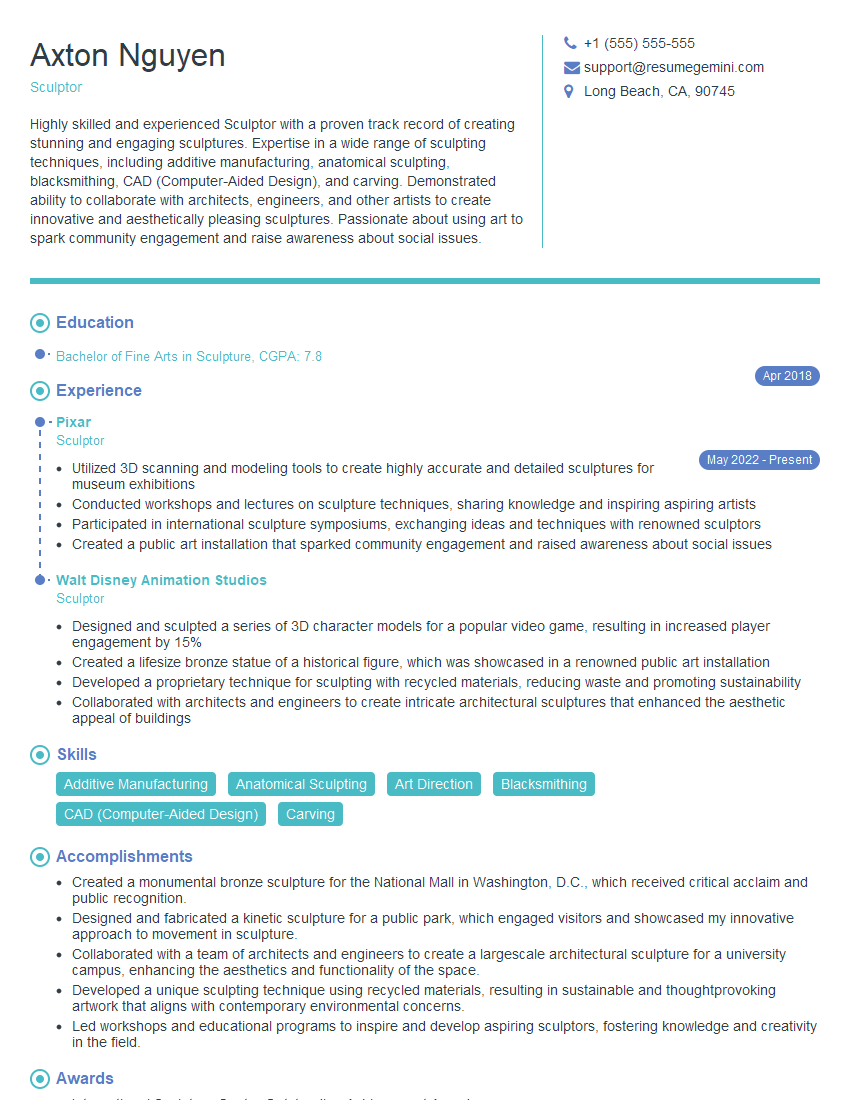
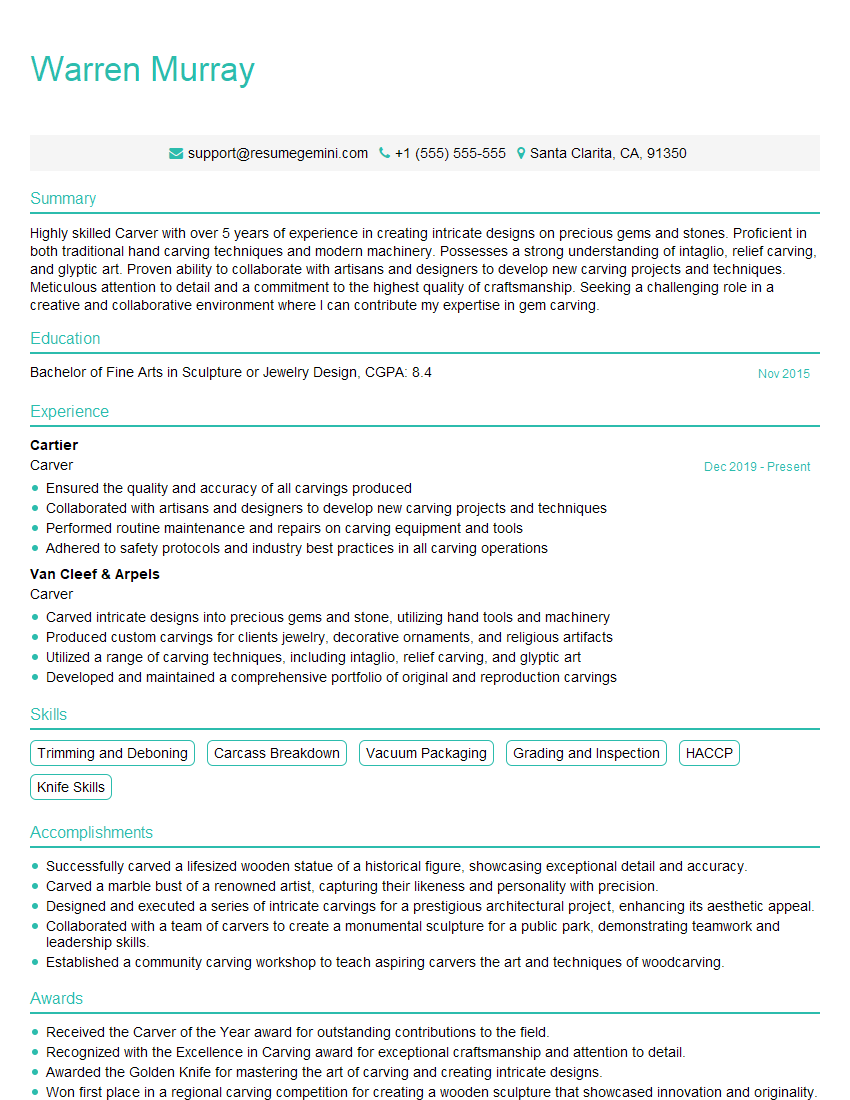
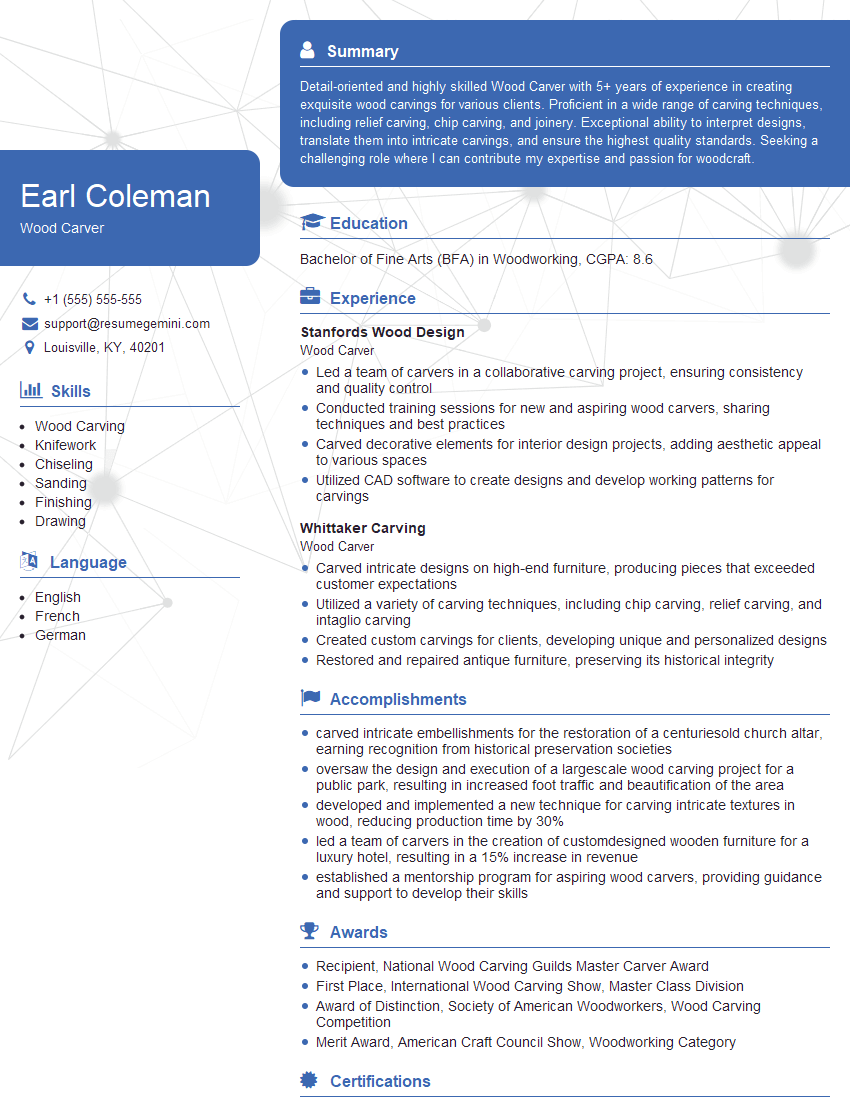
Mastering the art of Sculpture and Carving opens doors to a fulfilling and diverse career, offering opportunities in fine art, design, and even restoration. To maximize your job prospects, crafting a strong, ATS-friendly resume is crucial. ResumeGemini is a trusted resource that can help you build a professional and effective resume, showcasing your skills and experience to potential employers. Examples of resumes tailored to the Sculpture and Carving field are available, providing valuable templates and guidance for your application materials. Invest time in presenting yourself effectively; your talent deserves the best possible representation.
Explore more articles
Users Rating of Our Blogs
Share Your Experience
We value your feedback! Please rate our content and share your thoughts (optional).
What Readers Say About Our Blog
Really detailed insights and content, thank you for writing this detailed article.
IT gave me an insight and words to use and be able to think of examples