Are you ready to stand out in your next interview? Understanding and preparing for Shipboard Communications Systems interview questions is a game-changer. In this blog, we’ve compiled key questions and expert advice to help you showcase your skills with confidence and precision. Let’s get started on your journey to acing the interview.
Questions Asked in Shipboard Communications Systems Interview
Q 1. Explain the Global Maritime Distress and Safety System (GMDSS) and its components.
The Global Maritime Distress and Safety System (GMDSS) is an internationally regulated system designed to ensure efficient and reliable maritime distress alerting, communication, and search and rescue (SAR) coordination. It’s essentially a global network for maritime safety, replacing older, less reliable systems. Its effectiveness relies on a combination of different communication technologies to ensure coverage in all areas, regardless of a vessel’s location.
- VHF Radio: Short-range communication, primarily used for communication within a coastal area or between nearby vessels.
- MF/HF Radio: Long-range communication used for communication across vast distances, particularly in areas beyond VHF range. These are essential for vessels operating in remote areas.
- Inmarsat: A satellite-based communication system providing global coverage. Different Inmarsat services cater to various communication needs, from simple text messaging to high-speed data transmission.
- EPIRB (Emergency Position Indicating Radio Beacon): An automatic distress alerting device activated manually or automatically in an emergency. It transmits a distress alert containing the vessel’s position to rescue coordination centers.
- SART (Search and Rescue Transponder): Activated by a search and rescue vessel’s radar, it responds with a homing signal to assist in locating the distressed vessel.
- NAVTEX (Navigational Telex): A system for broadcasting navigational warnings and meteorological information to vessels within range.
Together, these components provide multiple layers of redundancy to ensure that a distress call can be received even if one system fails.
Q 2. Describe the different types of shipboard communication systems (VHF, HF, Inmarsat, etc.).
Shipboard communication systems utilize various technologies to achieve different ranges and capabilities. Here’s a breakdown:
- VHF (Very High Frequency) Radio: Short-range communication (up to approximately 80km under ideal conditions) using line-of-sight transmission. Primarily used for communication with nearby vessels, coast stations, and port authorities. It’s relatively simple and inexpensive, but its range is limited by the curvature of the earth.
- HF (High Frequency) Radio: Long-range communication (thousands of kilometers) utilizing sky-wave propagation. Essential for vessels operating in areas with limited or no VHF coverage. More complex and requires skilled operators for optimal performance. Propagation can be affected by atmospheric conditions, resulting in variable signal strength and clarity.
- Inmarsat: A satellite-based communication system providing global coverage. Inmarsat uses geostationary satellites that remain fixed above the Earth’s surface, allowing for continuous communication to most areas.
- Other Systems: Other technologies like Iridium, which uses a constellation of low-Earth orbit satellites, and future advancements such as LTE-Maritime and 5G maritime, are expanding options for ship-to-shore and ship-to-ship communications, offering higher bandwidth and increased data transfer rates.
Q 3. What are the limitations of VHF radio communication?
VHF radio communication, while convenient for short-range communication, has several limitations:
- Limited Range: Line-of-sight transmission restricts its range to approximately 80km under ideal conditions. Obstacles like hills, buildings, and even the curvature of the Earth significantly reduce the range.
- Susceptibility to Interference: VHF frequencies are congested, and interference from other vessels, land-based transmitters, and atmospheric conditions can degrade signal quality and cause communication problems.
- Line-of-Sight Dependency: Effective communication requires a clear line of sight between the transmitting and receiving antennas.
- Weather Dependence: Severe weather conditions can significantly attenuate VHF signals, making reliable communication difficult or impossible.
For instance, during a storm, VHF communication may become unreliable, especially at longer distances. This highlights the importance of utilizing other GMDSS components, such as HF radio or Inmarsat, for reliable communication in challenging conditions.
Q 4. How does Inmarsat work, and what are its various services?
Inmarsat utilizes a network of geostationary satellites to provide global maritime satellite communications. These satellites are positioned at a fixed point above the Earth’s equator, ensuring continuous coverage for vessels within their respective service areas. The system works by transmitting signals from a ship’s terminal to the satellite, which then relays the signal to a ground station, and from there to the recipient. The process is reversed for receiving messages.
Inmarsat offers various services, including:
- Inmarsat-C: Primarily used for sending and receiving short text messages and safety-related communications.
- Inmarsat-B: Provides more advanced features than Inmarsat-C, including higher data rates and the ability to send and receive voice calls, fax, and data messages.
- Inmarsat-FleetBroadband: A high-speed broadband service that allows for efficient email, internet access, and data transfer.
- Inmarsat-Global Xpress (GX): The latest generation Inmarsat service, offering global coverage with very high-speed data capabilities.
Each service offers varying levels of bandwidth, data transfer rates, and features to meet different operational needs.
Q 5. Explain the process of sending a distress call using GMDSS.
Sending a distress call using GMDSS follows a well-defined procedure to ensure rapid response. The process typically involves these steps:
- Activate the distress alert: This can be done through various means, including the EPIRB, the ship’s VHF radio, or the Inmarsat satellite communication system.
- Transmit the distress message: The distress message includes the vessel’s name, position, nature of the distress, and any other relevant information.
- Repeat the distress message: Repeated transmissions increase the likelihood that the message is received by the relevant authorities.
- Maintain communication: Continue to communicate with rescue coordination centers (RCCs) and provide updates on the situation.
- Follow instructions: Follow instructions from the RCCs to aid in the rescue operation.
The type of communication method used will depend on the location and circumstances, using the most reliable system available. For example, if a vessel is in a remote area, HF radio or Inmarsat would be used, while in coastal waters VHF might be sufficient.
Q 6. What is the role of the EPIRB and SART in emergency situations?
The EPIRB and SART play crucial roles in emergency situations:
- EPIRB (Emergency Position Indicating Radio Beacon): This is an autonomous device activated manually or automatically (in case of a sinking vessel) transmitting a distress alert containing the vessel’s position, identification, and other essential information to nearby vessels and satellite-based rescue coordination centers. This ensures rapid mobilization of search and rescue efforts.
- SART (Search and Rescue Transponder): The SART is activated when a rescue vessel is in the vicinity of a distressed vessel, responding to radar signals and providing a stronger homing signal which makes it easier for rescuers to locate the ship in difficult conditions such as poor visibility or at night.
Imagine a vessel sinking in rough seas during a storm. The EPIRB, automatically activating, provides the vital location information to initiate a rescue. Once rescuers are searching the area, the activation of the SART provides a strong radar signal aiding in the location of the distressed vessel.
Q 7. Describe your experience with troubleshooting shipboard communication equipment.
Throughout my career, I’ve gained extensive experience in troubleshooting various shipboard communication equipment. This involves a systematic approach, starting with identifying the problem and progressively narrowing down the cause. For example:
- Symptom Identification: I first identify the specific issue, such as no communication, poor signal quality, or equipment malfunction.
- Visual Inspection: Checking for obvious physical damage, loose connections, or damaged cables.
- Testing: Employing specialized testing equipment (signal generators, spectrum analyzers) to test various components and identify faulty elements.
- Component replacement: Replacing faulty components, ensuring they are correctly installed and wired.
- System reconfiguration: Occasionally, a reconfiguration of the system parameters is necessary to optimize performance.
- Firmware Updates: Upgrading outdated software or firmware to address known issues and security vulnerabilities.
I once encountered a situation where the ship’s HF radio was experiencing intermittent transmission failures. Through systematic testing, I isolated the problem to a faulty power supply unit. Replacing the unit restored full functionality, emphasizing the importance of proper maintenance and thorough diagnostics.
Q 8. How do you ensure the security of shipboard communication systems?
Ensuring the security of shipboard communication systems is paramount, given the sensitive nature of navigational data, cargo information, and crew safety. A multi-layered approach is crucial. This involves physical security measures like access control to equipment rooms and network infrastructure, alongside robust cybersecurity protocols.
- Firewall implementation: Firewalls act as the first line of defense, filtering network traffic and blocking unauthorized access attempts. We’d configure them to allow only necessary ports and protocols for various shipboard applications, for example, limiting access to the Global Maritime Distress and Safety System (GMDSS) to authorized personnel only.
- Intrusion Detection/Prevention Systems (IDS/IPS): These systems actively monitor network traffic for malicious activity, alerting us to potential breaches and automatically blocking threats. Think of them as the security guards continuously patrolling the network.
- Regular software updates and patching: Keeping all software and firmware up-to-date is crucial to patching known vulnerabilities. This includes not just communication systems, but also navigation and engine room systems that connect to the network. A delay in patching can leave the ship vulnerable to cyberattacks.
- Access control and user authentication: Strong passwords, multi-factor authentication, and role-based access control (RBAC) are vital to restrict access to sensitive data and systems based on user roles and responsibilities. This prevents unauthorized access even if a password is compromised.
- Data encryption: Encrypting sensitive data both in transit (using VPNs or TLS) and at rest (using disk encryption) is crucial to protecting data from unauthorized access even if a breach occurs.
- Regular security audits and penetration testing: Proactive security assessments identify vulnerabilities before attackers can exploit them. Simulating attacks helps strengthen our defenses.
For example, during my time on the *Ocean Voyager*, we implemented a comprehensive security plan that included all these measures. Following a simulated cyberattack during a penetration test, we identified a vulnerability in our VPN configuration that was swiftly resolved.
Q 9. What are the different types of antennas used in shipboard communications?
Shipboard communication systems utilize a variety of antennas, each optimized for specific frequency bands and communication types. The choice depends on the communication technology and the ship’s needs.
- VHF Antennas: These are essential for short-range communication, typically used for communication with other vessels and shore stations. They are often omni-directional for maximum coverage.
- HF Antennas: Used for long-range communication, often employing whip antennas or more sophisticated directional arrays to improve signal quality and reach. These are critical for communication in areas with limited satellite coverage.
- Satellite Communication Antennas: These include various types like VSAT (Very Small Aperture Terminal) antennas for data and voice communication via satellite, which can be stabilized for consistent communication or smaller, less sophisticated antennas. They’re becoming increasingly common due to global coverage.
- Inmarsat Antennas: These are specifically designed to work with Inmarsat satellite networks, offering global coverage for various communication services.
- AIS (Automatic Identification System) Antennas: These antennas transmit and receive AIS data, providing crucial information about nearby vessels for collision avoidance. These are often integrated with other antenna systems.
The selection process considers factors like frequency range, power requirements, size and weight constraints, and installation location. For instance, the placement of a satellite antenna must be carefully considered to ensure an unobstructed view of the satellite.
Q 10. Explain the concept of frequency hopping spread spectrum (FHSS).
Frequency Hopping Spread Spectrum (FHSS) is a digital modulation technique that enhances communication security and robustness. It involves rapidly switching the transmission frequency across a predefined range of frequencies according to a pseudorandom sequence known only to the transmitter and receiver.
Imagine a conversation where you and a friend constantly switch to different, random communication channels. An eavesdropper would struggle to follow the conversation because they wouldn’t know which channel you’re using at any given time. That’s essentially what FHSS does.
This technique offers several advantages:
- Reduced vulnerability to jamming and interference: A jammer would need to jam a wide range of frequencies simultaneously, making it significantly more difficult.
- Enhanced security: The pseudorandom sequence makes interception and decoding of the signal much more challenging.
- Improved resistance to multipath fading: By hopping frequencies, the signal is less likely to be affected by signal degradation caused by reflections.
FHSS is used in various shipboard communication systems, often integrated into secure data links or other secure communications systems to improve the security and reliability of data transmission. However, it’s important to note that FHSS alone isn’t a complete security solution and should be combined with other security measures.
Q 11. How do you maintain accurate navigational data using communication systems?
Accurate navigational data relies heavily on integrated communication systems. Several communication technologies contribute to this accuracy.
- GPS (Global Positioning System): GPS receivers receive signals from satellites to determine the ship’s precise location. However, the accuracy can be affected by atmospheric conditions and signal blockage. Communication systems play a role in receiving differential GPS (DGPS) corrections to enhance accuracy.
- GLONASS (Global Navigation Satellite System): This Russian equivalent to GPS provides an independent source of positioning data, which can be combined with GPS for increased redundancy and reliability. Communication is necessary for receiving GLONASS signals and data processing.
- ECDIS (Electronic Chart Display and Information System): ECDIS utilizes communication systems to download updated charts, navigational warnings, and other relevant information, ensuring the ship has the most current data available.
- AIS (Automatic Identification System): AIS provides real-time information about the positions and movements of other vessels in the vicinity. This information is crucial for collision avoidance and safe navigation, and relies on VHF communication.
- VHF Radio: Direct communication with other ships and coastal stations provides critical navigational information, such as weather reports, warnings of hazards, and assistance requests.
Maintaining accuracy involves regular system checks, calibration, and ensuring that the communication systems used to receive updates are functioning correctly. For example, on the *Arctic Explorer*, we experienced a GPS signal outage in a heavy storm. However, by switching to GLONASS and using our ECDIS system with the most updated charts downloaded via Inmarsat, we maintained accurate navigation.
Q 12. What are the regulatory requirements for shipboard communications?
Regulatory requirements for shipboard communications are stringent and internationally standardized to ensure safety and efficient operation. These regulations are primarily governed by the International Maritime Organization (IMO).
- GMDSS (Global Maritime Distress and Safety System): This mandates the use of specific communication equipment for distress alerting, safety communication, and search and rescue operations. Compliance is strictly enforced.
- SOLAS (Safety of Life at Sea) Convention: SOLAS regulations define requirements for various safety-related equipment, including communication systems. Regular inspections and certifications are mandated.
- ISM (International Safety Management) Code: This code necessitates a safety management system for ships, including procedures for maintaining and using communication equipment.
- IMO performance standards: The IMO sets specific performance standards for various communication equipment, ensuring that systems meet minimum criteria for reliability and functionality.
- National and regional regulations: Individual countries or regions may have additional regulations, for example, concerning licensing and spectrum allocation.
Failure to comply with these regulations can lead to significant penalties, including detention of the vessel. Regular audits and inspections are essential to maintain compliance.
Q 13. Describe your experience with network administration in a maritime environment.
My experience with network administration in a maritime environment spans over eight years, encompassing various vessel types and communication technologies. I’ve managed both small, localized networks on smaller cargo ships and larger, more complex networks on cruise liners.
My responsibilities included:
- Network design and implementation: Designing and implementing shipboard networks, considering factors such as bandwidth requirements, security considerations, and integration with various systems.
- Network maintenance and troubleshooting: Identifying and resolving network issues, including hardware malfunctions, software bugs, and connectivity problems. This often involves working with remote support teams and utilizing diagnostic tools.
- Security management: Implementing and maintaining network security protocols, including firewalls, intrusion detection systems, and access control measures. Regular security updates and vulnerability scans are part of this.
- User support: Providing technical assistance to ship’s crew in utilizing the network and associated applications.
- System upgrades and migrations: Planning and executing upgrades to network hardware and software to improve performance and maintain security.
I’m proficient in managing various network protocols, including TCP/IP, routing protocols, and VLAN configurations. For example, during a major network upgrade on the *Seafarer*, I successfully migrated the entire network infrastructure to a new system with minimal downtime, improving network performance significantly.
Q 14. What is your experience with cybersecurity protocols in maritime communications?
My experience with cybersecurity protocols in maritime communications is extensive and includes practical application of several key strategies.
- Vulnerability assessments and penetration testing: I’ve conducted and participated in numerous vulnerability assessments to identify and mitigate security risks within shipboard networks. This includes simulating attacks to test the effectiveness of our security measures.
- Implementation and management of firewalls and IDS/IPS systems: I have hands-on experience in configuring and maintaining firewalls, intrusion detection, and prevention systems to protect against cyber threats. This includes setting up rules and policies to control network traffic and block malicious activity.
- Secure configuration of network devices: I ensure all network devices, including routers, switches, and servers, are configured securely to minimize vulnerabilities. This includes using strong passwords, enabling appropriate security features, and disabling unnecessary services.
- Incident response planning and execution: I’ve developed and implemented incident response plans to handle cybersecurity incidents effectively. This includes procedures for identifying, containing, and recovering from attacks.
- Crew training and awareness: I’ve conducted training sessions for ship’s crew on cybersecurity best practices, emphasizing the importance of password security, phishing awareness, and safe internet usage.
During my time on the *Oceanic Pride*, we faced a phishing attempt targeting the captain’s account. Thanks to our training program, the attempt was identified and stopped, preventing a potential breach. I am also familiar with various cybersecurity frameworks like NIST Cybersecurity Framework and ISO 27001.
Q 15. How do you manage multiple communication systems simultaneously during an emergency?
Managing multiple communication systems during an emergency requires a structured approach prioritizing critical information. Think of it like a tiered system: the most urgent communications get top priority.
- Tier 1: Distress Calls: GMDSS (Global Maritime Distress and Safety System) takes precedence. This involves using the Inmarsat-C or EPIRB (Emergency Position-Indicating Radio Beacon) to send distress alerts to the appropriate authorities (e.g., Coast Guard).
- Tier 2: Internal Communication: Simultaneously, internal communication is crucial for coordinating crew actions. This involves using the ship’s public address system, internal VHF radio, and potentially a dedicated emergency network. Clear, concise instructions are vital, minimizing ambiguity.
- Tier 3: External Updates: After addressing immediate safety concerns, updating relevant parties (e.g., owners, agents, family) becomes important. This might involve using Inmarsat FleetBroadband or Iridium satellite systems for higher bandwidth communication.
Regular drills are essential for familiarizing the crew with these procedures. During drills, we focus on seamless system integration and information dissemination, ensuring everyone knows their role and how to communicate effectively under pressure.
Career Expert Tips:
- Ace those interviews! Prepare effectively by reviewing the Top 50 Most Common Interview Questions on ResumeGemini.
- Navigate your job search with confidence! Explore a wide range of Career Tips on ResumeGemini. Learn about common challenges and recommendations to overcome them.
- Craft the perfect resume! Master the Art of Resume Writing with ResumeGemini’s guide. Showcase your unique qualifications and achievements effectively.
- Don’t miss out on holiday savings! Build your dream resume with ResumeGemini’s ATS optimized templates.
Q 16. Explain your experience with different communication protocols (e.g., TCP/IP, UDP).
My experience encompasses various communication protocols, each suited for different tasks. TCP/IP (Transmission Control Protocol/Internet Protocol) is the backbone of most network communications, providing reliable, ordered data delivery. It’s used for email, file transfers, and accessing internet resources onboard. However, its overhead makes it less suitable for time-sensitive data.
UDP (User Datagram Protocol) offers a faster, less reliable alternative. It prioritizes speed over accuracy, making it ideal for applications like streaming live video or VoIP (Voice over Internet Protocol) where minor data loss is acceptable. I’ve used UDP extensively in integrating navigational sensor data into the ship’s network, prioritizing speed for real-time decision-making.
Consider this scenario: I needed to troubleshoot a slow file transfer (TCP/IP) issue between the bridge and the engine room. I first checked network connectivity using ping (ICMP) and then examined TCP packet details using a network analyzer to identify bottlenecks. In contrast, when configuring a VoIP system (UDP), I focused on optimizing network settings for minimal latency rather than error correction.
Q 17. Describe your experience with maintaining and repairing shipboard communication equipment.
Maintaining and repairing shipboard communication equipment requires a blend of practical skills and theoretical understanding. I am proficient in troubleshooting various systems, from basic VHF radios to complex satellite communication terminals.
- Preventive Maintenance: This involves regular inspections, cleaning, and testing of equipment according to manufacturers’ recommendations. This includes checking antenna connections, cable integrity, and power supply stability.
- Troubleshooting: I am adept at diagnosing faults using multimeters, signal generators, and specialized test equipment. For example, isolating a faulty component in a satellite modem might involve checking signal strength, analyzing error logs, and systematically replacing parts until the issue is resolved.
- Repairs: I am skilled in performing minor repairs, replacing faulty components, and running diagnostic software to restore functionality. When major repairs are required, I coordinate with external service providers to ensure minimal downtime.
One instance involved a sudden failure of the Inmarsat FleetBroadband system. Through systematic troubleshooting, I found a faulty power supply unit. Replacing it restored communication within an hour, preventing operational disruption.
Q 18. How do you handle communication failures during a voyage?
Communication failures at sea necessitate a layered approach. The first step involves identifying the nature and scope of the failure. Is it a complete blackout, or does a specific system have issues?
- Prioritize Communication: If GMDSS is down, immediately switch to backup systems (e.g., EPIRB, emergency VHF radio). This is critical for safety.
- Troubleshooting: Diagnose the problem by checking power supplies, cabling, and antenna connections. Consult documentation and technical manuals.
- Redundancy: Utilize backup systems and alternate communication methods. This could involve switching to a different satellite system or using a high-frequency (HF) radio.
- Reporting: Document the failure, including the time, nature of the fault, and steps taken to rectify it. Report the issue to the appropriate authorities (e.g., ship management, classification society).
During one voyage, a storm damaged the primary satellite antenna. We quickly switched to our secondary system (a smaller, lower-bandwidth antenna) and reported the damage. Repairs were scheduled for the next port of call, ensuring ongoing, albeit reduced, communication.
Q 19. What is your experience with satellite communication systems (Inmarsat, Iridium)?
I have extensive experience with both Inmarsat and Iridium satellite communication systems. Inmarsat offers various services, from low-bandwidth Inmarsat-C for safety communications to high-bandwidth FleetBroadband for data and voice. Iridium provides global coverage, even in polar regions, but typically with lower bandwidth compared to Inmarsat.
My experience includes installing, configuring, and troubleshooting both systems. For example, I’ve configured FleetBroadband for email, internet access, and data transfer between the ship and shore. With Iridium, I’ve set up systems for position reporting and emergency communications in areas with limited or no other communication options. The choice between the two often depends on bandwidth requirements and geographical location.
I once worked on a project integrating Inmarsat FleetBroadband with the ship’s navigation system to provide real-time position updates to shore-based monitoring centers.
Q 20. Explain the importance of maintaining a comprehensive communication log.
Maintaining a comprehensive communication log is vital for several reasons. It serves as a record of all communication activities, ensuring accountability and facilitating efficient troubleshooting.
- Auditing: The log enables review of communication history for operational efficiency and regulatory compliance.
- Troubleshooting: It provides a detailed history that helps pinpoint the cause of communication failures.
- Legal Compliance: Accurate logs are crucial for investigations and dispute resolution.
- Safety: A well-maintained log ensures proper documentation of distress calls and other critical communication events.
A typical log entry includes the date and time, communication method used (e.g., VHF, Inmarsat), recipient and sender, subject of communication, and summary of the conversation or message.
Q 21. How do you ensure compliance with SOLAS regulations regarding communication systems?
Ensuring compliance with SOLAS (Safety Of Life At Sea) regulations regarding communication systems is paramount. These regulations mandate specific equipment and operational procedures to ensure safe and efficient communication at sea.
- GMDSS Compliance: This involves ensuring the ship’s GMDSS equipment (e.g., VHF radio, EPIRB, Inmarsat-C) is fully operational, regularly tested, and maintained according to SOLAS standards.
- Regular Testing: We conduct routine checks and tests on all communication systems, documenting the results in the maintenance log. This includes checking the functionality of each system, ensuring proper antenna alignment, and verifying backup systems.
- Crew Training: SOLAS also mandates comprehensive training for the crew on the use and operation of the ship’s communication systems, including emergency procedures.
- Documentation: Maintaining comprehensive records of testing, maintenance, and training activities is critical for demonstrating compliance.
Failure to comply with SOLAS regulations can result in serious consequences, including detention of the vessel. A robust compliance program, involving regular inspections, rigorous maintenance, and effective training, is essential for operational safety and legal compliance.
Q 22. What are the challenges of maintaining communication systems in remote areas?
Maintaining communication systems in remote areas presents unique challenges due to factors like limited infrastructure, geographical barriers, and weather conditions. Think about a cargo ship in the middle of the Pacific Ocean – there’s no readily available technician support, and satellite connectivity might be unreliable due to atmospheric interference or even solar flares.
- Limited Infrastructure: The lack of terrestrial infrastructure like cell towers or fiber optic cables necessitates reliance on satellite communication, which is often more expensive and susceptible to delays and outages.
- Geographical Barriers: Mountains, dense forests, or even the curvature of the Earth can obstruct signal transmission, requiring strategic antenna placement and powerful transmitters.
- Weather Conditions: Severe weather, including storms and heavy rainfall, can significantly impact satellite signal reception and degrade the quality of communication.
- Maintenance Accessibility: Repairing or replacing faulty equipment in remote locations can be time-consuming and expensive, often requiring specialized vessels or personnel.
To mitigate these challenges, robust redundancy is crucial. Systems often incorporate backup communication methods, such as high-frequency (HF) radio, and employ advanced error correction techniques to improve signal reliability. Regular preventative maintenance and well-trained personnel are also key to minimizing downtime.
Q 23. Explain your experience with integrating new communication technologies onto a vessel.
I recently led the integration of a new VSAT (Very Small Aperture Terminal) system onto a cruise liner. This involved careful planning and execution across several phases:
- Needs Assessment: We first assessed the vessel’s existing communication infrastructure and determined the specific requirements of the new VSAT system. This included bandwidth needs, antenna placement, and integration with existing onboard networks.
- System Selection: We chose a VSAT system provider based on factors such as reliability, bandwidth capacity, global coverage, and cost-effectiveness. We also considered the need for seamless integration with existing systems, such as the ship’s network and existing communication software.
- Installation: This involved installing the VSAT antenna, modem, and other necessary hardware. We had to carefully coordinate the work to minimize disruption to the ship’s operations. This included specialized training for onboard staff to handle the new system.
- Testing and Commissioning: Following installation, we conducted rigorous testing to verify the functionality and performance of the new system, ensuring its compatibility with existing equipment and achieving optimal bandwidth performance.
- Training: Critically, we provided comprehensive training to the ship’s crew on the operation and maintenance of the new system. This ensures the long-term success of the implementation.
The successful integration significantly improved the ship’s communication capabilities, allowing for faster data transfer speeds and higher quality voice and video communications, ultimately enhancing both operational efficiency and passenger experience.
Q 24. What are some common communication system malfunctions, and how do you troubleshoot them?
Common communication system malfunctions are diverse and range from simple issues to complex system failures. Here are a few, along with troubleshooting approaches:
- Antenna Problems: Misalignment, damage, or corrosion can impact signal strength. Troubleshooting involves checking antenna positioning, inspecting for physical damage, and measuring signal strength.
- Modem Failures: Faulty modems can cause intermittent connectivity or complete communication loss. Troubleshooting involves testing modem functionality, checking cable connections, and potentially replacing the faulty unit.
- Software Glitches: Software bugs can lead to unexpected behavior. Troubleshooting often requires restarting systems, updating software, or consulting system logs for error messages.
- Network Issues: Problems within the ship’s internal network can affect communication. This requires checking network connectivity, looking at routers and switches, and analyzing network traffic to identify bottlenecks or faulty components.
- Satellite Issues: Satellite outages or poor signal quality due to weather or atmospheric conditions can be beyond the control of the ship. Monitoring satellite status, switching to backup communication systems, or waiting out adverse weather conditions are necessary responses.
My approach to troubleshooting involves a systematic process: Start with simple checks, then move to more complex diagnoses, always documenting findings to aid in future maintenance. Using diagnostic tools and consulting manuals are essential parts of this process.
Q 25. How do you ensure the confidentiality and integrity of shipboard communications?
Ensuring confidentiality and integrity of shipboard communications is paramount, particularly considering the sensitive nature of navigational data, cargo manifests, and financial transactions. We employ a multi-layered approach:
- Encryption: All sensitive data is encrypted using strong encryption protocols, such as AES (Advanced Encryption Standard), both in transit and at rest. This prevents unauthorized access to the information.
- Access Control: Access to sensitive systems and data is strictly controlled using password protection, role-based access control, and regular security audits. This limits access to authorized personnel only.
- Firewall Protection: Firewalls are used to prevent unauthorized access to the ship’s network from external sources. This acts as a barrier between the ship’s internal systems and the outside world.
- Regular Security Updates: Software and firmware updates are regularly applied to address known security vulnerabilities. Keeping systems up-to-date is crucial to defend against emerging threats.
- Intrusion Detection Systems (IDS): Implementing IDS allows monitoring network traffic for suspicious activity and alerts the crew to potential security breaches.
Regular security training for the crew is also crucial to ensure everyone understands and adheres to security protocols, and promotes a culture of security awareness.
Q 26. Describe your experience with using different types of communication software.
My experience encompasses a wide range of communication software, including:
- GMDSS (Global Maritime Distress and Safety System) software: This is essential for distress calls, safety communications, and search and rescue operations. Experience includes using different GMDSS terminal types and understanding their operation.
- Navigation software: This integrates with communication systems for data exchange with shore-based facilities. My experience includes understanding the communication protocols (e.g., AIS) used by navigation software.
- Fleet management software: This allows for the monitoring and control of vessels. Experience encompasses software capable of data exchange and remote monitoring of vessel parameters and location.
- Messaging applications: Secure messaging applications are used for crew communication and data exchange. My experience includes using both satellite-based and terrestrial messaging platforms tailored to the maritime environment.
- Email and VoIP systems: These are used for general communication and enhance crew coordination. Experience includes managing and troubleshooting these systems aboard vessels.
Familiarity with the strengths and weaknesses of various software packages allows me to select and implement the most appropriate solutions for specific operational requirements. Understanding how to configure these and integrate them seamlessly with existing infrastructure is crucial.
Q 27. How do you stay up-to-date with the latest advancements in shipboard communication technologies?
Staying current with advancements in shipboard communication technologies is an ongoing process requiring proactive engagement. My methods include:
- Industry Publications: Regularly reading maritime industry journals and online publications keeps me informed about new technologies and trends.
- Conferences and Trade Shows: Attending industry conferences and trade shows allows for networking with other professionals, gaining firsthand experience of new technologies, and learning about future directions.
- Manufacturer Websites and Documentation: Staying up-to-date with the latest offerings from major manufacturers and reviewing technical specifications of new equipment is essential.
- Online Courses and Webinars: Participating in online courses and webinars on topics like satellite communications, network security, and new communication protocols keeps my knowledge fresh.
- Professional Organizations: Membership in professional organizations, such as the Institute of Marine Engineering, Science & Technology (IMarEST), provides access to resources, training, and networking opportunities.
This multifaceted approach ensures I maintain a strong understanding of the evolving landscape of shipboard communications, enabling me to effectively implement and maintain state-of-the-art communication systems for improved safety, efficiency, and cost-effectiveness.
Key Topics to Learn for Shipboard Communications Systems Interview
- GMDSS (Global Maritime Distress and Safety System): Understand the regulations, equipment, and procedures involved in distress alerting, safety communication, and search and rescue operations. Consider practical scenarios involving distress calls and emergency response.
- VHF Radio Communication: Master the operation of VHF radios, including channel selection, proper communication protocols, and the use of DSC (Digital Selective Calling). Explore troubleshooting common VHF radio issues and their solutions.
- Inmarsat and Satellite Communication: Learn about different Inmarsat services (FleetBroadband, Inmarsat C, etc.), their applications, and limitations. Focus on understanding the advantages and disadvantages of satellite communication compared to terrestrial systems.
- Network Systems on Ships: Familiarize yourself with LAN (Local Area Network) configurations and troubleshooting on vessels. Understand the role of network security and data management in shipboard operations.
- AIS (Automatic Identification System): Understand the principles of AIS, its use in collision avoidance, and its role in vessel tracking and management. Consider scenarios involving AIS malfunctions and their impact.
- Navigation Systems Integration: Explore how communication systems integrate with navigational equipment (GPS, radar, ECDIS) to enhance safety and operational efficiency. Think about the data exchange and potential points of failure.
- Maintenance and Troubleshooting: Be prepared to discuss preventative maintenance procedures and troubleshooting techniques for common shipboard communication equipment. Highlight your practical experience and problem-solving skills.
Next Steps
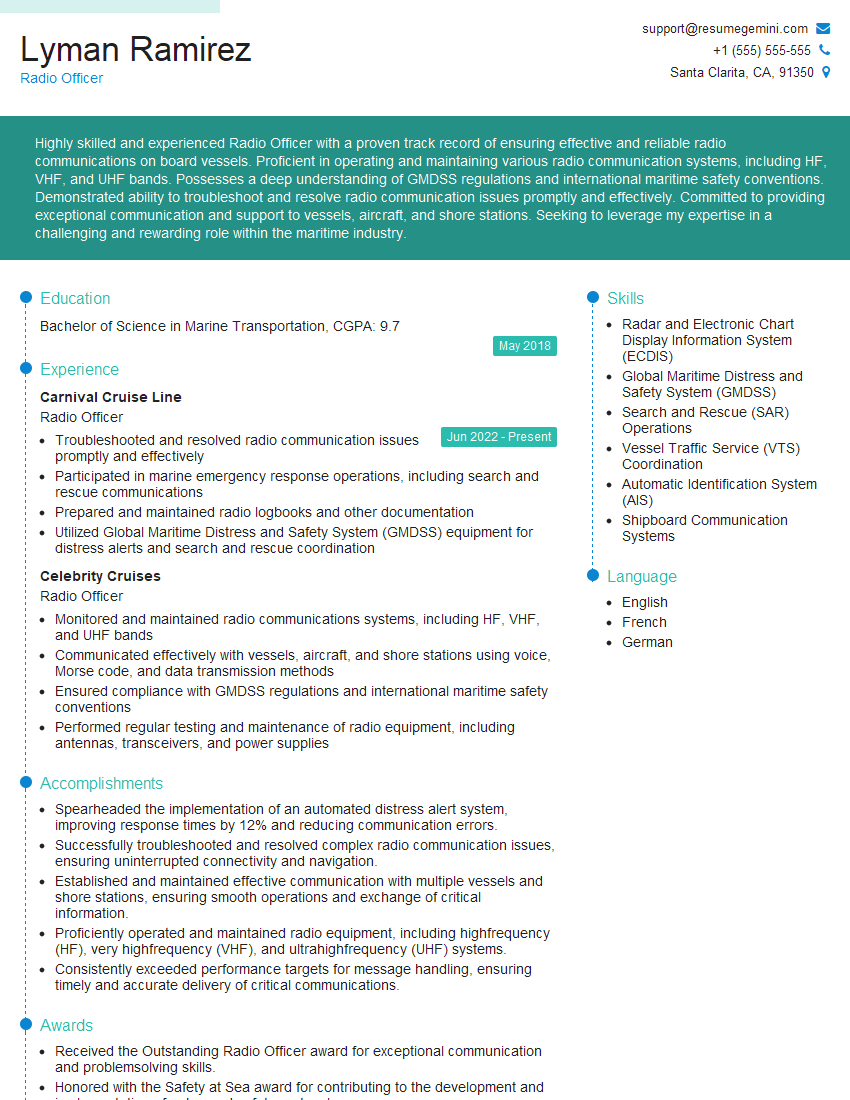
Mastering Shipboard Communications Systems is crucial for career advancement in the maritime industry, opening doors to specialized roles and increased responsibilities. A strong understanding of these systems demonstrates a commitment to safety and operational excellence, making you a highly desirable candidate. To significantly boost your job prospects, create an ATS-friendly resume that effectively highlights your skills and experience. ResumeGemini is a trusted resource that can help you build a professional and impactful resume tailored to the maritime industry. Examples of resumes tailored to Shipboard Communications Systems are available, providing you with valuable templates and guidance.
Explore more articles
Users Rating of Our Blogs
Share Your Experience
We value your feedback! Please rate our content and share your thoughts (optional).
What Readers Say About Our Blog
Really detailed insights and content, thank you for writing this detailed article.
IT gave me an insight and words to use and be able to think of examples