Feeling uncertain about what to expect in your upcoming interview? We’ve got you covered! This blog highlights the most important Signal Compliance interview questions and provides actionable advice to help you stand out as the ideal candidate. Let’s pave the way for your success.
Questions Asked in Signal Compliance Interview
Q 1. Explain the difference between EMI and EMC.
EMI and EMC are closely related but represent different perspectives on electromagnetic interference. EMI (Electromagnetic Interference) refers to the unwanted electromagnetic energy that disrupts the performance of electronic equipment. Think of it as the problem. For example, a malfunctioning power supply emitting radio waves could create EMI that interferes with a nearby radio receiver. EMC (Electromagnetic Compatibility), on the other hand, is the ability of electronic equipment to function satisfactorily in its electromagnetic environment without causing unacceptable electromagnetic interference to anything else. It’s the solution; ensuring your device doesn’t cause problems and is robust against problems caused by others. In essence, EMC is the goal, and managing EMI is a crucial part of achieving it.
Q 2. Describe your experience with signal integrity simulation tools (e.g., ADS, HFSS).
I have extensive experience using both Advanced Design System (ADS) and High-Frequency Structure Simulator (HFSS) for signal integrity simulations. In ADS, I’ve leveraged its capabilities for simulating high-speed digital channels, including the effects of various transmission line structures, connectors, and components. I’ve used the tool to perform analyses such as time-domain and frequency-domain simulations, eye diagram generation, and impedance matching studies. This allowed me to identify potential signal integrity issues such as reflections, crosstalk, and jitter early in the design process. In HFSS, I’ve modeled complex 3D structures to precisely analyze electromagnetic fields and optimize antenna designs for optimal signal transmission and reception. For example, I successfully used HFSS to analyze and mitigate unwanted radiation from a high-speed data bus in a previous project, significantly improving the system’s EMC performance. My work with these tools frequently involves creating and optimizing models of complex PCBs and their components to prevent signal integrity issues.
Q 3. How do you troubleshoot signal integrity issues on a PCB?
Troubleshooting signal integrity issues on a PCB is a systematic process. I typically start with a thorough review of the design specifications and schematics, paying close attention to the high-speed signal paths. This is followed by a physical inspection of the PCB itself, looking for any obvious problems such as poor soldering, damaged traces, or incorrect component placement. Next, I use various test equipment such as oscilloscopes, spectrum analyzers, and network analyzers to capture signals at various points along the signal path and identify problematic areas. If the problem involves high-frequency signals, I might employ techniques like TDR (Time Domain Reflectometry) to pinpoint reflections and impedance mismatches. I frequently use simulation tools mentioned earlier (ADS, HFSS) to corroborate my findings and test potential solutions. The process often involves iterative simulations, adjustments to layout, and retesting until the signal integrity meets specifications. For example, in one project, I discovered that an unexpected ground plane discontinuity was causing significant signal reflections, which I resolved by adding appropriate ground vias.
Q 4. What are the common causes of signal reflections?
Signal reflections are caused by impedance mismatches along the signal path. Whenever a signal encounters a change in impedance, a portion of the signal is reflected back toward the source. Common causes include:
- Impedance discontinuities at connectors: Different connector types or improperly mated connectors can introduce significant impedance mismatches.
- Trace discontinuities on the PCB: Sharp bends, abrupt width changes, or vias can create impedance discontinuities.
- Open or short circuits: These are extreme forms of impedance mismatch, causing significant reflections.
- Poor termination: Lack of proper termination resistors at the end of a transmission line leads to reflections.
- Mismatched component impedances: If the impedance of a component doesn’t match the characteristic impedance of the transmission line, reflections can occur.
In essence, any abrupt change in the electrical characteristics of the signal path can lead to reflections. Minimizing these discontinuities is crucial for maintaining signal integrity.
Q 5. Explain impedance matching and its importance in signal integrity.
Impedance matching refers to the practice of ensuring that the impedance of a transmission line is consistent throughout its length, and that it matches the impedance of the source and load. This is crucial for signal integrity because mismatches cause signal reflections, leading to signal distortion, signal loss, and potential data corruption. Think of it like a highway: if the highway has sudden narrowings or widenings, the traffic flow (signal) will be disrupted. A well-matched system ensures smooth and efficient signal transmission, minimizing signal loss and ensuring the signal reaches its destination without significant distortion. In practice, impedance matching is achieved by using appropriate transmission line structures, terminations (resistors), and careful PCB layout techniques to maintain a constant characteristic impedance. This often involves the use of controlled impedance traces on the PCB, careful selection of connectors, and the proper termination of the transmission lines.
Q 6. Describe your experience with various EMC/EMI testing standards (e.g., FCC, CE, CISPR).
I possess extensive experience with a wide range of EMC/EMI testing standards, including FCC Part 15, CE marking (EN 55032, EN 55024), and CISPR standards. I understand the nuances of each standard’s requirements for radiated and conducted emissions and immunity testing. My experience encompasses the entire process, from pre-compliance testing to full certification, including test planning, fixture design, test execution, and report generation. I’m familiar with various test equipment such as EMC chambers, LISNs (Line Impedance Stabilization Networks), and antennas, and have extensive experience in analyzing test results and implementing corrective measures to meet regulatory compliance. For example, in a recent project, I successfully guided a product through the rigorous FCC Part 15 certification process, successfully addressing several identified emission issues through design modifications and improved shielding techniques.
Q 7. How do you perform differential signal integrity analysis?
Differential signal integrity analysis focuses on the characteristics of the signal difference between two conductors rather than a single conductor’s signal relative to ground. This is crucial for high-speed serial communication like DDR memory interfaces and high-speed serial links. The analysis considers parameters such as common-mode noise, differential impedance, and crosstalk between the differential pair. The process involves simulating the differential pair’s behavior using tools like ADS or HFSS. This includes modeling the differential impedance of the transmission lines, considering the effects of common-mode noise, and analyzing potential crosstalk with adjacent signals. Eye diagrams are also critical in evaluating the quality of the differential signal, looking for effects like jitter and intersymbol interference. My experience includes leveraging simulation results to optimize the PCB layout for optimal signal integrity, including techniques like controlled impedance routing and proper grounding to minimize noise and crosstalk. For example, in a recent project, differential signal integrity analysis helped us identify and correct a crosstalk issue between high-speed data lines, preventing data corruption and ensuring reliable communication.
Q 8. What are the key parameters to consider when designing for signal integrity?
Designing for signal integrity involves meticulously managing the quality of signals as they travel through a system. Key parameters include:
- Rise/Fall Time: How quickly a signal transitions between logic levels. Faster transitions increase the high-frequency content, demanding more careful design to avoid signal distortion and noise.
- Bandwidth: The range of frequencies a signal can effectively pass through. Higher bandwidth signals require components and traces that can handle higher frequencies.
- Impedance Matching: Ensuring consistent impedance along the signal path minimizes reflections that can distort the signal. Think of it like matching the diameter of a water pipe – abrupt changes cause water hammer (signal reflections).
- Crosstalk: Unwanted coupling between adjacent signal traces. This can lead to data corruption. Minimizing this requires proper trace spacing and routing.
- Propagation Delay: The time it takes for a signal to travel from source to destination. This becomes crucial in high-speed designs, impacting timing constraints.
- Jitter: Unwanted variations in the timing of a digital signal. Even small amounts of jitter can cause data errors, especially in high-speed serial interfaces.
- Power Integrity: Ensuring stable and clean power supply to the circuitry. Power supply noise can significantly degrade signal quality.
Ignoring these parameters can lead to malfunctions, data corruption, and system instability.
Q 9. Explain the concept of return loss and its significance.
Return loss quantifies how much of a signal is reflected back to the source rather than being transmitted down the line. It’s expressed in decibels (dB). A high return loss (a large negative number in dB) indicates good impedance matching, implying minimal signal reflection. A low return loss (a small negative number or even a positive number in dB) means significant reflection, potentially causing signal degradation and distortion.
Imagine sending a sound wave down a pipe. If the pipe’s diameter changes abruptly, a significant portion of the wave will bounce back, analogous to a low return loss. Good impedance matching ensures the wave travels efficiently through the pipe, mimicking a high return loss.
Return loss is critical because reflections can cause signal distortion, timing errors, and interference. In high-speed digital systems, even small reflections can disrupt data transmission.
Q 10. How do you measure signal integrity parameters in a lab setting?
Measuring signal integrity parameters requires specialized lab equipment. Common tools include:
- Vector Network Analyzer (VNA): Measures S-parameters (scattering parameters), which describe how a signal is reflected and transmitted through a network. This is crucial for characterizing impedance matching and return loss.
- Time Domain Reflectometer (TDR): Displays impedance discontinuities along a transmission line, helping identify sources of signal reflections.
- Oscilloscope: Observes signal waveforms in the time domain, allowing measurement of rise/fall times, jitter, and other timing parameters.
- Logic Analyzer: Captures and analyzes digital signals, useful for identifying data errors caused by signal integrity issues.
- Spectrum Analyzer: Measures the frequency content of signals, revealing noise and interference sources.
The specific measurement techniques depend on the signal type (analog, digital, high-speed), the parameters of interest, and the system architecture. Calibration is essential to ensure accurate results.
Q 11. What are your experiences with common-mode noise and differential-mode noise?
Common-mode noise is a signal that appears equally on both conductors of a differential pair (or multiple conductors). Think of it as a noise that affects both wires simultaneously in the same way. It’s often due to inductive coupling from external sources, like electromagnetic fields from motors or power lines. Differential-mode noise, on the other hand, is a signal that appears with opposite polarities on the two conductors of a differential pair. It’s the signal that we actually want to transmit. A good differential receiver is designed to reject common-mode noise and amplify the differential-mode signal.
I’ve encountered common-mode noise in several projects, especially in high-noise industrial environments. For instance, in a motor control system, the proximity to the motor itself significantly contributed to common-mode noise. We mitigated this using shielded cables, common-mode chokes, and differential signaling techniques.
Q 12. Describe your experience with conducted and radiated emissions testing.
Conducted emissions are electromagnetic interference (EMI) that travels along the power and signal lines, while radiated emissions are EMI that propagates through space as electromagnetic waves. Both types of emissions must meet regulatory limits, defined by standards like FCC Part 15 and CISPR 22, depending on the device and its intended use.
My experience includes conducting these tests in a fully anechoic chamber and using specialized equipment like EMI receivers, LISN (Line Impedance Stabilization Networks) and antennas. Successful testing demands careful attention to grounding, shielding, and proper cabling. I’ve often worked with compliance engineers to identify and resolve emission issues, sometimes involving redesign of the PCB layout or the addition of EMI filters.
Q 13. How do you mitigate ground bounce and power supply noise?
Ground bounce is a voltage fluctuation on the ground plane due to sudden current changes, often during switching events. Power supply noise refers to unwanted voltage fluctuations on the power supply rails. Both contribute to signal integrity problems.
Mitigation strategies include:
- Proper Grounding: Establishing a single-point ground connection minimizes ground loops and reduces ground bounce.
- Decoupling Capacitors: Placing capacitors close to the IC pins provides a local reservoir of charge, preventing voltage fluctuations.
- Bypass Capacitors: Shunt high-frequency noise to ground.
- Shielding: Protecting sensitive circuits from external noise sources.
- Careful Power Supply Design: Using appropriately sized power supply rails and filtering can suppress noise.
- Optimized PCB Layout: Minimizing loop areas and keeping high-current traces away from sensitive circuits reduces noise coupling.
In one project, we significantly reduced ground bounce by implementing a multi-layer PCB with a dedicated ground plane and carefully placed decoupling capacitors.
Q 14. Explain the use of decoupling capacitors in signal integrity design.
Decoupling capacitors are essential components for maintaining power supply integrity and minimizing noise. They act as local reservoirs of energy, providing a quick source of charge to the integrated circuits (ICs) during transient current demands. This prevents voltage sags (drops in voltage) that can cause signal distortion or malfunctions.
Imagine a water tank supplying water to a house. If a faucet is opened suddenly, there will be a pressure drop. Decoupling capacitors are like small tanks placed directly next to each faucet, ensuring a continuous supply of water during high demand.
They are typically placed close to the ICs’ power and ground pins, using a combination of different capacitor types (ceramic, tantalum, etc.) to cover a broad range of frequencies. Selecting the correct capacitance values is critical and depends on the application’s switching frequency and current requirements.
Q 15. What are your experiences with high-speed serial interfaces (e.g., PCIe, USB 3.0)?
My experience with high-speed serial interfaces like PCIe and USB 3.0 spans several projects, from design to validation. I’ve worked extensively with PCIe Gen3 and Gen4, understanding the intricacies of their signaling protocols, including equalization techniques and clocking strategies. For instance, on a recent project involving a high-performance graphics card, I was responsible for optimizing the PCIe link to minimize jitter and ensure reliable data transfer at speeds exceeding 16 GT/s. With USB 3.0 and 3.1, my focus has been on achieving compliance with the USB Implementers Forum (USB-IF) specifications, addressing issues like signal reflections and EMI. This included using simulation tools to predict signal integrity and selecting appropriate components such as termination resistors and high-speed connectors.
I’m proficient in analyzing signal characteristics such as rise/fall times, overshoot, and undershoot to ensure they meet the specification. I understand the importance of channel equalization and have experience working with various equalization techniques such as continuous-time linear equalization (CTLE) and decision feedback equalization (DFE) to compensate for channel impairments.
Career Expert Tips:
- Ace those interviews! Prepare effectively by reviewing the Top 50 Most Common Interview Questions on ResumeGemini.
- Navigate your job search with confidence! Explore a wide range of Career Tips on ResumeGemini. Learn about common challenges and recommendations to overcome them.
- Craft the perfect resume! Master the Art of Resume Writing with ResumeGemini’s guide. Showcase your unique qualifications and achievements effectively.
- Don’t miss out on holiday savings! Build your dream resume with ResumeGemini’s ATS optimized templates.
Q 16. How do you analyze eye diagrams to assess signal quality?
Analyzing eye diagrams is crucial for assessing signal quality in high-speed digital systems. Think of an eye diagram as a visual representation of the signal’s behavior over time. Each ‘eye’ represents a single bit, and its shape tells us a lot about the signal integrity. A ‘clean’ eye, with a wide open aperture, indicates good signal quality. Conversely, a narrow, distorted eye suggests problems.
I analyze eye diagrams by looking for several key characteristics:
- Aperture Width: A wider aperture means more margin against noise and jitter. A narrow aperture implies susceptibility to errors.
- Aperture Height: Represents the voltage difference between the ‘high’ and ‘low’ states. Low height indicates low signal amplitude and increased susceptibility to noise.
- Jitter: Variations in the timing of the signal transitions. Excessive jitter can cause bit errors. I analyze both random and deterministic jitter components.
- Overshoot/Undershoot: Signal excursions beyond the intended voltage levels. These can be caused by impedance mismatches or reflections.
- Inter-symbol Interference (ISI): The overlapping of adjacent symbols, blurring the signal’s transitions. This reduces the eye opening.
By quantifying these parameters, I can pinpoint the root cause of signal integrity issues and propose effective solutions. For example, a narrow aperture might indicate the need for better equalization, while excessive jitter might require improved clocking or layout changes.
Q 17. Explain the importance of controlled impedance in PCB design.
Controlled impedance in PCB design is paramount for signal integrity, particularly in high-speed applications. It ensures consistent signal propagation and minimizes signal reflections. Imagine sending a signal down a transmission line – if the impedance changes unexpectedly, some of the signal energy will reflect back, potentially interfering with subsequent signals and causing distortion or errors.
Maintaining controlled impedance involves carefully selecting PCB materials, trace dimensions, and layer stackups to achieve a consistent characteristic impedance (typically 50 ohms for high-speed signals). This requires precise manufacturing tolerances and careful attention to detail during the design process. Failure to control impedance can lead to signal reflections, attenuation, crosstalk, and ultimately system malfunction. It’s like building a highway – if the road suddenly becomes narrower or changes surface, you’ll experience bottlenecks and delays.
Q 18. Describe your experience with different PCB stackup configurations.
My experience with PCB stackup configurations is extensive, ranging from simple two-layer boards to complex ten-layer designs for high-speed applications. I understand how different dielectric materials, layer thicknesses, and trace placement impact impedance, crosstalk, and power integrity. I’ve worked with various stackup configurations such as:
- Stripline: Signal traces embedded within the dielectric layers, offering excellent impedance control.
- Microstrip: Signal traces on one side of a dielectric layer, grounded on the other, commonly used for less demanding applications.
- Multilayer Stackups: Employing multiple signal and ground planes to reduce crosstalk and improve power delivery.
Choosing the right stackup involves careful consideration of the design requirements, signal speeds, cost, and manufacturing constraints. For instance, a high-speed design might require a controlled impedance stackup with multiple ground planes to minimize noise and crosstalk, while a cost-sensitive application might use a simpler two-layer design.
I use simulation tools to model different stackup configurations and optimize them for signal integrity performance. This allows me to make informed decisions about trace widths, spacing, and layer thicknesses to meet the design requirements.
Q 19. How do you handle signal integrity challenges in high-frequency applications?
Handling signal integrity challenges in high-frequency applications requires a multi-pronged approach. The key is to identify the potential problems early in the design process and implement appropriate mitigation strategies.
Common challenges include:
- Reflections due to impedance mismatches: Addressing this requires careful control of impedance throughout the signal path, using appropriate termination techniques (series, parallel, etc.).
- Crosstalk: Signal interference between adjacent traces. This can be mitigated through careful routing and placement of traces, using shielding, or employing differential signaling.
- Jitter: Variations in signal timing. This often requires careful clock management and potentially incorporating jitter reduction techniques.
- EMI/EMC: Electromagnetic interference and electromagnetic compatibility. Proper grounding, shielding, and filtering are essential.
My approach involves using simulation tools like ADS or Sigrity to model the signal path and identify potential problems before prototyping. I also use careful PCB layout techniques and incorporate design for manufacturability (DFM) principles to ensure the final product meets the signal integrity requirements. For instance, I’ve used techniques like controlled impedance routing, differential pairs, and careful component placement to minimize crosstalk and improve signal quality.
Q 20. What are the challenges of signal integrity in high-density PCB design?
High-density PCB designs present unique signal integrity challenges due to the close proximity of traces and components. The key challenges include:
- Increased Crosstalk: Closely spaced traces are more susceptible to crosstalk, leading to signal degradation and potential errors. This requires meticulous routing and potentially the use of differential signaling or shielding.
- Power Integrity Issues: High component density can stress the power delivery network (PDN), leading to voltage drops and noise. Proper power plane design, decoupling capacitors, and careful component placement are crucial.
- Thermal Management: Higher component density can lead to increased heat generation, which can impact signal integrity. Thermal simulations and appropriate heat sinks are needed.
Solving these challenges requires careful planning and simulation. I frequently use simulation tools to model the effects of high-density layouts and optimize the design for optimal performance. For example, I might employ techniques such as using multiple ground planes, adding vias to improve ground connections, and optimizing trace routing to minimize crosstalk.
Q 21. Explain your experience with signal integrity analysis tools (e.g., IBIS, S-parameters).
I have extensive experience with signal integrity analysis tools such as IBIS (Input/Output Buffer Information Specification) models, S-parameters, and simulation software like ADS (Advanced Design System) and Sigrity.
IBIS models provide accurate representations of the input/output characteristics of integrated circuits, allowing for more realistic simulations of the signal path. S-parameters describe the behavior of components and transmission lines, allowing for detailed analysis of impedance matching and signal reflections. I use these models in conjunction with simulation software to predict signal integrity performance and identify potential problems early in the design cycle.
For example, I’ve used IBIS models to simulate the behavior of high-speed transceivers and accurately predict signal eye diagrams. This allows me to identify potential problems with signal quality and optimize the design before it goes to manufacturing. I regularly utilize S-parameters to analyze impedance mismatches and reflections within the signal path, helping in designing proper termination schemes and improving overall signal integrity.
Beyond these specific tools, I am also proficient in using other simulation software to analyze various aspects of signal integrity such as power integrity, electromagnetic interference, and thermal analysis. These tools allow for a holistic approach to signal integrity design, ensuring system reliability and performance.
Q 22. Describe your process for developing a signal integrity budget.
Developing a signal integrity budget is crucial for ensuring reliable high-speed data transmission. It’s like creating a financial budget – you allocate resources to meet specific performance goals. The process involves identifying all potential sources of signal degradation and allocating a portion of the overall budget to each.
My process typically starts with defining the system requirements, including data rate, distance, and acceptable bit error rate (BER). Next, I analyze the transmission path, considering factors like PCB trace length, impedance, connectors, and components. I use simulation tools like IBIS-AMI, HSPICE, or Altium Designer’s signal integrity simulator to model the system and predict signal degradation. This allows me to identify potential bottlenecks, such as reflections, crosstalk, and attenuation. Based on the simulation results, I allocate portions of the overall signal integrity budget to each potential problem area, ensuring that the accumulated degradation remains within acceptable limits. For example, if crosstalk is predicted to cause a 10% degradation, I might allocate 15% of the budget to mitigation strategies, such as differential signaling or proper routing.
Finally, I incorporate margins of safety to account for uncertainties and variations in manufacturing. This ensures the system meets its performance requirements even under less-than-ideal conditions. It’s an iterative process; I refine the budget based on simulation results and hardware testing.
Q 23. How do you determine the acceptable level of signal integrity degradation?
Determining the acceptable level of signal integrity degradation depends on the application’s sensitivity to signal errors. Imagine sending a crucial instruction to a spacecraft – a small error is unacceptable. Conversely, a minor glitch in a low-bandwidth application might be tolerable. The acceptable degradation is usually expressed as a maximum acceptable bit error rate (BER) or an eye diagram margin.
For high-speed serial links like PCIe or SATA, a typical target is a BER below 10-12. This stringent requirement means very little signal degradation is permitted. In contrast, lower-speed systems or those with built-in error correction might tolerate a higher BER. The acceptable level is often determined through a combination of simulations, specifications provided by the components used, and industry standards. For example, standards like JESD204B specify allowable signal degradation for specific data rates. A thorough analysis considers not just the nominal performance but also variations due to temperature, manufacturing tolerances, and other environmental factors.
Q 24. Explain the role of shielding and grounding in EMC/EMI compliance.
Shielding and grounding are fundamental to Electromagnetic Compatibility (EMC) and Electromagnetic Interference (EMI) compliance. They work together to prevent unwanted electromagnetic emissions from interfering with other circuits or radiating into the environment. Think of shielding as a barrier that prevents electromagnetic fields from entering or escaping a specific area, while grounding provides a low-impedance path for unwanted currents to flow to earth.
Shielding involves enclosing sensitive circuits or components with conductive materials like metal enclosures or conductive coatings. This creates a barrier that reflects or absorbs electromagnetic waves. The effectiveness of shielding depends on the material’s conductivity, thickness, and the frequency of the interfering signal. Properly designed shielding is crucial to prevent unwanted emissions from radiating and also to protect circuits from external interference.
Grounding involves connecting circuit components to a common reference point, usually earth ground. This ensures that all components operate at the same potential, preventing voltage differences that can create unwanted currents and emissions. A properly implemented grounding system reduces noise and protects the circuit from ground loops and common-mode noise. In practice, both shielding and grounding are critical for ensuring both EMC and EMI compliance. A poorly designed grounding system can actually worsen EMI problems despite the presence of shielding.
Q 25. What are some common signal integrity problems you’ve encountered and how did you solve them?
Throughout my career, I’ve encountered various signal integrity problems. One common issue is reflection caused by impedance mismatches in the signal path. This occurs when a signal encounters a change in impedance, such as at the transition between a PCB trace and a connector. The reflected signal can interfere with the original signal, causing distortion and data errors. I’ve solved this by carefully controlling the impedance of the signal path, using impedance-matched components and connectors, and ensuring proper termination.
Another recurring problem is crosstalk, the unwanted coupling of signals between adjacent traces. This is especially problematic in high-density PCBs. I’ve mitigated this by using differential signaling, carefully routing traces to minimize coupling, and employing ground planes for shielding. For example, in one project with significant crosstalk, I rerouted traces using a controlled impedance routing technique and introduced additional ground vias to significantly reduce the problem.
Finally, EMI issues are frequently encountered. A project involved designing a high-speed data acquisition system where noise from the power supply was interfering with the signals. The solution involved implementing robust filtering and shielding techniques. Careful power supply design, including decoupling capacitors and ferrite beads near the sensitive components, significantly reduced the noise levels.
Q 26. How do you ensure compliance with international regulatory standards?
Ensuring compliance with international regulatory standards requires a multifaceted approach. We start by identifying the relevant standards for the specific application and geographic region. This often involves standards like FCC Part 15, CISPR 22, and EN 55032 for conducted and radiated emissions. These standards define limits on electromagnetic emissions and immunity requirements.
The next step involves designing and testing the product to meet these limits. This might involve using simulation tools for predicting emissions, employing various mitigation techniques (such as the shielding and grounding discussed earlier), and conducting rigorous electromagnetic compatibility (EMC) testing in a controlled environment.
The testing usually involves both conducted emission (testing the emissions conducted along the power lines) and radiated emission (testing the emissions radiated into the air) measurements. Any emissions exceeding the specified limits need to be addressed through design modifications. Finally, documentation is crucial, including a complete test report demonstrating compliance with all relevant standards. I often work closely with regulatory compliance engineers to verify that all requirements are met. The goal is not only to meet the minimum requirements but to design systems that exhibit robust immunity and minimal emissions for long-term reliability.
Q 27. Describe your experience with developing and implementing signal integrity best practices.
Developing and implementing signal integrity best practices is a continuous process. It involves following a structured methodology throughout the design lifecycle, starting from the initial system requirements definition through to manufacturing and testing. One key practice is employing controlled impedance design, which ensures consistent signal propagation and minimizes reflections. This requires meticulous PCB layout and selection of appropriate materials and components.
Another critical aspect is the use of simulation tools for predicting signal integrity performance. These tools allow for early identification and mitigation of potential problems, reducing design iterations and costs. We make extensive use of simulation to ensure that the design meets the performance and compliance requirements. Furthermore, proper grounding and shielding strategies, as described previously, are always emphasized. We ensure that adequate filtering and power supply decoupling are implemented to minimize noise and EMI issues.
Finally, thorough testing and validation are indispensable. This includes both simulations and physical measurements on prototypes to ensure the design meets the specified performance requirements and compliance standards. Regular training and knowledge sharing within the team are crucial to maintain a high level of expertise in signal integrity and ensure consistent adherence to best practices.
Key Topics to Learn for Signal Compliance Interview
- Regulatory Frameworks: Understand the foundational legal and regulatory landscape governing signal integrity, including relevant industry standards and compliance requirements. Consider exploring specific regulations related to your target role and industry.
- Signal Integrity Principles: Master the core principles of signal integrity, such as impedance matching, reflections, crosstalk, and signal attenuation. Be prepared to discuss how these principles apply in real-world scenarios.
- Testing and Measurement Techniques: Familiarize yourself with common signal integrity testing methodologies and instrumentation. Understand how to interpret test results and troubleshoot signal integrity issues.
- Design for Signal Integrity (DFSI): Learn the practical application of signal integrity principles in the design process. This includes understanding layout considerations, component selection, and simulation techniques to mitigate signal integrity problems.
- EMI/EMC Compliance: Explore the relationship between signal integrity and electromagnetic compatibility (EMC) and interference (EMI). Understand how design choices impact emissions and susceptibility.
- Problem-Solving and Troubleshooting: Develop your ability to diagnose and resolve signal integrity challenges. Practice identifying potential sources of signal degradation and proposing effective solutions.
- Specific Technologies: Depending on the role, focus on relevant technologies such as high-speed serial interfaces (e.g., PCIe, SATA, USB), memory interfaces, or specific communication protocols.
Next Steps
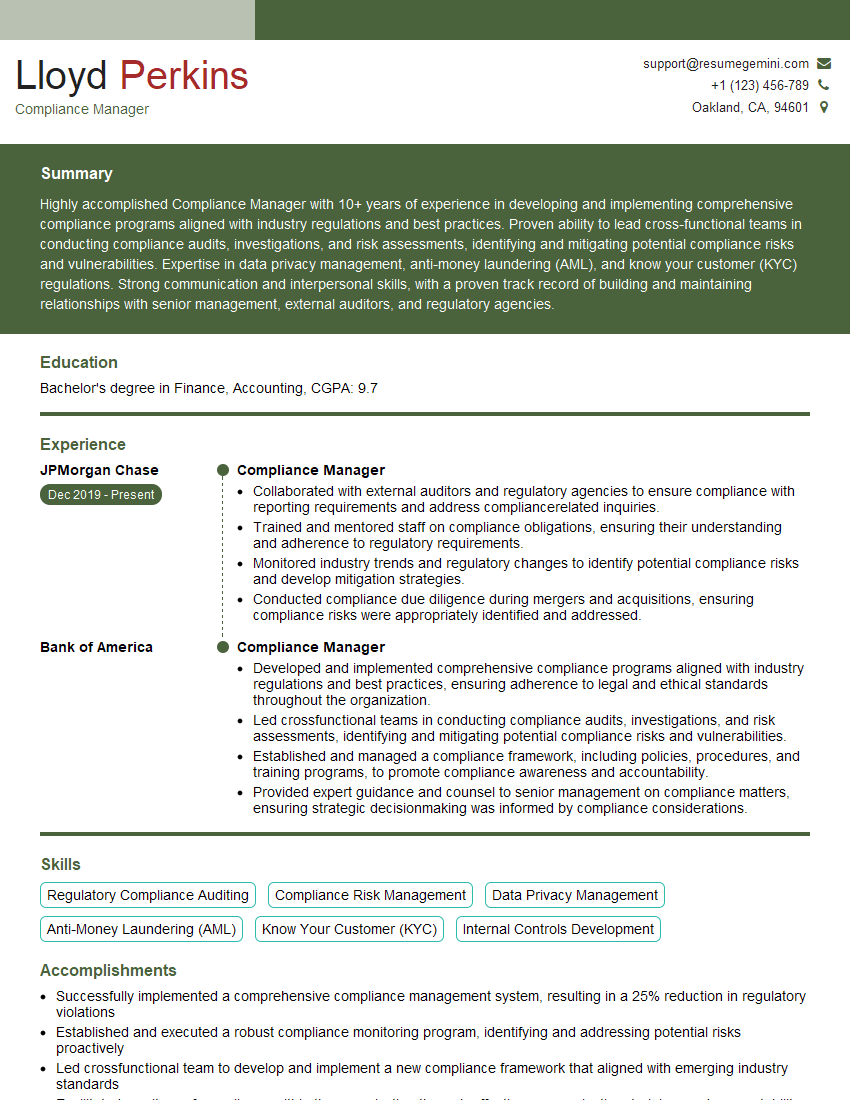
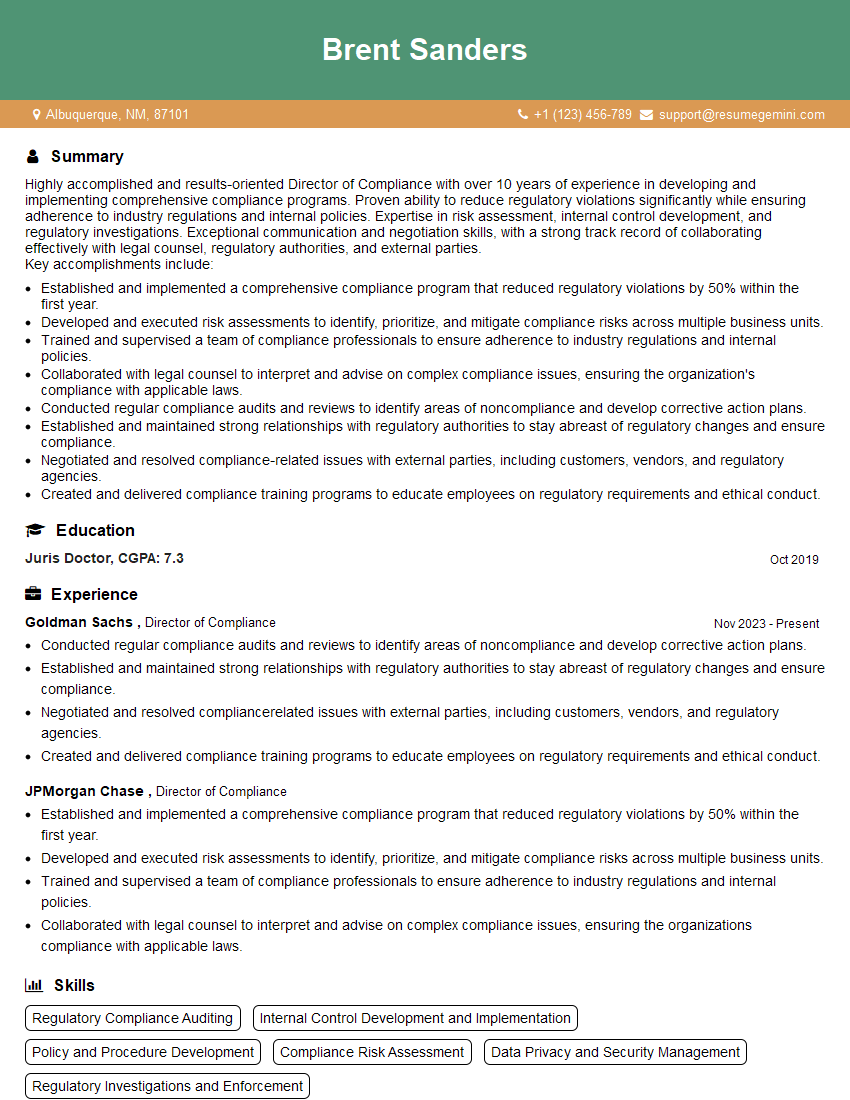
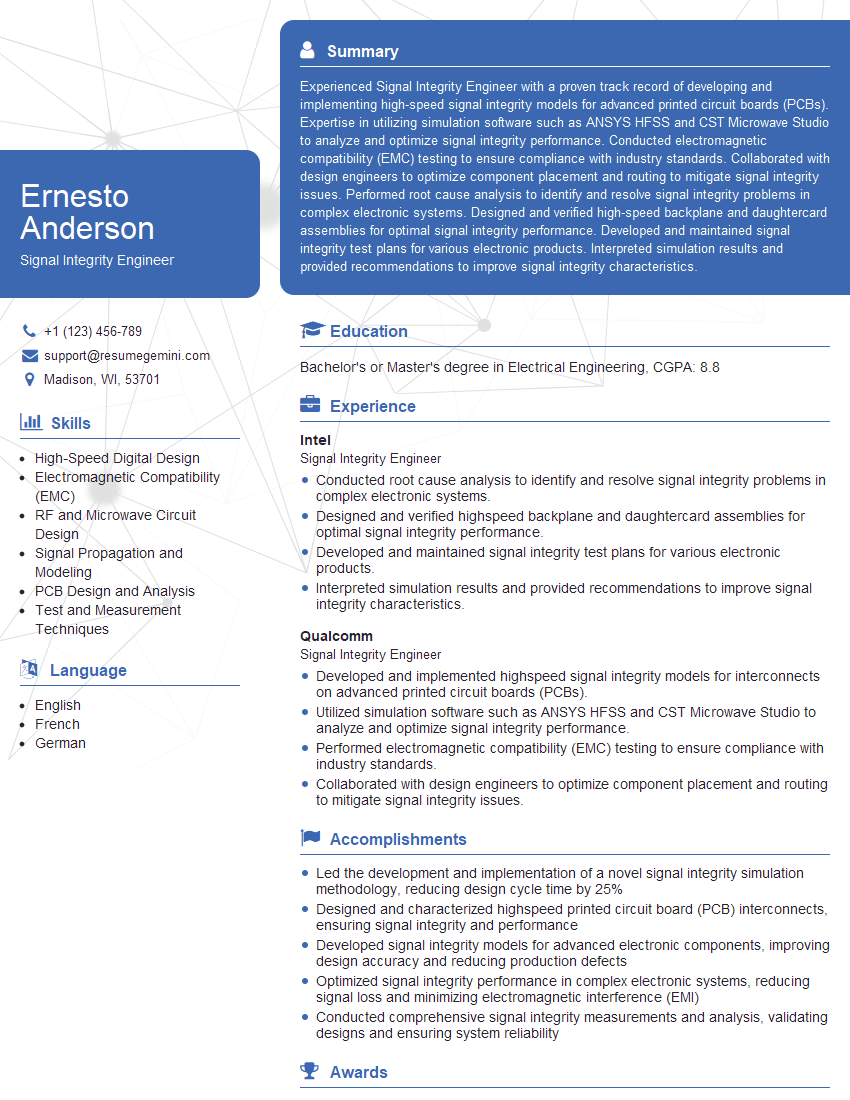
Mastering Signal Compliance opens doors to exciting career opportunities in a rapidly evolving technological landscape. A strong understanding of these concepts is highly valued by employers and significantly enhances your job prospects. To maximize your chances of success, create an ATS-friendly resume that effectively showcases your skills and experience. We highly recommend using ResumeGemini, a trusted resource, to build a professional and impactful resume. Examples of resumes tailored to Signal Compliance roles are available to help guide you.
Explore more articles
Users Rating of Our Blogs
Share Your Experience
We value your feedback! Please rate our content and share your thoughts (optional).
What Readers Say About Our Blog
Really detailed insights and content, thank you for writing this detailed article.
IT gave me an insight and words to use and be able to think of examples