Unlock your full potential by mastering the most common Immigration Law and Policy Expertise interview questions. This blog offers a deep dive into the critical topics, ensuring you’re not only prepared to answer but to excel. With these insights, you’ll approach your interview with clarity and confidence.
Questions Asked in Immigration Law and Policy Expertise Interview
Q 1. Explain the difference between adjustment of status and consular processing.
Adjustment of status and consular processing are two distinct pathways to obtaining a U.S. green card (permanent residency). The key difference lies in where the application is filed and who is applying.
Adjustment of Status: This process allows certain individuals already in the U.S. legally to apply for a green card without leaving the country. They file Form I-485, Application to Register Permanent Residence or Adjust Status, with United States Citizenship and Immigration Services (USCIS). Eligibility depends on the applicant’s current visa status and the availability of a green card through a family member or employer sponsorship. For instance, a spouse of a U.S. citizen could adjust their status.
Consular Processing: This route involves applying for a green card at a U.S. embassy or consulate in the applicant’s home country. Individuals who are outside the U.S. or those who are ineligible for adjustment of status typically utilize this method. The National Visa Center (NVC) processes the application before the interview at the consulate. The applicant undergoes an interview, medical examination, and background check before receiving the green card upon entering the U.S.
Imagine you’re trying to get to the top of a mountain. Adjustment of status is like climbing from the base camp, already on the mountain; consular processing is like starting your ascent from the valley floor.
Q 2. Describe the process for obtaining a U.S. green card through marriage.
Obtaining a U.S. green card through marriage is a multi-step process that requires patience and careful attention to detail. The U.S. citizen spouse must petition for the foreign national spouse using Form I-130, Petition for Alien Relative. Once USCIS approves the petition, the foreign national spouse can then either adjust their status (if already in the U.S. legally) or undergo consular processing (if outside the U.S.).
Step-by-step process (Adjustment of Status):
- Filing I-130: The U.S. citizen files Form I-130.
- Approval of I-130: USCIS approves the petition.
- Filing I-485: The foreign national spouse files Form I-485, along with supporting documentation like marriage certificate, proof of relationship, and financial documents demonstrating the ability to support the spouse financially.
- Biometrics Appointment: The foreign national attends a biometrics appointment (fingerprints and photo).
- Interview: An interview is scheduled with a USCIS officer.
- Green Card Approval: If approved, the green card is issued.
Step-by-step process (Consular Processing):
- Filing I-130: Same as above.
- Approval of I-130: Same as above.
- NVC Processing: The case is transferred to the NVC for processing.
- Consulate Interview: An interview is scheduled at the U.S. embassy or consulate in the foreign national’s home country.
- Medical Examination: A medical examination is required.
- Green Card Issuance: The green card is issued at the consulate and the individual enters the U.S. as a lawful permanent resident.
It’s crucial to provide accurate and comprehensive documentation throughout the process to avoid delays or denials. The process can be lengthy, and legal representation is often advisable.
Q 3. What are the grounds for inadmissibility under U.S. immigration law?
U.S. immigration law outlines various grounds of inadmissibility, meaning reasons why an individual may be denied entry into the U.S. or barred from becoming a lawful permanent resident. These grounds are broadly categorized, including:
- Health-related grounds: Individuals with certain communicable diseases or conditions may be inadmissible.
- Criminal grounds: Convictions for certain crimes, even minor ones, can lead to inadmissibility. The severity and nature of the crime are critical factors.
- Security grounds: Individuals deemed a threat to national security may be inadmissible.
- Public charge: Individuals likely to become dependent on public assistance may be deemed inadmissible (although this criterion has been significantly altered and has more lenient standards).
- Immigration violations: Previous immigration violations, such as illegal entry or visa overstays, can make an individual inadmissible.
- Misrepresentation: Providing false information to immigration officials can lead to inadmissibility.
Each ground has specific criteria and waivers may be available in some situations. It’s important to consult with an immigration attorney to assess your specific circumstances.
For example, a person convicted of a DUI (Driving Under the Influence) may be inadmissible, while another person with a minor traffic violation may not be.
Q 4. Explain the different types of non-immigrant visas.
Non-immigrant visas allow foreign nationals to enter the U.S. for temporary purposes. There’s a wide array of these visas, each with specific requirements and limitations. Some common examples include:
- B-1/B-2 (Tourist/Visitor): For tourism, pleasure, or business visits of limited duration.
- F-1 (Student): For academic study at accredited schools.
- M-1 (Student): For vocational study.
- H-1B (Specialty Occupation): For skilled workers in specialized fields.
- L-1 (Intracompany Transferee): For employees transferring within a multinational company.
- E-2 (Treaty Investor): For investors from countries with treaties with the U.S.
- J-1 (Exchange Visitor): For participation in exchange programs.
The specific requirements for each visa vary greatly, depending on the purpose of the visit. Applicants must demonstrate a clear intention to return to their home country after their temporary stay. Failure to do so can result in immigration consequences. A B-1/B-2 visa is generally for tourism and short business trips; an H-1B visa is required for highly skilled professionals working temporarily in the U.S.
Q 5. Discuss the requirements for asylum seekers in the U.S.
Asylum seekers in the U.S. must meet specific requirements to be granted asylum, which is a form of protection for those who fear persecution in their home country. They need to demonstrate a well-founded fear of persecution based on race, religion, nationality, membership in a particular social group, or political opinion.
Key Requirements:
- Fear of Persecution: The applicant must show a genuine fear of persecution in their home country if they were to return.
- Past Persecution (Not always required): While not always mandatory, evidence of past persecution strengthens the case significantly.
- Well-Founded Fear: The fear must be objectively reasonable, meaning a reasonable person in the applicant’s situation would also fear persecution.
- Nexus: The fear of persecution must be directly linked to one of the five protected grounds (race, religion, nationality, social group, political opinion).
- Filing within one year: Typically, asylum seekers must file their application within one year of arriving in the U.S. unless there is an exception.
Asylum seekers go through a rigorous screening process involving interviews and investigations. Legal representation is highly recommended due to the complexities of asylum law. Each application is assessed on a case-by-case basis; what constitutes a well-founded fear depends on the details of the applicant’s situation and the conditions in their home country.
Q 6. What is the role of the Department of Homeland Security in immigration enforcement?
The Department of Homeland Security (DHS) plays a crucial role in enforcing U.S. immigration laws. Primarily through its component agency, Immigration and Customs Enforcement (ICE), DHS is responsible for identifying, apprehending, and removing individuals who are in violation of immigration laws. This involves:
- Enforcement of Removal Orders: ICE apprehends and removes individuals with final orders of removal from the U.S.
- Interior Enforcement: ICE conducts operations within the U.S. to locate and apprehend individuals who have violated immigration laws.
- Border Security: Customs and Border Protection (CBP), another DHS component, works to secure the nation’s borders and prevent illegal entry.
- Investigations: DHS investigates immigration-related crimes, such as human smuggling and document fraud.
- Detention: ICE operates detention facilities to hold individuals pending removal proceedings.
DHS’s enforcement activities are guided by priorities set by the government and are subject to legal and ethical guidelines. The balance between enforcement and humanitarian concerns is a continuing discussion point in U.S. immigration policy.
Q 7. Explain the concept of ‘credible fear’ in asylum cases.
In asylum cases, ‘credible fear’ is a crucial threshold determination. It refers to a reasonable fear of persecution that warrants a more thorough investigation of the asylum claim. If an asylum officer finds that an applicant has a credible fear, the individual is permitted to proceed with a full asylum hearing before an immigration judge. This is a significant step, as failing to meet the credible fear standard will result in the asylum claim being dismissed.
Determining Credible Fear: Asylum officers assess a number of factors when determining whether a credible fear exists. This includes:
- Consistency of the Applicant’s Story: The officer evaluates the plausibility and consistency of the applicant’s account of the fear of persecution.
- Country Conditions: The officer takes into account information about the conditions in the applicant’s home country, including reports of human rights abuses and persecution.
- Applicant’s Individual Circumstances: The officer considers the specific circumstances of the applicant, such as their personal background and experiences.
The credible fear standard is not a high bar. It simply requires that the officer find it plausible that the applicant has a well-founded fear of persecution. The standard is lower than the ultimate standard for proving asylum, which requires demonstrating a well-founded fear through substantial evidence.
Q 8. What are the different pathways to U.S. citizenship?
There are several pathways to U.S. citizenship, each with its own specific requirements and complexities. The most common routes include:
- Family-Based Immigration: U.S. citizens and lawful permanent residents can petition for relatives to immigrate. The priority and waiting times vary depending on the relationship to the petitioner (e.g., spouse, parent, child).
- Employment-Based Immigration: Individuals with specialized skills or job offers in high-demand occupations can obtain green cards through employer sponsorship. This often involves a multi-step process, including labor certification.
- Investment Immigration: Individuals who invest a significant amount of capital in a U.S. business that creates jobs for American citizens can qualify for a green card.
- Refugee and Asylum: Individuals fleeing persecution in their home countries can seek refuge or asylum in the U.S. This involves demonstrating a well-founded fear of persecution based on race, religion, nationality, political opinion, or membership in a particular social group.
- Naturalization: Lawful permanent residents who meet specific requirements, such as residing in the U.S. for a certain number of years, passing a civics test, and demonstrating good moral character, can apply for naturalization and become U.S. citizens.
Each pathway has its own detailed requirements and procedures, making it crucial to consult with an immigration attorney for personalized guidance.
Q 9. Describe the process of appealing an immigration decision.
Appealing an immigration decision is a complex process that involves navigating specific legal procedures and deadlines. The first step is usually filing a motion to reopen or reconsider with the agency that made the initial decision (e.g., U.S. Citizenship and Immigration Services, or USCIS, or an Immigration Judge). This requires demonstrating new evidence or showing that the initial decision was based on an error of law or fact. If this is unsuccessful, the next step may involve filing an appeal to a higher court, such as the Board of Immigration Appeals (BIA) or a federal court, depending on the type of decision and the specific circumstances. Each level of appeal has strict deadlines and specific requirements for filing documentation. Failing to meet these requirements can result in the appeal being dismissed. It’s crucial to involve an experienced immigration attorney to navigate this process effectively.
For example, if USCIS denies a green card application, an appeal might be filed with the Administrative Appeals Office (AAO). If the AAO also denies the appeal, the applicant could potentially sue in federal court. Each step requires detailed documentation and legal arguments.
Q 10. What are the legal implications of employing undocumented workers?
Employing undocumented workers carries significant legal and financial implications for employers. Under the Immigration Reform and Control Act of 1986 (IRCA), it’s illegal to knowingly hire or recruit undocumented individuals. Penalties can include:
- Civil Penalties: These can be substantial fines per violation, potentially reaching tens of thousands of dollars.
- Criminal Penalties: In cases of repeated violations or egregious conduct, employers can face criminal charges, including imprisonment.
- Business Sanctions: The government can impose sanctions on businesses, such as debarment from government contracts.
- Civil lawsuits: Undocumented workers might file civil lawsuits against employers who have failed to pay them legally mandated wages or other benefits.
Furthermore, even unintentional hiring of undocumented workers can result in penalties if the employer fails to properly verify employment eligibility through the E-Verify system. Companies should establish robust compliance programs to ensure adherence to IRCA and related regulations. It’s imperative that employers understand and comply with all applicable employment laws.
Q 11. Explain the differences between lawful permanent resident status and temporary resident status.
The key difference between lawful permanent resident (LPR) status and temporary resident status lies in the duration and scope of the permission to remain in the United States.
- Lawful Permanent Resident (LPR) or Green Card Holder: An LPR has the right to live and work permanently in the U.S. They have many of the same rights as citizens, except the right to vote and hold certain government positions. Their status is not temporary; it’s indefinite unless revoked.
- Temporary Resident: A temporary resident is granted permission to stay in the U.S. for a specific period, for a specific purpose (e.g., student visa, work visa, tourist visa). Their stay is conditional and subject to the terms of their visa. They may have limitations on their employment authorization and may not be eligible for certain benefits available to LPRs. Once their visa expires, they must leave the country unless they apply for and receive an extension or a change of status.
Think of it like renting versus owning a house: an LPR ‘owns’ their right to live in the U.S., while a temporary resident is ‘renting’ their stay for a limited time.
Q 12. Discuss the impact of recent immigration policy changes on your area of expertise.
Recent immigration policy changes have had a profound impact on my area of expertise, primarily affecting the admissibility of individuals, the processing of applications, and the enforcement of immigration laws. For example, changes to asylum policies have made it more difficult for asylum seekers to qualify for protection. Similarly, shifts in visa allocation and processing times have created significant backlogs and delays for those seeking legal immigration status. The increased focus on border security has also resulted in greater challenges for individuals attempting to enter the country legally. These changes require immigration lawyers to adapt their strategies and legal arguments, emphasizing the importance of thorough preparation and meticulous attention to detail in all application materials. It also necessitates a strong awareness of constantly evolving court precedents and administrative guidance.
Q 13. How do you stay current with changes in immigration law and policy?
Staying current with changes in immigration law and policy is crucial for any practitioner in this field. I employ a multi-faceted approach that includes:
- Subscription to legal databases and newsletters: This provides access to the latest case law, legislative updates, and administrative pronouncements.
- Professional development courses and seminars: Attending continuing legal education programs keeps me abreast of new developments and best practices.
- Membership in professional organizations: Organizations such as the American Immigration Lawyers Association (AILA) offer valuable resources and networking opportunities.
- Monitoring government websites and publications: Regularly reviewing websites of agencies like USCIS, ICE, and the Department of Homeland Security is essential.
- Networking with colleagues: Discussions with other immigration attorneys allows me to share knowledge and stay updated on recent cases and developments.
This multi-pronged approach ensures I am always well-informed and can offer my clients the most up-to-date and effective legal advice.
Q 14. How would you handle a client who is facing deportation?
Handling a client facing deportation requires a calm, strategic, and comprehensive approach. The immediate priority is to assess the client’s situation thoroughly, gathering all relevant documentation and information, including their immigration history, any prior violations, and any potential grounds for relief. Based on this assessment, I would:
- Explore all potential avenues for relief: This might include applying for asylum, cancellation of removal, waivers, or other forms of relief from deportation, depending on the client’s individual circumstances and eligibility.
- Gather and prepare supporting evidence: This is critical for building a strong case. Evidence may include documentation related to family ties, employment history, humanitarian concerns, or any other relevant factors that might support the client’s claim.
- Represent the client in immigration court: This involves preparing legal arguments, presenting evidence, and cross-examining witnesses. Effective courtroom advocacy is paramount.
- Maintain open communication with the client: Keeping the client informed about the progress of their case, potential challenges, and the next steps is crucial throughout the process.
- If necessary, assist with appeals: If the initial ruling is unfavorable, I would guide the client through the appeals process, seeking to overturn the deportation order.
It’s crucial to remember that deportation cases are emotionally challenging for clients, requiring sensitivity and empathy. Providing clear, concise, and compassionate legal representation is paramount.
Q 15. Describe a situation where you had to navigate complex immigration regulations.
One particularly complex case involved a client seeking a U visa, which is set aside for victims of certain crimes who have assisted law enforcement. The client, a victim of human trafficking, had limited documentation and faced significant challenges in proving their cooperation with authorities. Navigating the regulations required meticulously compiling evidence, including medical records, police reports, and witness testimonies, all while ensuring the information was translated accurately and presented in a format compliant with USCIS regulations. This involved not only understanding the specific requirements of the U visa but also strategizing how to overcome the client’s lack of documentation through detailed witness statements and corroborating evidence. Ultimately, successful representation hinged on a thorough understanding of the nuances within the regulations and a tailored approach to compensate for the gaps in the initial documentation provided.
Career Expert Tips:
- Ace those interviews! Prepare effectively by reviewing the Top 50 Most Common Interview Questions on ResumeGemini.
- Navigate your job search with confidence! Explore a wide range of Career Tips on ResumeGemini. Learn about common challenges and recommendations to overcome them.
- Craft the perfect resume! Master the Art of Resume Writing with ResumeGemini’s guide. Showcase your unique qualifications and achievements effectively.
- Don’t miss out on holiday savings! Build your dream resume with ResumeGemini’s ATS optimized templates.
Q 16. What ethical considerations are most important in immigration law practice?
Ethical considerations are paramount in immigration law. Confidentiality is critical—information shared by clients is protected by attorney-client privilege. Integrity demands honest and accurate representation of clients, even when faced with challenging cases. We must avoid conflicts of interest and always act in the best interest of our clients, even if it means recommending against pursuing a case that lacks merit. Advocating for clients’ rights while adhering to the law is crucial. For example, I once had a client who was eligible for multiple forms of relief, but only one offered the best path forward, and we prioritized that despite the other options existing. Transparency with clients about the potential outcomes, challenges, and costs associated with the case is essential for maintaining trust and ethical practice. Furthermore, remaining abreast of changes in the law and its interpretation is crucial to provide competent and ethical representation.
Q 17. Explain the difference between family-based and employment-based immigration.
Family-based immigration allows U.S. citizens and lawful permanent residents (LPRs) to petition for family members to immigrate to the United States. This process is based on family relationships, with preference given to spouses, children, and parents. Employment-based immigration, on the other hand, focuses on individuals who have skills or qualifications that are needed in the U.S. workforce. These categories often require sponsorship from an employer who can demonstrate that the foreign national possesses skills not readily available in the U.S. labor market. The difference lies in the basis for eligibility: family ties versus job skills. Think of it this way: family-based immigration is about reunification, while employment-based immigration is about filling labor demands.
Q 18. What are the various forms of relief available to immigrants facing removal?
Immigrants facing removal have several potential avenues for relief. These include asylum, which protects individuals who fear persecution in their home country; withholding of removal, a slightly narrower form of protection; cancellation of removal, which may be available to LPRs or long-term residents with significant ties to the U.S.; adjustment of status, allowing certain individuals to obtain lawful permanent residency without leaving the country; and various waivers that can overcome inadmissibility grounds. The availability of each form of relief depends on the individual’s circumstances, and the specific requirements can be quite complex and fact-specific. For instance, an individual fleeing political persecution would likely pursue asylum, whereas an LPR with a criminal conviction might explore cancellation of removal.
Q 19. Discuss the role of international law in U.S. immigration policy.
International law plays a significant, albeit often debated, role in U.S. immigration policy. Treaties, conventions, and international human rights law influence the development and interpretation of U.S. immigration laws. For example, the 1951 Refugee Convention and its 1967 Protocol define who qualifies as a refugee, shaping U.S. asylum law. However, the U.S. retains significant discretion in implementing and interpreting these international norms. There can be tension between international legal obligations and national interests, leading to ongoing debates regarding the scope and application of international human rights standards in U.S. immigration policy. This can manifest in differing interpretations of the definition of “refugee,” the treatment of asylum seekers, and the level of protection afforded to vulnerable groups.
Q 20. How do you assess the credibility of a client’s asylum claim?
Assessing the credibility of an asylum claim requires a thorough and multifaceted approach. This involves carefully reviewing all available evidence, including the applicant’s testimony, country conditions reports, and any supporting documentation. Consistency in the applicant’s narrative is crucial. Discrepancies or inconsistencies need to be carefully examined and explained. The attorney assesses the applicant’s demeanor, their ability to recall details, and the overall plausibility of their story in light of the evidence. Country conditions reports from reputable sources provide background information about the applicant’s home country, including levels of violence, political instability, and persecution. The goal is to build a strong and persuasive case demonstrating the applicant’s well-founded fear of persecution.
Q 21. Explain the process of obtaining a work permit for a foreign national.
The process of obtaining a work permit for a foreign national varies depending on their immigration status and the reason for their presence in the U.S. Many foreign nationals need to file Form I-765, Application for Employment Authorization. Some common scenarios include individuals with pending adjustment of status applications, those granted asylum, or those with certain non-immigrant visas allowing for work authorization. The process often involves submitting the application with supporting documentation, such as proof of identity, immigration status, and employer sponsorship (if required). Processing times vary, and it is crucial to file the application in a timely manner and accurately provide all required documentation to ensure the efficient processing of the work permit.
Q 22. What are the key differences between immigration laws in different countries?
Immigration laws vary drastically across countries, reflecting each nation’s unique history, social fabric, and economic priorities. There’s no one-size-fits-all approach. Key differences emerge in areas such as:
- Visa categories: Some countries prioritize skilled migration, offering numerous pathways for professionals, while others may focus on family reunification or humanitarian concerns. For instance, Canada’s Express Entry system emphasizes points-based selection for skilled workers, contrasting with the US system’s more diverse range of visa options, including employment-based, family-based, and humanitarian visas.
- Application processes: The complexity and length of the application process can differ significantly. Some countries might have streamlined online systems, while others rely on extensive paperwork and in-person interviews. The waiting times for processing applications can also vary greatly.
- Integration policies: Post-arrival support and integration programs for immigrants vary widely. Some countries offer comprehensive language training, job placement services, and cultural orientation programs, whereas others may provide minimal assistance.
- Enforcement policies: The strictness of border control and immigration enforcement varies considerably, impacting asylum seekers and undocumented immigrants differently across nations. Some countries have stricter penalties for illegal immigration than others.
- Pathways to citizenship: Requirements for obtaining citizenship differ, ranging from length of residency to language proficiency tests and civics exams. Some countries offer faster routes to citizenship than others.
Understanding these differences is crucial for immigration attorneys and policy analysts to effectively advise clients and advocate for policy changes.
Q 23. How familiar are you with the INA (Immigration and Nationality Act)?
I am intimately familiar with the Immigration and Nationality Act (INA). My expertise encompasses all its titles, including those dealing with visas, adjustments of status, deportation, and citizenship. I understand the intricacies of its provisions, including the nuances of various visa categories (like H-1B, L-1, etc.), waivers, and the grounds for inadmissibility and deportability. I regularly consult the INA and its associated regulations in my work, and I’m adept at interpreting complex legal language and applying it to specific client situations. My experience includes working on cases involving:
- Family-based immigration petitions
- Employment-based immigration petitions
- Asylum and refugee applications
- Deportation defense cases
- Naturalization applications
Furthermore, I stay current on all amendments and case law interpretations that impact the INA, ensuring my advice is always up-to-date and legally sound. The INA is the foundation of my professional practice.
Q 24. Discuss some common challenges faced by immigration attorneys/policy analysts.
Immigration attorneys and policy analysts face many unique challenges. Some of the most common include:
- Complex and ever-changing laws: Immigration law is incredibly intricate, with frequent updates and changes making it difficult to stay abreast of all developments. This requires constant learning and adaptation.
- Emotional toll on clients and attorneys: Immigration cases often involve high-stakes situations and significant personal hardship for clients, leading to emotional stress for both clients and their representatives.
- Dealing with bureaucratic hurdles: Navigating the complex bureaucracy of immigration agencies can be time-consuming and frustrating, requiring persistence and meticulous attention to detail.
- Limited resources and high caseloads: Many attorneys and analysts face high caseloads with limited resources, creating significant time constraints and potential for burnout.
- Ethical dilemmas: Attorneys often encounter ethical dilemmas, such as balancing client confidentiality with reporting obligations.
- Language barriers: Effective communication with clients from diverse linguistic backgrounds can be challenging without proper interpretation services.
- Political climate and policy shifts: Changes in immigration policy can significantly impact case outcomes and require quick adaptation.
Effectively managing these challenges requires strong organizational skills, emotional resilience, dedication to continuing education, and a strong ethical compass.
Q 25. How do you manage competing priorities and deadlines in a fast-paced immigration environment?
The fast-paced nature of immigration law demands exceptional organizational skills and efficient time management. I employ a multi-pronged approach to manage competing priorities and deadlines:
- Prioritization Matrix: I use a prioritization matrix to rank tasks based on urgency and importance, ensuring that critical deadlines are met first. This often involves clearly defining which cases require immediate attention.
- Project Management Software: I utilize project management software to track deadlines, allocate resources, and monitor progress on multiple cases simultaneously. This provides a clear overview of all my ongoing commitments.
- Delegation (where appropriate): I delegate tasks when feasible to increase efficiency and free up time to focus on high-priority items. This could involve assigning research tasks to junior staff or paralegals.
- Time Blocking: I allocate specific time blocks for particular tasks to enhance focus and minimize distractions. This helps maintain a structured work routine.
- Regular Review and Adjustment: I regularly review my schedule and adjust my priorities as needed to accommodate unexpected delays or new case developments. Flexibility is key.
This structured approach allows me to maintain a balance between diverse tasks, meet all deadlines effectively, and provide the best possible service to my clients.
Q 26. Describe your experience working with diverse communities.
Throughout my career, I have consistently worked with diverse communities, representing clients from various cultural backgrounds, socioeconomic statuses, and immigration experiences. This has provided me with invaluable insights into the unique challenges faced by different groups. For instance, I’ve worked extensively with:
- Refugee and asylum seekers: Understanding their trauma and legal needs requires sensitivity and a deep understanding of international human rights law.
- Immigrants from diverse countries: Each country’s immigration system and cultural norms have unique aspects that must be considered when assisting immigrants.
- Low-income families: Navigating the immigration system can be particularly challenging for those with limited financial resources, demanding creativity in finding solutions.
My experience working with diverse communities has instilled in me a strong commitment to cultural sensitivity, empathy, and effective cross-cultural communication. This allows me to build rapport with clients from all backgrounds, effectively understand their needs, and tailor my approach to their specific circumstances.
Q 27. How would you handle a client with limited English proficiency?
When working with a client with limited English proficiency, I prioritize clear and effective communication. This involves several steps:
- Professional Interpretation Services: I always utilize certified interpreters, ensuring accurate and confidential communication. This is paramount to avoid misunderstandings.
- Simple and Clear Language: Even when using an interpreter, I communicate in simple and clear language, avoiding legal jargon as much as possible.
- Visual Aids: When appropriate, I use visual aids, like diagrams or flowcharts, to supplement verbal explanations and improve comprehension.
- Written Materials in Client’s Language: I provide all important documents translated into the client’s native language, ensuring they understand their rights and obligations.
- Patience and Understanding: I approach every interaction with patience and understanding, allowing ample time for questions and ensuring the client feels comfortable expressing their concerns.
Ensuring effective communication with clients regardless of language proficiency is crucial for providing competent and ethical legal representation.
Q 28. What are your strategies for dealing with stressful situations related to immigration cases?
Immigration cases can be intensely stressful, given the high stakes involved for clients. I employ several strategies to manage stress effectively:
- Mindfulness and Meditation: I incorporate mindfulness and meditation practices into my daily routine to manage stress and maintain mental clarity.
- Strong Support System: I maintain a strong support network of colleagues and mentors, who I can turn to for guidance and emotional support during challenging times.
- Healthy Lifestyle: Maintaining a healthy lifestyle through regular exercise, adequate sleep, and a balanced diet is essential for managing stress and enhancing resilience.
- Professional Boundaries: Setting and maintaining strong professional boundaries is important to avoid emotional burnout and maintain objectivity in my work.
- Seeking Supervision: When dealing with particularly challenging cases, I might seek supervision from senior colleagues or a therapist specializing in stress management and trauma.
By prioritizing self-care and seeking support when needed, I can effectively manage stress and maintain my ability to provide high-quality legal services to my clients.
Key Topics to Learn for Immigration Law and Policy Expertise Interview
- Immigration Law Fundamentals: Understanding foundational legal principles, including visa categories, adjustment of status, and deportation procedures. Consider practical application through case studies and hypothetical scenarios.
- Policy Analysis and Impact: Analyzing the impact of immigration policies on various stakeholders (individuals, communities, and the nation). Practice applying theoretical frameworks to real-world policy debates.
- Ethical Considerations in Immigration Law: Exploring the ethical dilemmas inherent in immigration law and policy, such as due process, human rights, and border security. Develop your ability to analyze and discuss these issues thoughtfully.
- Immigration Enforcement and Detention: Understanding the processes and legal frameworks surrounding immigration enforcement, detention, and removal. This includes analyzing relevant court cases and legislation.
- Specific Immigration Laws and Regulations: Focusing on key immigration statutes and regulations relevant to your area of interest within immigration law and policy. Be prepared to discuss these in detail.
- Problem-solving and Case Management: Develop your ability to assess complex immigration cases, identify legal issues, and propose effective solutions. Prepare case studies that demonstrate your problem-solving skills.
- Current Events and Policy Debates: Stay updated on current immigration-related news, legislation, and policy debates. Be prepared to discuss recent developments and their implications.
Next Steps
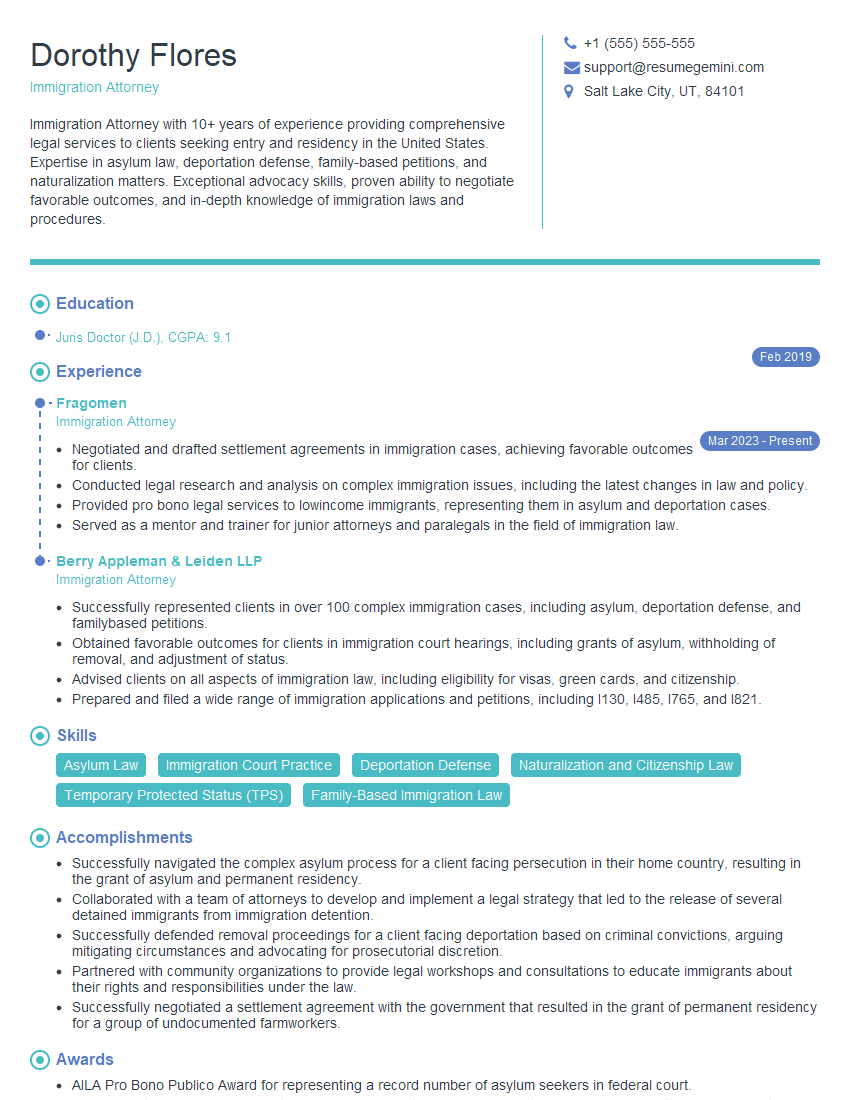
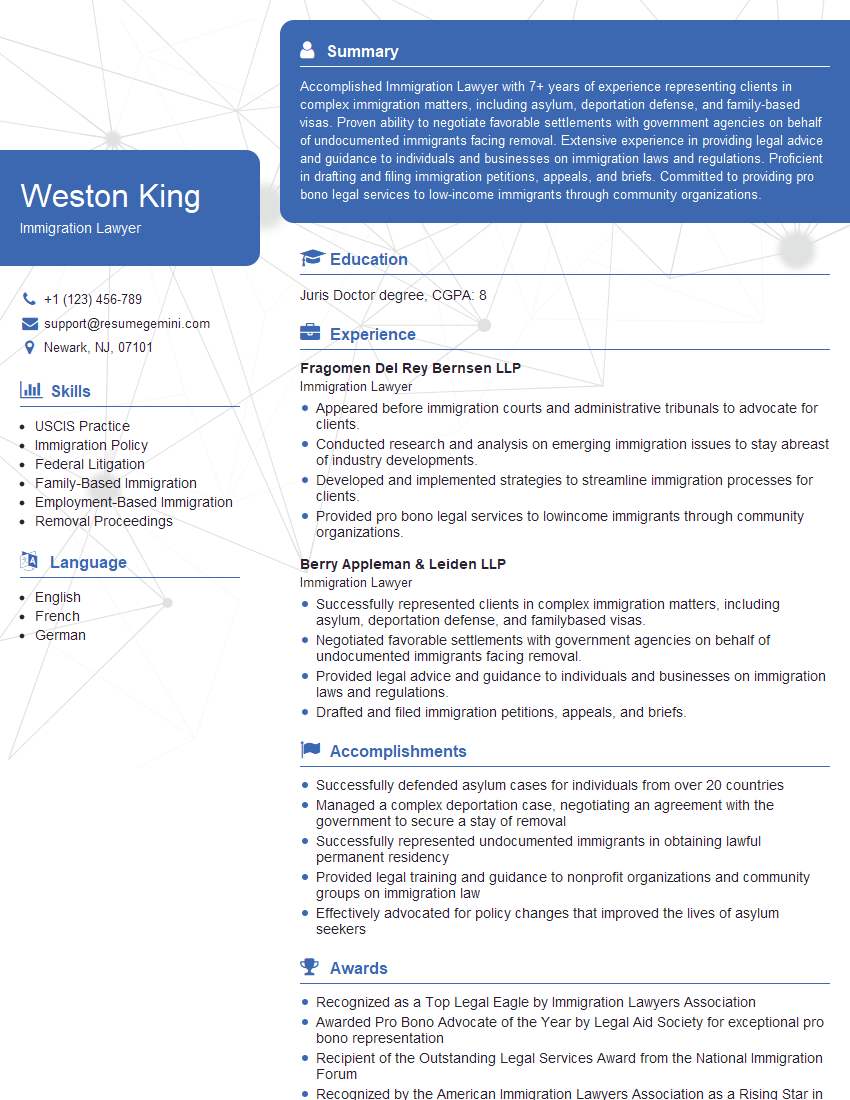
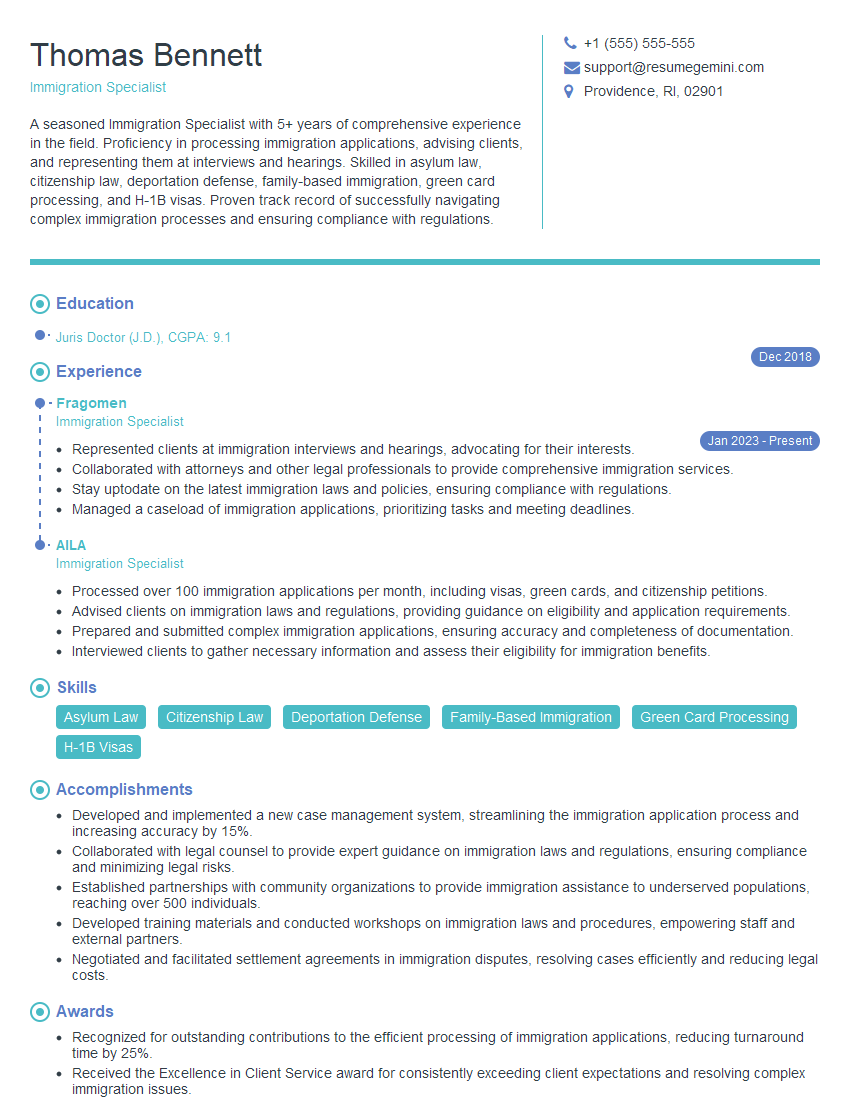
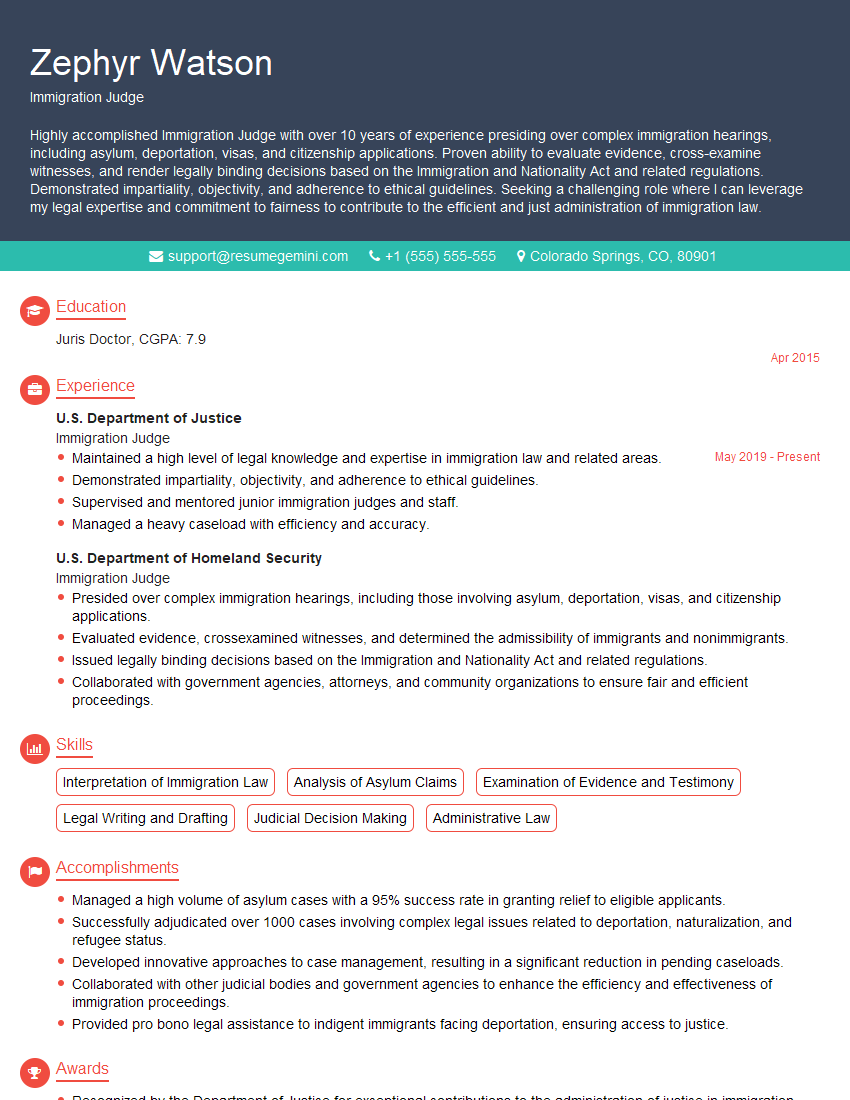
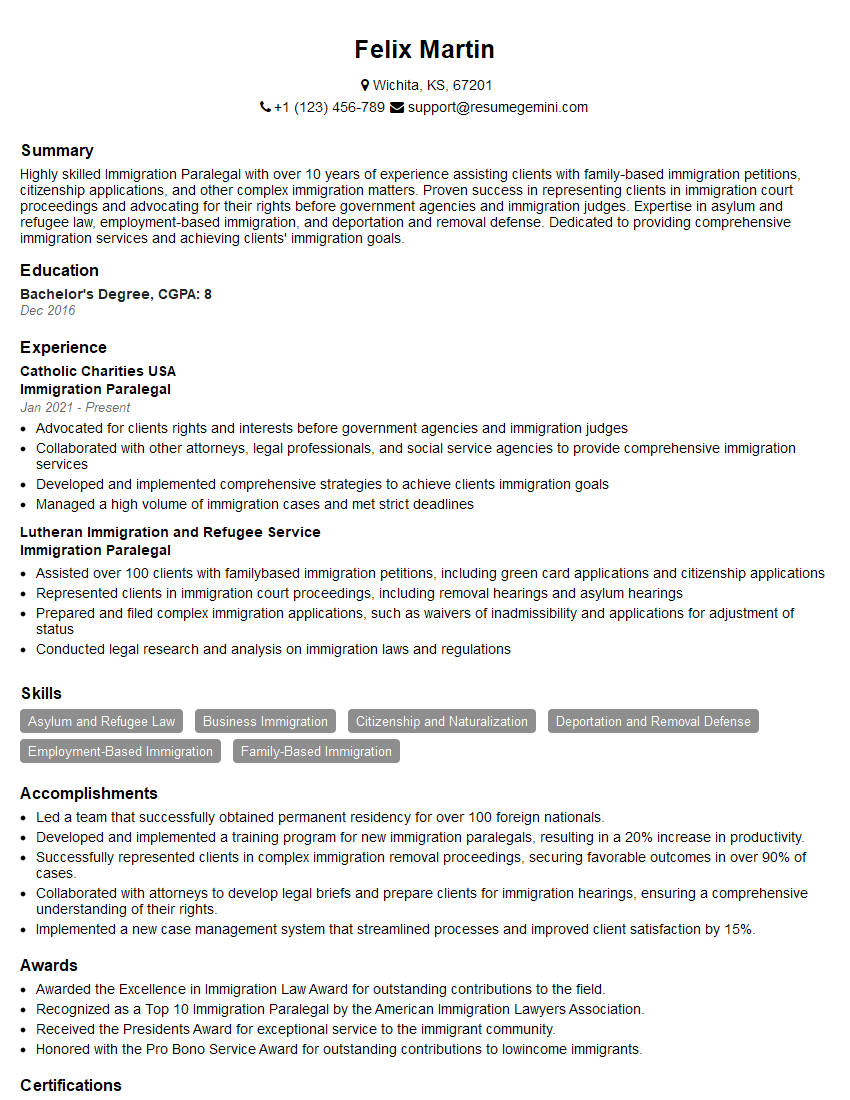
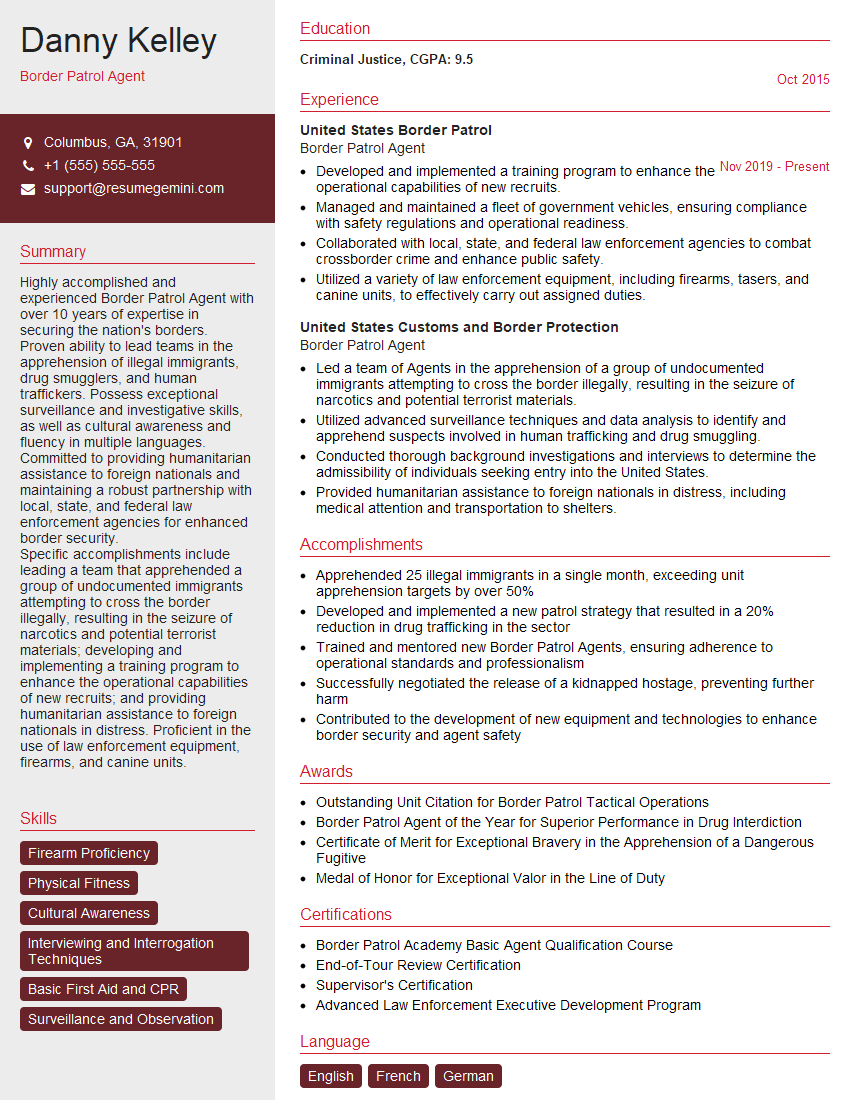
Mastering Immigration Law and Policy Expertise opens doors to impactful careers, offering opportunities to advocate for individuals and influence policy changes. A strong resume is crucial for showcasing your skills and experience to potential employers. Building an ATS-friendly resume increases your chances of getting noticed by recruiters and landing interviews. ResumeGemini is a trusted resource to help you craft a professional and impactful resume that highlights your unique qualifications. We provide examples of resumes tailored to Immigration Law and Policy Expertise to guide you in showcasing your achievements and expertise effectively.
Explore more articles
Users Rating of Our Blogs
Share Your Experience
We value your feedback! Please rate our content and share your thoughts (optional).
What Readers Say About Our Blog
Really detailed insights and content, thank you for writing this detailed article.
IT gave me an insight and words to use and be able to think of examples