Preparation is the key to success in any interview. In this post, we’ll explore crucial Specimen Casting interview questions and equip you with strategies to craft impactful answers. Whether you’re a beginner or a pro, these tips will elevate your preparation.
Questions Asked in Specimen Casting Interview
Q 1. Describe the different types of casting processes you are familiar with.
Specimen casting encompasses various processes, each chosen based on the material properties and the desired final product. The most common methods I’m familiar with include:
- Sand Casting: This is a widely used, cost-effective method involving creating a mold from sand (typically silica sand mixed with a binder). Molten material is poured into the mold, allowed to solidify, and then the sand mold is broken away to reveal the casting. It’s excellent for producing large, complex shapes but has limitations in surface finish and dimensional accuracy.
- Investment Casting (Lost-Wax Casting): A high-precision method where a wax pattern is created, coated in a ceramic shell, and then the wax is melted out, leaving a cavity for molten material. This technique excels at producing intricate details and highly accurate castings. It’s commonly used for aerospace and jewelry applications.
- Die Casting: This high-speed process uses metal molds (dies) to create castings. Molten material is injected under high pressure into the die, which leads to high production rates and excellent dimensional accuracy. It’s suitable for mass production of smaller components with consistent quality.
- Permanent Mold Casting: This method uses reusable metal molds, typically made of steel or graphite. It offers improved surface finish and dimensional accuracy compared to sand casting and is suitable for medium-to-high volume production.
The selection of the process depends on factors like the material being cast, the required quantity, desired tolerances, and the complexity of the part.
Q 2. Explain the process of creating a mold for specimen casting.
Mold creation is a critical step, and the process varies based on the chosen casting method. Let’s take sand casting as an example:
- Pattern Making: A pattern, representing the desired casting shape, is made from wood, metal, or plastic. The pattern is typically slightly larger than the final casting to compensate for shrinkage during solidification.
- Mold Preparation: The pattern is placed in a flask (a box-like frame) filled with sand. The sand is compacted around the pattern, creating a cavity in the shape of the pattern.
- Parting Line Creation: A parting line is created to separate the mold into two halves, facilitating easy removal of the pattern and later, the casting.
- Pattern Removal: The pattern is carefully removed from the sand mold, leaving behind the cavity for casting. Sprue, runner, and riser systems (explained later) are created to manage the flow of molten material.
- Mold Assembly: The two halves of the sand mold are carefully joined together to create a complete mold, ready for pouring.
For other methods like investment casting, the mold is created using a wax pattern which is then coated with refractory material, while in die casting the mold is a reusable metal die.
Q 3. What are the key considerations for selecting a specific casting material?
Material selection is crucial and depends on several factors:
- Mechanical Properties: The required strength, hardness, ductility, and other mechanical properties of the final casting dictate the material choice. For instance, high-strength aluminum alloys would be preferred for aerospace components, while ductile iron might be used for engine blocks.
- Melting Point: The melting point influences the casting process and energy requirements. Materials with lower melting points are generally easier and cheaper to cast.
- Castability: Some materials are more easily cast than others. Good castability implies the material flows well into the mold without excessive oxidation or gas formation.
- Cost: Material cost is a major factor in industrial applications. The balance between material properties and cost needs to be carefully considered.
- Corrosion Resistance: If the casting is to operate in corrosive environments, materials with high corrosion resistance (like stainless steels or specific alloys) are necessary.
For example, selecting a bronze alloy might be ideal for a decorative piece requiring good corrosion resistance and attractive appearance, while a steel alloy would be suitable for a structural component demanding high strength and durability.
Q 4. How do you ensure the accuracy and precision of a cast specimen?
Accuracy and precision are paramount. Several methods are employed:
- Precise Pattern Making: Accurate patterns are essential. Modern techniques like CNC machining ensure high dimensional accuracy of the patterns.
- Proper Mold Making Techniques: Careful compaction of the molding material (sand, ceramic shell, etc.) ensures the mold accurately reflects the pattern’s shape.
- Controlled Pouring: Maintaining a consistent pouring temperature and rate minimizes defects and promotes uniform filling of the mold.
- Post-Casting Machining: Minor inaccuracies can often be corrected through post-casting machining. However, this adds to the overall cost and complexity.
- Inspection and Quality Control: Rigorous inspection using various techniques, including dimensional checks and non-destructive testing (NDT), is vital to ensure that the final casting meets the required specifications.
For instance, using investment casting with precise wax patterns can produce castings with tolerances as low as 0.02 mm, whereas sand casting might only achieve tolerances of several millimeters.
Q 5. What are the common defects found in castings and their causes?
Casting defects are common and can significantly impact the quality and functionality of the final product. Some of the most frequent defects and their causes are:
- Shrinkage Porosity: Occurs due to volume reduction during solidification. This can be minimized by proper risering, using suitable casting materials, and optimizing the cooling rate.
- Gas Porosity: Caused by dissolved gases in the molten material that are released during solidification. Proper degassing techniques and mold venting can minimize this issue.
- Cold Shut: Forms when two streams of molten material fail to fuse together completely, creating a weak area in the casting. Proper mold design and pouring techniques can prevent cold shuts.
- Hot Tears: These cracks form in the casting due to high internal stresses during cooling. This can be mitigated by using appropriate materials and designing the casting to minimize stress concentrations.
- Misruns: Occur when the molten material doesn’t completely fill the mold cavity. Proper mold design, including gating and risering, is key to preventing misruns.
- Surface Defects: Include scabs, sand inclusions, and surface roughness, often resulting from poor mold preparation or pouring techniques.
Identifying the root cause of defects is critical for corrective actions. Thorough analysis using metallographic techniques, visual inspection, and NDT methods helps to pinpoint the origin of these defects.
Q 6. Describe your experience with quality control procedures in specimen casting.
Quality control is an integral part of my workflow. My experience involves implementing and overseeing various procedures, including:
- Incoming Material Inspection: Checking the chemical composition and physical properties of the raw materials to ensure they meet specifications.
- Process Monitoring: Closely monitoring parameters like pouring temperature, pouring rate, and mold conditions during the casting process.
- Dimensional Inspection: Using tools like calipers, CMMs (Coordinate Measuring Machines), and other measuring instruments to verify the dimensions of the castings.
- Visual Inspection: Carefully examining castings for surface defects and other imperfections.
- Non-Destructive Testing (NDT): Employing techniques such as radiography, ultrasonic testing, and dye penetrant testing to detect internal flaws and surface cracks.
- Data Analysis: Tracking and analyzing casting parameters and defect rates to identify trends and areas for improvement.
- Documentation: Maintaining detailed records of all quality control procedures and findings.
In one instance, by carefully analyzing the defect rate data, we identified a correlation between the mold temperature and the incidence of gas porosity. By adjusting the mold preheating process, we reduced the defect rate by over 30%.
Q 7. Explain the importance of proper gating and risering systems.
Proper gating and risering systems are critical for successful casting. They manage the flow of molten material into the mold cavity and control the solidification process.
- Gating System: Directs the flow of molten metal from the pouring basin into the mold cavity. A well-designed gating system ensures that the mold is filled smoothly and completely, avoiding turbulence and air entrapment.
- Sprue: The vertical channel through which the molten metal flows from the pouring basin into the runner system.
- Runner: A horizontal channel that distributes the molten metal to various sections of the mold cavity.
- Ingates: Small openings that connect the runner system to the mold cavity.
- Risering System: Provides a reservoir of molten metal that feeds the casting during solidification, compensating for shrinkage and preventing shrinkage defects.
- Riser: A separate cavity connected to the main casting that supplies molten metal to compensate for shrinkage during cooling.
Think of it like watering a garden. The gating system is like the main pipe, the runners are the smaller pipes that distribute the water, and the risers are like extra water tanks to ensure the plants don’t dry out. A poorly designed system leads to uneven filling, air entrapment, and ultimately, defective castings. A properly designed system helps ensure that the casting is completely filled, reducing the likelihood of shrinkage and other defects.
Q 8. How do you troubleshoot casting defects?
Troubleshooting casting defects involves a systematic approach. It begins with careful observation of the defect itself – its location, size, shape, and appearance. This visual inspection often provides clues to the root cause. For instance, a surface crack might indicate rapid cooling or insufficient mold venting, whereas porosity could point to gas entrapment during pouring or insufficient degassing of the molten metal.
Next, I analyze the process parameters: pouring temperature, mold material and preparation, gating system design, and metal composition. Was the pouring temperature too high, leading to burning or excessive shrinkage? Was the mold properly prepared, ensuring consistent permeability and strength? Was the gating system correctly designed to avoid turbulence and ensure a smooth metal flow? A poorly designed gating system can lead to cold shuts (unfused metal sections) or misruns (incomplete filling of the mold).
- Porosity: This is often due to dissolved gases in the metal. Solutions include proper degassing techniques, adjusting pouring temperature, or using different mold materials.
- Shrinkage: Insufficient metal volume in the mold cavity or rapid cooling can lead to shrinkage cavities. Solutions include optimizing the gating system for adequate metal flow, using appropriate risers (reservoirs to feed the casting as it solidifies), and controlling cooling rates.
- Misruns: This occurs when the molten metal fails to completely fill the mold cavity. Adjusting the pouring temperature or the gating system design can typically resolve this.
Finally, I meticulously document each step and the results of the troubleshooting process. This allows for continuous improvement and prevents the recurrence of similar defects. It is crucial to combine experience with systematic analysis to effectively troubleshoot and improve casting quality.
Q 9. What safety precautions do you take when working with molten metals?
Safety is paramount when working with molten metals. My safety procedures begin with proper personal protective equipment (PPE), including heat-resistant gloves, safety glasses with side shields, a full-length apron, and closed-toe safety shoes. I also ensure the work area is well-ventilated to mitigate exposure to fumes and gases generated during the melting and pouring process. The work area needs to be kept clean and organized to prevent accidents.
Before handling any molten metal, I always double-check the pouring temperature using a calibrated thermocouple to avoid overheating and potential burns. I use appropriate safety tools like tongs and ladles designed for handling molten metal, never attempting to handle it directly. Spills are a major concern, so I have a plan in place for containing spills, including readily available sand or fire-retardant materials. Furthermore, I establish clear communication protocols with my colleagues, notifying them before starting any critical operations. Regular safety training and adherence to strict safety guidelines are crucial for minimizing risk. After each casting, I thoroughly clean the work area to remove any remaining metal debris.
Q 10. Describe your experience with different types of casting molds (sand, investment, etc.).
My experience encompasses a broad range of casting mold types. Sand casting, a relatively inexpensive and versatile method, forms the basis of my foundational knowledge. I’m proficient in preparing sand molds, including mixing the sand with appropriate binders, creating cores, and assembling the mold components. I’ve worked with both green sand (moist sand) and dry sand molds, understanding their respective strengths and limitations in terms of surface finish and dimensional accuracy.
Investment casting (lost-wax casting) offers higher dimensional accuracy and more complex geometries. My experience includes creating wax patterns, investing them in ceramic slurry, dewaxing the mold, and pouring the molten metal. Investment casting is particularly suitable for intricate designs, offering excellent surface finish and close tolerances.
I’ve also worked with other mold types such as permanent mold casting (using metal molds) and die casting (high-pressure injection of molten metal into metal molds), each offering unique advantages in terms of production rate, surface finish, and dimensional control. My experience spans diverse applications, allowing me to choose the optimal mold type based on design complexity, required tolerances, and production volume.
Q 11. How do you determine the appropriate pouring temperature for a given material?
Determining the correct pouring temperature is crucial for successful casting. It’s not a single value but depends on several factors, primarily the material’s properties (melting point, fluidity, tendency to oxidize) and the casting process itself.
I consult material data sheets and relevant literature to find the recommended pouring temperature range for the specific alloy. However, these are guidelines, and fine-tuning is often necessary. Factors like mold material, mold size, and casting complexity affect the actual optimal pouring temperature. I might need to experiment within a small range to find the sweet spot that prevents defects such as shrinkage, porosity, and cold shuts.
Using a calibrated thermocouple is essential for accurate temperature measurement. Overheating can lead to excessive oxidation, burning, and reduced mechanical properties, while underheating results in poor fluidity and incomplete mold filling. Experience plays a vital role in making small adjustments to achieve the ideal pouring temperature, and I continuously refine my understanding through detailed observation and record-keeping.
Q 12. What is your experience with post-casting processing techniques (machining, heat treatment)?
Post-casting processing is vital for achieving the desired final product characteristics. My experience encompasses various techniques, including machining, heat treatment, and surface finishing. Machining, using tools like milling machines, lathes, and grinders, removes excess material, corrects dimensional inaccuracies, and creates precise features. I’m skilled in selecting appropriate machining parameters to avoid damaging the cast part.
Heat treatment techniques, such as annealing, quenching, and tempering, alter the mechanical properties of the cast metal. I understand how different heat treatments affect hardness, strength, ductility, and other properties. For example, annealing can relieve internal stresses, while quenching and tempering can increase hardness and strength. The specific heat treatment chosen depends on the material and the required properties of the final product.
Surface finishing processes, including grinding, polishing, and plating, improve the aesthetic appeal and corrosion resistance of the casting. I’m familiar with various surface treatment methods and can select the appropriate technique to meet specific requirements. The choice of post-casting processing heavily depends on the specific application of the cast specimen.
Q 13. Explain the concept of solidification shrinkage and its impact on casting design.
Solidification shrinkage is the volume reduction that occurs when molten metal transitions to a solid state. This is a fundamental aspect of casting that must be carefully considered during design. As the metal cools, it contracts, potentially leading to shrinkage cavities or porosity if not properly accounted for.
The magnitude of shrinkage varies depending on the material. For example, cast iron has a higher shrinkage rate than aluminum. To compensate for shrinkage, designers incorporate features such as risers (reservoirs of molten metal) in the mold. Risers feed the casting as it solidifies, preventing the formation of shrinkage cavities. The size and location of risers are critical and depend on the casting geometry and material. Chill (cooling) zones in the mold can also be used to control the solidification rate and minimize shrinkage.
Understanding solidification shrinkage is essential for designing castings that are dimensionally accurate and free from defects. Ignoring shrinkage can lead to significant issues, including cracking, porosity, and dimensional inaccuracies, compromising the structural integrity and functionality of the cast part.
Q 14. How do you ensure the dimensional accuracy of cast specimens?
Ensuring dimensional accuracy in cast specimens requires a multi-faceted approach, starting with careful mold design and material selection. The mold must be precisely manufactured to the desired dimensions, accounting for solidification shrinkage. The use of precision-machined patterns for investment casting or accurate mold-making techniques for sand casting is paramount.
Controlling the pouring temperature and rate is crucial to minimize variations in the casting. Maintaining consistent metal properties (chemical composition, temperature) ensures uniform solidification and reduces the likelihood of dimensional inconsistencies. Proper mold venting prevents gas entrapment, which can distort the cast shape. Careful control of the cooling rate helps to reduce internal stresses that can cause warping.
Finally, post-casting processing techniques, such as machining, play a vital role in achieving the final dimensional accuracy. Machining can correct small deviations from the intended dimensions, but excessive machining undermines the cost-effectiveness of casting. In summary, achieving dimensional accuracy is a balance between careful control throughout the casting process and employing appropriate post-processing techniques when necessary.
Q 15. What software or tools do you use for casting design and simulation?
For casting design and simulation, I primarily utilize software like Autodesk Moldflow and Magmasoft. These programs allow for the creation of detailed 3D models of the casting process, enabling the prediction of potential defects such as porosity, shrinkage, and hot tears. Moldflow, for example, excels at simulating the flow of molten metal within the mold cavity, allowing for optimization of gating systems and runner design to minimize turbulence and ensure complete filling. Magmasoft, on the other hand, provides more advanced capabilities for predicting solidification patterns and thermal stresses within the casting. In addition to these sophisticated packages, I also use CAD software like SolidWorks to create the initial design of the casting itself, ensuring compatibility with the casting process and the desired final part geometry. The integration between these tools is crucial for a robust and efficient design process.
Career Expert Tips:
- Ace those interviews! Prepare effectively by reviewing the Top 50 Most Common Interview Questions on ResumeGemini.
- Navigate your job search with confidence! Explore a wide range of Career Tips on ResumeGemini. Learn about common challenges and recommendations to overcome them.
- Craft the perfect resume! Master the Art of Resume Writing with ResumeGemini’s guide. Showcase your unique qualifications and achievements effectively.
- Don’t miss out on holiday savings! Build your dream resume with ResumeGemini’s ATS optimized templates.
Q 16. Explain your experience with different casting alloys and their properties.
My experience encompasses a wide range of casting alloys, each with unique properties influencing their suitability for different applications. For instance, aluminum alloys are frequently chosen for their lightweight properties and excellent castability, making them ideal for automotive parts and aerospace components. However, their lower melting point requires careful control of the pouring temperature to prevent excessive shrinkage or porosity. Steel alloys, conversely, offer superior strength and durability but are more challenging to cast due to their higher melting point and greater viscosity. This often necessitates the use of specialized casting techniques like investment casting to achieve fine details and complex geometries. I’ve also worked extensively with zinc alloys, known for their low melting point and excellent surface finish, making them suitable for intricate decorative items or parts requiring a high degree of precision. Selection of the appropriate alloy is driven by a careful consideration of the mechanical properties required, the complexity of the part geometry, and the cost-effectiveness of the overall casting process.
Q 17. Describe your experience with maintaining casting equipment.
Maintaining casting equipment is paramount for consistent high-quality castings and operator safety. My experience involves regular preventative maintenance schedules, including cleaning and lubrication of critical components such as pumps, furnaces, and molding machines. This includes meticulous inspection for signs of wear and tear, paying particular attention to potential hazards like cracked refractory linings in furnaces or worn-out hydraulic seals in molding machines. I also oversee the calibration and verification of temperature sensors and pressure gauges, ensuring accurate control of the casting parameters. Regular training of personnel on safe operating procedures and the importance of preventative maintenance is another key aspect of my role. For example, I implemented a new, colour-coded system for identifying maintenance tasks, leading to a 15% reduction in downtime due to equipment failure. This demonstrates my commitment to optimizing equipment performance and minimizing disruptions to production.
Q 18. How do you manage and interpret casting inspection results?
Casting inspection involves a multi-stage process beginning with visual inspection for surface defects like cracks, cold shuts, or misruns. This is then followed by non-destructive testing (NDT) methods such as radiography (X-ray) to detect internal defects such as porosity or inclusions. Ultrasonic testing might also be employed to assess the internal integrity of the casting. I am proficient in interpreting the results from these methods, correlating the findings with the casting process parameters to identify potential sources of defects. For instance, excessive porosity could indicate problems with degassing during melting, while shrinkage cavities might be linked to improper mold design or insufficient feeding. Detailed records are kept for each casting, including the inspection results and any corrective actions taken. This data is crucial for continuous improvement efforts, aiming for consistent quality and defect reduction. I use statistical process control (SPC) techniques to analyze inspection data, identifying trends and preventing future problems.
Q 19. What are the different methods used to measure the properties of cast specimens?
Various methods are employed to measure the properties of cast specimens, depending on the specific characteristics of interest. Tensile testing determines the ultimate tensile strength, yield strength, and elongation of the material, providing key insights into its mechanical performance. Hardness testing, using techniques like Brinell or Rockwell, provides a measure of the material’s resistance to indentation, reflecting its strength and wear resistance. Impact testing assesses the material’s ability to absorb energy upon impact, essential for applications involving shock loading. Furthermore, techniques like chemical analysis determine the alloy’s composition, ensuring it meets the specified requirements. Microstructural analysis, using optical or electron microscopy, provides information about the grain size and phase distribution within the material, revealing the relationships between processing parameters and resulting microstructure and mechanical properties. This comprehensive approach guarantees a full understanding of the casting’s performance.
Q 20. How do you ensure the reproducibility of casting results?
Reproducibility is crucial in specimen casting. It’s achieved through rigorous process control and meticulous documentation. This includes standardizing all aspects of the casting process, from alloy composition and melting procedures to mold preparation, pouring techniques, and heat treatment. Detailed process parameters, such as furnace temperature profiles, holding times, and pouring rates, are carefully recorded and monitored. Regular calibration of equipment and adherence to established procedures are essential. Using statistical process control (SPC) charts helps identify deviations from the established norms and allows for timely corrective actions. Standardized testing methods are followed for material characterization, allowing for consistent comparison between batches. By meticulously documenting and controlling all these variables, we can guarantee consistent casting quality and reproducibility of results across different batches and time periods. This is vital for meeting client specifications and ensuring long-term product reliability.
Q 21. Explain your understanding of the different types of casting defects and their causes.
Casting defects can significantly impact the quality and functionality of the final product. Common defects include shrinkage cavities (voids caused by volume reduction during solidification), hot tears (cracks formed due to stresses during cooling), cold shuts (incomplete fusion of metal streams), and porosity (small gas pockets trapped within the metal). Gas porosity can result from insufficient degassing of the molten metal or improper venting of the mold. Shrinkage cavities can be minimized by employing appropriate riser design to compensate for volume shrinkage. Cold shuts are usually a result of improper pouring techniques or inadequate mold design. The causes of these defects are multifaceted and often interlinked, requiring a systematic approach to identify the root cause. Through careful analysis of the casting process and the results of non-destructive testing, we can pinpoint the underlying problem and implement the necessary corrective actions to improve the casting process.
Q 22. Describe your experience with various casting techniques such as die casting, investment casting, and sand casting.
My experience spans a wide range of casting techniques, each with its unique strengths and applications. Let’s start with die casting. This is a high-speed process ideal for mass production of complex parts with thin walls. I’ve worked extensively with zinc and aluminum die castings, overseeing projects from mold design and material selection to the final quality inspection. A key challenge here is ensuring consistent metal temperature and injection pressure for flawless castings. For example, in a recent project manufacturing automotive parts, precise control over these parameters was crucial for meeting tight dimensional tolerances.
Investment casting, also known as lost-wax casting, offers superior accuracy and intricate detail. This process is perfect for producing highly complex geometries that would be impossible with other methods. My work in this area involved casting aerospace components requiring extremely tight tolerances and surface finishes. A critical aspect is the creation of the wax pattern, which needs to be meticulously designed and manufactured to achieve the desired result.
Finally, sand casting remains a versatile and cost-effective technique, especially for larger castings. I’ve used sand casting for various projects involving heavier components and prototypes. The key here is ensuring proper sand preparation, mold design, and gating systems to prevent defects like porosity or cold shuts. One example was casting a large prototype pump housing; the sand mold design had to accommodate for the part’s size and intricate internal channels.
Q 23. How do you handle non-conforming castings?
Handling non-conforming castings requires a systematic approach. First, we identify the root cause of the defect through thorough inspection and analysis. This might involve metallurgical examination, dimensional checks, and review of the casting process parameters. Common causes include improper mold preparation, incorrect pouring temperature, or defects in the raw material. Once the root cause is identified, we implement corrective actions – this could range from adjusting process parameters to replacing faulty equipment or retraining personnel. The severity of the non-conformity dictates the action taken; minor defects might be rectified through machining, while severely flawed castings are scrapped. Maintaining detailed records of these occurrences is vital for continuous improvement and preventing future problems. We utilize a robust root-cause analysis methodology like the 5 Whys to fully investigate and eliminate the source of non-conformances.
Q 24. What are the challenges associated with large-scale casting projects?
Large-scale casting projects present unique challenges. Logistics become paramount – managing the flow of raw materials, handling large molds and castings, and ensuring timely delivery all require meticulous planning. Cost control is another crucial factor; material costs, energy consumption, and labor all increase significantly with scale. Quality assurance is heightened; ensuring consistency across a large batch of castings is demanding, and advanced inspection techniques are often necessary. Finally, managing the thermal stresses within very large castings during cooling is critical to prevent cracking or warping. For instance, in a recent project casting large turbine housings, we employed specialized cooling strategies to minimize internal stresses and ensure dimensional accuracy.
Q 25. What are the environmental considerations in specimen casting?
Environmental considerations are increasingly important in specimen casting. We aim to minimize waste generation through careful material selection and process optimization. This includes using recycled materials whenever possible and implementing techniques that reduce scrap. We also focus on reducing emissions – controlling fumes from melting processes, implementing proper ventilation systems, and minimizing energy consumption are key areas. Proper disposal of hazardous waste materials, such as spent molding sand and cleaning solutions, is also critical. Compliance with all relevant environmental regulations is paramount, and we continuously strive to improve our environmental footprint.
Q 26. Describe your experience with statistical process control (SPC) in casting.
Statistical Process Control (SPC) is integral to maintaining consistent quality in casting. We use control charts to monitor key process parameters like pouring temperature, holding time, and cooling rate. By tracking these parameters over time, we can identify trends and potential deviations from the desired range. This allows for timely intervention, preventing defects and maintaining consistent quality. For example, we use X-bar and R charts to monitor the dimensions of castings, ensuring they stay within specified tolerances. The data collected is analyzed to identify any assignable causes of variation, helping us to refine the casting process and continuously improve its effectiveness. SPC ensures proactive rather than reactive quality management.
Q 27. How do you stay updated on the latest advancements in specimen casting techniques?
Staying updated on advancements in specimen casting requires a multifaceted approach. I regularly attend industry conferences and workshops, networking with peers and learning about new technologies and best practices. Trade publications and journals provide valuable insights into cutting-edge research and developments. I also actively participate in online forums and communities dedicated to casting technologies, exchanging knowledge and insights with other professionals in the field. Continuous professional development courses keep me abreast of the latest methodologies and quality control techniques. Staying informed ensures that my work consistently utilizes the most efficient and effective casting techniques available.
Q 28. Explain your experience with implementing lean manufacturing principles in a casting environment.
Implementing lean manufacturing principles in a casting environment focuses on eliminating waste and maximizing efficiency. This involves streamlining the entire process, from raw material handling to finished product delivery. We’ve employed techniques like 5S (Sort, Set in Order, Shine, Standardize, Sustain) to organize the workspace and improve workflow. Value stream mapping helped us identify and eliminate non-value-added activities, reducing lead times and improving overall efficiency. Implementing Kanban systems for inventory management reduced waste and improved responsiveness to customer demands. Continuous improvement through Kaizen events allows for ongoing optimization of the casting process, improving quality and reducing costs. These lean principles have significantly improved productivity and reduced waste in our casting operations, leading to a more efficient and profitable operation.
Key Topics to Learn for Specimen Casting Interview
- Material Science Fundamentals: Understanding the properties of various materials used in specimen casting (metals, polymers, resins) and their impact on casting quality.
- Casting Processes: Deep knowledge of different casting methods (e.g., investment casting, die casting, sand casting) including their advantages, limitations, and suitability for different applications.
- Mold Design and Manufacturing: Understanding the principles of mold design, including considerations for gating systems, vents, and cooling channels. Familiarity with mold manufacturing techniques.
- Quality Control and Inspection: Knowledge of techniques used to inspect castings for defects (e.g., porosity, shrinkage, cracks) and methods for ensuring quality control throughout the casting process.
- Process Optimization: Understanding how to optimize casting parameters (e.g., temperature, pressure, pouring rate) to achieve desired results and minimize defects.
- Troubleshooting and Problem Solving: Ability to identify and resolve common casting problems, such as cold shuts, misruns, and inclusions. Experience with root cause analysis is highly beneficial.
- Health and Safety: Understanding and adhering to safety protocols and regulations associated with specimen casting, including handling of molten materials and hazardous substances.
- Computer-Aided Design (CAD) and Computer-Aided Manufacturing (CAM): Familiarity with CAD/CAM software for mold design and process simulation is a significant advantage.
Next Steps
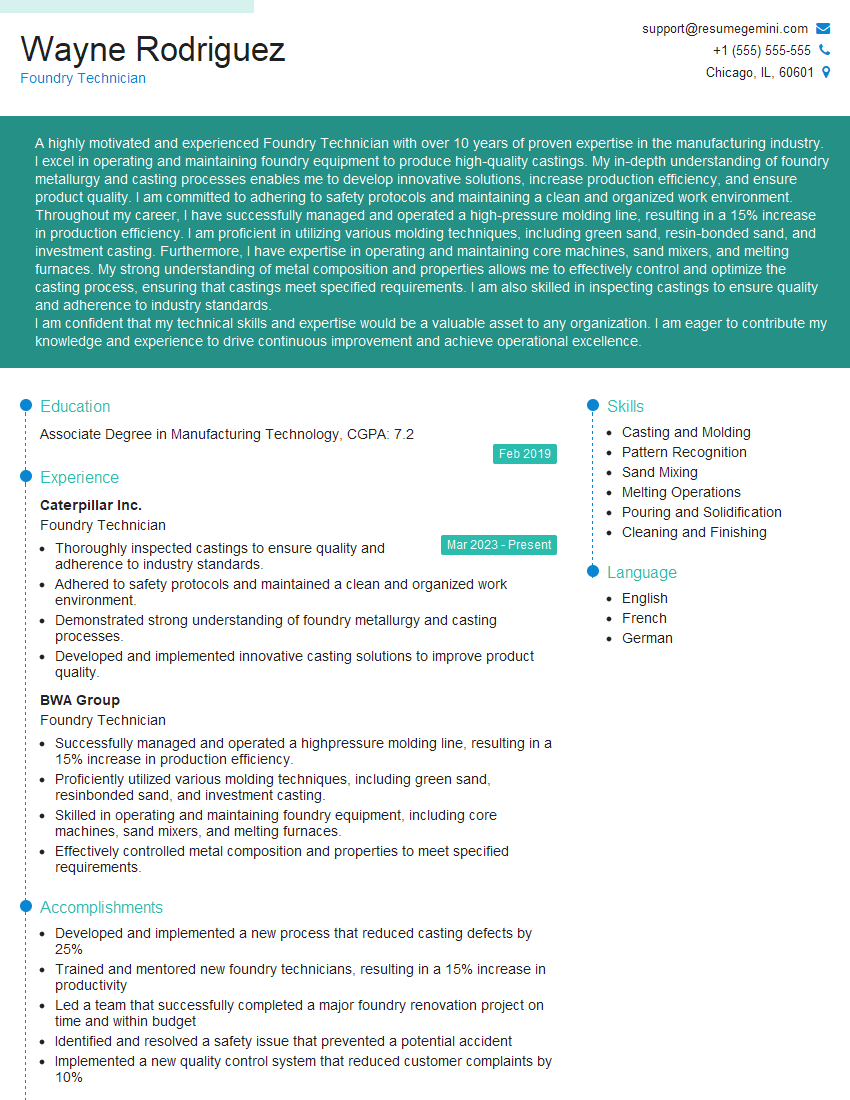
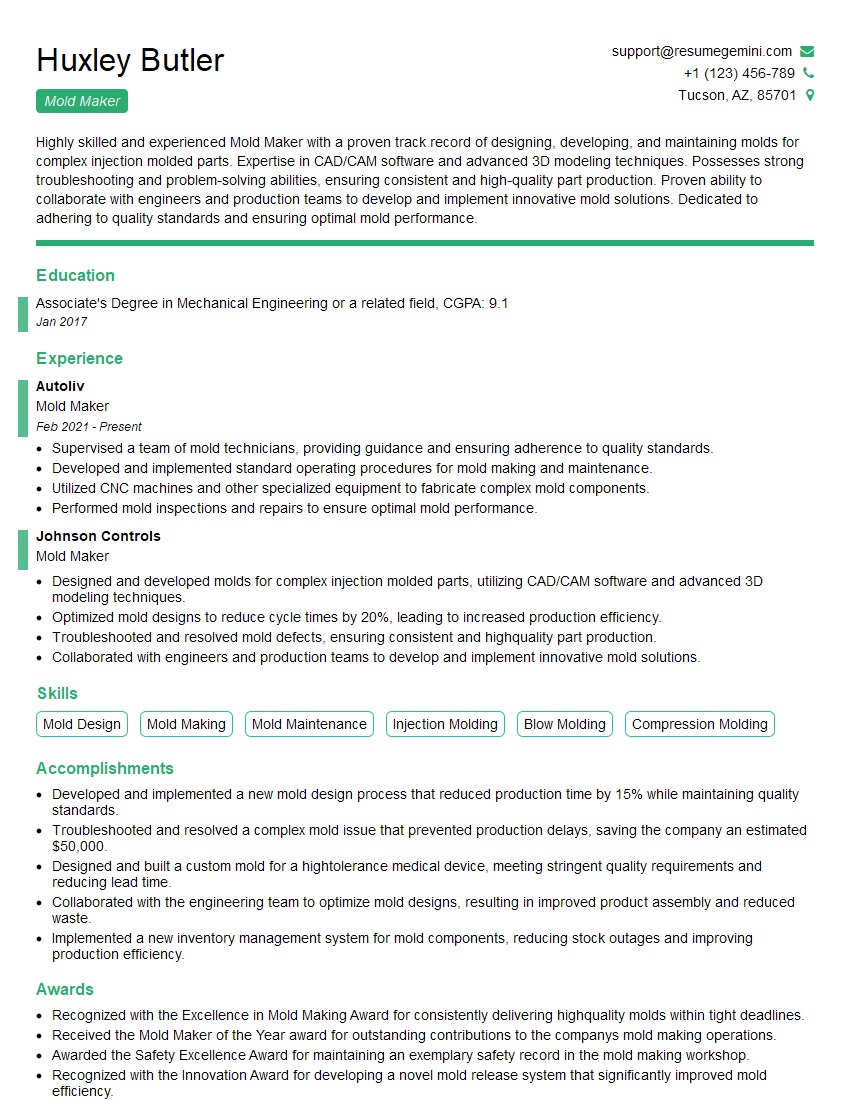
Mastering specimen casting opens doors to exciting career opportunities in diverse industries, offering excellent prospects for growth and advancement. A strong resume is your key to unlocking these opportunities. Creating an ATS-friendly resume is crucial to get your application noticed by recruiters. We highly recommend using ResumeGemini to build a professional and effective resume that highlights your skills and experience in specimen casting. ResumeGemini provides examples of resumes tailored to the Specimen Casting field to help guide you through the process. Invest time in crafting a compelling resume – it’s your first impression and a vital step in your career journey.
Explore more articles
Users Rating of Our Blogs
Share Your Experience
We value your feedback! Please rate our content and share your thoughts (optional).
What Readers Say About Our Blog
Really detailed insights and content, thank you for writing this detailed article.
IT gave me an insight and words to use and be able to think of examples