Are you ready to stand out in your next interview? Understanding and preparing for Sports Psychology for Tennis Players interview questions is a game-changer. In this blog, we’ve compiled key questions and expert advice to help you showcase your skills with confidence and precision. Let’s get started on your journey to acing the interview.
Questions Asked in Sports Psychology for Tennis Players Interview
Q 1. Describe your experience working with tennis players on improving focus and concentration during matches.
Improving focus and concentration on the tennis court is crucial for success. My approach involves a multifaceted strategy combining mindfulness techniques, attention training exercises, and performance analysis.
Firstly, we work on mindfulness, teaching players to anchor themselves in the present moment. This involves focusing on their breath, body sensations, and the immediate task at hand – the point being played. We practice this through guided meditation and body scans, helping them to resist distractions and stay present.
Secondly, I utilize attention training exercises. These involve drills designed to improve selective attention, the ability to focus on relevant cues while ignoring distractions. For example, we might practice focusing solely on the ball’s trajectory during a serve, or the opponent’s body language before a crucial shot. This is often coupled with visualization to create a mental blueprint of successful focus during a match.
Finally, we analyze their performance using video analysis. This allows us to identify recurring patterns of distraction or lapses in concentration, and to pinpoint specific triggers in the game that lead to a loss of focus. This data-driven approach lets us create a personalized plan, addressing their unique challenges. For instance, one player might struggle with crowd noise, requiring specific techniques to manage that distraction. Another may falter after making an unforced error, necessitating resilience training and a mental reframing of mistakes.
Q 2. Explain your approach to helping tennis players manage pre-match anxiety and nerves.
Pre-match anxiety is a common challenge for tennis players. My approach is holistic and focuses on building both psychological resilience and effective coping mechanisms.
I start by helping players identify their individual anxiety triggers and the specific physical and emotional responses they experience (e.g., rapid heartbeat, negative self-talk). Once identified, we can start to develop strategies to manage them.
We use a combination of techniques, including relaxation exercises (deep breathing, progressive muscle relaxation), cognitive restructuring (challenging negative thoughts and replacing them with more positive and realistic ones), and visualization. Visualization helps them mentally rehearse the match successfully, reducing anxiety by building confidence in their ability to perform under pressure.
Furthermore, I teach players self-compassion techniques, encouraging them to treat themselves kindly and to acknowledge that feeling nervous is normal. This approach differs from simply trying to eliminate anxiety; it’s about learning to manage it effectively and turning it into positive energy. For example, instead of viewing nerves as a weakness, we reframe them as a sign of passion and engagement, focusing on channeling that energy into a powerful performance.
Q 3. How do you assess a tennis player’s mental strengths and weaknesses?
Assessing a tennis player’s mental strengths and weaknesses is a crucial first step in developing a personalized training plan. My assessment involves multiple methods, ensuring a comprehensive evaluation.
I begin with detailed interviews, exploring their past experiences, current challenges, and self-perceptions on the court. This qualitative data helps me understand their mental landscape. I then use standardized psychological questionnaires to measure specific traits such as self-esteem, self-efficacy (belief in one’s ability), anxiety levels, and coping strategies. These questionnaires provide a quantifiable measure of their mental profile.
Finally, I observe their performance during practice and matches. This observational data helps me see how their mental game manifests on the court – their reactions to success and failure, their ability to handle pressure, and their communication style. By integrating these three sources of information – interviews, questionnaires, and observation – I get a detailed picture of their mental strengths and weaknesses, paving the way for targeted interventions.
Q 4. What techniques do you use to enhance self-confidence and self-belief in tennis players?
Building self-confidence and self-belief is a cornerstone of success in tennis. My strategies focus on both cognitive and behavioral techniques.
On the cognitive side, we use positive self-talk and cognitive restructuring. This involves replacing negative self-statements (e.g., ‘I’m going to lose’) with more positive and realistic ones (e.g., ‘I’m going to give my best’). We also work on identifying and challenging unhelpful thought patterns, replacing catastrophic thinking with more balanced perspectives.
Behaviorally, we work on setting achievable goals, celebrating successes, no matter how small, and analyzing failures constructively, focusing on learning rather than self-criticism. Keeping a success journal, where players record their accomplishments and positive experiences, can be a powerful tool for building confidence over time. Finally, practicing mindfulness and focusing on the present moment helps players avoid getting caught up in negative self-evaluation and build a sense of self-acceptance and self-efficacy.
I often use goal-setting strategies using the SMART criteria (Specific, Measurable, Achievable, Relevant, Time-bound). For instance, instead of a vague goal like ‘improve my serve,’ a SMART goal might be ‘Increase my first-serve percentage by 5% in the next month by focusing on my toss and footwork.’ This framework ensures clear, achievable, and measurable progress, boosting confidence with each milestone achieved.
Q 5. How would you address the issue of choking under pressure in a tennis player?
Choking under pressure is a performance impairment caused by excessive anxiety. My approach involves a combination of techniques to address both the physiological and psychological aspects.
We start by identifying the situations that trigger choking. It might be specific game points, facing a highly ranked opponent, or playing in front of a large crowd. Once identified, we work on developing specific coping strategies for those specific situations.
This includes practicing pressure situations in training, gradually increasing the level of pressure to build resilience. We also implement relaxation techniques (breathing exercises, progressive muscle relaxation) to manage physiological arousal during high-pressure moments. Cognitive restructuring is crucial; we help players replace negative thoughts (‘I’m going to fail’) with positive self-statements (‘I’ve practiced this, I can handle it’) and focus on the process rather than the outcome.
Furthermore, we develop pre-shot routines to promote focus and automaticity, reducing the cognitive load during critical moments. The idea is to create a predictable sequence of actions that allows the player to perform without consciously thinking about each step. This helps them avoid overthinking and prevents the cycle of self-doubt and performance impairment common in choking situations. Finally, we teach them to accept mistakes as part of the game and focus on learning from them, which prevents negative rumination and allows them to regain composure faster.
Q 6. Explain your understanding of imagery and visualization techniques and their application in tennis.
Imagery and visualization are powerful mental training tools that can significantly enhance performance in tennis. They involve creating vivid mental images of successful actions and outcomes.
I guide players through various visualization techniques, such as seeing themselves hitting perfect serves, executing precise volleys, or winning crucial points. We work on making these images as realistic as possible – engaging all five senses (sight, sound, smell, touch, and taste) to maximize their impact.
We use different types of imagery: ‘outcome imagery’ (visualizing the outcome of a point or match), ‘process imagery’ (visualizing the steps involved in executing a shot or movement), and ‘kinesthetic imagery’ (feeling the sensations of performing the action). We tailor the imagery exercises to address specific skills or situations, such as improving the serve or developing composure during pressure points.
For example, a player struggling with their serve might visualize themselves hitting a perfect serve with a powerful toss, a smooth swing, and the satisfying sound and feel of the ball landing in the service box. The more realistic and vivid the imagery, the more effective it will be in enhancing motor skills, building confidence, and reducing anxiety.
Q 7. How do you help tennis players develop effective pre-competition routines?
Developing effective pre-competition routines is essential for optimizing performance. A well-structured routine helps athletes manage anxiety, enhance focus, and build confidence.
I work with players to create personalized pre-competition routines that are consistent and predictable. This provides a sense of control and reduces uncertainty, which can be a major source of anxiety. These routines are not rigid but flexible enough to adapt to different circumstances.
A typical routine might include elements like: warm-up exercises (both physical and mental), review of game strategy, visualization of key points or matches, and relaxation techniques. The key is to create a routine that is individually tailored to the player’s personality and preferences.
For instance, some players might prefer a quiet and contemplative warm-up, while others might prefer a more energetic and social one. The routine’s timing and length should also be personalized to fit individual needs. Finally, we emphasize the importance of consistency in adhering to the routine. Consistent execution fosters a sense of control, calm, and readiness, enhancing performance by reducing pre-match anxiety and improving focus on the court.
Q 8. Describe your experience with goal setting strategies for tennis players.
Goal setting is crucial for tennis players, providing direction and motivation. I utilize a SMART goals framework – Specific, Measurable, Achievable, Relevant, and Time-bound. We collaboratively identify short-term and long-term goals, breaking down larger aspirations into smaller, manageable steps. For example, instead of a vague goal like ‘improve my serve,’ we might set a SMART goal such as ‘Increase my first-serve percentage to 65% by the end of the month by focusing on consistent toss and contact point.’ This allows for progress tracking and prevents feelings of overwhelm. We also consider process goals (e.g., practicing my serve technique three times a week) alongside outcome goals (e.g., winning a specific tournament). This balanced approach fosters both skill development and performance success.
Q 9. How would you work with a tennis player struggling with burnout or overtraining?
Burnout and overtraining are significant challenges. My approach involves a multi-pronged strategy. First, we assess the player’s training regimen, sleep patterns, nutrition, and overall lifestyle to identify potential stressors. Then, we implement strategies to reduce training volume and intensity gradually. We might incorporate active recovery methods like light jogging or swimming, and prioritize proper rest and sleep. I also use relaxation techniques such as mindfulness meditation and progressive muscle relaxation to help manage stress and anxiety. Crucially, we address the mental aspects, focusing on setting realistic expectations, promoting self-compassion, and encouraging them to prioritize their well-being. Reframing their perspective on success – from solely performance-based to encompassing overall health and enjoyment of the game – is vital for long-term sustainability. In severe cases, consultation with a sports physician or other healthcare professional may be necessary.
Q 10. How do you help tennis players manage their emotions during matches?
Managing emotions on the court is essential for consistent performance. I teach players techniques rooted in mindfulness and self-awareness. We practice identifying and labeling their emotions (e.g., ‘I’m feeling frustrated’), separating the emotion from their performance, and developing coping strategies for negative emotions. This often involves deep breathing exercises, positive self-talk, and refocusing techniques. We also work on pre-match routines to build confidence and manage pre-game anxiety. Visualization techniques, where players mentally rehearse successful scenarios, are highly effective. Finally, I emphasize the importance of self-compassion. Tennis is emotionally challenging; allowing for self-forgiveness after mistakes and maintaining a focus on improvement rather than solely results, fosters resilience.
Q 11. What strategies do you use to improve a tennis player’s resilience?
Resilience is the ability to bounce back from setbacks. We build resilience through a combination of mental skills training and strategic practice. This includes exposure to challenging situations in a controlled environment, helping the player learn coping strategies and building their confidence in handling adversity. We use failure analysis, where players learn from their mistakes rather than dwelling on them. This helps to prevent negative self-talk and fosters a growth mindset. We also focus on building intrinsic motivation, ensuring the player values the game for its inherent enjoyment, making them less vulnerable to external pressures and setbacks. Positive self-talk, visualization of success even in adverse scenarios, and establishing a strong support system are also vital components.
Q 12. Explain your understanding of self-talk and its impact on tennis performance.
Self-talk is the internal dialogue we have with ourselves. It can be positive, negative, or neutral. Negative self-talk (‘I’m going to lose this point’, ‘I’m terrible at serving’) hinders performance by creating self-doubt and anxiety. Positive self-talk (‘I can do this’, ‘I’m focusing on my technique’) boosts confidence and improves focus. We work on identifying and replacing negative self-talk with positive and constructive alternatives. For instance, if a player makes a mistake, instead of saying ‘I’m so stupid,’ we might reframe it as ‘That wasn’t my best shot, let’s focus on the next point.’ This requires consistent effort and practice, often using journaling or mindfulness to become more aware of one’s inner dialogue.
Q 13. How do you help tennis players develop a positive mindset?
Developing a positive mindset is a gradual process. We start by identifying and challenging negative thought patterns. We use cognitive restructuring techniques to replace these with more positive and realistic ones. This includes reframing setbacks as learning opportunities and emphasizing effort and progress rather than solely focusing on outcomes. Gratitude exercises, focusing on what they’re thankful for both on and off the court, can boost positive emotions. Visualization of success, focusing on positive self-talk, and regularly celebrating small victories all contribute to building a positive mindset. Maintaining a balanced perspective, recognizing both strengths and areas for improvement, is key to sustainable optimism.
Q 14. Describe your experience using biofeedback techniques to enhance tennis performance.
Biofeedback is a valuable tool. It involves using sensors to measure physiological responses like heart rate, muscle tension, and skin conductance. This provides the player with real-time feedback on their physiological state, enabling them to learn how to control their arousal levels. For example, we might use biofeedback to help a player manage pre-match anxiety by teaching them relaxation techniques while monitoring their heart rate. The goal is to develop conscious control over these physiological responses, translating into improved focus, concentration, and performance under pressure. It’s important to note biofeedback is not a standalone solution; it’s most effective when integrated with other mental skills training techniques.
Q 15. How would you address a player’s negative self-perception impacting their performance?
Negative self-perception is a significant hurdle for many tennis players. It manifests as self-doubt, fear of failure, and a tendency to focus on mistakes rather than successes. Addressing this requires a multifaceted approach combining cognitive restructuring, behavioral activation, and self-compassion techniques.
Cognitive Restructuring: We challenge negative thoughts by identifying and reframing them. For instance, if a player thinks ‘I always double fault at crucial moments,’ we’d explore the evidence for that statement. Perhaps they double faulted only twice in the last ten matches. We then replace the negative thought with a more balanced one, like ‘I’m working on my serve consistency, and I’m improving with each practice.’
Behavioral Activation: This involves setting small, achievable goals to build confidence and experience success. It could be mastering a specific serve technique, consistently hitting the target during practice drills, or winning a specific point during a match. Small wins lead to larger confidence boosts.
Self-Compassion: Tennis involves setbacks. We help players develop self-compassion by encouraging self-kindness and reminding them that everyone makes mistakes. It’s about learning from errors, not dwelling on them. We might utilize mindfulness exercises to help manage self-criticism.
For example, I worked with a junior player who constantly berated herself after missed shots. We used a combination of journaling to track negative thoughts, positive self-talk techniques during practice, and celebrating small victories. Over time, her self-perception shifted, leading to improved on-court performance and a more positive attitude.
Career Expert Tips:
- Ace those interviews! Prepare effectively by reviewing the Top 50 Most Common Interview Questions on ResumeGemini.
- Navigate your job search with confidence! Explore a wide range of Career Tips on ResumeGemini. Learn about common challenges and recommendations to overcome them.
- Craft the perfect resume! Master the Art of Resume Writing with ResumeGemini’s guide. Showcase your unique qualifications and achievements effectively.
- Don’t miss out on holiday savings! Build your dream resume with ResumeGemini’s ATS optimized templates.
Q 16. How do you tailor your coaching approach to different personality types and learning styles within tennis?
Adapting my coaching style to diverse personalities and learning styles is crucial for effective sports psychology intervention. I employ a variety of techniques to suit individual needs:
Personality Assessments: I often begin with personality assessments (like the Myers-Briggs Type Indicator or similar tools) to gain insight into a player’s strengths, weaknesses, and preferred communication styles. This helps me tailor my approach. For example, an introverted player might benefit from more one-on-one sessions, while an extroverted player might thrive in group settings.
Learning Style Preferences: I assess learning styles (visual, auditory, kinesthetic). A visual learner might benefit from diagrams and videos illustrating mental skills techniques, while a kinesthetic learner may find role-playing and physical exercises more effective.
Personalized Interventions: Based on the assessment, I personalize strategies. For a highly anxious player, I might focus on relaxation techniques and mindfulness. A player struggling with motivation might benefit from goal-setting strategies and positive reinforcement.
For instance, I once worked with two players on improving their focus. One, a visual learner, responded well to imagery exercises, while the other, a kinesthetic learner, found success through guided meditation and physical movement during practice breaks to regain composure.
Q 17. What is your approach to working with coaches and support staff to create a holistic training environment?
Collaboration is vital in creating a holistic training environment. I work closely with tennis coaches, physiotherapists, and strength and conditioning coaches to ensure a unified and supportive approach to player development.
Regular Communication: I maintain open communication with the entire support team. This ensures consistency in messaging and avoids conflicting advice for the athlete.
Shared Goals and Objectives: We collaborate on setting clear, measurable goals, both on and off the court. This may involve integrating mental skills training into the physical training program.
Integrated Approach: Mental and physical training are interwoven. For instance, if a player is experiencing physical fatigue, I might help manage the mental strain associated with it by teaching stress-management techniques. The physical coach can help with appropriate rest and recovery strategies.
In a recent collaboration, I worked with a player’s coach and physiotherapist to address her recurring shoulder injury. We found that her anxiety about the injury was exacerbating the problem. By integrating relaxation techniques and positive self-talk into her rehabilitation, we saw improvements in both her physical recovery and her mental state.
Q 18. Explain your understanding of the role of motivation and intrinsic drive in tennis performance.
Intrinsic motivation, the drive that comes from within, is the cornerstone of sustained high performance in tennis. It’s about finding joy and satisfaction in the game itself, rather than relying solely on external rewards like trophies or prize money.
Understanding Motivation: I help players identify their intrinsic motivators – what aspects of tennis they truly enjoy. This might be the challenge of improving their serve, the thrill of competition, the satisfaction of mastering a difficult shot, or the camaraderie with teammates.
Goal Setting: We collaborate on setting both short-term and long-term goals, making sure they align with intrinsic values. These goals should be challenging yet attainable, providing a sense of accomplishment and encouraging further effort.
Autonomy Support: I encourage player autonomy by giving them choices in their training plans and the strategies they use. This fosters a sense of ownership and increases commitment.
A successful example involves working with a player who felt burned out from the pressure of professional tennis. We redirected their focus towards the intrinsic aspects of the game – the enjoyment of practicing, improving their skills, and playing for the love of the sport. The shift in focus revitalized their passion and enhanced their performance.
Q 19. How do you monitor a player’s progress and measure the effectiveness of your interventions?
Monitoring progress and measuring the effectiveness of my interventions is an ongoing process. I employ a variety of methods:
Performance Tracking: We track on-court performance data like match results, win percentages, serve statistics, and error rates. This provides objective data on improvement.
Self-Report Measures: Players complete questionnaires and rating scales assessing their confidence, anxiety levels, and overall well-being. These offer subjective insights into their mental state.
Behavioral Observation: During practices and matches, I observe player behavior to identify patterns related to mental toughness, coping strategies, and emotional regulation.
Regular Feedback Sessions: We have regular sessions to discuss progress, challenges, and adjustments needed in the intervention strategy. The player’s feedback is invaluable.
For instance, I worked with a player experiencing high pre-match anxiety. After implementing relaxation techniques and visualization exercises, we tracked their heart rate variability before matches, self-reported anxiety levels, and their on-court performance. The data showed a significant decrease in anxiety and a corresponding improvement in performance, demonstrating the effectiveness of the intervention.
Q 20. Describe your experience working with players at different skill levels (e.g., junior, collegiate, professional).
My experience spans various skill levels, from junior players to collegiate athletes and professionals. Each level presents unique challenges and opportunities:
Junior Players: At this level, the focus is on building a solid foundation for mental skills. It’s about instilling positive habits, managing early anxieties, and developing a love for the game. Challenges include balancing competitive pressures with age-appropriate development.
Collegiate Players: The demands intensify here with academic pressures and intense competition. The focus shifts to optimizing performance under pressure, managing stress, and setting long-term goals.
Professional Players: These athletes face extreme pressure, and psychological resilience is paramount. Work focuses on peak performance strategies, managing setbacks, maintaining motivation, and dealing with the intense scrutiny of professional tennis.
The common thread is adapting my strategies to the specific needs of each athlete. The underlying principles – fostering self-awareness, building resilience, and maximizing potential – remain consistent, but the implementation varies significantly depending on the player’s developmental stage and context.
Q 21. How do you maintain confidentiality and ethical standards in your work with tennis athletes?
Maintaining confidentiality and ethical standards is paramount. I adhere strictly to professional guidelines:
Informed Consent: I obtain informed consent from every athlete before commencing any intervention. This means they understand the nature of the work, the risks and benefits, and their right to withdraw at any time.
Confidentiality: I treat all information shared by athletes as strictly confidential. I only disclose information with their explicit permission or when legally required.
Professional Boundaries: I maintain clear professional boundaries, avoiding dual relationships and conflicts of interest.
Supervision and Consultation: I regularly engage in peer supervision and consultation to ensure ethical practice and continuously enhance my skills.
My commitment to ethical practice fosters trust and ensures that the athlete-sports psychologist relationship is built on mutual respect and confidence.
Q 22. Explain your familiarity with relevant research and literature in sports psychology pertaining to tennis.
My familiarity with sports psychology research in tennis is extensive. I regularly review peer-reviewed journals like the Journal of Sport & Exercise Psychology and the International Journal of Sport Psychology, focusing on studies related to tennis-specific performance anxieties, motivation, attentional control, and mental imagery techniques. I’m particularly interested in research on the impact of pressure situations, such as tie-breaks and championship matches, on players’ cognitive and emotional processes. For example, I’ve studied extensively the work on choking under pressure and the different coping mechanisms athletes utilize. I also keep abreast of current research on mindfulness and its application in enhancing performance and resilience in tennis.
Furthermore, I’m familiar with the works of prominent researchers in this field, including those who have developed and empirically tested interventions such as imagery training, self-talk modification, and stress management techniques specific to the demands of the sport. This broad knowledge base allows me to tailor my approach to the unique needs and challenges of each individual player.
Q 23. How do you incorporate technology (e.g., apps, wearables) into your mental training program for tennis players?
Technology plays a vital role in my mental training programs. I utilize several apps and wearables to enhance the effectiveness of my interventions. For example, apps like Headspace or Calm can be incorporated to guide players through mindfulness exercises, promoting relaxation and focus. Wearables, like smartwatches that track sleep patterns and heart rate variability, provide valuable data that helps me understand the player’s physical and mental state. This data offers objective insights into recovery and stress levels, allowing for adjustments to the training regimen.
Beyond these readily available tools, I also incorporate personalized apps that track practice performance and identify areas needing improvement from a mental perspective. For instance, we might track the frequency of negative self-talk during matches or the consistency of pre-shot routines. This data-driven approach allows for a more precise and targeted mental training strategy, providing concrete feedback and promoting accountability. It helps both the player and myself identify patterns and make positive adjustments over time.
Q 24. Describe your understanding of the impact of sleep, nutrition, and recovery on a tennis player’s mental state.
Sleep, nutrition, and recovery are fundamental pillars of a tennis player’s mental well-being and performance. Insufficient sleep leads to impaired cognitive function, reduced concentration, increased irritability, and heightened emotional reactivity – all detrimental to performance. Similarly, poor nutrition can lead to energy crashes, mood swings, and diminished mental resilience. The body and mind are deeply interconnected; neglecting physical needs invariably affects mental fortitude.
Optimal recovery, including adequate rest, proper hydration, and effective injury management, is crucial for maintaining a positive mental outlook. Chronic fatigue or lingering injuries can significantly increase stress and negatively impact self-confidence and motivation. I work closely with my clients, often in conjunction with their physical trainers and nutritionists, to develop personalized plans that ensure they prioritize sleep, consume a balanced diet, and employ effective recovery strategies to optimize both their physical and mental capabilities. This holistic approach ensures that every aspect of their well-being contributes to peak performance.
Q 25. How would you handle a situation where a player is experiencing a significant performance slump?
Addressing a significant performance slump requires a systematic and empathetic approach. First, I’d conduct a thorough assessment, examining both technical and mental factors. This involves reviewing recent matches, analyzing training logs, and engaging in open discussions with the player to understand their current feelings, thoughts, and beliefs. It’s vital to identify if the slump is rooted in technical issues, mental blocks, physical fatigue, or a combination of these factors.
Next, I would implement a tailored intervention plan that may include techniques such as: modifying self-talk to foster a more positive and encouraging inner dialogue; improving pre-shot routines to enhance focus and reduce anxiety; utilizing imagery techniques to visualize successful outcomes; and incorporating mindfulness practices to improve present moment awareness and reduce overthinking. It’s important to emphasize the process over the outcome, focusing on consistent effort and skill development rather than solely on results. Progress takes time, and patience is essential. Depending on the severity and cause of the slump, collaboration with other professionals like physical therapists or sports medicine doctors might be necessary.
Q 26. What are some of the common challenges faced by tennis players from a mental perspective and how do you address them?
Tennis players commonly face several mental challenges. Pre-performance anxiety, manifesting as nervousness and excessive worry before matches, is extremely prevalent. Self-doubt and lack of confidence can cripple performance, especially after a series of losses. Frustration and anger management are also critical areas, as tennis involves moments of high pressure and potential for errors. Maintaining focus and concentration throughout a match, particularly during long rallies or challenging points, is another key challenge. Lastly, dealing with pressure and expectations, from coaches, parents, or even self-imposed, can be incredibly difficult.
I address these challenges through a combination of techniques such as cognitive restructuring (changing negative thought patterns), relaxation training (progressive muscle relaxation, deep breathing), mindfulness practices (cultivating present-moment awareness), goal setting (establishing realistic and achievable targets), and performance enhancement strategies (imagery, self-talk). The specific approach is customized to each individual, depending on their unique needs and challenges.
Q 27. How do you build rapport and trust with your tennis player clients?
Building rapport and trust is paramount. I initiate this process by actively listening to my clients, showing genuine interest in their experiences both on and off the court. I avoid judgmental language and create a safe space for open and honest communication. I approach each player as an individual, acknowledging their unique personality, strengths, and challenges. This personalized approach shows respect and demonstrates a genuine desire to understand their perspectives. I’m careful not to impose my ideas but instead to collaboratively develop strategies that align with their goals and values.
Another crucial aspect is demonstrating competence. I’m transparent about my approach and provide regular feedback based on data and observations. Celebrating both big and small victories fosters confidence and strengthens the client-professional bond. Maintaining confidentiality and respecting boundaries are fundamental to establishing and preserving trust. Essentially, I strive to create a collaborative partnership where both the player and I work together to achieve their goals.
Q 28. Describe your approach to integrating mental skills training into the overall tennis training program.
Integrating mental skills training into the overall tennis training program is essential for holistic development. I advocate for a seamless integration, not a separate entity. Instead of scheduling separate mental training sessions, I aim to embed mental skills practice directly within their physical training sessions. For example, I might incorporate mindfulness exercises during warm-ups to enhance focus and reduce anxiety. I also use physical drills as opportunities to practice self-talk strategies or to improve attentional control. Furthermore, I provide feedback and guidance during match simulations to promote better emotional regulation and decision-making under pressure.
This holistic approach ensures consistency and reinforces the importance of mental skills as an integral component of the overall game. The coach and I work in tandem, sharing information and coordinating our approaches to provide the player with a comprehensive and unified training plan. By integrating mental skills naturally into their routines, the process becomes less intimidating and more readily applicable during actual matches.
Key Topics to Learn for Sports Psychology for Tennis Players Interview
- Mental Toughness & Resilience: Understanding the psychological factors contributing to a player’s ability to overcome setbacks, pressure, and adversity. Practical application: Developing tailored mental training programs to improve focus and composure during matches.
- Goal Setting & Motivation: Exploring effective goal-setting strategies and motivational techniques for optimizing performance. Practical application: Designing personalized performance goals and implementing strategies to maintain motivation throughout training and competition.
- Imagery & Visualization: The role of mental imagery in enhancing performance and skill acquisition. Practical application: Coaching athletes in effective visualization techniques to improve stroke mechanics and strategic game planning.
- Self-Talk & Cognitive Restructuring: Identifying and modifying negative self-talk patterns to enhance confidence and self-efficacy. Practical application: Guiding players in developing positive self-talk strategies and reframing negative thoughts into constructive ones.
- Anxiety & Stress Management: Understanding the impact of anxiety and stress on tennis performance and developing coping mechanisms for managing these challenges. Practical application: Implementing relaxation techniques (e.g., mindfulness, breathing exercises) to reduce pre-match anxiety and improve performance under pressure.
- Team Dynamics & Communication (if applicable): Exploring the dynamics of team interactions and effective communication strategies within a coaching or support team environment. Practical application: Facilitating effective communication between coaches, players, and support staff to enhance collaboration and team cohesion.
- Performance Enhancement Techniques: Exploring various techniques used to enhance performance, such as mindfulness, meditation, and neurofeedback. Practical application: Selecting and implementing appropriate techniques based on individual player needs and preferences.
Next Steps
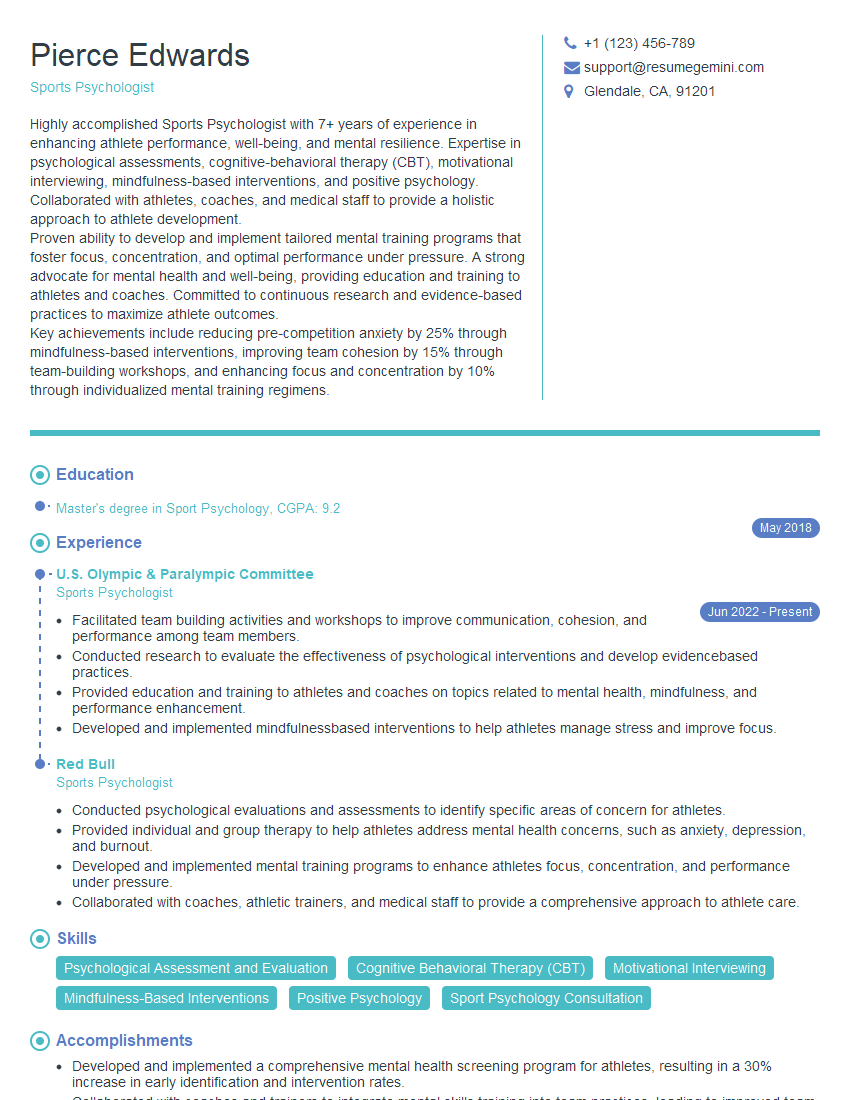
Mastering Sports Psychology for Tennis Players significantly enhances your career prospects, opening doors to rewarding roles within high-performance coaching, athlete support, and sports science. To maximize your job search success, focus on crafting an ATS-friendly resume that highlights your skills and experience effectively. ResumeGemini is a trusted resource that can help you build a professional and impactful resume. ResumeGemini provides examples of resumes tailored to Sports Psychology for Tennis Players, ensuring your application stands out. Take the next step towards your dream career by leveraging the power of a well-crafted resume.
Explore more articles
Users Rating of Our Blogs
Share Your Experience
We value your feedback! Please rate our content and share your thoughts (optional).
What Readers Say About Our Blog
Really detailed insights and content, thank you for writing this detailed article.
IT gave me an insight and words to use and be able to think of examples