Interviews are opportunities to demonstrate your expertise, and this guide is here to help you shine. Explore the essential Stability and Control Analysis interview questions that employers frequently ask, paired with strategies for crafting responses that set you apart from the competition.
Questions Asked in Stability and Control Analysis Interview
Q 1. Explain the concept of stability derivatives.
Stability derivatives are dimensionless coefficients that quantify the changes in aerodynamic forces and moments in response to changes in aircraft motion parameters. Think of them as measuring how much the aircraft’s forces and moments will change if you nudge it slightly. They are crucial for understanding and predicting an aircraft’s response to disturbances.
For example, the derivative CLα (pronounced ‘C-L-alpha’) represents the change in lift coefficient (CL) for a given change in angle of attack (α). A positive CLα indicates that increasing the angle of attack increases the lift, which is generally desirable for stability.
Other important stability derivatives include Cmα (pitching moment due to angle of attack), CYβ (side force due to sideslip angle), and Cnβ (yawing moment due to sideslip angle). These derivatives are used in the equations of motion to model the aircraft’s dynamics and analyze its stability characteristics.
Q 2. Describe the difference between static and dynamic stability.
Static stability describes the aircraft’s tendency to return to its equilibrium state after a small disturbance. Imagine a pendulum: if you displace it slightly, a statically stable pendulum will swing back to its resting position. Similarly, a statically stable aircraft will tend to return to its original flight path after a small gust of wind or control input.
Dynamic stability, on the other hand, concerns how the aircraft returns to its equilibrium. A statically stable aircraft might be dynamically unstable if its oscillations grow larger over time, like a poorly damped pendulum that swings wildly before eventually settling. Dynamic stability describes the nature of this return: is it smooth and rapid (well-damped), oscillatory (underdamped), or divergent (unstable)?
An aircraft can be statically stable but dynamically unstable, making dynamic stability analysis essential for safe flight. A good analogy is a marble in a bowl (static stability) versus a marble in a saddle (static instability).
Q 3. What are the methods for determining aircraft stability?
Several methods exist for determining aircraft stability, ranging from simple stability derivatives analysis to complex computational fluid dynamics (CFD) simulations.
- Stability Derivatives Analysis: This involves calculating stability derivatives from wind tunnel testing or theoretical aerodynamic models and substituting them into the equations of motion to analyze stability characteristics. This is a classical approach, relatively inexpensive, and provides good insight into the physics.
- Linearized Equations of Motion: The aircraft’s equations of motion are linearized around an equilibrium flight condition. This simplifies the analysis and allows for the application of linear system theory to determine stability and response characteristics. Eigenvalue analysis is often employed to determine stability.
- Computational Fluid Dynamics (CFD): CFD simulations provide a detailed prediction of aerodynamic forces and moments and are used increasingly for stability and control analysis, especially for complex configurations. This method is computationally intensive but very accurate.
- Flight Testing: Flight testing is essential for validating theoretical predictions and identifying any unmodeled dynamics. This involves carefully controlled maneuvers to observe the aircraft’s response and infer stability characteristics.
The choice of method depends on the desired accuracy, available resources, and complexity of the aircraft configuration.
Q 4. Explain the role of control surfaces in aircraft stability and control.
Control surfaces, such as ailerons, elevators, and rudder, are crucial for both stability and control of an aircraft. They provide the means for the pilot (or autopilot) to manipulate the aircraft’s attitude and flight path.
In terms of stability: Some control surfaces contribute to inherent stability. For example, a dihedral angle (the upward tilt of the wings) induces a restoring moment in response to sideslip, enhancing lateral stability. Similarly, the horizontal tailplane contributes to longitudinal stability.
In terms of control: Control surfaces are the primary actuators used to maneuver the aircraft. Ailerons control roll, elevators control pitch, and the rudder controls yaw. These actuation mechanisms enable precise changes in the aircraft’s orientation.
It’s a delicate balance; while control surfaces are essential for maneuvering, excessive control surface deflections can destabilize an aircraft. This highlights the need for careful design of both the control system and airframe.
Q 5. How do you analyze the longitudinal and lateral-directional stability of an aircraft?
Longitudinal and lateral-directional stability are analyzed separately due to their relative independence. This simplification is possible through the assumption of small perturbations from a trimmed flight condition.
Longitudinal stability involves motion in the pitching plane (pitch, angle of attack, airspeed). Analysis typically focuses on the pitching moment coefficient, Cm, and its dependence on angle of attack and pitching velocity. A stable aircraft will exhibit a restoring moment that returns it to its trimmed flight condition after a disturbance.
Lateral-directional stability involves motion in the yawing and rolling planes (roll, yaw, sideslip angle). Analysis often involves examining the yawing and rolling moment coefficients (Cn and Cl) in response to sideslip angle and roll rate. Stable lateral-directional behavior requires self-correcting moments that counter deviations from the equilibrium flight path.
Both analyses usually involve the use of linearized equations of motion and eigenvalue analysis to determine the stability characteristics (eigenvalues determine damping and frequency of motion).
Q 6. Describe the process of designing a control system for stability augmentation.
Designing a stability augmentation system (SAS) involves a multi-step process aimed at improving the aircraft’s handling qualities and/or stability. This is often necessary when an aircraft’s inherent stability is insufficient for good handling qualities or safe flight.
1. Define Requirements: This involves specifying the desired handling qualities, damping characteristics, and robustness to uncertainties. These requirements are dictated by pilot handling qualities specifications (e.g., MIL-F-8785C) and safety considerations.
2. Develop a Mathematical Model: An accurate representation of the aircraft’s dynamics is needed. This might involve linearized equations of motion with suitable stability derivatives.
3. Control Law Design: A suitable control law is designed to generate control surface commands based on aircraft state feedback (e.g., angle of attack, pitch rate). Common methods include classical control techniques (PID, lead-lag compensation) or modern control techniques (LQG, H-infinity).
4. Simulation and Analysis: The designed control system is tested extensively through simulations to verify performance and robustness under various conditions.
5. Implementation and Testing: The control law is implemented in hardware (typically using flight computers) and tested in flight tests to ensure that the system meets the specified requirements.
Q 7. Explain the concept of feedback control and its application in stability and control systems.
Feedback control is fundamental to stability augmentation systems and many other aircraft control systems. It involves measuring the aircraft’s state (e.g., pitch angle, roll rate), comparing it to the desired state, and generating control inputs to reduce the difference (error).
Example: Consider a pitch attitude control system. A sensor measures the current pitch angle. This is compared to the desired pitch angle (the pilot’s input or the autopilot’s setpoint). If there’s a difference (error), the control system calculates the required elevator deflection to correct the pitch angle. This continuous measurement, comparison, and correction is the essence of feedback control.
The benefits of feedback control are numerous. It improves stability by actively compensating for disturbances and uncertainties. It enhances precision and responsiveness by reducing the error between the desired and actual aircraft state. Feedback control is essential for modern aircraft, enabling safe and efficient flight even in challenging conditions.
Q 8. What are the different types of control systems used in aerospace applications?
Aerospace applications utilize a variety of control systems, ranging from simple to highly complex designs. The choice depends on factors like the aircraft’s size, mission requirements, and desired level of automation. Some common types include:
- Classical Control Systems: These systems, often based on proportional-integral-derivative (PID) controllers, are relatively simple to design and implement. They are effective for controlling single-input, single-output (SISO) systems and are frequently used for tasks like altitude hold or airspeed regulation. Think of the autopilot in a small general aviation aircraft – a PID controller might manage altitude by adjusting the elevator.
- Modern Control Systems: These leverage more sophisticated techniques, including state-space methods, optimal control, and robust control theory. They are better suited for handling multi-input, multi-output (MIMO) systems and dealing with uncertainties and disturbances. For instance, a modern flight control system might manage multiple axes simultaneously (pitch, roll, yaw) while considering wind gusts and aircraft flexibility.
- Adaptive Control Systems: Designed to adjust their control parameters automatically in response to changing operating conditions. This is crucial for situations where the system dynamics are not precisely known beforehand or vary significantly during operation. Imagine an adaptive cruise control system adjusting its set speed and braking based on the traffic ahead.
- Nonlinear Control Systems: Necessary when dealing with inherently nonlinear systems. These often involve more complex control strategies like feedback linearization, sliding mode control, or model predictive control (MPC). For high-performance aircraft maneuvers, nonlinear controllers may be necessary to handle large angle-of-attack flight or highly coupled dynamics.
The choice of control system heavily relies on the specific aerospace application and its performance requirements.
Q 9. Discuss the challenges of controlling nonlinear systems.
Controlling nonlinear systems presents significant challenges compared to their linear counterparts. The main difficulties arise from:
- Lack of superposition and homogeneity: Linear systems obey the principles of superposition (the response to multiple inputs is the sum of the individual responses) and homogeneity (scaling the input scales the output proportionally). Nonlinear systems do not adhere to these principles, making analysis and design more complex.
- Difficulty in finding analytical solutions: Closed-form solutions for the response of nonlinear systems are often impossible to obtain, requiring numerical methods for analysis and simulation.
- Potential for chaotic behavior: Slight changes in initial conditions or parameters can lead to drastically different behaviors in nonlinear systems, making prediction and control challenging.
- Multiple equilibrium points: Nonlinear systems can have multiple stable, unstable, or semi-stable equilibrium points, making it difficult to guarantee the system will converge to the desired operating point.
To overcome these challenges, advanced nonlinear control techniques, such as feedback linearization, sliding mode control, or model predictive control are employed. These methods often rely on approximations or local linearizations to simplify the control design.
Q 10. How do you model and simulate the dynamics of a system?
Modeling and simulating system dynamics is crucial for understanding and controlling a system’s behavior. The process involves several key steps:
- System identification: Determining the mathematical relationships between the system’s inputs, outputs, and internal states. This might involve experimental data analysis, theoretical modeling, or a combination of both.
- Model development: Creating a mathematical representation of the system’s dynamics, often using differential equations or transfer functions. The complexity of the model depends on the system’s characteristics and the level of accuracy required. For example, a simple model might represent an aircraft’s longitudinal motion using a few key equations, while a more complex model might include many more degrees of freedom and effects.
- Simulation: Using numerical methods to solve the model’s equations and predict the system’s response to various inputs. Software tools like MATLAB/Simulink or specialized aerospace simulation packages are commonly used.
- Model validation: Comparing the simulation results with experimental data to assess the accuracy and reliability of the model. Discrepancies may necessitate model refinement or adjustment.
Consider a simple pendulum: We can model its dynamics using a second-order differential equation based on Newton’s laws. Simulating this equation gives us the pendulum’s angular position and velocity over time, allowing us to study its oscillatory behavior under various conditions.
Q 11. What are some common stability analysis techniques?
Stability analysis is fundamental in control systems. Several techniques are commonly used:
- Eigenvalue analysis: Examining the eigenvalues of the system’s state matrix to determine stability. A system is asymptotically stable if all eigenvalues have negative real parts.
- Routh-Hurwitz criterion: A algebraic method for determining the stability of a linear time-invariant system by examining the coefficients of its characteristic polynomial.
- Nyquist stability criterion: A frequency-domain method that analyzes the system’s open-loop frequency response to determine stability, considering the effect of feedback.
- Lyapunov stability theory: A powerful method for analyzing the stability of both linear and nonlinear systems. It’s particularly useful for systems where eigenvalue analysis is not directly applicable.
- Bode plots and gain/phase margins: These graphical methods provide insights into the system’s frequency response and robustness to variations in gain and phase.
The selection of a particular technique depends on the system’s complexity and the information available.
Q 12. Explain the concept of eigenvalues and eigenvectors in stability analysis.
Eigenvalues and eigenvectors are fundamental concepts in linear algebra and play a vital role in stability analysis. For a linear system represented by the state-space equation dx/dt = Ax, where x is the state vector and A is the system matrix, the eigenvalues (λ) are the solutions to the characteristic equation det(A - λI) = 0, where I is the identity matrix.
Each eigenvalue corresponds to an eigenvector (v), which satisfies the equation Av = λv. The eigenvalues represent the system’s natural frequencies, while the eigenvectors represent the directions of motion associated with these frequencies. In stability analysis, the real parts of the eigenvalues determine the stability of the system. If all eigenvalues have negative real parts, the system is asymptotically stable (it returns to equilibrium after a disturbance). If any eigenvalue has a positive real part, the system is unstable.
Imagine a mass-spring-damper system: the eigenvalues would represent the natural frequencies of oscillation and damping rates, revealing whether the system will oscillate indefinitely or eventually settle to rest.
Q 13. What is the Routh-Hurwitz criterion and how is it used?
The Routh-Hurwitz criterion provides a systematic algebraic method for determining the stability of a linear time-invariant system. It doesn’t require calculating eigenvalues directly, making it useful for higher-order systems. The criterion involves constructing a Routh array from the coefficients of the system’s characteristic polynomial. The polynomial is typically represented as:
a_n*s^n + a_{n-1}*s^{n-1} + ... + a_1*s + a_0 = 0Stability is determined by examining the first column of the Routh array. If all entries in the first column are positive, the system is stable; otherwise, it is unstable. The number of sign changes in the first column indicates the number of roots with positive real parts.
Example: Consider a characteristic polynomial s^3 + 2s^2 + 3s + 1 = 0. Constructing the Routh array will reveal whether the system is stable or not. If any negative values are encountered in the first column, it suggests the system is unstable. The method is particularly valuable for quick checks of system stability given the coefficients of the characteristic equation.
Q 14. What is the Nyquist stability criterion and how is it used?
The Nyquist stability criterion is a frequency-domain method used to analyze the stability of a closed-loop system by examining its open-loop frequency response. It’s particularly useful for systems with feedback, such as those commonly found in aerospace applications. The criterion involves plotting the open-loop frequency response on a complex plane (Nyquist plot). The plot shows the gain and phase shift of the system as a function of frequency.
Stability is determined by examining how many times the Nyquist plot encircles the critical point (-1, 0). The number of encirclements indicates the difference between the number of unstable poles in the closed-loop and open-loop transfer functions. If the plot does not encircle the critical point, the closed-loop system is stable. The number of clockwise encirclements represents the number of unstable poles in the closed loop system. This offers a visual insight into stability margins and the robustness of the feedback system.
For instance, analyzing the Nyquist plot of a flight control system allows engineers to assess its stability and robustness under various operating conditions and to design the controller to have sufficient gain and phase margins to ensure stability even with uncertainties in the system model.
Q 15. How do you handle uncertainties and disturbances in control systems?
Handling uncertainties and disturbances is crucial in control systems because real-world systems are never perfectly modeled. We use several techniques to mitigate their effects. One approach is to design robust controllers. These controllers are designed to maintain stability and performance even when significant deviations from the nominal model occur. This often involves incorporating uncertainty bounds into the design process.
For example, we might use techniques like H-infinity control, which minimizes the worst-case effect of disturbances. Another technique is to use adaptive control, where the controller parameters adjust online based on system measurements, allowing it to learn and adapt to changing conditions. This is particularly useful when dealing with uncertain system dynamics. Finally, we can implement disturbance observers, which estimate the disturbances acting on the system and compensate for them in the control signal.
Imagine controlling a robot arm: unexpected variations in payload mass and external forces (disturbances) can throw it off course. Robust control would ensure the arm accurately follows its path despite these variations, while an adaptive controller would continually adjust its actions based on real-time sensor data.
Career Expert Tips:
- Ace those interviews! Prepare effectively by reviewing the Top 50 Most Common Interview Questions on ResumeGemini.
- Navigate your job search with confidence! Explore a wide range of Career Tips on ResumeGemini. Learn about common challenges and recommendations to overcome them.
- Craft the perfect resume! Master the Art of Resume Writing with ResumeGemini’s guide. Showcase your unique qualifications and achievements effectively.
- Don’t miss out on holiday savings! Build your dream resume with ResumeGemini’s ATS optimized templates.
Q 16. Describe your experience with control system design software (e.g., MATLAB/Simulink).
I have extensive experience using MATLAB/Simulink for control system design, simulation, and analysis. I’ve used it throughout my career to model complex systems, design controllers (PID, state-space, etc.), conduct simulations under various operating conditions, and analyze system performance. My proficiency includes designing and simulating control systems for various applications, including robotic systems, aerospace systems, and industrial processes.
Specifically, I’ve utilized Simulink’s block diagrams to create visual representations of control systems, enabling easy modification and analysis. I’m also proficient in using MATLAB’s Control System Toolbox for functions such as root locus analysis, Bode plots, and Nyquist plots which are fundamental in stability and performance analysis. My work has involved using Simulink’s simulation capabilities to test the designed controllers under various scenarios, including the presence of noise and disturbances, to ensure system robustness.
% Example MATLAB code for a simple PID controller Kp = 1; Ki = 0.1; Kd = 0.01; sys = tf([Kd Kp Ki],[1 0]); step(sys);Q 17. Explain your experience with various control system architectures (e.g., PID, state-space).
I’m familiar with a wide range of control system architectures, with extensive experience in both PID and state-space approaches. PID control is a widely used, simple, and effective technique suitable for many applications. It’s based on proportional, integral, and derivative feedback terms, which can be tuned to achieve desired performance. It’s intuitive to understand and implement.
State-space representation, on the other hand, provides a more mathematically rigorous framework for analyzing and designing complex systems. It allows for a more systematic approach to handle multivariable systems, incorporating internal system states explicitly. Techniques like pole placement and optimal control can be readily applied within the state-space framework for advanced performance optimization.
For instance, I’ve used PID control for temperature regulation in a chemical process, where its simplicity made it ideal for straightforward implementation and tuning. In contrast, I’ve employed state-space control for a complex robotic arm where its ability to handle multiple inputs and outputs and account for system dynamics was essential for precise control.
Q 18. How do you validate and verify a control system design?
Validation and verification are critical to ensuring a control system’s reliability and safety. Verification focuses on ensuring that the design meets the specified requirements, while validation confirms that the implemented system performs as intended in the real-world environment. This is a multi-step process.
- Requirements Traceability: Every design decision should be traceable back to a specific requirement.
- Simulation: Extensive simulations under various operating conditions (nominal, extreme, and fault scenarios) are essential for verifying the design’s behavior.
- Testing: Rigorous testing, including unit, integration, and system-level tests, is crucial to validate the implemented system. This may involve hardware-in-the-loop (HIL) simulation or testing on a physical prototype.
- Formal Methods: For safety-critical systems, formal methods can provide mathematically rigorous verification of properties such as stability and performance.
For example, in an aircraft control system, validation might involve flight testing to ensure the autopilot functions correctly in various flight conditions.
Q 19. Describe your experience with testing and debugging control systems.
My experience with testing and debugging control systems is extensive. Debugging often starts with analyzing the system’s response. Are there oscillations? Is the response too slow or too fast? Does it overshoot? Tools like oscilloscopes, data loggers, and Simulink’s debugging capabilities are essential. Examining the control signals and system outputs helps pinpoint the source of errors.
Systematic approaches are key. For example, if a PID controller isn’t performing optimally, I’d first check the tuning parameters, then examine the sensor readings for noise or errors. If a state-space controller has issues, I would check for inaccuracies in the system model. This might include verifying the parameters used in the state-space matrices. Using logging and monitoring tools to continuously record signals and parameters is incredibly beneficial for identifying patterns and tracing errors. Step-by-step testing and isolation are essential in pinpointing where things go wrong.
I recall debugging a temperature control system where unexpected oscillations were observed. Through careful analysis of logged data, I identified a faulty temperature sensor that was causing inaccurate feedback. Replacing the sensor resolved the issue.
Q 20. What are the advantages and disadvantages of different control strategies?
Different control strategies offer varying advantages and disadvantages. PID control, for instance, is simple to implement and tune, making it suitable for many applications where precise modeling isn’t necessary. However, its performance can be limited for complex systems with nonlinearities or significant disturbances.
State-space control provides a more rigorous approach, enabling advanced design techniques like optimal control and robust control. It excels in handling complex multivariable systems but requires a more detailed system model and can be more challenging to implement and tune. Model predictive control (MPC) offers excellent performance by optimizing future control actions based on a predictive model, but it demands significant computational resources.
The choice depends on the specific application requirements. For simple systems, a PID controller might suffice. For complex, high-performance systems, a state-space or MPC approach might be necessary. The trade-off is always between complexity, performance, and computational resources.
Q 21. How do you ensure robustness in a control system design?
Robustness ensures a control system performs reliably despite uncertainties and disturbances. Several techniques enhance robustness. One common approach is to design controllers that are insensitive to parameter variations. Techniques like gain scheduling adapt the controller parameters to changing operating conditions, maintaining performance over a wider range.
Robust control design methods, such as H-infinity control and LQR control with robust weighting matrices, explicitly account for uncertainty in the system model during the design process. These techniques guarantee stability and performance even in the presence of significant uncertainties. Proper sensor placement and redundancy add to robustness, mitigating the effects of sensor failures.
Consider an automotive cruise control system. Robustness is crucial because variations in road incline, wind resistance, and vehicle mass can significantly affect the system’s performance. A robust controller would maintain the desired speed despite these variations, ensuring safe and reliable operation.
Q 22. Explain your understanding of Lyapunov stability theory.
Lyapunov stability theory is a cornerstone of nonlinear control systems analysis. It allows us to assess the stability of an equilibrium point of a system without explicitly solving the system’s equations. Instead, we use a Lyapunov function, a scalar function that resembles an energy-like quantity. If this function is decreasing along the system’s trajectories, then the equilibrium point is stable. Think of it like rolling a ball down a hill – the hill’s height represents the Lyapunov function. If the ball always rolls downhill towards the bottom (the equilibrium point), the equilibrium is stable.
There are different types of Lyapunov stability, including asymptotic stability (the system converges to the equilibrium point), and global vs. local stability (whether the stability holds for all initial conditions or only within a certain region). The key is finding an appropriate Lyapunov function, which can be a challenging task. For instance, in analyzing the stability of a robotic arm, we might use the potential energy of the arm as a Lyapunov function. If we can prove this energy decreases over time, we’ve shown that the arm’s desired configuration (equilibrium point) is stable.
In my work, I’ve extensively utilized Lyapunov’s direct method to analyze the stability of various nonlinear systems, including power systems and aerospace applications. This involved creatively selecting Lyapunov functions and applying the appropriate theorems to guarantee stability and robustness. I’ve also employed numerical tools to verify the conditions of Lyapunov stability for complex systems where analytical solutions are impractical.
Q 23. Describe your experience with adaptive control systems.
Adaptive control systems are designed to handle uncertainties and variations in system parameters. Unlike traditional controllers, which rely on a precise model, adaptive controllers adjust their parameters online to maintain performance despite these uncertainties. Imagine a self-driving car navigating a snowy road – the friction coefficient changes drastically. An adaptive controller would continuously adjust its steering and braking strategies to compensate for this changing environment.
My experience includes designing and implementing adaptive controllers for various applications, including flight control and robotics. I’ve worked extensively with Model Reference Adaptive Control (MRAC) and Self-Tuning Regulators (STR). In one project, we developed an adaptive controller for a flexible robotic arm, where the arm’s flexibility posed significant challenges to traditional control methods. The adaptive controller successfully compensated for the unknown flexibility parameters, resulting in accurate and precise trajectory tracking. This involved selecting appropriate adaptation laws and using stability analysis techniques to ensure convergence and robustness. We successfully used Lyapunov stability theory to prove stability of the adaptive control loop.
Q 24. How do you handle system nonlinearities in control design?
Nonlinearities are ubiquitous in real-world systems, often significantly impacting performance and stability. Ignoring them can lead to poor control design and even instability. There are several approaches to handle these nonlinearities:
- Linearization: For small deviations around an operating point, we can linearize the nonlinear system. This simplifies the design process as linear control techniques can then be applied. However, this approach is valid only within a limited operating region.
- Feedback Linearization: This technique transforms a nonlinear system into an equivalent linear system through a suitable coordinate transformation and feedback control law. It can be more effective than simple linearization but can be complex to implement.
- Nonlinear Control Techniques: Methods like sliding mode control, backstepping, and Lyapunov-based control are explicitly designed to handle nonlinearities. These techniques often offer better performance and robustness compared to linearization-based methods.
In my work, I’ve combined these techniques. For example, I’ve used feedback linearization to address dominant nonlinearities and then applied robust control techniques to compensate for remaining uncertainties and unmodeled dynamics. One successful example was designing a controller for a nonlinear chemical reactor where a combination of feedback linearization and sliding mode control ensured effective control despite significant nonlinearities and disturbances.
Q 25. What is your experience with model-order reduction techniques?
Model-order reduction techniques are crucial when dealing with high-order systems. These systems are often computationally expensive to simulate and control. The goal of model reduction is to create a lower-order model that accurately approximates the behavior of the original high-order system. This simplified model allows for faster simulations, reduced computational costs, and easier controller design.
I have extensive experience with several model-order reduction techniques, including balanced truncation, Krylov subspace methods, and proper orthogonal decomposition (POD). The choice of technique depends on the specific system and desired accuracy. For instance, balanced truncation is suitable when preserving both controllability and observability is essential, while Krylov subspace methods are effective for capturing frequency-domain characteristics. In a recent project involving a large-scale power system model, I employed balanced truncation to reduce the model order while preserving the system’s dominant dynamics, enabling real-time simulation and more efficient controller design. This reduced the computational cost by several orders of magnitude.
Q 26. Explain the concept of controllability and observability.
Controllability and observability are fundamental concepts in control theory that determine the ability to control and observe a system’s state. A system is controllable if it’s possible to steer its state from any initial condition to any desired final condition in a finite time using an appropriate control input. Conversely, a system is observable if it’s possible to determine its current state by observing its outputs over a finite time interval.
Imagine controlling a robot arm – if the arm is uncontrollable, it may be impossible to reach certain configurations. If the arm is unobservable, you might not be able to determine its exact position and orientation based on sensor readings. Controllability and observability are typically checked using rank conditions on specific matrices derived from the system’s state-space representation. [A,B] controllability matrix and [A',C'] observability matrix. In my practice, checking these conditions is the first step in any control system design; uncontrollable or unobservable modes indicate a flaw in the model or system design that must be addressed before proceeding. It helps ensure the controller will be able to effectively influence the system’s behaviour.
Q 27. Describe the role of sensors and actuators in a control system.
Sensors and actuators are the essential interface between a control system and the physical plant. Sensors measure the system’s state variables (e.g., position, velocity, temperature), providing feedback to the controller. Actuators are the components that apply control inputs to the system (e.g., motors, valves, heaters) based on the controller’s commands. They are responsible for generating the forces, torques, or other physical quantities necessary to influence the system’s behavior.
Think of a thermostat: the temperature sensor measures the room temperature (feedback), and the actuator (heater) adjusts the heating level based on the difference between the measured and desired temperatures. In my experience, sensor and actuator selection is a critical aspect of control system design. It requires careful consideration of factors like accuracy, bandwidth, noise, and physical limitations. The characteristics of the sensors and actuators directly impact the achievable control performance and the controller design itself. For example, selecting high-bandwidth actuators enables faster response times, but they may also introduce additional complexity and challenges in terms of stability and robustness.
Q 28. How do you address the limitations imposed by actuator saturation?
Actuator saturation occurs when the actuator’s output reaches its physical limits (e.g., a motor reaches its maximum speed or torque). This phenomenon can severely degrade control performance and even lead to instability. The controller might demand an output beyond the actuator’s capabilities, causing undesirable behavior.
Several methods exist to address actuator saturation:
- Anti-windup schemes: These methods aim to prevent the integrator in the controller from accumulating errors when the actuator is saturated. This helps avoid large overshoots and oscillations after the saturation is relieved.
- Saturation function modeling: Incorporating the actuator saturation directly into the system model helps better predict the system’s behavior and design controllers that anticipate the saturation effect.
- Model predictive control (MPC): MPC explicitly considers the actuator constraints during the optimization process, producing control actions that respect the saturation limits while optimizing the performance.
In my professional experience, I have used all these methods. For example, in a project involving a high-performance motor control, a combination of anti-windup techniques and a sophisticated saturation function model were crucial in ensuring stability and optimal performance under severe saturation conditions. The choice of method often depends on the complexity of the system and desired performance level.
Key Topics to Learn for Stability and Control Analysis Interview
- Linear Systems Analysis: Understanding system representation (state-space, transfer functions), stability criteria (Routh-Hurwitz, Nyquist), and frequency response analysis. Practical application: Analyzing the stability of a control system in a robotic arm.
- Nonlinear Control Systems: Exploring concepts like phase plane analysis, limit cycles, and Lyapunov stability. Practical application: Designing a robust controller for a non-linear system like a spacecraft.
- Control System Design: Familiarize yourself with various control design techniques like PID control, lead-lag compensators, and state feedback control. Practical application: Tuning a PID controller for an industrial process to optimize performance and stability.
- Model Identification and Parameter Estimation: Learn about system identification methods to obtain mathematical models from experimental data. Practical application: Identifying the aerodynamic parameters of an aircraft from flight test data.
- Robust Control: Understanding the concepts of uncertainty and robustness in control systems and methods to design controllers that are insensitive to parameter variations. Practical application: Designing a control system that is robust to changes in environmental conditions.
- State Estimation and Observers: Explore techniques for estimating the state of a system when not all states are directly measurable. Practical application: Designing an observer for a system with limited sensor information.
- Advanced Topics (depending on experience level): Adaptive control, optimal control, predictive control, and model predictive control.
Next Steps
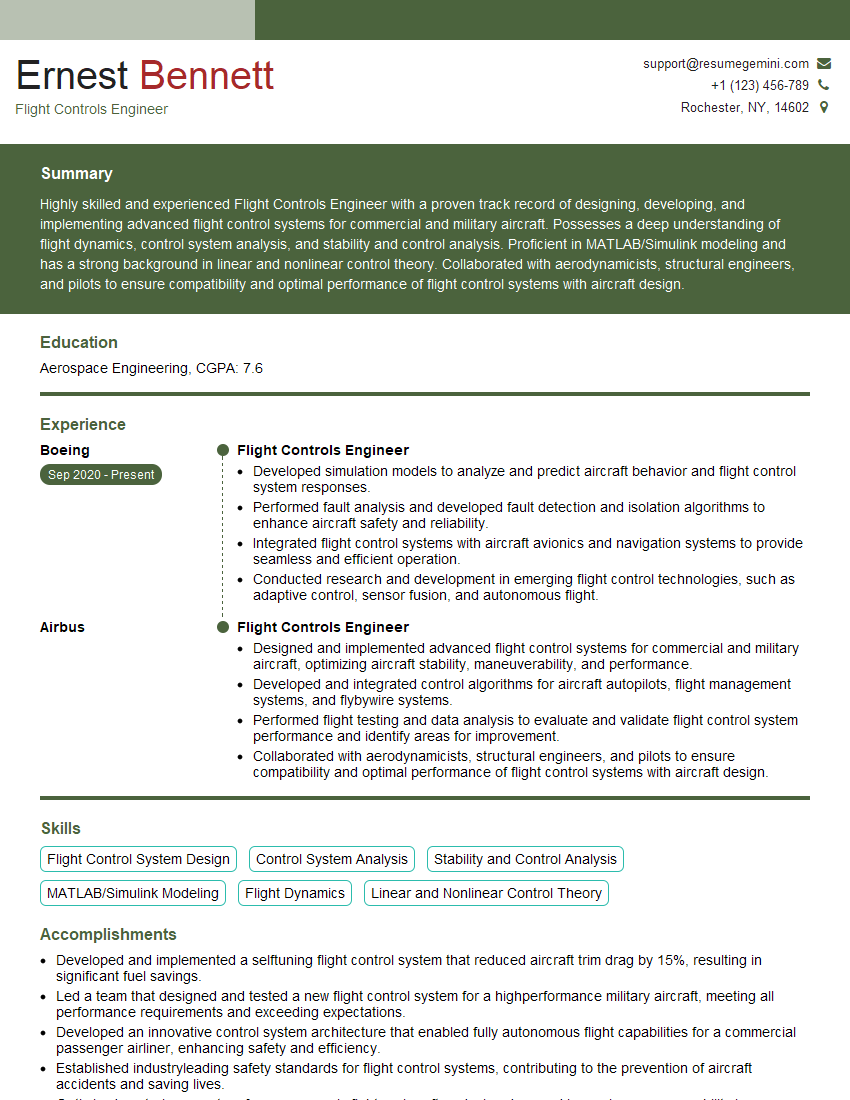
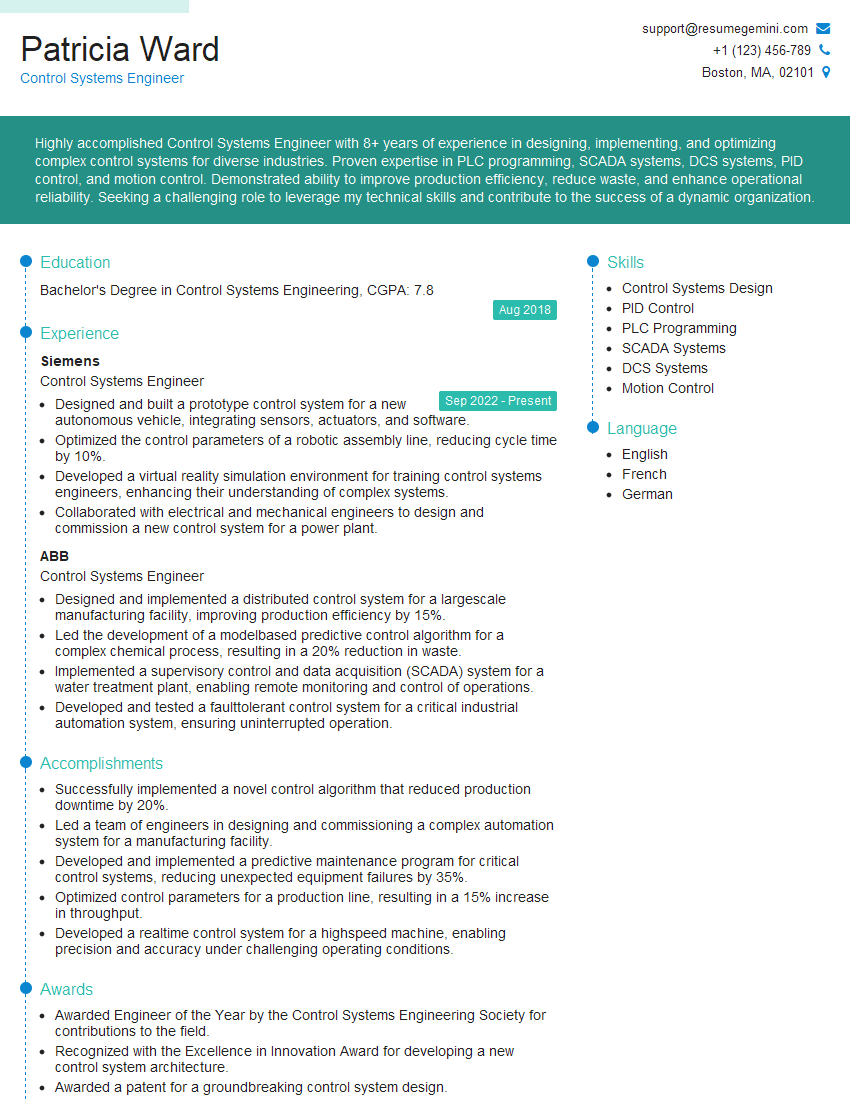
Mastering Stability and Control Analysis opens doors to exciting career opportunities in various industries, including aerospace, automotive, robotics, and process control. A strong understanding of these principles is highly valued by employers and significantly enhances your career prospects. To further boost your job search, crafting an ATS-friendly resume is crucial. This ensures your application gets noticed by recruiters and hiring managers. We highly recommend using ResumeGemini to build a professional and effective resume. ResumeGemini provides a user-friendly platform and offers examples of resumes tailored specifically to Stability and Control Analysis roles, helping you present your skills and experience in the most impactful way.
Explore more articles
Users Rating of Our Blogs
Share Your Experience
We value your feedback! Please rate our content and share your thoughts (optional).
What Readers Say About Our Blog
Really detailed insights and content, thank you for writing this detailed article.
IT gave me an insight and words to use and be able to think of examples