Are you ready to stand out in your next interview? Understanding and preparing for Understanding of intellectual property rights and copyright laws interview questions is a game-changer. In this blog, we’ve compiled key questions and expert advice to help you showcase your skills with confidence and precision. Let’s get started on your journey to acing the interview.
Questions Asked in Understanding of intellectual property rights and copyright laws Interview
Q 1. Explain the difference between a patent, trademark, and copyright.
Patents, trademarks, and copyrights are all forms of intellectual property (IP) protection, but they protect different things. Think of it like this: a patent protects an invention, a trademark protects a brand, and a copyright protects creative works.
- Patent: Grants exclusive rights to an inventor for a limited time to exclude others from making, using, or selling their invention. This could be a new process, machine, manufacture, composition of matter, or improvement thereof. For example, a patent could protect a new type of smartphone battery or a unique algorithm for image recognition.
- Trademark: Protects brand names, logos, and other identifying marks used on goods and services. It prevents others from using confusingly similar marks that could mislead consumers. Think of the Nike swoosh, the Apple logo, or the Coca-Cola script. These trademarks help consumers identify and trust the source of the goods or services.
- Copyright: Protects original works of authorship, including literary, dramatic, musical, and certain other intellectual works. This means books, songs, movies, software code, and even architectural designs are eligible for copyright protection. The key here is originality – the work must be independently created and not simply a copy of something else.
In short, patents protect inventions, trademarks protect brands, and copyrights protect creative works. Each serves a distinct purpose in safeguarding intellectual property.
Q 2. What are the requirements for copyright protection?
Copyright protection in most countries automatically attaches to a work upon its creation and fixation in a tangible medium. This means that as soon as you write a poem, compose a song, or paint a picture, and it’s recorded in some form (written, recorded, or printed), it’s automatically copyrighted. However, registration of your copyright with the relevant copyright office (like the U.S. Copyright Office) provides several advantages, including:
- Legal evidence of ownership: Registered copyrights make it much easier to prove you own the copyright in case of a dispute.
- The ability to file a lawsuit: In many jurisdictions, registration is a prerequisite for filing a copyright infringement lawsuit.
- Statutory damages and attorney’s fees: Registered copyrights allow you to claim statutory damages and attorney’s fees if you win a lawsuit, potentially deterring infringement.
While registration isn’t mandatory in all countries for basic copyright protection, it’s highly recommended for the additional legal benefits it provides.
Q 3. What are the different types of patents?
There are three main types of patents:
- Utility patents: Protect the way an invention works (its function). They are the most common type of patent and cover new and useful processes, machines, manufactures, compositions of matter, or any new and useful improvement thereof. Think of a new type of engine or a novel medical device.
- Design patents: Protect the ornamental design of an article of manufacture. This means they protect the way something looks, rather than how it functions. A design patent might cover the unique shape of a chair or the aesthetic design of a computer mouse.
- Plant patents: Protect newly invented or discovered asexually reproduced plants. This is for inventors who have developed new varieties of plants that can be reproduced without sexual reproduction (e.g., through grafting or cuttings).
Each type of patent has its own specific requirements and application process. The type of patent you seek will depend on the nature of your invention.
Q 4. Describe the process of obtaining a trademark.
The process of obtaining a trademark varies slightly from country to country, but generally involves these steps:
- Trademark search: Conduct a thorough search to ensure your desired mark isn’t already in use or confusingly similar to an existing trademark.
- Application filing: File a trademark application with the relevant intellectual property office (e.g., the USPTO in the U.S.). This includes providing information about your mark, the goods and services it will be used on, and filing fees.
- Examination: The trademark office will examine your application to determine if it meets all the legal requirements.
- Publication: If the examiner approves your application, it will be published for opposition. This allows others to object to your trademark registration if they believe it conflicts with their rights.
- Registration: If no oppositions are filed or successfully resolved, your trademark will be registered, granting you exclusive rights to use the mark in connection with the specified goods and services.
The entire process can take several months or even years, depending on the jurisdiction and any challenges encountered during the examination and opposition periods.
Q 5. Explain the concept of ‘fair use’ in copyright law.
“Fair use” is a legal doctrine in copyright law that permits limited use of copyrighted material without obtaining permission from the copyright holder. It’s a defense against copyright infringement, not a license. Determining whether a particular use is fair use depends on a multi-factor test, which typically considers:
- The purpose and character of the use: Is the use for educational, non-profit, transformative, or commercial purposes? Transformative uses, which add new meaning or message to the original work, are generally more likely to be considered fair use.
- The nature of the copyrighted work: Is it a factual work or a fictional one? Fictional works are generally given more protection.
- The amount and substantiality of the portion used: Using a small portion of a work is more likely to be considered fair use than using a substantial portion.
- The effect of the use upon the potential market for or value of the copyrighted work: Does the use harm the market for the original work?
Fair use is highly fact-specific, and what constitutes fair use can vary depending on the circumstances. It’s best to carefully evaluate each factor before using copyrighted material without permission.
Example: Quoting a short passage from a book in a critical review is more likely to be fair use than copying the entire book.
Q 6. What are the potential consequences of copyright infringement?
The consequences of copyright infringement can be severe and vary depending on the nature and extent of the infringement. They can include:
- Injunctions: A court order requiring the infringer to stop infringing activities.
- Monetary damages: The copyright holder can sue for actual damages (lost profits) or statutory damages, which are set by law and can be substantial.
- Criminal penalties: In some cases, particularly involving willful and large-scale infringement, criminal penalties including fines and imprisonment can be imposed.
- Seizure of infringing materials: The copyright holder can obtain a court order to seize and destroy infringing copies of the copyrighted work.
- Reputational damage: Copyright infringement can damage the infringer’s reputation and credibility.
It’s crucial to understand and respect copyright laws to avoid these potentially serious consequences.
Q 7. How long does a copyright last?
The duration of copyright protection varies depending on the country and the type of work, but generally it’s a significant period. In the United States, for example:
- Works created by individuals: Life of the author plus 70 years.
- Works created by corporate entities (e.g., companies): The shorter of 95 years from publication or 120 years from creation.
After the copyright expires, the work enters the public domain, meaning it’s free for anyone to use without permission. This is an important consideration for determining whether a work is still protected by copyright.
Q 8. How long does a patent last?
The duration of a patent varies depending on the type and the country where it’s filed. In the United States, for example, utility patents (covering the function of an invention) generally last for 20 years from the date of application, not from the date of issue. Design patents, which protect the ornamental design of an article of manufacture, typically have a term of 15 years from the date of grant. This means the clock starts ticking differently for each type. It’s crucial to understand these timelines as they significantly impact the exclusivity and commercialization period of your invention. Think of it like a lease – after the term expires, anyone can use your invention freely.
Q 9. What is a trade secret, and how is it protected?
A trade secret is information that companies keep confidential to give them an advantage over their competitors. Unlike patents, trade secrets don’t require registration with any government agency. Protection comes from actively maintaining secrecy. This can involve measures like non-disclosure agreements (NDAs) with employees and contractors, secure storage of sensitive data, and limiting access to only those who need it on a need-to-know basis. For example, Coca-Cola’s formula is famously protected as a trade secret. However, if a competitor independently discovers the secret through legal means, or if an employee reveals it in breach of their NDA, the protection is lost. Successfully maintaining a trade secret requires ongoing effort and vigilance.
Q 10. Explain the concept of licensing intellectual property.
Licensing intellectual property (IP) is an agreement where the owner (licensor) grants another party (licensee) the right to use their IP – a patent, trademark, copyright, or trade secret – for a specific period and under defined conditions. Think of it as renting out your IP. The licensee pays royalties or fees to the licensor in exchange for the right to use the IP. Licensing can be exclusive (only the licensee can use the IP) or non-exclusive (the licensor can also use the IP, or grant licenses to others). For instance, a software company might license its patented technology to another company to incorporate into their products. This allows the licensor to generate revenue without directly manufacturing or distributing the product, while the licensee gains access to valuable technology.
Q 11. What is a patent assignment?
A patent assignment is the transfer of all rights, title, and interest in a patent from the original inventor or patent holder to another party. It’s a legal document that essentially gives ownership of the patent to someone else. This transfer is usually done in exchange for compensation, such as money, equity in a company, or other valuable consideration. It’s akin to selling a piece of property. The assignment needs to be recorded with the patent office to be legally effective. Imagine a startup developing a groundbreaking technology; they might assign the patent rights to a larger corporation in exchange for funding and access to distribution channels.
Q 12. What is a trademark infringement?
Trademark infringement occurs when someone uses a trademark that is confusingly similar to another’s registered trademark without authorization. This can lead to consumers mistaking one product or service for another. The unauthorized use can be in various contexts, including the product packaging, advertising, or even the name of a company. For example, if a new coffee company used a logo that is very similar to Starbucks’ iconic mermaid logo, it could be considered trademark infringement. The level of similarity required to constitute infringement is determined on a case-by-case basis, considering factors such as the strength of the original trademark, the similarity of marks and the goods/services offered. The consequences can be significant, including legal action, injunctions, and monetary damages.
Q 13. Describe the differences between design patents and utility patents.
Both design patents and utility patents protect inventions, but they do so in different ways. A utility patent protects the function of an invention—how it works. It covers the underlying mechanics and processes. Think of a new type of engine or a novel software algorithm. A design patent, on the other hand, protects the appearance of an invention – its ornamental design. It’s about how something looks, not how it works. Consider the unique shape of a chair or the aesthetic design of a phone case. A utility patent provides broader protection over functionality while a design patent safeguards the visual aspects of a product. You could have both a utility and a design patent for a single invention, covering both its function and its appearance.
Q 14. How does international copyright protection work?
International copyright protection doesn’t automatically extend across borders. While the Berne Convention provides some baseline protection for works originating in signatory countries, the level of protection and the enforcement mechanisms vary from nation to nation. Generally, a work is protected in other Berne Convention member countries once it’s protected in the author’s home country. However, registration in individual countries is often recommended for stronger legal recourse, especially for commercial exploitation. Some international treaties, like the WIPO Copyright Treaty, address digital copyright issues. There’s no single global copyright system. For effective international protection, you need to understand the laws of the specific countries where you plan to use or distribute your copyrighted work. Think of it as a patchwork quilt of different national copyright laws, rather than a single universal system.
Q 15. What are the key elements of a strong patent application?
A strong patent application hinges on clearly and concisely describing a novel and useful invention that meets patentability requirements. Key elements include a detailed specification explaining the invention’s structure and function, comprehensive claims defining the scope of protection sought, and sufficient evidence of novelty and non-obviousness. Think of it like building a strong case in court; every detail matters.
- Detailed Description: This section needs to be thorough enough for someone skilled in the art to recreate your invention without undue experimentation. Include diagrams, flowcharts, and examples to clarify complex concepts.
- Claims: These are the most critical part, legally defining what the patent protects. They should be carefully drafted to balance breadth of protection with the likelihood of being upheld. Too broad, and they’re easily challenged; too narrow, and they might not cover all aspects of your invention.
- Drawings: Visual representations are essential, particularly for complex inventions. They help clarify the description and are often key to understanding the invention’s structure.
- Evidence of Novelty and Non-Obviousness: You must demonstrate that your invention is new and not an obvious modification of existing technology. This might involve a prior art search, highlighting the differences between your invention and existing solutions. A strong patent attorney is crucial here.
For example, a patent application for a novel type of bicycle lock would need to meticulously describe its mechanism, how it differs from existing locks (demonstrating novelty), and clearly define the scope of protection (e.g., does it cover all locking mechanisms using a specific material, or just a specific configuration?).
Career Expert Tips:
- Ace those interviews! Prepare effectively by reviewing the Top 50 Most Common Interview Questions on ResumeGemini.
- Navigate your job search with confidence! Explore a wide range of Career Tips on ResumeGemini. Learn about common challenges and recommendations to overcome them.
- Craft the perfect resume! Master the Art of Resume Writing with ResumeGemini’s guide. Showcase your unique qualifications and achievements effectively.
- Don’t miss out on holiday savings! Build your dream resume with ResumeGemini’s ATS optimized templates.
Q 16. What are some common defenses against patent infringement?
Defending against patent infringement involves demonstrating that the alleged infringement doesn’t actually infringe on the claims of the patent. Strategies include challenging the validity of the patent itself, arguing that the accused product or process doesn’t fall within the scope of the patent’s claims (non-infringement), or asserting a license or other authorization.
- Invalidity: This involves arguing that the patent is not valid due to issues such as prior art (the invention was already known), lack of novelty, or obviousness. This requires demonstrating that the patent didn’t meet the criteria for patentability at the time of filing.
- Non-Infringement: Even if the patent is valid, the accused invention might not infringe. This could be because the accused product doesn’t incorporate all the elements of the patent claims, or because it operates differently.
- License: A valid license from the patent holder grants permission to use the patented invention, negating any claim of infringement.
- Experimental Use: Using a patented invention for bona fide research or development purposes might fall outside of infringement.
- Doctrine of Equivalents: This legal doctrine can expand the scope of a patent, but it also provides a potential defense if the accused invention, while seemingly similar, avoids the literal language of the claims.
Imagine a company being sued for infringing on a patent for a specific type of smartphone camera. They might argue that their camera, while similar, uses a different lens configuration that avoids the specific claim elements, thus constituting non-infringement. Alternatively, they might challenge the validity of the patent by providing evidence of prior art showcasing a similar design.
Q 17. How do you determine whether a work is protected by copyright?
Copyright protection automatically arises the moment a work is fixed in a tangible medium of expression. This means it’s been recorded in a way that can be reproduced, such as a written document, a musical recording, a photograph, or a computer program. Registration isn’t strictly necessary for protection but offers several key advantages. It’s like having a birth certificate for your creative work.
- Originality: The work must be independently created and possess at least a minimal degree of creativity. It doesn’t have to be groundbreaking; it just needs to show some originality compared to existing works.
- Tangible Medium: The work must be recorded in some form, be it a physical manuscript, a digital file, or a sound recording.
- Authorship: The work must be created by a human being, as opposed to something generated automatically by a machine.
A simple handwritten poem is automatically protected by copyright the moment it’s written down. A software program’s source code is also protected upon its creation and saving to a file. However, the ideas underlying a work (like the concept for a story) aren’t protected – only the expression of that idea in a tangible form.
Q 18. What is the difference between a registered and unregistered trademark?
The key difference lies in the legal protection and evidence afforded. An unregistered trademark provides some common-law protection, meaning you can still take action against infringement, but a registered trademark offers significantly stronger legal standing and broader protection.
- Unregistered Trademark: This provides limited protection, primarily within the geographic area where the mark is used. It offers weaker enforcement capabilities; proving prior use can be challenging. Think of it as having a claim, but without solid proof.
- Registered Trademark: Federal registration provides nationwide protection, stronger legal presumption of ownership, and greater enforcement rights. It serves as constructive notice to others, reducing the risk of unintentional infringement. It’s like having a legally recognized certificate, making your claim much stronger.
For example, a small bakery using the name “Sweet Treats” might have an unregistered trademark based on its local use. However, if a large chain starts using the same name nationally, the small bakery’s claim is significantly weaker than if “Sweet Treats” were federally registered.
Q 19. Explain the concept of ‘first to file’ in patent law.
The ‘first-to-file’ system, adopted by many countries (including the US), awards patent rights to the first applicant to file a patent application, regardless of who actually invented the technology first. This contrasts with the older ‘first-to-invent’ system. It emphasizes the importance of timely filing.
This system simplifies the patent process, reducing the need for lengthy and costly interference proceedings to determine who invented something first. It encourages prompt disclosure of inventions, fostering innovation and competition. However, it can potentially disadvantage inventors who may have conceived of an invention earlier but filed later.
Imagine two inventors independently develop the same technology. Under first-to-file, the inventor who files their patent application first will be granted the patent, even if the other inventor had the idea earlier. This encourages inventors to diligently protect their inventions promptly.
Q 20. How does the DMCA (Digital Millennium Copyright Act) impact online copyright enforcement?
The DMCA significantly impacts online copyright enforcement by providing legal tools to address copyright infringement in the digital space. It creates a framework for addressing online copyright infringement, including provisions for ‘notice and takedown’ procedures and limitations on liability for online service providers.
- Notice and Takedown: Copyright holders can issue takedown notices to online service providers (like YouTube or hosting companies) demanding the removal of infringing content. The service provider is then obligated to act promptly.
- Safe Harbor Provisions: Online service providers are generally shielded from liability for copyright infringement by their users if they comply with the DMCA’s notice and takedown procedures. This encourages participation in online copyright enforcement without overwhelming platforms with legal burden.
- Anti-Circumvention Provisions: The DMCA prohibits the creation and distribution of technologies designed to circumvent copyright protection measures (like DRM). This is important in protecting copyrighted digital works from unauthorized copying or access.
For example, if someone uploads a copyrighted movie to YouTube, the copyright holder can issue a DMCA takedown notice to YouTube. YouTube is then required to remove the video, and they are generally protected from liability if they follow the correct process.
Q 21. Describe your experience with intellectual property due diligence.
My experience with intellectual property due diligence involves conducting thorough reviews of a company’s IP portfolio to assess its strength and value. This often occurs before mergers and acquisitions, investments, or licensing agreements.
The process typically includes:
- Inventory and Assessment: Identifying and cataloging all IP assets, including patents, trademarks, copyrights, and trade secrets. This involves reviewing documentation, conducting interviews, and performing searches to ensure a complete picture.
- Validity Analysis: Assessing the strength of each IP asset, considering factors like the remaining term of patents, the scope of trademark protection, and the originality of copyrighted works. Potential weaknesses or risks are identified.
- Freedom-to-Operate Analysis: This crucial step examines potential conflicts with third-party IP rights. It helps determine if a company’s activities infringe on others’ patents or trademarks, and vice-versa.
- Valuation: Estimating the monetary value of the IP portfolio, considering factors such as revenue generated by the IP, licensing agreements, and the potential for future earnings.
- Documentation Review: Ensuring all relevant IP documentation is in order and up-to-date, with particular attention to any pending or litigated matters.
For example, in a recent due diligence engagement for a tech startup, our review uncovered a potential infringement of a competitor’s patent. This significantly impacted the valuation and led to renegotiation of the acquisition terms. My expertise allowed the client to avoid a potentially costly legal battle down the line.
Q 22. How would you handle a situation where a company is infringing on your client’s intellectual property?
Handling intellectual property infringement begins with a thorough investigation. We’d first need to confirm the infringement, gathering evidence like comparing the infringing product or work to our client’s intellectual property (patent, trademark, copyright). This might involve purchasing the infringing product, reviewing online materials, and conducting a thorough market analysis. Once we’ve established clear evidence, we’d assess the scope of the infringement and the potential damages. Next, we’d explore various options:
- Cease and desist letter: A formal letter demanding the infringing party stop the activity and possibly compensate for damages.
- Negotiation and settlement: Attempting to reach an amicable resolution outside of court.
- Litigation: Filing a lawsuit seeking injunctive relief (stopping the infringement) and monetary damages.
The chosen course of action depends on various factors: the client’s resources, the severity of the infringement, the infringer’s financial status, and the client’s risk tolerance. For example, if the infringement is minor and the infringer is a small company, a cease and desist letter might suffice. However, in cases of significant infringement by a major competitor, litigation might be necessary.
Q 23. Explain the role of a patent attorney in litigation.
A patent attorney plays a crucial role in patent litigation. Their expertise spans several key areas:
- Patent Prosecution: They prepare and file patent applications, ensuring the claims are strong and defensible. This experience is vital in litigation as they understand the nuances of patent claim construction.
- Litigation Strategy: They help develop the overall litigation strategy, including deciding whether to sue or defend, selecting the appropriate jurisdiction, and managing discovery.
- Expert Witness Testimony: Patent attorneys frequently act as expert witnesses, explaining complex technical aspects of the patent to the judge and jury.
- Evidence Gathering and Presentation: They are skilled at gathering and presenting evidence, including technical documents, expert reports, and prior art.
- Negotiation and Settlement: They negotiate with opposing counsel to attempt to settle the case before trial.
In essence, a patent attorney acts as a strategic advisor and advocate, guiding their client through the complexities of patent litigation to protect their intellectual property rights.
Q 24. Describe your understanding of the Paris Convention for the Protection of Industrial Property.
The Paris Convention for the Protection of Industrial Property is an international treaty designed to protect intellectual property rights across participating countries. Think of it as a global agreement promoting international cooperation in IP protection. Its key principles include:
- National Treatment: Treats foreign nationals the same as domestic nationals regarding IP rights.
- Priority Right: Allows applicants who have filed an IP application in one member country to file in other member countries within a certain time frame, maintaining their original filing date. This prevents losing priority to others who might file later.
- Common Rules: Sets common minimum standards for protecting various forms of IP, including patents, trademarks, and industrial designs.
The Paris Convention significantly simplifies the process of obtaining international IP protection, reducing the burden of filing multiple applications in different countries independently. Imagine trying to protect a trademark in every country worldwide without this treaty; it would be extremely time-consuming and costly. The Paris Convention provides a framework for a more streamlined and efficient process.
Q 25. What is the Madrid Protocol, and how does it simplify international trademark registration?
The Madrid Protocol is an international treaty administered by the World Intellectual Property Organization (WIPO) that simplifies international trademark registration. Instead of filing separate trademark applications in each country, applicants can file a single application through a designated office in their home country. This application, once approved, is then transmitted to other member countries through WIPO.
It simplifies international registration by:
- Centralized Filing: One application covers multiple countries.
- Reduced Costs: Eliminates the need for multiple filings and associated fees.
- Simplified Process: Streamlines the paperwork and procedures.
However, it’s crucial to remember that the Madrid Protocol doesn’t eliminate the need for local counsel in each country; they are usually needed to deal with any local issues or oppositions that may arise.
Imagine an entrepreneur wanting to protect their brand globally. The Madrid Protocol allows them to file one application, saving significant time, money, and administrative effort, instead of navigating the legal complexities of multiple countries individually.
Q 26. Explain the concept of moral rights in copyright.
Moral rights in copyright are distinct from economic rights. While economic rights deal with the financial aspects of copyright (like the right to reproduce and distribute a work), moral rights focus on the creator’s personal connection to their work. They are typically non-transferable and often persist even after the copyright has been sold.
These rights usually include:
- Attribution: The right to be identified as the author of the work. This means that the author’s name should be associated with their work, and their name shouldn’t be removed without their consent.
- Integrity: The right to object to any distortion, mutilation, or other modification of the work that could be prejudicial to the author’s honor or reputation. This protects the author’s artistic vision.
Imagine a painter who sells their painting. They retain the moral right to be recognized as the painter and to object if the painting is significantly altered in a way that damages their reputation. Even if the buyer owns the painting, they cannot erase the artist’s signature or drastically alter the painting without their consent, if moral rights are protected in that jurisdiction.
Q 27. What are some common pitfalls to avoid when protecting intellectual property?
Many pitfalls can hinder effective IP protection. Here are some common ones:
- Failing to document inventions and creations: Thorough documentation, including dates, detailed descriptions, and witness testimonies, is critical in proving ownership and priority.
- Not understanding different types of IP protection: Different types of protection exist (patents, trademarks, copyrights, trade secrets) each suited to specific forms of IP. Choosing the right type is crucial.
- Delaying filing applications: The earlier you file, the better, to establish priority and prevent others from claiming your IP.
- Insufficiently defining the scope of protection: Broad, well-defined claims are essential for maximizing the scope of your protection.
- Ignoring international protection: If you intend to sell or use your IP internationally, you need to consider international protection mechanisms.
- Poorly managing trade secrets: Trade secrets need strong security measures to prevent disclosure and misappropriation.
Ignoring these pitfalls can lead to disputes, lost revenue, and even the loss of your IP rights entirely. Imagine a brilliant inventor failing to document their invention; if someone else independently develops and patents a similar invention, the original inventor might lose out.
Q 28. How would you advise a client on the best strategy for protecting their intellectual property?
Advising a client on IP protection involves a holistic strategy. We’d first conduct a comprehensive IP audit to identify all the client’s valuable IP assets. This involves examining patents, trademarks, copyrights, trade secrets, and know-how.
Next, we’d analyze the client’s business goals and risks, determining the optimal IP protection strategy. This might involve:
- Securing appropriate IP rights: This includes filing patent applications for inventions, trademark applications for brand names and logos, and copyright registrations for creative works.
- Developing and implementing a trade secret protection plan: This includes confidentiality agreements, security measures, and internal training programs.
- Monitoring for infringement: Regularly monitoring the market to identify potential infringers.
- Enforcing IP rights: Taking appropriate action against infringers, ranging from cease-and-desist letters to litigation.
- Licensing and commercialization: Exploring opportunities to license the IP to generate revenue.
The strategy would be tailored to the specific needs of the client, considering their industry, business model, and financial resources. For example, a startup with limited resources might focus on securing key patents and trademarks while a large corporation might adopt a broader, more aggressive enforcement strategy. A clear, proactive, and well-defined plan is paramount to maximizing the value and protection of their intellectual property.
Key Topics to Learn for Understanding of Intellectual Property Rights and Copyright Laws Interview
- Types of Intellectual Property: Understand the distinctions between patents, trademarks, copyrights, and trade secrets. Consider the criteria for protection under each category.
- Copyright Law Fundamentals: Grasp the basics of copyright ownership, duration, fair use, and infringement. Be prepared to discuss real-world examples of copyright disputes.
- Licensing and Agreements: Familiarize yourself with different types of intellectual property licenses (e.g., exclusive, non-exclusive) and the key clauses in such agreements. Understand the implications of breach of contract.
- International IP Protection: Explore the complexities of protecting intellectual property across national borders and the role of international treaties.
- Practical Application: Prepare examples demonstrating your understanding of how IP laws impact business decisions, such as product development, marketing, and strategic partnerships.
- Ethical Considerations: Discuss the ethical implications of intellectual property rights and the importance of responsible innovation and usage.
- Enforcement and Litigation: Gain a basic understanding of the legal processes involved in protecting and enforcing intellectual property rights, including potential remedies for infringement.
Next Steps
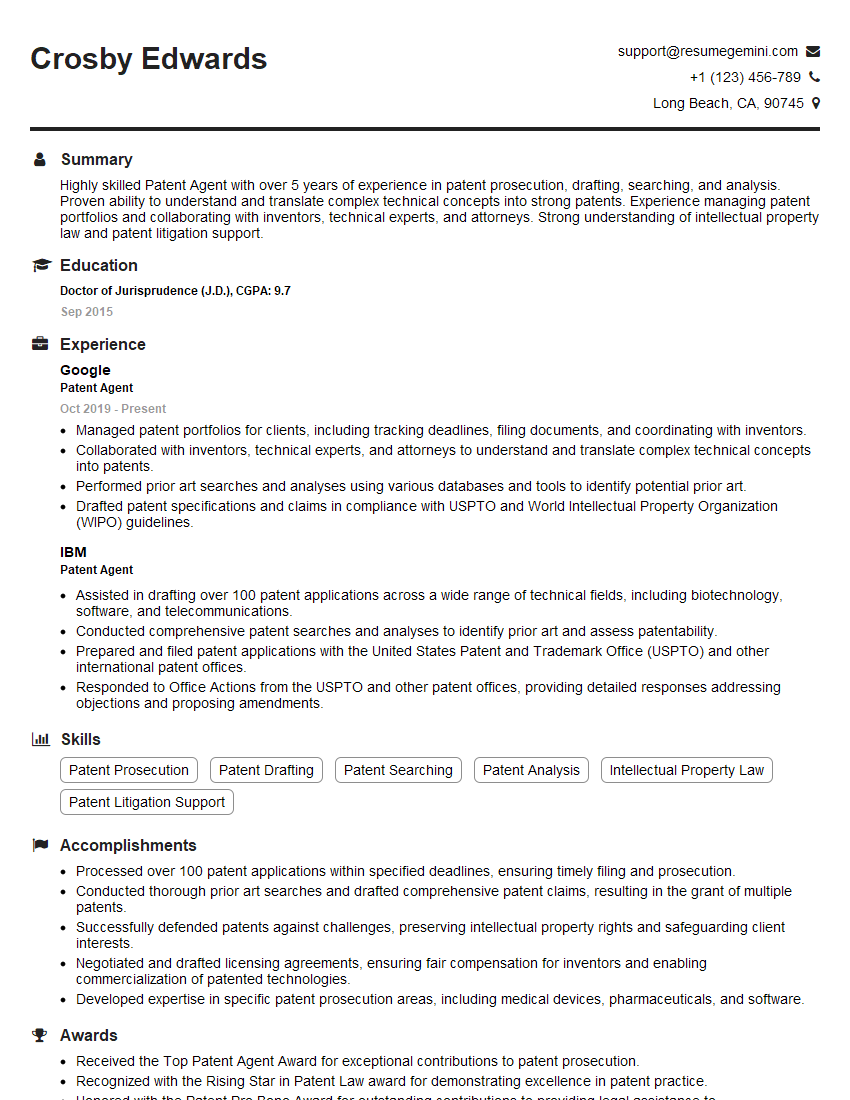
Mastering intellectual property rights and copyright laws is crucial for career advancement in numerous fields, opening doors to specialized roles and higher earning potential. A strong understanding of these laws showcases your professionalism and commitment to ethical practices. To maximize your job prospects, creating an ATS-friendly resume is essential. ResumeGemini offers a trusted platform for building professional resumes that highlight your skills and experience effectively. We provide examples of resumes tailored to showcasing expertise in Understanding of intellectual property rights and copyright laws to help you present yourself in the best possible light. Take the next step toward your dream career today!
Explore more articles
Users Rating of Our Blogs
Share Your Experience
We value your feedback! Please rate our content and share your thoughts (optional).
What Readers Say About Our Blog
Really detailed insights and content, thank you for writing this detailed article.
IT gave me an insight and words to use and be able to think of examples