Unlock your full potential by mastering the most common Static and Dynamic Structural Analysis interview questions. This blog offers a deep dive into the critical topics, ensuring you’re not only prepared to answer but to excel. With these insights, you’ll approach your interview with clarity and confidence.
Questions Asked in Static and Dynamic Structural Analysis Interview
Q 1. Explain the difference between static and dynamic structural analysis.
The core difference between static and dynamic structural analysis lies in how they treat the applied loads. Static analysis assumes the loads are applied slowly and steadily, causing no significant acceleration or inertia effects. The structure is considered to be in equilibrium at all times. Think of a building under its own weight – the load is essentially static. In contrast, dynamic analysis considers loads that change with time, such as impact, vibrations, or earthquakes. These time-varying loads induce inertia forces that significantly affect the structure’s response. Imagine a bridge experiencing the vibrations of a heavy truck passing over it – this is a dynamic loading scenario. The key difference is the consideration of inertia and time-dependent effects.
Q 2. Describe the assumptions made in linear static analysis.
Linear static analysis relies on several crucial assumptions:
- Linear elastic material behavior: The material responds proportionally to the applied load, meaning stress is directly proportional to strain (Hooke’s Law applies). Once the load is removed, the structure returns to its original shape.
- Small displacements: The deformation of the structure is small compared to its overall dimensions. This allows us to simplify the analysis by using the initial geometry instead of the deformed geometry.
- Static loads: Loads are applied slowly and remain constant in magnitude and direction. There’s no acceleration or inertia involved.
- Linear superposition: The effects of multiple loads can be superimposed to obtain the overall response. This means we can analyze individual loads and then add their effects together.
Q 3. What are the limitations of linear static analysis?
Linear static analysis has limitations arising directly from its underlying assumptions:
- Inelastic material behavior: It cannot accurately model materials that exhibit nonlinear behavior, such as yielding, plastic deformation, or fracture. This limits its application in scenarios involving high loads or cyclic loading.
- Large displacements: The analysis is inaccurate for structures undergoing significant deformation, where geometric nonlinearity becomes important. This is common in flexible structures or structures under large loads.
- Dynamic loads: It cannot handle time-varying loads or transient effects, making it unsuitable for analyzing structures subjected to impact, vibrations, or seismic events. Dynamic analysis is required in such cases.
- Buckling: Linear static analysis cannot predict buckling, a phenomenon where a slender structure under compressive load suddenly collapses. A separate buckling analysis is necessary.
Q 4. Explain the concept of stiffness matrix in finite element analysis.
In finite element analysis (FEA), the stiffness matrix (often denoted as K) is a fundamental concept. It represents the relationship between the applied forces (F) and the resulting displacements (u) within a structure. The equation governing this relationship is Ku = F. Each element in the stiffness matrix quantifies how much force is needed to cause a unit displacement in a specific degree of freedom. For instance, K(1,1) indicates the force required to cause a unit displacement in the first degree of freedom. The stiffness matrix is assembled by combining the individual stiffness matrices of the finite elements that make up the structure. It’s a sparse, symmetric matrix, which means it contains many zero entries and is symmetrical across its diagonal. Solving Ku = F for u gives us the displacements at each node in the model, allowing us to calculate stresses and strains within the structure.
Q 5. How do you handle boundary conditions in a finite element model?
Boundary conditions specify how the structure is supported and constrained. They are crucial for obtaining a realistic solution in FEA. These conditions define the degrees of freedom (DOF) that are restricted. For example, a fixed support prevents all displacements and rotations at that point. A roller support constrains only one direction of displacement. These constraints are incorporated into the global stiffness matrix (K) by modifying the rows and columns corresponding to the constrained DOFs. For a fixed support, the relevant rows and columns are set to 1 (on the diagonal) and 0 elsewhere, effectively removing these DOFs from the equation. Incorrectly defined boundary conditions lead to inaccurate results. Imagine analyzing a cantilever beam without specifying that one end is fixed – the solution would be physically unrealistic.
Q 6. What are different types of elements used in FEA and their applications?
FEA employs various types of elements, each suited to specific applications:
- Truss elements: These are one-dimensional elements used to model structures like bridges or trusses where loads are applied along the element’s axis. They only consider axial forces.
- Beam elements: Also one-dimensional, these elements model beams and account for axial, bending, and shear forces. Useful for modeling beams, columns, and frames.
- Shell elements: Two-dimensional elements that model thin-walled structures like plates and shells, considering bending and membrane stresses. Ideal for modeling aircraft wings, pressure vessels, and car bodies.
- Solid elements: Three-dimensional elements that model three-dimensional bodies and are capable of handling complex stress states. Used for modeling massive structures, parts with intricate geometries, or situations requiring detailed stress analysis.
Q 7. Describe different methods for solving systems of equations in FEA.
Solving the system of equations Ku = F in FEA, often involving millions of equations, requires efficient numerical methods:
- Direct methods: These methods provide exact solutions (within machine precision) but can be computationally expensive for large systems. Examples include Gaussian elimination and Cholesky decomposition, often used for smaller problems.
- Iterative methods: These methods approximate the solution by iteratively refining an initial guess. They are better suited for large systems and require less memory than direct methods. Popular examples include Conjugate Gradient, Gauss-Seidel, and Preconditioned Conjugate Gradient (PCG) methods, frequently used in modern FEA software.
Q 8. Explain the concept of modal analysis.
Modal analysis is a crucial technique in structural dynamics that helps us understand how a structure vibrates at its natural frequencies. Imagine plucking a guitar string – it vibrates at specific frequencies, and these are its natural frequencies. Similarly, every structure has its own set of natural frequencies and corresponding mode shapes. Modal analysis identifies these inherent vibrational characteristics, which is critical for predicting a structure’s response to dynamic loads like earthquakes or wind gusts.
In essence, it’s about finding the structure’s inherent ‘musical notes’. Understanding these ‘notes’ is essential for designing a structure that won’t resonate excessively and potentially fail under dynamic loading.
Q 9. How do you determine natural frequencies and mode shapes of a structure?
Determining the natural frequencies and mode shapes involves solving the structure’s eigenvalue problem. This is typically done using finite element analysis (FEA) software. The software discretizes the structure into smaller elements, and then solves a system of equations that relate the structure’s stiffness, mass, and damping properties.
The solution provides a set of eigenvalues (natural frequencies, often denoted as ωn) and eigenvectors (mode shapes, often denoted as Φn). Each eigenvalue represents a natural frequency at which the structure will vibrate, and its corresponding eigenvector depicts the structure’s deformation pattern (mode shape) at that frequency. The lowest frequency is usually called the fundamental frequency, and it’s particularly important because the structure is most susceptible to resonance at that frequency.
For example, a tall building might have a fundamental frequency in the range of 0.1-1 Hz. Higher modes represent more complex vibrational patterns with multiple nodal points.
Q 10. Describe different methods for dynamic analysis (e.g., time history, response spectrum).
Several methods exist for dynamic analysis, each with its own strengths and weaknesses:
- Time History Analysis: This method directly inputs the time-varying dynamic load (e.g., an earthquake acceleration record) into the structural model. The software then numerically integrates the equations of motion to determine the structure’s response (displacements, velocities, accelerations, and stresses) over time. It’s highly accurate but computationally intensive and requires detailed load data.
- Response Spectrum Analysis: This approach utilizes response spectra, which are curves showing the maximum response of a single-degree-of-freedom (SDOF) system to a specific ground motion. It’s more efficient than time history analysis because it doesn’t require detailed time-varying load information. Instead it uses the maximum response from spectra. Various modal combinations are used to find the maximum response of the structure. It is particularly useful for earthquake engineering.
- Frequency Response Analysis: This method focuses on the structure’s response to sinusoidal loads at various frequencies. It is useful for identifying potential resonant frequencies where the structure is particularly susceptible to large vibrations. This can be useful for finding machine induced vibrations.
The choice of method depends on the specific application, available data, and desired level of accuracy. For instance, time history analysis is often preferred for critical structures subjected to complex dynamic loads, while response spectrum analysis is suitable for preliminary design or when detailed load data is scarce.
Q 11. Explain the concept of damping in dynamic analysis.
Damping represents energy dissipation within a structure during vibration. Without damping, a structure would continue to oscillate indefinitely after an initial disturbance. Damping mechanisms include material internal friction, structural joints, and energy radiation into the surrounding environment. In real-world structures, damping reduces the amplitude of vibrations over time. It helps to mitigate the effects of resonance by reducing the amplitude of vibrations.
Damping is often modeled using several approaches such as Rayleigh damping, which is a combination of mass and stiffness proportional damping or using a constant damping ratio (ζ). The damping ratio is a dimensionless parameter that quantifies the level of damping. A higher damping ratio indicates faster decay of vibrations.
Accurate modeling of damping is crucial for realistic dynamic analysis, particularly when dealing with resonant conditions. Underestimating damping can lead to overly conservative designs, while overestimating it may result in unsafe structures.
Q 12. How do you model soil-structure interaction in dynamic analysis?
Soil-structure interaction (SSI) refers to the coupled dynamic behavior between a structure and the surrounding soil. Ignoring SSI can lead to inaccurate predictions, particularly for structures founded on soft soils or subjected to significant dynamic loads. Modeling SSI requires considering the soil’s dynamic properties (e.g., stiffness and damping) and their influence on the structure’s response.
Several methods are available for modeling SSI, ranging from simplified spring-dashpot models to more sophisticated finite element models that incorporate both the soil and structure. The selection depends on factors such as the soil type, foundation characteristics, and the level of accuracy required. Spring-dashpot models are simpler and computationally efficient but less accurate compared to FE models. FE models allow for accurate representation of soil geometry and material properties but are more computationally expensive.
For example, a tall building on soft soil might experience significant settlement and increased vibrations if SSI is not accounted for during the design process.
Q 13. What are the effects of different types of loading (static and dynamic) on structures?
Static and dynamic loads have fundamentally different effects on structures:
- Static Loads: These loads are applied gradually and remain constant over time, like the self-weight of a structure or a snow load. Static loads primarily cause stresses and deformations that can be calculated using principles of statics and mechanics of materials. The primary concern is ensuring the structure has sufficient strength and stiffness to withstand these loads without excessive deformation or failure.
- Dynamic Loads: These loads vary with time, such as wind gusts, earthquakes, or moving vehicles. Dynamic loads cause inertia forces in addition to the static forces, leading to more complex stress and deformation patterns. The primary concern is preventing resonance and ensuring the structure’s structural integrity under these fluctuating forces.
Dynamic loads often induce much larger stresses and deformations compared to static loads of the same magnitude. This is because the structure’s dynamic response is greatly affected by its natural frequencies and damping characteristics. A structure could fail under dynamic loads even if it could successfully withstand static loads of the same magnitude.
Q 14. Explain the concept of stress concentration and how to mitigate it.
Stress concentration occurs when stress levels in a structure become significantly higher in localized areas due to abrupt changes in geometry, such as holes, notches, or fillets. These high stress concentrations can initiate cracks and lead to premature failure, even if the overall stress levels in the structure are low. Imagine a sheet of paper – if you poke a small hole in it, the stress near that hole becomes drastically higher compared to the rest of the paper.
Mitigating stress concentration involves careful design considerations:
- Smooth transitions in geometry: Avoid sharp corners and abrupt changes in cross-sectional area by using smooth curves and fillets.
- Reinforcement: Adding extra material in regions of high stress concentration can reduce the local stress levels.
- Material selection: Using materials with better fracture toughness can improve the structure’s resistance to crack initiation.
- Finite element analysis (FEA): FEA is invaluable in determining regions of stress concentration and evaluating the effectiveness of different mitigation strategies.
Ignoring stress concentration can have severe consequences, leading to unexpected failures even in structures designed to withstand significant loads. Therefore, it is important to perform stress analysis to identify stress concentration regions, and implement strategies to reduce these stress concentrations during design and fabrication.
Q 15. How do you perform buckling analysis?
Buckling analysis determines the critical load at which a structural member under compressive stress will suddenly deform and lose its stability. Imagine a perfectly straight, slender column; if you apply enough force along its axis, it will suddenly bend significantly rather than just compressing further. This sudden deformation is buckling.
Performing a buckling analysis typically involves these steps:
- Geometric Modeling: Creating an accurate 3D model of the structure in FEA software, accurately representing all dimensions and boundary conditions.
- Material Properties: Defining the material’s elastic modulus (Young’s modulus) and Poisson’s ratio, essential for accurate stress-strain calculations. For example, using the correct values for steel versus aluminum is critical.
- Boundary Conditions: Defining how the structure is supported. Is it fixed at one end and free at the other (like a cantilever column), pinned at both ends, or fixed at both ends? Incorrect boundary conditions can drastically alter the results.
- Load Application: Applying the compressive load(s) to the structure. This might be a simple axial load or a more complex combination of loads. The location and direction of the load are crucial.
- Eigenvalue Buckling Analysis (Linear): This is a linear analysis method that finds the critical buckling load (eigenvalue) and the corresponding buckling mode shape (eigenvector). The lowest eigenvalue represents the critical buckling load, and its associated mode shape indicates how the structure will buckle.
- Nonlinear Buckling Analysis (Geometric Non-linearity): For more complex scenarios, a nonlinear analysis is necessary to account for large deformations and the change in stiffness as the structure deforms. This approach provides a more accurate prediction, especially as the load approaches the critical buckling load.
- Post-processing and Interpretation: Examining the results, including the critical buckling load, buckling mode shapes, and stress distribution. This helps determine if the design is adequate to withstand the anticipated loads.
For instance, in designing a tall building, buckling analysis of columns is crucial to ensure they can support the building’s weight without collapsing under their own weight.
Career Expert Tips:
- Ace those interviews! Prepare effectively by reviewing the Top 50 Most Common Interview Questions on ResumeGemini.
- Navigate your job search with confidence! Explore a wide range of Career Tips on ResumeGemini. Learn about common challenges and recommendations to overcome them.
- Craft the perfect resume! Master the Art of Resume Writing with ResumeGemini’s guide. Showcase your unique qualifications and achievements effectively.
- Don’t miss out on holiday savings! Build your dream resume with ResumeGemini’s ATS optimized templates.
Q 16. What are different failure criteria used in structural analysis?
Failure criteria are used to predict when a material or structural component will fail under stress. Several criteria exist, each with its own strengths and weaknesses. The choice of criterion depends on the material’s behavior and the type of loading.
- Maximum Principal Stress Theory (Rankine): Failure occurs when the maximum principal stress exceeds the material’s tensile strength. Simple to apply but may be overly conservative.
- Maximum Shear Stress Theory (Tresca): Failure occurs when the maximum shear stress exceeds half the material’s yield strength. Often a good approximation for ductile materials.
- Maximum Distortion Energy Theory (von Mises): Failure occurs when the distortion energy exceeds the distortion energy at yield. A more accurate criterion for ductile materials, widely used in FEA software.
- Mohr-Coulomb Criterion: Used for brittle materials and considers both tensile and compressive strengths as well as the internal friction angle of the material.
- Brittle Coulomb-Mohr: Suitable for brittle materials, specifically considering the tension and compression strength of the material and the ratio between them.
For example, in designing a pressure vessel, von Mises criterion is commonly used because it accounts for the multiaxial stress state within the vessel’s walls. However, if you are working with concrete which is brittle, you might use the Mohr-Coulomb criterion for a more realistic representation of failure.
Q 17. Explain the concept of fatigue analysis.
Fatigue analysis focuses on the failure of a material under cyclic loading. Even if the maximum stress in each cycle is below the material’s yield strength, repeated loading can lead to crack initiation and propagation, eventually causing failure. Think of bending a paperclip back and forth; eventually, it will break, even if the force in each bend is not enough to break it immediately.
Fatigue analysis involves:
- Stress-Life Approach (S-N Curves): This method uses S-N curves (stress-number of cycles to failure curves) to estimate the fatigue life of a material under various stress levels. These curves are material-specific and are obtained through experimental testing.
- Strain-Life Approach (ε-N Curves): This method is more accurate than S-N curves, especially for high-cycle fatigue. This approach considers plastic strain accumulation and is useful for materials with significant plastic deformation under cyclic loading.
- Crack Propagation Analysis: This involves predicting crack growth rates based on the stress intensity factor at the crack tip. It is commonly used in predicting the life of components with pre-existing cracks or flaws.
For example, in designing an aircraft wing, fatigue analysis is critical because the wing experiences many loading cycles during its lifespan. The analysis helps ensure the wing will not fail due to fatigue before its intended lifespan.
Q 18. How do you verify the accuracy of your FEA results?
Verifying FEA results is crucial to ensure their accuracy and reliability. Several methods can be employed:
- Mesh Convergence Studies: Refining the mesh (increasing the number of elements) until the results no longer change significantly. This helps to demonstrate that the solution is independent of the mesh size.
- Comparison with Analytical Solutions: For simple structures, analytical solutions or hand calculations can provide a benchmark for validating the FEA results.
- Experimental Validation: Comparing the FEA predictions with experimental results from physical testing is the gold standard for verification. This can involve strain gauge measurements, displacement measurements, or load testing.
- Verification with Established Benchmarks: Checking against well-established benchmarks or case studies provides confidence in the accuracy of the FEA model and the chosen approach. For instance, comparing results against established experimental results for similar problems.
- Review of Model Assumptions: Carefully reviewing the assumptions made during model creation, such as material properties, boundary conditions, and load applications. Incorrect assumptions can lead to inaccurate results.
For example, when simulating the stress in a bridge component, comparing the FEA results with the strain readings from strain gauges placed on the actual bridge during testing provides a direct measure of accuracy. Discrepancies need to be investigated thoroughly.
Q 19. What software packages are you proficient in (e.g., ANSYS, ABAQUS, SAP2000)?
I am proficient in several industry-standard FEA software packages, including ANSYS, ABAQUS, and LS-DYNA. My experience with these tools spans a wide range of structural analysis applications. I’m particularly comfortable utilizing their advanced features for nonlinear analysis, fatigue simulation, and optimization studies. Furthermore, I have experience with pre- and post-processing tools associated with these packages.
Q 20. Describe your experience with meshing techniques.
Meshing is a critical aspect of FEA, as the accuracy of the results heavily relies on the quality of the mesh. My experience encompasses various meshing techniques, including:
- Structured Meshing: Suitable for simple geometries, creating a regular pattern of elements. Easy to generate but less adaptable to complex shapes.
- Unstructured Meshing: Provides more flexibility and can handle complex geometries effectively. Offers more accuracy in areas with high stress gradients. However, it is computationally more expensive.
- Adaptive Meshing: Refines the mesh automatically in areas with high stress concentrations, improving accuracy without requiring manual mesh refinement.
- Mesh Refinement Techniques: I am adept at employing various techniques such as local mesh refinement around areas of interest (like stress concentrations), to accurately capture critical details without excessive computational costs.
The choice of meshing technique depends on the geometry’s complexity, the expected stress distribution, and the required level of accuracy. For example, a fine mesh is needed around stress concentrations such as holes or sharp corners to capture the stress accurately. A coarser mesh can be used in areas where the stress is relatively uniform to save computation time. Balancing accuracy and computational efficiency is key.
Q 21. How do you handle non-linearity in structural analysis?
Nonlinearities in structural analysis arise from various sources, including geometric nonlinearities (large deformations) and material nonlinearities (nonlinear material behavior). Handling these requires specialized techniques.
- Geometric Nonlinearity: This occurs when the deformations are large enough to significantly alter the structure’s geometry and stiffness. Solving this often requires iterative solution methods, such as Newton-Raphson, which updates the stiffness matrix at each iteration to account for the changing geometry. Software packages like ABAQUS and ANSYS are well-equipped to handle such analyses.
- Material Nonlinearity: This occurs when the material’s constitutive relationship (stress-strain relationship) is nonlinear. This could be due to plasticity (permanent deformation), creep (time-dependent deformation), or hyperelasticity (large elastic deformation). Appropriate material models need to be selected within the FEA software to represent the material’s nonlinear behavior accurately.
- Contact Nonlinearities: When different parts of a structure come into contact, the contact interactions introduce nonlinearities. These require specialized contact algorithms within the FEA software to model the behavior realistically. For instance, a bolt and nut assembly creates contact nonlinearities.
For instance, analyzing the crashworthiness of a vehicle requires accounting for both geometric and material nonlinearities. The large deformations during the crash significantly alter the geometry, and the materials exhibit plastic behavior, so the analysis needs to explicitly capture this nonlinear behavior.
Q 22. Explain the concept of geometric nonlinearity.
Geometric nonlinearity in structural analysis refers to situations where the geometry of the structure changes significantly under load, affecting the stiffness and ultimately the response. Imagine a slender column: under small loads, it behaves linearly, but as the load increases, it bends noticeably. This bending alters its stiffness, leading to a nonlinear relationship between load and displacement. This isn’t simply a matter of exceeding the elastic limit; even within the elastic range, large deformations can induce geometric nonlinearity.
We typically encounter geometric nonlinearity in structures with high flexibility or slenderness ratios, such as tall buildings, suspension bridges, and thin shells. The effects are particularly pronounced in buckling problems where small imperfections can significantly alter the load-carrying capacity. Analyzing geometric nonlinearity often requires iterative numerical methods like the Newton-Raphson method because the stiffness matrix changes with deformation.
For example, consider a simple cantilever beam under a large lateral load. A linear analysis might underestimate the deflection considerably because it fails to account for the change in the beam’s geometry as it bends. Nonlinear analysis, however, captures this change and provides a more accurate prediction of the displacement.
Q 23. Explain the concept of material nonlinearity.
Material nonlinearity occurs when the material’s constitutive relationship – the relationship between stress and strain – is not linear. This means that the material’s response to applied load isn’t proportional to the load itself. Think of a rubber band: it stretches easily at first, but then becomes increasingly stiffer as you pull harder. This non-proportional behavior is material nonlinearity. It’s often characterized by yielding, hardening, softening, or other complex phenomena like creep or plasticity.
Unlike geometric nonlinearity, which is primarily a geometric effect, material nonlinearity is an intrinsic property of the material. It’s crucial to account for material nonlinearity when dealing with materials that exhibit significant plasticity, such as steel beyond its yield strength or concrete under compression. Nonlinear material models, like those based on plasticity theory (e.g., von Mises yield criterion), are necessary to accurately capture this behavior.
For instance, designing a reinforced concrete column under seismic loading necessitates the use of nonlinear material models for both concrete and steel. These models reflect the concrete’s cracking and crushing behavior, and the steel’s yielding and strain hardening. Ignoring these effects would lead to an overly optimistic prediction of the column’s strength and ductility.
Q 24. Describe your experience with experimental verification of FEA results.
I have extensive experience in experimental verification of FEA (Finite Element Analysis) results. This is a critical step in ensuring the accuracy and reliability of numerical simulations. My approach typically involves a three-stage process:
- Careful Experiment Design: This includes selecting appropriate experimental methods (e.g., strain gauge measurements, displacement transducers, load cells), designing the test setup to minimize extraneous influences, and meticulously documenting the procedure.
- Correlation and Validation: After conducting the experiments, I compare the measured data (displacements, stresses, strains, frequencies, etc.) with the corresponding results obtained from the FEA. This comparison often involves statistical techniques to assess the level of agreement and identify potential discrepancies. Discrepancies can highlight areas where the FEA model needs refinement, like mesh density, material properties, or boundary conditions.
- Model Refinement and Iteration: Based on the comparison, I adjust the FEA model to improve the correlation between experimental and simulated results. This might involve refining the mesh, updating material properties based on experimental data, or reassessing boundary conditions. This iterative process continues until a satisfactory level of agreement is achieved.
For example, in a recent project involving the analysis of a composite bridge deck, we conducted static load testing and compared the measured deflections with those predicted by the FEA model. A slight discrepancy was initially observed, which we traced to an inaccurate representation of the composite action between the concrete deck and steel beams in the FEA model. By modifying the model to more accurately capture this interaction, we significantly improved the correlation between the experimental and numerical results.
Q 25. How do you ensure the quality and reliability of your structural analysis work?
Ensuring quality and reliability in structural analysis is paramount. My approach involves a multi-layered strategy:
- Model Validation and Verification: I always validate my FEA models by comparing them to analytical solutions or experimental data whenever possible. I also verify the accuracy of the numerical methods used, checking for convergence and mesh independence.
- Code Verification: I regularly review and test the code used for analysis, applying established coding practices and employing code checking tools.
- Peer Review: I actively involve colleagues in the review of my work, encouraging critical scrutiny of the model, assumptions, and results.
- Documentation: Maintaining clear and comprehensive documentation of the analysis process, including all assumptions, inputs, outputs, and interpretations, is essential. This allows for transparency and facilitates future review and modification.
- Sensitivity Studies: Performing sensitivity analyses allows me to identify the influence of input parameters on the results, quantifying the uncertainties associated with the analysis.
- Adherence to Standards: I strictly adhere to relevant codes and standards (e.g., ASCE, ACI, Eurocode) to ensure the analysis complies with accepted engineering practice.
This rigorous approach helps to minimize errors, enhance confidence in the results, and produce reliable structural designs.
Q 26. Describe a challenging structural analysis problem you faced and how you solved it.
One challenging project involved analyzing the structural behavior of a historic masonry arch bridge undergoing rehabilitation. The bridge exhibited significant cracking and deterioration, making accurate modeling extremely difficult. The complexity stemmed from several factors:
- Material Heterogeneity: The masonry was highly heterogeneous, with variations in material properties across different sections of the arch.
- Nonlinear Behavior: The masonry exhibited nonlinear behavior, including cracking and crushing, which required the use of sophisticated material models.
- Complex Geometry: The geometry of the arch was irregular and complex, requiring a highly refined FEA mesh.
To address this, we employed a phased approach:
- Detailed Site Investigation: This involved extensive in-situ inspections, material testing, and detailed documentation of the existing cracks and damage.
- Nonlinear FEA Model: We developed a sophisticated nonlinear FEA model that incorporated the heterogeneous material properties, accounted for the observed cracking, and used advanced material models for masonry.
- Model Calibration: The model was calibrated using available experimental data from previous investigations and limited load testing conducted on site.
- Sensitivity Analysis: We performed a thorough sensitivity analysis to determine the influence of model parameters on the results. This provided confidence in the predictions.
This meticulous approach allowed us to accurately predict the bridge’s response under various loading conditions, guiding the rehabilitation efforts and ensuring the long-term stability of the structure.
Q 27. What are the ethical considerations in structural engineering?
Ethical considerations are paramount in structural engineering, where public safety is paramount. Several key ethical principles guide my work:
- Honesty and Integrity: Maintaining honesty in all aspects of the work, including reporting results and acknowledging limitations of the analysis.
- Competence: Undertaking only assignments for which I possess the necessary knowledge and experience, seeking consultation when needed.
- Public Safety: Prioritizing public safety and welfare in all design and analysis decisions. This often involves a conservative approach, accepting some level of uncertainty and risk aversion.
- Objectivity: Maintaining objectivity in judgments, avoiding conflicts of interest that might compromise impartial assessment.
- Confidentiality: Respecting client confidentiality and not disclosing sensitive information without authorization.
- Professional Development: Continuing professional development to stay abreast of new technologies, techniques, and regulations.
Ethical lapses can have devastating consequences. Prioritizing ethical conduct ensures that the profession maintains public trust and avoids potentially catastrophic failures.
Q 28. Explain the concept of load path in structural design.
The load path in structural design refers to the route that loads follow through a structure from point of application to the supports. Understanding the load path is fundamental to efficient and safe structural design. Think of it as the ‘highway’ the load travels on, from its origin (e.g., the weight of a roof) to its destination (the foundations). A well-designed structure facilitates a clear and predictable load path, ensuring that loads are effectively transferred to the supports without causing excessive stresses in any part of the structure.
Consider a simple beam supported at both ends. The load applied to the beam travels along the beam itself to the supports. In a more complex structure like a high-rise building, the load path is more intricate, involving the transfer of loads from the floors through columns, beams, shear walls, and ultimately to the foundations. Disruptions or inefficiencies in the load path can lead to stress concentrations and potential failure.
Designing for an efficient load path often involves strategic placement of structural elements, such as beams and columns, to channel loads smoothly. This can be visualized through free body diagrams and load flow diagrams. For example, ensuring proper connections between beams and columns, or using bracing elements to control the load path and prevent lateral instability are critical aspects of ensuring efficient load transfer.
Key Topics to Learn for Static and Dynamic Structural Analysis Interview
- Static Analysis: Fundamentals: Understanding equilibrium equations, stress and strain relationships, methods of analysis (e.g., method of joints, method of sections, force method, displacement method). Practical application: Analyzing the stability of a bridge structure under dead load.
- Static Analysis: Advanced Concepts: Indeterminate structures, influence lines, principle of virtual work, energy methods. Practical application: Designing a robust building frame to withstand various load combinations.
- Dynamic Analysis: Introduction to Vibrations: Understanding free and forced vibrations, natural frequencies, damping, mode shapes. Practical application: Assessing the seismic response of a tall building.
- Dynamic Analysis: Time-History Analysis: Analyzing structural response to dynamic loads using numerical methods (e.g., direct integration, modal superposition). Practical application: Simulating the impact of an earthquake on a dam.
- Finite Element Method (FEM) Fundamentals: Understanding the basic principles of FEM, meshing techniques, element types, and application in static and dynamic analysis. Practical application: Analyzing complex geometries and material properties efficiently.
- Material Behavior and Constitutive Modeling: Understanding linear and nonlinear material behavior, and appropriate constitutive models for different materials (e.g., steel, concrete). Practical application: Accurately predicting the response of a structure under extreme loading conditions.
- Software Proficiency: Demonstrating practical experience with relevant structural analysis software (e.g., SAP2000, ABAQUS, ANSYS). Practical application: Solving real-world engineering problems using industry-standard software.
- Failure Theories and Design Codes: Understanding different failure theories (e.g., maximum shear stress, von Mises) and applying relevant design codes (e.g., ACI, AISC). Practical application: Ensuring the safety and reliability of designed structures.
Next Steps
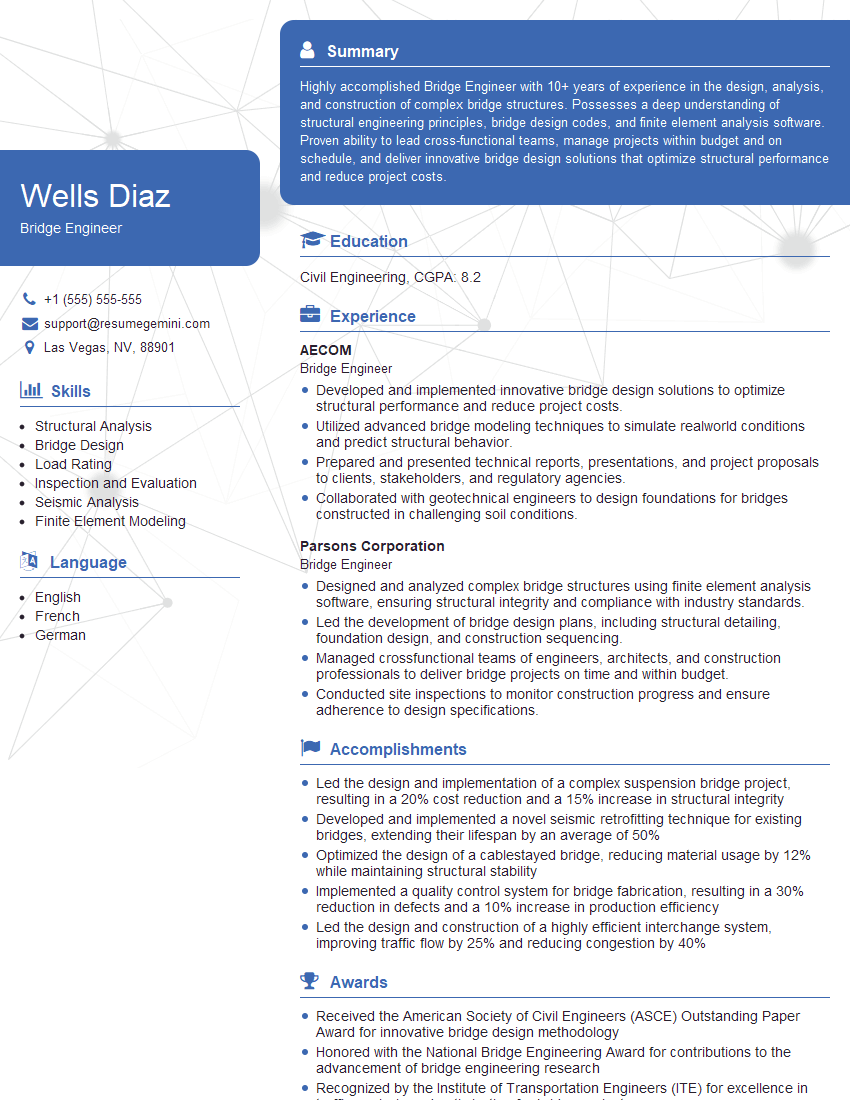
Mastering Static and Dynamic Structural Analysis is crucial for a successful career in structural engineering, opening doors to exciting projects and leadership opportunities. A well-crafted resume is your key to unlocking these prospects. Building an ATS-friendly resume significantly increases your chances of getting noticed by recruiters. To make this process easier and more effective, we strongly recommend using ResumeGemini. ResumeGemini provides a streamlined approach to resume building and offers examples of resumes tailored to roles in Static and Dynamic Structural Analysis, ensuring your qualifications shine.




Explore more articles
Users Rating of Our Blogs
Share Your Experience
We value your feedback! Please rate our content and share your thoughts (optional).
What Readers Say About Our Blog
Really detailed insights and content, thank you for writing this detailed article.
IT gave me an insight and words to use and be able to think of examples