Preparation is the key to success in any interview. In this post, we’ll explore crucial Statistical Analysis of Remote Sensing Data interview questions and equip you with strategies to craft impactful answers. Whether you’re a beginner or a pro, these tips will elevate your preparation.
Questions Asked in Statistical Analysis of Remote Sensing Data Interview
Q 1. Explain the difference between supervised and unsupervised classification techniques in remote sensing.
Supervised and unsupervised classification are two fundamental approaches in remote sensing image analysis, differing primarily in how they utilize training data. Think of it like teaching a child to identify objects.
Supervised classification is like showing a child pictures of cats and dogs and telling them which is which. We provide the algorithm with labeled samples (training data) representing different land cover classes (e.g., forest, water, urban). The algorithm then learns the spectral characteristics of each class and uses this knowledge to classify unseen pixels. Common supervised methods include Maximum Likelihood Classification (MLC), Support Vector Machines (SVM), and Random Forest.
Unsupervised classification, on the other hand, is like letting the child explore a picture book of animals and group them based on similarities without prior instruction. We don’t provide labeled samples; instead, the algorithm identifies natural groupings or clusters in the data based on spectral similarity. The analyst then interprets these clusters based on their spectral signatures and geographic context. K-means clustering and ISODATA are examples of unsupervised methods.
In essence, supervised methods require prior knowledge, leading to more accurate but potentially biased results. Unsupervised methods are exploratory and can reveal unexpected patterns but require more interpretation.
Q 2. Describe various methods for atmospheric correction in remote sensing data.
Atmospheric correction is crucial for obtaining accurate surface reflectance from remotely sensed data, as the atmosphere interacts with electromagnetic radiation, causing scattering and absorption. Imagine trying to see the true color of a painting through a hazy window – the window distorts the view. Several methods tackle this:
- Dark Object Subtraction (DOS): A simple method assuming the darkest pixel in an image represents zero reflectance. It’s easy to implement but can be inaccurate if no truly dark objects exist.
- Empirical Line Methods (ELM): These methods use relationships between known atmospheric parameters and sensor readings. They often rely on ground-based measurements or ancillary data.
- Radiative Transfer Models (RTM): These sophisticated models simulate the interaction of light with the atmosphere. MODTRAN and 6S are examples of widely used models. RTMs are computationally expensive but provide the most accurate atmospheric corrections if accurate input parameters are available (e.g., aerosol properties).
- Image-based methods: These methods derive atmospheric parameters directly from the image itself, using statistical relationships between pixels.
The choice of method depends on the sensor, the atmospheric conditions, and the desired accuracy. Often, a combination of methods is used. For example, you might use a simple method like DOS for a quick assessment and then a more rigorous RTM for higher-accuracy analysis.
Q 3. What are the common sources of error in remote sensing data, and how can they be mitigated?
Remote sensing data is susceptible to various errors that can compromise the accuracy and reliability of analyses. These errors can be broadly categorized into:
- Sensor errors: These include calibration errors, striping noise, and geometric distortions. Regular sensor calibration and quality control measures can minimize these.
- Atmospheric effects: Scattering and absorption of radiation by atmospheric components can alter the spectral signature of features on the ground, necessitating atmospheric correction techniques as described earlier.
- Geometric errors: Errors in geolocation, spatial resolution, and registration can lead to misalignment and inaccurate spatial relationships. Georeferencing and geometric correction techniques are essential to address these.
- Data acquisition errors: Cloud cover, shadows, and variations in sun angle affect the quality of the acquired data. Careful planning of data acquisition and the use of multiple images or dates can help mitigate these issues.
Mitigation Strategies: Error mitigation involves employing various preprocessing techniques such as atmospheric correction, geometric correction, radiometric calibration, and noise reduction. Moreover, using robust statistical methods that account for uncertainty and employing quality control measures throughout the analysis are vital.
Q 4. How do you handle missing data in remote sensing datasets?
Missing data is a common challenge in remote sensing, arising from cloud cover, sensor malfunctions, or data loss during transmission. Ignoring missing data can bias results. Several approaches exist:
- Deletion: Removing rows or columns with missing data is simple but reduces the dataset size and may introduce bias if missing data is not random.
- Imputation: Replacing missing values with estimated values. Methods include mean/median imputation (simple but can distort variability), k-Nearest Neighbors (k-NN) imputation (using values from nearby pixels), or more sophisticated methods like multiple imputation that create multiple plausible datasets.
- Interpolation: Estimating missing values using spatial interpolation techniques (see question 6). This is especially useful for spatially continuous data like elevation or temperature.
The best approach depends on the nature of the data, the extent of missing data, and the research question. For example, k-NN is suitable for spatially continuous data, while multiple imputation is more robust when dealing with non-randomly missing data. Always consider the potential impact of the imputation method on your analysis.
Q 5. Explain the concept of spatial autocorrelation and its implications in remote sensing analysis.
Spatial autocorrelation describes the degree to which nearby observations in a spatial dataset are more similar than those farther apart. Imagine a map of house prices: houses in the same neighborhood tend to have similar prices compared to houses in a different area. This spatial dependence violates the assumption of independence, often required in standard statistical analyses.
Implications in Remote Sensing: Ignoring spatial autocorrelation can lead to inaccurate statistical inferences. For instance, a simple regression model might overestimate the significance of relationships between variables if spatial clustering is present. Spatial autocorrelation also affects the estimation of variances, leading to potentially inflated Type I errors (false positives).
Handling Spatial Autocorrelation: Several techniques address spatial autocorrelation:
- Spatial filtering: Smoothing the data to reduce local variability.
- Geostatistical methods: Techniques like kriging account for spatial dependence during data interpolation and prediction.
- Spatial econometrics: Incorporating spatial weights matrices into regression models to account for spatial dependence.
Proper consideration of spatial autocorrelation ensures more robust and accurate results in remote sensing analysis.
Q 6. What are different types of spatial interpolation techniques and when would you use each?
Spatial interpolation techniques estimate values at unsampled locations based on values at known locations. This is essential when working with remotely sensed data that might have gaps or limited spatial coverage.
- Nearest Neighbor: Assigns the value of the nearest known location. Simple but can produce abrupt changes and is sensitive to outlier points.
- Inverse Distance Weighting (IDW): Weights values based on their distance from the unsampled location; closer points receive higher weights. Produces smoother surfaces than nearest neighbor but can be sensitive to data clustering.
- Kriging: A geostatistical method that considers both the distance and spatial autocorrelation between points. Optimal for situations with known or estimated spatial covariance structure. Provides estimates with associated uncertainties.
- Spline interpolation: Fits a smooth surface to the data using mathematical functions. Different spline types (e.g., thin-plate splines) offer different levels of smoothness and flexibility.
The choice of method depends on the data characteristics, the spatial arrangement of known points, and the desired level of smoothness. For example, Kriging is preferred when spatial autocorrelation is significant, while IDW might be sufficient for simple interpolation tasks.
Q 7. Describe your experience with different image registration and rectification methods.
Image registration and rectification are crucial steps in remote sensing data processing to ensure that images from different sources or different times align correctly. This enables accurate comparisons and analyses.
Image Registration: This involves aligning two or more images by identifying common features and transforming one image to match the geometry of the other (reference image). Methods include:
- Manual registration: A tedious process of manually identifying and matching control points. Suitable for low-resolution images or small areas.
- Automatic registration: Uses image processing algorithms to automatically identify and match control points, such as feature-based methods (e.g., SIFT, SURF) that find distinctive features in images, or area-based methods that correlate image patches.
Image Rectification: This transforms the image to a known map projection, removing geometric distortions caused by sensor perspective, Earth curvature, or relief displacement. This often involves using ground control points (GCPs) whose geographic coordinates are known.
My experience involves using both manual and automatic registration techniques using various software packages, including ERDAS Imagine and ENVI. I’ve worked extensively with GCP-based rectification using polynomial transformations to correct geometric distortions, ensuring accurate georeferencing of imagery. For instance, during a project involving change detection analysis over a forested region, accurate registration and rectification were essential to quantify deforestation over time.
Q 8. How do you assess the accuracy of your remote sensing classifications?
Assessing the accuracy of remote sensing classifications is crucial for ensuring the reliability of our results. We primarily use a combination of quantitative and qualitative methods. Quantitatively, we employ error matrices (also known as confusion matrices), which compare the classified map to a reference data set (e.g., ground truth data collected through fieldwork). This matrix provides key metrics like overall accuracy, producer’s accuracy (how well each class was classified), user’s accuracy (how reliable a classification is for a given class), and the kappa coefficient, which adjusts for chance agreement.
For example, if we’re classifying land cover types, we’d compare our classified image’s assignment of pixels to ‘forest,’ ‘urban,’ etc., against actual field observations of those same pixels. A low overall accuracy would indicate a problem with our classification process, prompting a review of our methodology, including the selection of input data, the classification algorithm, and the parameters used. The kappa coefficient is particularly useful as it corrects for the agreement that might occur simply by chance.
Qualitative assessments involve visual inspection of the classified map alongside aerial imagery or high-resolution satellite data to identify areas of misclassification. This visual comparison helps understand the spatial patterns of errors and inform improvements to the classification process. For instance, we might notice a systematic misclassification of a certain land cover type due to spectral confusion with another similar type, indicating a need for refining the spectral indices or classification algorithm.
Q 9. Explain the concept of NDVI and its applications.
The Normalized Difference Vegetation Index (NDVI) is a widely used spectral index that indicates the relative abundance of green biomass. It’s calculated using the near-infrared (NIR) and red reflectance values of a pixel: NDVI = (NIR - Red) / (NIR + Red). Values range from -1 to +1. Negative values usually represent water bodies, values near zero indicate bare soil or rock, and values close to +1 suggest dense vegetation.
NDVI has numerous applications, including:
- Monitoring vegetation health and growth: Changes in NDVI over time reflect seasonal variations, drought impacts, or the effectiveness of agricultural practices.
- Assessing crop yields: NDVI data can predict crop yields by providing an estimate of biomass.
- Detecting deforestation and forest degradation: Decreases in NDVI can indicate forest loss or degradation.
- Mapping vegetation cover: NDVI facilitates the creation of vegetation maps at various scales.
For instance, in precision agriculture, farmers use NDVI derived from drone imagery or satellite data to apply fertilizer or pesticides more efficiently, optimizing resource utilization and minimizing environmental impact.
Q 10. What are the advantages and disadvantages of using different remote sensing platforms (e.g., Landsat, Sentinel, MODIS)?
Different remote sensing platforms offer distinct advantages and disadvantages:
- Landsat: Offers a long-term historical record, high spatial resolution (30m for some bands), and good spectral coverage. However, its revisit time (frequency of image acquisition) is relatively long (16 days).
- Sentinel: Provides high spatial (10m for some bands) and temporal (daily for some satellites) resolution with free and open access data. The spectral coverage is excellent for various applications, though it might have some gaps compared to Landsat.
- MODIS: Provides very high temporal resolution (daily global coverage), making it ideal for monitoring dynamic processes like wildfire or flood. However, its spatial resolution is coarser (250m-1km), limiting its use for fine-scale analysis.
The choice depends on the specific application. If we need a long historical record and moderate spatial resolution, Landsat is suitable. For frequent monitoring with high spatial resolution and open data, Sentinel is preferred. For large-scale monitoring of dynamic events at a global level, MODIS becomes indispensable. The trade-offs between spatial, spectral, and temporal resolution are crucial considerations.
Q 11. How do you select appropriate spectral indices for a specific application?
Selecting appropriate spectral indices for a given application requires careful consideration of the target feature’s spectral characteristics and the available sensor data. We first identify the spectral signatures of the features of interest. For example, if monitoring chlorophyll content in vegetation, indices sensitive to the red and near-infrared regions, such as NDVI or EVI (Enhanced Vegetation Index), are optimal.
The choice of the index also depends on the characteristics of the sensor data, including the available spectral bands and their resolution. If dealing with data from a sensor lacking specific bands used in a particular index, an alternative index must be selected. Further, factors like atmospheric conditions, soil background, and potential shadows can affect the performance of different indices. It’s essential to consider the potential impact of these factors and choose robust indices that are less sensitive to these influences. We may also explore the literature for established indices commonly used for the specific application, comparing their advantages and limitations in the context of our data and project goals. In some instances, customized indices might be developed based on a thorough understanding of the target spectral signatures.
Q 12. Explain your experience working with different remote sensing software packages (e.g., ENVI, ArcGIS, QGIS).
I have extensive experience using various remote sensing software packages. ENVI is my preferred platform for image processing and analysis, particularly for tasks involving atmospheric correction, spectral unmixing, and advanced classification techniques. I frequently leverage its powerful tools for creating customized workflows to address specific project requirements. For example, I used ENVI to develop a robust methodology for mapping impervious surfaces from Landsat 8 imagery, incorporating advanced classification algorithms and post-classification refinement steps. ArcGIS is vital for geospatial data management, integration with other geodata (e.g., topography, soil data), and map creation. QGIS, while less comprehensive than ArcGIS and ENVI, is valuable as an open-source alternative for tasks such as data visualization and basic image analysis, offering cost-effectiveness and flexibility.
My experience spans working with these tools in various projects, from analyzing multispectral imagery to hyperspectral data sets. Proficiency in these software platforms allows for efficient and rigorous remote sensing analysis, ensuring data quality and accuracy throughout the entire process.
Q 13. Describe your proficiency in programming languages used in remote sensing data analysis (e.g., Python, R).
Python and R are both essential programming languages for remote sensing data analysis. Python, with libraries like rasterio, GDAL, scikit-learn, and numpy, offers exceptional flexibility for data manipulation, processing, and analysis. I use Python extensively for automating repetitive tasks, developing custom algorithms (e.g., for classification or change detection), and integrating remote sensing data with other datasets. For instance, I’ve developed Python scripts to automatically process large stacks of satellite images, performing atmospheric correction, creating NDVI time series, and performing object-based image analysis.
R, with packages like sp, raster, and rgdal, excels in statistical analysis, spatial modeling, and data visualization. I use R for statistical analysis of remote sensing data, particularly when investigating relationships between remotely sensed variables and environmental factors. For instance, I’ve used R to model the relationship between NDVI and rainfall to assess drought impacts on vegetation cover.
My proficiency in both languages enables me to tackle complex analyses efficiently and reproducibly, tailoring my approaches to specific project needs.
Q 14. Explain your understanding of different statistical distributions used in remote sensing analysis.
Several statistical distributions are relevant in remote sensing analysis. The normal distribution is often assumed for error terms in many statistical models. However, remote sensing data often deviates from normality due to various factors like atmospheric effects and sensor noise. The gamma distribution is used to model skewed data, commonly observed in remotely sensed reflectance values. The exponential distribution might model time-to-failure type scenarios. We often test for normality using Shapiro-Wilk or Kolmogorov-Smirnov tests.
Understanding these distributions allows for appropriate choices of statistical methods. If the assumption of normality is violated, we use non-parametric methods or transformations to ensure robust analysis. For instance, if analyzing vegetation indices, we often encounter skewed data, and we might apply a logarithmic transformation to approximate normality before performing parametric tests. In other cases, non-parametric methods like the Mann-Whitney U test or the Kruskal-Wallis test might be used directly without transformation. The correct choice of distribution and statistical method is crucial for drawing valid conclusions from the analysis.
Q 15. How do you handle outliers in your remote sensing datasets?
Outliers in remote sensing data, like unusually high or low pixel values, can significantly skew analyses. Identifying and handling them is crucial for accurate results. My approach is multifaceted.
Visual Inspection: I begin with visual examination of histograms and scatter plots to spot potential outliers. This provides a quick overview and helps identify patterns.
Statistical Methods: I employ robust statistical methods less sensitive to outliers. For example, instead of the mean, I might use the median, which is less affected by extreme values. The Interquartile Range (IQR) is invaluable for identifying data points beyond a certain range (e.g., 1.5 * IQR above the third quartile or below the first quartile).
Spatial Context: I consider the spatial context of the outlier. Is it a single pixel anomaly, or is it part of a larger, legitimate feature? A lone outlier might indicate sensor noise or an error, while a cluster could represent a genuine, unusual phenomenon.
Removal vs. Transformation: Simply removing outliers is risky, as it can remove valid data. Instead, I often prefer transformations. Log transformations, for example, can compress the range of data and reduce the influence of outliers.
Imputation: If removal or transformation is unsuitable, I might impute (replace) outliers with values from neighboring pixels using techniques like interpolation or kriging, leveraging the spatial autocorrelation present in remote sensing images.
For instance, in a project analyzing forest biomass, an outlier might be caused by a misclassification (e.g., a bright area in a forest classified as forest, but it may be a clear-cut area that was incorrectly classified), or shadow effects. Understanding the cause allows for informed decision-making about the best outlier handling strategy.
Career Expert Tips:
- Ace those interviews! Prepare effectively by reviewing the Top 50 Most Common Interview Questions on ResumeGemini.
- Navigate your job search with confidence! Explore a wide range of Career Tips on ResumeGemini. Learn about common challenges and recommendations to overcome them.
- Craft the perfect resume! Master the Art of Resume Writing with ResumeGemini’s guide. Showcase your unique qualifications and achievements effectively.
- Don’t miss out on holiday savings! Build your dream resume with ResumeGemini’s ATS optimized templates.
Q 16. Describe your experience with time-series analysis of remote sensing data.
Time-series analysis of remote sensing data is fundamental for monitoring dynamic processes like deforestation, urban expansion, or glacier melt. My experience encompasses various techniques.
Trend Analysis: I use techniques like linear regression or non-parametric methods (e.g., Theil-Sen estimator) to determine long-term trends in time-series data. This helps establish the rate and direction of change.
Seasonal Decomposition: Seasonal variations can mask underlying trends. I apply techniques like STL decomposition (Seasonal and Trend decomposition using Loess) to separate seasonal, trend, and residual components, allowing for more accurate trend analysis.
Change Point Detection: This identifies abrupt changes in the time series, such as the sudden onset of a drought or a major land cover change. Methods like Bayesian change point analysis or CUSUM are frequently used.
Remote Sensing Indices (RSIs): Time series of RSIs such as NDVI (Normalized Difference Vegetation Index) or EVI (Enhanced Vegetation Index) are commonly analyzed to monitor vegetation health over time. We can then utilize change detection algorithms to evaluate changes in vegetation health between different time points.
Software: I have extensive experience with R (using packages like ‘zoo’, ‘xts’, and ‘forecast’) and Python (using libraries like ‘pandas’ and ‘statsmodels’) for time-series analysis of remote sensing data.
In a recent project tracking agricultural yields, we used time-series NDVI data to predict crop yields and identify periods of stress related to water availability. This information was crucial for optimizing irrigation strategies.
Q 17. Explain your understanding of change detection techniques.
Change detection involves identifying differences in features or characteristics of a geographic area over time using remote sensing data from different dates. Many techniques exist, categorized broadly as pixel-based or object-based.
Pixel-Based Change Detection: This compares individual pixels from different dates. Simple methods include image differencing (subtracting one image from another) or image rationing. More sophisticated methods include post-classification comparison, where we classify images individually and then compare the classifications.
Object-Based Change Detection: This analyzes changes in objects (e.g., buildings, forests) instead of individual pixels, leveraging segmentation algorithms to group pixels into meaningful units. This approach is often more robust to noise and variations in image acquisition.
Specific Techniques: I have experience with various techniques, including:
- Image differencing and rationing
- Post-classification comparison
- Change vector analysis (CVA)
- Principal component analysis (PCA) for change detection
The choice of technique depends on the specific application and data characteristics. For example, in a study of urban growth, object-based change detection might be preferred because of the improved accuracy of detecting changes in defined objects like buildings, compared to pixel-based methods that may be affected by boundary problems.
Q 18. What are the challenges associated with analyzing high-resolution remote sensing data?
High-resolution remote sensing data presents unique challenges:
Data Volume: The sheer volume of data requires significant computational resources and efficient data storage solutions. Processing terabytes of data is common, requiring high-performance computing (HPC) and specialized software.
Computational Complexity: Analyzing high-resolution data is computationally intensive, especially for tasks like object-based image analysis or advanced classification techniques. Efficient algorithms and parallel processing are essential.
Data Heterogeneity: High-resolution data often contains more variability and complexity, making accurate classification and analysis more challenging. Careful consideration of spectral and spatial information is critical.
Cost: Acquiring and processing high-resolution data can be expensive, demanding careful planning and resource allocation.
Correction and Preprocessing: High-resolution data requires thorough atmospheric and geometric corrections to minimize errors and ensure accurate analysis. Careful attention to radiometric calibration is needed.
For instance, analyzing high-resolution LiDAR data to create detailed 3D models requires substantial computing power and expertise in point cloud processing. Careful data preprocessing is crucial to remove noise and ensure accuracy.
Q 19. How do you incorporate ancillary data to improve the accuracy of your remote sensing analyses?
Incorporating ancillary data significantly improves the accuracy and reliability of remote sensing analyses. Ancillary data provides contextual information that remote sensing data alone might lack.
Types of Ancillary Data: This can include topographic data (DEMs), land use/cover maps, climate data, soil data, census data, etc.
Integration Methods: Several methods exist for incorporating ancillary data:
Supervised Classification: Using ancillary data as predictor variables in a supervised classification improves the accuracy of land cover mapping. For example, elevation from a DEM could be used as a variable in classifying forest types.
Regression Modeling: Regression models can be employed to predict variables of interest (e.g., biomass, crop yield) using remote sensing data and ancillary data as predictor variables.
Post-Classification Refinement: Ancillary data can help refine initial classifications, correcting misclassifications based on known ground-truth information.
Data Fusion: Techniques like data fusion (combining data from different sources) can integrate the spatial information from remote sensing images and the thematic information from ancillary data.
In a project assessing flood risk, we used elevation data (DEM) and hydrological data to improve the accuracy of flood inundation mapping derived from satellite imagery. The inclusion of ancillary data in this scenario allowed for improved accuracy in delineating floodplains and zones prone to flooding.
Q 20. Explain your experience with object-based image analysis (OBIA).
Object-based image analysis (OBIA) is a powerful approach that analyzes images by segmenting them into meaningful objects rather than individual pixels. This allows for more context-aware analysis. My experience includes:
Segmentation Algorithms: I’m proficient in using various segmentation algorithms, such as multiresolution segmentation, watershed segmentation, and region growing, selecting the best algorithm based on the characteristics of the data and the research question.
Object Feature Extraction: I extract various spectral, spatial, and shape features from the segmented objects. These features are then used for classification or other analyses. Examples include mean pixel values, standard deviation, texture metrics, area, perimeter, and shape indices.
Object-Based Classification: I utilize various classification methods on the extracted object features, such as decision trees, support vector machines (SVMs), and random forests, which frequently outperform pixel-based classification in terms of accuracy and robustness.
Software: I have hands-on experience with software packages like eCognition and ArcGIS for OBIA workflows.
For example, in a study on urban land cover mapping, OBIA allowed us to accurately classify buildings and roads based on both spectral information (from satellite imagery) and shape characteristics, leading to better accuracy compared to traditional pixel-based methods, particularly in areas with complex or mixed land cover types.
Q 21. Describe your knowledge of different data formats used in remote sensing (e.g., GeoTIFF, HDF).
Remote sensing data comes in various formats, each with its strengths and weaknesses. Understanding these formats is crucial for efficient data handling and analysis.
GeoTIFF (.tif): A widely used format combining geospatial information (location, projection) with image data. It is relatively straightforward to work with, and widely supported by GIS software.
HDF (.hdf, .h5): Hierarchical Data Format is often used for storing large, multi-dimensional datasets, particularly from sensors like MODIS or Landsat. It is versatile and allows for efficient storage of different data types within a single file. However, it might require specialized software for access and manipulation.
ENVI (.img): This format is specifically designed for use within the ENVI remote sensing software package. It contains both image data and metadata.
Other formats: Other formats include NITF (National Imagery Transmission Format), which is used for storing high-resolution imagery from aerial and satellite sources, and various proprietary formats that can arise from specific sensors or applications.
The choice of format often depends on the source of the data and the software used for processing. My experience covers many formats, and I can adapt my workflow to handle different file types effectively.
Q 22. How do you ensure the reproducibility of your remote sensing analyses?
Reproducibility in remote sensing analysis is paramount for ensuring the reliability and validity of our findings. It’s like following a detailed recipe – if someone else follows the same steps, they should get the same results. We achieve this through meticulous documentation and the use of reproducible workflows.
Detailed Documentation: I meticulously document every step of my analysis, including data sources, preprocessing techniques, algorithms used, parameter settings, and any assumptions made. This documentation is crucial for others to replicate the study and for me to revisit my work later.
Version Control (e.g., Git): I utilize version control systems like Git to track changes in my code and data. This allows me to revert to previous versions if needed and provides a clear history of the analysis. Think of it as saving different versions of a document – you can always go back to an earlier draft.
Containerization (e.g., Docker): For complex analyses, I use containerization technologies like Docker to create reproducible environments. This ensures that the software and dependencies used are consistent across different systems, preventing discrepancies due to differing software versions or configurations.
Scripting Languages (e.g., Python with Jupyter Notebooks): I rely heavily on scripting languages like Python, often using Jupyter Notebooks, to automate my workflows. This makes the entire process transparent and easily reproducible. The code itself becomes the documentation for the steps taken.
For example, in a recent vegetation mapping project, I used a Docker container containing all necessary libraries and software versions to preprocess Landsat 8 data and perform classification. The complete code, along with the Dockerfile, was uploaded to a repository, allowing anyone to replicate my analysis.
Q 23. Explain your understanding of different image enhancement techniques.
Image enhancement techniques aim to improve the visual quality and information content of remote sensing imagery, making features easier to identify and analyze. It’s like enhancing a photograph to bring out details that might be otherwise hidden.
Linear Enhancement: Techniques like contrast stretching (e.g., histogram equalization) adjust the pixel values to improve the overall contrast and visibility of features. Think of it as adjusting the brightness and contrast on a photo.
Nonlinear Enhancement: Techniques such as histogram specification or equalizing histograms target specific ranges of pixel values for enhancement. This is especially useful for highlighting specific features of interest, such as differentiating subtle variations in vegetation density.
Spatial Filtering: This involves applying filters to smooth or sharpen the image. Smoothing filters remove noise, while sharpening filters enhance edges and boundaries. Think of smoothing out wrinkles in a photo or sharpening a blurry image.
Fourier Transforms: These are used to analyze spatial frequencies in the image and enhance specific frequency bands to improve resolution or reduce noise. This is a more advanced technique often used for image restoration.
Principal Component Analysis (PCA): This technique reduces the dimensionality of the data while retaining most of the variance. In remote sensing, this can be used to highlight features that are difficult to identify in the original bands, such as identifying subtle variations in soil type.
For instance, in a project involving urban planning, I used PCA to reduce the dimensionality of multispectral imagery, then applied contrast stretching to enhance the visibility of roads and buildings for better urban feature extraction.
Q 24. Describe your experience with the analysis of LiDAR data.
LiDAR (Light Detection and Ranging) data provides highly accurate three-dimensional information about the Earth’s surface. My experience with LiDAR data analysis involves a range of applications, from generating Digital Terrain Models (DTMs) to identifying individual trees in a forest canopy.
DTM Generation: I routinely process LiDAR point clouds to generate DTMs, representing the bare earth surface. This involves filtering out vegetation and other non-ground points.
Digital Surface Model (DSM) Generation: I create DSMs that include all points, representing the surface including buildings and vegetation. The difference between DSM and DTM represents the canopy height model, useful in forestry.
Object-Based Image Analysis (OBIA): I use OBIA techniques to segment and classify LiDAR data, identifying individual trees or buildings. This is crucial for applications such as forest inventory or urban analysis.
Change Detection: By comparing LiDAR datasets acquired at different times, I can detect changes in elevation, such as erosion or landslides.
In a recent project, I used LiDAR data to create a high-resolution DTM for a flood-prone area. This DTM was then used to model flood inundation and inform flood mitigation strategies. This involved filtering out noise from the point cloud, classifying ground points using algorithms like Cloth Simulation, and then interpolating them to create the DTM.
Q 25. How do you validate your remote sensing results?
Validating remote sensing results is essential to ensure their accuracy and reliability. It’s like testing a recipe – you need to make sure it produces the desired outcome. Validation methods vary depending on the application, but often involve a combination of approaches.
Ground Truthing: This involves collecting data on the ground (e.g., field measurements, GPS coordinates) to compare with the remote sensing results. For example, I might compare my classification of land cover types with field observations.
Accuracy Assessment: I perform accuracy assessments using metrics such as producer’s accuracy, user’s accuracy, overall accuracy, and the kappa coefficient to quantify the agreement between the remote sensing results and reference data.
Comparison with Existing Data: I might compare my results with existing datasets (e.g., topographic maps, census data) to assess consistency and identify potential discrepancies.
Independent Verification: If possible, I’ll have an independent team or expert validate my results to ensure objectivity. This is important for critical applications where the stakes are high.
In a recent project on crop yield estimation, I validated my results by comparing satellite-derived estimates with actual yield data obtained from farmers. This involved calculating accuracy metrics and identifying areas where the satellite-based estimates were less accurate, allowing for adjustments to the estimation model.
Q 26. Explain the importance of metadata in remote sensing data analysis.
Metadata is crucial in remote sensing data analysis; it’s the descriptive information that accompanies the data itself. It’s like the instructions on a food package – it tells you everything you need to know about the product. Without proper metadata, the data is essentially useless.
Data Acquisition Parameters: Metadata provides details about the sensor used (e.g., Landsat 8, Sentinel-2), the date and time of acquisition, and the spatial and spectral resolution. This is essential for understanding the capabilities and limitations of the data.
Preprocessing Steps: Information about any preprocessing steps (e.g., atmospheric correction, geometric correction) applied to the data is crucial for understanding how the data has been transformed and its potential biases.
Processing History: A record of all the processing steps is vital for reproducibility. It allows for tracing back to the origin of any errors or inconsistencies.
Geographic Information: Precise geographic coordinates and projections are essential for spatial analysis and integration with other geographic datasets.
Imagine trying to analyze a satellite image without knowing when it was acquired, what sensor was used, or its spatial resolution – it would be virtually impossible to interpret the results accurately. Metadata ensures that the analysis is sound and the results are reliable.
Q 27. How do you handle large remote sensing datasets?
Handling large remote sensing datasets requires efficient strategies and tools. It’s like managing a massive library – you need an organized system to access and process the information efficiently.
Cloud Computing: I leverage cloud computing platforms (like AWS, Google Cloud, or Azure) to store and process large datasets. These platforms provide scalable computing resources and storage solutions.
Parallel Processing: I use parallel processing techniques to distribute the computational workload across multiple processors, significantly reducing processing time. Think of it like assigning different tasks to different members of a team.
Data Subsetting: When working with very large datasets, I often process subsets of the data at a time to manage memory usage and processing time. This is similar to breaking a large project into smaller, more manageable tasks.
Big Data Tools: I employ big data tools like Hadoop or Spark for processing and analyzing extremely large datasets that exceed the capacity of traditional computing environments.
Data Compression: I often employ appropriate data compression techniques to reduce storage requirements and improve processing efficiency.
For example, in a national-scale land cover mapping project, I used Google Earth Engine to process and analyze a massive amount of Landsat imagery. The platform’s scalability and parallel processing capabilities enabled the efficient processing of the data.
Q 28. Describe your experience with cloud computing platforms for remote sensing data processing.
Cloud computing platforms are invaluable for remote sensing data processing, offering significant advantages in terms of scalability, cost-effectiveness, and accessibility. It’s like having a powerful, always-available laboratory at your fingertips.
Scalability: Cloud platforms can easily scale to handle datasets of any size, providing the computing power needed for complex analyses without the need for significant upfront investment in hardware.
Cost-Effectiveness: Cloud computing often reduces costs compared to maintaining an on-premises high-performance computing cluster. You only pay for the resources you use.
Accessibility: Cloud platforms are accessible from anywhere with an internet connection, enabling collaboration and remote work.
Pre-built Tools and Libraries: Many cloud platforms offer pre-built tools and libraries specifically designed for remote sensing data processing, simplifying workflow development.
I have extensive experience using Google Earth Engine for processing large satellite image datasets. Its cloud-based infrastructure and integrated tools have enabled me to perform computationally intensive tasks such as large-area classification and time-series analysis much more efficiently than would be possible on a local machine. I’ve also used Amazon Web Services (AWS) for storing and managing large datasets and for running more specialized workflows requiring specific software configurations.
Key Topics to Learn for Statistical Analysis of Remote Sensing Data Interview
- Descriptive Statistics & Data Exploration: Understanding data distributions, measures of central tendency and dispersion, and visualization techniques for remote sensing data (histograms, box plots, scatter plots).
- Data Preprocessing & Cleaning: Handling missing data, outlier detection and removal, atmospheric correction, and geometric corrections crucial for accurate analysis.
- Regression Analysis: Applying linear and non-linear regression models to relate remote sensing data to ground truth measurements (e.g., predicting crop yield from NDVI).
- Classification Techniques: Mastering supervised (e.g., Maximum Likelihood Classification, Support Vector Machines) and unsupervised (e.g., K-means clustering) classification methods for land cover mapping.
- Change Detection: Analyzing multi-temporal remote sensing data to identify changes over time (e.g., deforestation, urban sprawl) using techniques like image differencing and post-classification comparison.
- Spatial Statistics: Understanding spatial autocorrelation, geostatistical techniques (kriging), and spatial regression models for analyzing spatially dependent data.
- Error Analysis & Uncertainty Assessment: Quantifying uncertainties associated with remote sensing data and analysis results, including accuracy assessment metrics (e.g., overall accuracy, Kappa coefficient).
- Software Proficiency: Demonstrating expertise in relevant software packages like R, Python (with libraries like GDAL, rasterio, scikit-learn), ENVI, or ArcGIS.
- Case Studies & Applications: Preparing examples of how you’ve applied these statistical methods to solve real-world problems using remote sensing data in your field of interest.
Next Steps
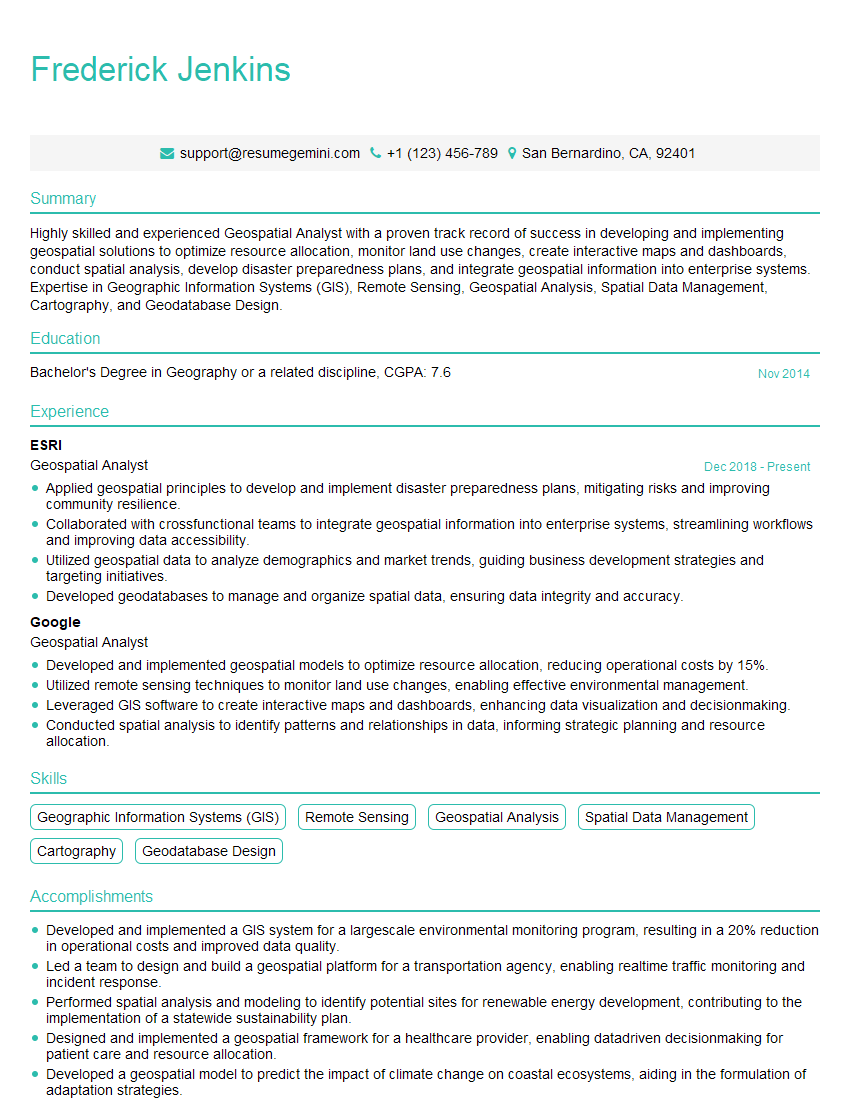
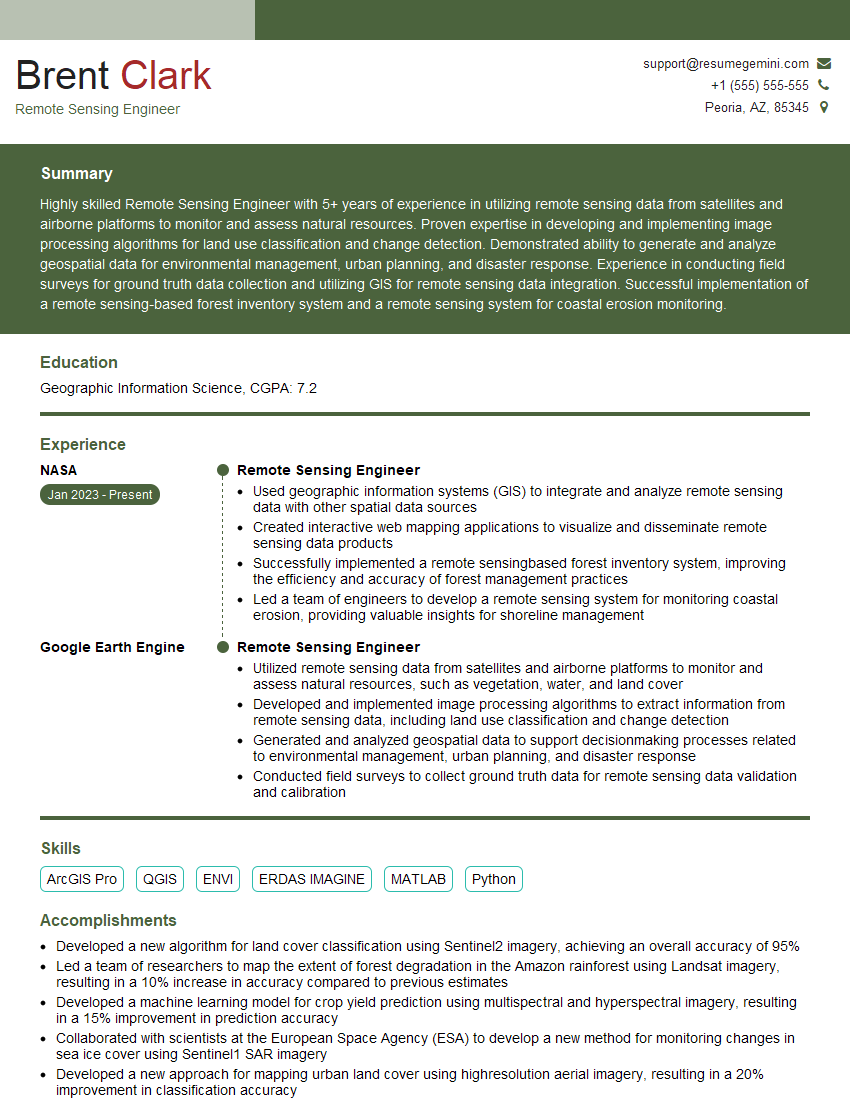
Mastering statistical analysis of remote sensing data significantly enhances your career prospects in fields like environmental monitoring, precision agriculture, urban planning, and natural resource management. A strong understanding of these techniques demonstrates valuable analytical and problem-solving skills highly sought after by employers. To stand out, it’s crucial to present your skills effectively. Creating an ATS-friendly resume is key to getting your application noticed. ResumeGemini is a trusted resource to help you build a professional and impactful resume that highlights your expertise. Examples of resumes tailored to Statistical Analysis of Remote Sensing Data are available to guide you.
Explore more articles
Users Rating of Our Blogs
Share Your Experience
We value your feedback! Please rate our content and share your thoughts (optional).
What Readers Say About Our Blog
Really detailed insights and content, thank you for writing this detailed article.
IT gave me an insight and words to use and be able to think of examples