Preparation is the key to success in any interview. In this post, we’ll explore crucial Meat Carving and Butchery interview questions and equip you with strategies to craft impactful answers. Whether you’re a beginner or a pro, these tips will elevate your preparation.
Questions Asked in Meat Carving and Butchery Interview
Q 1. Explain the difference between wet-aging and dry-aging beef.
Both wet-aging and dry-aging are methods of tenderizing beef, improving its flavor and texture, but they differ significantly in their approach. Wet-aging involves storing the beef in a vacuum-sealed package, allowing for enzymatic breakdown of muscle fibers. This process occurs at a slower rate due to the controlled environment. Dry-aging, on the other hand, involves storing the beef uncovered in a temperature and humidity-controlled environment. This allows for surface dehydration and the concentration of flavors. The surface of the meat will lose moisture and form a hard crust, which is then trimmed away before the meat is sold.
Key Differences:
- Moisture Loss: Wet-aging retains significantly more moisture, resulting in less weight loss. Dry-aging leads to substantial moisture loss, often 10-20% or more, resulting in a more concentrated flavor.
- Flavor Profile: Dry-aged beef develops a more intense, umami-rich flavor due to the concentration of flavors from moisture loss. Wet-aged beef retains more of its original, milder flavor.
- Tenderness: Both methods tenderize the meat through enzymatic action, although dry-aging might achieve slightly more tenderness due to the longer aging period and increased enzymatic activity.
- Cost: Dry-aging is more expensive due to the significant weight loss, and more complex environmental requirements to ensure consistent high quality, while wet-aging is a more cost-effective method.
Think of it this way: wet-aging is like marinating your meat gently, while dry-aging is like letting the meat age and develop its full flavor profile over a much longer time period.
Q 2. Describe the proper technique for breaking down a whole hog.
Breaking down a whole hog is a multi-step process requiring precision and a strong understanding of hog anatomy. It’s crucial to work hygienically and use sharp knives to prevent tearing and maximize yield. I typically start with:
- Head Removal: Sever the head at the atlas vertebra (first neck bone) using a cleaver or heavy-duty knife.
- Feet Removal: Remove the feet at the ankle joints using a cleaver or saw.
- Splitting the Carcass: Split the carcass down the center using a cleaver or band saw, creating two halves.
- Removing the Shoulder: Separate the shoulder from the rib cage by sawing or cutting through the bones. This creates the picnic shoulder.
- Rib Removal: Remove the ribs and back from the carcass. The ribs can be further divided into racks or individual ribs. The back becomes the loin and tenderloin.
- Loin and Tenderloin Separation: Carefully separate the tenderloin (a long, slender muscle) from the loin (larger muscle).
- Leg Removal: Remove the hind legs (hams) at the hip joints.
- Belly Removal: Remove the belly, which is used for bacon or other cured products.
Throughout the process, I carefully separate different muscle groups to maximize yield and maintain the integrity of individual cuts. Yield and quality greatly depend on how well the cuts are made. Proper utilization of specialized tools (like a meat hook) and knowledge of the anatomy is essential for efficiency and safety.
Q 3. What are the key cuts of a beef primal rib?
The beef primal rib, a large cut located between the chuck and the short loin, yields several valuable cuts. The key cuts include:
- Standing Rib Roast: A large roast encompassing several ribs, ideal for roasting whole.
- Rib Roast (bone-in or boneless): Sections of the standing rib roast, available in various rib counts (e.g., 3-bone, 4-bone).
- Rib-Eye Steaks (or Ribeyes): Individual steaks cut from the rib-eye muscle, prized for marbling and tenderness. These are some of the most expensive steaks available.
- Back Ribs (or Short Ribs): Often cut from the lower portion of the rib primal, very flavorful and delicious.
The quality and yield of each cut depend on the degree of marbling (fat distribution) and the overall quality grade of the beef. A skilled butcher understands how to identify these key characteristics to maximize the value of the primal rib.
Q 4. How do you identify and address spoilage in meat?
Identifying spoilage in meat requires keen observation and an understanding of the signs. Spoilage is primarily due to microbial growth or enzymatic breakdown. Here are some key indicators:
- Off-Odor: A sour, putrid, or ammonia-like smell is a strong indicator of spoilage.
- Slimy Surface: A slimy or sticky surface on the meat is a major sign of bacterial growth.
- Discoloration: Meat turning grayish-brown or greenish-black is often a sign of spoilage.
- Changes in Texture: Meat becoming sticky, soft, or mushy is also a clear indication.
- Unusual Appearance: Changes in texture or color that are inconsistent with the type of meat.
Addressing Spoilage:
If spoilage is suspected, the meat must be discarded immediately. It should not be consumed under any circumstances as it can cause foodborne illness. Proper storage and handling are crucial to prevent spoilage. This includes maintaining proper refrigeration temperatures and minimizing cross-contamination.
Q 5. What are the USDA grading standards for beef?
The USDA grading standards for beef are based on factors like marbling (intramuscular fat), maturity (age of the animal), and firmness and texture of the meat. The grades are typically represented using the following letters:
- Prime: The highest grade, exhibiting abundant marbling, resulting in excellent tenderness, juiciness, and flavor.
- Choice: Moderately abundant marbling, resulting in very good tenderness, juiciness, and flavor.
- Select: Less marbling than Choice, still palatable but slightly less tender and flavorful.
- Standard and Commercial: Less desirable grades due to less marbling. These grades are often used for ground beef or processed products.
- Utility, Cutter, and Canner: These are the lowest grades and typically used for processed meats.
While the grading system primarily reflects quality in terms of palatability and flavor, it’s worth remembering that proper handling and cooking methods significantly impact the final outcome regardless of the grade.
Q 6. Explain the process of making sausage.
Sausage making is a culinary art combining meat science and culinary skill. The process generally involves these steps:
- Meat Selection: Choosing the right type and cut of meat is crucial, depending on the desired sausage type. This often involves a blend of lean meats and fat to achieve the desired texture and flavor.
- Grinding: The meat is ground using a meat grinder, often to a specific consistency determined by the recipe.
- Mixing: The ground meat is mixed with spices, seasonings, and other ingredients (such as water, ice, or curing agents). The quality of your sausage heavily depends on the seasoning mixture, which is frequently adjusted based on experience or the desired sausage type.
- Stuffing: The mixture is then stuffed into casings (natural or artificial). This can be done manually or using a sausage stuffer. This process requires practice to maintain consistent casing filling.
- Curing (optional): Some sausages, like salami, require curing which involves aging the product under carefully controlled environmental conditions.
- Cooking: Finally, the sausage is cooked using a variety of methods such as grilling, frying, smoking, boiling, or baking, depending on the specific sausage recipe and type.
Safety is paramount throughout the process. Maintaining proper hygiene and handling techniques are essential to prevent foodborne illnesses. The finished product depends heavily on every single step being completed to a high standard.
Q 7. How do you maintain proper sanitation and hygiene in a butcher shop?
Maintaining proper sanitation and hygiene in a butcher shop is paramount to prevent foodborne illnesses and ensure product safety. This requires a multifaceted approach:
- Regular Cleaning and Sanitization: All surfaces, equipment, and tools must be cleaned and sanitized regularly using appropriate food-grade sanitizers. This usually involves a two-step process; cleaning with detergent and then a thorough sanitizing rinse.
- Handwashing: Employees must wash their hands thoroughly and frequently, especially after handling raw meat and before handling other products or touching any ready-to-eat food. This is probably the most critical component of any food-handling operation.
- Proper Temperature Control: Maintaining proper refrigeration and freezing temperatures is crucial to prevent the growth of harmful bacteria. Regular temperature checks of refrigerators and freezers are very important.
- Cross-Contamination Prevention: Raw meat must be handled separately from ready-to-eat foods to prevent cross-contamination. Using separate cutting boards and utensils is critical. Raw meat must be stored below other food items to avoid dripping and cross contamination.
- Waste Disposal: Proper disposal of waste materials, including bones, scraps, and packaging, is also a vital part of sanitation and hygiene, to avoid attracting insects and rodents.
- Pest Control: Implementing pest control measures to keep insects and rodents out of the butcher shop is very important, as this also prevents contamination of the products.
Regular inspections and adherence to food safety regulations are crucial to ensure a sanitary and hygienic environment, contributing to overall food safety.
Q 8. Describe your experience with various cutting tools and equipment.
My experience with cutting tools and equipment spans over 15 years, encompassing a wide range from basic butcher knives to specialized power tools. I’m proficient with various types of knives: breaking knives for large cuts, boning knives for precise work around bones, and trimming knives for removing fat and sinew. I also have extensive experience with band saws for efficient cutting of large primal cuts, meat grinders for sausages and ground meats, and vacuum sealers for proper storage and preservation. My understanding extends beyond simply using these tools; I know how to properly sharpen and maintain them, ensuring optimal performance and safety. For example, I’ve developed a sharpening routine for my knives that involves a honing steel followed by a sharpening stone, leading to cleaner cuts and longer knife lifespan. Proper maintenance of a band saw involves regularly cleaning the blade and ensuring tension is correct to prevent accidents and ensure precision. This holistic approach ensures both safety and high-quality results.
Q 9. How do you handle customer inquiries and complaints related to meat quality?
Handling customer inquiries and complaints regarding meat quality is crucial for maintaining customer satisfaction. My approach involves active listening and empathetic communication. I start by acknowledging the customer’s concern, then carefully examine the meat in question. If the complaint is valid, such as discoloration or off-odor indicating spoilage, I immediately offer a replacement or refund. I document each complaint to identify trends and address potential issues within our processes. For instance, if multiple complaints point to a specific supplier’s meat, we investigate that supplier’s practices. I believe in proactive communication, keeping customers updated throughout the resolution process. Building rapport and demonstrating a genuine desire to address their concerns is key. Once a problem is solved, I often follow up to ensure their continued satisfaction.
Q 10. What are the different methods for trimming fat from meat?
Trimming fat from meat involves several methods, depending on the cut and desired outcome. The most common methods include:
- Manual trimming with a knife: This is precise and allows for selective fat removal. Different knives are used depending on the thickness of the fat and the desired level of trimming.
- Using a fat trimming machine: These machines efficiently remove large amounts of fat from larger cuts of meat. It’s important to adjust the settings properly to avoid removing too much lean meat.
- Deboning: Often, fat removal is integrated with deboning; the fat is removed along with the bone.
The choice of method depends on several factors including the type of meat, the desired leanness, and the scale of operation. For example, a whole beef tenderloin requires careful manual trimming to maintain its shape and tenderness. On the other hand, large quantities of ground beef might benefit from a trimming machine for speed and efficiency. The key is to maintain consistency in fat removal across cuts to meet both customer preference and operational standards.
Q 11. Explain your knowledge of different meat cuts and their culinary applications.
My knowledge of meat cuts and their culinary applications is extensive. I understand the different primal cuts (e.g., chuck, loin, rib, round for beef) and sub-primal cuts (e.g., sirloin, tenderloin, short ribs) of various animals, including beef, pork, lamb, and poultry. This knowledge extends to understanding the muscle structure and how it influences the meat’s texture, flavor, and tenderness. For example, a chuck roast, being a tougher cut, is ideally suited for slow cooking methods like braising or stewing, while a tenderloin, being tender, is perfect for grilling or pan-searing. Understanding the appropriate cooking method for each cut enhances its culinary potential. Similarly, specific cuts are better suited for certain dishes: short ribs for BBQ, sirloin for steak, and pork belly for roasting. This knowledge allows me to provide customers with insightful recommendations for preparing different cuts of meat, catering to their cooking preferences and skill levels.
Q 12. What is your experience with portioning and packaging meat?
My experience in portioning and packaging meat is a critical part of my role. Accurate portioning ensures consistency and minimizes waste. I use various techniques, including weighing and visual estimation, depending on the customer order and the type of meat. For instance, steaks are typically weighed to ensure uniformity, while roasts are often visually assessed. Packaging is crucial for maintaining freshness and extending shelf life. I use various packaging materials, including vacuum-sealed bags, butcher paper, and plastic trays, selecting the appropriate option based on the type of meat and its intended use. Proper labeling is essential, including weight, cut, and date. Efficient and attractive packaging contributes significantly to customer satisfaction.
Q 13. Describe your experience with inventory management in a butcher shop.
Effective inventory management is critical in a butcher shop. I’m experienced with various methods, including FIFO (First-In, First-Out) to minimize spoilage, maintaining detailed records of stock levels, and utilizing inventory management software to track purchasing, sales, and stock rotation. Regularly checking for spoilage and rotating stock is essential to avoid losses. This involves carefully inspecting meat for any signs of spoilage and removing expired or damaged products immediately. Accurate forecasting helps to prevent overstocking or shortages. I use historical sales data to estimate demand, allowing me to order appropriate quantities. This proactive approach minimizes waste and ensures that the shop has sufficient stock to meet customer demand. Regular audits ensure the accuracy of inventory records, confirming physical stock matches the recorded data.
Q 14. How do you ensure food safety regulations are followed?
Ensuring food safety is paramount. I adhere strictly to all relevant food safety regulations, including proper temperature control (maintaining cold chain integrity), hygienic practices (handwashing, sanitation of equipment), and safe handling techniques. This includes understanding and following guidelines set by organizations like the FDA. For example, ensuring the temperature of the walk-in cooler is maintained below 40°F (4°C) is crucial for preventing bacterial growth. Detailed record-keeping, documenting temperatures, and cleaning and sanitization procedures, is essential for traceability and compliance audits. Furthermore, staff training on food safety regulations is an ongoing process, ensuring everyone understands and follows established protocols. This commitment to food safety not only safeguards public health but also builds customer trust and confidence in our shop.
Q 15. What are the different types of knives used in butchering?
A butcher’s knife collection is like a painter’s palette – each tool serves a specific purpose. We use a variety of knives, each designed for optimal performance on different cuts and tasks.
- Breaking Knife: A heavy, broad-bladed knife ideal for splitting large bones and cutting through tough connective tissues. Think of it as your demolition tool for the tougher cuts.
- Butcher Knife: A versatile knife with a long, strong blade, used for general butchering tasks, from trimming fat to portioning meat. It’s the workhorse of the kitchen.
- Boning Knife: A thinner, flexible blade perfect for separating meat from bone. Its flexibility allows you to navigate around bone structures with precision.
- Slicing Knife: Long and thin, designed for creating thin, even slices of cooked meats, roasts, or cured products. Think of slicing ham or roast beef.
- Scimitar Knife: A curved blade excellent for trimming and portioning larger cuts. Its shape helps in navigating the contours of the meat.
- Meat Cleaver: A heavy, rectangular blade used for chopping bones and meat, frequently utilized when processing poultry.
Choosing the right knife for the job is crucial for efficiency and safety. For instance, attempting to bone a chicken with a cleaver would be clumsy and dangerous.
Career Expert Tips:
- Ace those interviews! Prepare effectively by reviewing the Top 50 Most Common Interview Questions on ResumeGemini.
- Navigate your job search with confidence! Explore a wide range of Career Tips on ResumeGemini. Learn about common challenges and recommendations to overcome them.
- Craft the perfect resume! Master the Art of Resume Writing with ResumeGemini’s guide. Showcase your unique qualifications and achievements effectively.
- Don’t miss out on holiday savings! Build your dream resume with ResumeGemini’s ATS optimized templates.
Q 16. Explain the proper sharpening techniques for butcher knives.
Sharpening butcher knives is an essential skill; a dull knife is dangerous because it requires more force, increasing the risk of slips and accidents.
I use a honing steel daily to maintain the knife’s edge. Think of it as straightening the teeth on a saw. Then, for a proper sharpening, I prefer a sharpening steel or whetstone, using a consistent angle (usually around 20 degrees) for both sides of the blade, employing a sweeping motion from heel to tip.
This is a careful process; it’s like sculpting, shaping the blade’s edge progressively. Regular sharpening not only ensures safety but also significantly improves the quality of your cuts; you’ll get cleaner cuts, minimizing meat damage and ensuring uniform portions.
Q 17. How do you handle bone-in and boneless cuts?
Handling bone-in versus boneless cuts requires different techniques and considerations.
Bone-in cuts: Require careful maneuvering of the knife to separate the meat from the bone without damaging either. For example, when boning a leg of lamb, you would use a boning knife to carefully work along the bone, following its contours. Precision and patience are key here.
Boneless cuts: Are generally easier to handle, requiring straightforward cutting and trimming. However, attention is still necessary for uniform portioning and achieving a visually appealing product. For instance, trimming a boneless chicken breast requires precision for creating uniformly sized cutlets.
Regardless of whether the cut is bone-in or boneless, sanitation and safety are paramount throughout the entire process. Proper handling prevents cross-contamination and reduces the risk of injury.
Q 18. What is your experience with grinding meat?
Grinding meat is a common task, and I’m highly experienced in operating various grinders, from small commercial models to large industrial units. Proper technique is crucial for ensuring a smooth, consistent grind.
I understand the importance of selecting the correct grinding plate for the desired texture – coarser plates for sausages and burgers, finer ones for items like meatloaf or pâté. I’m meticulous in ensuring that the meat is properly chilled and processed to prevent overheating, maintaining the texture and quality of the end product. In addition, maintaining proper hygiene throughout the grinding process is non-negotiable.
Experience has taught me to recognize and address potential issues like clogging or uneven grinding, adapting my technique as needed.
Q 19. How do you determine the doneness of meat using various methods?
Determining the doneness of meat requires a combination of methods, utilizing sight, touch, and temperature measurement.
- Visual Inspection: Observing the color change of the meat is a key indicator. For example, a rare steak will have a red center, while a well-done steak will be brown throughout.
- Touch Test: Gently pressing the meat can indicate its doneness. A rare steak will feel soft and yielding, while a well-done steak will feel firm.
- Thermometer: The most accurate method is using a meat thermometer to measure the internal temperature, which is important for food safety. Different meats have different ideal temperatures.
The combination of visual inspection, touch test, and temperature measurement provides the most comprehensive assessment of meat doneness, ensuring both quality and safety.
Q 20. What is your experience with different types of poultry processing?
My experience with poultry processing is extensive, encompassing all aspects from initial inspection and cleaning to cutting, portioning, and packaging. I’m familiar with processing various types of poultry, including chickens, turkeys, ducks, and geese.
I understand the importance of maintaining hygiene throughout the process to prevent bacterial contamination. I’m skilled in using different tools, including poultry shears and knives, to effectively and efficiently process birds of different sizes and weights. I can easily perform tasks such as deboning, skinning, and portioning, following all safety and sanitary guidelines.
I’m also experienced in preparing poultry for specific applications, such as roasting, grilling, or other cooking methods.
Q 21. How do you handle customer orders and special requests?
Handling customer orders and special requests is a crucial part of my job. I always listen carefully to customer needs, clarifying any ambiguities to ensure I accurately understand their requirements.
I’m adept at suggesting appropriate cuts or alternative options when necessary, always providing helpful information about the different cuts and their suitability for various recipes. I prioritize clear communication, confirming details before processing orders.
Special requests, such as custom cuts or specific packaging needs, are handled with careful attention, and I always strive to exceed customer expectations. Customer satisfaction is a top priority.
Q 22. Describe your experience with working under pressure and meeting deadlines.
In my previous role at Miller’s Meats, we often faced peak demands during holiday seasons, requiring us to process and package significantly more meat than usual within tight deadlines. I thrived under this pressure. My experience in managing a team, prioritizing tasks, and maintaining quality control under intense workload allowed us to consistently meet our deadlines and exceed customer expectations. For example, during last year’s Thanksgiving rush, we received a last-minute order for 500 turkeys. By effectively delegating tasks, optimizing our workflow, and ensuring clear communication, we not only fulfilled the order but also maintained our high standards of quality and hygiene. This experience instilled in me the importance of proactive planning, efficient resource management, and strong teamwork in high-pressure environments.
Q 23. What are your salary expectations for this position?
My salary expectations are in the range of $60,000 to $75,000 per year, depending on the specifics of the benefits package and the overall responsibilities of the role. This is based on my extensive experience, my proven track record of success in high-volume butchering environments, and my specialized skills in meat preservation and quality control. I am open to discussing this further and am confident we can reach a mutually agreeable figure.
Q 24. What are your strengths and weaknesses as a butcher?
My greatest strength lies in my meticulous attention to detail, particularly in the crucial aspects of meat cutting and trimming. I pride myself on my ability to consistently produce high-quality cuts with minimal waste. This is a skill honed over years of practice and a deep understanding of different muscle structures and meat anatomy. For instance, I can consistently achieve a 98% yield on a prime rib roast, minimizing trim waste. However, my biggest weakness used to be delegating tasks effectively, especially when under intense time pressure. I’ve actively addressed this through dedicated training in leadership and team management, and I now feel confident in guiding and mentoring junior butchers.
Q 25. Why are you interested in this particular butchering position?
I am particularly interested in this butchering position because of [Company Name]’s reputation for exceptional quality and its commitment to sustainable practices. I’ve been consistently impressed by your commitment to sourcing locally, and I strongly align with this ethos. My skills in precision cutting, meat preservation, and customer service would be a valuable asset to your team. I am eager to contribute my expertise to a company that prioritizes both ethical sourcing and the highest standards of meat quality.
Q 26. Describe your experience with different meat preservation techniques.
My experience encompasses a wide range of meat preservation techniques, including:
- Refrigeration: Understanding the optimal temperature ranges and storage times for different types of meat to prevent bacterial growth and maintain quality.
- Freezing: Employing proper freezing techniques to minimize ice crystal formation, which can compromise texture. This includes rapid freezing methods, such as blast freezing.
- Vacuum Sealing: Using vacuum sealing to remove air and extend the shelf life of meat products, minimizing oxidation and preventing freezer burn.
- Curing: Employing various curing techniques, such as dry curing and brine curing, to enhance flavor and shelf life of products like ham and bacon, and to understand and apply the relevant food safety regulations. This involves a deep understanding of salt concentrations, curing times, and temperature control.
- Smoking: Utilizing smoking techniques to add flavor and extend shelf life while carefully controlling temperature and smoke exposure to prevent overcooking and preserve the meat’s integrity.
I am proficient in selecting the appropriate preservation method based on factors such as the type of meat, desired shelf life, and desired flavor profile.
Q 27. How do you maintain the freshness and quality of meat products?
Maintaining freshness and quality starts with sourcing high-quality meat. After that, meticulous attention to temperature control is paramount throughout the entire process. This includes maintaining consistently cold temperatures during storage, processing, and display. We employ FIFO (First In, First Out) inventory management to ensure that older products are used before newer ones. Proper hygiene protocols, including handwashing, sanitation of equipment, and use of appropriate protective gear are essential to prevent contamination. Regular quality checks throughout the process, and actively monitoring for any signs of spoilage, help ensure only the freshest meat reaches the customer.
Q 28. Describe a time you had to solve a problem related to meat quality or spoilage.
During a particularly busy summer, we experienced a rapid increase in the spoilage rate of ground beef. Initially, I suspected a refrigerator malfunction. However, a thorough investigation revealed that the issue wasn’t the refrigeration but rather a lapse in proper hygiene practices during the grinding process. We implemented a stricter sanitation protocol before, during and after the grinding process, including more frequent cleaning and sanitization of the grinder itself. This included employee retraining on proper hygiene procedures. The spoilage rate subsequently dropped significantly. This experience taught me the value of systematic troubleshooting and the importance of addressing hygiene concerns proactively to prevent costly losses and ensure food safety.
Key Topics to Learn for Your Meat Carving and Butchery Interview
- Understanding Meat Anatomy: Learn the bone structure, muscle groups, and fat distribution of various animal carcasses (beef, pork, lamb, poultry). This foundational knowledge is crucial for efficient and accurate cutting.
- Safe Handling and Sanitation Practices: Demonstrate your understanding of food safety regulations, including proper hygiene, temperature control, and preventing cross-contamination. This is paramount in the industry.
- Different Cuts and Their Applications: Master the names, characteristics, and culinary uses of various meat cuts. Be prepared to discuss the differences between cuts and how to select the best option for a specific recipe or cooking method.
- Knife Skills and Techniques: Showcase your proficiency in various knife techniques, including breaking down carcasses, trimming fat, and creating specific cuts. Practice your precision and speed.
- Yield and Waste Management: Explain your strategies for maximizing yield and minimizing waste during the butchering process. This demonstrates cost-effectiveness and resourcefulness.
- Equipment Knowledge: Familiarize yourself with the various tools and equipment used in a butchery, including saws, cleavers, grinders, and their safe operation.
- Quality Control and Assessment: Explain how to evaluate the quality of meat, identifying factors like marbling, color, and texture. Discuss methods for ensuring consistent quality throughout the process.
- Inventory Management and Ordering: Demonstrate your understanding of inventory control, forecasting needs, and placing orders to minimize spoilage and meet customer demands.
- Problem-Solving and Adaptability: Be ready to discuss situations where you’ve had to solve a problem related to meat quality, equipment malfunction, or unexpected orders. Highlight your ability to adapt to changing circumstances.
Next Steps
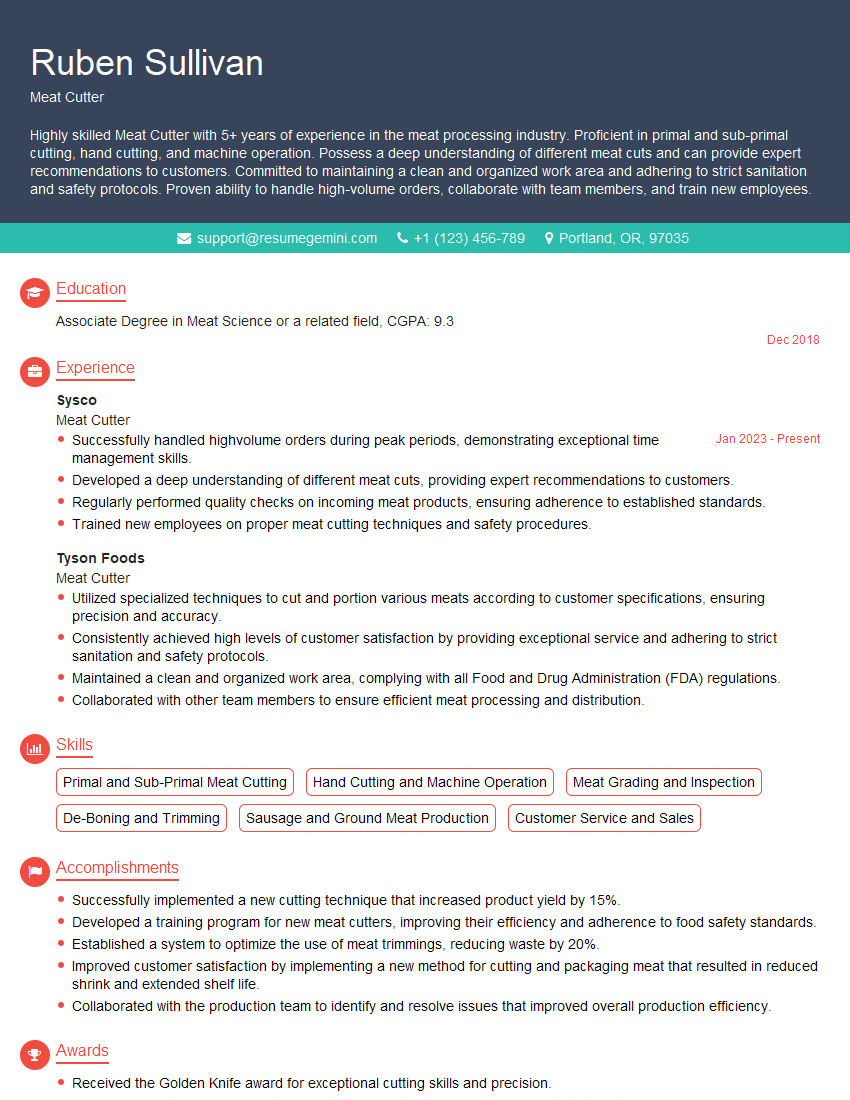
Mastering meat carving and butchery opens doors to a rewarding career with excellent growth potential. From entry-level positions to specialized roles, proficiency in this skillset is highly valued. To increase your chances of landing your dream job, create a compelling, ATS-friendly resume that showcases your skills and experience effectively. ResumeGemini is a trusted resource that can help you build a professional resume that stands out. They offer examples of resumes tailored to the Meat Carving and Butchery industry to help you get started.





Explore more articles
Users Rating of Our Blogs
Share Your Experience
We value your feedback! Please rate our content and share your thoughts (optional).
What Readers Say About Our Blog
Really detailed insights and content, thank you for writing this detailed article.
IT gave me an insight and words to use and be able to think of examples