Feeling uncertain about what to expect in your upcoming interview? We’ve got you covered! This blog highlights the most important Strong Portfolio of Published Comic Work interview questions and provides actionable advice to help you stand out as the ideal candidate. Let’s pave the way for your success.
Questions Asked in Strong Portfolio of Published Comic Work Interview
Q 1. Describe your process for developing a comic book character.
Developing a compelling comic book character is a multi-stage process that begins with a core concept – their essence. I start by brainstorming their backstory, motivations, flaws, and relationships. This isn’t just about physical attributes; it’s about understanding their inner world. For example, for my character ‘Seraphina,’ a futuristic bounty hunter, I spent weeks outlining her childhood in a war-torn city, her training regimen, and the events that hardened her yet left her with a surprising vulnerability. Then I flesh out their visual design, ensuring the look reflects their personality and backstory. I experiment with different sketches, outfits, and even hairstyles to find the perfect visual representation. Finally, I meticulously define their role in the story’s narrative arc, considering how their actions and interactions will drive the plot forward. This iterative process involves constant refinement, often revisiting earlier stages to ensure consistency and depth.
Think of it like sculpting – you start with a rough form (the core concept), gradually refining the details (backstory, design, role) until you have a fully realized character who feels authentic and relatable.
Q 2. Explain your approach to storytelling in a sequential art format.
Storytelling in sequential art is all about pacing, visual storytelling, and the effective use of panels. I employ a variety of techniques to control the rhythm and emotional impact of the narrative. For instance, I might use a series of small panels to build suspense, then switch to a large, sprawling panel for a dramatic reveal. Similarly, the use of gutters (the space between panels) significantly influences the pacing – a wider gutter implies a longer time lapse, while a narrow one suggests immediate succession.
Beyond panel arrangement, I leverage visual cues like character expressions, body language, and camera angles to enhance the narrative. This approach requires careful consideration of every element on the page, ensuring visual consistency and a clear progression of events. The story shouldn’t just be read; it should be experienced visually. I often use storyboards to plan panel layouts and camera angles before beginning the actual art, especially for action-packed sequences.
My approach leans heavily on creating strong visual metaphors. For my series ‘Echoes of the City,’ I used the city’s architecture itself as a character, reflecting the decaying moral compass of the inhabitants.
Q 3. How do you manage deadlines and revisions in a collaborative comic book project?
Managing deadlines and revisions in collaborative projects requires meticulous planning and clear communication. We typically utilize project management software like Asana or Trello to track progress, deadlines, and assigned tasks. Each stage, from scriptwriting to inking to lettering, has its own timeline and assigned deadlines. Regular check-ins, both individual and group, are crucial to identify and address potential issues early on. We use a version control system – for example, Dropbox or Google Drive with version history – to track revisions, enabling us to easily revert to previous versions if needed. Open communication is key; any challenges or concerns are raised promptly and collaboratively addressed to maintain momentum and keep the project on track.
For example, in my last project, we faced delays in the coloring phase. By immediately communicating the delay and adjusting other tasks’ deadlines accordingly, we were able to minimize the project’s overall impact. The key is proactive problem-solving and transparent communication amongst the entire team.
Q 4. What software and tools are you proficient in for creating comics?
My workflow involves a suite of software tailored to each stage of the comic creation process. For sketching and concept art, I primarily use Adobe Photoshop and Clip Studio Paint. These programs offer powerful tools for creating dynamic illustrations and refining character designs. For the actual comic creation and page layouts, I utilize Clip Studio Paint, which is incredibly versatile, allowing me to manage panels, dialogue, and effects efficiently. For lettering and adding final touches, I rely on Adobe Illustrator for precise typography and vector-based editing. Proficiency in these tools allows me to optimize my workflow and maintain a high level of visual consistency throughout the comic.
Q 5. Discuss your experience with different printing and publishing processes.
My experience encompasses various printing and publishing methods, from self-publishing through print-on-demand services like Printful to working with larger publishers. Print-on-demand offers flexibility and lower upfront costs, particularly suited for smaller projects or testing the market. However, print quality might vary slightly compared to offset printing. Offset printing, employed by larger publishers, offers superior quality and consistency but necessitates a larger print run, incurring higher initial costs.
I have also experimented with digital publishing platforms such as ComiXology and Tapas, which provide wider reach and direct engagement with readers. Each method has its advantages and disadvantages, and selecting the right approach depends on the project’s budget, target audience, and desired level of quality and distribution.
Q 6. How do you incorporate audience feedback into your comic book creation?
Audience feedback is invaluable in shaping the comic’s direction and improving its quality. I actively seek feedback through various channels, including social media engagement, online forums, and reader surveys. This feedback helps gauge reader reception to characters, plot points, and the overall art style. Constructive criticism is particularly important, as it identifies areas that need improvement. However, it’s crucial to differentiate between constructive feedback and subjective opinions. I use a combination of quantitative (e.g., survey results) and qualitative (e.g., online comments) data to gain a holistic view of reader preferences.
For example, feedback on an early arc of ‘Echoes of the City’ indicated that readers found one character to be underdeveloped. This led to a significant rewrite of that character’s arc in subsequent issues, bolstering their role within the overall narrative. Listening to readers helps refine the story and ensure it resonates with the target audience.
Q 7. Describe your experience with creating different comic book styles and genres.
My portfolio encompasses a range of comic book styles and genres, from the gritty realism of my noir-inspired series ‘City of Shadows’ to the vibrant fantasy world of ‘Aetheria.’ I’ve explored different art styles, including detailed, painterly approaches and simpler, more graphic styles, adapting my technique to suit the genre and story being told. The storytelling approach also differs – ‘City of Shadows’ uses a darker, more atmospheric palette and slower pacing, contrasted with the dynamic action sequences and brighter palette of ‘Aetheria.’ This versatility allows me to adapt my skills and approach to a wide range of projects, consistently delivering engaging and visually appealing storytelling.
Q 8. Explain your approach to world-building in your comic book narratives.
World-building in comics isn’t just about creating a setting; it’s about crafting a believable and engaging universe that supports the narrative. My approach is multi-faceted. First, I start with a core concept – a central idea or mystery that drives the plot. This could be a unique magic system, a specific societal structure, or a compelling historical event. Then, I build outwards. I consider the geographical features, the political climate, the technological level, the prevalent beliefs and superstitions, and even the everyday routines of the inhabitants. I create detailed maps, timelines, and character profiles to ensure consistency and depth. For example, in my series ‘Echoes of the Aether,’ the core concept was a world where sound holds magical properties. This then informed everything from the architecture (designed to amplify or dampen sound) to the social structure (hierarchies based on auditory abilities) to the very language spoken (rich in onomatopoeia).
Crucially, I don’t over-burden the reader with exposition. I reveal details organically through the story and characters’ interactions, letting the world unfold gradually. Think of it like peeling back layers of an onion – each panel reveals a new layer of the world’s complexity, keeping the reader engaged and invested.
Q 9. How do you balance artistic vision with commercial considerations?
Balancing artistic vision with commercial considerations is a constant tightrope walk. Ultimately, a successful comic needs both artistic integrity and market appeal. My approach involves finding common ground. I start by clearly defining my core artistic vision – the style, themes, and message I want to convey. Then, I research the market. What kind of stories are currently popular? What are readers engaging with? This market research doesn’t mean compromising my artistic vision; rather, it helps me identify avenues to share my unique voice in a way that resonates with a wider audience. For instance, while I might favor a more experimental art style, I might find ways to incorporate elements that are more familiar to readers within the context of my unique style. This could involve adjustments to page layouts or the way I present the narrative. In my experience, compromise often leads to innovation. Trying to please everyone is impossible, but striving for a healthy balance yields the best results.
Q 10. Describe your experience with creating compelling character arcs.
Compelling character arcs are the heart of any successful comic. My approach is to create characters with clear motivations, internal conflicts, and flaws. I avoid creating perfect heroes or villains; instead, I aim for characters who are relatable, complex, and undergo significant change throughout the story. I use a combination of internal and external pressures to drive their development. External pressures might involve challenging circumstances or antagonistic forces. Internal pressures stem from their own personal struggles, doubts, and moral dilemmas. In ‘Chronicles of the Crimson Dawn,’ the protagonist, a seasoned warrior, grapples with the consequences of his past actions, leading him on a journey of self-discovery and redemption. This journey unfolds through both his interactions with other characters and his own inner monologue. Understanding a character’s backstory, their dreams, their fears – these are the keys to crafting a truly believable and moving arc. Each decision a character makes, each relationship they forge, should contribute to their overall growth or downfall.
Q 11. How do you handle creative differences with collaborators?
Creative differences are inevitable in collaborative projects. My approach is based on open communication and mutual respect. I believe in fostering a collaborative environment where everyone feels comfortable expressing their ideas and concerns. We brainstorm together, discussing different approaches and exploring various options. When disagreements arise, I encourage active listening and a willingness to compromise. It’s crucial to understand the other person’s perspective and to find common ground that honors everyone’s contributions. Sometimes, a step back, perhaps a few days away from the project, can provide needed clarity. Ultimately, the goal is to produce a comic book that everyone is proud of. If compromise doesn’t yield results, I try to find solutions that accommodate each view, perhaps by dividing the work in such a way that each party’s vision is realized.
Q 12. What is your approach to marketing and promoting your comic book work?
Marketing and promotion are as important as the creative process itself. My approach is multi-pronged. I utilize social media platforms like Twitter and Instagram to interact directly with readers, sharing behind-the-scenes content, concept art, and updates on the comic’s progress. I participate in online comic communities, engage in relevant discussions and collaborate with other creators. Attending conventions and comic book festivals is a great way to network and connect with readers face-to-face. Building a strong online presence through a well-maintained website and engaging with readers helps generate buzz and anticipation. Additionally, I collaborate with publishers and distributors to ensure wide reach and visibility of my work.
Q 13. How do you ensure visual consistency across a long comic book series?
Maintaining visual consistency across a long series requires meticulous planning and attention to detail. Before beginning, I create a style guide that outlines key elements such as character designs, costume details, environment style, and even font choices. This serves as a reference throughout the entire series. I utilize digital tools to ensure color palettes and line weights remain consistent. For example, I might use color swatches and pre-set brushes in my digital art program to maintain uniformity. Regularly reviewing past issues and checking for consistency is vital – having a second pair of eyes for this quality control can be very beneficial. This ensures that the visual identity of the comic remains cohesive, even as the story unfolds over many years. Consistent visual style reinforces the identity of the comic and creates a more immersive reading experience.
Q 14. Explain your understanding of color theory and its application in comics.
Color theory is fundamental to creating engaging and effective comic art. Understanding color relationships – complementary colors (e.g., blue and orange), analogous colors (e.g., blue, blue-green, green), and triadic colors (e.g., red, yellow, blue) – helps in creating visually pleasing and emotionally resonant compositions. Color temperature – warm (reds, oranges, yellows) versus cool (blues, greens, purples) – can be used to set the mood and atmosphere. Warm colors often evoke feelings of excitement and energy, while cool colors might suggest calmness or melancholy. For example, in a dramatic scene, I might use a contrasting combination of warm and cool colors to emphasize the conflict. Similarly, the saturation and brightness of colors can significantly impact the overall feel. Muted colors might create a sense of realism or quiet contemplation, while vibrant, saturated colors could enhance feelings of excitement and action. In essence, the skillful use of color theory allows me to communicate the mood and emotion of the story effectively and subtly influence the reader’s perception.
Q 15. What strategies do you use for pacing and suspense in your narratives?
Pacing and suspense are crucial for gripping comic narratives. It’s about controlling the reader’s emotional rhythm, building anticipation, and delivering impactful reveals at the right moments. I employ several strategies. First, I vary panel sizes and layouts. A series of small panels can build speed and urgency during an action sequence, while larger panels can slow the pace, emphasizing a character’s emotional state or a pivotal moment. Think of it like a musical score – sometimes it’s a crescendo, sometimes a quiet interlude.
Secondly, I strategically use cliffhangers. Ending a chapter or issue with a sudden plot twist, a dangerous situation, or an unanswered question leaves the reader wanting more and eagerly anticipating the next installment. The classic ‘to be continued’ is a testament to this technique’s effectiveness. This can be achieved even within individual pages, leading to page-turners.
Thirdly, I utilize foreshadowing, hinting at future events or dangers without giving everything away. This creates a sense of unease and anticipation, keeping the reader engaged in trying to solve the puzzles laid out in the visual narrative. For example, a seemingly innocuous object in the background of an early panel might become crucial later in the story. Finally, I meticulously plan the information reveal, ensuring that crucial details are placed in high-impact panels and supported by expressive visuals.
Career Expert Tips:
- Ace those interviews! Prepare effectively by reviewing the Top 50 Most Common Interview Questions on ResumeGemini.
- Navigate your job search with confidence! Explore a wide range of Career Tips on ResumeGemini. Learn about common challenges and recommendations to overcome them.
- Craft the perfect resume! Master the Art of Resume Writing with ResumeGemini’s guide. Showcase your unique qualifications and achievements effectively.
- Don’t miss out on holiday savings! Build your dream resume with ResumeGemini’s ATS optimized templates.
Q 16. Describe your experience with different lettering styles and techniques.
Lettering is more than just words; it’s a visual element that contributes significantly to the mood and tone of a comic. I’ve experimented with various styles, from classic serif fonts for a more traditional feel to sans-serif fonts for a modern, clean look. The choice depends heavily on the genre and the specific narrative being told. For a gritty crime story, a rough, hand-lettered style might be appropriate, whereas a whimsical children’s book might call for a playful, rounded font.
Beyond the font itself, I consider the size, kerning (spacing between letters), and tracking (spacing between words). These subtle adjustments can dramatically impact readability and emphasize certain words or phrases. I also play with the placement of dialogue balloons, using their size and shape to reinforce emotional beats or draw attention to important information. For instance, a large, bold speech bubble can highlight a character’s shout or a particularly critical piece of dialogue. Additionally, I experiment with letter styles in the different panels to show character differentiation such as changes in tone, emotion, or even background sounds. I aim for consistency while also maintaining flexibility to achieve stylistic impact.
Q 17. How do you balance visual detail with readability in your comic panels?
Balancing visual detail with readability is a constant challenge. Too much detail can overwhelm the reader, making it difficult to follow the narrative. Too little, and the comic feels bland and uninteresting. My approach involves careful planning and prioritization. I start with a clear understanding of the narrative’s focal points in each panel. What is the most important information I need to convey? What emotion am I trying to evoke?
Then, I use a layered approach to the visuals. The most crucial elements are rendered with sharp detail, while the background might have less detail, creating a visual hierarchy. This way, the reader’s eye is naturally drawn to what matters most. For example, I might render a character’s face with fine detail, showcasing their expression, while the background environment might be sketched with less detail to not distract the reader from the emotional message.
I also consider the overall composition of the panel, ensuring that there is sufficient whitespace (negative space) to prevent visual clutter. White space can be just as important as the details themselves; it allows the reader’s eye to rest and process information more easily. It’s about knowing what to emphasize and what to leave out, to both showcase detail effectively and maintain readability.
Q 18. What is your process for developing compelling comic book covers?
Comic book covers are a crucial marketing tool; they’re the first impression, the silent salesman. My process begins with a thorough understanding of the story within. What is the central conflict? What is the emotional core? Who are the main characters?
I usually start with several thumbnail sketches, exploring different visual approaches – a dynamic action scene, a character portrait, a symbolic image. The chosen sketch evolves through several refinement stages, paying close attention to composition, color palette, and typography. The cover should reflect the tone and genre while simultaneously grabbing the reader’s attention.
I frequently use strong visual cues – dramatic lighting, compelling character poses, and striking color contrasts – to create visual interest and communicate the story’s essence quickly. Typography plays a vital role. The title must be clearly visible, and the font style should align with the overall aesthetic. For instance, a horror comic might feature a bold, gothic font, whereas a sci-fi comic might use a futuristic, sleek typeface. Finally, I make sure that the cover art balances all elements, making it both visually appealing and informative about the comic’s content.
Q 19. Explain your approach to creating dynamic and engaging action sequences.
Creating dynamic action sequences requires a deep understanding of movement and visual storytelling. I use a combination of techniques. First, I carefully plan the choreography of the action, considering the flow of movement and the impact of each action. I might use storyboards to visualize the sequence before transferring it to the final artwork.
Secondly, I utilize panel layouts to enhance the feeling of motion. A series of smaller panels can depict rapid movements, creating a sense of speed and urgency, while larger panels can highlight specific impacts or critical moments. I experiment with various angles and perspectives, using close-ups and wide shots to maximize the dynamism and make it easy for the readers to follow the movement.
Thirdly, I employ motion lines and visual effects to reinforce the action and amplify the sense of movement. These lines guide the reader’s eye and enhance the sense of speed and force. Finally, I pay close attention to character expressions and body language, ensuring that they are consistent with the action and add emotional weight to the sequence. It’s a combination of careful planning, visual language, and a keen sense of dramatic timing.
Q 20. How do you use panel layouts to enhance storytelling?
Panel layouts are fundamental to the storytelling process. They control the pacing, rhythm, and emotional impact of the narrative. A simple grid layout can create a sense of order and calm, while a more fragmented layout can convey chaos or excitement. I experiment with various layouts, from traditional grid systems to more unconventional arrangements, depending on the specific narrative needs.
For example, a series of horizontal panels might be used to show a wide panoramic view, whereas a series of vertical panels might emphasize height or depth. Varying the size of the panels can also be used to control the pacing and emphasize specific moments. Large panels might be used to highlight a key event, whereas small panels might be used to quickly convey background information or advance the story.
I also consider the use of gutters (the spaces between panels). Narrow gutters can create a sense of continuity and speed, whereas wider gutters can introduce pauses and create visual separation. The strategic use of panel layouts is a powerful tool for enhancing the storytelling and guiding the reader’s experience. It’s like composing a visual symphony, where the arrangement of the panels dictates the emotional flow and thematic impact.
Q 21. Describe your experience with working with editors and publishers.
Working with editors and publishers has been invaluable to my growth as a comic book creator. They provide crucial feedback, helping to refine my stories and improve the overall quality of my work. I’ve always appreciated the collaborative nature of the comic book creation process. Good communication is critical for successful collaboration.
Editors often offer insights into pacing, character development, plot structure, and overall visual storytelling. They provide a fresh perspective, often catching inconsistencies or flaws I might have missed. Publishers, on the other hand, bring a business acumen and marketing expertise that I may lack, helping navigate the complexities of production and distribution.
Through my work with several publishers, I’ve learned about the complexities of the industry, such as deadlines, budgeting, and marketing. Their guidance has been instrumental in refining my skills, improving my workflow, and growing as a professional storyteller. It’s a rewarding collaborative partnership where everyone contributes to the creation of a successful comic.
Q 22. How do you adapt your artistic style to different projects and target audiences?
Adapting my artistic style is crucial for success in the comics industry. It’s about understanding the project’s tone, target audience, and genre. I approach this by carefully analyzing the script and collaborating closely with the writer and editor. For example, a children’s book requires a simpler, more vibrant style than a gritty crime noir comic. For a children’s book, I might employ rounder characters, brighter colours, and simpler backgrounds. In contrast, a crime noir comic would call for sharper lines, darker tones, and a more detailed environment to enhance the mood. I also consider the publishing platform. Webcomics, for instance, often benefit from a style that’s easy to read on screen, potentially involving cleaner lines and less intricate details than a print comic. I’ve successfully adapted my style from the whimsical illustrations of my children’s graphic novel, ‘Rainbow Ranch,’ to the darker, more realistic style of my crime comic series, ‘Shadow Syndicate,’ showcasing my versatility and ability to meet diverse project demands.
Q 23. Explain your experience with copyright and intellectual property in the comics industry.
Copyright and intellectual property are paramount in the comics industry. My experience includes understanding the various copyright laws that protect original works, from characters and storylines to art style and design. I always ensure I have proper contracts in place detailing ownership and usage rights, and I’m careful to avoid plagiarism. Early in my career, I learned the hard way about the importance of securing these rights when a freelance project resulted in a dispute over ownership of the character designs. That experience taught me the absolute necessity of clear contracts and legal counsel when collaborating on projects. I’m familiar with the intricacies of work-for-hire agreements, understanding that in those situations, the copyright often resides with the publisher. I also know how to register copyrights for my self-published works, safeguarding my creations from unauthorized use. Furthermore, I understand the importance of adhering to fair use guidelines when referencing existing works for inspiration, ensuring I don’t cross the line into infringement. This thorough understanding of copyright law allows me to work effectively and protect my interests, as well as those of the clients I work for.
Q 24. Describe a time you faced a significant challenge in your comic book work and how you overcame it.
During the production of ‘Shadow Syndicate,’ I faced a significant challenge when my primary inker unexpectedly fell ill. The deadline was looming, and losing that crucial collaborator threatened the entire release schedule. I immediately explored several solutions. First, I reached out to my professional network, finding a highly skilled replacement inker within my contacts. Then, to ensure a smooth transition, I provided a detailed style guide outlining my preferred line weights, shading techniques, and overall aesthetic. Further, I offered extra consultation calls to clarify any ambiguities. Ultimately, despite the initial setback, the new inker delivered high-quality work on time, and the comic book was published without delay. This experience underscored the importance of proactive planning, maintaining a strong professional network, and having clear communication strategies in place to handle unexpected complications.
Q 25. What are your salary expectations for this role?
My salary expectations depend on the specifics of this role, including the scope of responsibilities, project size, and the company’s compensation structure. However, based on my experience and the industry standard for a comic book artist with my portfolio, I’m targeting a salary within the range of [Insert Salary Range]. I’m open to discussing this further once I have a more comprehensive understanding of the position’s requirements.
Q 26. What are your long-term career goals in the comics industry?
My long-term career goals involve establishing myself as a respected and sought-after comic book artist known for both my artistic versatility and storytelling abilities. I aspire to work on a variety of projects, from independent graphic novels to mainstream comic books and even animation. I want to push creative boundaries and explore different artistic mediums and styles. I also aim to mentor and support aspiring comic book artists, sharing my knowledge and experience to help grow the industry.
Q 27. What are your strengths and weaknesses as a comic book artist?
My strengths lie in my adaptability, my ability to translate complex narratives into compelling visual storytelling, and my proficiency in a range of artistic styles. I’m also a highly organized and detail-oriented individual, crucial for managing the complexities of comic book production. My biggest weakness is sometimes getting overly invested in the details, which can occasionally slow down my workflow. However, I’m actively working on improving my time management skills to better balance attention to detail with project deadlines. I utilize project management tools and strategies to manage my time more effectively.
Q 28. Why are you interested in this specific opportunity?
I’m extremely interested in this opportunity because [Insert Company Name]’s reputation for producing high-quality, innovative comics aligns perfectly with my creative aspirations. I’ve been consistently impressed by [mention specific works, projects, or company values]. The opportunity to contribute to such a dynamic and forward-thinking team, along with the chance to work on [mention specific project or aspect of the job if known], makes this a particularly exciting prospect for my career development.
Key Topics to Learn for Strong Portfolio of Published Comic Work Interview
- Narrative Structure and Pacing: Understanding how to build compelling narratives through panel layouts, pacing, and visual storytelling techniques. Consider how different storytelling choices impact the reader’s experience.
- Character Design and Development: Demonstrating proficiency in creating memorable and believable characters through visual design, dialogue, and actions. Be prepared to discuss your creative process and choices.
- Visual Communication and Style: Articulating your artistic style and its effectiveness in conveying the story’s tone and themes. Discuss your influences and how you adapt your style to different projects.
- Collaboration and Workflow: Illustrating your experience working with editors, writers, and other collaborators. Discuss your understanding of deadlines, feedback incorporation, and effective communication within a team.
- Published Work Analysis: Being able to critically analyze your own published work, identifying strengths, weaknesses, and areas for improvement. Prepare to discuss your creative decisions and their impact.
- Industry Knowledge and Trends: Demonstrating familiarity with the current landscape of the comics industry, including publishing trends, market demands, and successful approaches to storytelling.
- Technical Skills and Software Proficiency: Showcasing your proficiency in relevant software (e.g., Photoshop, Clip Studio Paint, etc.) and your ability to adapt to different workflows and technical requirements.
Next Steps
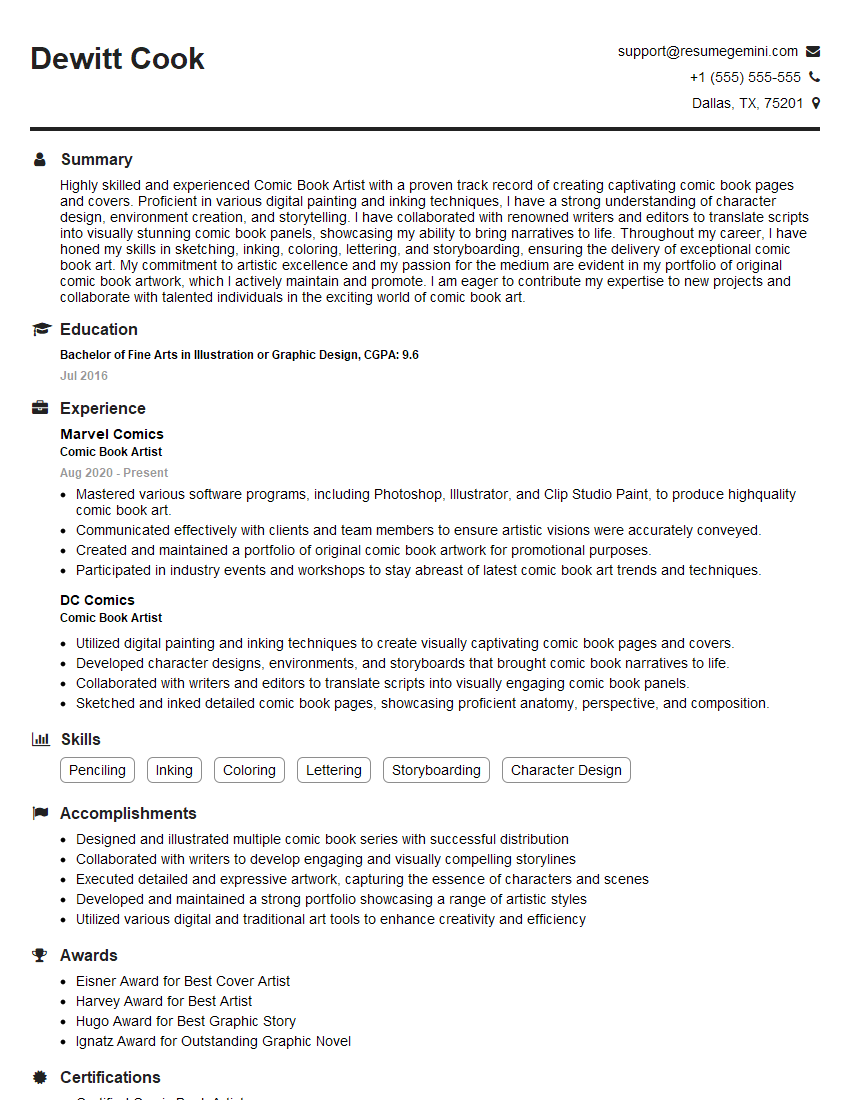
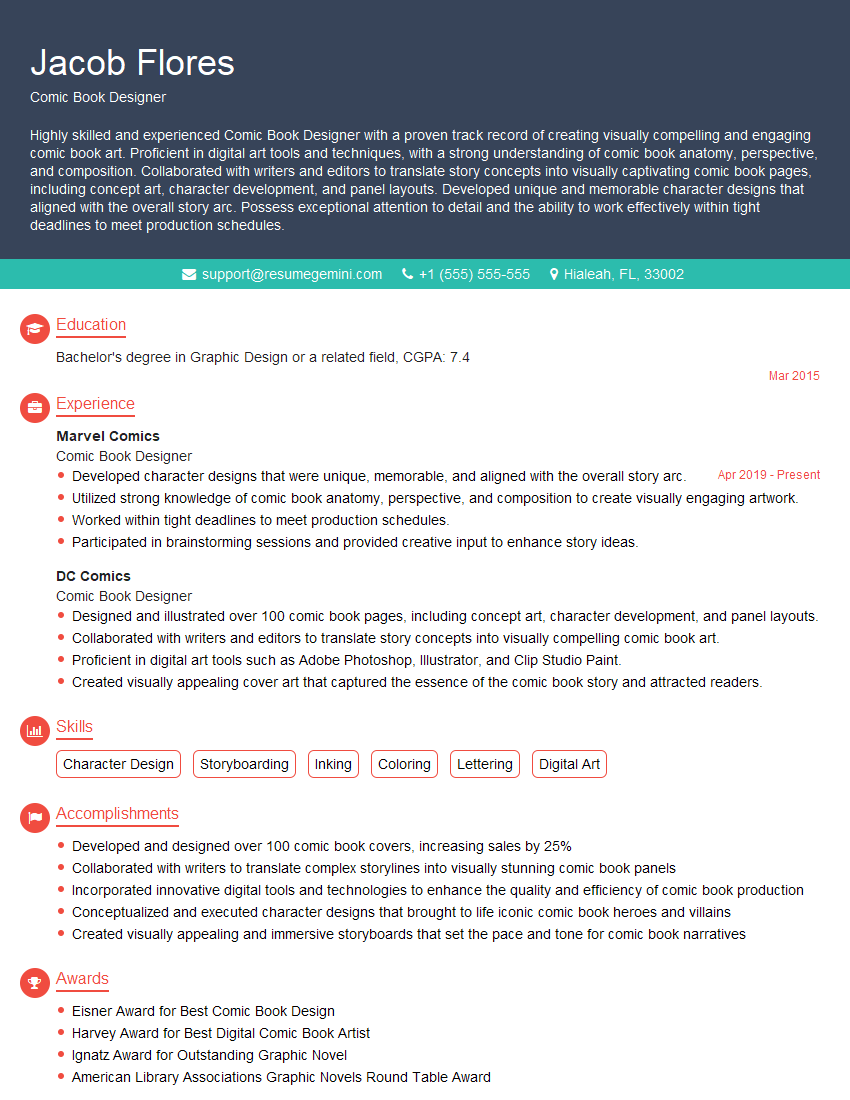
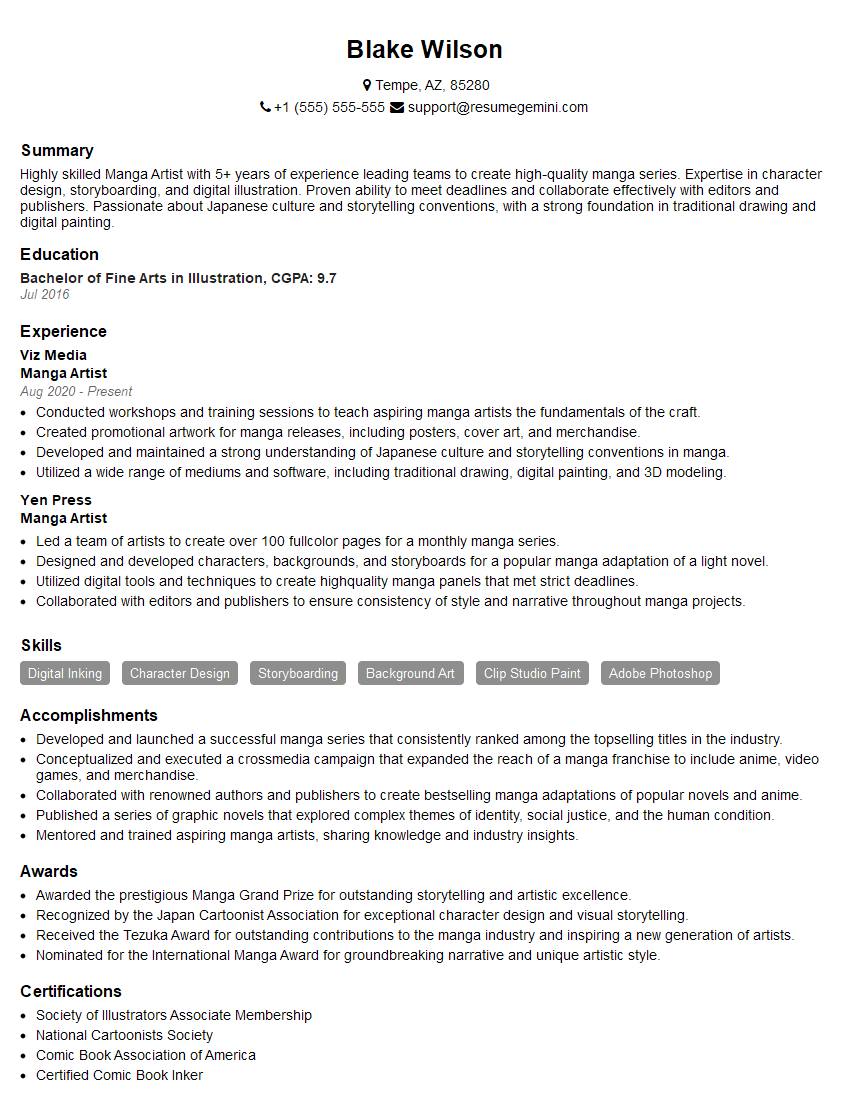
Mastering the art of presenting a strong portfolio of published comic work is crucial for career advancement in the competitive world of illustration and comics. A well-crafted portfolio showcasing your skills and creative vision is your most powerful asset. To significantly boost your job prospects, creating an ATS-friendly resume is essential. This ensures your application gets noticed by recruiters and hiring managers. We highly recommend using ResumeGemini to build a professional and effective resume tailored to highlight your unique skills and experience. Examples of resumes tailored to showcasing a strong portfolio of published comic work are available within ResumeGemini’s resources.
Explore more articles
Users Rating of Our Blogs
Share Your Experience
We value your feedback! Please rate our content and share your thoughts (optional).
What Readers Say About Our Blog
Really detailed insights and content, thank you for writing this detailed article.
IT gave me an insight and words to use and be able to think of examples