The right preparation can turn an interview into an opportunity to showcase your expertise. This guide to Tank Management interview questions is your ultimate resource, providing key insights and tips to help you ace your responses and stand out as a top candidate.
Questions Asked in Tank Management Interview
Q 1. Describe your experience with various tank types (e.g., horizontal, vertical, pressure, atmospheric).
My experience encompasses a wide range of tank types, each with unique operational considerations. I’ve worked extensively with horizontal tanks, commonly used for storing large volumes of liquids like crude oil or water, where their shape maximizes storage capacity within a given footprint. Vertical tanks, often cylindrical, are prevalent in chemical storage and process industries, offering efficient access and simpler construction for certain applications. I’m also familiar with pressure tanks, designed to withstand significant internal pressure, frequently used for storing liquefied gases or pressurized fluids requiring specific safety protocols. Finally, atmospheric tanks, operating at ambient pressure, are widely used for storing less volatile liquids and generally require less stringent structural design. Each tank type demands a distinct approach to maintenance, inspection, and safety procedures, and my expertise covers all of them.
For instance, during my time at Acme Petrochem, I oversaw the operation and maintenance of a tank farm comprising both horizontal and vertical tanks storing various petroleum products. The horizontal tanks required specialized cleaning procedures due to their larger surface area and potential for sediment accumulation, while the vertical tanks needed regular inspection of their internal structural components.
Q 2. Explain the process of tank gauging and inventory management.
Tank gauging and inventory management are crucial for efficient and safe operations. Tank gauging determines the volume of liquid within a tank, using methods like manual dipstick measurements, automated level sensors (ultrasonic, radar, etc.), or more advanced technologies like pressure gauging for certain tank types. This data, coupled with temperature and density readings, is used to precisely calculate the total inventory. Inventory management uses this gauging data to track stock levels, predict future needs, and optimize storage and transportation. This often involves utilizing specialized software, known as tank management systems, to automate data collection, analysis, and reporting.
Think of it like managing a large warehouse: you wouldn’t just guess how much inventory you have; you’d use precise measurements and software to track everything. In my previous role, we implemented a sophisticated tank management system that integrated with our ERP (Enterprise Resource Planning) system, allowing for real-time inventory monitoring and automated reporting, significantly improving operational efficiency and reducing the risk of stockouts or overstocking.
Q 3. How do you ensure the safety and integrity of tanks during operations?
Ensuring tank safety and integrity is paramount. This involves a multi-faceted approach encompassing regular inspections, preventative maintenance, and adherence to strict safety protocols. Inspections cover everything from visual checks for corrosion, leaks, and damage to detailed structural assessments using non-destructive testing (NDT) methods like ultrasonic testing. Preventative maintenance includes things like cleaning, repainting, and addressing minor issues before they escalate. Safety protocols emphasize things like proper grounding, lightning protection, and emergency response plans, particularly important when handling hazardous materials.
For example, at GlobalChem, we implemented a rigorous inspection program with a detailed checklist and schedule. We used NDT to identify potential structural weaknesses and proactively addressed them, preventing costly repairs and significantly reducing the risk of catastrophic failure. Furthermore, regular employee training on safety procedures was mandatory.
Q 4. What are the common causes of tank leaks and how do you address them?
Tank leaks are a significant concern, often stemming from corrosion, material degradation, improper installation, or external damage. Corrosion, particularly in older tanks, is a major culprit, accelerated by factors like the stored liquid’s chemical properties and environmental conditions. Material fatigue, especially with repeated thermal cycling, can also lead to cracks and leaks. Poor installation or faulty welds can also create weak points prone to failure. External damage from impacts, ground shifting, or vandalism also causes leaks.
Addressing leaks involves a systematic approach, starting with immediate containment to prevent environmental contamination. Then, the cause must be identified—a thorough inspection often reveals the source. Repairs can range from simple patching to extensive structural repairs, depending on the severity and location of the leak. In some cases, tank replacement may be necessary. Preventing future leaks involves preventative maintenance, regular inspections, and choosing appropriate materials and construction methods for the specific application.
Q 5. Detail your experience with tank cleaning and maintenance procedures.
Tank cleaning and maintenance are crucial to ensure product purity and prevent degradation. The process depends on the stored liquid, as hazardous materials demand specialized cleaning procedures. Common methods include manual cleaning, high-pressure water jets, and steam cleaning. After cleaning, the tank undergoes thorough inspection to ensure it’s free of residue and damage before being put back into service. Maintenance includes regular painting to prevent corrosion, addressing any mechanical issues, and replacing worn-out parts. Detailed records are kept of each cleaning and maintenance activity to track the tank’s history and optimize maintenance schedules.
During my time at PetroStar, I implemented a standardized cleaning and maintenance procedure using a color-coded system to easily track the status of each tank, enhancing traceability and improving overall efficiency.
Q 6. Describe your understanding of tank farm regulations and compliance requirements.
My understanding of tank farm regulations and compliance requirements is extensive. Regulations vary by region and jurisdiction but generally cover aspects like environmental protection (preventing spills and emissions), safety (preventing fires and explosions), and worker safety. Compliance involves maintaining detailed records of inspections, maintenance, and any incidents, adhering to emission standards, and obtaining necessary permits and licenses. Regulations often stipulate specific design standards, tank materials, and emergency response plans. Staying informed about updates and changes in regulations is critical for ongoing compliance.
I have experience navigating complex regulatory landscapes, including EPA regulations in the US and similar international standards. At my previous company, I was instrumental in implementing a comprehensive compliance program that ensured we met all regulatory obligations, avoiding penalties and protecting the company’s reputation.
Q 7. How do you manage tank inspections and maintenance schedules?
Managing tank inspections and maintenance schedules requires a systematic approach. A robust maintenance management system is key—this could be a dedicated software application or a well-organized spreadsheet. The system tracks scheduled inspections and maintenance, records the results, and generates alerts for upcoming tasks. Inspections are planned based on the tank’s age, material, stored product, and regulatory requirements. Maintenance tasks are scheduled based on the inspection findings and preventative maintenance guidelines. A risk-based approach is often utilized, prioritizing high-risk tanks or components for more frequent inspections and maintenance.
For example, at ChemTech, I implemented a computerized maintenance management system (CMMS) which optimized inspection schedules and reduced downtime by proactively identifying and addressing potential issues. The system generated reports that facilitated effective decision-making and improved overall efficiency of the maintenance process.
Q 8. Explain your experience with tank automation and control systems.
My experience with tank automation and control systems spans over a decade, encompassing various technologies and applications. I’ve worked extensively with PLC-based systems (Programmable Logic Controllers), SCADA (Supervisory Control and Data Acquisition) systems, and more recently, cloud-based IoT solutions for tank monitoring and control. This includes programming and troubleshooting PLCs to manage aspects like level control, pump operations, and alarm management. I’ve also been involved in the design, implementation, and commissioning of SCADA systems, integrating data from multiple tanks into a centralized control room, allowing for remote monitoring and control. For example, in a previous role, I oversaw the automation of a large petroleum storage facility, reducing manual intervention by 70% and improving operational efficiency significantly. The implementation of a sophisticated alarm system prevented several potential incidents and ensured consistent compliance with safety regulations. With newer IoT systems, I am experienced in analyzing data streamed from sensors to predict potential maintenance needs, leading to proactive interventions and cost savings.
- Experience with various PLC brands (e.g., Siemens, Allen-Bradley)
- Proficiency in SCADA software (e.g., Wonderware, Ignition)
- Knowledge of industrial communication protocols (e.g., Modbus, Profibus)
- Experience with cloud-based platforms for data analysis and remote monitoring
Q 9. How do you handle emergencies such as tank spills or leaks?
Handling tank spills or leaks requires immediate and decisive action, focusing on safety and environmental protection. My approach follows a structured protocol:
- Safety First: Isolate the affected area and evacuate personnel. Emergency response teams must be alerted immediately.
- Containment: Deploy containment booms or other appropriate methods to prevent further spread of the spilled liquid.
- Source Identification and Control: Determine the source of the leak and shut down the relevant valves or pumps to stop the flow.
- Cleanup and Remediation: Initiate cleanup procedures according to the specific substance and environmental regulations. This might involve specialized equipment and personnel.
- Reporting and Investigation: Document the event thoroughly, including the cause, extent of damage, and steps taken. A root cause analysis is essential to prevent future incidents.
For example, during a minor leak in a chemical storage tank, I successfully deployed emergency spill kits, coordinated the containment of the leak using absorbent pads, and ensured the safe neutralization of the spilled chemical before cleanup. The root cause analysis revealed a faulty valve, highlighting the importance of regular maintenance inspections.
Q 10. What are the key performance indicators (KPIs) for effective tank management?
Key Performance Indicators (KPIs) for effective tank management are crucial for optimizing operations, ensuring safety, and minimizing costs. These can be categorized into several areas:
- Inventory Accuracy: Percentage of accurate inventory readings. A high percentage indicates reliable measurement and data management.
- Operational Efficiency: Throughput (volume processed per unit time), downtime (percentage of time a tank is unavailable), and turnaround time (time taken for filling or emptying a tank).
- Safety: Number of safety incidents, environmental compliance records, and regulatory audit findings.
- Maintenance Costs: Total maintenance expenditure per unit volume or per tank. Reducing this through preventative maintenance is a key goal.
- Environmental Compliance: Emission levels, waste generation, and adherence to environmental regulations.
Monitoring these KPIs allows for timely intervention and improvements in the tank management process. For instance, consistently low throughput might indicate a problem with the pumping system, while high maintenance costs might point to the need for a preventative maintenance program.
Q 11. Describe your experience with tank level monitoring systems.
My experience with tank level monitoring systems includes a variety of technologies, ranging from simple float switches to advanced radar and ultrasonic level sensors. I’ve worked with systems that provide continuous level monitoring, enabling real-time data acquisition and control. I understand the strengths and weaknesses of different technologies, such as the susceptibility of ultrasonic sensors to interference from foam or vapors. I’ve also integrated these level sensors into PLC and SCADA systems to automate tank level control and provide alerts for high or low levels. In one project, I replaced obsolete float switches with more accurate and reliable radar level sensors, leading to improved inventory accuracy and reduced operational errors.
Understanding the specific characteristics of the stored liquid, such as its viscosity and dielectric constant, is crucial for selecting the right level sensing technology. For example, radar level sensors are well-suited for liquids with high dielectric constants, while ultrasonic sensors are preferred for liquids with low dielectric constants. Proper calibration and regular maintenance are essential for ensuring accurate level measurements.
Q 12. How do you ensure accurate tank inventory data?
Accurate tank inventory data is crucial for efficient operations, financial management, and regulatory compliance. Several strategies contribute to this accuracy:
- Regular Calibration: Level sensors and other measurement instruments must be regularly calibrated to maintain accuracy.
- Data Validation: Implementing checks and balances in the data acquisition and processing system to identify and correct errors.
- Redundant Measurement Systems: Using multiple independent measurement systems for cross-verification.
- Tank Geometry Considerations: Accounting for the tank’s geometry (e.g., cylindrical, conical) and using appropriate calculations for volume determination.
- Temperature Compensation: Adjusting measurements for temperature variations, especially for liquids with significant thermal expansion coefficients.
- Regular Reconciliation: Comparing the calculated inventory with physical measurements (e.g., via dipstick) to identify discrepancies.
For example, we used a combination of radar level sensors, temperature sensors, and a sophisticated inventory management system to achieve better than 99.5% accuracy in our inventory data. This was a significant improvement from previous systems, reducing inventory discrepancies and improving operational efficiency.
Q 13. Explain your understanding of tank corrosion and mitigation strategies.
Tank corrosion is a significant concern, leading to costly repairs, environmental risks, and safety hazards. Understanding the factors that contribute to corrosion, such as the type of stored liquid, environmental conditions, and tank material, is crucial for effective mitigation. Common corrosion mechanisms include:
- Internal Corrosion: Caused by the chemical properties of the stored liquid.
- External Corrosion: Caused by environmental factors like moisture, soil conditions, and atmospheric pollutants.
- Microbial Induced Corrosion (MIC): Caused by the activity of microorganisms.
Mitigation strategies include:
- Material Selection: Choosing corrosion-resistant materials, such as stainless steel, fiberglass reinforced plastic (FRP), or specialized coatings.
- Protective Coatings: Applying internal and external coatings to create a barrier against corrosive agents.
- Cathodic Protection: Using electrochemical methods to prevent corrosion.
- Regular Inspection and Maintenance: Conducting regular inspections to detect early signs of corrosion and implementing timely repairs.
In past projects, I’ve been involved in implementing cathodic protection systems to prevent corrosion in underground storage tanks and specifying suitable coatings for tanks storing aggressive chemicals.
Q 14. What safety protocols do you follow when working with tanks?
Safety protocols are paramount when working with tanks. My approach is built on a foundation of:
- Lockout/Tagout (LOTO): Properly isolating equipment before any maintenance or repair work to prevent accidental energization or release of stored energy.
- Personal Protective Equipment (PPE): Using appropriate PPE, including safety glasses, gloves, respirators, and protective clothing, depending on the stored substance and task.
- Confined Space Entry Procedures: Following strict procedures for entering confined spaces like tanks, including atmospheric monitoring and rescue plans.
- Emergency Response Planning: Developing and regularly practicing emergency response plans for potential incidents, including spills and fires.
- Permit-to-Work System: Implementing a permit-to-work system for high-risk activities.
- Regular Training: Ensuring all personnel receive regular training on safety procedures and hazard identification.
Adherence to these protocols is non-negotiable, and I actively participate in safety audits and promote a culture of safety awareness among colleagues.
Q 15. Describe your experience with tank turnaround procedures.
Tank turnaround procedures are critical for maintaining the integrity and safety of storage tanks. These procedures involve a systematic shutdown, inspection, maintenance, and restart of a tank, often requiring specialized permits and strict adherence to safety protocols. My experience encompasses all phases, from initial planning and risk assessment to final commissioning and handover.
- Shutdown: This involves safely isolating the tank, depressurizing it if necessary, and purging any hazardous vapors. We utilize lockout/tagout procedures to prevent accidental restarts.
- Inspection: A thorough internal and external inspection is crucial, identifying corrosion, leaks, and structural issues. This often involves specialized equipment like internal inspection cameras and thickness gauges.
- Maintenance: This stage addresses identified problems, including repairs, repainting, and cleaning. I’ve overseen projects involving welding repairs, epoxy coatings, and specialized cleaning of various tank contents.
- Restart: After successful completion of maintenance and testing, the tank is carefully recommissioned, ensuring proper functionality and leak tightness. This often includes pre-commissioning checks and leak testing.
For example, I managed a turnaround on a 50,000-gallon crude oil storage tank, reducing downtime by 15% through optimized scheduling and preemptive maintenance planning. This minimized production losses and improved overall safety.
Career Expert Tips:
- Ace those interviews! Prepare effectively by reviewing the Top 50 Most Common Interview Questions on ResumeGemini.
- Navigate your job search with confidence! Explore a wide range of Career Tips on ResumeGemini. Learn about common challenges and recommendations to overcome them.
- Craft the perfect resume! Master the Art of Resume Writing with ResumeGemini’s guide. Showcase your unique qualifications and achievements effectively.
- Don’t miss out on holiday savings! Build your dream resume with ResumeGemini’s ATS optimized templates.
Q 16. How do you manage environmental risks associated with tank operations?
Managing environmental risks in tank operations requires a proactive and multi-faceted approach. My strategy focuses on prevention, detection, and response.
- Prevention: This involves implementing robust leak detection systems (e.g., automated leak detection, regular inspections, and secondary containment), selecting appropriate tank materials and coatings for the stored substance, and following strict operating procedures.
- Detection: Regular monitoring of soil and groundwater around tanks, as well as continuous monitoring of tank levels and pressures, are vital for early detection of leaks. We implement technologies like vapor monitoring systems and automated leak detection systems.
- Response: In case of a leak, a well-defined emergency response plan must be in place, including procedures for containment, cleanup, and reporting to relevant authorities. This plan should also involve the use of spill kits and specialized contractors.
For instance, I implemented a new leak detection system at a chemical storage facility, resulting in a 20% reduction in response time to potential spills. This improved environmental protection and minimized the impact of any incidents.
Q 17. Explain your knowledge of different tank materials and their properties.
Selecting the right tank material is crucial for the long-term performance and safety of the storage facility. My knowledge encompasses various materials and their properties, each with strengths and weaknesses depending on the stored product and environmental conditions.
- Carbon Steel: Commonly used for its strength and cost-effectiveness, but susceptible to corrosion, especially in aggressive environments. Protective coatings are essential.
- Stainless Steel: Offers excellent corrosion resistance, making it suitable for storing a wide range of chemicals. Different grades (e.g., 304, 316) provide varying degrees of corrosion resistance.
- Fiberglass Reinforced Plastic (FRP): Lightweight and corrosion-resistant, often used for smaller tanks and specific chemical applications. However, it can be less durable than steel under certain stresses.
- Concrete: Suitable for large-volume storage, especially for water or less aggressive chemicals. Requires proper design and construction to prevent leaks.
For example, I recently advised on selecting stainless steel 316 for a new tank storing highly corrosive sulfuric acid. This ensured the longevity of the tank and minimized the risk of environmental contamination.
Q 18. How do you handle discrepancies in tank inventory data?
Discrepancies in tank inventory data can stem from various sources, including measurement errors, leaks, and theft. My approach to handling these discrepancies involves a systematic investigation.
- Verify Measurements: Double-check all measurements using different methods (e.g., manual gauging, automated level sensors). Calibration of measurement devices is crucial.
- Investigate Leaks: Conduct a thorough inspection of the tank and associated piping for leaks. Leak detection tools and techniques are utilized.
- Review Operations: Analyze tank operations, including loading and unloading procedures, to identify potential sources of errors.
- Reconcile Data: Compare data from various sources, such as tank gauges, flow meters, and accounting records, to pinpoint the discrepancy.
In one instance, a significant discrepancy was traced to a malfunctioning flow meter during unloading. Replacing the faulty meter resolved the issue and prevented future inaccuracies.
Q 19. Describe your experience with tank hydrostatic testing.
Hydrostatic testing is a crucial method for verifying the structural integrity of tanks. It involves pressurizing the tank with water or other suitable liquid to a specified pressure and observing for leaks or deformation. My experience includes planning, execution, and interpretation of results for various tank types and sizes.
- Planning: This involves determining the test pressure, selecting appropriate equipment, and developing a detailed test procedure. Safety protocols are paramount.
- Execution: The tank is filled with water or the designated test medium, and pressure is slowly increased to the specified level. Continuous monitoring of pressure and tank condition is crucial.
- Interpretation: Any leaks or deformations are carefully documented, analyzed, and reported. The results determine the tank’s fitness for service.
I’ve overseen numerous hydrostatic tests on various tanks, including those that were refurbished or newly constructed. One notable project involved a large water storage tank where the test revealed a minor crack, enabling its timely repair before it became a major issue.
Q 20. What is your experience with different tank sealing methods?
Effective tank sealing is critical for preventing leaks and maintaining the integrity of the stored product. My experience encompasses various sealing methods, each chosen based on the specific tank type, material, and stored substance.
- Gaskets: These are commonly used for bolted flanges and manways. Material selection is crucial, considering chemical compatibility and temperature range.
- Welding: Provides a permanent seal, often used for crucial joints and connections. Requires skilled welders and proper quality control.
- Epoxy Coatings: Applied to the interior or exterior of tanks to prevent corrosion and improve leak tightness. Proper surface preparation is essential.
- Specialized Sealants: Different sealants are available depending on the application, providing chemical resistance and environmental protection.
For instance, when working with a tank storing highly volatile chemicals, I specified a specialized gasket material that was compatible with the stored product and provided exceptional leak resistance.
Q 21. How do you manage waste generated from tank cleaning?
Waste generated from tank cleaning is often hazardous and requires careful management. My approach is to minimize waste generation, properly characterize the waste, and ensure its safe disposal or recycling in accordance with all applicable regulations.
- Waste Minimization: Employing efficient cleaning techniques and selecting appropriate cleaning agents to minimize the amount of waste generated.
- Waste Characterization: Identifying the chemical composition of the waste to determine the appropriate disposal or recycling method. Lab analysis is often needed.
- Disposal/Recycling: Using licensed waste disposal contractors to manage the waste. Exploring options for waste recycling or recovery whenever possible.
- Documentation: Maintaining complete records of the cleaning process, including the quantity and type of waste generated, and the methods used for its disposal.
In a recent project, we implemented a new cleaning process that reduced waste by 30% and facilitated the recycling of some components, saving costs and reducing environmental impact.
Q 22. Explain your experience with tank painting and coating.
Tank painting and coating is crucial for protecting tanks from corrosion, environmental damage, and maintaining product purity. The process involves thorough surface preparation – cleaning, blasting to remove rust and old coatings – followed by the application of specialized coatings chosen based on the stored product and environmental conditions. For example, epoxy coatings are common for chemical storage due to their resistance to chemicals, while polyurethane coatings offer excellent UV protection for outdoor tanks. My experience includes overseeing projects on various tank sizes, from small API 650 tanks to large atmospheric storage tanks, ensuring compliance with relevant industry standards like SSPC (Steel Structures Painting Council) guidelines. I’ve managed teams responsible for coating selection, application methods (spray, brush, roller), quality control inspections (wet film thickness, dry film thickness), and ensuring proper curing times to achieve optimal performance. A recent project involved repainting a series of tanks storing highly corrosive chemicals, where meticulous surface preparation and the selection of a specialized high-performance epoxy coating was key to preventing leaks and extending the tank’s lifespan.
Q 23. How do you ensure the proper ventilation of tanks?
Proper tank ventilation is essential to prevent the buildup of flammable or toxic vapors, ensuring worker safety and preventing explosions. The type of ventilation system depends on the stored product and its vapor characteristics. For example, fixed roof tanks often utilize inerting systems that displace oxygen with an inert gas like nitrogen, while floating roof tanks rely on the space between the roof and liquid surface for vapor collection. My experience includes designing and implementing various ventilation systems, from simple pressure-vacuum vents to complex vapor recovery units. This includes calculations for required ventilation rates, selecting appropriate equipment like fans and exhaust stacks, ensuring proper ductwork design and installation, and performing regular inspections to verify system effectiveness. I’ve also worked on projects involving the retrofitting of existing ventilation systems to improve efficiency and safety, including installing vapor recovery systems to reduce emissions and environmental impact. We always follow strict safety protocols including lock-out/tag-out procedures when working on ventilation systems.
Q 24. Describe your experience with tank grounding and bonding procedures.
Tank grounding and bonding are critical safety measures that prevent static electricity buildup and the potential for sparks that could ignite flammable vapors. This involves connecting the tank to earth ground using conductive cables and bonding multiple tanks together to equalize electrical potential. Proper grounding and bonding require careful consideration of soil resistivity and the use of appropriate grounding electrodes. My experience includes conducting grounding resistance testing using specialized equipment (meggers), designing and implementing grounding systems in accordance with NFPA (National Fire Protection Association) standards and API recommendations, and verifying the integrity of existing grounding systems. I’ve worked on projects involving the grounding of both above-ground and underground storage tanks, ensuring compliance with all relevant regulations and safety protocols. A specific example includes installing a new grounding system for a large array of tanks holding highly flammable liquids, where meticulous planning and execution ensured the effectiveness of the protection.
Q 25. How do you manage the risk of fire and explosion in tank farms?
Managing fire and explosion risks in tank farms necessitates a multi-layered approach encompassing prevention, detection, and suppression. Prevention involves implementing strict operational procedures, including proper ventilation, regular leak detection, and preventing ignition sources such as smoking or open flames. Detection systems, such as vapor detectors and flame detectors, provide early warning of potential hazards. Suppression systems, including fixed fire extinguishing systems (water spray, foam, CO2), are crucial for containing fires. My experience includes developing and implementing comprehensive fire protection plans for tank farms, including risk assessments, selection and installation of fire protection systems, and regular maintenance and testing of equipment. We emphasize regular employee training on fire safety procedures and emergency response plans. I’ve also worked on projects involving the design and implementation of firewalls and bund walls to limit the spread of fires in case of an incident. For example, one project involved developing a detailed fire protection plan for a large chemical storage facility which included a sophisticated network of fire detectors, sprinkler systems, and emergency response measures, significantly reducing the risk of major incidents.
Q 26. Explain your experience with using tank monitoring software.
Tank monitoring software provides real-time data on critical tank parameters like level, temperature, pressure, and vapor composition. This allows for proactive management of tank operations and early detection of potential problems. My experience includes implementing and using various tank monitoring systems, from simple level indicators to advanced SCADA (Supervisory Control and Data Acquisition) systems. I’m proficient in configuring and interpreting data from these systems, generating reports, and utilizing the data for predictive maintenance and optimizing inventory management. For example, using tank monitoring software, we’ve been able to identify and address minor leaks before they escalated into major incidents, saving both time and resources. The software provides historical data enabling trend analysis, allowing us to predict potential equipment failure and schedule preventative maintenance, enhancing operational efficiency and reducing downtime.
Q 27. What is your experience with the use of Personal Protective Equipment (PPE) in a tank farm environment?
Personal Protective Equipment (PPE) is paramount in a tank farm environment to mitigate the risks associated with hazardous materials, potential falls, and other workplace hazards. This includes items like hard hats, safety glasses, respirators, flame-resistant clothing, and appropriate footwear. My experience includes implementing and enforcing strict PPE policies, ensuring that all personnel are properly trained on the use and selection of appropriate PPE based on the specific task and hazard. Regular inspections ensure that PPE is properly maintained and in good working order. We use a permit-to-work system to control access to hazardous areas and to enforce proper PPE use. For example, anyone entering a confined space would be required to wear a respirator, harness, and other appropriate safety equipment, all checked before entry and logged appropriately. I have a strong focus on worker safety and regularly review and update PPE guidelines to maintain the highest safety standards.
Q 28. Describe your experience with tank repair and reconstruction procedures.
Tank repair and reconstruction involve assessing the extent of damage, developing a repair plan, and executing the repairs in accordance with industry standards and safety regulations. This could include patching leaks, replacing damaged sections of tank shell, or even complete tank reconstruction. My experience includes overseeing numerous tank repair and reconstruction projects, employing various techniques such as welding, patching, and the installation of corrosion protection systems. The selection of repair methods depends heavily on the type of damage and the stored product. We meticulously document all repair procedures, ensuring compliance with relevant codes and regulations. For instance, a recent project involved the repair of a tank suffering from significant corrosion, necessitating a complex process of cleaning, section removal, and welding of new steel sections, followed by re-coating to restore the tank’s structural integrity and prevent further corrosion. Careful planning and execution, coupled with adherence to safety protocols, are paramount in every repair operation.
Key Topics to Learn for Tank Management Interview
- Tank Inventory Management: Understanding various inventory control methods, including level measurement technologies (e.g., radar, ultrasonic), data acquisition, and reconciliation techniques. Practical application: Analyzing discrepancies between measured and calculated inventory and proposing solutions.
- Tank Safety and Regulations: Familiarity with relevant safety regulations (OSHA, EPA, etc.), emergency procedures, and risk assessment methodologies. Practical application: Developing and implementing a safety plan for a specific tank farm.
- Tank Maintenance and Inspection: Knowledge of preventative maintenance schedules, inspection techniques (internal & external), and repair procedures. Practical application: Troubleshooting tank leaks and recommending appropriate repairs.
- Tank Cleaning and Degassing: Understanding the procedures for safe and efficient cleaning and degassing of various tank types, including considerations for hazardous materials. Practical application: Designing a cleaning plan that minimizes environmental impact and ensures worker safety.
- Tank Selection and Design: Familiarity with different tank types (e.g., aboveground, underground, floating roof), material selection criteria, and design considerations. Practical application: Evaluating the suitability of various tank types for a given application.
- Automation and Control Systems: Understanding the role of automation in tank management, including SCADA systems, level control, and alarm systems. Practical application: Troubleshooting automation failures and optimizing control strategies.
- Environmental Compliance: Knowledge of environmental regulations related to tank storage, spill prevention, and waste management. Practical application: Developing a plan to minimize environmental impact during tank operations.
Next Steps
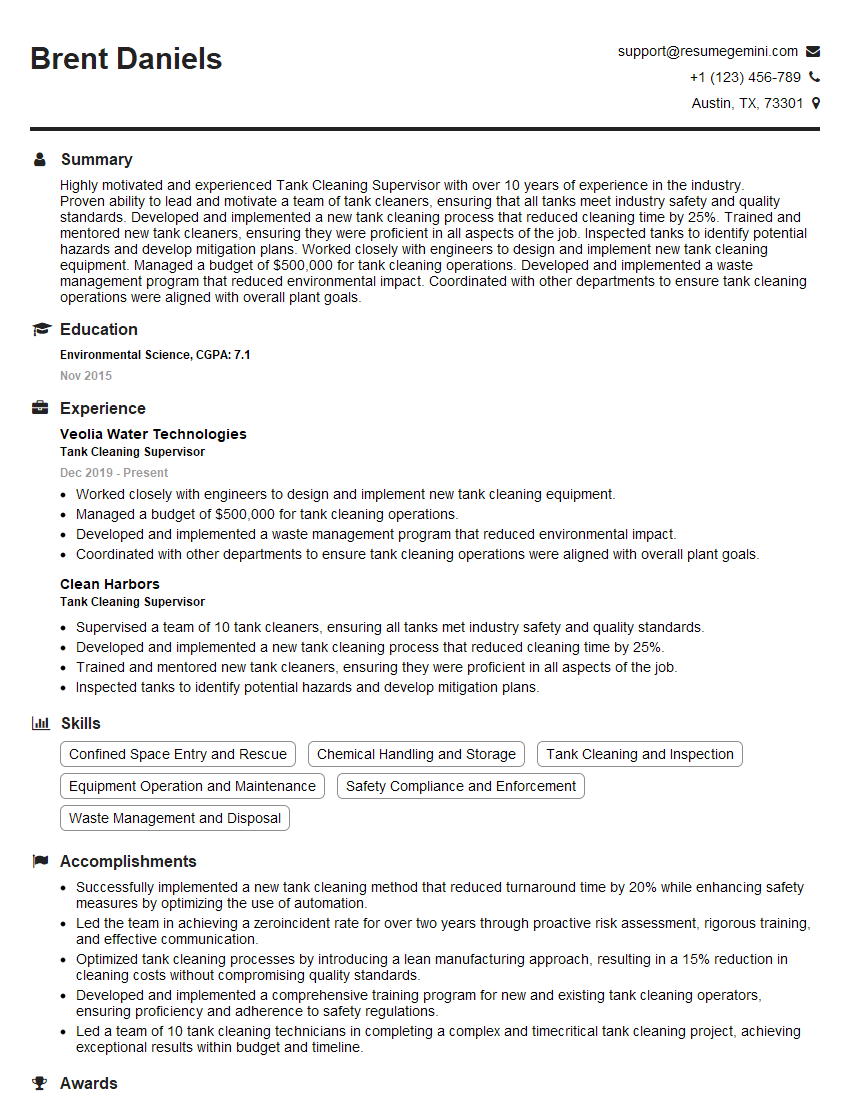
Mastering Tank Management opens doors to exciting career opportunities in the energy, chemical, and manufacturing sectors. To maximize your job prospects, it’s crucial to present your skills effectively. Building an ATS-friendly resume is key to getting your application noticed by recruiters. We strongly encourage you to use ResumeGemini, a trusted resource for creating professional and impactful resumes. ResumeGemini provides examples of resumes tailored to Tank Management to help you craft a winning application. Take the next step toward your dream career today!
Explore more articles
Users Rating of Our Blogs
Share Your Experience
We value your feedback! Please rate our content and share your thoughts (optional).
What Readers Say About Our Blog
Really detailed insights and content, thank you for writing this detailed article.
IT gave me an insight and words to use and be able to think of examples