Preparation is the key to success in any interview. In this post, we’ll explore crucial Terrazzo Worker interview questions and equip you with strategies to craft impactful answers. Whether you’re a beginner or a pro, these tips will elevate your preparation.
Questions Asked in Terrazzo Worker Interview
Q 1. Describe your experience with different types of terrazzo mixes.
My experience encompasses a wide range of terrazzo mixes, from traditional cement-based blends to the more contemporary resin-based systems. Cement-based terrazzo, the classic choice, offers durability and a timeless aesthetic. The mix involves Portland cement, aggregates (marble chips, quartz, granite, glass, etc.), and water. The aggregate size and color variations significantly influence the final appearance. For instance, a mix with larger, varied-colored aggregates creates a more dramatic, rustic look, whereas smaller, uniformly colored aggregates yield a smoother, more refined finish. Resin-based terrazzo, on the other hand, uses epoxy or polyester resins as a binder instead of cement. This results in a denser, stronger, and quicker-setting material, ideal for demanding applications or faster project turnarounds. I’ve worked extensively with both types, tailoring the mix design to the project’s specific needs—considerations including intended load bearing, aesthetic goals, and the location’s climate.
For example, in a high-traffic commercial setting, I’d favor a resin-based mix for its superior durability and resistance to wear. In a residential setting with a more artistic design, a customized cement-based mix with unique aggregate choices could be the preferred option. I also have experience with metallic terrazzo, incorporating metal pieces for a unique look. Understanding the properties of each mix is crucial for achieving the desired outcome.
Q 2. Explain the process of preparing a substrate for terrazzo installation.
Substrate preparation is paramount to a successful terrazzo installation; it ensures proper bonding and prevents future problems. The process begins with a thorough cleaning of the surface to remove any dust, debris, oil, or other contaminants. This is usually achieved with a pressure washer or thorough sweeping and vacuuming. Next, the substrate – whether concrete, plywood, or metal – needs to be evaluated for strength and levelness. Any cracks or imperfections must be repaired using appropriate patching compounds. For uneven surfaces, self-leveling compounds are often used to create a smooth, flat base. The substrate’s moisture content is also critical; excessive moisture can weaken the bond, leading to delamination. Therefore, moisture testing is essential to ensure the substrate is adequately dry. The final step involves applying a bonding agent, a specialized primer that enhances adhesion between the substrate and the terrazzo mix.
Think of it like preparing a canvas for a painting; a rough, uneven canvas won’t allow the paint to adhere properly. Similarly, a poorly prepared substrate compromises the integrity of the terrazzo installation. I always meticulously document each stage of substrate preparation to maintain consistent quality and avoid future complications.
Q 3. How do you ensure proper bonding between the terrazzo and the substrate?
Achieving proper bonding is crucial for the longevity and performance of the terrazzo. Several factors contribute to a strong bond: proper substrate preparation (as described above), the correct choice of bonding agent, and the careful application of the terrazzo mix. The bonding agent acts as a bridge, creating a strong mechanical and chemical link between the substrate and the terrazzo. The type of bonding agent selected depends on the substrate material and the type of terrazzo mix. For instance, epoxy-based bonding agents are often used for resinous terrazzo systems, offering exceptional adhesion and chemical resistance. I pay close attention to the manufacturer’s instructions for mixing ratios and application methods. In addition, I ensure the terrazzo mix is properly compacted into the substrate to eliminate any voids or air pockets which could weaken the bond. Finally, curing conditions are carefully monitored; temperature and humidity play a significant role in the curing process and the development of the bond strength.
Imagine trying to glue two pieces of wood together with a weak adhesive—the bond will easily fail under stress. Similarly, a weak bond between the terrazzo and the substrate can lead to cracking, delamination, or even complete failure of the installation.
Q 4. What are the different methods for grinding and polishing terrazzo?
Grinding and polishing are critical to achieve the desired surface finish and reveal the beauty of the terrazzo. Several methods exist, starting with rough grinding using diamond-segmented tooling to remove excess material and level the surface. This is followed by progressively finer grits of diamond abrasive tools, gradually smoothing the surface. The final stage involves polishing with increasingly finer abrasives, culminating in a high-gloss finish. Wet grinding is usually preferred to control dust and manage heat generated during the process. The choice of grinding and polishing methods depends on factors such as the terrazzo type, desired finish (e.g., honed, polished), and the presence of any embedded materials.
Mechanical grinding, utilizing specialized machines such as planetary grinders, is the most common method. However, hand grinding might be necessary in certain areas or for intricate designs. The entire process requires skill and precision to avoid damaging the terrazzo. Each grit level needs to be applied uniformly to prevent uneven wear and tear. Proper equipment maintenance and operator skill are key to a successful finish.
Q 5. What tools and equipment are commonly used in terrazzo work?
Terrazzo work demands specialized tools and equipment. These include:
- Grinding and polishing machines: Planetary grinders, single-head grinders, and hand grinders are essential for achieving different levels of surface refinement.
- Diamond abrasive tools: A range of diamond grinding and polishing segments, ranging in grit size from coarse to fine, are critical for achieving a smooth and polished surface.
- Mixing equipment: Concrete mixers or specialized mixers for resin-based terrazzo are used for preparing the terrazzo mix.
- Measuring and mixing tools: Buckets, scales, trowels, and other standard construction tools are vital for precise mixing and application.
- Safety equipment: Dust masks, eye protection, ear protection, and appropriate clothing are crucial for worker safety.
- Other tools: Floats, screeds, edgers, and power tools for cutting and shaping the terrazzo may also be used.
The choice of specific tools depends on the scale and complexity of the project. On larger projects, more advanced and specialized equipment is used to improve efficiency and consistency. Maintaining this equipment is crucial for optimal performance and longevity.
Q 6. How do you achieve a specific color or pattern in terrazzo?
Achieving specific colors and patterns in terrazzo relies on careful selection of the aggregates and their arrangement within the mix. The color palette is determined by the choice of aggregates: marble chips in various colors, quartz, granite, glass, or even recycled materials can create unique visual effects. The aggregate size and distribution also influence the final appearance. Larger aggregates create a bolder, more textured look, while smaller aggregates result in a smoother, more refined finish. For intricate patterns, aggregates can be pre-arranged on the substrate before the binder is applied. This is called a pre-placed terrazzo. This allows for the creation of intricate designs, logos, or artistic motifs. Alternatively, colored pigments can be added to the binder for a more homogenous color throughout the material. Sometimes, a combination of these methods is used to achieve complex and unique patterns.
For instance, I once worked on a project that involved creating a terrazzo floor with a company logo embedded in the center. This required pre-placing the aggregates to create the logo’s outline, followed by filling in with aggregates of a different color for the background. The possibilities are essentially limitless, limited only by creativity and the project’s requirements.
Q 7. Describe your experience with repairing damaged terrazzo surfaces.
Repairing damaged terrazzo surfaces requires a careful approach to match the existing material and ensure a seamless repair. The first step involves thoroughly cleaning the damaged area and assessing the extent of the damage. Cracks are typically repaired using epoxy resins or specialized patching compounds that closely match the color of the existing terrazzo. Missing or chipped areas may require the installation of new terrazzo sections, meticulously matched in color and aggregate size. This often involves carefully cutting out the damaged section, preparing the surrounding area, and then installing the new section, followed by grinding and polishing to blend it seamlessly with the surrounding terrazzo. The color matching is a crucial aspect of the repair process; using specialized dyes and carefully selecting aggregates ensures a near-invisible repair. The final step involves grinding and polishing the repaired area to achieve a consistent surface finish.
Imagine a chipped painting—a skillful restoration will seamlessly blend the repair with the original artwork. Similarly, successful terrazzo repair requires precision, patience, and a keen eye for detail to ensure the repaired area is undetectable.
Q 8. What are the common problems encountered during terrazzo installation?
Common problems during terrazzo installation often stem from poor preparation or improper execution. These can include:
- Uneven substrate: An uneven base will lead to an uneven finished surface, requiring significant extra work to correct.
- Insufficient curing time: Rushing the curing process can result in cracking or weakening of the terrazzo.
- Improper mixing of materials: Incorrect proportions of cement, aggregate, and pigments will compromise the final appearance and durability.
- Air pockets: These create weak points and visual imperfections within the terrazzo.
- Poor bonding: Failure to achieve proper adhesion between the terrazzo and the substrate can lead to delamination (separation of layers) later on.
- Insufficient compaction: Insufficient vibration during placement can result in a porous and weak surface.
- Inconsistent pigmentation: Variations in color throughout the terrazzo slab are undesirable and can be caused by uneven mixing or application.
Addressing these issues involves meticulous preparation, careful material handling, and adherence to established best practices. For example, using a self-leveling compound before pouring the terrazzo can mitigate uneven substrate issues.
Q 9. How do you handle variations in substrate levels during installation?
Variations in substrate levels are a common challenge. The key is to create a consistently level surface before the terrazzo is poured. Think of it like baking a cake – you wouldn’t expect a level cake from a bumpy pan. Here’s how I handle it:
- Thorough inspection: A detailed assessment of the substrate’s levelness using a laser level or straight edge is the first step. Identifying high and low spots is crucial.
- Substrate preparation: Depending on the severity of the unevenness, I might use self-leveling compounds, patching compounds, or even grind down high spots to achieve a smooth, level base.
- Underlayment: In cases of significant variations, a suitable underlayment, such as a cement-based screed, might be necessary to create the required level surface.
- Verification: Before pouring the terrazzo, I’ll re-check the levelness to ensure a consistent surface ready for placement.
This systematic approach ensures the final terrazzo surface is even and aesthetically pleasing. Ignoring this step almost guarantees problems later.
Q 10. What safety precautions do you follow when working with terrazzo materials?
Safety is paramount. Terrazzo work involves handling potentially hazardous materials and using power tools, so I follow these precautions religiously:
- Respiratory protection: Always wear a respirator to avoid inhaling cement dust and other airborne particles.
- Eye protection: Safety glasses or goggles are essential to protect against flying debris during grinding and polishing.
- Hearing protection: Power tools generate significant noise; earplugs or earmuffs are mandatory.
- Hand protection: Gloves protect hands from abrasive materials and chemicals.
- Foot protection: Steel-toe boots protect feet from dropped objects.
- Proper ventilation: Ensure adequate ventilation in the workspace to minimize dust and fumes.
- Safe handling of chemicals: Follow the manufacturer’s instructions carefully when working with cement, pigments, and other chemicals.
- Proper use of tools: Ensure all power tools are in good working order and used according to manufacturer’s instructions.
Safety isn’t just a guideline; it’s a non-negotiable element of every project. A safe work environment prevents accidents and protects both the workers and the quality of the work itself.
Q 11. Explain the importance of using the correct polishing compounds.
Using the correct polishing compounds is critical for achieving the desired terrazzo finish and maximizing its durability. Each compound has a specific grit size, designed for a particular stage of the polishing process. Using the wrong compound can:
- Damage the surface: Using too coarse a compound early on can scratch the terrazzo.
- Produce an uneven finish: Skipping stages or using an inappropriate compound will result in a less than ideal shine.
- Reduce durability: Improper polishing leaves the surface vulnerable to damage.
The process typically involves a progression from coarser to finer grits, removing progressively smaller scratches until a mirror-like finish is achieved. I always follow the manufacturer’s recommendations for each compound and the recommended sequence of application. Think of it like sanding wood – you wouldn’t start with the finest sandpaper, would you?
Q 12. How do you determine the appropriate grout for a terrazzo installation?
Choosing the right grout depends on several factors, including the type of terrazzo, the environment, and the desired aesthetic. The grout should be compatible with the terrazzo and resistant to the conditions it will face.
- Epoxy grouts: Are very strong, stain-resistant and ideal for high-traffic areas. They are also more expensive.
- Cement-based grouts: Are more affordable and suitable for less demanding areas. They require careful sealing to prevent staining.
- Furan grouts: Are exceptionally durable and chemical-resistant, making them suitable for industrial settings.
The color of the grout should complement the terrazzo. Often, a grout color slightly darker or lighter than the terrazzo creates a visually appealing contrast. I always discuss grout options with the client to ensure their expectations align with the properties and cost of each type.
Q 13. Describe your experience with different types of terrazzo finishes (e.g., honed, polished).
I’ve worked extensively with various terrazzo finishes, each offering unique characteristics:
- Honed: This finish provides a smooth, matte surface with a low sheen. It’s less prone to showing scratches but is not as glossy as polished terrazzo.
- Polished: This achieves a high gloss, mirror-like finish, enhancing the color and vibrancy of the aggregate. It’s more susceptible to scratches but provides a luxurious look.
- Satin: This finish falls between honed and polished, offering a subtle sheen without being overly glossy. It’s a good balance between aesthetics and durability.
The choice of finish is dictated by the project’s requirements and the client’s aesthetic preferences. For example, a honed finish might be preferred for a bathroom floor for its slip resistance, while a polished finish is more appropriate for a high-end lobby.
Q 14. How do you calculate the amount of terrazzo needed for a project?
Calculating the amount of terrazzo needed requires precise measurements and consideration of waste factors. Here’s my approach:
- Detailed measurements: Accurately measure the area to be covered, factoring in any complex shapes or curves.
- Waste calculation: Add a percentage for waste, typically ranging from 5% to 15% depending on the project complexity and the size of the terrazzo pieces being used. More complex patterns increase waste.
- Thickness consideration: Determine the required thickness of the terrazzo. This will vary based on intended use and local code requirements.
- Volume calculation: Multiply the area by the thickness to get the volume of terrazzo needed (Length x Width x Thickness = Volume).
- Material order: Once the volume is calculated, factoring in waste, I can order the required amount of materials to complete the job efficiently.
For example, for a 100 sq ft area requiring a 1-inch thick terrazzo, with a 10% waste factor, you’d need approximately 110 sq ft of material. This method ensures sufficient material and minimizes delays caused by material shortages.
Q 15. Explain the process of creating a terrazzo border or inlay.
Creating a terrazzo border or inlay involves a meticulous process that requires precision and artistry. Think of it like creating a mosaic, but with a much more durable and integrated result. First, we prepare the substrate, ensuring it’s level and clean. Then, a form – often made of wood or metal – is set in place to define the border’s shape and dimensions. This form acts as a mold for the terrazzo mixture.
Next, we carefully mix the terrazzo aggregate (marble chips, quartz, glass, etc.) with the cement binder. The mixture is then poured into the form, ensuring it’s completely filled and compacted to avoid air pockets. We use a combination of hand tools and vibrators to ensure a dense, uniform pour. Once the terrazzo sets, the form is removed, and any excess material is carefully trimmed away. Finally, the surface is ground and polished to achieve the desired sheen and smoothness, matching the surrounding terrazzo flooring.
For intricate inlays, we might use pre-cast terrazzo pieces or create smaller sections within the form, arranging them carefully for the desired design. The process is similar, but the level of detail and planning is significantly increased.
Career Expert Tips:
- Ace those interviews! Prepare effectively by reviewing the Top 50 Most Common Interview Questions on ResumeGemini.
- Navigate your job search with confidence! Explore a wide range of Career Tips on ResumeGemini. Learn about common challenges and recommendations to overcome them.
- Craft the perfect resume! Master the Art of Resume Writing with ResumeGemini’s guide. Showcase your unique qualifications and achievements effectively.
- Don’t miss out on holiday savings! Build your dream resume with ResumeGemini’s ATS optimized templates.
Q 16. What are the different types of aggregates used in terrazzo?
The beauty and durability of terrazzo are greatly influenced by the aggregate used. We have a wide range of options to choose from, each offering different aesthetic qualities and performance characteristics.
- Marble chips: These are classic and widely used, offering a range of colors and veining that create a luxurious look. They provide good strength and durability.
- Quartz: Quartz aggregates are incredibly durable and resistant to staining and scratching, making them a popular choice for high-traffic areas. They offer a more uniform look than marble.
- Glass: Glass aggregates add a modern, elegant touch and come in various colors and sizes. They can be particularly effective in creating interesting patterns and visual depth.
- Granite: Granite offers exceptional durability and a distinctive look, but it can be more expensive than other options.
- Recycled materials: Sustainability is increasingly important, and we use recycled glass, porcelain, and other materials in our terrazzo mixes for eco-friendly flooring solutions.
The choice of aggregate depends on the project’s requirements, budget, and the desired aesthetic.
Q 17. How do you maintain the quality of your work throughout the process?
Maintaining quality throughout the process is paramount. It starts with careful material selection, ensuring the aggregates are consistent in size, color, and quality. We meticulously control the mixing ratios of the binder and aggregate to guarantee a uniform and strong mix. We employ regular quality control checks at every stage – from substrate preparation to the final polishing – to detect and correct any deviations from the specifications.
Experience plays a vital role. My years in the field have taught me to anticipate potential issues and address them proactively. For example, I carefully monitor the curing process to prevent cracking or uneven settling. I also use specialized tools and techniques to ensure the surface is smooth and free of imperfections. Finally, working closely with clients and understanding their expectations is key to delivering a high-quality final product that meets their needs.
Q 18. Describe your experience working with different types of saws and cutting equipment.
I’m proficient in operating a variety of saws and cutting equipment, from hand-held angle grinders and wet saws to larger, more specialized machinery. My experience encompasses different blade types – diamond blades for terrazzo, abrasive blades for other materials – and I understand the importance of selecting the right blade for the job to avoid damage to the material or the equipment.
Working with wet saws is crucial for accurate and clean cuts in terrazzo. The water helps to cool the blade, preventing damage to the terrazzo and producing less dust. Safety is always my top priority when operating any cutting equipment; I always wear appropriate safety gear, including eye protection, hearing protection, and a dust mask. I am also familiar with maintenance and safety procedures for all equipment. I’ve worked on projects requiring intricate cuts and detailed work and have honed my skills in precise cutting over the years.
Q 19. What are the typical tolerances for terrazzo installations?
Tolerances for terrazzo installations are typically quite tight, reflecting the high standards of craftsmanship expected in this type of flooring. Common tolerances for levelness might be within 1/8 inch over 10 feet, ensuring a smooth, even surface. Joint widths are also closely controlled, usually within +/- 1/16 inch to create a uniform and visually appealing finish. These tolerances vary depending on the project’s specific requirements and the complexity of the design.
Meeting these tolerances requires careful planning and execution. It starts with proper substrate preparation, accurate measurements, and the use of precision tools during the installation and finishing process. Any deviations from these tolerances can compromise the aesthetic appeal and durability of the finished product, which is why precise workmanship is crucial.
Q 20. How do you address issues with uneven surfaces or lippage during installation?
Uneven surfaces and lippage are common challenges in any flooring installation, and terrazzo is no exception. Addressing these issues requires a systematic approach. For uneven surfaces, we might use self-leveling compounds to create a smooth, even base before installing the terrazzo. This ensures that the finished floor is level and prevents cracking or other problems down the line.
Lippage, where tiles or slabs are uneven in height, is addressed through careful planning and execution during installation. Precise grouting techniques help to minimize lippage, but in some cases, we may need to grind down high spots to achieve a level surface. This requires experience and a careful hand to avoid damaging the surrounding terrazzo.
Prevention is better than cure, so thorough substrate preparation is vital to avoid these problems from the start.
Q 21. What experience do you have with epoxy terrazzo installations?
Epoxy terrazzo is a modern variation that uses epoxy resin as a binder instead of traditional cement. I have extensive experience with epoxy terrazzo installations, and I find it offers some advantages over cement-based terrazzo. Epoxy sets faster, allowing for quicker project completion. It also produces a very dense, non-porous surface that’s highly resistant to staining, moisture, and chemicals, making it ideal for high-demand environments like hospitals or laboratories.
However, working with epoxy requires specialized knowledge and techniques. The mixing ratios are critical, and the pot life of the epoxy is limited, requiring careful planning and execution. Proper ventilation is also essential, as epoxy fumes can be hazardous. I’m fully versed in all safety precautions and skilled in achieving the high-quality finish characteristic of epoxy terrazzo installations.
Q 22. Describe your experience with the installation of terrazzo in high-traffic areas.
Installing terrazzo in high-traffic areas requires a meticulous approach, focusing on durability and longevity. We use high-strength binders and carefully select aggregates for superior wear resistance. For instance, in a recent project at a busy airport terminal, we opted for a denser concrete mix and employed a larger proportion of quartz aggregates known for their hardness. This ensured the floor could withstand the constant pressure of heavy foot traffic and wheeled luggage. Furthermore, the finishing process is critical; multiple stages of grinding and polishing are essential to create a dense, impervious surface that resists staining and chipping. We often use a diamond-impregnated tooling for these processes, ensuring a consistently smooth and durable finish that can handle heavy use.
Beyond material selection and finishing, proper installation techniques are paramount. This includes ensuring a level subfloor, accurately mixing and pouring the terrazzo, and employing appropriate curing methods to prevent cracking and weakening. We’ve found that laser-guided leveling systems significantly improve the accuracy of the base preparation, leading to a superior final product. We meticulously monitor and control the curing process to ensure optimal strength and prevent issues later on. In the airport terminal example, consistent monitoring of temperature and humidity was crucial for a successful installation in a potentially volatile climate-controlled environment.
Q 23. How familiar are you with industry safety standards related to terrazzo work?
Safety is my top priority. I’m fully versed in OSHA standards and industry best practices related to terrazzo work. This includes proper use of personal protective equipment (PPE), such as respirators (to mitigate silica dust inhalation), safety glasses, and hearing protection (due to the noise from grinding and polishing equipment). I also rigorously adhere to protocols for handling hazardous materials, like epoxy resins and grinding compounds. I’m trained in fall protection techniques (for elevated work), the safe operation of machinery (grinders, polishers, saws), and emergency response procedures. A recent project required working at heights, where I meticulously followed the fall protection protocols, ensuring the safety of myself and the team. Regular safety meetings and toolbox talks are crucial, and I always take the initiative to identify and address potential hazards.
Beyond individual safety, I ensure the worksite is organized and free of tripping hazards, with clear signage and barricades in place to protect visitors. I’m also trained to respond to emergencies and familiar with first aid procedures. We maintain detailed safety logs to document every step, ensuring accountability and transparency.
Q 24. What methods do you use to clean terrazzo surfaces after installation?
Cleaning terrazzo after installation involves a multi-step process. Initially, we remove any loose debris or excess grout with a vacuum cleaner. Then, we start with a gentle cleaning using neutral pH cleaners, ensuring we avoid anything acidic or alkaline that could damage the surface. We might use a wet vacuum to remove any remaining residue. Subsequently, polishing is undertaken using progressively finer grits of diamond pads, eliminating any scratches or imperfections from the installation process. For stubborn stains, we might consider specialized terrazzo cleaners. Finally, the terrazzo is rinsed thoroughly with clean water and allowed to dry completely. In some instances, especially with highly polished finishes, a sealant might be applied to enhance protection against stains and wear. For extremely porous terrazzo, this sealing process is essential.
The key is to choose the right cleaning products and tools to avoid scratching or damaging the surface. Improper cleaning methods can result in dullness, etching, or discoloration. Proper maintenance cleaning after installation is very important to maintain its appearance and long-term durability.
Q 25. Explain your experience with color matching in terrazzo repairs.
Color matching in terrazzo repairs is a skill honed through experience and attention to detail. It requires a keen eye for color nuances and a methodical approach. I start by carefully analyzing the existing terrazzo to determine the exact shade and distribution of aggregates. I then select aggregates, either from existing stockpiles if available, or through careful sourcing of new materials which closely match the original composition. Mixing the binder carefully is also vital to getting the exact shade. Even subtle variations in the binder can affect the final color. I often use small test batches to fine-tune the mixture before committing to larger quantities. I also consider the surrounding environment, lighting, and the overall design to ensure that the repair blends seamlessly with the existing terrazzo.
One time, I had to repair a section of terrazzo in a historic building. The original terrazzo was a complex mix of several aggregate types and colors. I worked closely with the preservation team to painstakingly match the unique color characteristics. I carefully documented my process and consulted with multiple experts to ensure a successful and historically sensitive repair.
Q 26. How do you troubleshoot common issues encountered during polishing?
Troubleshooting polishing issues often involves identifying the root cause. If the surface is dull or uneven, it could be due to insufficient grinding, improper application of polishing compounds, or the presence of ingrained contaminants. If the polish isn’t uniform it might be due to the grinder’s speed, the pad pressure, or the technique used. I systematically check each step of the polishing process. For example, if there are deep scratches, I might need to start with coarser grits and work my way up to finer ones. If the surface is pitted, it could indicate issues with the initial terrazzo mix or curing process. Similarly, burning of the surface could indicate the use of too much pressure or improper use of the machine. My approach is always methodical and iterative, ensuring quality throughout the entire polishing process.
For instance, on a recent project, we encountered uneven polishing in a large area. By carefully examining the process, I identified that the subfloor wasn’t perfectly level which made it impossible to achieve a perfect polish. Rectifying the subfloor, and repeating the polishing solved this.
Q 27. Describe your experience working as part of a team on a terrazzo project.
I thrive in team environments. Terrazzo installation is a collaborative process requiring skilled professionals with diverse expertise. My experience has involved working with installers, finishers, and project managers. Effective communication, mutual respect, and a shared commitment to quality are key. I actively contribute to team discussions, offering insights based on my experience, and readily assist colleagues when needed. Good communication about daily tasks is vital. For example, the preparation stage has to be coordinated between the subfloor team and the terrazzo installation team. I help facilitate communication and resolve conflicts to keep the project on schedule and within budget. I also believe in mentoring junior team members, sharing my knowledge and experience to help them grow professionally.
On a recent large-scale project at a museum, the team successfully completed a complex installation ahead of schedule thanks to efficient teamwork and open communication.
Q 28. How do you stay updated on current trends and best practices in the terrazzo industry?
Staying current in the terrazzo industry involves continuous learning. I regularly attend industry conferences and workshops, networking with other professionals and learning about new techniques and materials. I subscribe to industry publications and online resources, keeping abreast of the latest trends and best practices. This includes exploring new aggregate types, sustainable installation methods, and innovative polishing techniques. Participating in online forums and attending training courses provided by manufacturers keeps me up-to-date on the latest technological advancements. I also actively seek feedback from clients and colleagues, using their insights to refine my own methods and improve my overall skillset.
For example, I recently learned about a new type of low-VOC epoxy resin which is more environmentally friendly and improves the durability of the final finish, and have integrated it into my approach.
Key Topics to Learn for Terrazzo Worker Interview
- Materials and Mix Design: Understanding the properties of cement, aggregates (marble chips, quartz, glass), and pigments used in terrazzo. Knowing how different mix ratios affect the final product’s strength, durability, and aesthetics.
- Installation Techniques: Familiarity with various terrazzo installation methods, including traditional, pre-cast, and thin-set applications. Understanding the importance of proper substrate preparation, leveling, and finishing techniques.
- Grinding and Polishing: Mastering the process of grinding and polishing terrazzo to achieve a smooth, even, and high-luster finish. Knowing the different stages of grinding and the appropriate tools and abrasives for each stage.
- Troubleshooting and Repair: Identifying and resolving common issues encountered during terrazzo installation and maintenance, such as cracks, discoloration, and uneven surfaces. Understanding repair techniques for damaged areas.
- Safety Procedures and Regulations: Adhering to safety regulations and best practices related to handling materials, using power tools, and working at heights. Understanding the importance of personal protective equipment (PPE).
- Tools and Equipment: Familiarity with the various tools and equipment used in terrazzo work, including grinders, polishers, saws, and mixing equipment. Understanding their proper operation and maintenance.
- Design and Aesthetics: Understanding different terrazzo designs, patterns, and color schemes. Being able to interpret design plans and specifications.
Next Steps
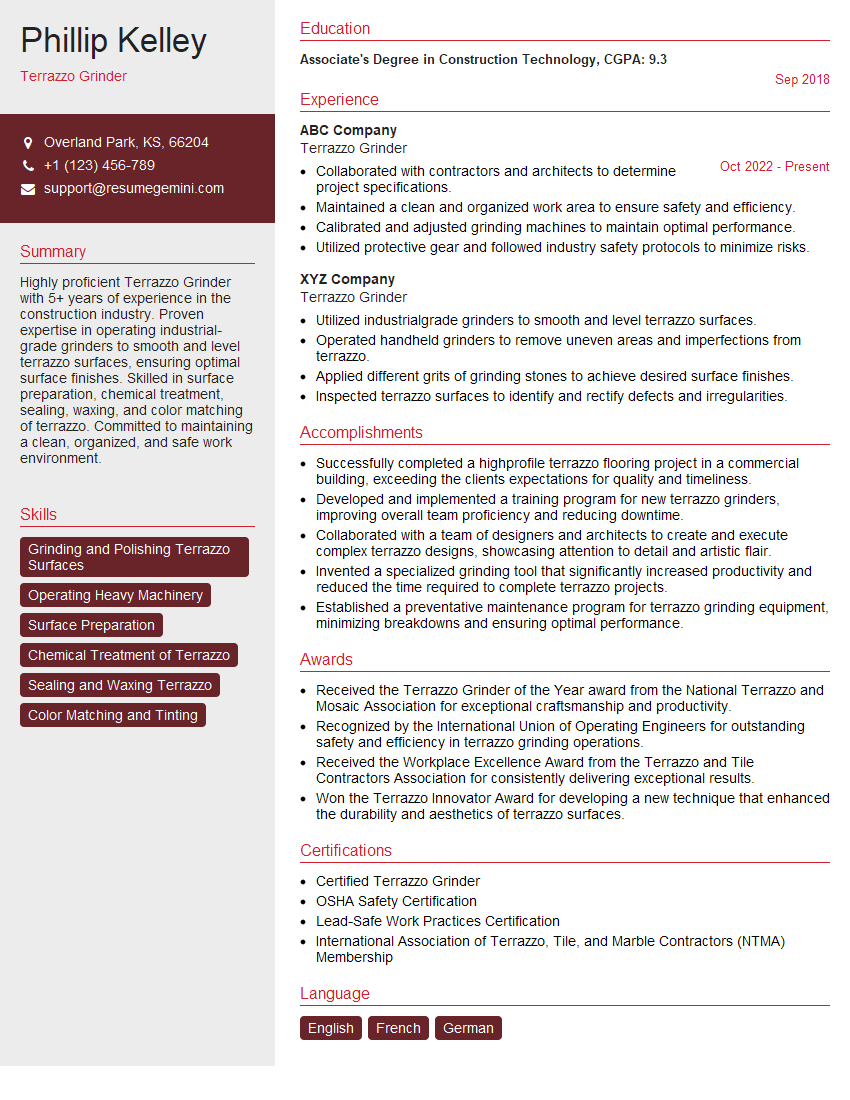
Mastering the skills and knowledge of a Terrazzo Worker opens doors to a rewarding career with diverse opportunities for growth and specialization. To maximize your job prospects, focus on crafting a strong, ATS-friendly resume that effectively showcases your qualifications. ResumeGemini is a trusted resource that can help you build a professional and impactful resume. Examples of resumes tailored to the Terrazzo Worker profession are available to guide you. Invest time in creating a compelling resume – it’s your first impression on potential employers.




Explore more articles
Users Rating of Our Blogs
Share Your Experience
We value your feedback! Please rate our content and share your thoughts (optional).
What Readers Say About Our Blog
Really detailed insights and content, thank you for writing this detailed article.
IT gave me an insight and words to use and be able to think of examples