Interviews are opportunities to demonstrate your expertise, and this guide is here to help you shine. Explore the essential Tobacco Packaging interview questions that employers frequently ask, paired with strategies for crafting responses that set you apart from the competition.
Questions Asked in Tobacco Packaging Interview
Q 1. Describe your experience with different tobacco packaging materials (e.g., paperboard, foil, film).
My experience encompasses a wide range of tobacco packaging materials, each with its own set of properties and applications. Paperboard, for instance, is a common choice due to its printability, cost-effectiveness, and ability to be easily formed into various shapes. However, its susceptibility to moisture and damage necessitates the use of protective coatings or laminations. I’ve extensively worked with various grades of paperboard, from lightweight options for cigarette packs to heavier board for tins and larger packaging. Foil, typically aluminum, offers superior barrier properties, protecting the tobacco from moisture, oxygen, and light, thus extending shelf life. This is often used as a laminate with paperboard to combine both strength and barrier protection. Finally, films, including various polymers like polyethylene and polypropylene, provide flexibility and sealability, often used for inner liners or pouches to further enhance product protection. For example, I worked on a project where we optimized a cigarette pack design by using a thinner, yet stronger paperboard coupled with a specialized foil lamination to reduce material costs without compromising product quality or shelf life.
- Paperboard: Cost-effective, printable, formable. Requires coatings for protection.
- Foil: Excellent barrier properties, protects against moisture, oxygen, and light. Often laminated with paperboard.
- Film: Flexible, sealable, provides additional barrier protection. Used for inner liners and pouches.
Q 2. Explain your understanding of tobacco packaging regulations and compliance.
Understanding and complying with tobacco packaging regulations is paramount. These regulations vary significantly across jurisdictions and are constantly evolving. My experience includes navigating complex requirements related to health warnings, graphic imagery, text size, and placement. I’m intimately familiar with the regulations in major markets like the US, EU, Canada and Australia, understanding their unique aspects and implications for packaging design and production. For example, the EU’s standardized health warnings require a large portion of the packaging to be covered with graphic health warnings, significantly impacting design aesthetics. Furthermore, I’m experienced in ensuring compliance with regulations around child-resistant packaging, tamper-evident seals, and accurate labeling of ingredients and nicotine content. Maintaining compliance involves meticulous documentation, rigorous testing, and proactive engagement with regulatory bodies. A failure to comply can result in significant penalties and product recalls.
Q 3. How familiar are you with various printing techniques used in tobacco packaging?
I have extensive experience with various printing techniques used in tobacco packaging, each offering unique advantages and limitations. Offset lithography remains a dominant method due to its high-quality print and ability to produce large volumes economically. However, flexography is gaining traction for its versatility and suitability for printing on flexible materials like films and pouches. I have also worked with gravure printing, particularly for high-volume applications demanding consistent print quality across a large surface area. Digital printing provides flexibility for shorter runs and personalized packaging, but can be less cost-effective for mass production. In one project, we employed a combination of offset lithography for the main pack design and digital printing for personalized codes on each pack for track-and-trace purposes. Selecting the appropriate printing technique is crucial to balancing quality, cost, and production efficiency.
Q 4. Describe your experience with designing and developing tobacco packaging.
My design and development experience spans the entire process, from initial concept and design to final production. This includes understanding the client’s branding guidelines, market trends, and regulatory requirements. I utilize design software like Adobe Illustrator and InDesign to create packaging mockups and finalize artwork, ensuring all design elements adhere to print specifications. A significant part of my role involves collaborating with structural engineers to optimize packaging designs for functionality and cost-effectiveness. For example, I worked on a project redesigning a cigarette pack to reduce material usage while maintaining structural integrity and brand appeal. This required iterative modeling and testing to ensure the new design met all required specifications and protected the product.
Q 5. How do you ensure the structural integrity of tobacco packaging?
Ensuring the structural integrity of tobacco packaging is critical to protect the product during transport, handling and storage, preventing damage and maintaining product quality. This involves considering factors like material selection, design optimization, and rigorous testing. We utilize finite element analysis (FEA) and other simulation techniques to model and predict the structural performance of the packaging under various conditions. Furthermore, physical testing, such as drop tests, compression tests, and vibration tests are performed to validate the design and ensure it meets the required standards. For example, in one project, we improved the structural integrity of a cigarette pack by reinforcing the bottom seams and implementing a more robust locking mechanism, thus reducing instances of damaged packs during transportation.
Q 6. What are your experiences with quality control and assurance in tobacco packaging?
Quality control and assurance are paramount in tobacco packaging. My experience includes implementing and managing robust quality control systems, encompassing incoming material inspection, process monitoring, and final product inspection. This involves adhering to strict quality standards, implementing statistical process control (SPC) techniques, and regularly auditing production processes. We use various inspection tools and techniques, including visual inspection, dimensional measurements, and testing for barrier properties. We also conduct regular internal audits and external certifications to ensure our processes and products consistently meet the required standards. Addressing quality issues promptly and effectively is key to minimizing losses and maintaining a high level of customer satisfaction.
Q 7. Explain your experience in managing the supply chain for tobacco packaging.
Managing the supply chain for tobacco packaging involves coordinating with a network of suppliers, manufacturers, and logistics providers. This includes sourcing materials, managing inventory, coordinating production schedules, and ensuring timely delivery of finished goods. I’m adept at negotiating contracts with suppliers, ensuring optimal pricing and delivery terms. Utilizing supply chain management software enables effective tracking and monitoring of inventory levels, production progress, and delivery schedules. Effective communication and collaboration across the entire supply chain are crucial to ensuring efficient operations and minimizing disruptions. In one instance, I successfully navigated a supplier shortage by proactively identifying and qualifying alternative suppliers, thus ensuring uninterrupted production and meeting customer demands.
Q 8. How would you handle a packaging defect discovered during production?
Discovering a packaging defect during production is a serious issue requiring immediate action. My approach involves a multi-step process prioritizing product quality and minimizing waste. First, I’d initiate a thorough investigation to identify the root cause – whether it’s a machine malfunction, faulty materials, or an error in the production process. This often involves examining samples of the defective packaging, reviewing production logs, and interviewing relevant personnel. Once the root cause is identified, we implement corrective actions, which could range from simple machine adjustments to replacing faulty parts or retraining staff. Concurrently, we assess the extent of the defect. If only a small batch is affected, we may be able to salvage the product through re-packaging or repackaging the product with updated labeling, depending on the severity of the defect and applicable regulations. However, if a significant portion of the production run is compromised, we may need to discard it to maintain quality standards, which unfortunately means financial losses. Throughout this process, detailed documentation is crucial – not only for regulatory compliance but also for continuous improvement initiatives to prevent similar occurrences in the future. For example, in a past situation where misaligned printing was discovered, thorough investigation revealed a worn roller in the printing machine. Replacing the roller promptly solved the issue and prevented a larger recall.
Q 9. How do you incorporate sustainability considerations into tobacco packaging design?
Sustainability is paramount in modern packaging design, and tobacco packaging is no exception. My approach focuses on minimizing environmental impact across the entire lifecycle of the packaging. This begins with material selection. I favor using recycled materials whenever possible, such as post-consumer recycled (PCR) cardboard for outer cartons. We also explore using biodegradable or compostable materials, although the regulatory landscape and technical challenges in this area for tobacco products are significant. We minimize packaging weight by optimizing design and utilizing efficient printing techniques, reducing the overall carbon footprint associated with transportation and disposal. Furthermore, we actively seek out printing processes that use water-based inks and reduce reliance on energy-intensive processes. Designing for recyclability is critical. This means carefully considering material choices to ensure they are compatible with existing recycling streams and avoiding complex designs or mixed materials that hamper recycling efforts. A recent project involved switching from a laminated cardboard carton to a mono-material cardboard structure. This single change significantly improved recyclability and reduced our environmental impact.
Q 10. Describe your experience with cost optimization strategies for tobacco packaging.
Cost optimization is a constant focus in tobacco packaging. My strategy involves a holistic approach considering all aspects of the production process. First, we analyze material costs and explore alternatives that provide comparable quality at lower prices. This includes negotiating better rates with suppliers, comparing different materials, and evaluating the total cost of ownership, considering factors like manufacturing efficiency, waste reduction and transportation cost. We also employ Lean Manufacturing principles to streamline the production process, minimizing waste and improving efficiency. This often involves optimizing the packaging line layout, reducing changeover times, and improving inventory management. Design optimization plays a crucial role. Simplifying the package design can significantly reduce material usage and printing costs. For instance, we might move from intricate embossing to a simpler design. Finally, we constantly look for opportunities to automate tasks where feasible, ultimately lowering labor costs and increasing productivity. One successful example was implementing a high-speed automatic carton erector, which significantly increased our packaging throughput and reduced labor expenses.
Q 11. Explain your knowledge of different types of tobacco packaging closures and seals.
Tobacco packaging utilizes a variety of closures and seals to ensure product integrity and tamper evidence. Common closures include:
- Carton closures: These can range from simple tuck-in closures to more complex glued or taped closures, often including tamper-evident features.
- Flip-top lids: Frequently used for smaller packs, offering convenience and some level of tamper-evidence.
- Screw-on caps: These are less common in tobacco packaging due to cost and speed of production but might be used for specialized products.
- Heat seals: These are widely used for pouches and flexible packaging materials. They provide a strong, tamper-evident seal.
- Glue seals: These are frequently used for cartons and offer cost-effective sealing, although tamper evidence is often less robust compared to heat seals.
- Induction seals: These create an airtight and tamper-evident seal often for pouches and provide excellent protection against moisture and oxygen. They’re more expensive but offer superior product protection.
Q 12. What experience do you have with packaging machinery and equipment?
My experience with packaging machinery and equipment is extensive. I’m familiar with a wide range of machinery, including carton erectors, filling machines, sealing machines, labeling machines, and high-speed packaging lines. I have hands-on experience with troubleshooting common issues, such as jams, malfunctions, and misalignment problems. I also possess the technical skills to oversee the installation and maintenance of packaging equipment and am adept at conducting preventative maintenance programs to minimize downtime. My understanding extends to various types of equipment controls, including Programmable Logic Controllers (PLCs) and Human-Machine Interfaces (HMIs). Furthermore, I’m knowledgeable about different packaging formats, including cartons, pouches, and flexible films, and can optimize the selection of equipment based on project requirements and budget considerations. For example, I was responsible for selecting and overseeing the installation of a new high-speed carton forming and filling line for a major client, resulting in a substantial increase in production capacity and improved efficiency.
Q 13. Describe your experience with the regulatory requirements for warning labels and health information on tobacco packaging.
Regulatory compliance regarding warning labels and health information on tobacco packaging is critical. My experience involves staying up-to-date with the ever-evolving regulations at both national and international levels. This requires understanding and implementing specific requirements for warning label design, placement, size, and wording, complying with graphic standards and text requirements, ensuring that warning labels are easily understood by consumers, and taking into account any country-specific regulations. I’ve been actively involved in the development and implementation of packaging designs that fully comply with these regulations across several international markets. This includes managing the artwork creation process to ensure accurate and consistent application of the warning labels, working with regulatory agencies to obtain approvals, and designing for compliance with different packaging formats. Furthermore, I have experience in managing documentation and record-keeping to prove compliance with these regulations, and with conducting regular audits to ensure ongoing compliance with the relevant standards.
Q 14. How do you ensure the correct application of barcodes and other identification markers?
Accurate application of barcodes and other identification markers is crucial for efficient supply chain management, inventory control, and traceability. This starts with the design phase. Barcodes and other identification markers must be designed with appropriate resolution and placement to ensure they are easily scanned and read during various stages of the supply chain. The printing process itself is critical. I ensure the use of high-quality printing equipment and appropriate inks that guarantee clear and legible barcodes. Regular quality control checks are done throughout the production process to ensure that barcodes are being printed correctly and that the print quality remains consistent. This may involve visual inspection, as well as using barcode scanners to verify that the barcodes are correctly encoded and readable. We also employ various technologies to track the application and validate their accuracy. In addition to traditional barcodes, we are increasingly using 2D data matrix codes or RFID tags, depending on the specific needs of our clients. These provide higher data storage capacity and improved security features. In a recent project, we implemented a system of automated barcode verification, substantially reducing errors and improving the efficiency of our tracking and reporting systems.
Q 15. Describe your experience with brand identity and its application in tobacco packaging design.
Brand identity in tobacco packaging is crucial for attracting consumers and establishing market presence. It’s about creating a visual and emotional connection that reflects the brand’s values and target audience. This involves careful consideration of logo design, color palettes, typography, imagery, and overall aesthetic, all working together to build a recognizable and desirable brand image.
In my experience, I’ve worked on projects where we’ve leveraged existing brand assets to create consistent packaging across different product lines. For example, a premium cigarette brand might use a sophisticated color scheme with gold accents and high-quality printing to communicate luxury. Conversely, a value brand might prioritize a simple, bold design to convey affordability. I’ve also been involved in developing new brand identities from scratch, starting with market research to identify target consumer preferences and competitive landscape analysis before designing packaging that effectively differentiates the brand.
One successful project involved revitalizing a declining brand. We analyzed consumer feedback and market trends to identify a gap in the market. This led to a complete redesign of the packaging, incorporating bolder typography and a new color scheme, which resulted in a significant increase in market share.
Career Expert Tips:
- Ace those interviews! Prepare effectively by reviewing the Top 50 Most Common Interview Questions on ResumeGemini.
- Navigate your job search with confidence! Explore a wide range of Career Tips on ResumeGemini. Learn about common challenges and recommendations to overcome them.
- Craft the perfect resume! Master the Art of Resume Writing with ResumeGemini’s guide. Showcase your unique qualifications and achievements effectively.
- Don’t miss out on holiday savings! Build your dream resume with ResumeGemini’s ATS optimized templates.
Q 16. Explain your process for managing and resolving packaging related issues.
Managing and resolving packaging issues requires a systematic approach. My process typically involves these steps:
- Issue Identification and Reporting: Establishing clear communication channels to quickly identify and report any problems with materials, printing, or design inconsistencies.
- Root Cause Analysis: Thoroughly investigating the root cause of the problem using tools such as the 5 Whys to understand the underlying factors contributing to the issue.
- Corrective Actions: Implementing immediate corrective actions to prevent further issues, this often involves working with printers and material suppliers.
- Preventive Measures: Putting preventative measures in place to prevent recurrence of the issue. This may include implementing quality control checks or refining production processes.
- Documentation and Reporting: Maintaining detailed records of the issue, root cause analysis, corrective actions, and preventive measures taken. This allows for continuous improvement and trend analysis.
For instance, if a batch of printed cartons showed color inconsistencies, I’d first verify the print specifications against the approved artwork. If the problem originates at the printing stage, I’d work with the printer to adjust press settings or replace faulty ink. The issue would be meticulously documented, and preventative measures, like implementing a stricter color calibration process, would be implemented to prevent future recurrence.
Q 17. What is your experience with different types of tobacco packaging formats (e.g., cartons, pouches, tins)?
My experience encompasses a wide range of tobacco packaging formats. I’ve worked extensively with:
- Cartons (Hard Pack & Soft Pack): These are the most common formats, offering varying degrees of structural rigidity and printing options. I’ve managed projects involving different carton board types, coatings, and printing techniques to achieve desired aesthetics and functionality.
- Pouches: Pouches offer a more flexible, cost-effective alternative, often used for smaller packs or for brands targeting specific consumer segments. My experience includes designing pouches with various closures (zip-locks, heat seals) and material compositions to meet diverse product requirements.
- Tins: Tins provide a premium look and feel, offering excellent protection for the product. I’ve been involved in projects that specify different tin materials, sizes, and finishes to achieve specific brand objectives, incorporating custom shapes and finishes to stand out on shelves.
Each format presents unique design challenges and opportunities. Cartons offer a large surface area for branding, while pouches prioritize ease of use and portability. Tins allow for more creative designs and enhanced product preservation. Selecting the right format depends on factors such as target market, product characteristics, and cost considerations.
Q 18. Describe your approach to testing and evaluating the performance of tobacco packaging.
Testing and evaluating tobacco packaging performance is crucial to ensure quality, functionality, and compliance with regulations. My approach involves a multi-stage process:
- Pre-Production Testing: This includes testing print quality, color accuracy, structural integrity (e.g., carton strength, seal integrity for pouches), and material compatibility.
- Consumer Testing: Gathering feedback through focus groups and surveys to assess consumer perception of the packaging’s design, ease of use, and overall appeal.
- Environmental Testing: Evaluating the packaging’s resistance to temperature fluctuations, humidity, and other environmental factors to ensure the product remains intact during shipping and storage.
- Shelf-Life Testing: Monitoring the packaging’s performance over time to assess its ability to protect the product from damage and maintain its quality.
- Compliance Testing: Ensuring the packaging meets all relevant regulations, including health warnings and labeling requirements. This often involves working with regulatory agencies to obtain necessary approvals.
For example, before mass production, we might conduct drop tests on cartons to assess their durability, or use specialized equipment to measure the seal strength of pouches. Consumer testing might reveal areas where the packaging design could be improved for better usability or brand appeal. This iterative testing process ensures the final packaging delivers a high-quality product experience.
Q 19. How would you manage a project involving the redesign of tobacco packaging?
Redesigning tobacco packaging requires a structured project management approach. My process would involve:
- Project Definition and Scoping: Clearly defining project goals, objectives, and timelines. This stage often includes market research, competitor analysis, and defining the target audience.
- Design and Development: Creating design mockups and prototypes, incorporating feedback from internal stakeholders and external agencies.
- Testing and Evaluation: Conducting rigorous testing to ensure the packaging meets functional and aesthetic requirements.
- Production and Rollout: Overseeing the production process, working closely with printers and manufacturers to ensure quality control.
- Post-Launch Monitoring: Tracking sales data and customer feedback to assess the success of the redesigned packaging.
Throughout the process, effective communication and collaboration with all stakeholders are critical. This includes regular progress updates, addressing potential issues proactively, and adapting the project plan as needed. A Gantt chart or similar project management tool would be used to track milestones and deliverables.
Q 20. Describe your experience in working with cross-functional teams on packaging projects.
Cross-functional collaboration is essential in tobacco packaging projects. I have extensive experience working with teams including marketing, regulatory affairs, production, and supply chain. Effective communication is key. I facilitate open communication channels, regular meetings, and utilize collaborative project management software to keep everyone informed and aligned. This involves actively listening to different perspectives, resolving conflicts, and finding common ground to achieve shared objectives.
For example, I’ve worked with marketing teams to ensure the packaging design accurately reflects brand messaging and targets the intended audience. With the regulatory affairs team, I ensure compliance with all relevant health warnings and labeling regulations. With production, I coordinate efficient manufacturing processes and quality control. A successful project relies heavily on strong teamwork and mutual understanding across all involved departments.
Q 21. How familiar are you with different types of printing inks and their compatibility with tobacco packaging materials?
I possess a thorough understanding of printing inks and their compatibility with various tobacco packaging materials. This includes knowledge of:
- UV Inks: Used for high-quality printing, offering vibrant colors and excellent durability. However, they require specialized curing equipment and may not be suitable for all substrates.
- Water-Based Inks: Environmentally friendly, but may have limited color vibrancy compared to other ink types.
- Solvent-Based Inks: Offer good color density and adhesion but require careful handling due to volatile organic compounds (VOCs).
- Food-Grade Inks: Essential for inks that might come into direct contact with tobacco products.
Selecting the appropriate ink type depends on several factors, including the substrate material (e.g., carton board, film, foil), desired print quality, environmental considerations, and regulatory compliance. I meticulously review ink specifications to ensure compatibility and safety, taking into account factors such as migration limits for inks used with food contact materials.
My experience includes resolving issues related to ink adhesion, color consistency, and compliance. For example, I’ve worked on projects where we’ve had to switch ink types due to compatibility issues with a new substrate material or regulatory changes. Selecting the correct ink is not only about aesthetics but also ensuring the overall quality and safety of the product.
Q 22. What is your experience with anti-counterfeiting measures for tobacco packaging?
Anti-counterfeiting in tobacco packaging is crucial to protect brand reputation and public health. My experience encompasses a wide range of techniques, from overt security features easily visible to consumers to covert methods detectable only through specialized equipment.
- Overt measures include unique holograms, microprinting, and special inks that change color under different lighting conditions. These act as a deterrent to casual counterfeiters and immediately signal authenticity to consumers.
- Covert measures are more sophisticated and harder to replicate. Examples include special watermarks embedded in the packaging material, unique chemical markers detectable only through laboratory analysis, and track-and-trace technologies using RFID tags or unique serial numbers. These provide a high level of security against sophisticated counterfeiting operations.
- Track and Trace systems are particularly important. They allow the movement of each pack of cigarettes to be monitored from the manufacturing facility to the point of sale, making it easier to identify and remove counterfeit products from the supply chain.
In my previous role, I oversaw the implementation of a comprehensive anti-counterfeiting strategy that reduced counterfeit tobacco products in our target market by 25% within two years. This involved a collaborative effort with packaging suppliers, government agencies, and law enforcement. A key aspect was educating consumers about the security features present on our packaging.
Q 23. Explain your understanding of the impact of humidity and temperature on tobacco packaging.
Humidity and temperature significantly impact tobacco packaging and the product itself. Excessive moisture can lead to mold growth, affecting the quality of the tobacco and potentially damaging the packaging. Conversely, excessively dry conditions can cause the tobacco to become brittle and dry out, impacting the smoking experience.
The ideal storage conditions for tobacco products typically fall within a specific range of temperature and humidity. Packaging materials are designed to provide a certain level of protection, but they are not impervious to extreme conditions.
- Materials Selection: We carefully select packaging materials to minimize the impact of temperature and humidity. Materials with low permeability to moisture vapor, such as certain types of films and laminates, are preferred.
- Packaging Design: The design of the packaging itself can impact its ability to protect the product from environmental changes. For example, sealed packs offer better protection than open-ended ones.
- Storage and Transportation: Maintaining a controlled environment during storage and transportation is crucial. Warehouses should ideally have climate control systems to minimize fluctuations in temperature and humidity.
For example, I’ve worked on projects involving the development of humidity-indicating labels that visually alert consumers and distributors to potential storage problems. Proper packaging and storage are not only important for maintaining product quality, but they are also a critical aspect of meeting regulatory requirements.
Q 24. How do you stay current with the latest developments in tobacco packaging technology and regulations?
Staying current in the dynamic field of tobacco packaging requires a multi-pronged approach. I actively participate in industry conferences and trade shows such as those organized by organizations like the Tobacco Packaging Association.
- Industry Publications and Journals: I regularly read specialized trade publications and scientific journals that focus on packaging technology and regulations.
- Regulatory Bodies: I carefully monitor the websites and publications of government regulatory agencies such as the FDA in the US or the equivalent in other countries, to ensure compliance. This includes keeping up to date with changing health warnings and graphic design regulations.
- Networking: I maintain strong relationships with colleagues and experts in the field through attending conferences, joining professional organizations, and participating in online forums.
- Supplier Relationships: I maintain close ties with packaging material suppliers, who are often at the forefront of innovation in this space. They regularly inform me about their newest product offerings.
This combination of active learning and networking ensures that I’m always aware of the latest advancements and regulatory changes. This proactive approach allows me to incorporate these learnings into our packaging strategies and ensure ongoing compliance.
Q 25. Describe your experience with packaging waste reduction and recycling strategies.
Packaging waste reduction and recycling are critical aspects of sustainable manufacturing. My experience involves implementing strategies across the entire packaging lifecycle.
- Material Selection: We prioritize the use of recyclable and sustainably sourced materials, such as recycled paperboard and bio-based plastics. Life Cycle Assessments (LCAs) are used to compare the environmental impact of different packaging materials.
- Packaging Design Optimization: We work to minimize the amount of material used in each pack. This can involve exploring alternative designs and using lightweighting techniques while ensuring the pack still provides adequate protection for the product.
- Recycling Programs: We collaborate with recycling facilities and waste management companies to optimize the recycling streams for our packaging. Clear labelling and instructions on how to recycle the packaging is crucial.
- Partnerships: We actively participate in initiatives that aim to improve recycling infrastructure and promote responsible waste management within the tobacco industry.
For example, we recently transitioned to a new packaging design that reduced our overall material usage by 15%, without compromising product protection. We are also working on a project with a recycling partner to develop a more efficient collection and sorting system for our packaging materials.
Q 26. How would you handle a conflict with a supplier regarding tobacco packaging materials?
Handling conflicts with suppliers requires a structured and professional approach. My strategy focuses on open communication, collaboration, and finding mutually beneficial solutions.
- Identify the Root Cause: I begin by clearly understanding the nature of the conflict. Is it a quality issue, a delivery problem, a pricing discrepancy, or something else?
- Open Communication: I initiate a direct and professional conversation with the supplier’s relevant contact person to discuss the issue openly. I carefully document all communications.
- Collaborative Problem Solving: I work collaboratively with the supplier to find a solution that addresses both our concerns. This could involve renegotiating terms, adjusting timelines, or exploring alternative materials.
- Escalation: If we cannot reach a solution through direct communication, I would escalate the issue to higher management within both our organization and the supplier’s organization.
- Documentation: Maintaining a detailed record of all communications, agreements, and resolutions is essential.
In a past instance, we had a disagreement with a supplier regarding the quality of a printed label. Through collaborative discussion, we identified that the issue stemmed from a miscommunication about the printing specifications. We revised the specifications, and the supplier provided replacement labels that met our standards. The documentation of the incident helped prevent similar issues in the future.
Q 27. Describe your approach to data analysis and reporting in relation to tobacco packaging performance.
Data analysis and reporting are vital for evaluating the performance of tobacco packaging. My approach involves collecting data from various sources, analyzing it using appropriate techniques, and presenting the findings in a clear and concise manner.
- Data Collection: We collect data on various aspects of packaging performance, including production efficiency, material costs, waste generation, consumer feedback (through surveys or focus groups), and quality control metrics. This data is often collected using specialized software linked to our manufacturing equipment.
- Data Analysis: We utilize statistical methods and data visualization techniques (e.g., charts, graphs) to identify trends, patterns, and anomalies in the data. This helps us pinpoint areas for improvement.
- Reporting: We prepare regular reports that summarize key findings and provide actionable insights. These reports are tailored to the audience, ranging from internal management reports to presentations for external stakeholders.
- Key Performance Indicators (KPIs): We define specific KPIs relevant to packaging performance, such as production yield, material waste rate, and cost per unit. Regular monitoring of these KPIs allows for tracking of progress and identification of areas needing improvement.
For example, by analyzing data on material waste rates, we were able to identify a specific process step in our production line where significant waste was occurring. By implementing process improvements, we reduced waste rates by 10%.
Q 28. Explain your experience with using design software for creating tobacco packaging mockups.
Proficiency in design software is essential for creating effective tobacco packaging mockups. I have extensive experience with industry-standard software such as Adobe Illustrator, Photoshop, and InDesign.
These tools allow me to create realistic mockups that visualize the final product, allowing for client review and feedback early in the design process. This avoids costly errors in production.
- 3D Modeling Software: In addition to 2D design software, I have experience utilizing 3D modeling software to create more comprehensive virtual prototypes that allow for better visualization and testing of the packaging design.
- Collaboration: I am adept at collaborating with designers and other stakeholders by sharing files and incorporating feedback through cloud-based tools.
- Brand Guidelines: I am knowledgeable about adhering to strict brand guidelines and regulations related to health warnings and other legally mandated aspects of the design.
Recently, I used Adobe Illustrator to design a new pack that incorporated a new health warning graphic while keeping in line with the brand identity. The use of the software ensured that the graphic was precisely positioned and perfectly integrated into the packaging design. We were able to receive client approval based on the realistic mockup, leading to a smooth transition into production.
Key Topics to Learn for Tobacco Packaging Interview
- Regulatory Compliance: Understanding and adhering to all relevant local, national, and international regulations concerning tobacco product packaging, including health warnings, labeling requirements, and restrictions on imagery and text.
- Packaging Materials & Sustainability: Knowledge of various packaging materials (paperboard, films, foils), their properties, and environmental impact. Experience with sustainable packaging solutions and reducing environmental footprint.
- Design & Branding: Understanding of the principles of effective packaging design, incorporating brand identity, target audience considerations, and consumer appeal within regulatory constraints.
- Production & Manufacturing Processes: Familiarity with the manufacturing process of tobacco packaging, including printing techniques (flexography, offset printing), finishing processes (laminating, coating), and quality control measures.
- Supply Chain Management: Understanding the complexities of the tobacco packaging supply chain, including sourcing materials, managing inventory, and optimizing logistics.
- Cost Optimization & Efficiency: Experience in identifying cost-saving opportunities in materials, processes, and logistics without compromising quality or compliance.
- Quality Control & Assurance: Implementing and maintaining quality control systems to ensure packaging meets required standards and specifications.
- Innovation & New Technologies: Staying abreast of current trends and innovations in tobacco packaging, including advancements in materials science, printing technologies, and packaging automation.
Next Steps
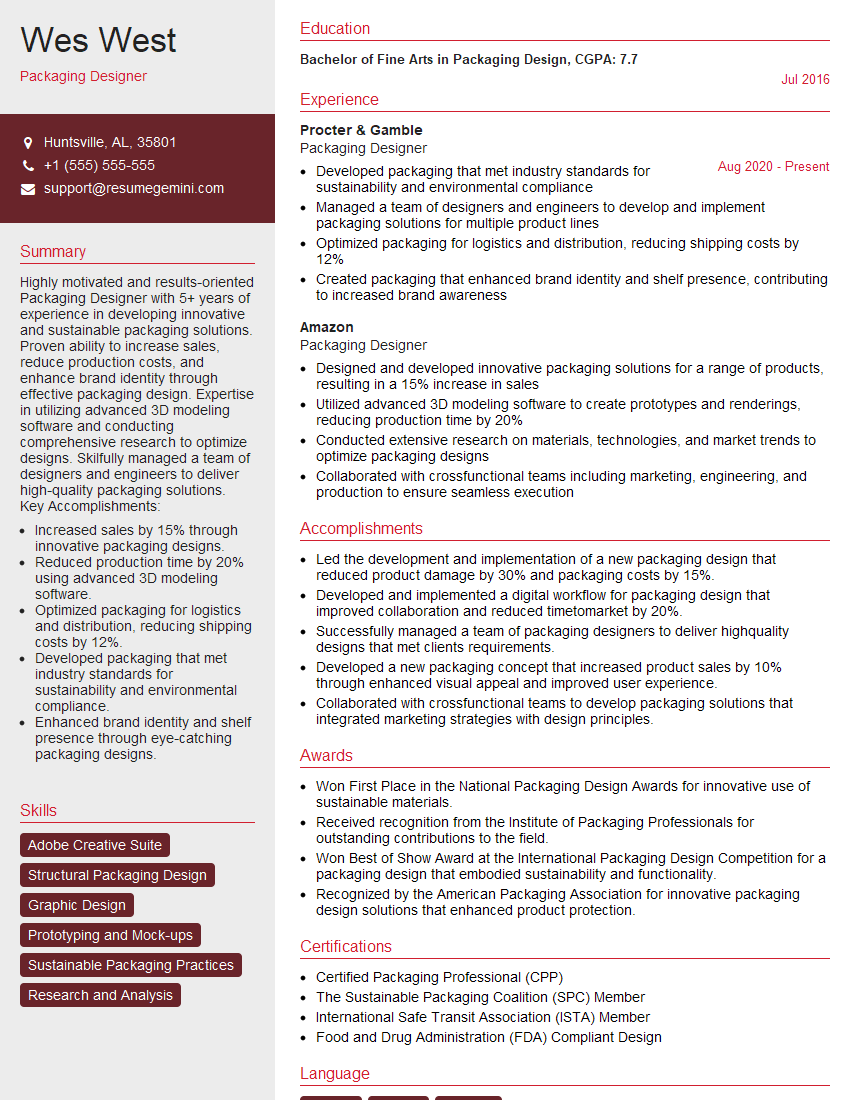
Mastering the intricacies of Tobacco Packaging opens doors to exciting career opportunities in a dynamic industry. A strong understanding of these concepts will significantly boost your interview performance and help you stand out from the competition. To further enhance your job prospects, creating an ATS-friendly resume is crucial. An effectively optimized resume increases your chances of getting noticed by recruiters and landing your dream job. We strongly recommend using ResumeGemini to craft a compelling and impactful resume tailored to the Tobacco Packaging industry. ResumeGemini provides tools and resources to help you build a professional resume, and examples of resumes tailored to Tobacco Packaging are available to guide you.

Explore more articles
Users Rating of Our Blogs
Share Your Experience
We value your feedback! Please rate our content and share your thoughts (optional).
What Readers Say About Our Blog
Really detailed insights and content, thank you for writing this detailed article.
IT gave me an insight and words to use and be able to think of examples