Interviews are opportunities to demonstrate your expertise, and this guide is here to help you shine. Explore the essential Graphic Novels interview questions that employers frequently ask, paired with strategies for crafting responses that set you apart from the competition.
Questions Asked in Graphic Novels Interview
Q 1. Describe your process for developing character designs in a graphic novel.
Developing compelling character designs is crucial in graphic novels. My process begins with a deep understanding of the character’s personality, backstory, and role within the narrative. I start with sketches, exploring different body types, facial features, and clothing styles to visually represent their inner world. For example, a brooding anti-hero might have sharp, angular features and dark clothing, while a cheerful protagonist could have softer lines and brighter colors.
Next, I refine these sketches, focusing on details like hairstyles, expressions, and posture. I often experiment with different poses to capture their unique personality. Think of it like creating a visual resume for each character! Once satisfied with the design, I move to digital refinement using software like Adobe Photoshop or Clip Studio Paint, adding textures, shading, and color to bring the character to life. Finally, I create a character sheet detailing their key features and clothing, ensuring consistency throughout the graphic novel.
A real-world example: While working on my fantasy graphic novel, ‘Chronicles of Aerthos,’ I spent weeks developing the main protagonist, Elara, a skilled warrior. Initially, I envisioned her as a typical ‘strong female character’ archetype, but through several iterations, I refined her design to reflect her vulnerability and inner turmoil, giving her a softer, more relatable quality.
Q 2. Explain your understanding of panel layout and its impact on storytelling.
Panel layout is the cornerstone of effective visual storytelling in graphic novels. It’s not just about placing images on the page; it’s about controlling the reader’s experience and pacing the narrative. Different panel sizes, shapes, and arrangements influence the reader’s emotional response and understanding of the scene. For instance, a large, dominant panel can emphasize a dramatic moment, while a series of smaller panels can convey a sense of urgency or rapid action.
Consider the use of gutters (the space between panels): Wide gutters slow down the pace, allowing the reader to linger on individual moments, while narrow gutters create a sense of immediacy and rapid succession of events. Experimenting with panel placement—a panel placed off-center, for instance, can draw attention to a specific element within the scene—adds dynamism to the page.
In my work, I often use a combination of techniques to guide the reader’s eye. For example, in a tense scene, I might use smaller panels and narrow gutters to increase the pacing, while a moment of reflection might be showcased in a larger, isolated panel. This careful manipulation of space and panel arrangement allows me to control the emotional impact of each scene.
Q 3. How do you balance visual storytelling with written narrative in a graphic novel?
Balancing visual and written narrative is a delicate act. The ideal is a harmonious interplay, where the visuals enhance and complement the text, rather than repeating it. The images should convey subtext, emotions, and details that the written words might not fully capture. The text should then provide context, internal thoughts, or detailed descriptions not easily shown visually.
I often use visual metaphors or symbolism to convey complex emotions or ideas. For instance, a character’s posture or facial expression might communicate their internal state far more effectively than lengthy dialogue. The text then serves to add context to these visual cues, providing deeper understanding. Consider the use of visual cues like color palette to indicate moods or setting—darker shades for a gloomy atmosphere, vibrant colors for a joyous one.
In my graphic novel ‘Echoes of the Past,’ a significant scene showcasing a character’s grief didn’t rely on long descriptions of sorrow. Instead, I used a muted color palette, close-up panels highlighting tear-streaked faces and empty hands, and minimalist dialogue—the impact was far greater than any verbose description could have achieved.
Q 4. Discuss your experience with different printing techniques for graphic novels.
My experience with printing techniques for graphic novels spans several methods, each with its unique benefits and drawbacks. Offset printing remains the industry standard for large print runs due to its cost-effectiveness and high-quality results. It’s a process that uses plates to transfer ink to paper, offering precise color reproduction and crisp lines. However, the setup costs can be significant, making it less ideal for smaller print runs.
Digital printing, on the other hand, is advantageous for short runs or on-demand publishing, requiring no printing plates. While the color reproduction might not always match offset printing, the cost-effectiveness and flexibility are significant benefits. I’ve also worked with a few smaller projects using risograph printing, a stencil-based printing method offering a unique, textured aesthetic, perfect for independent publications with a more ‘DIY’ feel.
The choice of printing technique heavily depends on the budget, print run size, and the desired aesthetic. For mainstream graphic novels, offset printing remains the superior choice, while digital printing is an effective choice for smaller-scale projects or self-publishing.
Q 5. What software are you proficient in for creating graphic novels (e.g., Adobe Creative Suite)?
My primary tools for creating graphic novels are within the Adobe Creative Suite. I’m highly proficient in Photoshop for digital painting, image manipulation, and color correction. I use Illustrator for creating clean line art, lettering, and any vector-based design elements. InDesign is invaluable for page layout and ensuring consistent formatting across the entire graphic novel. I also utilize Clip Studio Paint, known for its intuitive brush engine and comic-creation features, particularly for detailed line work and sketching.
Example of a basic Photoshop command for color adjustment: Image > Adjustments > Hue/Saturation
Proficiency in these software packages is essential for producing high-quality graphic novels. The ability to seamlessly integrate these tools into the workflow is key to efficient production.
Q 6. Explain your approach to creating believable and engaging characters.
Creating believable and engaging characters requires a multifaceted approach. I begin with a thorough character sketch, outlining their physical attributes, personality traits, motivations, flaws, and relationships with other characters. This deep understanding is critical to portraying them consistently and authentically throughout the narrative.
Next, I focus on their arc. What are their goals? What challenges do they face? How do they evolve over the course of the story? This arc forms the backbone of their development, ensuring that their actions and reactions remain true to their character. For example, I might give a seemingly cold character a hidden vulnerability that gradually reveals itself as the story progresses.
Furthermore, I look for ways to make them relatable. Even seemingly villainous characters need understandable motivations. Adding layers of complexity—moral ambiguities, internal conflicts—makes them more interesting and memorable. The goal is to make the reader care about them, regardless of their actions.
Q 7. How do you manage deadlines and workload in a fast-paced graphic novel production environment?
Managing deadlines and workload in the fast-paced world of graphic novel production requires meticulous planning and strong organizational skills. I begin by creating a detailed project timeline, breaking down the entire process into manageable tasks with assigned deadlines. This approach allows me to track progress and identify potential bottlenecks early on. Tools like project management software (e.g., Trello, Asana) can be invaluable for this task.
Prioritization is key. I focus on completing the most critical tasks first and delegate responsibilities whenever possible. This might involve working with other artists for inking, coloring, or lettering. Consistent communication with my team is crucial to ensure everyone is on the same page and aware of any adjustments to the schedule.
Finally, I practice self-care. Burnout is a real threat in this field, so maintaining a work-life balance is paramount. Regular breaks, time off, and focusing on my wellbeing are essential for maintaining productivity and creative energy throughout the project. Avoiding procrastination and establishing a disciplined workflow are also essential.
Q 8. Describe your understanding of different narrative structures in sequential art.
Narrative structure in sequential art, or graphic novels, is far more complex than simply a linear progression of panels. It’s a multifaceted dance between visual storytelling and textual elements. We can break down common structures into a few key categories:
- Linear Narrative: This is the most straightforward approach, where panels unfold chronologically, much like a traditional novel. Think of many superhero comics, where the story moves from point A to B to C with minimal flashbacks or non-linear elements.
- Non-Linear Narrative: This structure jumps between timelines, using flashbacks, flash-forwards, or multiple perspectives to enhance complexity. Watchmen by Alan Moore is a prime example, constantly shifting between past and present to build a complete picture.
- Parallel Narrative: This presents multiple storylines simultaneously, often interweaving them to reveal connections and contrasts. Maus by Art Spiegelman utilizes this technique masterfully, showing both the present-day interview and the past trauma experienced by the Holocaust survivor.
- Episodic Narrative: This structure consists of self-contained stories within a larger overarching narrative, like many anthology comics or series like The Walking Dead. Each issue might be a self-contained story, but contributes to a bigger picture.
- In Media Res: This technique plunges the reader directly into the action, often without preamble, establishing context later. Many crime or thriller graphic novels use this gripping approach.
Mastering these structures is crucial to creating a compelling and engaging narrative experience for the reader. The choice of structure fundamentally impacts the pacing, tone, and overall impact of the story.
Q 9. How do you incorporate symbolism and metaphor into your graphic novel artwork?
Symbolism and metaphor are the backbone of potent visual storytelling in graphic novels. They allow me to convey complex ideas and emotions without relying solely on dialogue or narration. For example, in one project I used a wilting flower to represent the decay of a relationship, while a soaring bird symbolized freedom and hope.
My approach involves:
- Careful selection of imagery: I choose visual elements that resonate with the thematic core of the story. A recurring motif, such as a specific color or object, can subtly build layers of meaning throughout the narrative.
- Contextual placement: The placement of a symbolic image within the panel, its size, and its relationship to other elements all contribute to its meaning. A small, shadowed image might represent a suppressed emotion, while a large, brightly lit one might symbolize something dominant.
- Subtlety and layered meaning: I avoid overly literal representations, opting instead for suggestions that allow readers to engage actively with the symbolism. This creates an enriching reading experience, encouraging multiple interpretations and analysis.
Think of it as painting a picture with more than just colors—it’s about layering in emotions and ideas that deepen the reader’s understanding of the narrative. This allows for a far richer and more rewarding experience.
Q 10. Discuss your experience with working collaboratively within a team on a graphic novel project.
Collaboration is the lifeblood of graphic novel creation. I’ve worked on several projects involving writers, letterers, colorists, and editors. It’s a process that demands open communication and mutual respect. My experience has taught me the importance of:
- Clearly defined roles and responsibilities: Each team member needs to understand their role and how their work contributes to the whole. This prevents duplication of effort and ensures a streamlined workflow.
- Regular communication and feedback: Consistent dialogue between team members is key, ensuring everyone is on the same page regarding creative vision and technical specifications.
- Respectful feedback and compromise: Constructive criticism is essential; it’s about finding the best possible outcome for the project, even if that means deviating slightly from initial ideas.
- Utilizing project management tools: Software like Trello or Asana can aid organization, tracking progress, and ensuring deadlines are met. This is especially crucial for larger projects with numerous team members.
Working collaboratively on a graphic novel project requires patience, flexibility, and a willingness to adapt. The end result, however, is always richer and more compelling because of the diverse talents and perspectives involved.
Q 11. How do you handle constructive criticism and feedback on your work?
Constructive criticism is invaluable in refining a graphic novel. I approach feedback with an open mind, remembering that its goal is to improve the work, not to critique the artist personally. My approach is:
- Actively listen and seek clarification: I take notes, ask clarifying questions, and avoid getting defensive.
- Analyze feedback objectively: I separate valid criticisms from subjective opinions and focus on the aspects that can be improved.
- Experiment and iterate: I don’t necessarily implement every suggestion, but I use the feedback to experiment with different approaches and see what works best.
- Maintain professional communication: I express gratitude for the time and effort the critic has put into providing feedback, even if I disagree with some aspects.
Feedback is a gift that helps improve my craft. The ability to receive criticism and improve based on it is crucial to growing as an artist.
Q 12. Describe your approach to world-building in a graphic novel setting.
World-building in a graphic novel is crucial for establishing a believable and engaging setting. It involves crafting a detailed and consistent reality that extends beyond what’s explicitly shown on the page. My approach considers:
- Geography and environment: I develop maps, sketches, and descriptions to define the physical space, detailing climate, geography, and architecture.
- Culture and society: This includes social structures, customs, beliefs, history, and language. Detailed research is often necessary to create believable and authentic cultures.
- Political systems and conflicts: Understanding the power dynamics, political structures, and ongoing conflicts within the world adds depth and realism.
- Magic systems (if applicable): If the story involves magic or fantasy elements, a clearly defined set of rules and limitations is needed to maintain consistency.
- Character interactions within the world: How characters interact with their environment and society reveals much about their personalities and motivations.
Thorough world-building enhances the immersion and believability of the story, giving it a richness that resonates with the readers. It’s like building a detailed stage set for your characters to act upon.
Q 13. How do you ensure visual consistency throughout a graphic novel?
Maintaining visual consistency throughout a graphic novel is essential for creating a cohesive and professional look. Inconsistent art can jar the reader and disrupt the flow of the story. My techniques include:
- Style guide: Creating a style guide outlining character designs, environment styles, and visual elements helps maintain consistency across the entire graphic novel.
- Reference sheets: Detailed reference sheets for characters, locations, and objects help ensure that they are drawn consistently across all panels.
- Consistent use of color palettes: Maintaining consistent colors for backgrounds, characters, and objects helps to create a unified visual experience.
- Regular self-checking: I constantly review my work to ensure that the style is consistent throughout the project, catching inconsistencies early.
- Collaboration with the colorist: Close collaboration with the colorist ensures that the color palettes complement the line art and maintain visual harmony.
Consistency is more than just aesthetics; it helps the reader focus on the story, not distracting inconsistencies.
Q 14. Explain your understanding of color theory and its application to graphic novels.
Color theory plays a vital role in setting the mood, conveying emotions, and guiding the reader’s eye in a graphic novel. Understanding color relationships is crucial for enhancing the narrative experience.
- Color temperature: Warm colors (reds, oranges, yellows) often evoke feelings of warmth, energy, and excitement, while cool colors (blues, greens, purples) suggest calmness, sadness, or mystery. Using these strategically can dramatically shift the emotional tone of a scene.
- Color harmony: Using harmonious color palettes, such as analogous colors (colors next to each other on the color wheel) or complementary colors (colors opposite each other on the color wheel), creates a visually pleasing and balanced composition.
- Color contrast: Strategic use of contrasting colors can draw the reader’s eye to specific elements within a panel, such as highlighting a character’s expression or emphasizing a key object.
- Color symbolism: Colors often carry cultural or symbolic meanings. Red might represent passion or danger, while black might symbolize mourning or evil. Understanding and leveraging these symbolic associations can add depth to the storytelling.
- Color saturation and value: Adjusting the saturation (intensity) and value (lightness or darkness) of colors can create a variety of effects. Desaturated colors can create a muted or nostalgic feeling, while high-saturation colors are vibrant and attention-grabbing.
Mastering color theory allows me to use color not just as decoration but as a powerful tool to influence the reader’s emotional response and understanding of the story.
Q 15. How do you utilize typography and lettering to enhance storytelling?
Typography and lettering are fundamental to a graphic novel’s success, going beyond mere readability to actively shape the narrative. They’re tools I use to convey emotion, establish character, and control the pacing of the story.
- Font Choice: Different fonts evoke different moods. A serif font might suggest a classic, timeless setting, while a sans-serif font could indicate a modern or futuristic one. For example, a gritty crime story might benefit from a bold, condensed sans-serif, whereas a whimsical children’s story could utilize a playful script font.
- Size and Weight: Varying font sizes and weights emphasize key words or phrases, directing the reader’s eye and highlighting emotional beats. A larger, bolder font can emphasize a character’s anger or surprise, while a smaller, lighter font can subtly convey a whisper or inner thought.
- Kerning and Tracking: Precise control over letter spacing (kerning) and overall word spacing (tracking) improves readability and can subtly affect mood. Tight kerning can create a sense of tension or claustrophobia, while looser kerning can feel more relaxed and open.
- Lettering Styles: Hand-lettered captions or dialogue bubbles can add personality and authenticity. For instance, a character’s messy handwriting could reflect their personality – rushed, anxious, or carefree.
In my work, I constantly experiment with these elements to achieve the desired effect, treating typography as another visual language layer woven into the artwork. I carefully consider each word’s visual impact and how it contributes to the overall narrative experience.
Career Expert Tips:
- Ace those interviews! Prepare effectively by reviewing the Top 50 Most Common Interview Questions on ResumeGemini.
- Navigate your job search with confidence! Explore a wide range of Career Tips on ResumeGemini. Learn about common challenges and recommendations to overcome them.
- Craft the perfect resume! Master the Art of Resume Writing with ResumeGemini’s guide. Showcase your unique qualifications and achievements effectively.
- Don’t miss out on holiday savings! Build your dream resume with ResumeGemini’s ATS optimized templates.
Q 16. Describe your experience with different types of storytelling techniques (e.g., flashback, foreshadowing).
My experience with various storytelling techniques is extensive, forming a core part of my creative process. I use them to enrich the narrative and provide depth.
- Flashback: I utilize flashbacks to reveal crucial backstory information or provide context for present events. Visually, I might shift to a different color palette, use a slightly less detailed art style, or incorporate visual cues like faded borders or sepia tones to distinguish flashbacks from the present timeline. For example, in a story about a detective, flashbacks could show a pivotal crime scene from the past, establishing the detective’s motivation.
- Foreshadowing: Foreshadowing builds suspense and engages the reader. I might use subtle visual clues—a recurring symbol, a character’s worried expression, or a specific object—to hint at future events. A dark cloud looming over a happy scene could foreshadow impending tragedy.
- Nonlinear Storytelling: I’ve experimented with nonlinear narratives, jumping between different timelines or perspectives to enhance the overall impact. This might involve using distinct visual motifs for each timeline to keep the reader oriented.
- Multiple Perspectives: Presenting the same event from different characters’ viewpoints through distinct panels and visual styles can provide a more nuanced understanding of the story. This creates a more complex and layered experience than a single point-of-view could deliver.
Each technique is carefully considered and integrated to achieve specific storytelling goals, with visual cues working in harmony with the written narrative.
Q 17. What is your understanding of the target audience for graphic novels?
The target audience for graphic novels is incredibly diverse, spanning across age groups, interests, and reading levels. It’s not a monolithic group.
- Age Range: From all-ages graphic novels designed for children to mature readers’ graphic novels tackling complex themes, the market caters to diverse age brackets.
- Genre and Interest: The genre is vast, encompassing superhero comics, romance, horror, sci-fi, fantasy, historical fiction, biography, and more. This vast selection means there’s a graphic novel for practically any interest.
- Reading Level: Some graphic novels are text-heavy and demand a higher reading level, while others rely more on visual storytelling and are accessible to a broader audience, including those with literacy challenges.
Understanding the specific target audience for a particular graphic novel is crucial for tailoring the art style, writing style, and content. A graphic novel aimed at younger children will require simpler language and brighter, more cartoonish art than one targeted at adults dealing with mature themes.
Q 18. Discuss your knowledge of the current graphic novel market and trends.
The graphic novel market is booming, and current trends reflect both established preferences and exciting innovations.
- Increased Diversity and Representation: There’s a growing demand for stories featuring diverse characters and perspectives, reflecting a broader range of experiences and identities.
- Experimentation with Form and Style: Artists are pushing creative boundaries, blending genres, and experimenting with unconventional panel layouts and artistic styles.
- Adaptation Boom: Many graphic novels are being adapted into film and television, further expanding their reach and popularity.
- Growth of Digital Platforms: Online platforms and digital comics are becoming increasingly important for distribution and accessibility.
- Webcomics and Online Communities: Webcomics and online communities play a crucial role in fostering emerging talent and promoting new graphic novels.
Staying current involves actively engaging with online communities, attending industry events, and analyzing sales data to understand evolving reader preferences. Adaptability and a willingness to experiment are key to success in this dynamic market.
Q 19. How do you ensure accessibility in your graphic novel designs?
Accessibility is paramount in graphic novel design, ensuring the story reaches the widest possible audience.
- Font Choice: Using clear, legible fonts with sufficient contrast against the background is crucial for readers with visual impairments.
- Color Contrast: Maintaining adequate color contrast between text and background improves readability for everyone, particularly those with low vision. Tools like color contrast checkers are invaluable.
- Alternative Text (Alt Text): Providing descriptive alternative text for images allows screen readers to convey visual information to visually impaired readers.
- Simplified Language: Using clear, concise language and avoiding overly complex sentence structures benefits readers with dyslexia or other learning disabilities.
- Layout and Design: A well-organized layout, with clear panel divisions and visual hierarchy, enhances readability and reduces cognitive load.
Accessibility considerations should be integrated from the initial design stages, ensuring the graphic novel is inclusive and enjoyable for all readers, regardless of ability.
Q 20. How do you research and develop accurate historical or fictional settings for your work?
Thorough research is the backbone of creating historically or fictionally accurate settings.
- Historical Research: For historical settings, I rely heavily on primary and secondary sources—historical documents, photographs, maps, scholarly articles, and books—to ensure accuracy in details like clothing, architecture, social customs, and technology. This might involve visiting museums, archives, and historical sites.
- Fictional Worldbuilding: For fictional worlds, I build detailed backstories, maps, and timelines, outlining the history, culture, politics, and geography of the fictional setting. Consistency is key to maintain believability.
- Visual Research: I extensively research visual elements through period artwork, photographs, and documentaries. This research informs the visual style and the level of detail in the artwork, ensuring authenticity and immersion.
- Expert Consultation: In cases where deep specialized knowledge is needed, I consult with experts—historians, archaeologists, or other specialists—to fact-check and ensure accuracy.
My goal is to create believable and immersive worlds, whether historical or fictional, that enrich the storytelling experience.
Q 21. Explain your process for creating compelling visual metaphors and symbolism.
Creating compelling visual metaphors and symbolism is a key aspect of elevating a graphic novel beyond a simple story.
- Conceptualization: The process begins with brainstorming, connecting abstract concepts to visual imagery. For example, I might represent loneliness with a single, isolated figure in a vast landscape.
- Visual Language: I rely on visual cues to communicate deeper meaning. Color palettes, repeated motifs, symbolic objects, and character gestures are utilized to enhance the thematic depth. A recurring motif of a broken mirror might symbolize a fractured identity.
- Subtlety vs. Explicitness: The degree of explicitness depends on the story and its audience. Sometimes a subtle visual cue is more powerful than a literal representation.
- Iteration and Refinement: The process is iterative. I might initially sketch several options, refining them based on feedback and experimenting with different approaches until I find the most evocative visual metaphor.
Successful visual metaphors are integrated seamlessly into the artwork, enriching the narrative and enhancing the reader’s understanding and emotional connection with the story.
Q 22. How do you use visual pacing to control the reader’s experience?
Visual pacing in graphic novels is the art of controlling the reader’s eye movement and the speed at which they consume the story. It’s about orchestrating the rhythm of the narrative through the strategic use of panel size, layout, and visual elements. Think of it like film editing – a quick cut creates tension, while a lingering shot builds atmosphere. In graphic novels, we achieve this through panel arrangement.
Panel Size and Shape: Large panels slow the pace, allowing the reader to dwell on details and absorb the mood. Small, numerous panels accelerate the pace, creating a sense of urgency or action. Irregular panel shapes can disrupt the flow, highlighting specific moments.
Gutter Space: The space between panels significantly impacts pacing. A wide gutter creates a break in the action, emphasizing a transition in time or space. Narrow gutters suggest a continuous flow, implying immediacy.
Perspective and Angle: A close-up panel emphasizes intimacy and emotion, slowing the pace. A wide shot establishes context and can speed up the pace, giving a broader overview of the scene.
Visual Elements: The use of motion lines, sound effects, and other visual elements can dramatically alter pacing. Abundant motion lines suggest rapid movement, while sparse elements create a slower, more contemplative feel.
For example, a fight scene might utilize small, numerous panels with motion lines to convey the speed and intensity of the combat, while a quiet, reflective moment might be depicted in a single, large panel with minimal detail.
Q 23. Describe your understanding of copyright and intellectual property in the context of graphic novels.
Copyright and intellectual property in graphic novels are crucial. Copyright protects the artistic and literary expression in the work – the story, characters, artwork, and overall design. This protection prevents unauthorized reproduction, distribution, adaptation, and public display of the graphic novel. Intellectual property encompasses all aspects of the creation, including the characters’ names, specific plot points that are original, and distinctive artistic styles.
Understanding copyright is vital for creators. It’s essential to register your copyright with the appropriate authorities (like the U.S. Copyright Office) to establish legal protection and potential recourse in case of infringement. Similarly, creators need to be mindful of other copyrighted works, avoiding plagiarism and securing permissions for any borrowed materials. This includes illustrations, fonts, samples of music, and potentially even character design elements based on pre-existing public knowledge of other works.
Contracts with publishers are essential. They detail ownership, usage rights, and revenue sharing, protecting both the creator’s interests and the publisher’s investment.
Q 24. What are some of your favorite graphic novels and why?
Choosing favorites is tough! But a few that stand out are:
Maus by Art Spiegelman: Its groundbreaking use of animal imagery to depict the Holocaust is both powerful and deeply affecting. Spiegelman masterfully blends personal narrative with historical context, setting a new standard for graphic novels’ potential.
Persepolis by Marjane Satrapi: A beautiful and poignant memoir of Satrapi’s childhood in Iran during the Islamic Revolution. Its simple yet expressive art style perfectly complements the moving story, offering a very human take on a powerful political situation.
Watchmen by Alan Moore and Dave Gibbons: A complex and deconstructive superhero story that explores themes of morality, politics, and the nature of heroism. Its innovative storytelling and stunning artwork have had a lasting impact on the comic book medium.
These works resonate with me due to their innovative storytelling, powerful themes, and masterful execution. They demonstrate the versatility and potential of graphic novels as a medium.
Q 25. Discuss the influence of other art forms (film, painting, etc.) on your graphic novel work.
Film, painting, and other art forms heavily influence my work. Film’s use of cinematic techniques, such as framing, shot composition, and editing, directly translates to panel arrangement and pacing in graphic novels. For example, a long shot might mimic a wide establishing shot in a movie, while close-ups mirror the intensity of a film’s close-up. Understanding film editing principles greatly aids in controlling the narrative’s rhythm.
Painting inspires my visual style, color palette, and composition. The way painters use light, shadow, and color to create mood and atmosphere is something I strive to emulate in my work. The compositions of classical and modern paintings often inform my approach to panel layouts and character placement. The work of masters like Rembrandt and Matisse is constantly influencing my style.
Ultimately, the diverse influences enrich the visual language of my graphic novels, creating a richer and more layered reading experience.
Q 26. Explain your understanding of different narrative voices and perspectives in graphic novels.
Narrative voice and perspective are fundamental. The voice refers to who is telling the story: a first-person narrator (using ‘I’), a third-person omniscient narrator (knowing all characters’ thoughts and feelings), or a third-person limited narrator (focusing on a single character’s perspective). The perspective refers to the viewpoint from which the story is told: subjective (showing a character’s biased view) or objective (presenting events neutrally).
Different choices impact the reader’s experience. A first-person narrative creates intimacy and immediacy, allowing readers to connect emotionally with the narrator. A third-person omniscient narrator can provide a broader view of the events and multiple characters’ perspectives, whereas a third-person limited view offers a more focused and suspenseful experience by limiting what the reader knows.
For example, a graphic novel about a detective might utilize a third-person limited perspective, following only the detective’s thoughts and observations, creating suspense by withholding information from the reader. In contrast, a historical account might employ a third-person omniscient perspective, offering a comprehensive view of various characters’ roles and motivations.
Q 27. How do you balance artistic vision with editorial feedback?
Balancing artistic vision with editorial feedback is a collaborative process. My artistic vision is paramount, as it drives the narrative and visual style. However, constructive feedback from editors is crucial for improving the story’s clarity, pacing, and overall impact. Open communication is key.
I approach editorial feedback as an opportunity for refinement, not criticism. While I firmly hold onto the core elements of my vision, I’m receptive to suggestions that improve the story’s coherence and readability. This can include adjustments to pacing, character development, and even visual elements. A collaborative spirit ensures the final product is both artistically fulfilling and commercially viable.
For instance, an editor might suggest a restructuring of a sequence to improve pacing or clarify a confusing plot point. While my artistic vision remains the cornerstone, such changes refine the overall experience.
Q 28. Describe your approach to marketing and promoting a graphic novel.
Marketing a graphic novel requires a multi-faceted approach. It begins long before publication. Building a following through social media, engaging with readers online, and attending relevant conventions are crucial. Creating a strong online presence (website, social media) showcasing artwork and excerpts is vital.
Pre-publication buzz is essential. This could involve releasing teasers, behind-the-scenes content, and early access to artwork. Working with publishers to establish a solid marketing strategy that aligns with the book’s genre and target audience is crucial. This usually involves pre-orders, media outreach, reviews from key influencers, and advertising campaigns.
Post-publication efforts include reviews, book signings, participation in festivals and conventions, and continued social media engagement to maintain momentum. Collaborating with booksellers, libraries and reviewers to increase the graphic novel’s visibility is also a critical element.
Key Topics to Learn for Graphic Novels Interview
- Narrative Structure & Pacing: Understanding how to build suspense, create compelling characters, and manage the flow of information across panels.
- Visual Storytelling Techniques: Mastering panel layouts, camera angles, and visual metaphors to enhance the narrative and evoke emotions.
- Character Design & Development: Creating believable and engaging characters through visual cues, body language, and consistent design choices.
- Color Theory & Palette Selection: Utilizing color to establish mood, guide the reader’s eye, and create a cohesive visual experience.
- Typography & Lettering: Choosing appropriate fonts and lettering styles that complement the artwork and enhance readability.
- Software Proficiency (e.g., Photoshop, Clip Studio Paint): Demonstrating practical skills in industry-standard software for creating and editing graphic novel pages.
- Genre Conventions & Trends: Familiarity with different graphic novel genres and current trends in the industry.
- Sequential Art Principles: Understanding the fundamentals of visual storytelling in a sequential format, including gutter, bleed, and panel transitions.
- Collaboration & Workflow: Discussing experience working with writers, editors, and other artists in a team environment.
- Portfolio Presentation & Self-Promotion: Articulating your creative process and showcasing your skills effectively to potential employers.
Next Steps
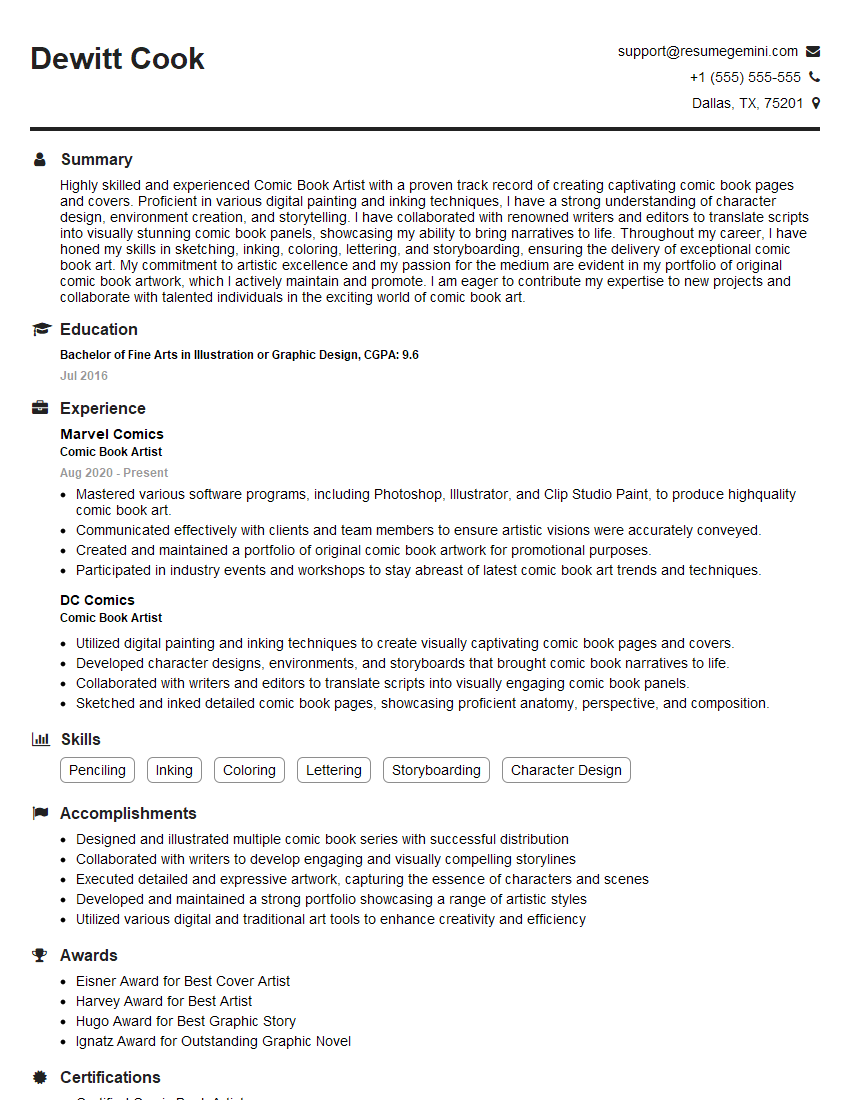
Mastering the art of graphic novel creation opens doors to exciting and fulfilling careers in a dynamic industry. To stand out from the competition, a strong, ATS-friendly resume is crucial. ResumeGemini can help you craft a compelling resume that highlights your skills and experience, maximizing your chances of landing your dream job. ResumeGemini provides examples of resumes tailored specifically to the Graphic Novels field, guiding you through the process of creating a professional and impactful document that gets noticed. Take the next step and create a resume that reflects your talent and passion.
Explore more articles
Users Rating of Our Blogs
Share Your Experience
We value your feedback! Please rate our content and share your thoughts (optional).
What Readers Say About Our Blog
Really detailed insights and content, thank you for writing this detailed article.
IT gave me an insight and words to use and be able to think of examples