Unlock your full potential by mastering the most common Transmission repair and replacement interview questions. This blog offers a deep dive into the critical topics, ensuring you’re not only prepared to answer but to excel. With these insights, you’ll approach your interview with clarity and confidence.
Questions Asked in Transmission repair and replacement Interview
Q 1. Explain the difference between an automatic and manual transmission.
The core difference between automatic and manual transmissions lies in how they manage gear shifting. In a manual transmission, the driver physically selects the gear using a clutch and gearstick, directly engaging the engine to the wheels. This offers greater control and efficiency but demands more driver skill and engagement. Think of it like a bicycle – you manually choose the gear based on your needs.
An automatic transmission, on the other hand, uses a complex system of hydraulics or electronics to automatically select the appropriate gear based on engine speed and load. This simplifies driving, making it more convenient, especially in city traffic. It’s like having the bike automatically shift gears for you based on the terrain.
In essence, manual transmissions provide driver-controlled gear selection for maximum control, while automatic transmissions prioritize ease of use and convenience through automated gear selection.
Q 2. Describe the function of a torque converter.
A torque converter is a fluid coupling found in automatic transmissions. Its primary function is to smoothly transfer power from the engine to the transmission, preventing harsh engagement and providing a smoother driving experience. Imagine trying to start a heavy wagon by directly connecting it to the engine – it would jolt violently. The torque converter acts as a cushion, allowing the engine to gradually increase its power output before fully engaging the transmission. It does this by using fluid to transfer power between an impeller connected to the engine and a turbine connected to the transmission. As engine speed increases, the fluid’s flow increases, resulting in more power transfer.
This fluid coupling also helps to multiply torque at low speeds, making it easier to start from a standstill. Crucially, it prevents stalling the engine when starting or stopping.
Q 3. How do you diagnose a slipping transmission?
Diagnosing a slipping transmission involves a systematic approach. A slipping transmission is characterized by a lack of responsiveness when accelerating; the engine revs up, but the vehicle doesn’t accelerate proportionally. This is often accompanied by a whining or humming sound.
- Road Test: The most important step is a thorough road test, paying close attention to acceleration, especially uphill. Slipping is often most noticeable under load.
- Fluid Check: Examine the transmission fluid. Low fluid levels or burnt, dark fluid are significant indicators of a problem. The fluid should be a light red or pink.
- Check for Codes: Use an OBD-II scanner to check for any diagnostic trouble codes (DTCs) related to the transmission. These codes can pinpoint specific issues.
- Inspection: Carefully check for external leaks and damage to the transmission casing.
If these checks indicate potential problems, further diagnostic tests by a specialist might involve removing the transmission pan to inspect the fluid filter and clutches for wear, or more advanced pressure tests.
Q 4. What are the common causes of transmission fluid leaks?
Transmission fluid leaks stem from several sources:
- Worn Seals and Gaskets: These are common culprits, often degrading with age and use, allowing fluid to escape.
- Damaged Transmission Case: Cracks or damage to the transmission housing itself can cause leaks. This is usually due to impact or corrosion.
- Loose or Damaged Lines: The fluid lines connecting the transmission to the cooler or other components can develop leaks due to wear, corrosion, or improper connection.
- Faulty Transmission Cooler: Leaks within the transmission cooler or its connections can lead to fluid loss.
Pinpointing the exact source of a leak requires a visual inspection, often with the vehicle raised on a lift, and sometimes involves a pressure test to identify the point of failure.
Q 5. How do you test a transmission for internal damage?
Testing a transmission for internal damage is typically more involved and often requires specialized equipment and expertise. It’s rarely a DIY job. Initial assessments can involve a road test and fluid analysis, as described earlier. More in-depth diagnosis may include:
- Fluid Analysis: A lab analysis of the transmission fluid can reveal the presence of metallic particles or other contaminants indicative of internal wear.
- Pressure Testing: This specialized test measures the hydraulic pressure within the transmission under various operating conditions. Abnormal pressure readings can point to problems with pumps, valves, or other internal components.
- Disassembly and Inspection: In many cases, a thorough internal inspection requires disassembling the transmission. This allows for a visual examination of the clutches, bands, gears, and other internal parts for wear, damage, or breakage.
The complexity of this process necessitates the involvement of a qualified transmission specialist with access to the proper equipment and expertise.
Q 6. Describe the process of replacing a transmission filter.
Replacing a transmission filter is a relatively straightforward procedure, but it requires specific tools and some mechanical aptitude. It is crucial to consult your vehicle’s service manual for specific instructions as procedures vary depending on the make and model.
Generally, the process involves:
- Drain the Transmission Fluid: Locate the transmission drain plug and carefully drain the old fluid into a suitable container.
- Remove the Transmission Pan: Carefully remove the transmission pan, being mindful of the fluid still inside. It can be messy.
- Replace the Filter: Locate the old filter and carefully replace it with a new one of the correct type and specifications. Ensure a tight seal.
- Replace the Pan Gasket: If needed, replace the pan gasket to ensure a leak-free seal. Do not reuse old gaskets.
- Reinstall the Transmission Pan: Carefully reinstall the transmission pan, ensuring all bolts are tightened to the correct torque specification.
- Refill with New Fluid: Refill the transmission with the correct type and amount of new fluid, following your vehicle’s specifications. Check your fluid level carefully.
Remember to always consult your vehicle’s service manual for precise steps and torque specifications. Failing to do so could damage your transmission.
Q 7. What are the different types of transmission fluids and their applications?
Transmission fluids are crucial for lubrication, cooling, and hydraulic function within the transmission. There are several types, categorized primarily by their viscosity and additive packages:
- Dexron (GM): A common type of automatic transmission fluid developed by General Motors, with various formulations (Dexron III, Dexron VI, etc.) offering improved performance and longevity.
- Mercon (Ford): Ford’s equivalent to Dexron, with its own specific formulations designed for Ford transmissions.
- ATF+4 (Chrysler): Chrysler’s specific fluid designed for its vehicles.
- Synthetic ATF: Synthetic fluids offer enhanced performance compared to conventional fluids, providing better protection and longer life. They often cost more.
Using the wrong type of transmission fluid can seriously damage your transmission. Always consult your vehicle’s owner’s manual to determine the correct fluid type and specification for your vehicle’s transmission.
Q 8. How do you troubleshoot a transmission that won’t shift?
Troubleshooting a transmission that won’t shift requires a systematic approach. First, we need to determine if the problem lies within the transmission itself, or if it’s a related issue like a faulty linkage, low fluid, or an electrical problem.
Step 1: Check the basics. Start by inspecting the transmission fluid level and condition. Low fluid or severely contaminated fluid is a common culprit. Then, check the linkage (in a manual) for proper adjustment and movement. For automatics, listen for unusual noises – whining, grinding, or banging – that might indicate internal problems.
Step 2: Diagnostic scan. Modern vehicles have onboard diagnostic systems (OBD-II). A scan tool can retrieve diagnostic trouble codes (DTCs) that pinpoint specific problems within the transmission control system. These codes can range from simple sensor issues to more complex internal transmission faults.
Step 3: Road test. Observe the vehicle’s behavior during a test drive. Note when the problem occurs (e.g., only in certain gears, under specific loads). This helps narrow down the possible causes. Does it only happen when cold or hot?
Step 4: Advanced diagnostics. If the initial steps don’t identify the cause, more advanced diagnostics may be needed, such as pressure testing the transmission (automatic) or conducting a thorough inspection of the manual transmission’s components.
Example: I once worked on a vehicle that wouldn’t shift out of park. The scan tool revealed a faulty shift interlock solenoid. Replacing the solenoid solved the problem. In another case, a grinding noise pointed to a worn clutch pack in an automatic transmission which eventually required a rebuild.
Q 9. Explain the function of a clutch in a manual transmission.
In a manual transmission, the clutch acts as a disconnecting device between the engine and the transmission. Think of it as a controllable ‘on/off’ switch for power. When you depress the clutch pedal, it disengages the clutch, allowing you to change gears without damaging the transmission. This is essential because the engine and transmission must be spinning at nearly matching speeds before the next gear can be smoothly engaged.
The clutch uses a pressure plate, clutch disc (friction plate), and throw-out bearing. The pressure plate pushes the clutch disc against the flywheel. When you push the clutch pedal, the throw-out bearing disengages the pressure plate, allowing the disc to separate from the flywheel and break the connection to the engine. Releasing the clutch pedal gradually re-engages the clutch, smoothly transferring power to the transmission and subsequently the wheels.
Without a functioning clutch, gear changes would be impossible without causing significant damage to the transmission’s gears. A slipping clutch indicates wear and needs immediate attention to prevent further damage.
Q 10. Describe the process of rebuilding a transmission.
Rebuilding a transmission is a complex process requiring specialized tools and expertise. It involves a thorough disassembly, cleaning, inspection, repair or replacement of worn or damaged components, and reassembly. The specifics vary slightly depending on the transmission type (automatic or manual).
Steps generally include:
- Disassembly: Carefully removing all components such as the case, gears, shafts, valve body (automatic), clutch packs (automatic), and synchronizers (manual).
- Cleaning: Thoroughly cleaning all parts using specialized solvents to remove debris, old fluid, and contaminants.
- Inspection: Inspecting each component for wear, damage, or defects. This involves measuring clearances, checking for wear patterns, and assessing overall condition.
- Repair/Replacement: Replacing worn or damaged components such as bearings, seals, gaskets, friction plates (clutch packs in automatics, or clutch discs in manuals), synchronizers (manual), etc. Worn gears may require specialized repair or replacement.
- Reassembly: Carefully reassembling the transmission, ensuring proper clearances and alignment. This step demands precision to avoid damaging components.
- Testing: After reassembly, the transmission may be bench tested on a specialized machine to verify proper function and identify any potential issues.
Example: Rebuilding an automatic transmission might involve replacing worn clutch packs, solenoids, and seals within the valve body. A manual transmission rebuild might focus on synchronizer rings, bearings, and gear teeth, and possibly even the clutch assembly if it was included.
Q 11. What safety precautions should be taken when working on a transmission?
Transmission repair presents significant safety risks. Jack stands must be used when working underneath a vehicle. Never rely solely on a jack. Transmission fluid is hazardous and should be handled with care – use gloves and eye protection.
Key Safety Precautions:
- Proper lifting and support: Securely lift and support the vehicle using jack stands rated for its weight.
- Personal Protective Equipment (PPE): Wear safety glasses, gloves, and appropriate clothing.
- Fluid handling: Properly dispose of used transmission fluid according to local regulations. Never pour it on the ground.
- Sharp edges and components: Be aware of sharp edges and components during disassembly and reassembly. Use caution when handling springs and other components under pressure.
- Heavy components: Use appropriate lifting equipment for heavy transmission components to avoid injury.
- Electrical hazards: Disconnect the battery’s negative terminal before working on electrical components.
Example: A heavy transmission can easily cause serious injury if it slips during removal or installation. Improper fluid disposal can lead to environmental contamination.
Q 12. How do you interpret transmission diagnostic codes?
Transmission diagnostic codes, retrieved using an OBD-II scan tool, provide valuable clues about the transmission’s condition. These codes are typically alphanumeric (e.g., P0730, P0740). They are not standardized across all makes and models and require consulting a service manual specific to the vehicle.
Interpreting Codes:
- Code lookup: Use a code reader or online database that matches the code to a specific description for the vehicle’s make, model, and year.
- Code classification: Codes generally indicate problems with sensors, solenoids, wiring, or internal transmission components.
- Multiple codes: The presence of multiple codes could point to a more complex issue. One problem may be causing others (a low fluid level can lead to multiple sensor codes).
- Context is key: Always consider the vehicle’s symptoms along with the codes. The same code might have slightly different implications depending on other conditions.
Example: A code P0733 might indicate a problem with third gear, but the underlying cause could be a faulty speed sensor, low fluid, or a mechanical issue within the transmission itself.
Q 13. What tools and equipment are essential for transmission repair?
Transmission repair requires a comprehensive set of specialized tools. The exact requirements vary depending on the type of transmission and the specific repair being performed, but essential tools include:
- Transmission jack: For safely lifting and supporting the transmission.
- Torque wrenches: For precisely tightening bolts to the manufacturer’s specifications.
- Socket sets and wrenches: Various sizes for removing and installing bolts and nuts.
- Pry bars and screwdrivers: For removing stubborn components.
- Transmission rebuild kit: Containing gaskets, seals, filters, and other replacement parts.
- Fluid pump: For safely transferring transmission fluid.
- Measuring tools: Micrometers, calipers, and dial indicators for precise measurements and clearances.
- Specialty pullers and tools: For removing specific components such as bearings and seals.
- Clean workspace: A clean bench and appropriate containers to hold components
Example: A specific transmission might need a special adapter to remove a particular clutch pack. Always reference the service manual for the vehicle to determine all the tools needed.
Q 14. Explain the function of a valve body in an automatic transmission.
In an automatic transmission, the valve body is the ‘brain’ that controls fluid flow. It’s a complex assembly of hydraulic passages, valves, and solenoids that directs the transmission fluid to different parts of the transmission based on driving conditions and driver input. This precisely timed fluid flow controls the engagement and disengagement of clutch packs, resulting in gear changes.
Functions:
- Shifting: The valve body directs fluid to engage and disengage the various clutch packs that change gears.
- Torque converter control: The valve body manages the lock-up converter clutch that directly connects the engine to the transmission, improving fuel economy.
- Fluid pressure regulation: The valve body regulates fluid pressure, essential for smooth operation and gear changes.
- Line pressure: The valve body ensures there’s enough pressure to shift gears firmly.
Issues: Problems with the valve body can lead to rough shifting, slipping, or failure to shift gears. Often, a failing valve body may start showing symptoms in the form of erratic shifts and then progress to complete transmission failure.
Example: A sticking valve within the valve body can prevent fluid from properly reaching a specific clutch pack, leading to a failure to shift into that gear.
Q 15. How do you identify a faulty transmission solenoid?
Identifying a faulty transmission solenoid often involves a combination of diagnostic techniques. First, you’ll need a diagnostic scanner capable of reading transmission codes. These codes pinpoint which solenoid might be malfunctioning. For example, a code related to shift problems might indicate a faulty shift solenoid. However, codes aren’t always definitive.
Next, a visual inspection is crucial. Look for any physical damage to the solenoid, like cracks or corrosion. This is easier on some transmissions than others, depending on accessibility. Sometimes, a solenoid might be internally damaged without any external signs.
Finally, and this is the most definitive test, you can use a multimeter to check the solenoid’s electrical resistance. Each solenoid has a specific resistance range; values outside this range indicate a problem. Consult your vehicle’s service manual for the correct specifications for each solenoid. Remember to disconnect the battery negative terminal before performing any electrical tests!
Think of it like this: the solenoids are like tiny valves in your transmission, controlling fluid flow to engage different gears. If one valve is stuck or leaky, the transmission won’t shift correctly.
Career Expert Tips:
- Ace those interviews! Prepare effectively by reviewing the Top 50 Most Common Interview Questions on ResumeGemini.
- Navigate your job search with confidence! Explore a wide range of Career Tips on ResumeGemini. Learn about common challenges and recommendations to overcome them.
- Craft the perfect resume! Master the Art of Resume Writing with ResumeGemini’s guide. Showcase your unique qualifications and achievements effectively.
- Don’t miss out on holiday savings! Build your dream resume with ResumeGemini’s ATS optimized templates.
Q 16. Describe the process of removing and installing a transmission.
Removing and installing a transmission is a complex procedure requiring specialized tools and a solid understanding of automotive mechanics. It’s not a job for the average DIYer; it’s best left to experienced professionals. The process generally involves these steps:
- Disconnect the battery: This is crucial for safety.
- Drain the transmission fluid: This prevents spills and makes the transmission lighter.
- Disconnect various components: This includes driveshafts, shift linkage, cooling lines, electrical connectors, and the torque converter.
- Support the transmission: Use a transmission jack to support the transmission’s weight as you unbolt it from the engine.
- Remove the transmission: Carefully lower the transmission using the jack.
- Installation is generally the reverse of removal: Ensure all components are properly aligned and torqued to specifications. Pay close attention to the torque converter installation.
- Refill with new fluid: Use the correct type and amount of transmission fluid specified in your vehicle’s service manual.
- Reconnect everything: Double-check all connections before starting the vehicle.
Proper alignment is critical. Improper installation can lead to serious damage.
Q 17. What are the common symptoms of a failing transmission?
Common symptoms of a failing transmission vary depending on the type of transmission (automatic or manual) and the specific problem. However, some common indicators include:
- Difficulty shifting: This can manifest as slipping gears, delayed engagement, or hard shifts in automatics, or grinding or difficulty engaging gears in manuals.
- Transmission slipping: The engine revs up without a corresponding increase in speed.
- Unusual noises: Whining, grinding, humming, or clunking noises can indicate internal transmission problems.
- Fluid leaks: Visible transmission fluid leaks are a serious sign requiring immediate attention.
- Check engine light: A illuminated check engine light often accompanies transmission issues, indicating fault codes stored in the vehicle’s computer.
- Burning smell: A burnt smell suggests overheating due to low fluid or internal friction.
Ignoring these symptoms can lead to catastrophic transmission failure, requiring an expensive rebuild or replacement.
Q 18. How do you adjust clutch cable or linkage in a manual transmission?
Adjusting the clutch cable or linkage in a manual transmission is crucial for proper clutch engagement. Improper adjustment can lead to incomplete disengagement, resulting in hard shifting, clutch slippage, or even damage to the clutch itself. The specific procedure varies widely depending on the vehicle’s make and model, so always consult the service manual.
Generally, adjusting a clutch cable involves using an adjuster nut or barrel located on the cable near the transmission. Turning the adjuster changes the cable tension, thereby adjusting the clutch engagement point. For linkage adjustments, there are usually adjustment points on the linkage itself, often involving threaded rods or eccentric bolts.
The goal is to achieve a clutch engagement point that allows smooth shifting without excessive free play. Too much free play results in incomplete disengagement, while too little free play can cause hard shifting and premature clutch wear.
Q 19. Explain the process of performing a transmission fluid and filter change.
Performing a transmission fluid and filter change is essential for maintaining your transmission’s health. The process generally involves:
- Warm up the transmission: This helps the fluid flow more easily.
- Locate the drain plug: Drain the old fluid into a suitable container.
- Remove the transmission pan: This allows access to the filter.
- Replace the filter: Use a new filter that matches the specifications for your vehicle.
- Clean the pan: Remove any debris or old gasket material from the pan.
- Replace the pan gasket: Install a new gasket to ensure a proper seal.
- Reinstall the pan: Tighten the pan bolts according to the manufacturer’s specifications.
- Refill the transmission: Use the correct type and amount of fluid, as specified in your vehicle’s service manual. You may need to use a transmission fluid pump to fill the transmission if the filler port isn’t easily accessible.
- Check the fluid level: Use the dipstick to verify the fluid level is correct.
Using the wrong fluid type can damage your transmission, so always double-check the recommended fluid type in your vehicle’s owner’s manual.
Q 20. What is the significance of proper torque specifications during transmission repair?
Proper torque specifications during transmission repair are absolutely critical. Bolts and nuts securing various components within the transmission, and those attaching the transmission to the engine, must be tightened to the correct torque values. This ensures the components are held securely in place and prevents leaks or damage. Over-tightening can strip threads or break bolts, while under-tightening can lead to leaks or looseness, potentially causing catastrophic failure.
Always consult a repair manual or service information to obtain the correct torque specifications for your vehicle’s transmission. Using a torque wrench calibrated regularly is paramount to achieve the accurate values.
Think of it as building with LEGOs – each brick must be connected firmly but not crushed. The wrong torque can easily ruin the entire structure.
Q 21. How do you diagnose and repair a transmission that is making unusual noises?
Diagnosing and repairing a transmission making unusual noises requires a systematic approach. First, carefully listen to the noise to determine its characteristics:
- Location: Where is the noise coming from? Is it consistent or intermittent?
- Pitch: Is it high-pitched (like a whine) or low-pitched (like a growl)?
- Speed correlation: Does the noise change with vehicle speed or engine RPM?
These clues help narrow down the potential sources. Whining noises might suggest issues with bearings, while grinding noises indicate gear problems. A clunking noise could indicate a loose component.
Once you’ve identified the type of noise and its possible source, further investigation may be needed, possibly including removing the transmission pan to inspect the internal components. A thorough inspection may reveal broken gears, worn bearings, or other internal damage, necessitating a transmission rebuild or replacement.
It’s crucial to accurately diagnose the noise before attempting any repairs. Misdiagnosis can lead to ineffective and potentially costly repairs.
Q 22. Describe your experience with different types of transmission designs.
My experience encompasses a wide range of transmission designs, from the simpler manual transmissions to the complex automated manual transmissions (AMTs) and continuously variable transmissions (CVTs). I’ve worked extensively with:
- Manual Transmissions: These are mechanical marvels, relying on gears and synchronizers for shifting. I’ve repaired numerous issues, from worn synchronizers causing difficult shifting to damaged gear teeth resulting in grinding noises. Understanding the precise engagement of gears is crucial here.
- Automatic Transmissions: These utilize hydraulic pressure and planetary gear sets for smooth shifting. I’m proficient in diagnosing and repairing problems across various automatic designs, including those using torque converters, valve bodies, and sophisticated electronic control units (ECUs).
- Automated Manual Transmissions (AMTs): Essentially a manual transmission controlled by a computer, AMTs combine the fuel efficiency of manuals with the convenience of automatics. My experience here includes troubleshooting issues with actuators, clutch systems, and control software.
- Continuously Variable Transmissions (CVTs): CVTs use belts or chains and cones to provide an infinite number of gear ratios, maximizing fuel efficiency. My expertise includes repairing belt failures, diagnosing issues within the control systems and understanding the unique characteristics of this type of transmission.
Each design presents its own set of challenges and requires a deep understanding of its mechanics and control systems.
Q 23. What are the common causes of transmission overheating?
Transmission overheating is a serious issue that can lead to significant damage. Common causes include:
- Low Transmission Fluid Level: Insufficient fluid leads to inadequate lubrication and cooling, causing excessive heat buildup. Think of it like not having enough oil in your engine; it will overheat quickly.
- Contaminated Transmission Fluid: Dirty fluid loses its ability to cool and lubricate effectively. Think of it like trying to cook with dirty oil; it doesn’t work as well and damages what you’re cooking.
- Malfunctioning Transmission Cooler: The transmission cooler helps dissipate heat; a faulty cooler will lead to increased transmission temperatures. It’s like having a broken radiator in your car; it will overheat.
- Internal Problems: Problems within the transmission itself, such as worn clutches, faulty bearings, or a failing torque converter, can generate excessive heat. These are often the more serious issues that require major repairs.
- Driving Habits: Aggressive driving, frequent towing, or prolonged idling can all contribute to transmission overheating. Think of it like constantly revving your engine; it’s going to get hot.
Proper diagnosis involves checking fluid levels, condition, and cooler functionality, along with careful inspection of the transmission for internal damage.
Q 24. How do you perform a visual inspection of a transmission?
A visual inspection is the first step in diagnosing transmission problems. It involves a methodical examination of the transmission and its surrounding components. I typically follow these steps:
- External Examination: I look for leaks, damage to the transmission case, loose connections, and corrosion. Any sign of fluid leakage is an immediate red flag.
- Fluid Inspection: I check the transmission fluid for color, smell, and debris. Dark, burnt-smelling fluid indicates problems.
- Wiring Harness Inspection: I meticulously inspect the wiring harness for damage, fraying, or corrosion. Electrical issues are often overlooked but can cause significant problems. I’ll check connectors for secure connections and any evidence of burning.
- Component Examination: If the transmission is removed, I’ll closely inspect the components for wear, damage, or debris, paying attention to bearings, seals, and other critical parts.
This visual inspection provides a valuable foundation for further diagnostics, often identifying obvious problems or narrowing down the areas requiring more in-depth investigation.
Q 25. Explain your experience with different transmission control systems.
My experience covers a variety of transmission control systems, from simple mechanical shift linkages to sophisticated electronic control units (ECUs) with complex algorithms. I’m familiar with:
- Hydraulic Control Systems: These systems utilize hydraulic pressure to control shifting in automatic transmissions. I’ve worked on diagnosing and repairing issues within the valve body, which is the heart of the hydraulic control system.
- Electronic Control Units (ECUs): Modern transmissions rely heavily on ECUs to manage shifting, torque management, and other functions. I can diagnose ECU faults using diagnostic scanners and troubleshoot issues with sensors, actuators, and the ECU itself. I’ve had to replace ECUs in several cases and program them to work with the specific transmission.
- Shift Solenoids and Sensors: These components are essential for proper operation. Diagnosing failures often involves checking electrical circuits, verifying sensor output, and replacing faulty components.
Understanding the interplay between these systems is critical for accurately diagnosing and repairing transmission issues. For example, a seemingly simple shifting problem could be caused by a faulty sensor, a wiring issue, or a malfunctioning ECU. My approach involves systematic testing to isolate the exact problem.
Q 26. What is your experience working with different makes and models of vehicles?
My experience spans a wide range of makes and models, including domestic and import vehicles. I’ve worked on transmissions from:
- General Motors (GM): Various automatic and manual transmissions across their vehicle lines.
- Ford Motor Company: Extensive experience with their automatic and manual transmissions, including those with unique features.
- Chrysler LLC: Experience with various automatic and manual transmissions used in their vehicles.
- Toyota: Worked on numerous Toyota vehicles, including their advanced automatic transmissions.
- Honda: Experience with Honda’s various transmissions, including their CVT designs.
This broad experience allows me to approach each repair with a solid understanding of the specific characteristics of the vehicle’s transmission.
Q 27. Describe a challenging transmission repair you successfully completed.
One particularly challenging repair involved a 2012 BMW 750i with a ZF 8HP70 automatic transmission exhibiting intermittent shifting problems and harsh engagement. Initial diagnostics pointed to a potential valve body issue, but replacing the valve body did not resolve the problem. After a thorough investigation, I discovered a rare fault: a tiny crack in the transmission’s internal hydraulic pump. This crack was almost invisible to the naked eye and was only detected using specialized tools and techniques. Repairing this internal component required complete transmission disassembly, precision machining to repair the pump, and reassembly with meticulous attention to detail. The repair was successful, and the transmission operated flawlessly after the procedure.
Q 28. How do you stay up-to-date with the latest advancements in transmission technology?
Keeping abreast of advancements in transmission technology is vital. I achieve this through several methods:
- Technical Publications and Manuals: I regularly consult factory service manuals and technical publications to stay informed about specific models and their unique characteristics. Keeping my subscriptions current is crucial.
- Industry Publications and Websites: I follow industry publications and online forums for updates on new technologies and common repair challenges. Staying in contact with online communities helps me learn new techniques from other professionals.
- Continuing Education Courses: I participate in continuing education courses and workshops to enhance my knowledge and learn about the latest diagnostic tools and repair techniques. I also actively seek out training from manufacturers and industry professionals.
- Manufacturer Training: Direct training from manufacturers like ZF, GM, and others is essential for understanding the intricacies of their transmission designs and control systems. This keeps me up to date with their current designs.
This ongoing learning is essential for remaining at the forefront of transmission repair and replacement.
Key Topics to Learn for Transmission Repair and Replacement Interviews
- Transmission Types and Operation: Understanding the mechanics of various transmission types (automatic, manual, CVT) including their internal components and operational principles. This includes knowledge of torque converters, clutches, gear sets, and valve bodies.
- Diagnosis and Troubleshooting: Mastering diagnostic techniques, utilizing scan tools and other diagnostic equipment to identify transmission malfunctions. This includes interpreting diagnostic trouble codes (DTCs) and understanding their implications for repair strategies.
- Repair Procedures: Detailed knowledge of common transmission repairs, including clutch pack replacement, valve body rebuilds, and the replacement of internal components. This also involves understanding proper fluid and filter changes.
- Transmission Removal and Installation: Safe and efficient removal and installation of transmissions, including proper alignment and torque specifications. This includes familiarity with different transmission mounting systems and associated components.
- Fluid and Filter Selection: Understanding the importance of proper fluid selection and its impact on transmission performance and longevity. Knowing the specifications and differences between various transmission fluids is crucial.
- Safety Procedures and Regulations: Adhering to all safety regulations and procedures when working with automotive transmissions, including proper use of safety equipment and waste disposal practices.
- Computerized Transmission Systems: Familiarity with modern electronically controlled transmissions and their diagnostic requirements. Understanding the interaction between the transmission control unit (TCU) and other vehicle systems.
- Problem-Solving and Critical Thinking: Developing the ability to effectively troubleshoot complex transmission issues, using logical reasoning and systematic approaches to identify and resolve problems.
Next Steps
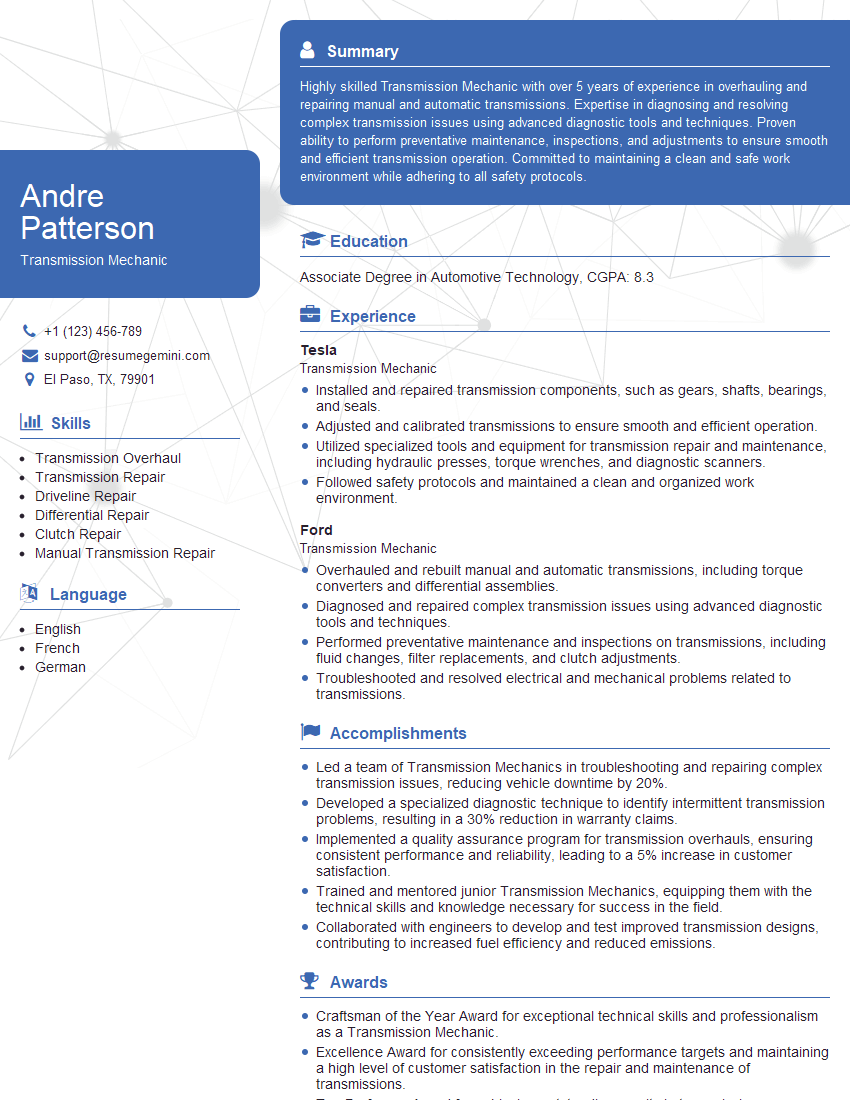
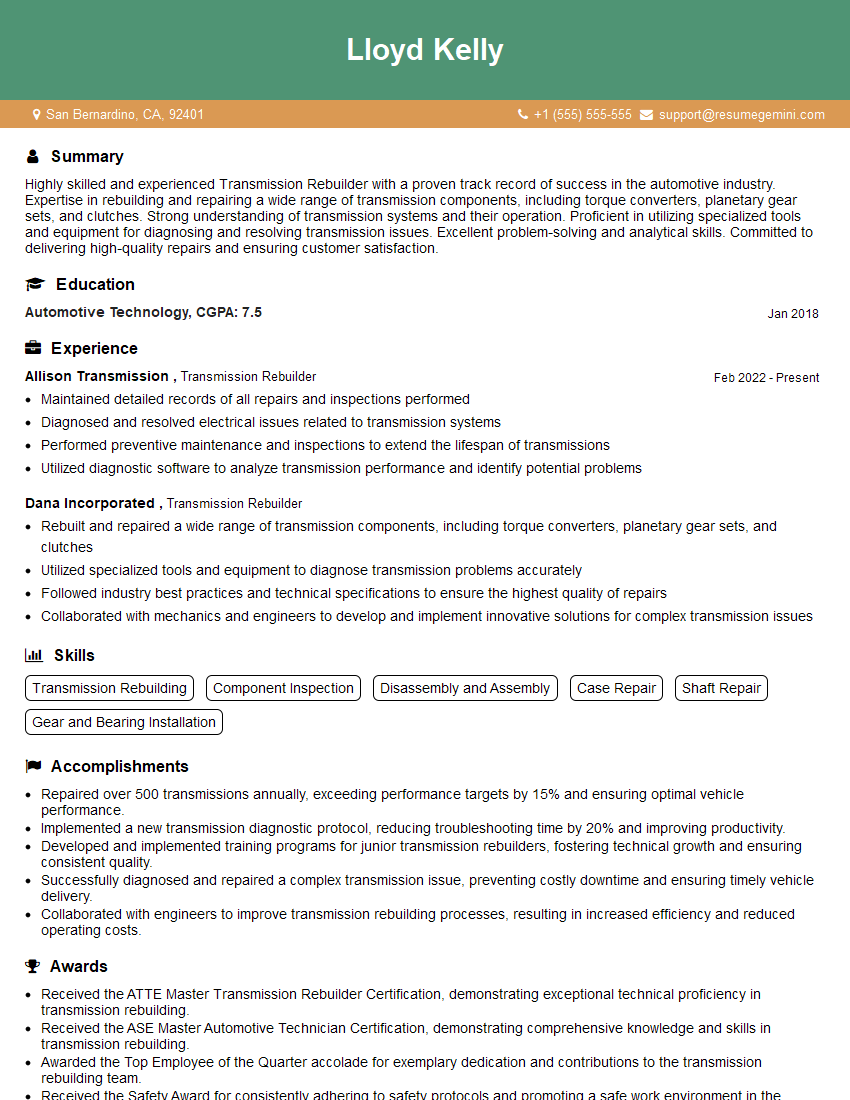
Mastering transmission repair and replacement opens doors to rewarding and high-demand careers in the automotive industry. Proficiency in this area demonstrates a valuable skillset and positions you for advancement and higher earning potential. To increase your chances of landing your dream job, focus on creating a compelling and ATS-friendly resume that highlights your skills and experience effectively. Use ResumeGemini to build a professional and impactful resume tailored to the automotive industry. ResumeGemini offers valuable tools and resources, including examples of resumes specifically designed for Transmission Repair and Replacement technicians, to help you present your qualifications in the best possible light.

Explore more articles
Users Rating of Our Blogs
Share Your Experience
We value your feedback! Please rate our content and share your thoughts (optional).
What Readers Say About Our Blog
Really detailed insights and content, thank you for writing this detailed article.
IT gave me an insight and words to use and be able to think of examples