Preparation is the key to success in any interview. In this post, we’ll explore crucial Laser Process Development interview questions and equip you with strategies to craft impactful answers. Whether you’re a beginner or a pro, these tips will elevate your preparation.
Questions Asked in Laser Process Development Interview
Q 1. Explain the differences between CO2, Nd:YAG, and fiber lasers.
CO2, Nd:YAG, and fiber lasers are all commonly used in material processing, but they differ significantly in their wavelength, power capabilities, and applications. Think of it like choosing the right tool for a job – a screwdriver for screws, a hammer for nails. Each laser type is best suited for specific materials and processes.
- CO2 Lasers: These lasers operate in the infrared region (10.6 µm wavelength). Their long wavelength makes them highly efficient at interacting with non-metallic materials like wood, plastics, and fabrics, causing rapid heating and ablation. They’re often used for cutting and engraving these materials, and large-scale industrial processes.
- Nd:YAG Lasers: Nd:YAG lasers emit light in the near-infrared region (1.06 µm wavelength). This shorter wavelength allows for better absorption in metals and certain ceramics. They are versatile and can be used for cutting, welding, and marking, with higher precision than CO2 lasers, particularly in metal processing. They are also available in pulsed modes, allowing for micromachining capabilities.
- Fiber Lasers: These lasers also operate in the near-infrared region (around 1.07 µm), but offer several advantages. They are highly efficient, compact, and robust, providing high beam quality and excellent power scalability. Fiber lasers have become increasingly popular for high-speed cutting and welding of metals, particularly in automotive and aerospace industries, thanks to their superior beam quality and high power.
In short: CO2 excels with non-metals, Nd:YAG is versatile but perhaps less efficient, and fiber lasers are the high-power workhorses for metal processing, offering superior beam quality and efficiency.
Q 2. Describe your experience with laser safety protocols and regulations.
Laser safety is paramount in my work, and I’ve always adhered to stringent protocols. My experience includes developing and implementing comprehensive safety procedures, complying with ANSI Z136 standards (or equivalent international standards) and laser safety regulations specific to the relevant industries. This includes ensuring proper laser enclosure, interlocks, and safety eyewear selection appropriate for the specific laser wavelength and power levels.
For example, in one project involving a high-power fiber laser, we implemented a multi-layered approach: a physical enclosure with interlocks preventing access during operation, beam path monitoring to shut down the system in case of misalignment, and mandatory use of specific safety eyewear and appropriate PPE (Personal Protective Equipment) by all personnel in the laser area. Regular laser safety training and competency assessments were also conducted for all team members involved in operating or maintaining the system. Documenting all safety procedures and performing regular equipment inspections are integral parts of maintaining a safe working environment.
Q 3. How do you optimize laser parameters (power, pulse duration, speed) for a specific material and process?
Optimizing laser parameters is a crucial aspect of laser processing. It’s an iterative process involving experimentation and data analysis to achieve the desired results. Imagine trying to sculpt with a chisel – you need the right force, angle, and speed. Similarly, we need to fine-tune laser parameters for optimal material interaction.
The process often involves:
- Material Characterization: Understanding the material’s absorption characteristics at the laser’s wavelength is critical. This influences the choice of laser type.
- Parameter Variation: A systematic approach is key. We’ll start with a base set of parameters (power, pulse duration, speed) and then vary one parameter at a time, observing the effect on the process. This might involve using Design of Experiments (DOE) methodologies for efficient exploration of parameter space.
- Process Monitoring: This is done through various techniques, from simple visual inspection to advanced methods such as in-situ imaging and spectroscopic analysis.
- Data Analysis: The results are analyzed to determine the optimal settings. The goal might be to maximize material removal rate, minimize heat-affected zone (HAZ), or achieve a specific surface finish. This might involve regression analysis or other statistical methods.
For instance, in cutting stainless steel with a fiber laser, we might need to adjust the laser power to balance cut speed and edge quality. Too little power, and the cut will be slow and ragged; too much power can cause excessive melting and undesirable effects. The pulse duration also influences the heat-affected zone, shorter pulses generally leading to narrower HAZs. The ideal combination depends on the specific material properties, desired cut speed, and desired edge quality.
Q 4. What are the common challenges in laser micromachining?
Laser micromachining presents unique challenges, many stemming from the small scale of the operations.
- Heat Affected Zone (HAZ): Controlling the HAZ is often a significant challenge. Excessive heat can damage the surrounding material, leading to undesirable effects. This requires careful parameter optimization and potentially the use of different techniques like scanning strategies or assisted processes (e.g., using gas jets).
- Material Removal Rate: Achieving a balance between speed and precision is often a trade-off. High removal rates might compromise precision, while slow processing can impact productivity.
- Accuracy and Precision: Maintaining high levels of accuracy and precision at a microscopic scale requires very stable laser systems, precise motion control, and often advanced imaging and feedback mechanisms.
- Debris Management: During micromachining, debris can accumulate and interfere with the process, leading to defects or damage to the optics. Efficient debris removal strategies are therefore crucial.
- Optical Aberrations: At such small scales, the effects of optical aberrations are amplified, reducing the quality of the laser beam focusing and impacting the final result. High-quality optics and careful alignment are critical.
Addressing these challenges often requires a combination of advanced laser technology, precise control systems, and sophisticated process optimization techniques.
Q 5. Describe your experience with different laser beam delivery systems.
My experience encompasses a variety of laser beam delivery systems, each with its strengths and weaknesses. The choice of system depends greatly on the specific application and the laser parameters being utilized.
- Galvanometer Scanners: These are widely used for high-speed, precise two-dimensional laser scanning, ideal for micromachining applications. I’ve used them extensively in marking and cutting operations, where rapid and precise movement of the beam is crucial. Their flexibility makes them ideal for complex geometries.
- F-Theta Lenses: These lenses are commonly used with galvanometer scanners to achieve accurate and consistent spot size across the entire scan field. Their design corrects for the distortion introduced by the scanner.
- Optical Fibers: Flexible fiber delivery systems offer great versatility, allowing for beam delivery to confined or hard-to-reach areas. I have used these for applications requiring remote processing or complex geometries that would be difficult to access directly with a fixed optical system. Fiber lasers are often delivered through fibers inherently.
- Beam Expanders: These are often used to adjust the beam diameter before focusing, influencing the spot size and depth of focus. They’re critical in controlling the laser interaction with the material.
Selecting the right beam delivery system requires careful consideration of factors such as scan speed requirements, accuracy, beam quality, working distance, and the complexity of the workpiece geometry.
Q 6. How do you troubleshoot issues related to laser beam quality?
Troubleshooting beam quality issues is a critical skill in laser processing. It requires a systematic approach, starting with careful observation and gradually narrowing down the possible causes.
My approach typically involves:
- Visual Inspection: A thorough visual inspection of the beam profile using a beam profiler or even a simple card can reveal issues like aberrations, mode instabilities, or beam wander.
- Power Measurement: Checking the laser output power using a power meter ensures the laser is operating at the expected level. Unexpected power fluctuations can indicate problems with the laser itself or the delivery system.
- Beam Alignment: Misalignment of optical components can dramatically affect beam quality. Careful alignment using appropriate tools and techniques is essential. This might involve using alignment telescopes and auto-collimators for precise alignment.
- Optical Component Inspection: Inspecting the mirrors, lenses, and other optical components for dust, damage, or contamination is crucial. Cleaning and replacing damaged components is often necessary.
- Thermal Effects: Thermal effects can sometimes cause beam distortion, particularly in high-power lasers. Assessing thermal management is important, potentially involving improving cooling systems or revisiting laser power levels.
For example, if I observe a distorted beam profile during processing, I would systematically check for dust or damage to the optics, ensure proper alignment, and examine the cooling system to rule out thermal effects. A detailed record-keeping is crucial for tracking down the root cause effectively.
Q 7. Explain your understanding of different laser scanning techniques.
Laser scanning techniques are crucial for controlling the interaction between the laser beam and the material. Different techniques offer advantages depending on the process and desired outcome.
- Raster Scanning: This is a common technique where the laser beam traces a series of parallel lines across the material. This is suitable for large-area processing like marking or engraving. Imagine a printer moving back and forth to create an image – it’s similar to raster scanning.
- Vector Scanning: Vector scanning follows a predefined path or contour, making it suitable for cutting or shaping complex geometries. It’s more efficient for cutting intricate designs.
- Spiral Scanning: In this technique, the laser beam traces a spiral path, often used for micromachining processes where a circular pattern or concentric rings are desired.
- Random Scanning: This technique employs a random or pseudo-random scanning pattern, often used for specific applications such as laser cleaning or surface modification where uniform coverage is important.
- Hybrid Scanning: Many advanced systems use hybrid approaches, combining different scanning techniques to optimize the process for specific applications. For example, it might use raster scanning for initial material removal and then vector scanning for detailed shaping.
The choice of scanning technique is dependent on factors like material type, desired processing speed, required accuracy, and the complexity of the desired pattern or geometry. Often, selecting the appropriate scanning strategy is crucial for process optimization and to achieve the best results.
Q 8. What are the key considerations for selecting a suitable laser for a particular application?
Selecting the right laser for an application hinges on understanding the material properties and desired outcome. Think of it like choosing the right tool for a job – a hammer won’t work for screwing in a screw!
- Wavelength: Different wavelengths interact differently with materials. For example, CO2 lasers (10.6 µm) are excellent for cutting wood and polymers, while Nd:YAG lasers (1.06 µm) are better suited for metal processing. The wavelength selection depends on the material’s absorption characteristics.
- Power and Pulse Duration: The required power dictates the speed and depth of processing. High power is needed for rapid cutting, while lower power might be preferred for delicate engraving. Pulse duration influences the heat affected zone (HAZ); shorter pulses minimize heat spread, ideal for delicate tasks.
- Beam Quality (M2): This parameter describes the laser beam’s divergence. A lower M2 value indicates a more tightly focused beam, crucial for precise micromachining applications. A higher M2 might be acceptable for tasks requiring less precision, like large-area cutting.
- Material Properties: The material’s reflectivity, absorptivity, and thermal conductivity strongly influence laser processing efficacy. For instance, highly reflective materials require lasers with high power or specialized coatings to ensure sufficient absorption.
- Application Requirements: The desired outcome (cutting, welding, marking, etc.) dictates the laser parameters. Cutting demands high power and fast speeds, whereas welding needs precise control of heat input for strong joints.
For example, in one project, we needed to precisely ablate thin layers of a biocompatible polymer. We chose a femtosecond laser due to its ultra-short pulses, minimizing heat damage and preserving the surrounding material.
Q 9. Describe your experience with laser process monitoring and control systems.
My experience encompasses both real-time and offline monitoring and control. Real-time systems use sensors (e.g., pyrometers, cameras) to monitor the process parameters (power, focus position, melt pool depth) during operation, allowing for adaptive control algorithms to maintain consistency. Offline systems analyze post-process data to identify trends and optimize parameters for future runs.
I’ve worked extensively with systems incorporating machine vision for process monitoring. For instance, in laser cladding, a vision system tracks the melt pool’s dimensions to ensure uniform coating thickness. Feedback from the vision system adjusts the laser power and scan speed accordingly to compensate for variations in material deposition. Furthermore, I have experience programming these feedback systems, usually in LabVIEW or similar industrial control software.
Example Control Algorithm (Conceptual): if (melt pool width > target width) { reduce laser power; reduce scan speed; } else if (melt pool width < target width) { increase laser power; increase scan speed; }These systems are crucial for ensuring high-quality, consistent results and reducing waste by minimizing rejects.
Q 10. How do you characterize the laser beam profile?
Characterizing the laser beam profile involves measuring its spatial intensity distribution. The most common method is using a beam profiler, which captures a 2D image of the beam's intensity. This image is then analyzed to determine key parameters:
- Beam Diameter: Typically measured at 1/e2 (13.5% of peak intensity) points, indicating the beam's size.
- Beam Shape: Can be Gaussian, top-hat, or other irregular shapes, affecting focusability and process precision.
- Beam Quality (M2): As mentioned before, determines the beam's divergence.
- Beam pointing stability: Measures the beam's drift over time, crucial for precise applications.
We often use software like BeamGage to analyze the captured images and extract these parameters. Deviations from the ideal profile (e.g., asymmetry, irregularities) can indicate issues within the laser system that need addressing, such as misalignment or mode hopping.
A real-world example: While setting up a high-precision laser marking system, we discovered an asymmetric beam profile. After careful investigation, we identified a slightly misaligned optic and corrected it, resulting in a significant improvement in the consistency and quality of the markings. Regular beam profiling is crucial for preventative maintenance.
Q 11. Explain your experience with different laser material interactions (ablation, melting, etc.)
My experience with laser-material interactions spans various processes. Each process involves a different interaction mechanism and produces unique outcomes:
- Ablation: The material is vaporized or removed by the laser's energy. This is often used for cutting, engraving, and micromachining. The key parameters are pulse duration (shorter pulses minimize heat-affected zone), wavelength (material absorption), and fluence (energy density).
- Melting: The material is heated above its melting point, typically leading to welding or surface modification. The key parameters are laser power, scan speed, and focusing optics. This is often used in laser welding, cladding and surface treatment.
- Annealing: The material's microstructure is modified by controlled heating and cooling, typically improving its properties. Precise control of laser power and dwell time is crucial. This may be used to reduce the hardness in some metals.
- Heat Treatment: This involves changing the material properties by using the laser's heat. This process can either harden or soften the material depending on the process. This process is crucial for changing the hardness of materials without causing thermal damage.
I have worked on projects involving laser ablation of ceramics for microfluidic devices, laser welding of stainless steel in automotive components, and laser annealing of silicon for semiconductor applications. Each demanded a different understanding of the material's response to the laser's energy and appropriate parameter selection.
Q 12. Describe your experience with laser welding processes and parameters.
Laser welding offers a precise, high-quality method for joining materials. The process parameters significantly influence the weld's strength, depth, and overall quality.
- Laser Type: Nd:YAG or fiber lasers are commonly used due to their good absorption in metals.
- Power: Determines the penetration depth and weld speed.
- Beam Focusing: The focal spot size affects the weld bead geometry.
- Scan Speed: Controls the heat input and weld bead width.
- Assist Gas: Often used to shield the weld pool and improve weld quality (e.g., Argon, Nitrogen).
- Joint Design: Proper joint design is crucial for achieving strong welds, and the geometry of the joint must be considered when selecting parameters.
In one project, we were tasked with welding thin sheets of titanium for aerospace applications. We optimized the laser parameters (power, speed, and focal position) through experiments, ensuring consistently strong and defect-free welds. Careful selection of assist gas (Argon) also minimized oxidation.
Furthermore, the use of numerical modelling is crucial for determining the optimal parameters. I use software such as ANSYS to simulate the welding process, allowing for parameters to be determined before extensive physical experimentation is carried out.
Q 13. How do you ensure the repeatability and consistency of laser processes?
Ensuring repeatability and consistency requires a multi-faceted approach focusing on process control and system maintenance.
- Precise Parameter Control: Using automated systems that maintain consistent laser power, beam position, and other critical parameters throughout the process is crucial. Feedback control loops, as discussed earlier, are essential.
- Regular Calibration: All laser system components (power meter, beam profiler, focusing optics) must be regularly calibrated to maintain accuracy.
- Environmental Control: Maintaining stable environmental conditions (temperature, humidity) minimizes variations that can affect the process.
- Material Consistency: Using materials with consistent properties is critical. This can be achieved through careful material selection and monitoring.
- Process Monitoring and Statistical Process Control (SPC): Real-time monitoring and SPC techniques help detect and address variations early on. This requires the collection of data on various parameters, including those discussed previously.
A robust quality control system, including regular process checks, is also vital. This could include periodic testing of welds or other products to verify adherence to specifications. Using Design of Experiments (DoE) helps in systematically exploring the parameter space to optimize the process and minimize its variability.
Q 14. What are the advantages and disadvantages of different laser processing methods?
Different laser processing methods have unique advantages and disadvantages:
| Method | Advantages | Disadvantages |
|---|---|---|
| Laser Cutting | High precision, fast processing, minimal material deformation | High capital cost, potential for heat damage depending on material, not suitable for all materials |
| Laser Welding | High-quality welds, precise control, minimal heat-affected zone (with short pulses) | Sensitivity to material properties, requires precise parameter control, potential for porosity in welds |
| Laser Marking | Permanent, high-resolution marking, versatile materials | Lower speed compared to cutting or welding, laser power must be optimised for different materials |
| Laser Ablation | High precision material removal, minimal heat damage (with short pulses) | Can be slow, suitable for specific materials |
| Laser Surface Treatment | Precise control of surface properties, can improve hardness and wear resistance | Requires precise control, potential for surface damage if parameters not optimised |
The choice depends on the specific application. For example, laser cutting is ideal for mass production of intricate parts, while laser welding might be preferred for joining high-value components. Laser ablation is often preferred for micromachining delicate parts, while laser surface treatment is used to enhance material properties.
Q 15. How do you evaluate the quality of laser-processed parts?
Evaluating the quality of laser-processed parts is crucial for ensuring product reliability and meeting customer specifications. This involves a multi-faceted approach encompassing visual inspection, dimensional measurement, and material property analysis.
Visual Inspection: This is the first and often quickest check, looking for obvious defects like burn marks, spatter, incomplete cuts, or surface roughness. Think of it like a quick quality control check on an assembly line – a simple glance can often reveal major problems.
Dimensional Measurement: Precise measurements using tools like calipers, CMMs (Coordinate Measuring Machines), or optical profilers are essential to verify the dimensions and tolerances of the processed parts. For example, in micromachining, variations of even a few micrometers can be critical. This ensures the parts fit their intended purpose.
Material Property Analysis: Depending on the application, we may need to assess the material's properties after laser processing. Techniques such as hardness testing, tensile testing, or microstructural analysis (using microscopy) can be employed to ensure the laser hasn't negatively impacted the material's strength, durability, or other key characteristics. Imagine laser cutting a high-strength steel; you need to ensure the heat hasn't compromised its strength.
Non-destructive testing (NDT): Methods like ultrasonic testing or X-ray inspection might be necessary to detect internal flaws not visible on the surface. This is particularly important for critical components where internal defects could lead to catastrophic failure.
The specific methods used depend heavily on the material being processed, the complexity of the part, and the application's requirements. A comprehensive quality control plan ensures consistent and high-quality laser processing.
Career Expert Tips:
- Ace those interviews! Prepare effectively by reviewing the Top 50 Most Common Interview Questions on ResumeGemini.
- Navigate your job search with confidence! Explore a wide range of Career Tips on ResumeGemini. Learn about common challenges and recommendations to overcome them.
- Craft the perfect resume! Master the Art of Resume Writing with ResumeGemini's guide. Showcase your unique qualifications and achievements effectively.
- Don't miss out on holiday savings! Build your dream resume with ResumeGemini's ATS optimized templates.
Q 16. Explain your experience with statistical process control (SPC) in laser processing.
Statistical Process Control (SPC) is indispensable in laser processing for ensuring consistent and predictable results. My experience involves implementing and managing control charts (like X-bar and R charts) to monitor key process parameters like laser power, pulse duration, scanning speed, and focal position.
For instance, I've used SPC to track the kerf width (the width of the cut) during laser cutting. By continuously monitoring the kerf width using a control chart, we can detect any deviations from the target value and promptly identify the root cause, preventing the production of defective parts. This proactive approach avoids significant scrap and rework.
Furthermore, I've utilized capability analysis (Cp and Cpk) to assess the process's ability to meet customer specifications. This helps us determine if the process is capable of producing parts within the required tolerances. If the capability indices fall below acceptable levels, we implement process improvements to enhance precision and reduce variability. A real-world example was optimizing the laser cutting parameters for a high-precision component, where we improved the Cpk value from 0.8 to 1.3 through careful adjustment of laser power and focal position, significantly reducing defects.
Implementing SPC also necessitates regular training for operators to ensure they understand the importance of data collection and process monitoring. This commitment to data-driven decision-making is fundamental to consistently producing high-quality parts.
Q 17. Describe your experience with designing and implementing laser processing fixtures.
Designing and implementing laser processing fixtures is crucial for ensuring accurate and repeatable results, particularly when processing complex or delicate parts. The design must account for several factors, including part geometry, material properties, and the laser processing parameters.
My experience covers designing fixtures for a wide range of applications, from simple clamping mechanisms for flat parts to intricate fixturing systems for three-dimensional geometries. For example, I once designed a fixture for laser welding miniature electronic components that involved precise positioning and vibration dampening to ensure accurate weld placement. The design utilized a combination of vacuum clamping and micro-adjustments to accommodate slight variations in component size and position.
Key considerations in fixture design include:
Part Holding: The fixture must securely hold the part in the correct orientation without causing damage or distortion.
Accuracy and Repeatability: The fixture must ensure precise positioning of the part relative to the laser beam to maintain consistency in processing results.
Material Compatibility: The fixture material should be compatible with the laser and the processing environment (e.g., resistant to heat and potential chemical reactions).
Ease of Use: The fixture should be easy to load and unload, minimizing downtime.
I often use CAD software to create detailed 3D models of the fixtures, allowing for simulations and virtual prototyping before physical construction. This approach minimizes design iterations and speeds up the overall process.
Q 18. How do you manage laser system maintenance and prevent downtime?
Preventative maintenance is key to minimizing laser system downtime. This involves a proactive approach focusing on regular inspections, cleaning, and component replacements.
My strategy includes:
Regular Inspections: Daily checks of the laser system's optical components (mirrors, lenses), gas flow rates, and cooling systems are essential to identify any potential issues early on. This is similar to checking the oil and tire pressure in a car – small problems caught early can prevent major breakdowns.
Cleaning Procedures: Regular cleaning of optical components is vital to prevent dust and debris from degrading beam quality and causing damage. Specific cleaning protocols are followed to avoid scratching or damaging sensitive surfaces.
Preventive Replacement: Components like laser tubes or gas filters have a limited lifespan and should be replaced proactively according to the manufacturer's recommendations, avoiding unexpected failures.
Logbook Maintenance: Detailed logs of all maintenance activities, including dates, performed actions, and any detected issues, are maintained to track the system's health and anticipate potential problems.
Operator Training: Thoroughly training operators on proper operation and maintenance procedures is crucial to prevent accidental damage and ensure the system's longevity.
By implementing a rigorous preventative maintenance program, we drastically reduce unexpected downtime and maintain optimal laser system performance, leading to increased productivity and reduced costs.
Q 19. What are your experiences with automation in laser processing?
Automation plays a critical role in enhancing efficiency, repeatability, and throughput in laser processing. My experience encompasses the integration of robots, automated material handling systems, and vision systems into laser processing lines.
I've worked on projects involving robotic arms for automated part loading and unloading, reducing manual intervention and improving consistency. Imagine a scenario where we were laser-welding hundreds of tiny components daily; automation ensures speed and precision that human hands alone cannot match.
Furthermore, I have experience implementing automated vision systems for part inspection and process monitoring. These systems can automatically detect defects and adjust processing parameters in real-time to compensate for variations in part geometry or material properties. This feedback loop is crucial for maintaining high-quality output even in high-volume production.
The integration of automation necessitates careful planning and coordination between various systems, encompassing PLC (Programmable Logic Controller) programming, robotic control software, and vision system integration. The benefits, however, far outweigh the complexity, resulting in significantly improved productivity, reduced labor costs, and higher overall quality.
Q 20. Describe your familiarity with different types of laser sensors.
Laser sensors are crucial for monitoring and controlling various aspects of the laser processing process. My familiarity includes a range of sensor types, each serving a specific purpose.
Power Meters: These measure the laser power output, ensuring consistent energy delivery to the workpiece. They're like a gauge on a car’s fuel tank, showing the amount of energy available.
Beam Profilers: These analyze the laser beam's spatial profile, providing information about its shape, size, and uniformity. This ensures the beam is appropriately shaped and focused for the specific application.
Position Sensors: These monitor the position of the workpiece relative to the laser beam, ensuring accurate targeting and preventing misalignment. This is critical for precise cutting, welding, or marking.
Temperature Sensors: These monitor the temperature of the workpiece or the processing environment, helping to optimize processing parameters and prevent damage from overheating.
Vision Systems: As mentioned previously, these play a crucial role in automated part inspection and process control, providing real-time feedback on part quality and process parameters.
The selection of appropriate sensors is dictated by the specific application requirements and the desired level of process control. Combining different sensor types allows for comprehensive monitoring and control, ensuring optimal processing performance and high-quality output.
Q 21. How do you handle unexpected events during laser processing?
Handling unexpected events during laser processing requires a systematic approach involving swift reaction and thorough investigation.
My strategy is based on:
Emergency Stop Procedures: Immediate activation of emergency stop buttons and shutdown procedures to ensure operator safety and prevent further damage to the equipment or workpiece. Safety is always paramount.
Fault Diagnosis: Systematically identifying the root cause of the event using diagnostic tools and error logs. This may involve checking laser parameters, gas flow rates, cooling systems, or optical alignment. This is like troubleshooting a computer problem; you methodically check each component.
Corrective Actions: Implementing necessary repairs or adjustments based on the fault diagnosis. This could involve replacing faulty components, recalibrating the system, or modifying processing parameters.
Preventative Measures: Implementing measures to prevent similar events from occurring in the future. This might include improvements to the system's design, enhanced maintenance procedures, or operator retraining. This ensures continuous improvement and helps minimize future disruptions.
Documentation: Meticulous documentation of the event, the root cause analysis, corrective actions, and preventative measures, ensuring future reference and continuous improvement of the process.
Effective handling of unexpected events is essential for maintaining operational efficiency, reducing downtime, and ensuring consistent high-quality output in laser processing.
Q 22. What safety measures do you employ during laser operation and maintenance?
Laser operation and maintenance demand rigorous safety protocols. Think of it like working with a highly concentrated beam of energy – carelessness can lead to serious consequences. My approach is multi-layered.
- Personal Protective Equipment (PPE): This is paramount. I always wear laser safety eyewear with the appropriate optical density (OD) rating for the specific laser wavelength and power. This protects my eyes from potentially blinding radiation. Depending on the process, additional PPE like laser-resistant gloves, lab coats, and safety glasses may be necessary to protect skin and other body parts from the intense heat and potentially hazardous byproducts.
- Enclosure and Interlocks: I prefer working with laser systems that are fully enclosed whenever possible. These enclosures prevent accidental exposure to the laser beam and reduce the risk of reflection hazards. Furthermore, interlocks on the enclosure ensure the laser automatically shuts down if the enclosure is opened. This is a crucial safety feature.
- Environmental Controls: Depending on the material being processed, appropriate ventilation and fume extraction systems are essential to remove potentially hazardous fumes or dust generated during laser processing. This ensures a safe working environment for me and others.
- Laser Safety Training and Procedures: I’ve consistently maintained up-to-date laser safety training throughout my career, and I meticulously follow established safety procedures and protocols. These procedures are designed to mitigate risk and ensure compliance with relevant safety standards. A pre-use equipment check is also part of my routine.
- Emergency Procedures: Having a clearly defined emergency plan and emergency shut-off mechanisms readily accessible in case of malfunction or accident is critical. This includes knowing the location of emergency eye-wash stations and first-aid kits.
For example, during a recent project involving a high-power CO2 laser, we implemented a comprehensive safety plan including a fully enclosed system with interlocks, specialized safety eyewear with an OD of 5, and a dedicated fume extraction system to remove the combustion byproducts.
Q 23. Describe your experience with laser-induced damage threshold (LIDT) measurements.
Laser-Induced Damage Threshold (LIDT) measurements are crucial for determining the resilience of optical components to high-intensity laser pulses. It’s like finding the breaking point of a material under laser stress. My experience involves both theoretical understanding and practical measurements.
I’ve used various methods to determine LIDT, including single-pulse and multi-pulse testing. Single-pulse testing assesses the damage threshold after a single, high-energy pulse; multi-pulse testing simulates real-world conditions with a series of pulses. The choice depends on the intended application. For example, a high-repetition-rate laser system might require multi-pulse LIDT measurements.
The process typically involves focusing the laser beam onto the optical component's surface while gradually increasing the pulse energy. The damage is observed using microscopes, and the LIDT is determined as the energy density at which damage occurs. I use specialized software to analyze the damage sites and determine the LIDT value. Accurate measurements require meticulous attention to detail and well-calibrated equipment. This data is used in selecting appropriate optics for the laser system, preventing premature failure, and ensuring reliable operation.
For instance, I once assisted in determining the LIDT of a set of lenses for a high-energy femtosecond laser system. The multi-pulse testing showed a significant decrease in LIDT compared to the single-pulse measurements, highlighting the importance of choosing the correct measurement method and correctly characterizing the laser used for the tests.
Q 24. What are the key factors affecting laser process efficiency?
Laser process efficiency is all about maximizing the desired outcome (e.g., cut depth, mark quality) while minimizing resources (energy, time, material). Several factors influence this.
- Laser Parameters: This includes the wavelength, power, pulse duration, pulse repetition rate, and beam focus size. The interplay of these parameters is critical. For example, a shorter pulse duration might be necessary for precision micromachining, while higher power might be needed for high-speed cutting.
- Material Properties: The material's absorptivity at the laser wavelength, thermal conductivity, and melting point significantly affect efficiency. A material with high absorptivity will require less laser energy for processing.
- Optical Setup: Proper alignment of the laser beam, focusing optics, and material processing is essential. Any misalignment can lead to reduced efficiency and poor quality results. I use software to simulate and predict the interaction of the beam with the optics and material surface.
- Process Parameters: Speed of processing, shielding gas type and flow rate (for applications such as laser cutting), and the use of assist gases all play crucial roles. Using the wrong assist gas or flow rate can alter the laser absorption and cause flaws on the processed material.
- System Maintenance: Regular maintenance, including cleaning of optical components and ensuring the laser system is properly calibrated, is key to long-term efficiency. Neglecting this can dramatically impact processing throughput and quality.
Imagine laser cutting steel: increasing laser power might seem efficient, but excessive power can lead to material distortion, reducing quality, and increasing waste. Finding the optimal balance among these parameters is where experience and optimization techniques come into play.
Q 25. Explain your experience with process optimization techniques such as Design of Experiments (DOE).
Design of Experiments (DOE) is a powerful statistical method for optimizing laser processes. It's like a systematic approach to understanding how different parameters interact and affect the outcome. My experience with DOE involves using various methodologies such as full factorial designs, fractional factorial designs, and response surface methodologies (RSM).
In a recent project involving laser ablation of a polymer, we used a full factorial DOE to investigate the effects of laser power, scan speed, and pulse repetition rate on the ablation depth and surface roughness. By carefully choosing the levels of each factor and running the experiments in a structured manner, we were able to determine the optimal parameter settings that maximized the ablation depth while minimizing surface roughness. We then analyzed the data using statistical software to determine main effects and interactions between the process parameters. This allowed us to produce a model which we can use to predict the process outcome for various combinations of inputs. This significantly reduced the number of experiments needed compared to a trial-and-error approach, saving time and resources. The resulting optimization improved ablation depth by 15% and reduced surface roughness by 20%.
RSM was used to further refine the optimal region of the design space, enabling us to achieve even better results.
Q 26. How do you determine the optimal laser parameters for a given material and desired outcome?
Determining the optimal laser parameters is a crucial step in any laser processing application. It’s a balance between achieving the desired outcome and avoiding damage to the material or equipment. It's a combination of scientific understanding, empirical testing, and often involves iteration.
My approach usually involves a combination of several methods:
- Literature Review and Material Data: I start by researching the material's properties, particularly its interaction with the laser wavelength I intend to use. Knowing the material's absorption coefficient, thermal conductivity, and melting/ablation threshold gives a good starting point.
- Simulation and Modeling: Laser processing simulation software is utilized to predict the effects of different parameters on the material, giving an educated guess of the optimum values. This saves a lot of experimental time.
- Experimental Testing and Iteration: I conduct systematic experiments by varying parameters, such as power, pulse duration, and scan speed, while monitoring the results. This process is often iterative, adjusting parameters based on the results of previous runs to refine the process.
- Statistical Analysis: After gathering sufficient data, I use statistical tools to analyze the results, identifying optimal parameter combinations that maximize the desired outcome and minimize unwanted effects like heat-affected zones or material damage.
For example, when optimizing laser welding parameters for aluminum alloys, I used simulations initially to get a rough estimate of optimal power and speed. I then performed experimental runs to fine-tune the laser parameters based on weld penetration and bead geometry. This iterative approach, guided by statistical analysis, ensured the development of a robust and repeatable welding process.
Q 27. Describe your experience with different laser marking techniques and their applications.
Laser marking encompasses a variety of techniques, each suited for different applications. Think of it as a toolbox of options for different jobs.
- Ablative Marking: This removes material, creating a permanent mark. It's like etching with a laser. This is suitable for metals, plastics, and ceramics where a deep, permanent mark is required. For example, serializing components or marking barcodes on metallic parts.
- Marking with Color Change: This changes the surface properties, leading to a change in color. Common for plastics where changing the color of the polymer without removing material is desirable.
- Annealing: This technique modifies the surface structure of the material, usually metals, creating a change in reflectivity or color without material removal. This can be used for creating logos or markings that are highly visible.
- Laser-Induced Forward Transfer (LIFT): This technique transfers material onto a substrate, like printing with a laser. It can be used for high-resolution marking of delicate materials.
My experience includes working with all these techniques. For example, I've used ablative marking for serializing medical implants and color change marking for creating decorative patterns on plastic consumer goods. The choice of technique depends heavily on the material being processed, the desired mark quality, and the throughput required.
Q 28. How do you ensure the long-term stability and reliability of a laser processing system?
Ensuring long-term stability and reliability of a laser processing system requires a proactive and comprehensive approach. It’s about preventive maintenance and minimizing the risk of failure.
- Regular Maintenance: A scheduled maintenance program is crucial. This includes cleaning optical components (mirrors, lenses), checking alignment, monitoring laser power output, and inspecting the cooling system. Regular checks on the air quality and purity (for gas lasers) are needed too.
- Environmental Control: Maintaining a stable temperature and humidity level in the laser system's environment is vital to preventing degradation of optical components and ensuring stable operation. Extreme temperature swings or high humidity can cause damage to lenses or mirrors.
- Calibration and Testing: Regular calibration of the laser system's power meter, beam profiler, and other measuring equipment ensures accuracy and reliability. Periodic testing of the system's safety interlocks is also critical.
- Quality Control Procedures: Implementing a strict quality control procedure ensures that each processed part meets the required specifications. Monitoring process parameters during operation and regular quality checks help to detect any potential problems early on.
- Data Logging and Analysis: Using software to collect data such as laser power, processing time, and other relevant parameters helps in detecting trends or anomalies, allowing for preventive action. Analyzing this data helps to identify potential issues before they cause significant problems.
For instance, a project involving a high-speed laser cutting system relied on a precise automated monitoring system that tracked laser power, processing speed, and cutting quality. This system alerted us to any deviations from the set parameters, preventing inconsistencies in the final product. Regular maintenance and thorough data analysis have ensured continued stability and high-quality output.
Key Topics to Learn for Laser Process Development Interview
- Laser Fundamentals: Understanding laser types (e.g., CO2, Nd:YAG, fiber), beam characteristics (wavelength, power, pulse duration), and laser-matter interactions.
- Process Optimization: Practical application of design of experiments (DOE) methodologies to optimize laser parameters for specific materials and applications. This includes analyzing process data and identifying key variables affecting quality.
- Material Science: Knowledge of the effects of laser processing on different materials (metals, polymers, ceramics) – including heat transfer, phase changes, and surface modification.
- Laser System Integration: Familiarity with laser system components (e.g., laser source, beam delivery system, control system) and their integration into automated manufacturing processes.
- Process Monitoring and Control: Implementing and interpreting in-situ process monitoring techniques (e.g., optical sensors, pyrometry) for real-time feedback and process control. This includes troubleshooting and resolving process issues.
- Safety and Regulations: Understanding laser safety standards and regulations, and implementing safe operating procedures for laser systems.
- Advanced Techniques: Explore topics like laser micromachining, laser ablation, laser welding, laser cladding, and additive manufacturing techniques using lasers.
- Problem-Solving and Troubleshooting: Develop a structured approach to identifying and resolving issues related to laser process development, including root cause analysis.
Next Steps
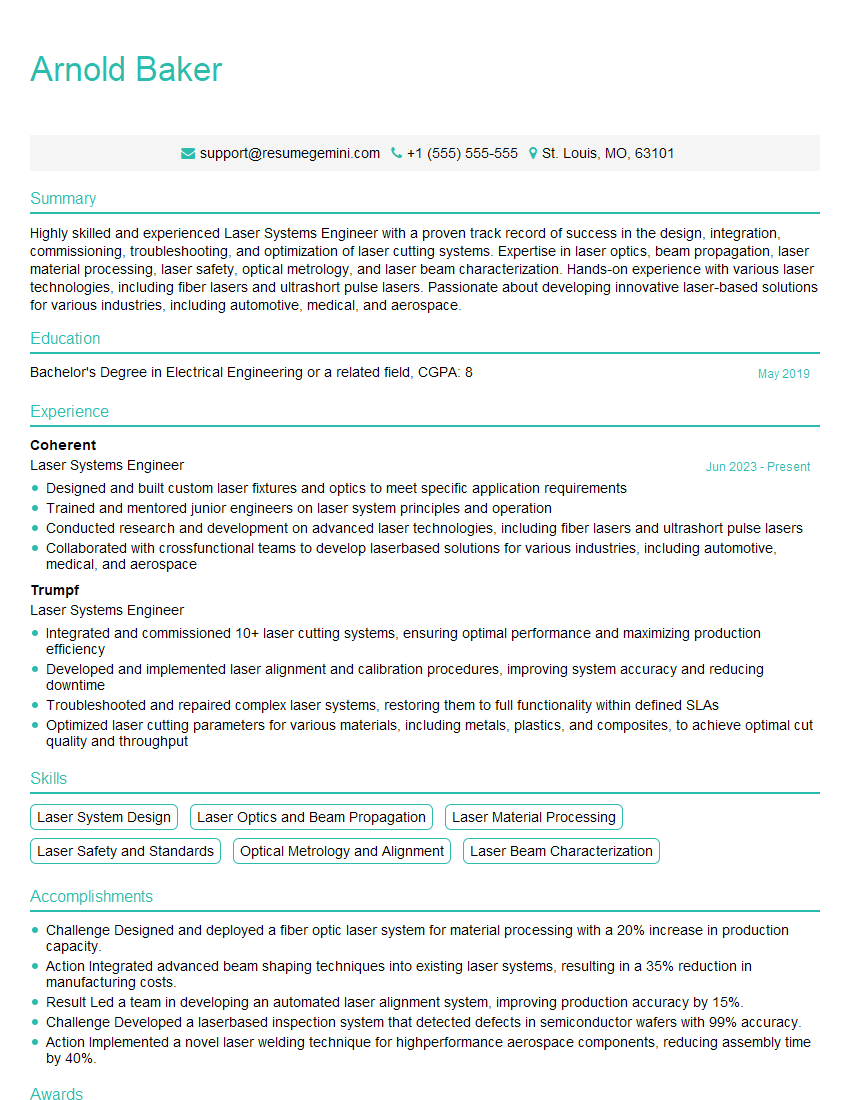
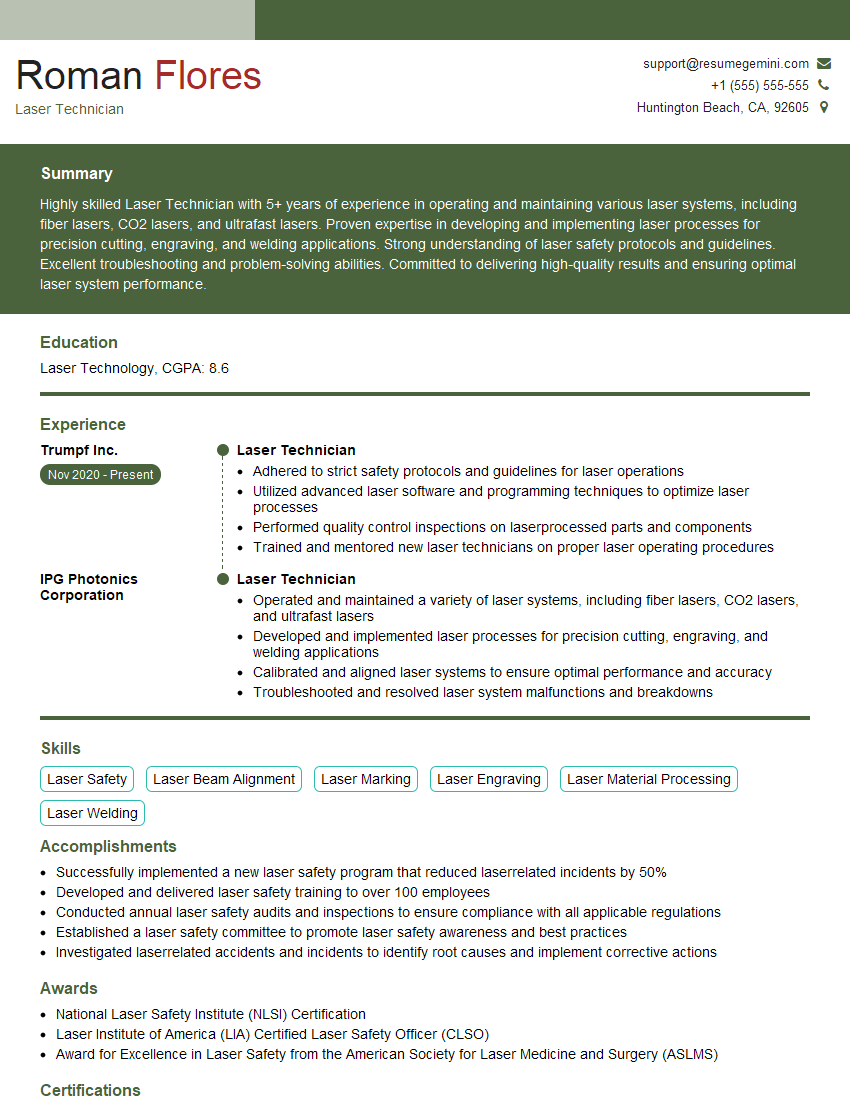
Mastering Laser Process Development opens doors to exciting and rewarding careers in advanced manufacturing, materials science, and research. To significantly enhance your job prospects, creating a compelling and ATS-friendly resume is crucial. This ensures your qualifications are effectively communicated to potential employers. We highly recommend utilizing ResumeGemini to build a professional and impactful resume. ResumeGemini provides a user-friendly platform and offers examples of resumes tailored to Laser Process Development to help you showcase your expertise effectively. Take this opportunity to craft a resume that truly reflects your capabilities and secures your next interview.
Explore more articles
Users Rating of Our Blogs
Share Your Experience
We value your feedback! Please rate our content and share your thoughts (optional).
What Readers Say About Our Blog
Really detailed insights and content, thank you for writing this detailed article.
IT gave me an insight and words to use and be able to think of examples