The thought of an interview can be nerve-wracking, but the right preparation can make all the difference. Explore this comprehensive guide to Tree Appraisal interview questions and gain the confidence you need to showcase your abilities and secure the role.
Questions Asked in Tree Appraisal Interview
Q 1. Explain the different methods used for tree appraisal.
Tree appraisal utilizes several methods to determine a tree’s value, each with its strengths and weaknesses. The most common approaches are:
- Replacement Cost Method: This method estimates the cost of replacing the tree with a similar-sized and species tree of comparable quality. It’s straightforward but doesn’t always accurately reflect the tree’s unique characteristics and maturity.
- Income Approach: This is less frequently used for individual trees but applicable in situations where a tree contributes significantly to property income, such as shade trees in a resort or fruit trees in an orchard. It focuses on the potential revenue generated by the tree.
- Market Approach: This method compares the subject tree to similar trees recently sold in comparable properties. Finding truly comparable sales can be challenging due to unique tree characteristics and location differences. It relies heavily on the availability of reliable comparable sales data.
- Comparative Approach: This method is similar to the market approach but focuses on comparing the subject tree’s characteristics to a database of tree values, often using tree size and species as key parameters. This method provides a quick estimate, but the accuracy depends on the database’s comprehensiveness and the comparability of the data.
The selection of the most appropriate method often depends on the specific circumstances of the appraisal, the availability of data, and the objectives of the appraisal. For example, in a residential setting, the replacement cost method might suffice, while in a commercial setting, a combination of methods might be necessary for a comprehensive valuation.
Q 2. Describe the factors influencing tree value.
Numerous factors influence a tree’s value. These can be broadly categorized as:
- Intrinsic Factors: These relate to the tree itself. Size (height and caliper – diameter at breast height), species (some species are more valuable than others due to rarity, aesthetic appeal, or specific uses), age, health (presence or absence of disease or damage), and aesthetic qualities (form, branching, vigor) are key intrinsic factors.
- Extrinsic Factors: These factors are external to the tree and affect its value. Location (trees in prominent locations or with significant views have higher value), landscaping context (the overall design and aesthetic of the property’s landscape), and the tree’s contribution to property value (e.g., increased property value due to shade or aesthetic enhancement) are significant extrinsic factors. Proximity to structures, utilities, and potential hazards (e.g., storm damage risk) also play a vital role.
For instance, a mature, healthy oak tree with exceptional form located in the front yard of a high-value home will command a significantly higher appraisal value than a smaller, diseased tree of lesser aesthetic merit in a less desirable location.
Q 3. How do you determine the age of a tree?
Determining a tree’s age accurately requires several methods often employed in conjunction:
- Increment Borer: This tool extracts a small core sample, revealing annual growth rings. Counting these rings provides a direct age estimation. This method is destructive but highly accurate. It’s important to note that accurate counting may be difficult if conditions have resulted in multiple rings being produced in a single year or a blurred ring pattern.
- Diameter at Breast Height (DBH): Measuring the DBH and using species-specific growth curves is a non-destructive method. While less precise than increment boring, it’s commonly used for rapid estimation of age in large populations.
- Visual Assessment: Experienced arborists can estimate age based on characteristics like branching patterns, bark texture, overall tree form, and species-specific growth habits. This is the least accurate method, but it is helpful in cases where destructive methods are not feasible.
The chosen method depends on the tree species, size, required accuracy, and whether destructive sampling is acceptable. For example, increment boring would be ideal for accurately determining the age of a rare specimen, whereas DBH with growth curves would be more practical for assessing many trees in a large-scale assessment.
Q 4. What are the common causes of tree damage and how do they impact value?
Various factors cause tree damage, significantly impacting their value. Some common causes include:
- Disease and Pests: Infections or infestations can weaken trees, reducing their lifespan and aesthetic appeal. Examples include Dutch elm disease, oak wilt, and various insect attacks. The severity of the damage will influence the reduction in value.
- Physical Damage: This includes damage from storms (windthrow, limb breakage), construction activities (root damage, trunk injury), vehicle collisions, or vandalism. The extent of the damage will heavily influence the appraisal.
- Environmental Stress: Factors like drought, soil compaction, air pollution, or inappropriate pruning practices can stress trees and reduce their health and vigor, negatively affecting their value.
The impact of damage on value depends on the extent and type of damage and the tree’s overall condition. Minor damage might only cause a slight reduction, while significant damage could render the tree worthless or even necessitate its removal. For instance, a large branch broken off a healthy oak tree during a storm would be considered significant damage.
Q 5. Explain the concept of tree replacement cost.
Tree replacement cost refers to the estimated expense of replacing a damaged or removed tree with a similar-sized and species tree of comparable quality. It includes the cost of the tree itself, planting, and any necessary follow-up care (watering, fertilization, staking). This value doesn’t necessarily reflect the mature tree’s intrinsic value, particularly for older specimens.
The calculation often involves:
- Tree Cost: Purchasing a replacement tree from a nursery, considering its size, species, and quality.
- Planting Cost: Labor costs for excavation, planting, and mulching.
- Maintenance Cost: Expenses for initial post-planting care.
Replacement cost is often the most straightforward method for insurance claims or when a tree needs replacement, offering a tangible measure of financial loss. However, it fails to capture the value of an older tree’s maturity, aesthetic qualities, and unique characteristics.
Q 6. How do you assess the health and vigor of a tree?
Assessing a tree’s health and vigor requires a thorough examination by a qualified arborist. Key aspects include:
- Visual Inspection: Examining the tree’s crown for signs of disease (leaf discoloration, dieback), pest infestations (insect damage, webbing), and structural defects (broken branches, cracks). The bark is also checked for signs of decay, and the overall form and vigor of the tree are evaluated.
- Trunk Examination: Checking for decay, cavities, wounds, and abnormal growth patterns.
- Root Assessment: Though more difficult, root examination may be necessary to determine if roots are affected by disease, compaction, or other issues. This might involve using specialized tools or looking for above-ground evidence.
- Stress Tests: Advanced tests can measure tree vitality and water stress using equipment to measure soil moisture and tree sap flow.
Vigor is indicated by strong growth, abundant foliage, and a healthy appearance. Poor vigor is shown through slow growth, sparse foliage, dead branches, and signs of disease or stress. A detailed assessment aids in developing recommendations for tree care and accurately estimating the tree’s value, factoring in potential longevity and contribution to property value.
Q 7. What are the limitations of various tree appraisal methods?
Each tree appraisal method has limitations:
- Replacement Cost Method: Doesn’t reflect the value of the tree’s maturity, aesthetic qualities, or unique characteristics. It may overestimate value in cases where readily available replacement trees are inexpensive.
- Income Approach: Limited applicability; mostly relevant when trees directly contribute to income generation.
- Market Approach: Relies on the availability of comparable sales data, which can be scarce, particularly for unique tree species or sizes. Comparability is often challenging, making it subjective.
- Comparative Approach: Accuracy depends entirely on the reliability and comprehensiveness of the database. Over-reliance on simplistic metrics like DBH might not capture other important factors such as tree health and form.
Therefore, it’s crucial to understand these limitations and choose the most appropriate method, or even a combination of methods, for a given situation. An experienced arborist or appraiser will carefully consider these limitations and select the method(s) that best serve the purpose of the valuation.
Q 8. How do you handle situations with conflicting data during appraisal?
Conflicting data is a common challenge in tree appraisal. It might arise from differing sources like historical records, visual inspections, or different appraisal methods. My approach involves a systematic process of verification and reconciliation.
- Source Verification: I meticulously examine the source of each data point. Is it from a reliable source? Are there potential biases or inaccuracies? For example, a homeowner’s estimate of tree size might be less precise than a professional arborist’s measurement. I always prefer data backed by verifiable methods and expertise.
- Data Triangulation: I seek corroborating evidence. If one source suggests a certain tree diameter, I’ll cross-reference that with other data such as photographs, growth charts for that species, and any available historical records. The more evidence supporting a specific data point, the greater its credibility.
- Quantitative Analysis: When the conflict can’t be resolved by verification, I employ quantitative techniques such as statistical analysis or regression analysis. This helps to identify outliers or anomalies that may stem from errors or inconsistencies. I might use a weighted average to give more weight to reliable data points.
- Professional Judgment: Ultimately, when reconciliation proves impossible, I use sound professional judgment to arrive at the most reasonable value. This involves considering all available information, my experience with similar cases, and relevant industry standards. I would clearly document my rationale for choosing a specific data point and the basis for my professional judgment.
For instance, if one method estimates a tree’s value at $5,000, while another yields $8,000, I’d carefully examine the underlying assumptions and methodologies of both approaches before reaching a well-justified conclusion, perhaps using a compromise value supported by detailed analysis and written justification.
Q 9. Describe your experience using tree appraisal software.
I’ve extensively used several tree appraisal software packages throughout my career, including iTree, TreePlotter, and ArborMaster. These programs offer various functionalities that streamline and enhance the appraisal process.
- Data Input and Management: These software packages enable efficient input of tree data, such as species, diameter at breast height (DBH), height, and condition. The software often includes pre-programmed formulas and algorithms for calculating tree volumes, which saves significant time and minimizes calculation errors.
- Growth Modeling: Many software programs incorporate models that predict future tree growth, considering factors like species, climate, and site conditions. This helps in forecasting the future value of the trees, a crucial element in long-term appraisal.
- Valuation Methods: The software simplifies the application of different valuation methods, including the replacement cost method, the market value approach, and income capitalization approaches. It often automates calculations and generates reports.
- Report Generation: A key advantage of using software is the automated report generation. These reports are professional, consistent, and easy to understand, allowing me to clearly communicate the details of my appraisal to clients.
For example, using iTree, I can easily input measured DBH and height, and the software automatically calculates the tree volume, allowing me to focus on evaluating other aspects of the tree’s condition and value in its unique site context. I rely on these tools for accuracy, consistency, and efficiency but always ensure that my professional judgment is not replaced by the program.
Q 10. Explain the importance of proper documentation in tree appraisal.
Proper documentation is paramount in tree appraisal for several reasons: It ensures transparency, accountability, defensibility, and facilitates future reference.
- Transparency: A detailed report clearly outlines the appraisal methodology, data sources, assumptions, and calculations. This transparency builds trust with clients and stakeholders.
- Accountability: Complete documentation provides a clear audit trail, allowing for the scrutiny of the appraisal process. It allows me to justify my conclusions and demonstrate the rigor of my work.
- Defensibility: In case of disputes or legal challenges, comprehensive documentation acts as critical evidence supporting the appraisal’s validity. This is particularly important in situations involving litigation or insurance claims.
- Future Reference: Detailed records allow for comparison and tracking of changes over time. This is particularly useful when monitoring the growth and health of trees or conducting future appraisals on the same property.
My documentation includes detailed descriptions of the site, photographs of the trees, species identification, measurements (DBH, height, crown spread), condition assessments (diseases, defects), calculation methodologies, and assumptions made during the valuation process. It concludes with a clear statement of value and my qualifications.
Q 11. How do you determine the appropriate discount rate in tree appraisal?
Determining the appropriate discount rate in tree appraisal is crucial because it reflects the time value of money; a dollar today is worth more than a dollar in the future. The rate should account for the risks associated with the investment in the tree, the expected rate of return from other investments, and inflation.
There’s no single ‘correct’ discount rate. Instead, it is determined through a combination of factors:
- Risk-Free Rate: This is the return an investor could expect from a risk-free investment, such as government bonds. It forms the foundation of the discount rate.
- Risk Premium: This adds to the risk-free rate to account for the inherent risks associated with investing in trees, such as disease, pest infestation, or damage from weather events. The higher the risk, the higher the premium.
- Market Conditions: Current economic conditions, including interest rates and inflation, influence the discount rate. Higher inflation might require a higher discount rate to reflect the reduced future value of money.
- Tree Species and Site Conditions: The species and its health determine its expected growth and lifespan, thereby impacting the risk premium and consequently the discount rate.
In practice, I often consult financial professionals or use industry benchmarks and published research to help determine an appropriate discount rate. The chosen rate is always explicitly justified in the appraisal report.
Q 12. What are the key differences between replacement cost and market value?
Replacement cost and market value represent two distinct approaches to valuing trees.
- Replacement Cost: This method estimates the cost of replacing a tree with a similar one of the same size, species, and age. It focuses on the cost of acquiring and planting a comparable replacement, including labor and materials. It doesn’t necessarily reflect the tree’s actual market value, especially if the tree is mature and has significant aesthetic or historical value.
- Market Value: This reflects the price a willing buyer would pay a willing seller for a tree in a competitive market. It’s based on comparable sales of similar trees in the same area, considering factors like size, species, condition, and location. Market value considers supply and demand forces that influence the price.
For example, the replacement cost of a mature oak tree might be $2,000, representing the cost of purchasing a sapling and the labor required for planting and establishment. However, its market value could be significantly higher, perhaps $5,000 or more, due to its mature size, established root system, and aesthetic contribution to the property. The choice of method depends on the context; replacement cost is often relevant for insurance claims, while market value is commonly used in real estate transactions.
Q 13. How do you account for potential future tree growth in your appraisal?
Accurately accounting for future tree growth is critical for long-term appraisals. This involves using growth models and projections to estimate the tree’s future size, value, and overall contribution.
- Growth Models: I utilize scientifically-based growth models specific to the tree species and site conditions. These models consider factors such as DBH, height, age, site quality, and local climate to predict future growth. Software such as iTree helps with this.
- Growth Rate Adjustments: Growth rates aren’t constant; they can vary based on environmental factors and the tree’s health. Adjustments to growth rates might be necessary if factors like disease or stress are present.
- Future Value Projections: Using projected growth, I estimate the future value of the tree by applying various valuation methods. The discount rate is used to account for the time value of money and risk associated with future growth.
- Sensitivity Analysis: I perform a sensitivity analysis to assess the impact of changes in growth rates and other variables on the projected value. This helps to understand the uncertainty inherent in future growth predictions.
For instance, a young tree’s value may be relatively low now but projects to a substantial value in 20 years, a critical element to consider for long-term land management and development plans.
Q 14. What are the ethical considerations in tree appraisal?
Ethical considerations are central to tree appraisal. Maintaining impartiality, objectivity, and transparency is paramount.
- Independence and Objectivity: Appraisers must remain independent and objective, avoiding any conflicts of interest that could compromise the integrity of the appraisal. This means disclosing any potential bias or relationships with parties involved.
- Competence: Appraisers should only undertake assignments within their areas of expertise. This entails continuous professional development and staying updated on industry best practices and relevant research.
- Transparency and Disclosure: All assumptions, methodologies, and data sources used in the appraisal must be clearly disclosed in the report. Any limitations or uncertainties in the appraisal should also be explicitly stated.
- Confidentiality: Appraisers must maintain the confidentiality of information obtained during the appraisal process, protecting the privacy of the client and other stakeholders.
- Accuracy and Honesty: The appraisal report must be accurate, honest, and truthful, representing a fair and unbiased assessment of the tree’s value.
An example of an ethical breach would be accepting an assignment for a tree species you’re not proficient in evaluating, failing to disclose a prior relationship with a party involved in the case, or intentionally under-or over-valuing a tree to favor a particular client. Upholding ethical standards is crucial for maintaining the profession’s credibility and public trust.
Q 15. How do local ordinances affect tree valuation?
Local ordinances significantly influence tree valuation by dictating what can and cannot be done with trees on a property. Zoning regulations might protect specific tree species or sizes, requiring permits for removal or pruning. These regulations directly impact the value a tree contributes – a protected oak might add significantly more value than one that can be easily removed. For example, a city with strict heritage tree preservation ordinances might place a higher value on a mature specimen than a city with looser regulations. Violation of these ordinances can lead to hefty fines, further impacting the property value and potentially the valuation of the tree itself. I always meticulously review local zoning codes, environmental protection laws, and any specific tree protection ordinances before starting any appraisal.
Career Expert Tips:
- Ace those interviews! Prepare effectively by reviewing the Top 50 Most Common Interview Questions on ResumeGemini.
- Navigate your job search with confidence! Explore a wide range of Career Tips on ResumeGemini. Learn about common challenges and recommendations to overcome them.
- Craft the perfect resume! Master the Art of Resume Writing with ResumeGemini’s guide. Showcase your unique qualifications and achievements effectively.
- Don’t miss out on holiday savings! Build your dream resume with ResumeGemini’s ATS optimized templates.
Q 16. Describe your experience with different tree species and their valuation.
My experience spans a wide range of tree species, and understanding their unique characteristics is crucial for accurate valuation. I’ve worked with everything from common species like red maples and oaks to more rare and valuable specimens such as mature Coast Redwoods or ancient Bald Cypress. Valuation differs significantly; a mature oak providing significant shade and aesthetic value will be appraised much higher than a newly planted sapling. Similarly, the condition of the tree plays a crucial role. A healthy, well-maintained specimen commands a higher value than a diseased or damaged one. I use a combination of established valuation methods, my extensive field experience, and data from resources like the Council of Tree and Landscape Appraisers (CTLA) to account for the specifics of each species and its condition. For example, I’ve found that the rarity of a particular species of Japanese Maple, combined with its age and impeccable health, can significantly increase its appraisal value compared to a common cultivar.
Q 17. Explain how you handle unusual or rare tree species during appraisal.
Appraising unusual or rare tree species requires a more nuanced approach. Standard valuation methods may not adequately capture their unique value. I often consult with arborists specializing in rare species, botanical experts, and even historical societies to gather information on the tree’s age, provenance, historical significance, and overall condition. Photographic documentation, detailed measurements, and sometimes even DNA analysis might be necessary to fully assess the tree’s value. The valuation incorporates not only its aesthetic and ecological contributions but also its potential scientific or historical value. For instance, a rare cultivar of a certain tree with a documented history might be invaluable to a botanical garden, thus commanding a much higher appraisal than a more common tree of similar size.
Q 18. How do you determine the impact of tree removal on property value?
The impact of tree removal on property value can be substantial, often resulting in a significant decrease. Several factors determine the extent of this impact, including the tree’s size, species, location on the property (e.g., near the street, providing shade for the house), overall landscape aesthetics, and the presence of any local ordinances. I use a before-and-after approach, comparing comparable properties with and without similar trees to quantify the effect on market value. Photography, detailed descriptions of the tree’s characteristics before removal, and relevant market data are all incorporated into the appraisal report. The loss of shade, decreased curb appeal, and potential disruption to the ecological balance can all contribute to the reduction in property value. Quantifying these impacts requires careful analysis and a deep understanding of the local real estate market.
Q 19. How do you deal with trees located in environmentally sensitive areas?
Trees located in environmentally sensitive areas require extra consideration during appraisal. I thoroughly research local, state, and federal regulations governing these areas. These areas often have strict guidelines about tree removal or alteration, and penalties for non-compliance can be severe. The appraisal takes into account the ecological significance of the tree and the potential environmental impact of any proposed actions. The presence of protected species, proximity to wetlands, or location within a conservation easement would significantly influence the appraisal and any recommendations made regarding the tree’s management. Collaboration with environmental consultants and regulatory agencies is often crucial to ensure compliance and accurate valuation. The value of the tree might be higher than in a less sensitive area due to the added regulatory protections.
Q 20. What is your experience with tree appraisal reports and their components?
My experience with tree appraisal reports is extensive. A comprehensive report should include: a detailed description of the subject tree(s), including species, size, age, condition, and location; photos and maps clearly identifying the trees; a discussion of relevant ordinances and regulations; a methodology section outlining the valuation approach used (e.g., cost approach, income approach, market data approach); a conclusion stating the appraised value and any qualifying statements; and a detailed list of references and supporting documentation. I always strive to create reports that are clear, concise, and easily understandable, even for individuals without extensive arboricultural knowledge. The report must be defensible, and I always provide transparent and well-supported reasoning for my valuation.
Q 21. How do you ensure the accuracy and reliability of your appraisals?
Ensuring accuracy and reliability in my appraisals is paramount. This involves adhering to rigorous professional standards, employing established valuation methodologies, and relying on data from multiple, reputable sources. I use a combination of quantitative and qualitative data, including tree measurements, species identification, condition assessments, and market analysis. Cross-referencing data from multiple sources helps reduce bias and increases the reliability of the valuation. Regular professional development, participation in professional organizations like the CTLA, and staying updated on the latest research and best practices in arboriculture and appraisal are also critical for maintaining accuracy and competency. Finally, a thorough review of the final report is essential before submission to ensure clarity, accuracy, and the absence of any potential errors.
Q 22. Describe your experience with tree appraisal litigation or disputes.
My experience in tree appraisal litigation and disputes involves acting as an expert witness, providing detailed reports and testimony in court or arbitration. I’ve been involved in cases ranging from property damage claims due to tree failure to disputes over the value of trees removed during construction. For example, in one case, I had to assess the damage caused by a falling tree on a neighbor’s property, considering factors like the tree’s species, age, health, and the prevailing wind conditions. This required meticulous documentation, including photographs, measurements, and detailed analysis of the tree’s condition before and after the incident. My role involved not only quantifying the damage but also explaining the causal relationship between the tree’s condition and the damage incurred, ultimately contributing to a fair settlement. In another instance, I helped determine the fair market value of mature oak trees removed during a road widening project, considering their size, species, rarity, and the cost of replacement.
Q 23. How do you stay current with the latest trends and developments in tree appraisal?
Staying current in this field requires continuous learning. I regularly attend professional development workshops and seminars offered by organizations such as the International Society of Arboriculture (ISA) and the American Society of Consulting Arborists (ASCA). I also actively participate in professional networks, exchanging knowledge and best practices with fellow arborists and appraisers. Subscribing to relevant journals and publications keeps me updated on the latest research findings in arboriculture and appraisal methods. Furthermore, I actively pursue continuing education courses to stay abreast of changes in appraisal standards and legal precedents. Keeping up with new technologies and software used in tree assessment is also crucial.
Q 24. What software or tools do you use for tree appraisal?
My work utilizes a variety of software and tools. For data collection and analysis, I rely heavily on GIS software for mapping and spatial analysis, helping visualize the location and distribution of trees within a specific area. Specialized tree measurement tools such as diameter tapes, clinometers, and hypsometers are fundamental for accurate data acquisition. Spreadsheets (like Excel) are used to organize and analyze the collected data, and tree appraisal software such as i-Tree Eco (for ecosystem services valuation) or custom-built databases are utilized for advanced analyses and report generation. Photo and video documentation are crucial, often integrated into my reports. Finally, strong word-processing software is essential for creating clear and comprehensive appraisal reports.
Q 25. Describe a situation where you had to make a difficult decision during a tree appraisal.
A challenging appraisal involved a large, mature oak tree exhibiting signs of significant decay hidden beneath healthy bark. Visually, it appeared healthy, but advanced techniques like Resistograph testing revealed extensive internal rot. The difficult decision was balancing the visual assessment with the objective data. If I relied solely on the visual inspection, the value assessment would have been significantly higher. However, the Resistograph data showed the tree was a significant safety hazard with a high risk of failure. My solution was to meticulously document both the visual assessment and the Resistograph results, explaining the discrepancies and the rationale behind my final, conservative value assessment. This transparent approach ensured that the client understood the justification for my valuation, even if it differed from initial expectations. This instance highlighted the crucial need to combine visual observation with advanced diagnostic techniques to avoid potentially inaccurate conclusions.
Q 26. How do you manage your workload and prioritize tasks effectively?
Effective workload management is critical. I utilize project management software to schedule appointments, track deadlines, and manage various aspects of multiple projects concurrently. Prioritization is based on a combination of factors, including urgency, client needs, and the complexity of the task. Urgent projects or those with tight deadlines take precedence. I often break down large projects into smaller, manageable tasks, ensuring consistent progress. Regular review of my schedule and task list allows for adjustments as needed, ensuring efficiency and avoiding bottlenecks. Effective communication with clients helps to set realistic expectations and manage any unforeseen delays.
Q 27. Explain your understanding of different tree appraisal standards.
My understanding of tree appraisal standards encompasses a range of methodologies and guidelines, often depending on the purpose and context of the appraisal. Generally, established standards like the ISA’s guidelines and best practices serve as a foundation. The approach might be influenced by the intended use: for example, a replacement cost appraisal focuses on the cost of acquiring a similar tree, while a fair market value appraisal considers the tree’s worth based on supply and demand in the open market. Other considerations include the specific regulations of the governing jurisdictions and any specialized standards relevant to the type of tree being appraised. For instance, the appraisal of heritage trees might involve considerations beyond simple market value, including historical significance and ecological contribution. Understanding these nuances is key to generating a robust and defensible appraisal.
Q 28. How do you communicate your findings clearly and effectively to clients?
Clear communication is paramount. My reports are structured logically, using plain language that avoids technical jargon wherever possible. I use visuals like photographs, diagrams, and maps to enhance understanding and make the data more accessible. When presenting findings to clients, I avoid overwhelming them with technical details. I provide a concise summary of the key findings first, followed by a more detailed explanation if requested. I am always available to answer questions and clarify any ambiguities. Building a strong rapport with the client is also critical, ensuring trust and transparency throughout the process. A well-written, easily understandable report that supports my conclusions in an accessible way is essential for both technical and non-technical audiences.
Key Topics to Learn for Tree Appraisal Interview
- Tree Biology and Physiology: Understanding tree growth, health, and common diseases is fundamental. This includes knowledge of species identification and growth patterns.
- Appraisal Methods: Mastering various valuation techniques, such as the cost approach, market approach, and income approach, as applied to trees. Consider the nuances of each method in relation to tree appraisal.
- Data Collection and Measurement: Learn how to accurately measure tree dimensions (DBH, height, crown spread) and assess tree condition using appropriate tools and techniques. Practical experience is invaluable here.
- Risk Assessment and Liability: Understanding potential hazards associated with trees and how to assess liability in relation to tree damage or injury is crucial.
- Legal and Regulatory Frameworks: Familiarize yourself with relevant regulations, local ordinances, and best practices pertaining to tree management and appraisal in your area.
- Report Writing and Presentation: Develop strong communication skills to clearly and concisely present your findings in professional reports and presentations. This includes justifying your valuation methods.
- Software and Technology: Familiarity with commonly used software for tree measurement, mapping, and appraisal reporting will demonstrate technical proficiency.
- Ethics and Professional Standards: Understand and adhere to ethical guidelines and professional standards in the field of tree appraisal.
Next Steps
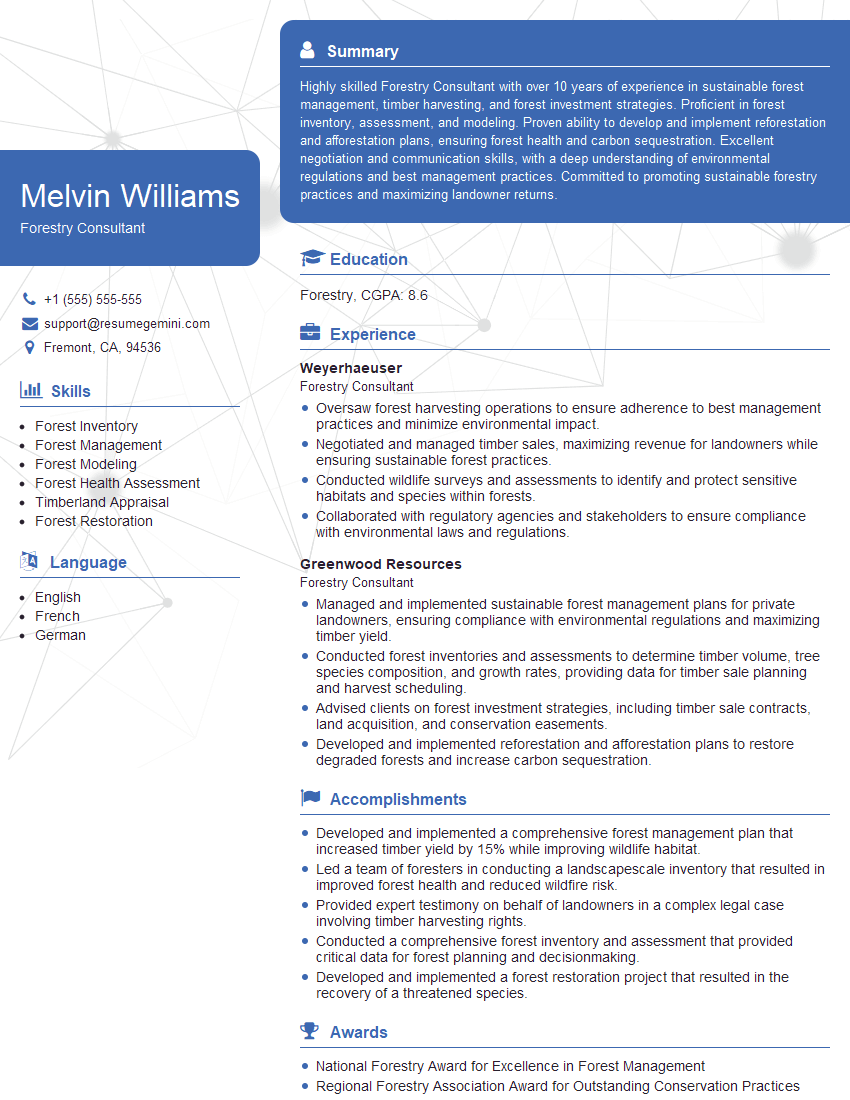
Mastering tree appraisal significantly enhances your career prospects, opening doors to specialized roles and higher earning potential within the arboriculture, landscape architecture, and real estate industries. A strong resume is your key to unlocking these opportunities. Creating an ATS-friendly resume is crucial for getting your application noticed by recruiters. To help you build a compelling and effective resume, we recommend leveraging the power of ResumeGemini. ResumeGemini provides a streamlined process for creating professional resumes, and we have examples of resumes tailored specifically for tree appraisal roles available to guide you.
Explore more articles
Users Rating of Our Blogs
Share Your Experience
We value your feedback! Please rate our content and share your thoughts (optional).
What Readers Say About Our Blog
Really detailed insights and content, thank you for writing this detailed article.
IT gave me an insight and words to use and be able to think of examples