Interviews are opportunities to demonstrate your expertise, and this guide is here to help you shine. Explore the essential Trend Strategy Development interview questions that employers frequently ask, paired with strategies for crafting responses that set you apart from the competition.
Questions Asked in Trend Strategy Development Interview
Q 1. Explain your understanding of the lifecycle of a trend.
The lifecycle of a trend, much like a living organism, follows distinct stages. It begins with an emergence phase, characterized by early adopters and niche interest. Think of it like the seedling stage of a plant – fragile, but with potential. Next comes the growth phase, where the trend gains momentum, visibility, and wider adoption. This is like the plant’s sapling stage – growing rapidly and becoming more established. The peak phase marks the highest point of popularity and saturation. It’s the mature plant, bearing fruit. This is often followed by a decline phase where the trend loses its appeal, replaced by newer alternatives, much like an aging plant starting to wither. Finally, there’s a legacy phase, where elements of the trend may persist in modified forms or influence future trends – think of the lasting impact of a once-popular tree, even after its death, in enriching the soil.
Understanding these phases is crucial for effective trend management. For instance, a business might aggressively promote a trend during the growth phase to maximize market share but begin to diversify during the peak phase to avoid being caught in the decline.
Q 2. Describe your process for identifying emerging trends.
My process for identifying emerging trends is a multi-faceted approach that combines quantitative and qualitative data analysis. I start by monitoring diverse data sources. This includes social media trends (Twitter, Instagram, TikTok), online forums, news articles, industry reports, and academic publications. I’m also actively involved in attending industry events and conferences. Secondly, I use data analytics tools to identify patterns and shifts in consumer behavior, search queries, and social media sentiment. This involves using tools to analyze large datasets, identifying correlations and trends in data. Thirdly, I employ qualitative research methods such as focus groups, interviews, and ethnographic studies to gain deeper insights into the motivations and aspirations driving the trends. Finally, I meticulously analyze the identified trends against various industry benchmarks and business contexts to assess their potential relevance and impact.
For instance, I recently noticed a surge in searches for ‘sustainable packaging’ coupled with a significant increase in social media posts highlighting environmentally friendly products. This led me to conduct interviews with consumers to understand their deeper motivations, leading to the validation of a significant emerging trend.
Q 3. How do you differentiate between a fad and a long-term trend?
The key difference between a fad and a long-term trend lies in their longevity and impact. A fad is a fleeting craze characterized by rapid growth and equally rapid decline. Think of the pet rock or fidget spinners – they gained immense popularity very quickly but just as quickly lost their appeal. A long-term trend, on the other hand, demonstrates sustained growth and influence over an extended period, often fundamentally altering consumer behavior or industry dynamics. Think of the long-term trend of increased demand for health and wellness products. It has sustained its popularity for many years and changed the landscape of the food and fitness industries.
To differentiate, I assess the trend’s lifespan, the depth of its impact on related sectors, and the underlying socio-cultural factors driving its appeal. Fads often rely on novelty or short-lived hype, while long-term trends reflect deeper societal shifts or evolving needs.
Q 4. What quantitative and qualitative methods do you use for trend analysis?
My trend analysis relies on a blend of quantitative and qualitative methods. Quantitative methods include analyzing sales data, website traffic, social media engagement metrics (likes, shares, comments), and search engine data (Google Trends). This provides a numerical understanding of the trend’s scope and trajectory. I use tools like Excel, R, and specialized analytics platforms to process and interpret this data.
Qualitative methods involve in-depth interviews, focus groups, and ethnographic studies. These provide richer contextual information about consumer perceptions, motivations, and the cultural significance of the trend. For example, I might conduct interviews with early adopters to understand their experience and identify unmet needs driving the trend. Combining both approaches creates a comprehensive picture of the trend and its potential.
Q 5. How do you assess the potential impact of a trend on a business?
Assessing a trend’s potential impact on a business requires a structured approach. I start by analyzing the trend’s alignment with the business’s strategic goals. Does the trend present opportunities for new product development, market expansion, or improved operational efficiency? Next, I evaluate the size and growth potential of the market related to the trend. This involves estimating the potential customer base and the trend’s likely lifespan. Then, I consider the competitive landscape. Are competitors already actively pursuing this trend? What are their strategies? Finally, I conduct a risk assessment, weighing the potential benefits against potential downsides like high investment costs or regulatory hurdles. This holistic approach enables the business to make informed decisions about how to engage with or leverage the trend.
Q 6. Explain your experience with trend forecasting methodologies.
I have extensive experience with various trend forecasting methodologies. These include trend extrapolation, which projects future trends based on historical data; scenario planning, which explores different potential futures based on various assumptions; diffusion of innovation models, which predict the rate of adoption of a trend among different consumer segments; and qualitative forecasting techniques like expert panels and Delphi studies, which leverage the collective wisdom of experts in the field. I’m also proficient in using statistical modeling and machine learning algorithms to enhance the accuracy and efficiency of forecasting processes. The choice of methodology depends on the specific trend, the available data, and the desired level of detail in the forecast.
Q 7. Describe a time you successfully identified and leveraged an emerging trend.
A few years ago, I identified the emerging trend of personalized health and wellness. I noticed an increase in consumer demand for products and services tailored to individual needs and preferences, driven by greater access to health information and wearable technology. By analyzing social media, fitness app data, and health-related news, I saw a clear shift towards proactive health management. Based on this, I recommended that my client, a large supplement company, expand its product line to include customized supplement packages based on individual genetic profiles and health goals. This strategy resulted in a significant increase in sales and market share for the company, demonstrating the value of identifying and leveraging emerging trends proactively.
Q 8. How do you incorporate trend analysis into strategic planning?
Incorporating trend analysis into strategic planning is crucial for making informed decisions and achieving long-term success. It’s not simply about identifying what’s popular; it’s about understanding the underlying forces shaping the future and adapting your strategy accordingly. I approach this in a structured way:
- Trend Identification: I begin by actively scanning various data sources – market research reports, social media sentiment, competitor analysis, economic indicators, and technological advancements – to identify emerging trends. This involves both quantitative and qualitative data analysis.
- Trend Prioritization: Once identified, trends are evaluated based on their potential impact (discussed further in question 2). Only the most impactful trends are selected for deeper investigation.
- Scenario Planning: For each prioritized trend, I develop different scenarios – optimistic, pessimistic, and most likely – to illustrate potential outcomes and their implications for the organization. This allows for proactive planning and contingency strategies.
- Strategic Alignment: Based on the scenarios and the potential impact of trends, I align the organization’s strategic goals and initiatives to either leverage opportunities presented by positive trends or mitigate the risks posed by negative ones. This often involves adjusting existing strategies or formulating entirely new ones.
- Monitoring and Adaptation: Trend analysis is not a one-time activity. Continuous monitoring is vital. Regular reviews allow for adjustments to the strategy as new data emerges and trends evolve.
For example, if I see a trend toward increased sustainability, I wouldn’t just jump to a ‘go green’ initiative. I’d analyze the depth and breadth of this trend, the potential market demand for sustainable products, the regulatory landscape, and our organization’s capacity to adapt. Then, I’d incorporate sustainable practices into our product development, marketing, and operations only after a careful evaluation.
Q 9. How do you prioritize trends based on their potential impact?
Prioritizing trends involves a multi-faceted assessment of their potential impact. I use a framework that considers several key factors:
- Impact: This evaluates the magnitude of the trend’s potential influence on the organization’s goals, market share, revenue, and overall success. A high-impact trend could drastically alter the business landscape.
- Probability: How likely is the trend to actually materialize? Some trends may be hyped but ultimately prove to be fleeting. This assessment requires rigorous data analysis and validation.
- Time Horizon: When will the trend’s impact be felt? Some trends have a short lifespan, while others unfold over years. This informs the urgency of the response.
- Relevance: Does the trend directly align with the organization’s strategic objectives and market position? Irrelevant trends, no matter how impactful, should be deprioritized.
- Controllability: To what extent can the organization influence or shape the trend? Some trends are external and uncontrollable, while others offer opportunities for proactive engagement.
I often use a prioritization matrix, plotting each trend based on its impact and probability. Trends falling in the high-impact, high-probability quadrant receive the highest priority, informing immediate strategic adjustments.
For instance, a trend indicating a significant shift in consumer preferences toward a particular product category would rank higher than a trend with low probability and minor market impact, such as a niche technological advancement with limited adoption potential.
Q 10. How do you present trend insights to stakeholders?
Presenting trend insights effectively requires tailoring the communication to the audience and the context. My approach involves:
- Clear and Concise Messaging: I avoid jargon and technical details unless absolutely necessary, focusing on conveying the core message clearly and concisely.
- Visualizations: Charts, graphs, and infographics are powerful tools for presenting complex data in an easily digestible manner. They help illustrate trends and patterns more effectively than text alone.
- Storytelling: Framing the data within a narrative context makes the insights more relatable and memorable. I connect trends to real-world examples and illustrate their potential implications for the organization.
- Interactive Presentations: Where appropriate, I leverage interactive dashboards or presentations to allow stakeholders to explore the data at their own pace and ask clarifying questions.
- Actionable Recommendations: I always conclude by providing clear and actionable recommendations based on the trend insights. This helps stakeholders understand what steps to take next.
For example, when presenting to the executive team, I’d focus on the high-level implications of key trends and their impact on overall business strategy. When presenting to a marketing team, I’d delve deeper into specific consumer trends and offer tactical recommendations for marketing campaigns.
Q 11. What tools and technologies do you use for trend analysis?
My trend analysis toolkit is diverse and leverages both quantitative and qualitative methods. Some key tools and technologies I regularly use include:
- Data Analytics Platforms:
Tableau,Power BI, and other business intelligence tools are essential for data visualization and analysis of large datasets. - Social Media Listening Tools:
Brandwatch,Talkwalker, and similar tools provide insights into consumer sentiment and discussions related to relevant trends. - Web Analytics Platforms:
Google Analyticsallows for in-depth analysis of website traffic patterns and user behavior, offering valuable insights into emerging trends. - Market Research Databases: Access to databases like
IBISWorldandMintelprovides comprehensive market data and trend reports. - Sentiment Analysis Software: Tools capable of analyzing textual data to gauge public opinion and sentiment around specific topics are invaluable for understanding societal shifts.
- AI-powered Trend Prediction Tools: Some specialized platforms utilize machine learning algorithms to predict future trends based on historical data.
The specific tools I select depend heavily on the project scope, the type of data available, and the research objectives.
Q 12. How do you handle conflicting trend data?
Conflicting trend data is common. It’s rarely a case of simple ‘right’ or ‘wrong,’ but rather a situation requiring deeper investigation and critical thinking. My approach involves:
- Data Source Validation: I first evaluate the credibility and reliability of the conflicting data sources. Some sources might be more authoritative or have a stronger methodological foundation than others.
- Data Triangulation: I seek additional data sources to corroborate or refute the conflicting information. The more data points supporting a particular trend, the stronger the evidence becomes.
- Qualitative Research: Sometimes, quantitative data alone isn’t sufficient. Conducting qualitative research such as interviews or focus groups can provide valuable context and insights to reconcile conflicting trends.
- Contextual Analysis: I analyze the specific context and timeframe of the data. Trends can evolve, so conflicting data might reflect different stages or perspectives on the same phenomenon.
- Sensitivity Analysis: When uncertainty remains, I perform a sensitivity analysis to understand the potential impact of different trend scenarios on strategic decision-making. This allows for building flexibility and adaptability into the plan.
For example, if one report suggests a decline in a particular market segment while another shows growth, I’d investigate the methodology of each report, look for additional data, and possibly conduct market research to understand the reasons for the discrepancy. It might be that the reports are looking at different sub-segments or timeframes.
Q 13. Explain your approach to validating trend predictions.
Validating trend predictions is crucial for ensuring the reliability of strategic decisions. My validation approach is iterative and multi-stage:
- Backtesting: Where historical data is available, I backtest the predictive model used to identify the trend. This helps assess the model’s accuracy in predicting past trends.
- Expert Validation: I consult with industry experts and subject matter specialists to get their perspectives on the predicted trend. Their insights can provide valuable validation or challenge assumptions.
- Pilot Programs: Sometimes, small-scale pilot programs or experiments can be conducted to test the assumptions underlying the trend prediction. This provides real-world feedback and validation.
- Continuous Monitoring: Even after initial validation, continuous monitoring of the trend is essential. This allows for early detection of any deviations from the predicted trajectory and timely adjustments to the strategy.
- A/B Testing (where applicable): If the trend impacts marketing campaigns or product features, A/B testing provides quantifiable evidence of the trend’s impact.
For example, if I predict an increase in demand for a specific product based on a trend analysis, I might conduct a small-scale test marketing campaign to validate this prediction before investing heavily in production and distribution.
Q 14. Describe your experience working with large datasets for trend analysis.
I have extensive experience working with large datasets for trend analysis. My approach focuses on leveraging the power of data analytics tools and techniques to extract meaningful insights. This involves:
- Data Cleaning and Preprocessing: This is often the most time-consuming step, involving handling missing data, dealing with inconsistencies, and transforming data into a usable format.
- Data Exploration and Visualization: Using data visualization tools, I explore the dataset to identify patterns, outliers, and potential trends. This is often an iterative process.
- Statistical Analysis: I utilize various statistical methods, such as regression analysis, time series analysis, and clustering techniques, to identify relationships and patterns within the data.
- Machine Learning Techniques (where appropriate): For certain types of data and prediction tasks, machine learning algorithms can be used to identify complex patterns and predict future trends.
- Data Interpretation and Storytelling: The final step involves interpreting the results of the analysis and communicating the findings in a clear and compelling narrative that resonates with stakeholders.
In a recent project, I worked with a dataset containing millions of social media posts to analyze consumer sentiment towards a specific product category. By applying natural language processing and sentiment analysis techniques, I was able to identify key themes, sentiments, and emerging trends that informed the client’s marketing strategy.
Q 15. How do you stay updated on the latest industry trends?
Staying ahead in the dynamic world of trends requires a multi-faceted approach. It’s not enough to simply read industry news; I actively cultivate a diverse information ecosystem. This involves regularly scanning publications like the Harvard Business Review, Fast Company, and industry-specific journals relevant to the sectors I’m tracking. I also leverage online resources like trend forecasting websites and social listening tools to identify emerging patterns and shifts in consumer behavior. Beyond passively consuming information, I actively participate in industry conferences and webinars, engaging with thought leaders and experts. Networking plays a crucial role, allowing me to gain first-hand insights and perspectives that aren’t readily available through traditional channels. Finally, I maintain a curated list of key influencers and analysts on social media platforms like Twitter and LinkedIn, leveraging their expertise to identify emerging trends before they become mainstream.
Career Expert Tips:
- Ace those interviews! Prepare effectively by reviewing the Top 50 Most Common Interview Questions on ResumeGemini.
- Navigate your job search with confidence! Explore a wide range of Career Tips on ResumeGemini. Learn about common challenges and recommendations to overcome them.
- Craft the perfect resume! Master the Art of Resume Writing with ResumeGemini’s guide. Showcase your unique qualifications and achievements effectively.
- Don’t miss out on holiday savings! Build your dream resume with ResumeGemini’s ATS optimized templates.
Q 16. How do you adapt your trend strategy approach to different industries?
Adapting my trend strategy approach across various industries requires understanding the unique characteristics and drivers of each sector. For example, trends in the fashion industry are heavily influenced by social media, celebrity endorsements, and rapid design cycles, demanding a highly agile and responsive strategy. In contrast, the automotive industry operates on longer product development cycles and is more susceptible to macroeconomic factors like fuel prices and government regulations, requiring a more long-term and data-driven approach. I tailor my methodologies to account for these differences. This includes adjusting my data sources – using specialized databases and industry reports specific to each sector. Furthermore, my analytical framework adapts to reflect industry-specific KPIs (Key Performance Indicators) and success metrics. For instance, while engagement rates might be crucial in evaluating a fashion trend’s success, sales figures and market share would be more relevant indicators for the automotive sector.
Q 17. Describe a time you had to change your trend prediction due to new information.
During a project analyzing the potential for personalized medicine in the healthcare sector, I initially predicted a slow adoption rate due to regulatory hurdles and high development costs. My initial trend prediction was based on historical data and expert interviews conducted early in the research. However, as new information emerged, particularly concerning the rapid advancements in gene editing technologies and the increasing public demand for personalized care options, I had to revise my prediction. The emergence of new, cost-effective gene sequencing techniques, coupled with a favorable regulatory environment change in a key market, significantly accelerated the timeline. This required a complete reassessment of the market dynamics and a shift from a cautious, slow-growth forecast to a more optimistic projection, emphasizing the potential for accelerated growth. The revised prediction incorporated the influence of these new variables and factored in the possibility of a faster-than-anticipated market adoption. The revised report accurately reflected the new market realities and provided valuable insights for strategic decision-making.
Q 18. How do you measure the success of a trend-driven strategy?
Measuring the success of a trend-driven strategy is crucial, and it requires a combination of quantitative and qualitative measures. Quantitative metrics might include sales figures, market share growth, increased brand awareness (measured via social media engagement or brand sentiment analysis), and improved customer satisfaction. However, quantifiable results aren’t always immediate. Qualitative data offers valuable insights into the impact of the trend strategy. This involves monitoring customer feedback through surveys, focus groups, and social media listening to gauge the resonance of the trend-driven initiatives. Furthermore, tracking competitor activity helps in evaluating the effectiveness of our strategy relative to the market. A robust approach necessitates a holistic view, combining both short-term and long-term metrics. For example, a successful trend strategy might show immediate results in social media engagement, while the actual increase in sales might take longer to materialize. Regular monitoring and analysis of these diverse data points enable iterative improvements and adjustments to the strategy.
Q 19. What are some common pitfalls to avoid in trend analysis?
Several pitfalls can derail even the most meticulous trend analysis. One common mistake is confirmation bias – selectively focusing on information that confirms pre-existing beliefs. Another major pitfall is overreliance on anecdotal evidence, drawing conclusions based on limited observations rather than robust data. Failing to consider external factors, like economic downturns or unexpected geopolitical events, can lead to inaccurate predictions. Ignoring counter-trends is also detrimental; many trends are accompanied by counter-movements that may significantly impact their overall trajectory. Finally, lack of adaptability; trends are dynamic; a rigid strategy that doesn’t evolve in response to new information is doomed to fail. Avoiding these pitfalls requires a rigorous and objective approach, using diverse data sources, critically evaluating information, and continually adapting the strategy based on new evidence.
Q 20. How do you identify the key drivers behind a particular trend?
Identifying the key drivers behind a trend requires a systematic investigation. I employ a multi-pronged approach involving both quantitative and qualitative research. I begin by analyzing quantitative data – market research reports, sales figures, consumer demographics – to identify statistical correlations and patterns. Simultaneously, I conduct qualitative research – conducting interviews with consumers, industry experts, and competitors – to gain a deeper understanding of the underlying motivations and attitudes driving the trend. Combining these methodologies allows for a holistic view of the drivers. For instance, analyzing the rise in plant-based diets, I’d look at quantitative data like increasing sales of plant-based products and a decline in meat consumption. Qualitative research would involve understanding consumer motivations – health concerns, environmental awareness, ethical considerations – to fully grasp the forces fueling this trend. This integrated approach provides a robust understanding that goes beyond simple statistical correlations.
Q 21. How do you integrate trend analysis into the product development process?
Integrating trend analysis into product development is paramount for creating successful and relevant products. It’s not a separate exercise but an integral part of each stage. During the ideation phase, trend insights inform the generation of new product concepts by identifying unmet needs and exploring emerging consumer desires. In the design phase, trends influence aesthetic choices, material selection, and overall product functionality. During prototyping and testing, trend analysis guides user interface design, feature prioritization, and overall user experience to ensure the product aligns with emerging preferences. Finally, in marketing and launch, trend analysis plays a critical role in developing effective communication strategies and target market selection. Effectively integrating trend analysis requires close collaboration between market research, design, and product development teams throughout the entire product lifecycle. A feedback loop ensures that emerging trends are continually monitored and incorporated into the product development process, maximizing the chances of market success.
Q 22. Explain your experience with scenario planning based on trend analysis.
Scenario planning based on trend analysis involves creating multiple plausible futures based on identified trends. It’s not about predicting the future, but rather about preparing for a range of possibilities. My approach starts with identifying key trends – technological advancements, societal shifts, economic changes, and environmental concerns. I then use these trends to construct several different scenarios, each outlining a unique future state. For instance, when working with a sustainable fashion brand, I might develop three scenarios: a best-case scenario where sustainable practices become mainstream, a worst-case scenario where consumer demand remains low, and a middle-ground scenario reflecting moderate growth in the sustainable fashion market. Each scenario guides the development of alternative strategies, ensuring the business is resilient and adaptable.
I utilize various techniques such as SWOT analysis (Strengths, Weaknesses, Opportunities, Threats) and PESTLE analysis (Political, Economic, Social, Technological, Legal, Environmental) to enrich the scenario development process. The scenarios are then ranked based on probability and impact, allowing for prioritized strategic responses.
Q 23. How do you assess the risks associated with following a specific trend?
Assessing the risks associated with following a trend requires a multi-faceted approach. Firstly, I evaluate the trend’s longevity. Is it a fleeting fad or a sustained shift? I consider the potential for disruption from competing trends or technological advancements. For example, the rise of e-commerce initially threatened brick-and-mortar retailers, but many have successfully adapted. I then analyze the resource commitment required to capitalize on the trend and the potential return on investment (ROI). A significant investment in a short-lived trend carries substantial risk. Finally, I consider potential reputational risks; aligning with a trend that later proves ethically questionable or environmentally damaging can be disastrous. A thorough risk assessment allows for informed decision-making and the development of mitigation strategies.
Q 24. How do you communicate the uncertainty inherent in trend forecasting?
Uncertainty is inherent in trend forecasting. Instead of presenting predictions as certainties, I emphasize the probabilistic nature of trends. I use visual aids like probability cones or range forecasts to illustrate the possible outcomes. For instance, instead of saying ‘Sales will increase by 20%,’ I’d say ‘Sales are projected to increase between 10% and 30%, with a 60% probability of falling within the 15-25% range.’ I also explain the underlying assumptions and limitations of the analysis and clearly define the timeframe of the forecast. Transparency builds trust and helps stakeholders understand the inherent uncertainty in any prediction, leading to more robust planning. Qualitative data, such as consumer interviews and expert opinions, are used to supplement quantitative data and enhance the overall clarity of the potential outcomes.
Q 25. How do you incorporate consumer insights into trend analysis?
Consumer insights are crucial for validating and contextualizing trend analysis. I integrate consumer insights using several methods: Surveys, focus groups, and social media listening provide qualitative data on consumer preferences, behaviors, and pain points. This data is then combined with quantitative data, such as sales figures and market research reports. For example, analyzing social media sentiment around a specific product category can reveal emerging consumer desires, allowing for more targeted trend analysis and strategy development. Ultimately, integrating consumer insights ensures that trend analysis is not just theoretical but grounded in the realities of consumer needs and market dynamics.
Q 26. Explain your understanding of disruptive trends and their implications.
Disruptive trends fundamentally change the way an industry or market operates. They often emerge unexpectedly and can quickly render existing products, services, or business models obsolete. Think of the impact of smartphones on the traditional camera market or streaming services on the cable TV industry. Understanding disruptive trends involves identifying nascent technologies, shifting consumer behaviors, and analyzing potential market disruptions. The implications can be both opportunities and threats. It is vital to assess potential for both adaptation (leveraging the disruption for growth) and defense (safeguarding the existing business model) when a disruptive trend is identified. For example, a traditional retailer might respond to the growth of e-commerce by investing in their own online presence or by focusing on in-store experiences that are difficult to replicate online. Proactive planning is crucial.
Q 27. Describe your experience with using trend analysis to inform marketing strategies.
Trend analysis directly informs marketing strategies by identifying target audience shifts, emerging communication channels, and relevant messaging themes. I utilize trend analysis to refine market segmentation, tailor messaging to resonate with evolving consumer values, and optimize marketing channels. For instance, the rising importance of sustainability can guide a brand to showcase its eco-friendly practices and target environmentally conscious consumers. Similarly, the increasing popularity of short-form video content can lead to a shift in marketing efforts towards platforms like TikTok and Instagram Reels. Using trend analysis to understand these shifts ensures that marketing campaigns remain relevant, effective, and engaging.
Q 28. How do you utilize trend analysis to inform competitive advantage?
Trend analysis helps build competitive advantage by enabling proactive adaptation and innovation. By identifying emerging trends before competitors, a company can secure a first-mover advantage. This could involve developing new products or services that cater to emerging needs, optimizing operations to leverage technological advancements, or building strategic partnerships to gain access to key resources. For example, a company that anticipates the shift toward a more personalized customer experience can develop sophisticated data analytics capabilities and implement customized marketing strategies ahead of its rivals. Identifying and leveraging trends effectively helps a company to not just stay ahead of the curve, but to shape the future of the market.
Key Topics to Learn for Trend Strategy Development Interview
- Trend Identification & Analysis: Understanding methodologies for identifying emerging trends across various sectors (e.g., consumer behavior, technology, social media). This includes both qualitative and quantitative research techniques.
- Trend Forecasting & Prediction: Applying forecasting models and analytical tools to predict the future impact of identified trends. Practice building scenarios and considering potential disruptions.
- Strategic Planning & Implementation: Developing actionable strategies based on trend analysis, including marketing plans, product development roadmaps, and communication strategies. Consider the practical steps to translate insights into business outcomes.
- Competitive Analysis & Benchmarking: Assessing how competitors are responding to similar trends and identifying opportunities for differentiation. Learn to analyze competitive landscapes and identify strategic advantages.
- Risk Assessment & Mitigation: Identifying potential risks associated with pursuing specific trends and developing strategies to mitigate those risks. Develop a framework for managing uncertainties and potential downsides.
- Data Visualization & Communication: Effectively communicating trend insights and strategic recommendations through compelling presentations and data visualizations. Practice articulating complex information clearly and concisely.
- Trend Validation & Measurement: Establishing metrics to track the success of implemented trend strategies and demonstrating ROI. Understand how to quantify the impact of your work.
Next Steps
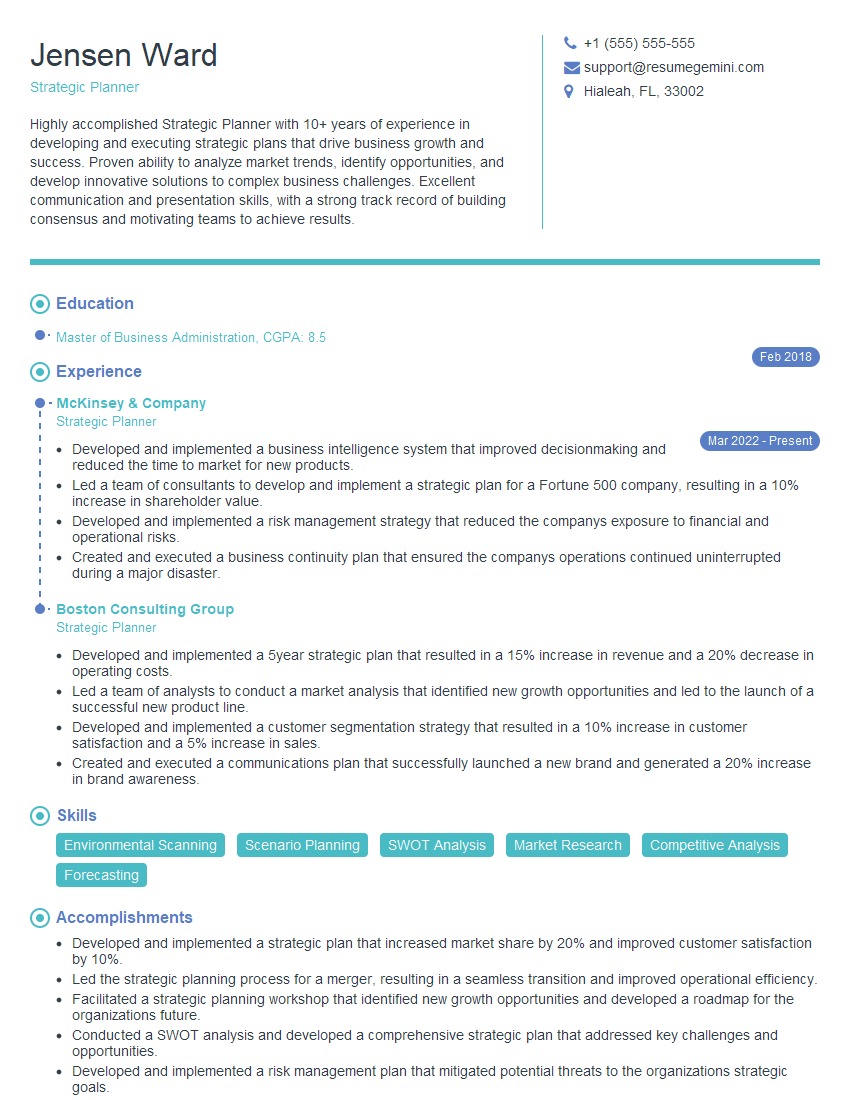
Mastering Trend Strategy Development is crucial for career advancement in today’s dynamic market. A strong understanding of trends enables you to anticipate market shifts, contribute innovative solutions, and drive significant business growth. To maximize your job prospects, creating an ATS-friendly resume is paramount. This ensures your qualifications are effectively communicated to recruiters and hiring managers. We strongly recommend using ResumeGemini to build a professional and impactful resume. ResumeGemini provides a streamlined process and offers examples of resumes tailored to Trend Strategy Development, giving you a head start in crafting a compelling application.
Explore more articles
Users Rating of Our Blogs
Share Your Experience
We value your feedback! Please rate our content and share your thoughts (optional).
What Readers Say About Our Blog
Really detailed insights and content, thank you for writing this detailed article.
IT gave me an insight and words to use and be able to think of examples