Interviews are more than just a Q&A session—they’re a chance to prove your worth. This blog dives into essential USDA Tobacco Grading Standards interview questions and expert tips to help you align your answers with what hiring managers are looking for. Start preparing to shine!
Questions Asked in USDA Tobacco Grading Standards Interview
Q 1. Describe the different grades of tobacco according to USDA standards.
The USDA doesn’t prescribe a single, universally applicable grading system for all types of tobacco. Grading standards vary depending on the specific type of tobacco (e.g., flue-cured, burley, dark air-cured). However, common grading factors across all types include leaf characteristics like color, size, and texture. Within each type, grades are often categorized using a letter system (e.g., A, B, C, etc.) or a numerical system, with higher grades indicating superior quality. A ‘Prime’ grade, for instance, denotes the highest quality within a specific type. Lower grades might reflect blemishes, poor curing, or inconsistencies in size and color. Think of it like grading coffee beans – the finest beans get the highest grade and the best price.
For example, flue-cured tobacco might have grades ranging from ‘A’ (premium quality) down to ‘C’ or even lower grades based on the presence of defects. Burley tobacco has its own specific grading system, reflecting the unique characteristics valued in that type.
Q 2. Explain the significance of leaf color in tobacco grading.
Leaf color is paramount in tobacco grading, as it directly reflects the curing process and the overall quality of the leaf. Different tobacco types have different ideal color ranges. For example, flue-cured tobacco is valued for its bright, golden-yellow to reddish-brown hues. Darker colors often indicate over-curing or improper handling, resulting in a lower grade. Conversely, lighter colors might suggest under-curing and a lack of desirable aroma and flavor characteristics. Imagine the difference between a perfectly ripe banana (ideal color) versus one that’s still green (underripe) or one that’s bruised and brown (overripe). Each color suggests a different level of quality and desirability.
Uniformity of color across a leaf is also crucial. Patches of different colors indicate inconsistent curing and can lead to a lower grade, even if the overall color falls within the acceptable range.
Q 3. How does leaf size and length influence tobacco grade?
Leaf size and length are significant factors influencing tobacco grade, particularly for types like flue-cured tobacco, which are often used for cigarette manufacturing. Larger, longer leaves are generally preferred because they can be processed more efficiently and yield a greater amount of usable material. Think of it like choosing lumber: longer, wider boards are more valuable than smaller, shorter ones.
However, leaf size alone isn’t sufficient for determining grade. The length-to-width ratio is also important. A leaf that is excessively long but narrow might be less desirable than a leaf that possesses a good balance between length and width. Uniformity of size within a specific lot is also considered. A batch of leaves with consistent size and length commands a higher price than one that includes a wide variation.
Q 4. What are the key characteristics evaluated in determining tobacco quality?
Determining tobacco quality involves a comprehensive evaluation of several key characteristics:
- Color: As discussed earlier, the color and uniformity of color are critical.
- Size and Length: The dimensions of the leaf and the consistency of size within a lot are assessed.
- Texture: Leaf texture, whether it’s smooth, pliable, or stiff, influences its quality and suitability for various uses.
- Aroma and Flavor: Sensory evaluation is integral. Experienced graders assess the aroma and potential flavor profile of the leaf.
- Moisture Content: Appropriate moisture levels are essential for proper storage, processing, and combustion.
- Body and Strength: This refers to the leaf’s density and overall strength, contributing to its burning characteristics.
- Cleanliness: The absence of damage, disease, insects, or foreign material is paramount.
Graders are highly trained professionals who use their expertise and sensory skills to evaluate these attributes comprehensively.
Q 5. Explain the role of the USDA in regulating tobacco grading.
While the USDA doesn’t directly grade tobacco anymore (the USDA Tobacco Grading Service was discontinued), its historical role was crucial in establishing and maintaining standardized grading practices. This standardization ensured fair and consistent evaluation, protecting both growers and buyers. The USDA’s published standards served as a benchmark, promoting transparency and trust in the tobacco market. Though no longer involved in the direct grading process, the established standards and methods the USDA developed continue to influence industry practices.
In essence, while the USDA may not be the direct regulator now, its legacy is crucial to the grading methods still used by private graders and companies.
Q 6. What are the different types of tobacco and their grading specifics?
Several types of tobacco exist, each with its own grading specifics. Here are a few examples:
- Flue-cured tobacco: Primarily used for cigarettes, it’s graded based on factors like color (bright yellow to reddish-brown), leaf size, and texture. Grades range from ‘A’ (highest) down to ‘C’ or lower, reflecting quality and consistency.
- Burley tobacco: Often used in blends, it’s characterized by its thicker leaves and darker color. Grading focuses on color (brown to reddish-brown), body, and aroma.
- Dark air-cured tobacco: Used in cigars and chewing tobacco, it’s valued for its dark, rich color and strong aroma. Grading considers color, body, and the presence of defects.
- Oriental tobacco: A type with aromatic leaves, it is often used in blends and cigarette mixes. Grading involves evaluating the aroma and strength of the leaf.
Each type possesses unique characteristics that determine its application and grading criteria. While similar factors (color, size, etc.) are often evaluated, the specific weight given to each factor varies based on the tobacco type and its intended use.
Q 7. How is the moisture content of tobacco assessed and its importance in grading?
Moisture content is a critical factor in tobacco grading and handling. Excessive moisture can lead to mold growth and spoilage, while insufficient moisture can make the leaves brittle and difficult to process. Moisture content is typically assessed using a moisture meter, an electronic device that measures the percentage of water in the tobacco leaves.
The ideal moisture content varies depending on the type of tobacco and its intended use. For example, flue-cured tobacco typically needs to be within a specific range (e.g., 18-22%) for optimal combustion and processing. Moisture content directly impacts the quality, usability, and overall value of the tobacco; deviations from the ideal range lead to lower grades and reduced market value.
Maintaining proper moisture content is not just important for grading but also for the entire process from harvesting to storage and manufacturing. It’s a crucial factor that affects the quality and shelf life of the tobacco products.
Q 8. Describe the process of preparing a tobacco sample for grading.
Preparing a tobacco sample for grading is crucial for obtaining an accurate assessment of its quality. It’s like preparing a chef’s prized ingredient for judging – presentation matters! The process involves carefully selecting a representative sample from the lot, ensuring it reflects the overall quality. This typically involves taking multiple small samples from different parts of the larger pile of tobacco. Then, the leaves are carefully cleaned, removing any extraneous material like dirt or debris. They are then laid out flat, often in a specific arrangement depending on the type of tobacco and the grading standards being used. This careful preparation eliminates bias and ensures the grader is assessing the tobacco’s inherent qualities, not artifacts of poor handling.
- Sample Selection: A truly representative sample is paramount; this requires expertise in identifying and selecting leaves that encompass the quality spectrum of the entire lot.
- Cleaning: Removing dirt, debris, and other foreign material prevents misinterpretations of defects.
- Arrangement: The orderly arrangement of leaves facilitates the grader’s examination of color, texture, and other key characteristics.
Q 9. Explain the use of a tobacco grader’s scale.
The tobacco grader’s scale is a vital tool, providing a standardized system for objectively measuring the leaf’s characteristics. Think of it as a ruler for tobacco quality, allowing for precise measurements rather than subjective estimations. It typically consists of a series of numbered or lettered grades, each corresponding to specific criteria like leaf length, width, color, and the presence of defects. The grader uses this scale to assign a grade to each leaf or a sample of leaves based on their observed properties. Using a standardized scale ensures consistency across different graders and over time, minimizing the possibility of biased assessments.
For example, a scale might grade leaves based on color intensity from a light shade (Grade 1) to a rich, deep shade (Grade 5). Similarly, it might categorize leaves by their length or the presence of specific defects and assign appropriate points for the different features, giving a final grade based on the accumulated points.
Q 10. What are the common defects found in tobacco leaves?
Tobacco leaves, like any agricultural product, are susceptible to various defects that affect their quality and value. These defects can stem from environmental factors, pest infestations, diseases, or improper handling. Common defects include:
- Holes: Caused by insects or disease.
- Stains: Discoloration from various sources, such as sap or water damage.
- Necrosis (dead spots): Tissue death resulting from disease or stress.
- Damaged Tips: Broken or damaged leaf edges.
- Mildew: A fungal growth affecting leaf appearance and quality.
- Weather Damage: Sunburn, hail damage, or wind damage.
The presence and severity of these defects significantly impact the final grade and market value of the tobacco.
Q 11. How are these defects categorized and graded?
Defects are categorized and graded based on their type, severity, and their impact on the overall quality and marketability of the leaf. Think of it as a point system where different defects carry different penalties. The USDA grading standards provide a detailed description of each defect, including its classification and point deductions. For instance, a small hole might receive a minor point deduction, while a large hole or multiple holes would result in a more significant deduction. Similarly, the severity of staining or necrosis is assessed and graded accordingly. The final grade is determined by considering the accumulation of these deductions alongside the leaf’s other qualities, such as color and size.
This systematic approach ensures fairness and consistency in the evaluation process, creating a level playing field for tobacco producers.
Q 12. How do you handle inconsistencies in grading between graders?
Inconsistencies in grading between graders are addressed through rigorous training, standardized procedures, and regular quality control checks. Imagine a panel of judges in a cooking competition – calibration is essential. Graders undergo extensive training to ensure they understand and apply the USDA standards consistently. Regular calibration sessions, using the same tobacco samples, are conducted to identify and correct any discrepancies in grading. Moreover, a senior grader or supervisor often reviews a sample of graded leaves to detect any major inconsistencies and provide feedback. This multi-layered approach reduces bias and increases accuracy across the grading process.
Q 13. Explain the importance of maintaining accurate grading records.
Maintaining accurate grading records is of paramount importance for several reasons. These records serve as a crucial historical document detailing tobacco quality, allowing for trends and patterns to be identified. They’re also vital for producers to track the quality of their crops over time. Accurate records are also essential for fair and transparent trading practices, providing buyers and sellers with reliable information. This ensures equitable pricing and protects the integrity of the tobacco market. Finally, these records provide essential data for research, helping improve cultivation techniques and quality control processes.
Think of these records as the backbone of responsible tobacco farming and commerce.
Q 14. What are the consequences of inaccurate tobacco grading?
Inaccurate tobacco grading can have significant consequences for all stakeholders involved. For producers, inaccurate grading could lead to unfair pricing and financial losses. Buyers might purchase tobacco of lower quality than expected, affecting their products and profitability. Furthermore, inaccurate grading erodes trust within the market, potentially leading to disputes and legal issues. It can also misrepresent the quality of tobacco to consumers, potentially affecting brand reputation and consumer confidence.
Ultimately, accurate grading is essential for a fair, efficient, and transparent tobacco market.
Q 15. Describe the different types of tobacco curing methods and their impact on grading.
Tobacco curing is a critical process that significantly impacts the final grade. It involves reducing the moisture content of harvested tobacco leaves, influencing their color, aroma, and overall quality. Different methods lead to distinct characteristics impacting the grade assigned by the USDA.
- Flue-curing: This method uses artificial heat in a barn-like structure. It produces a light-colored, milder tobacco often used in cigarettes. The evenness of curing directly impacts grade; unevenly cured leaves may receive a lower grade due to inconsistent color and texture.
- Air-curing: This natural method relies on air circulation and takes longer. It results in a darker, more robust tobacco frequently used in cigars. Grades here depend heavily on the consistent control of temperature and humidity during the curing period, preventing mold or discoloration.
- Sun-curing: This involves drying the tobacco leaves directly under the sun. This leads to a unique flavor profile and color, often darker than air-cured. Grading in this case depends heavily on consistent sunlight exposure, avoiding excessive bleaching or over-drying.
For instance, a flue-cured leaf with consistent, bright golden color would command a higher grade than one with mottled patches or dark spots, even if the leaf size is similar. This consistency in color and texture is a direct result of the curing process.
Career Expert Tips:
- Ace those interviews! Prepare effectively by reviewing the Top 50 Most Common Interview Questions on ResumeGemini.
- Navigate your job search with confidence! Explore a wide range of Career Tips on ResumeGemini. Learn about common challenges and recommendations to overcome them.
- Craft the perfect resume! Master the Art of Resume Writing with ResumeGemini’s guide. Showcase your unique qualifications and achievements effectively.
- Don’t miss out on holiday savings! Build your dream resume with ResumeGemini’s ATS optimized templates.
Q 16. How does the handling and storage of tobacco impact its grade?
Proper handling and storage are crucial for maintaining tobacco quality and directly influence grading. Improper handling can lead to leaf damage, discoloration, and mold growth, significantly impacting the final grade.
- Harvesting: Careful harvesting prevents damage. Bruised or torn leaves will have a lower grade.
- Curing and Storage Conditions: Maintaining optimal temperature and humidity during curing and storage is vital to prevent mold and deterioration, preserving leaf quality and earning higher grades.
- Packaging and Transportation: Safe packaging protects leaves from damage during transport. Leaves arriving damaged will receive lower grades, irrespective of their initial quality.
Imagine a perfectly cured tobacco leaf; if it’s improperly stored and becomes moldy, its grade will plummet. Conversely, careful handling from the field to the warehouse can ensure that a leaf retains its quality and receives the highest possible grade.
Q 17. What are the different types of tobacco production systems and their influence on grading?
Different tobacco production systems influence the characteristics of the final product and consequently its grade. Factors like planting density, fertilization, and pest management significantly impact leaf size, color, and overall quality.
- Conventional Farming: This system typically utilizes higher inputs, including fertilizers and pesticides. While it might lead to higher yields, the impact on the quality and the consistent grading can be variable. Over-fertilization can lead to uneven leaf growth, negatively impacting grade.
- Organic Farming: This approach uses natural methods, eliminating synthetic fertilizers and pesticides. While the yield might be lower, the quality often earns premium grades due to the naturally occurring flavors and characteristics.
- Integrated Pest Management (IPM): This system balances chemical and biological controls to manage pests. An effective IPM approach minimizes damage, leading to better leaf quality and higher grading compared to conventional practices with higher pesticide use that might leave residues.
For example, organically grown tobacco, carefully managed to avoid pests and diseases, often commands premium grades due to its superior quality and unique flavor profile, even if the yield per acre is slightly lower.
Q 18. Describe your experience with specific USDA tobacco grading standards documents.
My experience encompasses a wide range of USDA tobacco grading standards documents, including the official grading guides for various tobacco types such as flue-cured, burley, and dark air-cured. I’ve worked extensively with documents outlining specific grading factors like color, texture, size, and aroma, as well as those detailing the procedures for official grading sessions and dispute resolution. I’m familiar with the historical evolution of these standards and the rationale behind changes. My hands-on experience has involved interpreting these standards to assess tobacco quality and consistently apply the guidelines in grading sessions.
I have particularly found the detailed descriptions of color standards, often expressed using color charts and visual aids, invaluable in maintaining consistency in my assessments. Understanding the nuances of these standards is crucial to ensuring fair and accurate grading.
Q 19. Explain the role of technology in modern tobacco grading.
Technology plays a significant role in modern tobacco grading, improving efficiency and consistency. Traditional methods relied heavily on human assessment, which, while invaluable, can be subjective. New technologies aim to minimize subjectivity and enhance precision.
- Image Analysis Software: This software analyzes digital images of tobacco leaves, objectively measuring parameters like color, size, and texture. This helps in quantifying quality aspects previously assessed subjectively.
- Spectroscopy: This technique measures the light reflected or absorbed by the leaf, providing data on its chemical composition and quality. This allows for a more in-depth assessment of chemical attributes linked to the final grade.
- Data Management Systems: These systems track data from various stages of tobacco production, curing, and grading, providing a comprehensive picture of tobacco quality throughout the process. This traceability enhances accuracy and accountability.
For example, image analysis software can quickly and consistently assess leaf color, reducing human bias and improving the overall consistency of grading across large batches of tobacco. This helps in producing objective grading reports, increasing trust and transparency in the process.
Q 20. How do you ensure the consistency and fairness of your tobacco grading process?
Consistency and fairness in tobacco grading are paramount. I ensure this through a multi-pronged approach.
- Strict Adherence to Standards: I meticulously follow the USDA grading standards and guidelines for every grading session.
- Regular Calibration and Training: Frequent calibration exercises using standardized samples help maintain consistency in my assessments. Regular training updates keep me current with any changes in standards or technological advancements.
- Blind Grading: Conducting blind grading sessions, where the origin or other identifying information is hidden, helps eliminate bias and ensures impartial evaluation.
- Documentation: Meticulous documentation of each grading session, including images, measurements, and grade assignments, ensures transparency and facilitates the resolution of any potential disputes.
Think of it as a jeweler carefully assessing a diamond’s clarity – the process requires rigorous adherence to standards, consistent methods, and an unbiased eye. Similarly, consistent application of standards and detailed documentation are crucial for fair and unbiased tobacco grading.
Q 21. How do you handle disputes related to tobacco grading?
Disputes related to tobacco grading are handled through a structured process. The first step involves reviewing the original grading documentation. If the discrepancy cannot be resolved by reviewing the original assessment, a re-grading might be conducted by a second grader, independent of the original grader.
In cases involving significant disagreements, an appeal process involving a panel of experienced graders might be initiated. This panel carefully reviews all available information, including the original grading, the grounds for the appeal, and any additional evidence. Their decision is usually final and binding.
Transparency throughout the entire process is critical, ensuring fairness and building confidence among all stakeholders. Similar to a legal case, the process prioritizes presenting evidence and ensuring a fair hearing to all parties involved.
Q 22. Describe your experience with different types of tobacco (e.g., flue-cured, burley, etc.).
My experience encompasses all major types of tobacco grown in the United States, with a particular focus on flue-cured, burley, and dark air-cured tobaccos. Flue-cured, known for its bright, yellowish color and used extensively in cigarettes, requires precise grading based on factors like leaf length, color, and texture. Burley, with its darker, richer color and fuller body, presents a different grading challenge, focusing on characteristics like body, aroma, and maturity. Dark air-cured tobaccos, like those used in chewing and pipe tobaccos, are graded based on their unique color, aroma, and overall character. I’ve personally graded thousands of samples, learning to identify subtle differences that dramatically impact quality and value. For example, the presence of small amounts of ‘sand’ or ‘green’ in flue-cured tobacco significantly affects its grade, while the ‘sugary’ texture in burley influences its suitability for certain blends. I’ve also worked with other types, gaining proficiency in recognizing the nuances of each variety and how variations in growing conditions affect the final product.
Q 23. What are the latest updates or changes in USDA tobacco grading standards?
While the USDA’s core grading standards remain consistent, the main updates often relate to clarifications and refinements in grading procedures, usually to address technological advancements in tobacco production and handling. For example, there have been recent clarifications on the use of electronic sensors in pre-grading assessment, providing more objective data which helps to reduce discrepancies and inconsistencies amongst graders. Additionally, changes are sometimes made to account for shifts in market demands. These changes are usually announced through official USDA publications and updates to their online resources. It’s critical for graders to stay abreast of these modifications to ensure consistent and accurate evaluation.
Q 24. How do you stay current with the latest information and best practices in tobacco grading?
Staying current is paramount in this field. I maintain my expertise through several key strategies: I regularly review the official USDA Tobacco Grading Standards handbook and any supplementary materials they release. I actively participate in professional development workshops and seminars organized by tobacco industry associations and agricultural universities. These events offer invaluable opportunities to network with fellow graders, share best practices, and learn about the latest techniques and industry trends. Furthermore, I subscribe to relevant industry publications and journals, and I closely monitor the online resources and forums of the USDA and related agencies. Continuous learning is vital to maintain my accuracy and to anticipate changes in the industry.
Q 25. Describe a situation where you had to resolve a grading discrepancy.
In one instance, a significant grading discrepancy arose between my assessment and another grader’s evaluation of a particular lot of burley tobacco. The disagreement centered on the leaf’s overall body and maturity. To resolve this, we systematically re-examined the sample using the official USDA grading standards. We focused on specific criteria, like leaf texture, aroma, and color, making sure to follow the detailed descriptions provided in the handbook. We meticulously compared our initial assessments with those provided by the leaf-testing lab. Through this collaborative review process, we identified a slight difference in interpretation of ‘maturity’ as defined in the standards. This highlighted the importance of adhering strictly to the definitions specified in the official documentation and also how subtle differences in interpretation can lead to grading discrepancies. After clarifying our understanding of the guidelines, we came to a mutually agreeable grade.
Q 26. Explain your understanding of the legal and regulatory aspects of tobacco grading.
Tobacco grading operates within a complex legal and regulatory framework. The USDA standards are not just guidelines; they are legally binding for official grading purposes, influencing pricing and trade. These regulations ensure fair and accurate evaluation, protecting both buyers and sellers. My understanding extends to the regulations surrounding tobacco handling, storage, and transport. I am aware of the various certifications and licenses necessary for performing official tobacco grading. Compliance with these regulations is essential not only for maintaining professional credibility but also for preventing legal ramifications. It’s crucial to understand any updates to these regulations that might influence grading practices or interpretation of the standards.
Q 27. What are the ethical considerations in tobacco grading?
Ethical considerations are central to tobacco grading. Objectivity and impartiality are paramount; personal biases or external pressures should never influence the grading process. Maintaining confidentiality regarding any sensitive information obtained during grading is also vital. Transparency and accuracy in reporting are crucial to maintain trust with all stakeholders. Furthermore, it’s ethical to always stay updated on the latest grading procedures and standards, ensuring that evaluations are performed in accordance with the established norms and regulations. Essentially, ethical grading fosters trust and fairness across the industry, supporting sustainable and responsible practices.
Q 28. What are your long-term career goals related to tobacco grading?
My long-term career goals involve continued professional growth and contribution to the field of tobacco grading. I aspire to become a recognized expert, potentially taking on a leadership role within a major tobacco grading agency or association. I’m also interested in exploring opportunities to utilize my skills in training and education, mentoring newer graders and sharing my expertise to foster consistent and high-quality evaluations. Furthermore, I would like to contribute to the advancement of tobacco grading techniques and standards through research and collaboration with industry professionals and relevant institutions, working towards greater accuracy and efficiency in this important part of the tobacco value chain.
Key Topics to Learn for USDA Tobacco Grading Standards Interview
- Leaf Grades and Classifications: Understand the different leaf grades (e.g., grades 1-6) and the factors influencing their classification (e.g., color, size, texture, and aroma).
- Color Grading: Master the ability to accurately assess and describe tobacco leaf color using the USDA’s standardized color charts and terminology. Practice identifying subtle color variations and their impact on grade assignment.
- Physical Characteristics: Learn to evaluate leaf characteristics such as body, elasticity, and burn. Understand how these characteristics influence the overall grade and market value.
- Sampling and Inspection Techniques: Familiarize yourself with proper sampling procedures and techniques used in assessing large batches of tobacco. Practice accurate and consistent grading to minimize bias.
- Grade Determination and Documentation: Understand the process of assigning final grades based on the evaluation of leaf characteristics. Learn how to accurately document your findings and prepare comprehensive grading reports.
- Market Factors and Trends: Gain an understanding of current market demands and trends affecting tobacco grading and pricing. This shows your awareness of the broader industry context.
- Regulations and Compliance: Become familiar with the USDA’s regulations and compliance procedures related to tobacco grading and quality control. This demonstrates professionalism and adherence to industry standards.
- Problem-Solving Scenarios: Practice analyzing hypothetical grading scenarios involving discrepancies or challenges in leaf assessment. Develop strategies for addressing and resolving these issues efficiently and accurately.
Next Steps
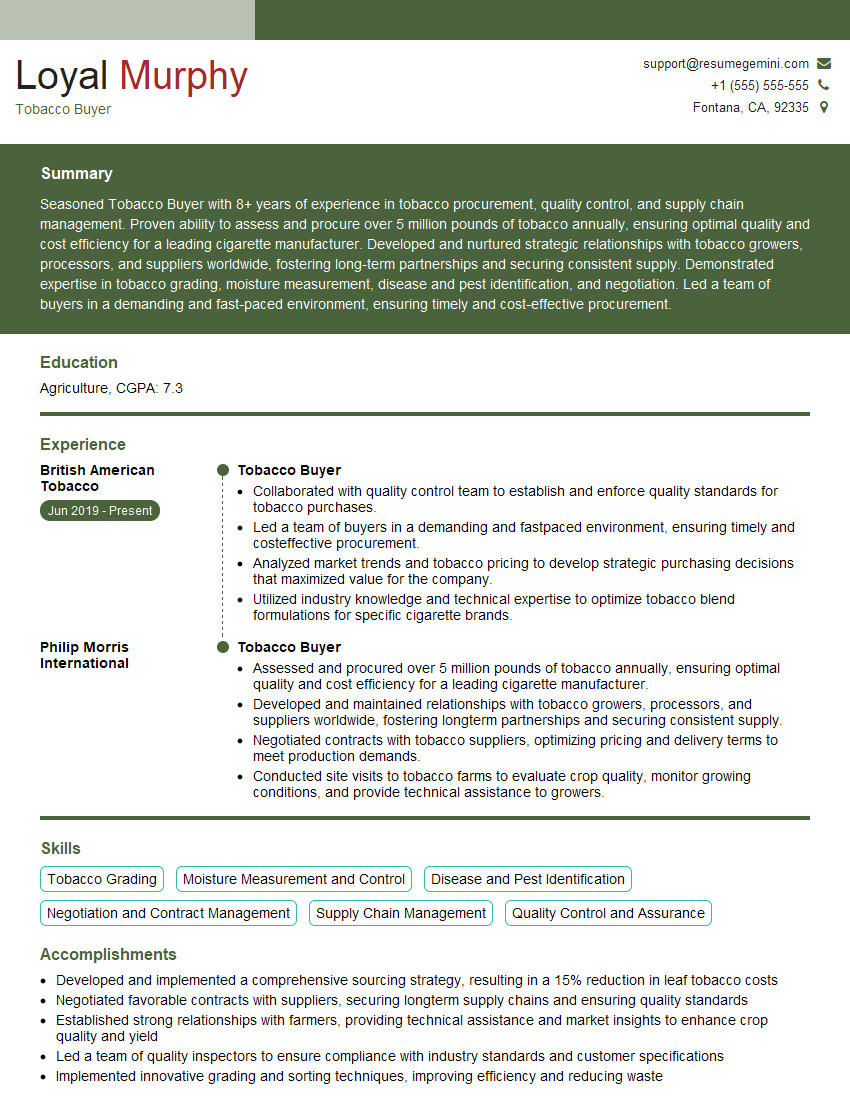
Mastering USDA Tobacco Grading Standards significantly enhances your career prospects within the agricultural industry, opening doors to rewarding opportunities with increased earning potential and professional growth. An ATS-friendly resume is crucial for getting your application noticed. To make your resume stand out and highlight your newly acquired skills, we strongly recommend using ResumeGemini. ResumeGemini provides a user-friendly platform for creating professional, ATS-optimized resumes, and we offer examples of resumes specifically tailored to the USDA Tobacco Grading Standards to guide you.


Explore more articles
Users Rating of Our Blogs
Share Your Experience
We value your feedback! Please rate our content and share your thoughts (optional).
What Readers Say About Our Blog
Really detailed insights and content, thank you for writing this detailed article.
IT gave me an insight and words to use and be able to think of examples