Are you ready to stand out in your next interview? Understanding and preparing for Vehicle Sketching interview questions is a game-changer. In this blog, we’ve compiled key questions and expert advice to help you showcase your skills with confidence and precision. Let’s get started on your journey to acing the interview.
Questions Asked in Vehicle Sketching Interview
Q 1. Explain your process for sketching a vehicle from initial concept to final rendering.
My vehicle sketching process is iterative and involves several key stages. It begins with initial concept sketching, where I quickly explore different ideas using loose, gestural lines to capture the overall form and proportions. This is often done with pencil on paper, focusing on capturing the essence of the design rather than fine details. Next, I move into refined sketches, progressively developing the chosen concept. This stage involves more precise linework, detailing key features like headlights, grilles, and wheels, and paying close attention to perspective and proportions. I might use a combination of pencil, digital tools, or even charcoal to achieve desired textures and values. The perspective refinement stage is critical, ensuring consistent vanishing points and a believable three-dimensional representation. Then, I create final renderings, focusing on adding detail, highlights, shadows, and texture to bring the design to life. This stage often involves digital painting techniques, enabling me to explore color palettes and material choices. Throughout this process, I regularly review and adjust my work, seeking feedback and making revisions to optimize the design.
For example, when designing a sports car, my initial sketches might focus on capturing its dynamic silhouette and aggressive stance. Subsequent refinements would then involve accurately depicting details such as the air intakes, spoilers, and wheel arches. My final rendering would then showcase the car’s sleek design through carefully applied highlights, shadows, and a vibrant paint job.
Q 2. Describe your experience with different sketching mediums (e.g., pencil, digital, charcoal).
I’m proficient in a variety of sketching mediums, each offering unique advantages. Pencil sketching allows for quick ideation and versatility, making it ideal for early concept exploration. The ability to easily erase and adjust is crucial in this stage. I often use different grades of pencils (e.g., 2H, HB, 2B) to control line weight and shading. Digital sketching using software like Photoshop or Procreate provides precision and the ability to easily manipulate and refine elements, particularly helpful for rendering and adding color. It also offers the ability to experiment with different brush styles and textures, simulating various materials. Charcoal is excellent for creating dramatic and expressive sketches, ideal for conveying the mood and emotion of a design. Its soft, smudgeable nature lends itself to creating realistic textures and shadows, making it perfect for showcasing the contours and form of a vehicle. The choice of medium often depends on the stage of the design process and the desired effect.
Q 3. How do you incorporate ergonomic considerations into your vehicle sketches?
Ergonomic considerations are paramount in vehicle design and are directly incorporated into my sketches from the outset. This involves understanding the human dimensions, reach, and movement within the vehicle’s interior. I consider factors such as: driver’s seat position and visibility (ensuring clear sightlines and comfortable reach to controls); passenger space and comfort (optimizing legroom, headroom, and overall ease of movement); and accessibility features (for those with mobility limitations). I often use anatomical references and sketches to ensure proper proportions and clearances in my design. For example, I might sketch a driver reaching for the steering wheel to check for natural hand placement and avoid awkward stretches. This ensures the design is not only aesthetically pleasing but also functional and user-friendly.
Q 4. How do you translate 2D sketches into 3D models?
The translation of 2D sketches to 3D models is a crucial step in the vehicle design process. I typically use my refined 2D sketches as a base, employing software such as Alias or Rhino. The process involves creating wireframes based on the key lines and proportions from the sketches. I then use these wireframes to construct the 3D surfaces, carefully matching them to the curves and details in my 2D drawings. The process is iterative, requiring constant comparison between the 2D sketch and the evolving 3D model to ensure accuracy. I also utilize reference images and potentially physical models to guide the 3D modeling process. This ensures that the final 3D model accurately reflects the design intentions captured in the initial sketches.
Q 5. How familiar are you with automotive design software (e.g., Alias, Rhino)?
I have extensive experience with industry-standard automotive design software, including Alias Automotive and Rhino. Alias is my primary tool for surface modeling, enabling me to create smooth, organic shapes with precise control over curves and details. Its powerful tools are essential for creating complex vehicle body panels and interior components. Rhino, with its versatility, is valuable for creating mechanical components and hard-surface models. My skills extend beyond simply operating the software; I understand the underlying principles of surface modeling and utilize the software to effectively translate my design vision into a 3D reality. I am also proficient in using these software packages to create renderings and animations, showcasing designs from multiple angles.
Q 6. Describe your experience with perspective drawing and its application in vehicle sketching.
Perspective drawing is fundamental to vehicle sketching, allowing me to convincingly represent the three-dimensional form on a two-dimensional surface. I employ various perspective techniques, including one-point, two-point, and three-point perspectives depending on the desired viewpoint and the design’s complexity. Understanding vanishing points, horizon lines, and orthogonals is crucial for maintaining accurate proportions and creating a believable sense of depth. For example, a two-point perspective is often used for side views of vehicles, allowing me to accurately depict the vehicle’s length and width while conveying its three-dimensional nature. Mastering perspective drawing ensures my sketches are not just visually appealing but also accurately represent the design’s size, shape, and spatial relationships.
Q 7. How do you ensure accuracy and proportion in your vehicle sketches?
Accuracy and proportion are paramount in vehicle sketching. I employ several techniques to maintain precision. Firstly, I use measurement grids and guides to ensure accurate scaling and proportions. These are especially helpful in early stages when establishing the overall dimensions and proportions of the vehicle. Secondly, I use reference images and technical drawings to accurately represent details, such as headlights, grilles, and wheels. Thirdly, I constantly compare and refine my sketches, using light sources to check for consistency in perspective and proportions. Finally, I use constructive geometry techniques in my sketches, laying down basic shapes before building up more complex forms. This structured approach assists in maintaining consistency and preventing distortions. Paying close attention to these details is essential for creating realistic and professional-quality vehicle sketches.
Q 8. How do you handle feedback and revisions on your vehicle sketches?
Feedback is crucial in vehicle sketching, as it helps refine the design and ensures it aligns with the client’s or team’s vision. I approach feedback iteratively. First, I actively listen and take detailed notes, clarifying any ambiguities. Then, I categorize the feedback – is it about proportions, details, style, or overall concept? This allows for a systematic approach to revisions. For example, if feedback points to an inaccurate wheelbase, I’ll adjust the proportions digitally or redraw the affected area, paying close attention to maintaining consistency throughout the sketch. If the feedback concerns the overall aesthetic, I might explore different lighting techniques or stylistic choices to achieve the desired effect. Finally, I present the revised sketch, explaining the changes made and addressing any remaining concerns. This collaborative process ensures a final product that meets expectations.
Q 9. Explain your understanding of automotive design trends and their influence on sketching.
Automotive design trends significantly influence my sketching process. I constantly monitor industry publications, attend automotive shows (both physical and virtual), and follow leading designers on social media to stay updated on emerging trends. Current trends, such as the increasing use of sustainable materials, the integration of advanced technology, and the focus on aerodynamic efficiency, directly impact my sketches. For instance, a trend towards minimalist designs might lead me to prioritize clean lines and avoid excessive detailing. Conversely, a trend towards more aggressive styling might influence me to incorporate sharper angles and more pronounced features in my work. Understanding these trends ensures my sketches resonate with the current automotive landscape and aren’t perceived as outdated.
Q 10. How do you balance artistic expression with functional considerations in your sketches?
Balancing artistic expression and functional considerations is a key aspect of automotive sketching. While artistic flair adds visual appeal, it’s crucial that the sketch also reflects the vehicle’s practical aspects. I achieve this balance through a thorough understanding of automotive engineering principles. For example, when sketching a car’s side profile, I pay close attention to the wheelbase, overhangs, and overall proportions to ensure they are realistic and functional. I might initially create a freehand sketch focusing on the artistic aspects, capturing the desired aesthetic, but then I’ll refine it based on engineering specifications, such as headroom, legroom, and cargo space. This iterative process ensures that the sketch is both visually stunning and technically sound.
Q 11. Describe your experience sketching different vehicle types (e.g., cars, trucks, motorcycles).
My experience spans various vehicle types. I’ve sketched everything from sleek sports cars to rugged pickup trucks and even futuristic motorcycles. Each vehicle type requires a different approach. For example, sketching a sports car emphasizes aerodynamic lines and sleek proportions, while sketching a truck focuses on strength, robustness, and functionality. The level of detail also varies; a motorcycle sketch might highlight intricate engine details, while a car sketch might focus on the overall form and character lines. This versatility stems from a deep understanding of the unique design language associated with each vehicle type, combined with continuous practice and exploration.
Q 12. How do you create compelling and realistic lighting effects in your sketches?
Creating realistic lighting effects is essential for conveying depth, volume, and mood in vehicle sketches. I utilize various techniques to achieve this. Firstly, I carefully consider the light source – is it sunlight, headlights, or ambient light? Then, I use shading and highlighting techniques to simulate the interaction of light with the vehicle’s surfaces. This includes understanding how light reflects differently on curved versus flat surfaces, and how shadows accentuate form. I often employ cross-hatching, stippling, or blending techniques to create smooth transitions between light and shadow, producing a three-dimensional effect. Additionally, I might use different mediums – colored pencils, markers, or digital tools – to achieve specific lighting effects. For example, a soft graphite pencil might be used for subtle shading, while a harder pencil might be used for sharper highlights.
Q 13. How do you manage your time effectively when creating vehicle sketches?
Effective time management is vital in vehicle sketching, especially when working on multiple projects simultaneously. I use a combination of planning and prioritization techniques. Before starting a sketch, I create a detailed plan outlining the key elements, the timeline, and any specific challenges. I break down the sketching process into manageable tasks, focusing on one aspect at a time. For instance, I might first complete the initial proportions, then move on to detailing, and finally add shading and highlights. Using a timer helps me track my progress and stay on schedule. I also avoid perfectionism by prioritizing accuracy over unnecessary details in the initial stages, allowing for refinements later. This structured approach maximizes my efficiency without compromising the quality of the work.
Q 14. Explain your approach to sketching vehicle interiors.
Sketching vehicle interiors requires a keen eye for detail and ergonomics. I start by understanding the overall layout and functionality of the interior space. I then focus on accurately depicting elements like the dashboard, seats, steering wheel, and control panels. I pay close attention to material textures and colors, using shading and highlighting to create depth and realism. Perspective is also crucial in conveying the spatial relationship between different elements within the cabin. I often utilize orthogonal projections to ensure accuracy in proportions and placement of interior features. The goal is to create a sketch that not only looks visually appealing but also conveys the ergonomics and user experience of the interior space. For example, the placement and design of controls should be intuitive and safe.
Q 15. How do you ensure consistency in style across multiple vehicle sketches?
Maintaining consistent style across multiple vehicle sketches is crucial for presenting a unified and professional design language. This involves establishing a clear set of guidelines early in the process.
- Style Guide: I create a comprehensive style guide that dictates aspects like line weight, perspective, rendering style (e.g., tonal shading, line rendering), and even the type of paper and tools used. This ensures uniformity across all sketches, regardless of the vehicle or project.
- Template Usage: For complex projects, I often use templates. These templates pre-define the perspective, proportions, and layout, acting as a foundation for all sketches. This minimizes variations caused by individual approaches.
- Reference Images: Consistent reference images for proportions, details, and surface reflections are also vital. This is especially true for complex curves or intricate details that can otherwise vary from sketch to sketch. For instance, referencing high-quality photographs of existing vehicles or using 3D models as references helps maintain accuracy.
- Regular Reviews: Frequent internal reviews and comparisons between sketches are vital. This helps to identify any deviations from the established style guide, allowing for timely corrections and refinement.
For example, in one project, I established a style guide specifying a specific line weight for major contours (0.5mm) versus smaller details (0.2mm), and we used the same perspective for every initial concept sketch of the vehicle. This ensured visual consistency across all initial design iterations.
Career Expert Tips:
- Ace those interviews! Prepare effectively by reviewing the Top 50 Most Common Interview Questions on ResumeGemini.
- Navigate your job search with confidence! Explore a wide range of Career Tips on ResumeGemini. Learn about common challenges and recommendations to overcome them.
- Craft the perfect resume! Master the Art of Resume Writing with ResumeGemini’s guide. Showcase your unique qualifications and achievements effectively.
- Don’t miss out on holiday savings! Build your dream resume with ResumeGemini’s ATS optimized templates.
Q 16. How do you incorporate brand identity into your vehicle sketches?
Incorporating brand identity into vehicle sketches is paramount, as it’s the first step in visually communicating a brand’s values and personality. This is achieved through a careful consideration of several elements:
- Brand’s Design Language: I meticulously study the brand’s existing design language, including its logo, color palette, typography, and existing vehicle designs. This informs the overall aesthetic choices in my sketches, such as the choice of lines, shapes, and proportions.
- Characteristic Features: Many brands have signature design elements—a specific grille shape, headlight design, or a characteristic crease line. These iconic features are carefully incorporated into my sketches, making the design instantly recognizable as belonging to that brand.
- Color Palette: The brand’s signature colors, or color families, must be considered. While initial sketches might be monochromatic, I ensure the design is compatible with the brand’s color palette. I might even create color studies using digitally enhanced sketches to show the vehicle in its brand colors.
- Sketch Style: The brand’s overall style influences the rendering style I choose. For example, a premium brand might call for more refined, detailed sketches with subtle shading, whereas a sportier brand might warrant a more dynamic, less detailed approach.
For example, while sketching a new SUV for a brand known for its rugged and adventurous image, I emphasized strong, bold lines, a high ground clearance, and incorporated design cues present in their existing truck lineup, ensuring visual alignment with their overall brand identity.
Q 17. Explain your understanding of vehicle aerodynamics and how it impacts sketching.
Understanding vehicle aerodynamics is crucial for creating both aesthetically pleasing and functional designs. Aerodynamic principles directly impact the form and function of a vehicle, and therefore significantly influence my sketching process.
- Form Follows Function: Aerodynamics dictates the shape of the vehicle. Features like smooth curves, streamlined profiles, and carefully designed underbody panels help reduce drag and improve fuel efficiency. I ensure my sketches reflect this, consciously incorporating aerodynamically sound shapes.
- Airflow Visualization: I often refer to CFD (Computational Fluid Dynamics) simulations or wind tunnel test data during the sketching phase to visually represent airflow. This helps me make informed decisions about design elements that impact aerodynamics, such as the shape of the front bumper or the placement of side mirrors.
- Drag Coefficient (Cd): The Cd value—a measure of aerodynamic drag—is a key performance indicator that informs my design decisions. Lower Cd values are highly desirable. My sketches often include annotations indicating features that contribute to a lower Cd, such as active aero components or optimized underbody fairings.
- Downforce and Lift: For high-performance vehicles, downforce is key to handling. I understand how design choices can influence downforce, incorporating elements like spoilers and diffusers into my sketches as appropriate.
For instance, when sketching a sports car, I focused on elements like a smooth underbody, a long, sloping hood, and a short rear deck, all of which contribute to minimizing drag and enhancing overall aerodynamic performance. My sketches reflect these elements to visually convey this performance.
Q 18. Describe your experience with rendering techniques for vehicle sketches.
Rendering techniques are essential for effectively communicating design ideas in vehicle sketches. My experience encompasses a variety of methods, both traditional and digital:
- Traditional Rendering: I am proficient in traditional techniques, using pencils, markers, charcoal, and colored pencils to create sketches with varying levels of detail and realism. This allows me to quickly iterate designs and convey different moods and feelings, from quick concept sketches to detailed renderings.
- Digital Rendering: I also utilize digital tools like Photoshop and Illustrator. These allow for more precise control, easier corrections, and exploration of a wider range of rendering styles, including photorealistic renders, shaded renderings, and more stylized approaches.
- Perspective and Shading: My rendering skills include mastering techniques like perspective drawing, which conveys depth and spatial relationships, and shading, which gives form and volume to the design. Understanding light sources and their impact on surfaces is crucial for producing realistic and impactful sketches.
- Material Representation: I also use rendering techniques to effectively represent different materials. For example, I utilize varied techniques to showcase differences in gloss, texture, and reflectivity between materials like metal, glass, plastic, and carbon fiber, enhancing the visual appeal and clarity of the sketch.
In a recent project, I used digital rendering to create photorealistic images of a concept car to present it to stakeholders. This gave them a much clearer sense of the car’s look and feel and allowed for detailed feedback before moving into more expensive digital modeling stages.
Q 19. How do you use sketching to solve design problems?
Sketching is an indispensable tool for problem-solving in vehicle design. It allows for rapid iteration and exploration of design ideas, helping to identify and resolve various design challenges.
- Idea Generation: Sketching is ideal for brainstorming and generating numerous initial design concepts. The freedom to quickly generate and discard ideas helps overcome design roadblocks.
- Proportion Studies: Proportion is paramount in automotive design. Sketching allows me to quickly experiment with different proportions, assessing their visual appeal and impact on the vehicle’s overall design and functionality. This iterative approach helps me to refine the proportions to perfection.
- Ergonomics and Packaging: Sketching helps to address ergonomics and packaging issues. By quickly sketching different layouts of interior components and exploring their spatial relationships, I can identify and resolve any constraints or conflicts early in the design process.
- Visual Communication: Sketches effectively communicate design concepts to a wider team. They are a powerful tool for sharing ideas, eliciting feedback, and fostering collaboration among designers, engineers, and stakeholders.
For instance, I once used sketching to resolve a packaging conflict where the engine and the cabin intrusion bar design interfered. By sketching numerous iterations, I was able to find a solution that satisfied both engineering and design requirements.
Q 20. How do you ensure the manufacturability of your design through sketching?
Ensuring manufacturability through sketching requires a deep understanding of manufacturing processes and constraints. While sketches are primarily a design tool, they can play a vital role in identifying potential manufacturability issues early on.
- Surface Complexity: I carefully consider surface complexity while sketching, ensuring the design avoids features that are overly difficult or expensive to manufacture. I avoid excessively complex curves or sharp angles that are problematic in manufacturing processes like stamping.
- Part Count and Assembly: The number of parts and their assembly process significantly impacts the cost and complexity of manufacturing. I keep this in mind while sketching, striving for designs that minimize part count and simplify the assembly procedure.
- Material Selection: My sketches often include notations indicating preferred materials for specific components, taking into account both their aesthetic appeal and manufacturability. Considerations include material strength, formability, and cost.
- Tolerance Analysis: While detailed tolerance analysis is usually done at a later stage, sketching can help identify potential areas of fit and finish issues. By considering the dimensional accuracy achievable in manufacturing, I can refine design features to avoid potential problems.
For example, while sketching a new car door, I would avoid designing overly complex curves that would be extremely difficult to stamp, instead opting for simpler, more readily manufacturable shapes.
Q 21. How do you stay up-to-date with industry trends in vehicle design?
Staying current with industry trends is vital for any vehicle designer. I employ several strategies to stay up-to-date:
- Industry Publications: I regularly read automotive design magazines, journals, and online publications to keep abreast of the latest design trends, technological advancements, and emerging materials.
- Automotive Shows and Events: Attending international automotive shows and design events provides firsthand exposure to the latest vehicle designs and allows for networking opportunities with other designers and industry professionals.
- Online Resources: I utilize online platforms, websites, and social media groups dedicated to automotive design to access information, inspiration, and engage with the broader design community.
- Competitor Analysis: I conduct thorough competitor analyses to understand the latest design trends and innovations within the automotive industry. Studying their designs helps me to identify successful design strategies and learn from the strengths and weaknesses of various approaches.
- Workshops and Conferences: Attending industry-specific workshops and conferences allows me to engage with leading experts, learn about the latest tools and techniques, and network with peers from various organizations.
For instance, recently, I attended the Frankfurt Motor Show and was deeply impressed by the new design language that several manufacturers were employing, specifically regarding lighting design. The insights gained from this event have already influenced my own sketching work.
Q 22. Describe your workflow for creating a digital vehicle sketch.
My digital vehicle sketching workflow is iterative and highly dependent on the project’s scope. It generally follows these stages:
- Concept Ideation & Thumbnail Sketches: I begin with quick, loose sketches exploring various design directions. Think small, roughly 2-3 inches, focusing on proportions and overall form. This helps eliminate bad ideas quickly.
- Refined Sketches: Based on promising thumbnails, I create more detailed sketches, enlarging the scale and adding more detail to proportions, major features (headlights, wheels, etc.), and overall silhouette.
- Digitalization: I scan or photograph my refined sketches and then use digital tools like Photoshop or Illustrator to refine them further. This stage allows for adjustments to lines, proportions, and the addition of details. I might use layers to keep things organized.
- Rendering: Once the lines are finalized, I add shading, highlights, and color to create a more realistic representation. This step is crucial in communicating the design’s mood and aesthetic.
- Presentation: The final sketch is prepared for presentation, potentially with annotations to highlight key design elements or considerations.
Throughout this process, I continually refine and iterate, using feedback from reviews to inform subsequent stages. For example, I might change the stance of a vehicle after receiving feedback on the initial refined sketch, then reflect that in the digital rendering.
Q 23. How do you use reference images to inform your vehicle sketches?
Reference images are indispensable. I use them to study proportions, details, and understand the underlying forms of real-world vehicles and even elements from nature that might inspire design choices. I don’t simply copy; I use references to inform my understanding and guide my hand. For example, when sketching a new headlight design, I might gather several photos of existing headlights with similar styling, noting their size relative to the overall vehicle, the way light reflects off their surfaces, and their integration with the surrounding bodywork. I might also look at images of insects or architecture to gain inspiration for different shapes and forms. This process prevents design choices from appearing arbitrary or isolated.
My approach involves:
- Gathering diverse reference images: I aim for a broad range of examples, including different angles and lighting conditions. This provides me a 360-degree view.
- Analyzing proportions and forms: I meticulously study the relationships between different elements of the car. For instance, the wheelbase relative to the overall length, the height of the hood compared to the cabin, and so on.
- Selective application: I avoid direct tracing; instead, I use the reference as a guide, applying only relevant details and forms to my own design. The goal is to create something new, inspired by and informed by, but not a copy of, the references.
Q 24. Explain your understanding of human factors and its relation to vehicle design sketching.
Human factors are paramount in vehicle design sketching. It involves considering how the vehicle interacts with its human occupants and users. Neglecting human factors can lead to designs that are unsafe, uncomfortable, or simply unappealing. My sketches consistently consider elements like:
- Ergonomics: The positioning of controls, seats, and visibility. I’ll sketch in details suggesting comfortable driver and passenger positions.
- Visibility and Safety: The design of the windows, mirrors, and blind spots, ensuring that the driver has optimal sight lines and safety is prioritized. A sketch might highlight where blind spots are, signaling the need for design improvements.
- Accessibility: Ensuring the vehicle is usable by people of varying heights and abilities. This might involve considering the placement and ease of use of controls for disabled individuals.
- Intuitiveness: The ease with which a person can understand and use the vehicle’s controls and features. Sketches are a great way to quickly test a user interface.
By incorporating human factors from the sketching stage onwards, potential problems can be addressed early in the design process, saving time and resources. For instance, a sketch might reveal that a proposed dashboard layout obscures critical instruments, leading to a revised design before investing time in detailed engineering.
Q 25. How do you handle sketching vehicles with complex shapes and curves?
Sketching complex curves and shapes requires a methodical approach. I start by breaking down the form into simpler geometric primitives – spheres, cylinders, cones – building up the overall form from these fundamental shapes. This helps to avoid distortion and maintain the overall consistency of the curves. Techniques I use include:
- Construction Lines: Using light construction lines to map out the overall form and proportions before adding details. These lines are like a framework for the more detailed curves to come.
- Ellipses and Perspective: Understanding and applying the principles of perspective drawing is crucial for rendering curves convincingly. For instance, circular wheels need to be rendered as ellipses when viewed from an angle, and the degree of curvature of this ellipse changes with the perspective.
- Varying Line Weight: Using thicker lines for areas closer to the viewer and thinner lines for areas further away creates depth and improves the illusion of three-dimensionality.
- Shading and Highlights: Properly applied shading and highlights further enhance the sense of form and curvature, emphasizing the three-dimensional nature of the object. The way the light strikes the curves reveals the complexity of the form.
It’s an iterative process. I might initially focus on the overall shape and refine the curvature and detailing in subsequent sketches. Working digitally allows for adjustments and refinements that would be much more time-consuming with traditional media.
Q 26. How do you communicate your design ideas effectively through sketching?
Effective communication through sketching requires clarity, precision, and visual storytelling. My approach involves:
- Clear Linework: Using clean, confident lines to convey the form and details of the vehicle, avoiding unnecessary clutter. Overly sketchy lines might look artistic but won’t accurately convey the design ideas.
- Perspective and Proportion: Employing proper perspective and accurate proportions helps create a realistic and believable representation of the vehicle. A skewed perspective makes the design hard to understand and evaluate.
- Strategic Shading and Color: Utilizing shading and color to emphasize key features and create a visually appealing sketch. For example, highlights can draw attention to particular styling cues, while shading reveals the vehicle’s contours.
- Annotations and Diagrams: Adding annotations to highlight specific features, dimensions, or design decisions. This allows me to explain design choices, especially complex ones, clearly. Adding a section view in addition to the main sketch can make design decisions more clear.
- Multiple Views: Presenting sketches from multiple angles – front, side, rear, and sometimes even interior views – to provide a comprehensive understanding of the design. This allows the observer to grasp the entire vehicle design from all angles.
The goal is to translate the design vision into a visual narrative that is easy to understand, even for non-designers.
Q 27. Describe your experience presenting your vehicle sketches to clients or stakeholders.
Presenting sketches to clients and stakeholders requires adapting the communication style to the audience’s technical understanding. I’ve presented sketches in various settings, from informal brainstorming sessions to formal design reviews.
My approach involves:
- Understanding the Audience: Before the presentation, I carefully consider the audience’s level of technical expertise and tailor my presentation accordingly. I would not present highly technical details to an entirely non-technical client group.
- Structured Presentation: I organize the presentation logically, leading the audience through the design process, from initial concepts to the final refinements. This helps to provide context and avoids making the audience feel overwhelmed by the details.
- Interactive Dialogue: I encourage questions and feedback throughout the presentation, using these interactions to clarify any misunderstandings and to gain valuable insights.
- Visual Aids: I use high-quality prints or digital projections of my sketches, ensuring they are clear, well-lit, and easily visible to everyone.
- Prototypes: Sometimes, supplementing sketches with physical models or digital 3D models enhances comprehension.
In several instances, initial client feedback led to significant design revisions. This iterative process is crucial for ensuring client satisfaction and a successful outcome.
Q 28. How do you adapt your sketching style to different design briefs?
Adaptability is key. My sketching style changes depending on the design brief. A brief for a rugged off-road vehicle will demand a different approach than a brief for a sleek, futuristic city car. I consider:
- Design Style: The design language of the vehicle dictates the overall aesthetic. A classic design will employ a different sketching approach compared to a modern or futuristic design.
- Target Audience: The target consumer group influences the design and, consequently, the sketching style. A luxury vehicle would necessitate a more polished and detailed sketch compared to a budget-friendly vehicle.
- Technical Requirements: Specific engineering or functional constraints can require adjustments to the sketching style to ensure these are addressed effectively.
- Time Constraints: A quick sketch for early exploration requires a different approach to a highly polished final presentation rendering. This will affect both sketching techniques and the level of detail included.
For instance, for a concept exploring biomimicry in design, I might use softer, more organic forms in my sketches, whereas for a high-performance sports car, I might adopt a more sharp and aggressive line style.
Key Topics to Learn for Vehicle Sketching Interview
- Perspective and Proportion: Mastering accurate representation of vehicle dimensions and spatial relationships in various views (front, side, perspective).
- Line Quality and Shading: Developing techniques to create clean, confident lines and effective shading to convey form and volume.
- Vehicle Anatomy and Design Elements: Understanding the fundamental components of vehicle design, including chassis, body, wheels, and detailing elements like headlights and grilles.
- Different Sketching Techniques: Exploring various sketching methods, such as quick gesture sketches, refined technical drawings, and digital sketching workflows.
- Design Process and Ideation: Understanding the iterative nature of the design process, from initial concept sketching to refined design proposals.
- Software Proficiency (if applicable): Demonstrating familiarity with relevant digital sketching software (e.g., Adobe Photoshop, Illustrator, or industry-specific tools).
- Communication and Presentation: Effectively communicating design ideas and rationale through clear sketches and concise verbal explanations.
- Problem-solving and Design Thinking: Applying design thinking principles to solve design challenges and create innovative vehicle concepts.
- Understanding Automotive Design Trends: Staying updated on current automotive design trends and industry best practices.
- Portfolio Development and Presentation: Creating a strong portfolio showcasing your best vehicle sketching work and effectively presenting it during the interview.
Next Steps
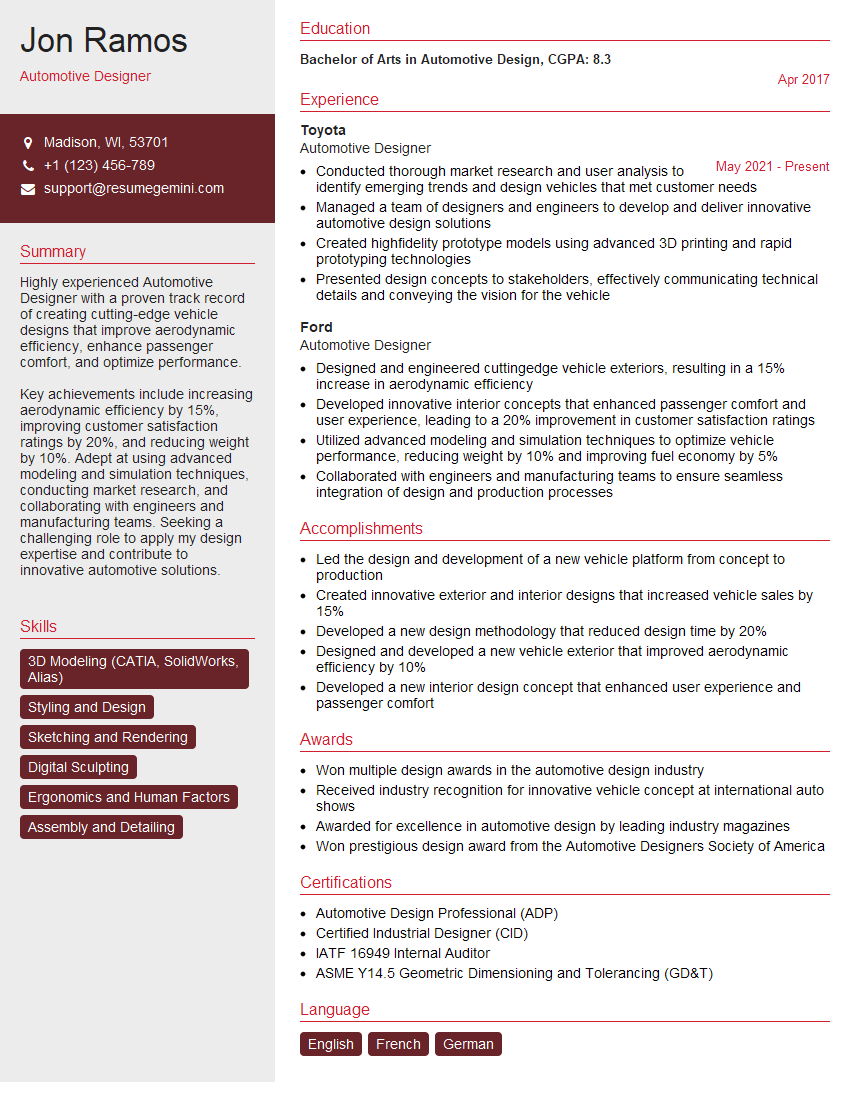
Mastering vehicle sketching is crucial for a successful career in automotive design, opening doors to exciting opportunities in concept development, styling, and production. A well-crafted resume is essential to highlight your skills and experience to potential employers. Building an ATS-friendly resume significantly increases your chances of getting your application noticed. ResumeGemini is a trusted resource to help you create a compelling and effective resume tailored to your specific skills and experience. Examples of resumes specifically tailored to Vehicle Sketching professionals are available to guide you through the process.
Explore more articles
Users Rating of Our Blogs
Share Your Experience
We value your feedback! Please rate our content and share your thoughts (optional).
What Readers Say About Our Blog
Really detailed insights and content, thank you for writing this detailed article.
IT gave me an insight and words to use and be able to think of examples