Unlock your full potential by mastering the most common VoIP Network Design and Implementation interview questions. This blog offers a deep dive into the critical topics, ensuring you’re not only prepared to answer but to excel. With these insights, you’ll approach your interview with clarity and confidence.
Questions Asked in VoIP Network Design and Implementation Interview
Q 1. Explain the difference between SIP and H.323.
Both SIP (Session Initiation Protocol) and H.323 are signaling protocols used in VoIP, defining how calls are established and terminated. However, they differ significantly in their architecture and approach.
SIP is a text-based, application-level protocol that’s more flexible and widely adopted. It uses a simpler, more scalable architecture based on requests and responses. Think of it like sending emails to set up a call; each step is clearly defined in a text message. This flexibility allows for easier integration with other applications and services.
H.323, on the other hand, is a more complex, binary protocol with a more rigid call setup process. Imagine it as a complex phone system with multiple layers of gateways and components. It’s less flexible and more challenging to implement and maintain. While it was dominant earlier, SIP has largely superseded it due to its scalability and ease of use.
In short: SIP is lightweight, flexible, and widely used; H.323 is heavier, less adaptable, and less prevalent.
Q 2. Describe the process of QoS configuration for VoIP.
QoS (Quality of Service) configuration for VoIP is crucial for ensuring clear, reliable calls. It involves prioritizing VoIP traffic over other network traffic to minimize jitter, latency, and packet loss – the main culprits of poor call quality.
The process typically involves these steps:
- Identifying VoIP traffic: This often involves using IP addresses, ports (typically UDP ports 5060, 5061 for SIP signaling and RTP ports for media), and Differentiated Services Code Point (DSCP) markings.
- Prioritizing VoIP traffic: This can be done using various QoS mechanisms, such as:
- Class of Service (CoS): Assigns priority levels to different traffic types. VoIP traffic gets a higher priority.
- DiffServ: Uses DSCP values in IP packets to indicate priority. VoIP packets are marked with a higher DSCP value.
- MPLS (Multiprotocol Label Switching): Labels packets for preferential treatment across the network.
- Traffic shaping/policing: Limits the amount of VoIP traffic to ensure consistent performance.
- Implementing QoS on network devices: Routers, switches, and firewalls need to be configured to support the chosen QoS mechanism. This involves defining QoS policies that specify which traffic gets prioritized and how.
- Monitoring and adjusting: Network monitoring tools are used to track key metrics like jitter, latency, and packet loss. QoS policies may need adjustment based on these observations.
Example: A common approach is to mark VoIP packets with a DSCP value of EF (Expedited Forwarding) to ensure they receive the highest priority on routers and switches throughout the network.
Q 3. What are the key considerations for designing a scalable VoIP network?
Designing a scalable VoIP network involves anticipating future growth and ensuring the system can handle increased call volume and users without performance degradation. Key considerations include:
- Network infrastructure: Choosing sufficient bandwidth, robust network devices (routers, switches), and redundant links to avoid single points of failure. Consider using layer 3 switching to improve scalability.
- Call signaling capacity: The signaling infrastructure (SIP servers, proxies) must be able to handle the expected number of simultaneous calls and registrations.
- Media processing: Select capable media gateways and servers capable of handling the concurrent media streams without affecting call quality. Consider distributed architectures for higher scalability.
- Database scalability: If the system relies on a central database (for user information, call records), ensure its design can scale to accommodate future data growth.
- Modular design: Architect the network in a modular fashion, allowing easy addition of new components as needed. This might involve using virtualization or cloud-based solutions.
- Redundancy and failover mechanisms: Implementing redundant systems and failover mechanisms ensures system availability in case of hardware or software failures. This can include redundant servers, gateways, and network paths.
- Capacity planning: Perform thorough capacity planning to anticipate future needs based on user growth projections and call traffic patterns. Tools like network simulation software are crucial here.
Q 4. How do you troubleshoot VoIP call quality issues?
Troubleshooting VoIP call quality issues requires a systematic approach. It’s like detective work, carefully examining clues to pinpoint the problem.
Here’s a step-by-step process:
- Gather information: Identify the affected users, times of day, and specific symptoms (e.g., choppy audio, one-way audio, dropped calls, latency).
- Check network connectivity: Verify network connectivity between endpoints using tools like ping and traceroute. Look for packet loss or high latency.
- Analyze QoS metrics: Examine QoS parameters like jitter, latency, and packet loss for VoIP traffic using network monitoring tools.
- Inspect SIP traces: Analyze SIP call setup logs to identify any signaling issues during call initiation or termination.
- Examine RTP streams: Analyze Real-time Transport Protocol (RTP) streams to detect jitter, packet loss, or other media-related issues. Tools that can capture and analyze RTP streams are necessary.
- Check codec compatibility: Verify that endpoints use compatible codecs, and if not, choose codecs with a lower bitrate and potentially lower quality to accommodate the network bandwidth.
- Check device configuration: Ensure that the VoIP devices (phones, gateways) are correctly configured and have the latest firmware.
- Investigate firewall rules: Ensure that firewalls are not blocking VoIP traffic (SIP and RTP ports). Consider using NAT traversal techniques (like STUN or TURN) to work around network address translation.
- Consider environmental factors: In some cases, external factors like electromagnetic interference can affect call quality.
Remember to isolate and test each component to narrow down the cause of the problem.
Q 5. Explain different VoIP codecs and their impact on call quality and bandwidth.
VoIP codecs (coder-decoders) compress and decompress audio signals for transmission over the network. The choice of codec significantly impacts call quality and bandwidth consumption.
Here are some examples:
- G.711: A high-quality codec, offering excellent audio quality. However, it has high bandwidth requirements (64 kbps per channel).
- G.729: A narrowband codec that provides good quality with lower bandwidth consumption (8 kbps). Suitable for situations with limited bandwidth.
- G.723.1: Offers variable bit rates (5.3 to 6.3 kbps), allowing adaptation to varying network conditions. Good balance between quality and bandwidth.
- Opus: A modern, wideband codec that provides high-quality audio at low bit rates (6 kbps to 510 kbps). Adaptive bitrate capabilities allow for excellent performance in diverse network conditions.
- iLBC: An efficient codec designed for low-bandwidth situations. Audio quality can be lower than G.729.
Choosing the right codec involves a trade-off between audio quality and bandwidth. For situations with abundant bandwidth, G.711 or Opus might be preferred, while in bandwidth-constrained environments, G.729 or iLBC might be more appropriate.
Q 6. What are the security threats specific to VoIP networks, and how can they be mitigated?
VoIP networks face unique security threats due to their reliance on internet protocols.
- Eavesdropping: Unsecured VoIP calls can be intercepted by malicious actors using packet sniffers. Mitigation: Use strong encryption protocols (SRTP/TLS).
- Denial of Service (DoS) attacks: Flooding SIP servers with bogus requests can disable VoIP services. Mitigation: Implement robust security measures on SIP servers, use firewalls and intrusion detection systems.
- Man-in-the-Middle (MitM) attacks: Attackers can intercept and modify VoIP traffic, potentially eavesdropping on calls or injecting malicious code. Mitigation: Use TLS to encrypt SIP signaling and SRTP to encrypt media streams. Verify certificates and use strong authentication mechanisms.
- Session hijacking: Attackers can take control of an active VoIP session. Mitigation: Use strong authentication and authorization mechanisms.
- Call spoofing: Attackers can make calls appear to come from different numbers (caller ID spoofing). Mitigation: Implement robust caller ID authentication mechanisms.
- Phishing attacks: Attackers can use VoIP to make fraudulent calls attempting to obtain sensitive information. Mitigation: User awareness training on phishing techniques.
A layered security approach, incorporating firewalls, intrusion detection systems, encryption, and robust authentication is crucial in mitigating these threats.
Q 7. What are the advantages and disadvantages of using Session Border Controllers (SBCs)?
Session Border Controllers (SBCs) are essential security and management gateways for VoIP networks, acting as a bridge between the public internet and the private VoIP network.
Advantages:
- Enhanced security: SBCs provide a crucial layer of security by filtering unwanted traffic, preventing DoS attacks, and enforcing authentication and authorization policies.
- NAT traversal: They handle NAT (Network Address Translation) issues, allowing communication between VoIP endpoints behind different NAT devices.
- Call control and routing: SBCs can manage and route calls efficiently, providing features like call admission control.
- Media transcoding: They can convert between different codecs, allowing interoperability between diverse VoIP systems.
- Improved scalability: SBCs can help improve the scalability of the VoIP network by handling large numbers of concurrent calls.
Disadvantages:
- Cost: SBCs can be expensive, particularly high-end models designed for large enterprises.
- Complexity: Configuring and managing SBCs can be complex, requiring specialized expertise.
- Potential bottleneck: A poorly configured or overloaded SBC can become a bottleneck in the VoIP network.
The decision to use an SBC depends on the specific requirements of the network. For smaller networks, the cost and complexity might outweigh the benefits, while for larger enterprises with stringent security requirements, the advantages are significant.
Q 8. Explain the concept of media gateways in VoIP.
Media gateways are essential components in VoIP networks that bridge the gap between different communication protocols. Think of them as translators, allowing VoIP systems to communicate with traditional Public Switched Telephone Networks (PSTNs).
For example, a VoIP system using SIP (Session Initiation Protocol) needs to connect to a PSTN using ISDN or TDM (Time Division Multiplexing). The media gateway handles this conversion, transforming the digital VoIP packets into analog signals for the PSTN and vice versa. It performs several crucial functions:
- Protocol Conversion: Converts between VoIP protocols (like SIP, H.323) and PSTN signaling protocols (like ISDN PRI).
- Media Transcoding: Converts between different audio codecs (e.g., G.711, G.729) to ensure compatibility.
- Signaling: Handles the setup and tear-down of calls between VoIP and PSTN networks.
- Media Rate Adaptation: Adjusts the bitrate of the audio stream to match the capacity of the connected network.
In essence, without media gateways, direct communication between VoIP and PSTN systems would be impossible. Imagine trying to have a conversation with someone speaking a completely different language – the gateway acts as the interpreter to make the conversation flow smoothly.
Q 9. Describe your experience with VoIP network monitoring tools.
I’ve extensive experience using a variety of VoIP monitoring tools, from open-source solutions like PRTG Network Monitor to enterprise-grade platforms such as SolarWinds VoIP & Network Performance Monitor. My experience spans deploying and configuring these tools to monitor key metrics across different VoIP architectures.
My focus typically centers on monitoring:
- Call Quality: Metrics like jitter, latency, packet loss, and Mean Opinion Score (MOS) are critical for ensuring a high-quality user experience. A sudden spike in jitter, for instance, points towards network congestion needing immediate attention.
- Network Performance: Bandwidth utilization, CPU and memory usage on VoIP servers, and network interface statistics (like errors and discards) are constantly monitored to prevent bottlenecks.
- Call Detail Records (CDRs): Analyzing CDRs helps identify trends, patterns in call failures, and troubleshoot specific calls. For example, a large number of failed calls to a specific number might indicate a problem with a gateway or a routing issue.
- Server Health: Proactive monitoring of server health ensures high availability. This includes checking CPU, memory, disk space and service status.
I’m proficient in interpreting the data generated by these tools to identify problems, pinpoint their root cause, and implement solutions proactively. This has been crucial in optimizing VoIP network performance and ensuring minimal downtime in several projects.
Q 10. How do you handle VoIP network capacity planning?
VoIP network capacity planning is a crucial aspect of designing a scalable and reliable system. It involves predicting future needs and ensuring the network can handle the expected call volume and bandwidth requirements.
My approach involves a multi-step process:
- Demand Forecasting: Projecting future call volumes based on historical data, anticipated growth, and business requirements. This might involve analyzing call patterns, user growth projections, and anticipated changes in usage.
- Bandwidth Calculation: Calculating the required bandwidth based on the number of concurrent calls, codec used, and quality of service (QoS) requirements. For example, using G.729 codec requires less bandwidth than G.711.
- Hardware Sizing: Choosing appropriate hardware like switches, routers, and VoIP servers with sufficient capacity to handle the projected load. Over-provisioning can be expensive, but under-provisioning leads to performance issues.
- QoS Implementation: Implementing Quality of Service mechanisms to prioritize VoIP traffic over other network applications. This often involves using features like DiffServ or MPLS to mark and prioritize VoIP packets, guaranteeing their timely delivery.
- Monitoring and Adjustment: Regularly monitoring the network’s performance and adjusting the capacity as needed. This ensures that the network remains optimized for evolving needs.
For instance, a growing business might need to significantly increase their VoIP capacity within a year. Proactive capacity planning helps avoid sudden performance degradation and ensures smooth operation.
Q 11. Explain the importance of redundancy and failover mechanisms in a VoIP infrastructure.
Redundancy and failover mechanisms are critical for ensuring high availability and reliability in a VoIP infrastructure. Downtime in a VoIP system can be costly, disrupting communication and impacting business operations. Redundancy means having backup systems in place to take over if the primary system fails, while failover is the automatic process of switching to the backup.
Key elements include:
- Redundant Servers: Deploying multiple VoIP servers to handle calls. If one server fails, the others take over seamlessly.
- Redundant Network Infrastructure: Using redundant routers, switches, and network links to prevent single points of failure. This might involve having dual uplinks to the internet or geographically diverse network connections.
- Redundant Power Supplies: Implementing uninterruptible power supplies (UPS) and generators to protect against power outages.
- Failover Mechanisms: Configuring automatic failover mechanisms (e.g., using HSRP or VRRP for routers) to ensure rapid switching to backup systems without manual intervention.
- Geographic Redundancy: For mission-critical systems, consider geographically diverse setups to protect against regional disasters.
Imagine a hospital relying on VoIP for critical communications. Without redundancy and failover, a single server failure could severely compromise patient care. By implementing these mechanisms, the system can maintain operation even during failures, ensuring business continuity.
Q 12. What are your experiences with different VoIP provisioning methods?
My experience with VoIP provisioning methods includes both automated and manual approaches. The choice depends on the size and complexity of the network, as well as the specific needs of the organization.
I’ve worked with:
- Automated Provisioning: Using tools and scripts to automatically configure VoIP phones and other devices. This is particularly efficient for large deployments, reducing manual effort and ensuring consistency.
- Zero-Touch Provisioning (ZTP): Automating the configuration of devices using DHCP, TFTP, and other network services. This simplifies the initial setup and reduces the need for on-site configuration.
- Manual Provisioning: Manually configuring each VoIP phone and device, which is suitable for smaller deployments or when highly specific configurations are required. This approach provides more control but is time-consuming.
- Bulk Provisioning: Using tools that allow for the simultaneous configuration of multiple devices via a configuration file or template.
Choosing the right provisioning method is a balance between efficiency and control. Automated provisioning excels in large deployments, while manual provisioning gives greater control in smaller, more complex settings. I always aim to select the approach that maximizes efficiency while maintaining the necessary level of precision.
Q 13. How do you ensure the security of VoIP calls, including encryption and authentication?
Securing VoIP calls is crucial to protect sensitive information from eavesdropping and unauthorized access. It involves implementing encryption and authentication mechanisms at multiple layers.
Key security measures include:
- SRTP (Secure Real-time Transport Protocol): Encrypts the media stream (voice and video) to prevent eavesdropping. It’s the industry standard for secure VoIP calls.
- TLS (Transport Layer Security) / SSL (Secure Sockets Layer): Secures the signaling traffic (SIP messages) between VoIP phones and servers, protecting call setup information.
- Authentication Mechanisms: Implementing strong authentication methods to verify the identity of users and devices, preventing unauthorized access. This includes using certificates, passwords, and RADIUS servers.
- Firewall and Network Segmentation: Using firewalls and network segmentation to restrict access to the VoIP infrastructure, limiting potential attack vectors.
- Regular Security Audits: Regularly auditing the VoIP system for vulnerabilities and implementing security updates to protect against known threats. This includes monitoring for known vulnerabilities and applying security patches promptly.
- Call Detail Record (CDR) Security: Protecting CDR data, which contains sensitive information, through encryption and access controls. This is essential for ensuring data privacy and compliance with regulations.
Failing to secure VoIP calls exposes sensitive conversations to potential interception. Implementing robust security measures is essential for ensuring confidentiality and maintaining user trust.
Q 14. Describe your experience with various VoIP platforms (e.g., Asterisk, Cisco CUCM).
I have extensive experience with a range of VoIP platforms, including open-source solutions like Asterisk and commercial platforms such as Cisco Unified Communications Manager (CUCM). Each platform offers unique strengths and capabilities.
My experience with Asterisk includes designing, implementing, and maintaining systems for diverse applications. Its flexibility and open-source nature allows for highly customized solutions. I’ve used it in smaller deployments where cost-effectiveness and customization are key.
With Cisco CUCM, I’ve worked on large-scale enterprise deployments, leveraging its advanced features for call management, integration with other systems, and robust security. The platform’s scalability and advanced features are ideal for complex enterprise environments requiring high reliability and sophisticated management capabilities.
My expertise extends beyond these platforms; I have also worked with other solutions like 3CX, Avaya Aura, and various cloud-based VoIP platforms. Choosing the right platform depends heavily on the specific requirements of the project, considering factors like scale, budget, required features, and integration needs. Each platform presents its unique set of challenges and opportunities, and my experience allows me to select and deploy the most appropriate solution for a given scenario.
Q 15. How do you troubleshoot VoIP connectivity issues?
Troubleshooting VoIP connectivity issues requires a systematic approach. Think of it like diagnosing a car problem – you need to check various systems to pinpoint the source. I begin by gathering information: Is the problem widespread, affecting all users, or isolated to a single device or location? What are the specific symptoms? Are users getting no dial tone, one-way audio, choppy audio, or dropped calls? This helps me narrow down the possibilities.
My troubleshooting process usually involves these steps:
- Check the basics: Verify network connectivity (ping the VoIP server, check network cables), power supply to the phones and gateways, and the VoIP phone’s configuration (correct IP address, subnet mask, DNS server). Sometimes, a simple reboot can resolve minor glitches.
- Analyze network traffic: Tools like Wireshark can capture and analyze network packets, helping to identify issues with SIP signaling (Session Initiation Protocol, the language VoIP phones use to communicate), RTP (Real-time Transport Protocol, which carries the voice data), or Quality of Service (QoS) settings.
- Review QoS settings: VoIP relies on QoS to prioritize voice traffic over other network traffic (like video streaming or file downloads). Incorrect QoS settings can lead to poor call quality. I’d examine router and switch configurations to ensure appropriate prioritization using techniques like DiffServ or MPLS.
- Examine call detail records (CDRs): CDRs provide valuable information about individual calls, such as duration, call direction, and any error codes. Analyzing CDRs can help to pinpoint recurring problems and identify faulty gateways or specific phone lines.
- Test the VoIP server and gateways: If the problem appears server-side, I’d conduct comprehensive server tests, checking CPU and memory utilization, network interface statistics, and the database integrity. Gateways need similar attention.
- Consult network monitoring tools: Tools like Nagios or Zabbix provide real-time monitoring of the network infrastructure, alerting me to potential problems before they significantly impact VoIP performance.
For example, I once diagnosed a widespread audio quality issue by analyzing CDRs and identifying a consistent pattern of high jitter during peak hours. This pointed to insufficient bandwidth and prompted me to upgrade the network infrastructure.
Career Expert Tips:
- Ace those interviews! Prepare effectively by reviewing the Top 50 Most Common Interview Questions on ResumeGemini.
- Navigate your job search with confidence! Explore a wide range of Career Tips on ResumeGemini. Learn about common challenges and recommendations to overcome them.
- Craft the perfect resume! Master the Art of Resume Writing with ResumeGemini’s guide. Showcase your unique qualifications and achievements effectively.
- Don’t miss out on holiday savings! Build your dream resume with ResumeGemini’s ATS optimized templates.
Q 16. Explain the different types of VoIP deployments (e.g., on-premise, cloud-based).
VoIP deployments can be broadly classified into on-premise and cloud-based solutions. Each has its own advantages and disadvantages.
- On-Premise Deployment: In this model, all VoIP infrastructure (servers, gateways, and phones) resides within the organization’s own physical location. This provides greater control and customization but requires significant upfront investment and ongoing IT management. Think of it like owning your own power generator – you have complete control, but you’re responsible for maintenance and repairs.
- Cloud-Based Deployment: Here, the VoIP service is hosted by a third-party provider in the cloud. This eliminates the need for on-site hardware and IT management, reducing capital expenditure and IT overhead. This is like using a public utility – reliable and convenient, but you have less direct control.
- Hybrid Deployment: This combines elements of both on-premise and cloud-based deployments. For example, a company might host its core VoIP infrastructure on-premise while utilizing cloud services for specific features such as call recording or advanced analytics. This allows for a flexible and scalable approach, offering customized elements alongside the convenience of cloud services.
The choice between these deployments depends on factors such as budget, technical expertise, security requirements, scalability needs, and the organization’s size and IT infrastructure.
Q 17. What are the challenges of integrating VoIP with legacy PBX systems?
Integrating VoIP with legacy PBX systems can present several challenges. The primary hurdle lies in the fundamental differences between the technologies. Legacy PBXs are typically circuit-switched, relying on dedicated physical connections for each call, while VoIP is packet-switched, using IP networks to transmit voice data.
- Protocol incompatibility: Legacy PBXs often use proprietary signaling protocols, while VoIP relies on SIP or other standards-based protocols. Bridging these requires gateways or media converters that can translate between the different protocols. This translation can sometimes introduce latency or quality issues.
- Network compatibility: Legacy PBXs were not designed for IP networks and may not be compatible with the QoS requirements of VoIP. Integrating them requires careful network configuration and possibly network upgrades to handle the additional traffic and ensure quality.
- Feature incompatibility: Some features available on the legacy PBX might not be directly supported by the VoIP system, and vice versa. This might necessitate compromises or the use of additional software or hardware to provide the necessary functionality.
- Security concerns: Integrating two disparate systems can create new security vulnerabilities if not properly addressed. Careful network segmentation and security policies are essential to mitigate these risks.
For instance, I once worked on a project where we had to implement a gateway to connect a legacy PBX with a new VoIP system. We faced challenges with call routing and feature compatibility, which we overcame by carefully configuring the gateway and developing custom scripts to handle specific functions.
Q 18. Describe your experience with call detail record (CDR) analysis.
Call Detail Record (CDR) analysis is crucial for VoIP network management and troubleshooting. CDRs are essentially logs of all calls made, providing rich data about each call. Think of them as flight recorders for your VoIP system.
My experience with CDR analysis involves using this data to:
- Identify trends and patterns: Analyzing call patterns can reveal bottlenecks or areas needing improvement. For example, high call abandonment rates during peak hours might indicate insufficient bandwidth or server capacity.
- Troubleshoot call quality issues: CDRs often contain information about call duration, dropped calls, and error codes. This data helps identify recurring problems with specific phones, lines, or gateways.
- Monitor resource utilization: CDRs can be correlated with network monitoring data to assess server load, bandwidth usage, and gateway performance. This assists in capacity planning and optimizing resource allocation.
- Generate reports and billing information: CDR data is often used to generate reports for billing purposes, providing detailed information on call usage and costs.
- Improve network security: Unusual call patterns, such as an unusually high number of international calls from a specific user, might indicate a security breach.
I typically use specialized CDR analysis tools that allow me to filter, sort, and analyze CDR data, generating reports and visualizations to identify key trends and insights. For example, by analyzing CDRs that showed a recurring error code related to RTP packet loss, we identified a faulty network switch that was causing the problem. Replacing the switch immediately resolved the call quality issues.
Q 19. How do you handle VoIP network performance optimization?
VoIP network performance optimization is an ongoing process. It’s about ensuring that your VoIP system consistently delivers high-quality calls. My approach to optimization involves a multi-faceted strategy:
- Network monitoring and analysis: Continuous monitoring of network performance metrics (latency, jitter, packet loss) using tools like SolarWinds or PRTG is crucial for proactive identification of potential problems.
- QoS configuration: Proper QoS configuration is essential to prioritize VoIP traffic over other network applications. This ensures that voice calls receive the necessary bandwidth and minimize latency and jitter.
- Bandwidth management: Sufficient bandwidth is essential for high-quality VoIP calls. Regular assessments of bandwidth usage and capacity planning help to ensure that the network has enough capacity to handle the expected call volume.
- Gateway optimization: Gateways are critical components of a VoIP network. Regularly checking their performance, CPU utilization, and memory usage can identify potential bottlenecks. If needed, upgrading to more powerful gateways might be beneficial.
- Codecs and jitter buffers: The choice of codecs (audio compression algorithms) and the size of jitter buffers (which compensate for network latency variations) can impact call quality. Experimentation and fine-tuning can significantly improve performance. Finding the right balance between compression (lower bandwidth) and quality is vital.
- Redundancy and failover mechanisms: Implementing redundant systems and failover mechanisms ensures that the VoIP system remains operational even in case of hardware failure or network outages.
For instance, in one project, by optimizing the QoS settings and implementing a more efficient codec, we reduced call latency significantly, leading to a dramatic improvement in call quality.
Q 20. Explain the significance of jitter and latency in VoIP communications.
Jitter and latency are two critical factors that impact VoIP call quality. Imagine you’re having a conversation, but the other person’s voice keeps skipping or arriving late – that’s the effect of jitter and latency.
- Latency: This refers to the delay between transmitting and receiving data packets. High latency causes noticeable delays in the conversation, making it sound unnatural and frustrating. Think of it as the echo in a long tunnel – the sound takes time to reach the other end.
- Jitter: This is the variation in latency. While some delay is expected, inconsistent delays create jitter, which manifests as choppy or distorted audio. It’s like the erratic rhythm of a drum solo – some beats arrive on time, others are early or late, making the whole experience uneven.
Both latency and jitter are caused by network congestion, inadequate bandwidth, packet loss, and suboptimal QoS settings. Acceptable levels are typically considered below 150ms for latency and below 30ms for jitter. Exceeding these thresholds often results in poor call quality, making conversations difficult or impossible.
Q 21. What are your experiences with different VoIP signaling protocols?
I have extensive experience with various VoIP signaling protocols, each with its own strengths and weaknesses. The most prevalent is SIP (Session Initiation Protocol).
- SIP (Session Initiation Protocol): This is the most widely used signaling protocol in VoIP. It’s a text-based protocol that handles call setup, teardown, and various call control functions. It’s flexible, scalable, and widely supported, making it the industry standard. I’ve used SIP extensively in various deployments, configuring SIP servers, proxies, and clients.
- H.323: This is an older protocol, less commonly used now, that’s more complex than SIP. It’s still relevant in some niche environments but has largely been superseded by SIP’s ease of use and flexibility.
- MGCP (Media Gateway Control Protocol): This protocol is used for controlling media gateways, bridging the gap between VoIP networks and traditional telephone networks. I’ve used MGCP in scenarios requiring interoperability between different network technologies.
- Megaco (Media Gateway Control): This is a newer protocol designed to improve on MGCP, offering better scalability and flexibility. My experience with Megaco includes its application in large-scale deployments.
Choosing the right signaling protocol depends on various factors, including the size of the network, the desired features, and the interoperability requirements. My expertise lies in selecting and configuring the most appropriate protocol for the specific needs of the project.
Q 22. How do you handle VoIP integration with other enterprise applications?
Integrating VoIP with other enterprise applications is crucial for a seamless communication and workflow experience. This involves leveraging APIs and integrating with CRM systems, collaboration platforms, and other business tools.
For instance, imagine integrating our VoIP system with a CRM like Salesforce. When a customer calls, the system automatically pulls up their contact information on the agent’s screen, improving response time and personalization. This integration might use a RESTful API to exchange data between the VoIP platform and Salesforce. The VoIP system sends call details (caller ID, call duration), and Salesforce provides customer information. This requires careful planning of data formats and security protocols.
Another example would be linking VoIP with a scheduling application. When a meeting is scheduled, an automated call or voice message could be sent to participants as a reminder. This involves configuring the VoIP system to trigger actions based on events within the scheduling system, possibly through webhooks or scheduled tasks. The key is to choose appropriate integration methods based on the capabilities of both systems and to manage potential data security and privacy concerns.
Q 23. What is your experience with VoIP troubleshooting tools and techniques?
Effective VoIP troubleshooting relies on a combination of tools and techniques. My experience includes using network monitoring tools like Wireshark for packet analysis to identify issues with call quality, jitter, or latency. I also use specialized VoIP diagnostic tools provided by vendors like Cisco or Avaya. These tools often offer detailed call flow analysis, codec information, and other metrics essential for troubleshooting.
Techniques include systematically investigating the entire call path – from the phone’s endpoint to the network infrastructure and the VoIP server. This involves checking network connectivity, analyzing QoS settings, verifying proper codec negotiation, and assessing server logs. I also leverage ping tests, traceroutes, and looking at the CPU/Memory usage on servers and network devices.
For example, if we experience poor call quality, we might start by checking the network jitter using Wireshark. High jitter indicates packet loss or delays and points toward network congestion or a faulty network device. We then might look at QoS configuration to see if VoIP traffic is receiving sufficient priority. If the problem persists, I’d then investigate the server logs to see if there are any errors or resource exhaustion issues. A methodical approach and a good understanding of the VoIP architecture are crucial for efficient troubleshooting.
Q 24. Describe your experience with different types of VoIP phones and their capabilities.
My experience encompasses a wide range of VoIP phones, from basic desk phones to sophisticated IP DECT handsets and softphones. Basic desk phones offer essential calling features, while more advanced models incorporate features like HD audio, Bluetooth connectivity, and integration with enterprise directories. IP DECT phones are ideal for mobility within an office environment, providing seamless roaming capabilities.
Softphones, software-based phone applications, offer flexibility and work on various devices, including laptops, tablets, and smartphones. This allows users to access their VoIP accounts from virtually anywhere with an internet connection. Capabilities vary widely depending on the phone model and vendor, but commonly include features like call hold, transfer, conferencing, voicemail integration, and visual voicemail.
For example, in one project, we deployed a mixture of Cisco IP desk phones for executive offices, providing high-quality audio and advanced features. For other areas, we used less expensive IP DECT handsets, granting employees mobility without compromising audio quality. Simultaneously, we offered softphones for remote workers, ensuring seamless communication across the organization.
Q 25. Explain the importance of network topology in VoIP design.
Network topology significantly impacts VoIP performance and scalability. A well-designed topology is crucial for minimizing latency, jitter, and packet loss – all major factors affecting call quality. The choice of topology depends on factors such as network size, geographical distribution, and the required level of redundancy.
Common topologies include star, mesh, and ring networks. A star topology, where all devices connect to a central hub (typically a switch or router), is simple to manage but can be vulnerable to single points of failure. A mesh topology, where devices connect to multiple other devices, provides redundancy but is more complex to manage. Ring topologies provide redundancy but can be susceptible to network failures if one link goes down.
For instance, in a large enterprise, we might employ a hierarchical topology consisting of multiple star networks interconnected through core switches, creating redundancy and load balancing. This ensures calls can be routed efficiently even during peak times and minimizes the impact of network failures. Careful consideration of bandwidth, latency, and redundancy are crucial elements in determining the optimal topology for a VoIP network.
Q 26. How do you ensure the quality of service (QoS) for VoIP traffic in a converged network?
Quality of Service (QoS) is paramount in converged networks where VoIP shares bandwidth with other applications like data and video. QoS prioritizes VoIP traffic, ensuring sufficient bandwidth and low latency, even under heavy network load. This is achieved through techniques like traffic shaping, prioritization, and resource reservation.
Common QoS mechanisms include DiffServ (Differentiated Services), which assigns different priority levels to traffic classes, and MPLS (Multiprotocol Label Switching), which facilitates traffic engineering and prioritization. These are often configured on network routers and switches. We might use DiffServ to mark VoIP packets with a higher priority (e.g., EF – Expedited Forwarding), ensuring they are processed first by network devices.
In a real-world scenario, imagine a busy office network with several VoIP calls running simultaneously along with high bandwidth applications. Without QoS, the data-intensive applications might consume all the bandwidth, resulting in poor call quality. By implementing QoS, we ensure that VoIP traffic receives preferential treatment, guaranteeing acceptable call quality even during peak network utilization.
Q 27. What is your experience with designing and implementing VoIP solutions for various business needs?
I have extensive experience designing and implementing VoIP solutions tailored to diverse business needs, from small offices to large enterprises. My work has included designing and implementing systems for contact centers, unified communications platforms, and branch office connectivity.
For example, in a recent project for a contact center, we designed a system with advanced features like Automatic Call Distributor (ACD), interactive voice response (IVR), and call recording, ensuring efficient call handling and improved customer service. In another project for a geographically dispersed enterprise, we implemented a VoIP solution utilizing a combination of SIP trunking and VPNs to ensure secure and reliable communication between remote offices.
The design process always starts with a thorough needs assessment, taking into account factors like call volume, network infrastructure, budget, and scalability requirements. This is followed by detailed system design, equipment selection, implementation, testing, and ongoing maintenance. The entire process necessitates close collaboration with clients to guarantee the solution aligns perfectly with their unique business needs.
Key Topics to Learn for Your VoIP Network Design and Implementation Interview
Landing your dream VoIP role requires a solid understanding of both theory and practice. This section outlines key areas to focus your preparation.
- Network Topologies and Protocols: Understand the strengths and weaknesses of various VoIP network topologies (e.g., star, mesh, ring) and the key protocols involved (SIP, H.323, RTP, etc.). Consider how these choices impact call quality, scalability, and security.
- QoS (Quality of Service): Mastering QoS mechanisms is crucial. Learn how to prioritize VoIP traffic, manage bandwidth, and ensure low latency to guarantee high-quality calls. Be prepared to discuss techniques like DiffServ and MPLS.
- Security Considerations: VoIP networks are vulnerable to various attacks. Study common security threats and mitigation strategies, including firewalls, encryption (SRTP, TLS), and access control lists.
- Call Flow and Signaling: A deep understanding of the call establishment process, including the role of SIP servers, proxies, and gateways, is vital. Be able to trace a call’s journey through the network and troubleshoot potential issues.
- Network Design and Implementation Best Practices: Familiarize yourself with industry best practices for designing scalable, reliable, and secure VoIP networks. This includes aspects like redundancy, failover mechanisms, and disaster recovery planning.
- Troubleshooting and Problem Solving: Practice diagnosing and resolving common VoIP issues, such as call quality problems, connectivity issues, and network congestion. Think through various troubleshooting steps and methodologies.
- VoIP Hardware and Software: Develop a strong understanding of the various hardware components (IP phones, gateways, routers) and software platforms (PBX systems, call managers) used in VoIP deployments.
Next Steps: Unlock Your Career Potential
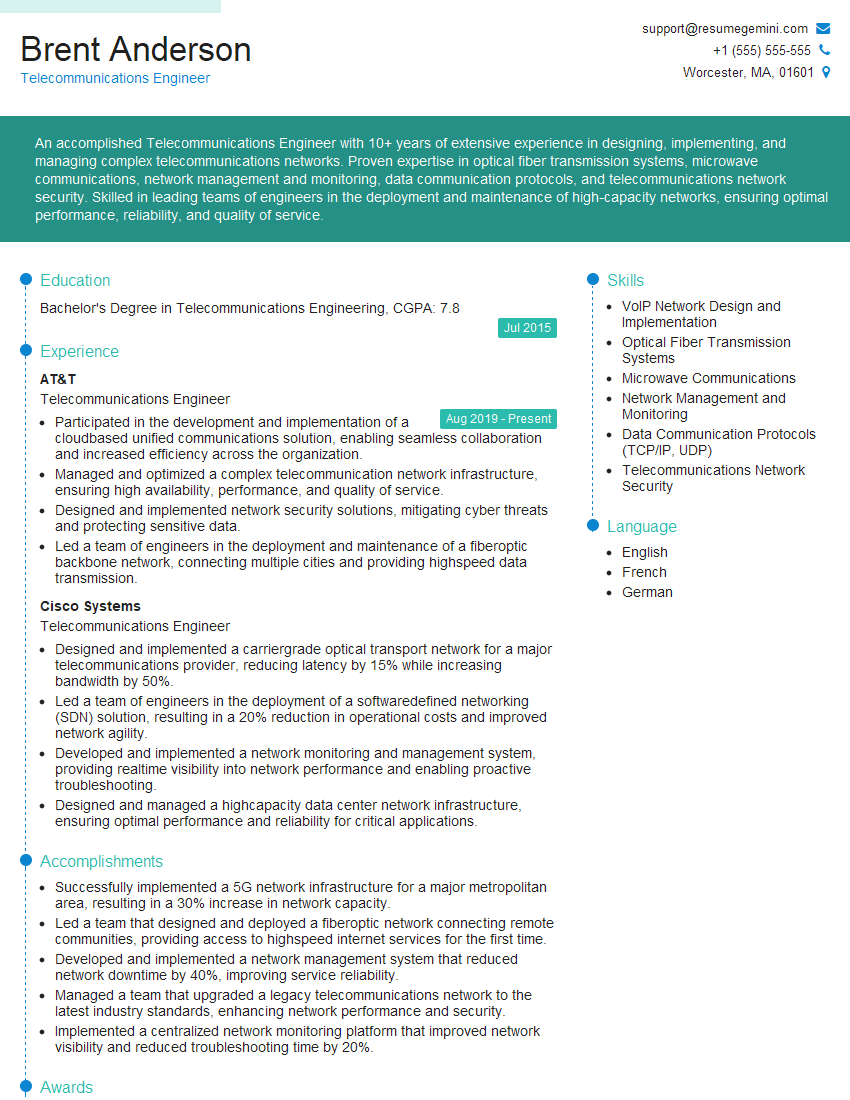
Mastering VoIP Network Design and Implementation opens doors to exciting career opportunities with significant growth potential. To maximize your chances of landing your ideal role, invest time in crafting a compelling resume that showcases your skills and experience effectively. An ATS-friendly resume is crucial for getting past Applicant Tracking Systems and into the hands of hiring managers.
ResumeGemini is a trusted resource that can help you build a professional, ATS-optimized resume that highlights your expertise in VoIP Network Design and Implementation. We offer examples of resumes tailored to this specific field to guide your process. Take the next step towards your dream career today!
Explore more articles
Users Rating of Our Blogs
Share Your Experience
We value your feedback! Please rate our content and share your thoughts (optional).
What Readers Say About Our Blog
Really detailed insights and content, thank you for writing this detailed article.
IT gave me an insight and words to use and be able to think of examples