Interviews are more than just a Q&A session—they’re a chance to prove your worth. This blog dives into essential Wallcovering installation and repair interview questions and expert tips to help you align your answers with what hiring managers are looking for. Start preparing to shine!
Questions Asked in Wallcovering installation and repair Interview
Q 1. What types of wallcovering materials are you experienced with (e.g., vinyl, fabric, grasscloth)?
My experience encompasses a wide range of wallcovering materials. I’m proficient with vinyl wallcoverings, which are popular for their durability and ease of cleaning. I also have extensive experience with fabric wallcoverings, offering a luxurious and textured finish, and I’m skilled in working with grasscloth, a natural fiber material known for its unique aesthetic. Each material presents its own unique challenges and requires a specific approach to installation. For instance, vinyl is relatively straightforward, while grasscloth demands more careful handling due to its delicate nature and susceptibility to tearing.
- Vinyl: Durable, washable, and comes in a huge variety of patterns and colors.
- Fabric: Offers a soft, luxurious feel, but requires more careful handling and cleaning.
- Grasscloth: Natural and elegant, but can be fragile and needs special preparation and application techniques.
Q 2. Describe your experience with surface preparation before wallcovering installation.
Surface preparation is the most crucial step in successful wallcovering installation – it’s the foundation for a flawless finish. Imagine building a house on a shaky foundation; the result wouldn’t be pretty! My process involves several key steps:
- Cleaning: Removing dust, dirt, cobwebs, and any loose paint or wallpaper is paramount. I use a slightly damp sponge or cloth for this, ensuring the walls are completely dry before proceeding.
- Repairing: Addressing any imperfections like holes, cracks, or dents is critical. I use spackle to fill these, sanding smooth once dry for a seamless surface.
- Priming: Applying a primer helps to seal the surface, ensuring the adhesive bonds properly and prevents the wall from absorbing moisture from the paste, which can cause bubbling or peeling. I choose a primer appropriate for the wall type and wallcovering material.
- Sealing: Especially important for porous surfaces like plaster, a sealer creates a barrier that prevents the wall from absorbing the wallpaper paste.
Proper surface preparation guarantees a smooth, even application and prevents future problems like peeling or bubbling.
Q 3. How do you measure and calculate the amount of wallcovering needed for a project?
Accurate measurement is essential to avoid costly material waste. My process involves:
- Measuring the Walls: I carefully measure the height and width of each wall, accounting for windows and doors. I usually add an extra 6 inches to the height and width to allow for trimming and pattern matching.
- Calculating the Total Area: I multiply the height and width of each wall to determine the square footage. I then add those figures together to get the total square footage to be covered.
- Accounting for Pattern Repeat: This is particularly crucial for patterned wallpaper. I measure the pattern repeat (the distance from the beginning of the pattern to its repetition) and incorporate this into my calculations to determine how much extra material I need for matching.
- Adding Waste: I always add extra to account for waste during cutting, matching, and potential errors. A 10-15% addition is usually sufficient, but it might be higher for complex patterns.
For example, if a wall is 10 feet high and 12 feet wide, and the pattern repeat is 24 inches, my calculation would consider this repeat, waste, and ensure enough material to fully cover the wall.
Q 4. What tools and equipment are essential for efficient wallcovering installation?
Having the right tools is key to efficient and professional wallcovering installation. My essential toolkit includes:
- Measuring Tape: Accurate measurements are paramount.
- Utility Knife/Razor Blade: For precise cutting.
- Seam Roller: To create a smooth, even seam.
- Paste Brush/Roller: For even application of adhesive.
- Smoothing Brush/Plastic Squeegee: To remove air bubbles and ensure proper adhesion.
- Plumb Bob and Level: To ensure straight vertical lines.
- Drop Cloths and Buckets: To protect the floor and hold paste.
- Step Ladder: For safe and easy access to higher areas.
- Scissors: Trimming excess material.
In addition to these hand tools, I may also use a paste machine for larger projects to save time and ensure even paste application.
Q 5. Explain your process for matching patterns in wallcovering.
Matching patterns is an art form requiring patience and precision. My process begins with carefully examining the pattern repeat on the roll. I then:
- Measure the Pattern Repeat: As mentioned before, accurately measuring the pattern repeat is vital.
- Pre-Paste and Book the Paper: This allows the paper to relax and prevents it from shrinking or stretching during hanging, crucial for accurate pattern matching.
- Cut and Arrange Strips: I cut the strips while keeping the pattern alignment in mind. I often lay them out on the floor to visualize the pattern match before application.
- Hang Strips Accurately: Once the first strip is hung correctly, subsequent strips need to perfectly align with the pattern of the first, using the pre-measured repeat to guide placement.
- Trim Excess Material: After hanging, carefully trim away excess wallpaper along ceilings, floors, and corners.
Working with complex patterns often requires careful planning and even using a pattern matching guide. It takes practice and attention to detail but a good pattern match can significantly enhance the overall look.
Q 6. How do you handle seams and ensure a seamless finish?
Seamless seams are a hallmark of professional wallcovering installation. My approach involves:
- Precise Cutting: Ensure the edges of the wallpaper strips are perfectly aligned before hanging.
- Even Paste Application: Applying an even layer of paste prevents one side from sticking more than the other, which leads to uneven seams.
- Careful Alignment: Precisely align the edges of the strips before pressing them firmly together.
- Seam Rolling: Using a seam roller firmly but gently removes air bubbles and creates a strong bond between the strips, eliminating visible seams.
- Finishing Touches: Inspect the seams carefully after rolling. If any imperfections are found, I lightly dampen the seam to readjust before it sets.
The goal is to create an almost invisible seam – a testament to the skill and precision involved in the process. It requires practice and an understanding of the wallpaper’s properties.
Q 7. What are the common challenges you face during wallcovering installation, and how do you overcome them?
Challenges are inevitable, but experience helps to address them effectively. Some common problems I encounter are:
- Uneven Walls: This can make it challenging to achieve a smooth finish. I address this by carefully preparing the surface, using a primer to fill small imperfections, and working in sections to ensure proper adhesion.
- Difficult-to-Match Patterns: Requires patience, careful planning, and sometimes a bit of creative problem-solving. A pattern matching guide is extremely helpful.
- Wallpaper Stretching or Shrinking: Proper pre-pasting and booking of the wallpaper minimize this, ensuring the wallpaper remains consistent.
- Seams Not Adhering: Usually due to uneven paste application or air bubbles trapped underneath. Using a seam roller and carefully removing any trapped air are vital steps to resolve this.
- Bubbling: Often caused by inadequate surface preparation or insufficient paste. Priming, using the correct amount of paste, and gently smoothing out any air bubbles are crucial steps.
Problem-solving is a large part of my job. By understanding the root cause and employing the appropriate techniques, I can address these challenges and deliver excellent results.
Q 8. Describe your experience with different types of adhesives and their application.
Choosing the right adhesive is crucial for a successful wallcovering installation. My experience spans a wide range of adhesives, each suited to different wallcoverings and substrates. For example, I use pre-pasted adhesives for vinyl wallcoverings – these are convenient because the paste is already applied to the back of the wallpaper. Simply activate it with water according to the manufacturer’s instructions. For heavier materials like fabric or grasscloth, I rely on heavy-duty, paste-the-wall adhesives, which provide superior adhesion and strength. These require mixing the paste according to the instructions and applying it to the wall. Clear adhesives are excellent for delicate papers or where minimal paste show is desired. Each adhesive has a different open time (how long it remains workable before setting), so understanding this is critical to efficient and accurate hanging. I also meticulously check the manufacturer’s recommendations for both the adhesive and the wallcovering before starting any project to ensure compatibility and avoid problems like bubbling or peeling.
I always consider the substrate as well. For smooth, finished drywall, a standard adhesive will typically suffice. However, textured walls or surfaces like plaster often necessitate a heavier-duty adhesive to ensure a secure bond. Lastly, proper application involves using a smoothing tool to eliminate air bubbles and ensure even adhesion, working from the center outward to avoid wrinkles and creases.
Q 9. How do you prepare corners and difficult areas for wallcovering?
Corners and difficult areas require meticulous preparation to achieve a professional finish. For inside corners, I carefully measure and cut the wallpaper to fit, overlapping slightly on each wall. A sharp utility knife ensures clean cuts and precise alignment. I then firmly press the wallpaper into the corner, using a seam roller to smooth out any wrinkles or air bubbles. For outside corners, I use the ‘butt joint’ method. This involves precisely measuring and cutting two separate pieces to meet neatly at the corner, rather than wrapping the wallpaper around it, minimizing bulk and creating a sharper, cleaner look. This technique requires patience and precision.
Around windows and door frames, I measure carefully and make precise cuts, using a sharp knife or scissors to follow the contours. I use a flexible measuring tape and a pencil to mark out the cuts, creating clean, professional-looking edges. Often I’ll pre-cut the wallpaper to precisely fit the openings for a clean edge rather than attempting to wrap around them.
For extremely difficult areas or unusual shapes, I utilize templates. A simple template – a piece of cardboard or similar material cut to the exact shape of the area – greatly improves the accuracy of cutting and positioning the wallpaper. This ensures a perfect fit every time.
Q 10. What is your process for cleaning up after a wallcovering installation?
Clean-up is an essential part of my process and reflects professionalism. I start by removing any excess adhesive immediately using a damp sponge. For more stubborn adhesive, I might use a specialized adhesive remover. I also carefully remove any dropped scraps of wallpaper, ensuring the work area is completely clear of debris. For paste-the-wall adhesives, cleaning involves thoroughly wiping down the walls and any nearby surfaces, making sure to remove all traces of adhesive before it dries. Protecting flooring is key; I cover floors with drop cloths to avoid damage and messy clean up after the job is finished. Finally, I take extra care to clean and dispose of any tools and materials properly and responsibly.
Q 11. How do you repair minor wallcovering damage (e.g., tears, bubbles)?
Minor repairs are often straightforward. For small tears, I carefully lift the edges of the tear, apply a small amount of matching adhesive underneath, gently press the edges together, and smooth out any wrinkles or air bubbles using a soft cloth. This technique usually requires a small amount of matching wallpaper to fill the tear if the tear is significant enough. For small bubbles, I carefully pierce the bubble with a pin and gently press the air out from under the wallpaper. If the bubble is large, I might carefully lift a section of the wallpaper, apply more adhesive underneath, and re-adhere it. For seams that have come apart, I clean the area with a damp cloth and use a seam roller to re-adhere the seam. Matching the color and pattern is key to making these repairs inconspicuous; sometimes replacing a small section is a better approach than a patch if pattern matching is a concern.
Q 12. Describe your experience with removing old wallcovering.
Removing old wallcovering is often the most challenging part of the job, and requires careful consideration. The type of wallcovering plays a significant role in how I approach the process. For vinyl wallcovering, I usually start by scoring the surface with a scoring tool to help penetrate the layers. Then, I use a spray bottle to saturate the wallcovering with water and a specialized wallpaper remover solution. This allows the glue to soften and makes the removal easier. I let it soak for some time to penetrate thoroughly before using a scraper to gently peel off the layers. Multiple applications of water and remover may be necessary. For non-vinyl wallcovering, the process might be more straightforward; however, sometimes a steamer is needed to loosen the adhesive. I always protect the underlying wall from damage by using a wide putty knife or scraper to minimize scraping the drywall.
After the wallcovering is removed, I carefully clean the wall to remove any residual adhesive. A scraper can be used to remove stubborn adhesive, followed by rinsing and cleaning with a damp sponge or cloth. I am always aware of protecting the wall from damage during the removal process. Once the wall is clean and dry, I can then proceed with preparing the surface for the new wallcovering.
Q 13. What safety precautions do you take during wallcovering installation and repair?
Safety is paramount in my work. I always wear appropriate personal protective equipment (PPE), including safety glasses to protect my eyes from debris, and gloves to protect my hands from chemicals. When using a scoring tool or scraper, I take care to avoid cutting myself. I also ensure adequate ventilation, particularly when working with chemical removers or adhesives. A well-ventilated work environment is crucial for minimizing the inhalation of hazardous fumes and dust. I work on stable surfaces to avoid falls or slips, and am very careful with ladders if elevated work is necessary. Proper disposal of waste materials, including adhesive containers and wallcovering scraps, is also part of my safety routine, following all local environmental regulations. I always make sure to have a fully charged phone and a first aid kit available should an emergency occur.
Q 14. How do you handle customer complaints or unexpected issues on the job?
Handling customer complaints or unexpected issues professionally and efficiently is crucial. I always actively listen to the customer’s concerns, validating their feelings and ensuring they feel heard. My first step is to thoroughly assess the situation, identifying the root cause of the problem. This might involve re-examining the installation process, checking the quality of materials, or investigating any unforeseen circumstances. Once I understand the issue, I develop a plan of action to resolve it promptly and effectively. This might involve repairing damaged areas, replacing faulty materials, or offering a partial or full refund depending on the severity of the issue.
Open communication is key. I keep the customer informed every step of the way, providing updates and explaining the steps I’m taking to resolve the problem. I strive to find a solution that satisfies the customer and maintains a positive working relationship. My goal is to turn a negative experience into a positive one, demonstrating my commitment to customer satisfaction and professionalism. In the unlikely event that I am unable to resolve the issue satisfactorily myself, I have colleagues and industry resources I can draw on for support and advice.
Q 15. What is your experience with different types of wall surfaces (e.g., drywall, plaster)?
My experience encompasses a wide range of wall surfaces, and understanding their nuances is crucial for successful wallcovering installation. Drywall, the most common type, requires careful preparation, including patching any imperfections and ensuring a smooth, primed surface. Plaster walls, while more traditional, present a different set of challenges. They can be more susceptible to cracking and require extra attention to ensure proper adhesion. I’ve worked with various plaster types, from smooth Venetian plaster to textured finishes, each needing a specific approach to ensure the wallpaper adheres correctly and looks its best. For instance, highly textured plaster might necessitate a stronger adhesive or a specialized primer. Other surfaces I’ve encountered include concrete, paneling, and even brick, each requiring its own unique preparation and installation techniques.
- Drywall: Requires priming and filling imperfections for a smooth base.
- Plaster: Needs assessment for cracks and appropriate primer/adhesive selection.
- Other surfaces: Concrete, paneling, and brick require specialized techniques and often additional prep work.
Career Expert Tips:
- Ace those interviews! Prepare effectively by reviewing the Top 50 Most Common Interview Questions on ResumeGemini.
- Navigate your job search with confidence! Explore a wide range of Career Tips on ResumeGemini. Learn about common challenges and recommendations to overcome them.
- Craft the perfect resume! Master the Art of Resume Writing with ResumeGemini’s guide. Showcase your unique qualifications and achievements effectively.
- Don’t miss out on holiday savings! Build your dream resume with ResumeGemini’s ATS optimized templates.
Q 16. Explain your understanding of industry standards and building codes related to wallcovering.
Adhering to industry standards and building codes is paramount in my work. This ensures safety, quality, and longevity of the installation. Key aspects include proper surface preparation, using appropriate adhesives for the wallcovering and substrate, and ensuring correct ventilation to prevent mold and mildew growth. For instance, the International Code Council (ICC) provides guidelines on fire-resistant materials, which I meticulously follow when working with commercial spaces or in areas requiring specific fire safety measures. I regularly update my knowledge to stay current on the latest standards and regulations to ensure all projects meet the highest level of quality and safety.
- Fire Safety Codes: Using appropriate fire-resistant materials when required.
- Adhesive Selection: Choosing adhesives based on the wallcovering and substrate type.
- Ventilation: Ensuring proper ventilation to prevent mold and mildew growth.
Q 17. How do you ensure the longevity and durability of your wallcovering installations?
Longevity and durability of my installations begin with meticulous surface preparation. This involves thorough cleaning, repairing imperfections, and applying appropriate primers. The selection of high-quality wallcovering and adhesive is critical. I always use reputable brands known for their durability and resistance to fading, tearing, and moisture damage. Proper installation techniques, such as precise matching of patterns and careful smoothing to eliminate air bubbles, further contribute to the longevity of the installation. Finally, I always advise clients on post-installation care, emphasizing gentle cleaning methods to prevent damage. Think of it like building a house – a strong foundation (surface prep), quality materials (wallcovering & adhesive), and skilled craftsmanship (installation) are all essential for a lasting outcome.
Q 18. Describe your experience with working with different types of wallpaper paste.
My experience with wallpaper paste spans various types, each with its own properties and applications. I’ve worked extensively with pre-mixed pastes for their convenience and consistent performance, particularly for vinyl wallcoverings. For more delicate papers, like grass cloth or silk, I prefer using powdered pastes, which offer a more controlled application and allow me to adjust the consistency based on the paper’s requirements. I also have experience with specialized adhesives for textured wallcoverings and difficult surfaces. Choosing the right paste is like choosing the right paint; the wrong one can lead to disastrous results. Understanding the characteristics of each paste and how they interact with different wallcoverings is crucial for a successful installation.
- Pre-mixed Pastes: Convenient and suitable for many wallcovering types.
- Powdered Pastes: Offer more control and are ideal for delicate papers.
- Specialized Adhesives: Necessary for textured wallcoverings and challenging surfaces.
Q 19. Have you worked with textured wallcoverings? Describe your experience.
Textured wallcoverings add depth and visual interest, but they require specialized techniques for successful installation. I’ve worked with a variety of textures, from subtle embossed patterns to heavily textured grass cloths and fabrics. The key here is to understand how the texture affects the application of the paste and the way the wallcovering drapes. Often, it requires more paste and careful smoothing to ensure the texture is evenly distributed and the paper adheres properly without tearing or showing gaps. For instance, installing a heavily textured grass cloth demands extra care to avoid stretching or damaging the material during the process. It’s a more demanding but ultimately rewarding process.
Q 20. What’s your experience with using a plumb bob or laser level for accurate installation?
Accuracy is paramount in wallcovering, and a plumb bob or laser level is indispensable for ensuring perfectly straight seams and a professional finish. I utilize both tools depending on the project’s scale and complexity. A plumb bob is great for smaller jobs, while a laser level provides superior accuracy and efficiency for large areas. Establishing a perfectly vertical or horizontal starting line using these tools ensures that subsequent panels align seamlessly, leading to a much more refined and pleasing aesthetic outcome. Imagine trying to hang pictures without a level; the result would be uneven and unprofessional. The same principle applies to wallcovering.
Q 21. How do you manage your time and prioritize tasks during a large-scale wallcovering project?
Managing time and priorities on large-scale projects requires a systematic approach. Before starting, I create a detailed schedule that breaks the project into manageable phases, including surface preparation, measuring, cutting, and installation. This involves careful assessment of the space and materials needed. I meticulously track my progress against the schedule, adjusting as needed based on unforeseen circumstances. Effective communication with the client and my team ensures everyone is informed about the progress and any potential delays. Prioritization involves focusing on critical path tasks – those that directly impact the project’s timeline. This methodical approach minimizes disruptions and ensures timely project completion.
Q 22. Describe your experience working as part of a team in wallcovering installations.
Teamwork is crucial in wallcovering installation, especially for large projects. My experience involves coordinating with other installers to efficiently manage tasks such as measuring, prepping walls, cutting and hanging wallpaper, and cleaning up. For example, on a recent hotel lobby project, we had a team of four: one focused on surface preparation, two on hanging, and one on finishing touches and cleanup. This division of labor ensured a smooth, fast, and high-quality result. Effective communication, clear roles, and mutual respect are key to successful collaboration. We consistently used a checklist to ensure no step was missed and to maintain quality control throughout the project.
Q 23. What are some common mistakes to avoid when installing wallcovering?
Many mistakes can be avoided with careful planning and execution. Common pitfalls include:
- Improper surface preparation: Failing to properly clean, repair, and prime the walls leads to poor adhesion and bubbling. Think of it like painting – you wouldn’t paint over a dirty, cracked wall.
- Incorrect measurement and cutting: Inaccurate measurements result in wasted material and mismatched patterns. Double-checking measurements and carefully planning the layout are essential.
- Uneven application of adhesive: Applying too much or too little adhesive leads to either bubbling or poor adhesion. Consistent application is key.
- Air bubbles: Not properly smoothing out air bubbles during installation leads to unsightly blemishes. Using a smoothing tool and taking your time is crucial.
- Ignoring seams: Seams that are not properly matched or hidden detract from the professional look. Overlapping slightly and using a seam roller are important.
Q 24. How do you handle uneven walls or surfaces before installing wallcovering?
Uneven walls are a common challenge. My approach involves a multi-step process:
- Assessment: I thoroughly assess the wall’s imperfections, noting the extent of unevenness and any major damage.
- Repair: I repair major imperfections such as holes and cracks using appropriate fillers and allow ample drying time before sanding smooth.
- Skimming: For minor imperfections, I might skim-coat the entire wall with joint compound, creating a smoother surface. This is like giving the wall a thin layer of makeup.
- Sanding: After the filler or skim coat dries, I meticulously sand the wall until it’s smooth and even.
- Priming: Finally, I apply a high-quality primer to seal the wall, ensuring good adhesion for the wallcovering.
This detailed process ensures a flawless final product, preventing the wallcovering from highlighting the imperfections.
Q 25. What is your approach to ensuring a professional and clean finish on the edges and corners?
Achieving a professional finish at edges and corners requires precision and attention to detail. I use several techniques:
- Sharp cutting: Using a sharp utility knife ensures clean, straight cuts, preventing frayed edges.
- Precise mitering: For corners, I carefully miter the edges of the wallpaper, creating a seamless join. This involves cutting the edges at a 45-degree angle, ensuring a perfect fit.
- Seam rolling: A seam roller is used to firmly press down the edges and seams, ensuring a secure bond and preventing air bubbles.
- Caulk: In some cases, particularly with vinyl wallpapers, I might use a paintable caulk to fill any gaps between the wallcovering and the wall or trim, giving a neat finish.
It’s like framing a beautiful picture; the edges must be as perfect as the main body.
Q 26. Describe your experience with different types of wallpaper borders.
I’ve worked with a wide variety of wallpaper borders, from simple self-adhesive strips to more intricate hand-painted designs. The materials range from vinyl and paper to fabric and metallic accents. My experience extends to installing borders above chair rails, along ceilings, and as standalone decorative elements. I consider the overall design scheme and the client’s preferences when selecting and installing borders, ensuring they complement the main wallpaper and the room’s decor. For example, a delicate floral border might pair well with a subtle patterned wallpaper, while a bold geometric border might complement a more modern design. Careful measurement and precision cutting are essential, especially with more elaborate designs.
Q 27. What methods do you use to ensure the proper drying time of the adhesive?
Proper drying time is essential for optimal adhesion and to prevent bubbling. I follow the manufacturer’s instructions on the specific adhesive used, as drying times vary based on the type of wallpaper and adhesive. Generally, I avoid touching the newly installed wallpaper for at least a few hours, allowing sufficient time for the adhesive to set. In humid environments, I might allow for a longer drying time. I also ensure proper ventilation in the room, as high humidity can slow the drying process and even affect the adhesive’s performance. For paste-the-wall applications, I allow enough time between coats for the paste to hydrate the wallcovering before hanging.
Q 28. How do you maintain a safe and clean work environment during wallcovering installation?
Safety and cleanliness are paramount. I always use appropriate personal protective equipment (PPE), including gloves, eye protection, and a dust mask, especially when working with adhesives or sanding. I protect floors and furniture with drop cloths and carefully manage waste materials by disposing of them responsibly. Tools are cleaned and stored neatly at the end of each work day. Spills are cleaned immediately, and I’m mindful of keeping work areas clear of clutter to prevent accidents. Maintaining a clean and orderly work environment not only ensures safety but also contributes to a more efficient and productive workflow. It’s about leaving a room better than I found it, both aesthetically and in terms of safety.
Key Topics to Learn for Wallcovering Installation and Repair Interview
- Surface Preparation: Understanding different wall types (drywall, plaster, etc.), identifying and addressing surface imperfections (cracks, holes), proper cleaning and priming techniques for optimal adhesion.
- Measuring and Cutting: Accurate measurement of walls and calculating material needs, efficient cutting techniques for various wallcovering patterns (straight match, drop match, etc.), minimizing waste and ensuring pattern alignment.
- Installation Methods: Proficiency in applying various wallcovering types (vinyl, fabric, wallpaper), understanding paste application methods (pre-pasted, paste-the-wall), proper hanging techniques to avoid bubbling, wrinkling, or seams showing.
- Seam Matching and Repair: Mastering precise seam alignment, techniques for repairing minor tears or imperfections, understanding how to blend repairs seamlessly with existing wallcovering.
- Troubleshooting and Problem-Solving: Identifying and resolving common installation issues (air bubbles, loose seams, pattern misalignment), understanding the causes of adhesion problems, and implementing effective solutions.
- Tools and Equipment: Familiarity with essential tools (measuring tapes, utility knives, smoothing brushes, seam rollers), understanding their proper use and maintenance, and knowing safety procedures related to their operation.
- Health and Safety: Adherence to safety regulations regarding the use of adhesives and solvents, proper handling of sharp tools, and maintaining a clean and organized workspace.
- Estimating and Budgeting: Accurately estimating project costs based on material needs and labor hours, creating detailed project budgets for clients.
Next Steps
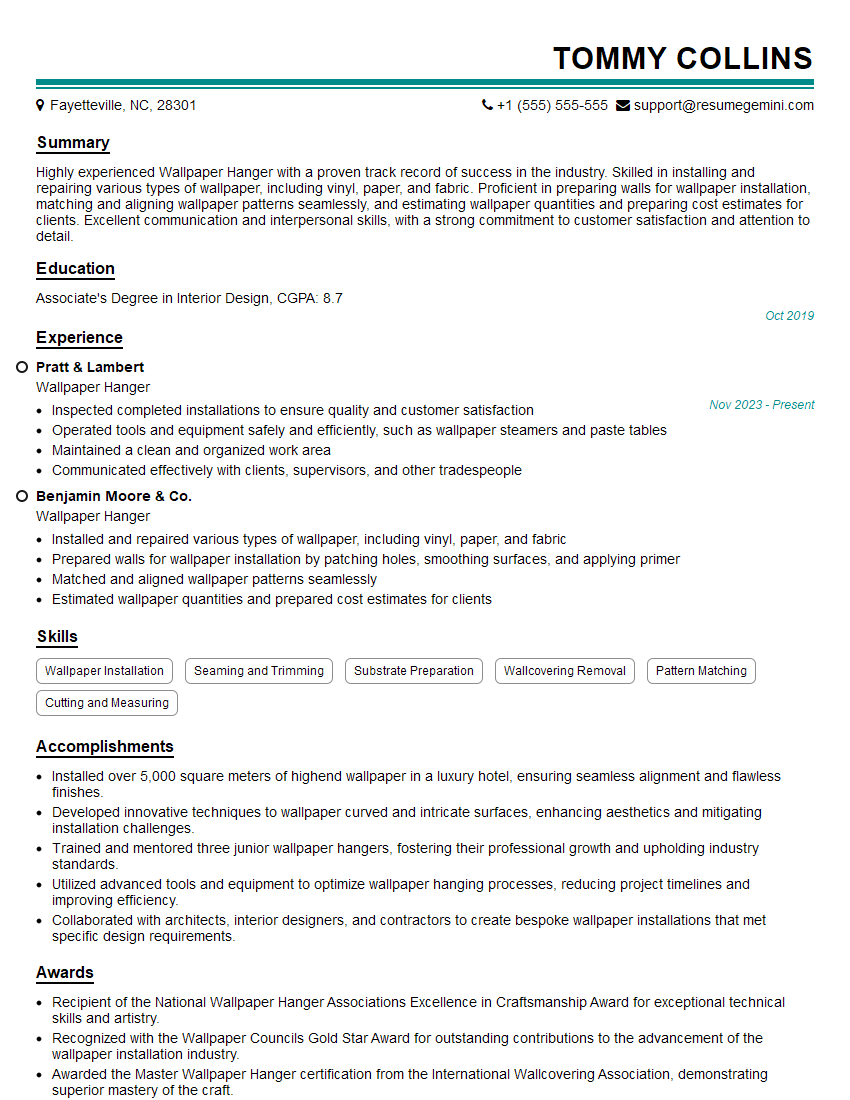
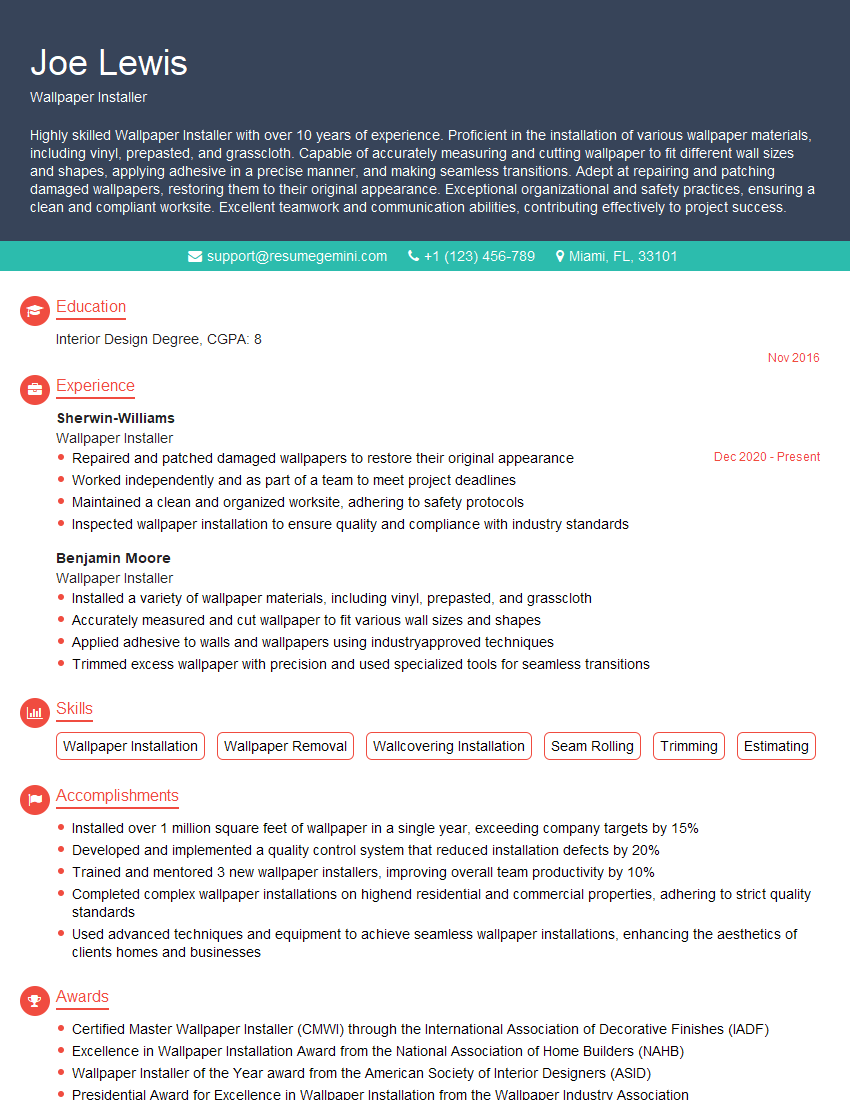
Mastering wallcovering installation and repair opens doors to a rewarding career with opportunities for advancement, from independent contractor to team leader or even project management. A strong resume is crucial to showcasing your skills and experience. To increase your chances of landing your dream job, creating an Applicant Tracking System (ATS)-friendly resume is essential. ResumeGemini is a trusted resource to help you build a professional and impactful resume that highlights your abilities effectively. Examples of resumes tailored to wallcovering installation and repair are available to guide you.
Explore more articles
Users Rating of Our Blogs
Share Your Experience
We value your feedback! Please rate our content and share your thoughts (optional).
What Readers Say About Our Blog
Really detailed insights and content, thank you for writing this detailed article.
IT gave me an insight and words to use and be able to think of examples