Unlock your full potential by mastering the most common Weld Engineering interview questions. This blog offers a deep dive into the critical topics, ensuring you’re not only prepared to answer but to excel. With these insights, you’ll approach your interview with clarity and confidence.
Questions Asked in Weld Engineering Interview
Q 1. Explain the difference between GMAW and GTAW welding processes.
GMAW, or Gas Metal Arc Welding, and GTAW, or Gas Tungsten Arc Welding, are both arc welding processes, but they differ significantly in their methods and applications. Think of it like this: GMAW is like using a spray paint can – fast and efficient for covering large areas – while GTAW is more like using a fine-tipped paintbrush – precise and ideal for detailed work.
- GMAW (MIG): Uses a consumable electrode (wire) fed continuously into the weld pool. A shielding gas (usually CO2 or a mixture of argon and CO2) protects the weld from atmospheric contamination. It’s known for its high deposition rate, making it suitable for mass production and large-scale projects. It’s relatively easy to learn and can be automated.
- GTAW (TIG): Employs a non-consumable tungsten electrode to create the arc. A shielding gas (usually argon or helium) protects the weld. A separate filler metal rod is often used. GTAW produces high-quality welds with excellent penetration and control, making it ideal for critical applications like aerospace and nuclear power. However, it’s generally slower and requires more skill.
In short, GMAW prioritizes speed and efficiency, while GTAW prioritizes precision and weld quality. The choice between the two depends heavily on the application, material, and desired outcome.
Q 2. Describe the various types of weld defects and their causes.
Weld defects are imperfections that compromise the integrity and performance of a weld. These can range from minor cosmetic issues to critical flaws that lead to failure. Understanding their causes is vital for preventative measures.
- Porosity: Small holes or voids within the weld metal, often caused by gases trapped during solidification. Causes include poor shielding gas coverage, moisture in the filler metal, or insufficient cleaning of the base metal.
- Inclusion: Foreign materials embedded in the weld, like slag (from flux) or oxides. This can happen due to improper cleaning of the joint before welding or inadequate flux removal.
- Undercut: A groove melted into the base metal at the edge of the weld, weakening the joint. It’s usually caused by excessive current, improper travel speed, or incorrect electrode angle.
- Cracks: Breaks or fissures within the weld metal or the heat-affected zone (HAZ). These can stem from high stresses during cooling, hydrogen embrittlement (hydrogen absorbed during welding), or improper preheating.
- Lack of Fusion: Incomplete bonding between the weld metal and the base metal. Insufficient heat input or improper joint preparation are common culprits.
- Lack of Penetration: Insufficient weld metal penetration into the joint, resulting in a weak connection. This can be caused by insufficient current, incorrect travel speed, or improper joint design.
Identifying and understanding the root causes of these defects is crucial for implementing corrective actions and ensuring consistent weld quality.
Q 3. What are the common non-destructive testing (NDT) methods used in welding?
Non-destructive testing (NDT) methods are crucial for evaluating the integrity of welds without damaging the component. Several techniques are commonly used:
- Visual Inspection (VT): The simplest method, involving visual examination of the weld for surface defects. It’s often the first step in any NDT process.
- Radiographic Testing (RT): Uses X-rays or gamma rays to detect internal flaws like porosity, cracks, and inclusions. It provides a permanent record of the inspection.
- Ultrasonic Testing (UT): Employs high-frequency sound waves to detect internal flaws. It’s particularly useful for detecting cracks and other discontinuities.
- Magnetic Particle Testing (MT): Used for ferromagnetic materials, it applies a magnetic field and iron particles to reveal surface and near-surface cracks.
- Dye Penetrant Testing (PT): A liquid penetrant is applied to the surface, revealing cracks and other surface-breaking defects by capillary action.
The choice of NDT method depends on the type of weld, the material being inspected, and the specific defects being sought.
Q 4. Explain the importance of pre-heating and post-heating in welding.
Preheating and post-heating are thermal treatments applied before and after welding, respectively, to improve weld quality and prevent defects. They’re particularly important for materials susceptible to cracking or distortion.
- Preheating: Reduces the cooling rate, mitigating the risk of cracking due to rapid thermal changes. This is especially important for high-carbon steels or materials with high hydrogen content.
- Post-heating: Reduces residual stresses that build up during welding, thereby lowering the likelihood of cracking. It can also improve the toughness and ductility of the weld.
The specific preheat and post-heat temperatures depend on the material, thickness, and welding process. They’re often specified in welding procedure specifications (WPS).
Imagine preheating as gently warming the metal before applying intense heat from welding – this helps to prevent sudden temperature shocks. Post-heating is like slowly cooling the metal afterwards, allowing it to relax and reduce the internal stresses which could otherwise cause cracks.
Q 5. What are the different types of weld joints and their applications?
Weld joints refer to the way the base metal pieces are joined. Different joints offer varying strengths and applications.
- Butt Joint: The edges of the base metals are butted together, creating a simple, strong joint suitable for many applications.
- Lap Joint: One piece of metal overlaps another. It’s easier to weld than a butt joint but may be less strong.
- T-Joint: One piece of metal is welded perpendicular to another, forming a ‘T’ shape. Common in structural and pipe welding.
- Corner Joint: Two pieces of metal are joined at a corner. Often used in box-shaped structures.
- Edge Joint: The edges of two plates are welded together.
The selection of the appropriate weld joint depends on the design requirements, accessibility for welding, and the desired strength and performance of the final structure.
Q 6. How do you determine the appropriate welding parameters (voltage, current, travel speed) for a given material and process?
Determining the appropriate welding parameters is crucial for achieving sound welds. It’s a combination of art and science, often guided by experience and WPS.
Factors considered include:
- Material Type: Different materials require different heat inputs and welding currents. Stainless steel, for instance, needs lower heat input compared to mild steel.
- Thickness of Material: Thicker materials require higher current and heat input to ensure complete penetration.
- Welding Process: GMAW and GTAW, for example, have different optimal parameter ranges.
- Joint Design: The geometry of the joint significantly impacts the necessary parameters.
A WPS typically provides a range of acceptable parameters. However, fine-tuning is often needed based on practical observations during welding. Factors like arc length and travel speed also interact with voltage and current to affect the weld outcome. Experience and understanding of the interplay of these parameters are key to success.
Often, welders begin with recommended values from a WPS and then adjust based on visual inspection of the weld bead. Things like bead width, penetration, and overall appearance serve as important feedback mechanisms.
Q 7. Describe the principles of weldability.
Weldability refers to the ease with which a material can be welded to produce a sound weld. It encompasses several factors:
- Melting Point and Thermal Conductivity: Materials with high melting points and low thermal conductivity are more challenging to weld, requiring higher heat inputs.
- Susceptibility to Cracking: Some materials, particularly high-carbon steels, are prone to cracking during welding due to stress and hydrogen embrittlement.
- Metallurgical Transformations: Phase changes during heating and cooling can affect the weld’s microstructure and properties.
- Oxidation and Contamination: Materials that readily oxidize or are susceptible to contamination during welding can experience reduced weld quality.
Understanding a material’s weldability is vital for selecting the appropriate welding process, parameters, and pre/post-heat treatments. Extensive material data sheets are consulted to assess weldability and avoid issues such as cracking or embrittlement.
Q 8. Explain the role of shielding gas in various welding processes.
Shielding gas plays a crucial role in various welding processes, primarily by protecting the molten weld pool from atmospheric contamination. Atmospheric gases like oxygen and nitrogen can react with the molten metal, causing undesirable effects such as porosity (small holes in the weld), embrittlement (making the weld more brittle), and reduced weld strength. The shielding gas forms a protective blanket around the weld, preventing these reactions and ensuring a sound, high-quality weld.
- GMAW (Gas Metal Arc Welding): Common shielding gases include Argon (Ar), Helium (He), Carbon Dioxide (CO2), and mixtures thereof. Argon provides excellent arc stability and produces clean welds, while CO2 is more cost-effective but can lead to slightly more spatter.
- GTAW (Gas Tungsten Arc Welding): Argon is the most commonly used shielding gas in GTAW due to its inert nature and ability to maintain a stable arc. Helium can also be used, offering deeper penetration but at a higher cost.
- SMAW (Shielded Metal Arc Welding): The flux coating on the electrode provides the shielding gas in SMAW, so an external shielding gas is not typically required.
Choosing the right shielding gas is critical; the selection depends on factors like the base metal, the welding process, and the desired weld quality. For instance, a stainless steel weld might require 100% Argon to prevent oxidation, while a mild steel weld might utilize a CO2-Ar mixture for better penetration and cost-effectiveness. Incorrect gas selection can result in significant weld defects.
Q 9. What are the safety precautions you need to take while performing welding operations?
Welding presents many potential hazards, so safety is paramount. Precautions must be taken to protect against:
- Eye and Face Protection: Always wear a welding helmet with appropriate shade lenses to protect against intense ultraviolet and infrared radiation from the arc. The shade number depends on the welding process and current.
- Respiratory Protection: Welding fumes can contain hazardous particles and gases. A respirator with appropriate filters is crucial, especially in confined spaces or when welding materials containing toxic substances.
- Skin Protection: Wear protective clothing such as gloves, long sleeves, and a flame-resistant apron to prevent burns from sparks and spatter. Proper footwear is also important to protect against falling objects.
- Fire Prevention: Ensure a fire extinguisher is readily available and that flammable materials are kept well away from the welding area. A fire watch is often necessary for large-scale welding operations.
- Electrical Hazards: Be aware of potential electrical shocks, especially when using arc welding equipment. Ensure proper grounding and insulation.
- Confined Spaces: Welding in confined spaces requires extra precautions due to the risk of fume accumulation and oxygen depletion. Proper ventilation is critical, and a safety observer should be present.
Regular safety training and adherence to established safety procedures are essential to minimize risks and ensure a safe working environment.
Q 10. What is the significance of a Welding Procedure Specification (WPS)?
A Welding Procedure Specification (WPS) is a documented set of parameters that define how a specific weld should be performed to consistently achieve the required quality. It’s a crucial document in ensuring weld integrity and repeatability. Think of it as a recipe for a perfect weld. It eliminates guesswork and ensures that every weld made following the WPS meets the necessary standards.
A WPS typically includes details such as:
- Base metal specifications: Type, thickness, and chemical composition.
- Welding process: e.g., GMAW, GTAW, SMAW.
- Welding consumables: Electrodes, filler wires, and shielding gases.
- Welding parameters: Current, voltage, travel speed, preheat, and post-weld heat treatment.
- Joint design: Type of joint, root opening, and bevel angles.
- Qualification requirements: Tests required to validate the WPS (e.g., bend tests, tensile tests).
The WPS ensures consistency and quality control in welding. Using a validated WPS reduces the risk of weld defects and improves overall project reliability. Non-compliance can lead to significant safety and economic implications.
Q 11. How do you interpret a welding symbol?
Welding symbols are a standardized way to represent welding requirements on engineering drawings. They’re concise and unambiguous, conveying all necessary information to the welder without lengthy descriptions. Understanding them is crucial for accurate weld fabrication.
A welding symbol typically consists of several elements placed on a reference line:
- Reference Line: The horizontal line upon which the symbol is placed.
- Arrow Side: The side of the reference line indicating which part of the joint receives the weld.
- Other Side: The opposite side of the reference line, showing if a weld is required on the other side as well.
- Basic Weld Symbol: Indicates the type of weld (e.g., fillet, groove, spot).
- Dimension and other details: These may include leg size, weld size, length, and any special requirements (e.g., preheating).
For example, a symbol showing a fillet weld with a leg size of 6mm on the arrow side would indicate the welder must create a fillet weld with a 6mm leg size on that specific part of the joint. Mastering welding symbol interpretation is vital for ensuring that the welder executes the design intent correctly.
Q 12. Explain the different types of weld metal transfer modes in GMAW.
In Gas Metal Arc Welding (GMAW), the transfer of weld metal from the electrode to the weld pool occurs in various modes, each having distinct characteristics impacting weld quality and appearance:
- Short-Circuiting Transfer: This mode uses a low voltage and high current, causing the electrode to repeatedly contact and short-circuit with the workpiece. It produces fine, spatter-free welds suitable for thin materials and out-of-position welding. The sound is a characteristic crackling or spitting.
- Globular Transfer: In this mode, large drops of molten metal are transferred to the weld pool, often producing spatter and a less visually appealing weld. Globular transfer is often observed when using higher voltages and lower currents with solid wires and less active shielding gases.
- Spray Transfer: This mode uses a high voltage and current to transfer small, uniform droplets of molten metal across the arc, producing high-quality welds with minimal spatter. This is generally ideal for thicker materials. The arc is usually smooth and consistent.
- Pulse Transfer: This mode combines aspects of short-circuiting and spray transfer. It applies short bursts of higher current pulses superimposed on a lower background current, offering the benefits of both methods – low spatter and deep penetration. Control is important to avoid excessive spatter.
The choice of transfer mode depends on factors such as the base metal thickness, the joint design, and the desired weld quality. Understanding the characteristics of each transfer mode is crucial for selecting the optimal settings and achieving the best possible results.
Q 13. Describe the process of creating a Welding Procedure Qualification Record (WPQR).
A Welding Procedure Qualification Record (WPQR) is a document demonstrating that a specific Welding Procedure Specification (WPS) produces welds that meet the required quality standards. It’s the proof that the ‘recipe’ (WPS) works as intended. It’s created through rigorous testing and verification of the welds produced according to the WPS.
Creating a WPQR involves the following steps:
- Develop a WPS: Carefully define all welding parameters and conditions.
- Weld Test Specimens: Weld test plates according to the WPS.
- Perform Mechanical Tests: Conduct destructive tests like tensile tests, bend tests, and impact tests on the welded specimens. The tests must be aligned with relevant welding codes and standards (e.g., ASME Section IX, AWS D1.1).
- Perform Visual Inspection: Carefully check the welds for any visible defects.
- Document Results: Record all test results meticulously and prepare a complete report.
- Review and Approval: Have the WPQR reviewed and approved by a qualified welding engineer or inspector.
The WPQR provides assurance that the WPS produces acceptable welds and is fundamental to maintaining consistent weld quality on a project. It’s a critical document for demonstrating compliance with industry standards and regulations.
Q 14. How do you control weld penetration and bead geometry?
Controlling weld penetration and bead geometry is essential for creating strong and reliable welds. These parameters significantly influence the weld’s mechanical properties and overall quality.
Several factors influence weld penetration and bead geometry:
- Welding Current: Higher current generally leads to deeper penetration and a wider bead.
- Welding Voltage: Higher voltage often results in greater penetration but may also increase spatter.
- Travel Speed: Slower travel speeds generally result in deeper penetration and wider beads, while faster speeds produce shallower penetration and narrower beads.
- Electrode Stick-out (GMAW): Longer stick-out can increase penetration but might also lead to increased spatter and arc instability.
- Shielding Gas: The choice of shielding gas impacts arc characteristics and, consequently, penetration and bead geometry.
- Joint Design: The type of joint and its dimensions significantly influence penetration and geometry.
- Preheating (Sometimes necessary): Preheating can improve penetration in thicker materials.
Controlling these parameters requires a combination of experience, careful observation, and adjustment of the welding parameters based on the specific application. Techniques like using a weaving motion or adjusting the current and voltage can effectively control weld penetration and bead geometry, making the welding process more precise and efficient.
Q 15. What are the factors affecting weld strength and ductility?
Weld strength and ductility are crucial properties determining a weld’s overall quality and performance. Numerous factors influence these characteristics. Think of it like baking a cake – if you don’t have the right ingredients or follow the recipe precisely, the result won’t be ideal. Similarly, numerous variables affect the weld’s final properties.
- Base Metal Properties: The chemical composition and mechanical properties (yield strength, tensile strength, ductility) of the base material directly impact the weld’s strength and ductility. A stronger base metal generally leads to a stronger weld, but the weld metal’s properties also play a crucial role. For example, a high-carbon steel will create a harder, potentially more brittle weld than a low-carbon steel.
- Welding Process: Different welding processes (e.g., Gas Metal Arc Welding (GMAW), Shielded Metal Arc Welding (SMAW), Tungsten Inert Gas Welding (TIG)) generate varying levels of heat input and cooling rates. Faster cooling rates can lead to increased hardness and reduced ductility, while slower cooling rates can result in a softer, more ductile weld. Consider the difference between quenching a metal (fast cooling) and annealing it (slow cooling).
- Filler Metal Composition: The filler metal’s chemical composition plays a vital role. The strength and ductility of the weld are directly influenced by the filler metal’s choice. Using a filler metal with similar properties to the base metal is often ideal to avoid mismatch and ensure proper fusion.
- Welding Parameters: Parameters such as welding current, voltage, travel speed, and preheat temperature significantly influence the weld’s microstructure and consequently its strength and ductility. Incorrect settings can lead to undesirable results, like excessive heat input causing cracking or insufficient heat leading to incomplete fusion.
- Joint Design and Preparation: A well-prepared joint ensures proper fusion and minimizes stress concentrations. Poor joint preparation can lead to weakness and cracking in the weld. This is analogous to building a house – a poor foundation will compromise the overall structure.
- Post-Weld Heat Treatment (PWHT): PWHT can relieve residual stresses and improve the weld’s toughness and ductility, particularly in thicker sections. It’s like gently relaxing a tense muscle after a workout.
Career Expert Tips:
- Ace those interviews! Prepare effectively by reviewing the Top 50 Most Common Interview Questions on ResumeGemini.
- Navigate your job search with confidence! Explore a wide range of Career Tips on ResumeGemini. Learn about common challenges and recommendations to overcome them.
- Craft the perfect resume! Master the Art of Resume Writing with ResumeGemini’s guide. Showcase your unique qualifications and achievements effectively.
- Don’t miss out on holiday savings! Build your dream resume with ResumeGemini’s ATS optimized templates.
Q 16. Explain the importance of proper joint preparation in welding.
Proper joint preparation is paramount to achieving strong, reliable welds. Think of it as laying a solid foundation for a building; if the foundation is weak, the entire structure is at risk. Poor preparation can lead to various defects, compromising the weld’s integrity.
- Ensuring Complete Penetration: Proper preparation guarantees that the filler metal properly fuses with the base metal, creating a complete joint. Insufficient penetration results in incomplete fusion, creating a weaker point susceptible to failure.
- Minimizing Stress Concentrations: A well-prepared joint minimizes abrupt changes in cross-section, reducing stress concentration areas that can act as initiation points for cracks. Sharp corners and uneven surfaces create stress points similar to a crack in a windowpane – a point of weakness that can cause the whole thing to break.
- Consistent Heat Transfer: Uniform joint preparation ensures consistent heat transfer during welding, promoting a homogeneous weld bead with uniform properties. Inconsistent preparation can result in uneven heating and cooling, leading to distortion and cracking.
- Removal of Contaminants: Proper cleaning of the joint surfaces removes oxides, grease, and other contaminants that can hinder fusion and cause porosity in the weld. Think of it as preparing a canvas for painting; you need a clean surface for proper adhesion.
Examples of good joint preparation include beveling the edges of thicker materials to allow for proper penetration and cleaning the surfaces with a wire brush to remove any contaminants.
Q 17. Describe different types of filler metals and their applications.
Filler metals are crucial in welding; they provide the material that fills the gap between the base metals, creating the weld joint. Different applications require specific filler metal properties.
- Mild Steel Filler Metals: These are commonly used for welding mild steel structures. They offer good weldability and mechanical properties suitable for general applications like construction and fabrication.
- Stainless Steel Filler Metals: These are designed for welding stainless steel, maintaining corrosion resistance and high strength. Different grades are available to match the specific type of stainless steel being welded.
- Aluminum Filler Metals: Aluminum filler metals are specifically formulated to weld aluminum alloys. They often contain silicon and magnesium to improve fluidity and mechanical properties.
- High-Strength Low-Alloy (HSLA) Steel Filler Metals: These are utilized for welding high-strength low-alloy steels, offering superior strength and toughness compared to mild steel filler metals.
- Nickel-Based Filler Metals: Used for welding high-temperature applications, requiring high-strength and corrosion resistance at elevated temperatures.
The choice of filler metal depends on the base metal, the welding process, and the desired properties of the finished weld. Improper filler metal selection can lead to weld cracking, porosity, and poor mechanical properties.
Q 18. What are the common causes of porosity and inclusions in welds?
Porosity and inclusions are common weld defects that significantly reduce the weld’s strength and fatigue life. They are like small air bubbles or impurities in the weld metal, weakening the overall structure.
- Porosity: This refers to the presence of small gas pockets or voids within the weld metal. Common causes include:
- Trapped Gases: Moisture in the base metal, electrodes, or shielding gas can lead to hydrogen porosity. Insufficient purging of inert gas in processes like TIG welding can trap atmospheric gases.
- Rapid Cooling: Very rapid cooling rates can trap gases before they can escape.
- Inclusions: These are non-metallic particles embedded within the weld metal. Causes include:
- Tungsten Inclusions (TIG welding): Excessive contact between the tungsten electrode and the weld pool.
- Slag Inclusions (SMAW): Improper cleaning of slag between weld passes.
- Oxides: Poor surface preparation leading to oxides forming on the base metal.
Preventing these defects requires careful control of welding parameters, proper surface preparation, and appropriate shielding gas usage.
Q 19. How do you identify and rectify weld defects?
Identifying and rectifying weld defects is critical to ensuring structural integrity. This often involves a combination of visual inspection, non-destructive testing (NDT), and destructive testing.
- Visual Inspection: A thorough visual examination can reveal surface defects like cracks, undercuts, and porosity. This is the first and often most important step.
- Non-Destructive Testing (NDT): NDT methods such as radiographic testing (RT), ultrasonic testing (UT), and magnetic particle testing (MT) are used to detect internal defects like cracks, porosity, and inclusions. These methods don’t damage the weld.
- Destructive Testing: Methods such as tensile testing, bend testing, and hardness testing provide quantitative data on the weld’s mechanical properties. These tests require destroying a sample of the weld.
Remediation depends on the type and severity of the defect. Minor surface defects might be acceptable, while serious internal defects may require rework, repair, or even replacement of the welded component. Repair involves grinding out the defective area and re-welding; sometimes preheating or post-weld heat treatment (PWHT) is also needed.
Q 20. Explain the concept of heat affected zone (HAZ) and its significance.
The Heat Affected Zone (HAZ) is the area of the base material surrounding the weld that is affected by the heat input during welding. It’s a region that experiences changes in microstructure and mechanical properties, often different from the original base metal. Think of it as the area around a campfire – it’s not directly burning, but it’s still affected by the heat.
Significance of HAZ:
- Microstructural Changes: The HAZ can undergo transformations in its microstructure, leading to changes in hardness, toughness, and ductility. These changes can be beneficial or detrimental depending on the base metal and the welding process.
- Residual Stresses: Welding introduces residual stresses in the HAZ due to the non-uniform heating and cooling. These stresses can be significant, contributing to cracking and other defects.
- Reduced Toughness: In some cases, the HAZ can exhibit reduced toughness compared to the base metal, making it susceptible to brittle fracture. This is particularly critical in low-temperature applications.
Understanding the HAZ is crucial for predicting the weld’s overall performance and preventing potential failures. Proper welding procedures, preheating, and post-weld heat treatments are often employed to control the HAZ and its effects.
Q 21. Describe the various types of welding electrodes and their characteristics.
Welding electrodes are consumable materials used in arc welding processes. They come in various types, each with specific characteristics suited for different applications.
- Shielded Metal Arc Welding (SMAW) Electrodes: These electrodes are coated with a flux that protects the weld from atmospheric contamination, provides shielding gas, and adds alloying elements to the weld metal. The coating type determines the electrode’s characteristics (e.g., E6010, E7018). The number indicates the tensile strength and other properties.
- Gas Metal Arc Welding (GMAW) Electrodes (Wire Feed): These are solid or flux-cored wires fed continuously into the weld pool. They offer high deposition rates and are suitable for various applications. The wire composition dictates the weld properties.
- Gas Tungsten Arc Welding (GTAW) Electrodes (Tungsten): These are non-consumable tungsten electrodes used with shielding gas (typically argon or helium). They produce high-quality welds with excellent control but require skilled operators.
- Flux-Cored Arc Welding (FCAW) Electrodes: These are tubular electrodes containing a flux core that provides shielding and alloying elements. They are useful in situations where shielding gas is impractical.
The selection of electrode type depends on factors like base metal, joint design, accessibility, and required weld properties. Each electrode type has its strengths and limitations concerning weld quality, deposition rate, and ease of use.
Q 22. What are the different types of robotic welding systems and their applications?
Robotic welding systems offer automation and precision in welding processes. Several types exist, each suited to different applications:
- Articulated Robots: These are the most common type, featuring multiple joints allowing for complex movements. They’re widely used in spot welding car bodies, arc welding pipelines, and laser welding intricate components.
- Cartesian Robots (Gantry Robots): These robots move along three linear axes (X, Y, Z). They excel in large-scale applications like welding large structures or fabricating large metal sheets, where precision and consistent movement across large areas are critical.
- SCARA Robots (Selective Compliance Assembly Robot Arm): These are specialized for assembly tasks, but can also be adapted for welding applications needing high speed and precision in a smaller work area, such as electronics or small-scale components.
- Cylindrical Robots: These robots have a cylindrical workspace, often used for welding in situations with limited space or where parts need to be rotated during the welding process.
The choice of robotic welding system depends heavily on factors such as the size and complexity of the workpiece, the required welding process (e.g., MIG, TIG, spot welding), production volume, and budget constraints. For instance, a car manufacturer would likely utilize numerous articulated robots for spot welding entire car bodies, while a smaller shop welding custom metal parts might opt for a more versatile, smaller articulated or SCARA robot.
Q 23. How do you ensure the quality of welds in a manufacturing environment?
Ensuring weld quality in manufacturing requires a multi-faceted approach encompassing preventative measures and rigorous inspection techniques. Here’s a breakdown:
- Process Qualification: This involves establishing and validating the welding parameters (current, voltage, travel speed, etc.) for each specific material and joint configuration. This ensures consistent weld quality from the start.
- Operator Training and Certification: Well-trained welders are fundamental. Certification programs like the American Welding Society (AWS) ensure welders possess the skills and knowledge to produce high-quality welds.
- Regular Equipment Maintenance: Malfunctioning equipment leads to poor welds. Regular maintenance of welding machines, including cleaning and calibration, is vital.
- Non-Destructive Testing (NDT): This is crucial for detecting internal flaws. Methods include radiographic testing (RT), ultrasonic testing (UT), and visual inspection. We carefully select the appropriate NDT method based on the weld type and material.
- Statistical Process Control (SPC): Monitoring key weld parameters and using control charts allows for real-time detection of deviations from established standards, enabling prompt corrective action.
- Documentation: Meticulous record-keeping, including welder qualifications, welding parameters, and NDT results, is essential for traceability and compliance.
For example, in a pipeline welding project, we’d use radiographic testing to ensure the integrity of the welds, as failure could have catastrophic consequences. In automotive manufacturing, spot weld strength is validated through destructive testing.
Q 24. Explain the principles of resistance welding.
Resistance welding uses heat generated by electrical resistance to join metals. The process involves clamping two metal pieces together and passing a high current through them for a short duration. The resistance at the interface generates heat, causing the metals to melt and fuse together. Key principles are:
- Electrical Resistance: The primary heat source; the higher the resistance, the greater the heat generation.
- Current Flow: A high current is required for sufficient heat generation in a short time.
- Electrode Pressure: Proper electrode force is essential for good contact and uniform heat distribution. Insufficient pressure results in inconsistent welds, while excessive pressure can damage the workpiece.
- Weld Time: The duration of the current flow; accurate control is vital for achieving optimal weld characteristics.
Different types of resistance welding exist, including spot welding (joining two overlapping sheets at a single point), seam welding (creating a continuous weld along a seam), and projection welding (using pre-formed projections on one part to concentrate heat). The process is widely used in automotive manufacturing, appliance assembly, and other high-volume production environments due to its speed and efficiency. Think of the body of your car – many of the steel panels are joined using resistance spot welding.
Q 25. Describe your experience with different types of welding codes and standards (e.g., AWS, ASME).
My experience encompasses a variety of welding codes and standards, primarily AWS (American Welding Society) and ASME (American Society of Mechanical Engineers) standards. I’m proficient in interpreting and applying these standards to ensure compliance and weld quality.
For instance, I’ve worked extensively with AWS D1.1 (Structural Welding Code – Steel) for structural steel projects, focusing on weld details, procedures, and inspections. ASME Section IX (Welding and Brazing Qualifications) is crucial for pressure vessel fabrication; I have experience developing and implementing Welding Procedure Specifications (WPS) and Procedure Qualification Records (PQR) in accordance with this standard. Understanding the nuances of these codes – including material specifications, preheat requirements, and post-weld heat treatment – is crucial for ensuring safe and reliable welded structures. A thorough understanding also extends to recognizing the differences in code requirements for different applications, materials, and weld types. In my previous role, using the correct code and its corresponding requirements was crucial for successful pressure vessel qualification and regulatory compliance.
Q 26. How do you manage a welding project effectively?
Effective welding project management involves a structured approach. My strategy involves:
- Detailed Planning: This includes defining project scope, establishing timelines, resource allocation (welders, equipment, materials), and risk assessment. A well-defined plan acts as a roadmap.
- Procurement: Sourcing appropriate materials and ensuring timely delivery. Material selection plays a crucial role in weld quality and project success.
- Weld Procedure Development: Creating WPSs based on applicable codes and standards, ensuring proper welding parameters are established and documented.
- Quality Control: Implementing a robust inspection and testing program, including NDT techniques to ensure compliance and quality.
- Communication: Maintaining clear and consistent communication among the team, stakeholders, and clients, keeping everyone informed of progress, challenges, and solutions.
- Cost Management: Tracking project expenditures, managing budgets effectively, and identifying cost-saving opportunities without compromising quality.
For example, in a recent project involving the fabrication of a large pressure vessel, I used a Gantt chart to visualize timelines and manage tasks, implemented regular progress meetings to keep the team aligned, and employed a rigorous quality control plan to ensure compliance with ASME Section IX. Successful project management is all about planning, organization, and close attention to detail.
Q 27. Describe your experience with different types of welding equipment.
My experience encompasses a broad range of welding equipment, including:
- Gas Metal Arc Welding (GMAW) machines (MIG): I’m proficient in using various GMAW machines, understanding the different wire feed speeds, shielding gas types, and voltage settings to achieve optimal weld quality for various materials. This is a versatile process used for a wide range of materials and thicknesses.
- Gas Tungsten Arc Welding (GTAW) machines (TIG): I have experience with TIG welding, which is crucial for applications requiring high precision and aesthetics. I’m comfortable with the challenges posed by its higher skill requirement.
- Shielded Metal Arc Welding (SMAW) machines (Stick): I understand the use of stick welders, especially their portability and ability to weld in outdoor environments and challenging positions.
- Resistance Welding equipment: I have experience operating spot welders, seam welders, and projection welders, understanding the critical role of electrode pressure, current, and weld time in controlling weld quality. This experience is valuable in high-volume production environments.
- Automated Welding Systems (Robots): I’m experienced with programming and operating various robotic welding systems, enhancing efficiency and precision in large-scale production.
I understand the strengths and limitations of each process and can select the most suitable equipment based on project requirements. For instance, TIG welding might be chosen for intricate stainless steel components, while GMAW might be used for high-volume steel fabrication. The selection is always carefully considered.
Q 28. What are your strategies for troubleshooting welding problems?
Troubleshooting welding problems requires a systematic approach:
- Visual Inspection: Start by carefully examining the weld for visual defects like porosity, cracks, undercuts, or excessive spatter.
- Analyze the Weld Parameters: Review the welding procedure specification (WPS) and compare it with the actual parameters used during the welding process. Discrepancies could be the cause of problems.
- Assess the Equipment: Ensure the welding machine is functioning correctly. Check gas flow, wire feed speed, voltage, and current. Malfunctioning equipment is a common culprit.
- Check Material Condition: Examine the base materials for any contamination, rust, or surface imperfections. Poor material quality often leads to poor welds.
- Consider Environmental Factors: External factors such as wind, humidity, or ambient temperature can significantly affect welding quality.
- Eliminate Variables: Through methodical elimination, we isolate the root cause. This may require testing different welding parameters, materials, or equipment to determine the source of the problem.
For example, if porosity is observed in a weld, you might investigate the shielding gas flow rate, the base material cleanliness, or even the electrode condition. A systematic approach helps to avoid guesswork and leads to a faster, more effective solution.
Key Topics to Learn for Your Weld Engineering Interview
- Weld Joint Design: Understanding different joint types (butt, lap, T-joint, etc.), their strengths and weaknesses, and selecting appropriate joints for specific applications. Consider factors like material thickness and anticipated stress.
- Welding Processes: Gain a firm grasp of various welding methods (SMAW, GMAW, GTAW, etc.), their advantages, limitations, and suitability for different materials and applications. Be prepared to discuss the nuances of each process.
- Weld Metallurgy: Familiarize yourself with the metallurgical changes that occur during welding, including heat-affected zones (HAZ), and how these changes affect the mechanical properties of the weld and the base metal. Understanding the microstructure is key.
- Weld Inspection and Testing: Learn about different Non-Destructive Testing (NDT) methods like visual inspection, radiography, ultrasonic testing, and magnetic particle inspection. Be ready to discuss their purposes and limitations.
- Welding Codes and Standards: Familiarity with relevant codes and standards (e.g., AWS D1.1) demonstrates professionalism and attention to detail. Understand their importance in ensuring weld quality and safety.
- Troubleshooting and Problem-Solving: Prepare to discuss common welding defects (porosity, cracks, lack of fusion), their causes, and how to prevent them. Demonstrate your analytical skills and problem-solving approach.
- Safety Procedures and Regulations: Highlight your understanding of relevant safety protocols and regulations related to welding, including personal protective equipment (PPE) and hazard mitigation.
Next Steps
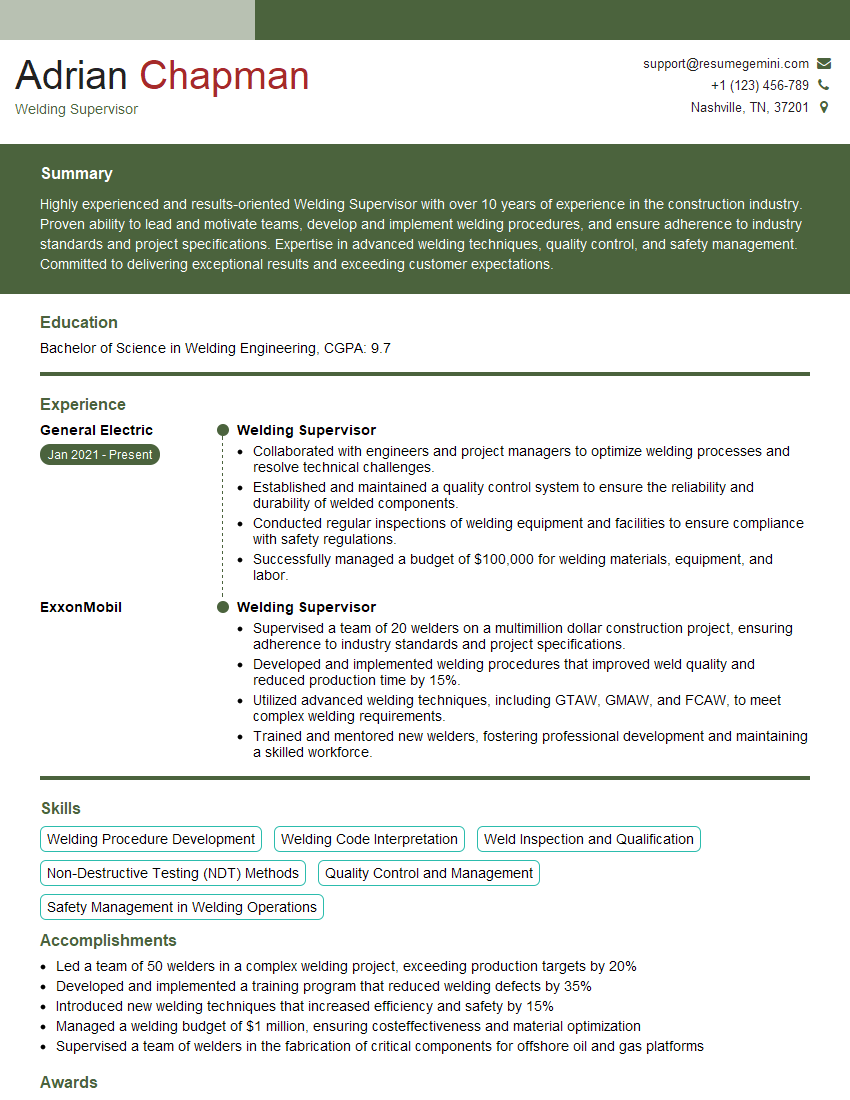
Mastering Weld Engineering opens doors to exciting career opportunities with significant growth potential. A strong foundation in these key areas will set you apart. To maximize your chances of landing your dream job, creating an ATS-friendly resume is crucial. ResumeGemini is a trusted resource that can help you build a professional and impactful resume tailored to the specific demands of the Weld Engineering field. Examples of resumes specifically designed for Weld Engineering positions are available to guide you. Invest the time to build a strong resume—it’s your first impression!


Explore more articles
Users Rating of Our Blogs
Share Your Experience
We value your feedback! Please rate our content and share your thoughts (optional).
What Readers Say About Our Blog
Really detailed insights and content, thank you for writing this detailed article.
IT gave me an insight and words to use and be able to think of examples