Preparation is the key to success in any interview. In this post, we’ll explore crucial Welding Procedures Development interview questions and equip you with strategies to craft impactful answers. Whether you’re a beginner or a pro, these tips will elevate your preparation.
Questions Asked in Welding Procedures Development Interview
Q 1. Explain the purpose of a Welding Procedure Specification (WPS).
A Welding Procedure Specification (WPS) is a document that outlines the parameters and procedures for a specific welding operation. Think of it as a recipe for creating a perfect weld. It ensures consistency and quality by providing detailed instructions for welders to follow. It’s crucial for meeting project requirements and complying with relevant codes and standards.
A WPS typically includes information such as:
- Base materials being welded
- Welding process
- Welding consumables (electrodes, filler wire, etc.)
- Preheating temperature
- Welding positions
- Travel speed
- Current/voltage settings
- Interpass temperature
- Post-weld heat treatment (if any)
Following a qualified WPS ensures the welds meet the required strength, durability, and quality standards.
Q 2. Describe the different types of welding processes and their applications.
Numerous welding processes exist, each suited for different applications. The choice depends on factors like material thickness, joint design, and access. Here are a few examples:
- Shielded Metal Arc Welding (SMAW): Uses a consumable electrode coated with flux to protect the weld from atmospheric contamination. It’s versatile, portable, and relatively inexpensive, ideal for various applications but can be slower than other methods.
- Gas Metal Arc Welding (GMAW): Uses a continuously fed consumable wire electrode, often with a shielding gas (like Argon or CO2). It’s highly productive, suitable for both thin and thick materials, widely used in manufacturing and construction. A common variation is MIG welding.
- Gas Tungsten Arc Welding (GTAW): Uses a non-consumable tungsten electrode and shielding gas. Known for its precision and ability to produce high-quality welds on various metals. Commonly known as TIG welding, it is often preferred for critical applications.
- Submerged Arc Welding (SAW): Uses a consumable wire electrode and flux covering the weld pool. High deposition rates make it efficient for large-scale projects. It is used for applications requiring high productivity like pipelines.
Choosing the right process requires careful consideration of factors specific to the project.
Q 3. What are the essential elements of a qualified Welding Procedure Qualification Record (WPQR)?
A Welding Procedure Qualification Record (WPQR) is a document that provides the results of tests performed to qualify a specific welding procedure. Think of it as the proof that the ‘recipe’ (WPS) works and produces consistently acceptable welds.
Essential elements of a WPQR include:
- Details of the welding procedure: This mirrors the WPS information, providing a reference point for the tests performed.
- Mechanical test results: Tensile, bend, and impact tests demonstrate the weld’s strength and toughness.
- Macro and micrographic examinations: Visual inspection (macro) and microscopic analysis (micro) reveal the weld’s internal structure and any defects.
- Chemical analysis (if required): Verifies the chemical composition of the weld metal.
- Identification of materials used: Precise specification of base and filler materials.
- Welder identification: Shows the welder who performed the qualification welds.
The WPQR confirms that the WPS produces welds that meet the required specifications.
Q 4. How do you determine the appropriate welding parameters for a specific application?
Determining appropriate welding parameters requires a combination of experience, knowledge, and calculations. It’s not just about selecting random numbers; it’s a science!
The process involves:
- Material selection: The base material’s type and thickness significantly impact parameter selection. Steel requires different settings than aluminum.
- Joint design: The type of joint (butt, lap, fillet) affects penetration and heat input.
- Welding process: Each process (SMAW, GMAW, etc.) has unique parameter ranges.
- Code requirements: Adherence to relevant codes (like ASME Section IX) dictates acceptable ranges for parameters.
- Trial welds and testing: Making trial welds and conducting non-destructive testing (NDT) ensures the chosen parameters produce acceptable results.
- Experience and judgment: Experienced welders can use their knowledge to fine-tune parameters for optimal results. This involves understanding how various settings influence heat input, penetration, and weld bead geometry.
Often, a combination of published data, welding handbooks, and practical experimentation are necessary to determine the optimal parameters.
Q 5. What are the common welding defects and their causes?
Welding defects can compromise the integrity of the weld and the structure it joins. Identifying their causes is crucial for preventing future occurrences. Common defects include:
- Porosity: Gas bubbles trapped within the weld. Causes include moisture in the shielding gas or electrode, improper cleaning of the base material.
- Cracks: Fractures in the weld metal. Causes include hydrogen embrittlement (hydrogen trapped during welding), excessive restraint during cooling.
- Undercutting: A groove melted into the base metal adjacent to the weld. Caused by excessive current, incorrect travel speed.
- Lack of fusion: Incomplete melting and bonding between the weld metal and base material. Caused by improper cleaning, insufficient heat input.
- Inclusion: Foreign materials trapped in the weld. Causes include poor shielding, contamination.
Careful attention to detail in the welding process, proper material preparation, and adherence to the WPS are critical in preventing these defects.
Q 6. Explain the importance of pre-weld inspection and post-weld inspection.
Both pre-weld and post-weld inspections are vital for ensuring quality and safety. They’re like quality checks at the beginning and end of a recipe to ensure the final product meets expectations.
Pre-weld inspection ensures the base materials are properly prepared. This involves checking for cleanliness, surface condition, correct material type and dimensions, and proper fit-up of the joint. This prevents defects from the start.
Post-weld inspection involves evaluating the completed weld for defects. This can include visual inspection, NDT methods (such as radiographic testing (RT), ultrasonic testing (UT), or liquid penetrant testing (PT)), and mechanical testing to assess weld strength. This detects and addresses problems before they become serious.
Both inspections are crucial for ensuring the structural integrity and safety of the welded component.
Q 7. Describe the different types of weld joints and their suitability for various applications.
Various weld joints cater to different applications based on strength, access, and aesthetics. Here are some examples:
- Butt joint: Two pieces are joined edge to edge. Provides high strength, suitable for structural applications.
- Lap joint: One piece overlaps the other. Simpler to weld but less strong than a butt joint, used when access is limited.
- T-joint: One piece is welded perpendicular to another. Common in structural steelwork.
- Corner joint: Two pieces are joined at a corner. Used in box sections or similar structures.
- Edge joint: Edges of two plates are welded together. Used for thin sheets.
The selection depends on the application’s specific needs, strength requirements, and the ease of welding access to the joint.
Q 8. How do you interpret welding symbols?
Welding symbols are a standardized graphical language used to communicate complex welding requirements concisely on engineering drawings. They provide essential information about the type of weld, its location, dimensions, and other crucial parameters. Think of them as shorthand instructions for welders.
Understanding welding symbols involves recognizing several key components: the reference line, the arrow, the basic weld symbols (like a square for fillet welds or a triangle for groove welds), supplementary symbols (indicating things like backing, reinforcement, or specific weld types), and dimensions. The arrow indicates which side of the reference line the weld is located on. Symbols placed above the reference line generally apply to the side the arrow points to, and symbols below the reference line typically pertain to the opposite side. Dimensions specify the size, length, and other characteristics of the weld.
Example: A symbol showing a small triangle above the reference line with a dimension ‘6mm’ indicates a 6mm groove weld on the side the arrow points to. A tail on the symbol may indicate specific weld preparation requirements.
- Arrow side: Side where the arrow points
- Other side: Opposite side of the arrow
- Reference line: The line the symbols are placed on
Q 9. What are the safety precautions to be taken during welding operations?
Welding involves significant safety risks, so rigorous precautions are essential. These precautions should be addressed throughout the entire welding process, from preparation to cleanup.
- Personal Protective Equipment (PPE): This includes welding helmets with appropriate shade lenses to protect eyes from intense UV and infrared radiation, welding gloves to protect hands from burns and sparks, flame-resistant clothing to prevent burns, and safety footwear with steel toes to protect feet from falling objects.
- Respiratory Protection: Welding fumes can be toxic, depending on the materials being welded. Appropriate respirators should be used to filter out harmful particles and gases.
- Fire Prevention: Welding often generates sparks and hot slag, so a fire watch is crucial, especially in areas with flammable materials. Fire extinguishers should be readily available and accessible.
- Electrical Safety: Welding equipment operates on high currents and can be dangerous if mishandled. Ensure proper grounding and insulation to prevent electrical shocks.
- Confined Space Entry: Welding in confined spaces requires special precautions to ensure adequate ventilation and prevent oxygen depletion. Proper ventilation and air monitoring should be in place.
- Environmental Considerations: Welding fumes and spatter can contaminate the environment. Appropriate measures such as ventilation or local exhaust ventilation should be used to control air quality.
Regular safety training and adherence to company safety policies are paramount. A well-defined safety plan specific to the welding operation should always be in place.
Q 10. Explain the concept of Heat Affected Zone (HAZ) and its significance.
The Heat Affected Zone (HAZ) is the area of base material that is not melted but has its microstructure and properties altered by the heat input from the welding process. Think of it as the area surrounding the weld that experiences a temperature rise, but not enough to melt. This change in the microstructure can significantly impact the mechanical properties of the base material, such as strength, hardness, and toughness.
The HAZ’s significance lies in its potential for undesirable effects. Rapid heating and cooling can lead to hardening (making the material brittle), cracking (due to stress), and reduced ductility. The size and characteristics of the HAZ are influenced by various factors like welding parameters (current, voltage, travel speed), base material properties, and pre- and post-weld heat treatments. Understanding the HAZ is critical in predicting the performance and durability of a weldment.
Significance: Managing the HAZ is crucial to preventing weld failures. This often involves careful selection of welding parameters and base materials, potentially incorporating preheating or post-weld heat treatments to reduce the HAZ’s impact. A thorough understanding of HAZ behavior is paramount for structural integrity.
Q 11. What are the different types of destructive and non-destructive testing methods used for welds?
Both destructive and non-destructive testing (NDT) methods are used to evaluate the quality of welds, ensuring they meet specified requirements. Destructive methods involve damaging the sample to assess its properties, while NDT methods allow examination without causing damage.
Destructive Testing Methods:
- Tensile Testing: Determines the ultimate tensile strength, yield strength, and elongation of the weld.
- Bend Testing: Evaluates the ductility and toughness of the weld by bending the specimen.
- Impact Testing: Measures the weld’s ability to withstand sudden impact loads. (Charpy or Izod test)
- Hardness Testing: Assesses the hardness of the weld and the HAZ, indicating the potential for brittleness.
- Macro and Micro examination: Visual inspection of the weld’s structure using magnification to reveal defects.
Non-Destructive Testing Methods:
- Visual Inspection: A basic but important method for detecting surface defects.
- Radiographic Testing (RT): Uses X-rays or gamma rays to detect internal defects like porosity and cracks.
- Ultrasonic Testing (UT): Employs high-frequency sound waves to detect internal flaws and measure weld thickness.
- Magnetic Particle Testing (MT): Detects surface and near-surface cracks in ferromagnetic materials.
- Liquid Penetrant Testing (PT): Identifies surface-breaking flaws by using a dye penetrant that seeps into cracks.
The choice of testing method depends on factors such as the weld’s type, application, and required level of quality assurance.
Q 12. How do you ensure the traceability of welding materials and procedures?
Traceability in welding ensures that all materials and procedures used in a project can be identified and their history documented. This is crucial for quality control, liability, and regulatory compliance.
Several mechanisms ensure traceability:
- Material Traceability: Welding consumables (electrodes, filler wires, etc.) should have clear identification markings, including manufacturer, batch number, and chemical composition. These details must be meticulously recorded and linked to specific welds. This is often done through certificates of conformity and material test reports.
- Procedure Traceability: Welding procedures (WPS) must be clearly identified and version-controlled. Any changes to a WPS should be documented and approved, maintaining a history of revisions. The WPS must be linked to specific welders and the welds they produced.
- Welder Qualification Traceability: Welder qualifications must be documented, including their certifications, training records, and performance testing results. This ensures that only qualified welders perform specific welds.
- Database Management: A robust database system is essential for managing welding material and procedure data, allowing easy retrieval of information when needed.
- Unique Identifiers: Assigning unique identifiers (e.g., barcodes, serial numbers) to materials and procedures aids in tracking and identification throughout the process.
Proper traceability is vital for ensuring the reliability and safety of welded structures, allowing for efficient investigation of any issues that might arise.
Q 13. Explain the role of AWS D1.1 in structural welding.
The American Welding Society (AWS) D1.1 standard, “Structural Welding Code—Steel,” is a widely recognized and highly influential code governing the welding of structural steel. It sets forth the requirements for the design, fabrication, and inspection of structural steel welds. It serves as a benchmark for quality and safety in the construction industry.
The AWS D1.1 establishes requirements concerning:
- Welding procedures: The code specifies the minimum requirements for developing and qualifying welding procedures (WPSs) and procedure qualification records (PQRs).
- Welder qualifications: It outlines the criteria for welder qualification, including performance tests and certifications.
- Welding materials: It defines the acceptable types and properties of welding materials and base materials.
- Weld inspection: It provides guidelines for inspecting welds to ensure they are free from defects and meet the design requirements.
- Design considerations: It considers various design aspects to ensure structural integrity.
Adherence to AWS D1.1 is critical for ensuring the safety and reliability of structures built with welded steel. It reduces the risk of weld failures, minimizes costs from rework, and provides a standardized framework for efficient construction.
Q 14. What is the significance of the PQR in relation to the WPS?
The Procedure Qualification Record (PQR) and the Welding Procedure Specification (WPS) are intrinsically linked documents that form the foundation of a qualified welding process. The PQR is a record of the welding parameters and test results used to qualify a specific WPS. The WPS, in turn, is a detailed set of instructions based on the successful PQR that dictates how welds must be performed to ensure consistent quality.
PQR: The PQR is a factual record of the parameters employed during qualification testing. This encompasses the details of the welding procedure used (e.g., type of welding process, electrode type, preheat temperature, current, voltage, etc.), along with the results of destructive and/or non-destructive tests performed on the test welds. The PQR verifies that the WPS, when followed, produces welds that meet the specified requirements.
WPS: The WPS is derived from the successful PQR. It translates the successful parameters into a concise set of instructions for the welders to follow during production welding. It ensures that all subsequent welds are made using the same proven and qualified parameters as those used for the PQR.
In essence, the PQR is the evidence that the WPS will reliably produce acceptable welds, and the WPS guides the welders to make those welds correctly and consistently.
Q 15. Describe your experience in developing WPSs for different materials (e.g., stainless steel, aluminum).
Developing Welding Procedure Specifications (WPSs) for different materials requires a deep understanding of each material’s metallurgical properties and how they react to the welding process. My experience spans a wide range of materials, including stainless steels (austenitic, ferritic, duplex), aluminum alloys (various series like 5xxx, 6xxx), and carbon steels. For each material, the WPS development process starts with identifying the base material’s specific characteristics, thickness, and joint design. Then, I conduct preliminary welding trials to determine optimal parameters like current, voltage, travel speed, and shielding gas type. For example, when working with stainless steel, controlling heat input is crucial to prevent sensitization and intergranular corrosion. This often means using lower current and slower travel speeds compared to carbon steel. With aluminum, it’s essential to maintain a clean welding environment and use appropriate filler metals to avoid porosity and cracking. I meticulously document every trial, recording parameters, observing weld appearance, and conducting necessary mechanical testing (like tensile and bend tests) to ensure the welds meet the required specifications. This iterative process continues until a consistent, high-quality weld is achieved across multiple test pieces. The final WPS then precisely outlines these parameters, ensuring repeatability and compliance.
Career Expert Tips:
- Ace those interviews! Prepare effectively by reviewing the Top 50 Most Common Interview Questions on ResumeGemini.
- Navigate your job search with confidence! Explore a wide range of Career Tips on ResumeGemini. Learn about common challenges and recommendations to overcome them.
- Craft the perfect resume! Master the Art of Resume Writing with ResumeGemini’s guide. Showcase your unique qualifications and achievements effectively.
- Don’t miss out on holiday savings! Build your dream resume with ResumeGemini’s ATS optimized templates.
Q 16. How do you address discrepancies between WPS and actual welding parameters?
Discrepancies between a WPS and actual welding parameters can significantly impact weld quality and potentially compromise structural integrity. Addressing these discrepancies requires a systematic approach. Firstly, I would investigate the root cause of the deviation. This might involve reviewing the welder’s performance, checking the equipment calibration (power source, wire feed speed), and ensuring the correct consumables (filler metal, shielding gas) are used. Sometimes, environmental factors like ambient temperature or humidity can also play a role. Once the cause is identified, corrective actions are implemented. This could range from retraining the welder, recalibrating equipment, or revising the WPS to reflect the necessary adjustments. Crucially, any significant deviation requires further welding trials and testing to validate the revised parameters and ensure they still meet the required standards. Documentation of all deviations, investigations, and corrective actions is essential for maintaining traceability and auditability.
Q 17. Explain the process of WPS qualification and certification.
WPS qualification and certification is a critical step in ensuring the integrity of welded joints. The process generally involves conducting a series of qualification welds according to the WPS. These welds are then subjected to various non-destructive testing (NDT) methods such as visual inspection, radiographic testing (RT), and ultrasonic testing (UT), depending on the application and relevant codes. In addition to NDT, destructive testing is also often performed. This might include tensile testing, bend testing, and macro/micro examination to determine the mechanical properties and microstructure of the weld. If all the test results meet the acceptance criteria specified in the relevant welding code (like ASME Section IX or AWS D1.1), the WPS is deemed qualified. Certification then involves issuing a formal document, often stamped by a qualified Welding Engineer, confirming the WPS’s approval for specific applications and materials. This certified WPS is then used as a reference document for welding production.
Q 18. How do you manage changes to an approved WPS?
Managing changes to an approved WPS requires a rigorous and documented process to maintain its integrity and validity. Any proposed change, no matter how minor, necessitates a thorough review. The impact of the change on weld quality must be carefully assessed. This often involves conducting additional welding trials with the modified parameters. If the change is significant (e.g., a change of base material or filler metal), the entire WPS qualification process must be repeated. For minor changes (e.g., a slight adjustment in amperage), additional testing might be sufficient to validate the modified parameters. All changes, the rationale behind them, and the results of any subsequent testing must be meticulously documented in a revision log attached to the WPS. This ensures traceability and maintains compliance with relevant standards and regulations. A revised WPS will then be re-certified, potentially requiring a new certification number.
Q 19. What software or tools do you utilize for WPS development and management?
I utilize several software tools to aid in WPS development and management. These include specialized welding software packages that assist in parameter calculation, data logging from welding machines, and creating comprehensive WPS documentation. Such software helps with calculations related to heat input, travel speed optimization, and pre-qualification assessments. Spreadsheet software is used for organizing test data, generating reports, and tracking WPS revisions. Database management systems are invaluable for archiving and retrieving WPSs, ensuring easy access and version control. Additionally, I utilize CAD software for detailed joint design and to create accurate models for simulation purposes in some cases. The use of such tools significantly improves efficiency, accuracy, and the overall organization of the WPS management process.
Q 20. Describe your experience with different welding codes and standards (e.g., ASME, API).
My experience encompasses various welding codes and standards, primarily ASME Section IX, AWS D1.1, and API 1104. ASME Section IX is widely used in the power generation and nuclear industries, emphasizing stringent requirements for WPS qualification and welder certification. AWS D1.1 focuses on structural welding and provides detailed guidelines for welding procedures and inspections. API 1104 pertains to welding in the petroleum and pipeline industries, highlighting specific requirements for corrosion resistance and leak prevention. Understanding the nuances of each code is crucial, as they differ in their acceptance criteria, required tests, and documentation procedures. I’m proficient in interpreting and applying the relevant clauses of these codes to develop WPSs that meet specific project requirements and regulatory compliance. This involves careful selection of welding processes, consumables, and testing methods based on the code’s stipulations. My expertise ensures projects meet the highest safety and quality standards.
Q 21. How do you ensure the consistency and repeatability of weld quality?
Ensuring the consistency and repeatability of weld quality is paramount in welding engineering. This involves a multi-faceted approach. Firstly, detailed and unambiguous WPSs are fundamental. These WPSs specify all parameters precisely, leaving no room for ambiguity. Regular welder qualification and certification ensure that welders are competent and consistent in their execution. Consistent use of calibrated equipment, including power sources, wire feeders, and measuring instruments, is crucial. A well-controlled welding environment, maintaining consistent ambient temperature and shielding gas purity, also contributes to weld quality repeatability. Process monitoring during welding, using real-time data acquisition from welding machines, helps to identify and correct any deviations from specified parameters. Finally, a robust quality control system, including regular inspections and NDT, verifies the consistent achievement of the desired weld quality. This ensures that the final product meets the required specifications and maintains structural integrity.
Q 22. What is your experience with different types of filler metals and their selection criteria?
Selecting the right filler metal is crucial for successful welding. It’s like choosing the right glue – the wrong one won’t stick, or worse, will weaken the joint. My experience spans various filler metal types, including solid wires (like ER70S-6 for mild steel), flux-cored wires (offering better protection in outdoor environments), and electrodes (for applications requiring specific properties). The selection criteria depend heavily on the base metal (the metal being welded), the welding process (MIG, TIG, stick), and the desired properties of the weld. For instance, if you’re welding stainless steel, you’d need a filler metal with similar chromium and nickel content to avoid corrosion. We consider factors such as tensile strength, ductility, impact resistance, and corrosion resistance. A specific application might require a filler metal with high impact resistance for a structure subjected to shock loads, whereas a high-tensile strength filler would be chosen for a load-bearing component. I use material datasheets and welding codes (like AWS D1.1) extensively to ensure proper selection, always considering the potential consequences of choosing incorrectly.
- Base Metal: The chemical composition of the base metal dictates the filler metal compatibility.
- Welding Process: Different processes require different filler metal forms (solid wire, electrode, etc.).
- Weld Joint Design: The geometry of the weld joint influences the selection.
- Service Conditions: Environmental factors (temperature, corrosion) significantly affect filler metal choice.
Q 23. How do you handle non-conformances during welding operations?
Non-conformances are inevitable in any welding process. My approach is rooted in a structured, documented response. First, we immediately stop the welding operation to prevent further defects. Next, the non-conformity is clearly documented, including location, type of defect (e.g., porosity, undercut, lack of fusion), and associated weld parameters (current, voltage, travel speed). Then, a thorough investigation is conducted to identify the root cause. This might involve visual inspection, destructive testing (like tensile or bend tests), or non-destructive testing (like radiography or ultrasonic testing). Depending on the severity of the non-conformance, it might involve rework, repair, or scrapping the defective weld. All actions taken are recorded and corrective actions are implemented to prevent recurrence. For example, if porosity is found to be the problem, we might adjust the shielding gas flow rate or preheat the base metal. The process is overseen by a qualified welding inspector, and all repairs are documented and inspected.
Q 24. Describe your experience with root cause analysis of welding defects.
Root cause analysis is critical for continuous improvement in welding. I use various techniques, such as the ‘5 Whys’ method, to drill down to the underlying issue behind a welding defect. For instance, if we find excessive spatter, we might ask: Why is there excessive spatter? (Answer: Incorrect welding parameters). Why were the parameters incorrect? (Answer: Inadequate welder training). Why was the training inadequate? (Answer: Insufficient training materials). By repeatedly asking ‘why’, we eventually reach the root cause. Other methods I employ include fault tree analysis and fishbone diagrams to visually map potential causes. Tools like statistical process control (SPC) help in analyzing trends and identifying patterns leading to defects. A recent example involved a series of incomplete penetration welds. Through root cause analysis, we found that the pre-cleaning process was inconsistent, resulting in contaminants hindering proper fusion. We implemented stricter cleaning procedures and added a visual inspection step, successfully resolving the issue. The key is a systematic approach, thorough documentation, and a commitment to continuous improvement.
Q 25. Explain your understanding of different types of weld testing (e.g., tensile, bend, impact).
Weld testing is essential to verify the integrity and quality of welds. Different tests assess different properties. Tensile testing measures the ultimate tensile strength and elongation of the weld metal, indicating its ability to withstand pulling forces. Imagine stretching a rubber band – tensile strength determines how much force it can take before breaking. Bend tests evaluate the weld’s ductility and its ability to withstand bending stresses. A good weld should bend without cracking. Impact testing (like Charpy or Izod tests) determines the weld’s resistance to sudden impacts or shocks, crucial for applications in cold climates or where sudden impact is anticipated. Visual inspection is always the first step, identifying surface imperfections. Non-destructive testing methods, such as radiography (X-ray) and ultrasonic testing, are used to detect internal flaws. The choice of test depends on the application and the relevant welding code requirements.
Q 26. How do you stay updated on the latest advancements in welding technology and procedures?
Staying current in welding technology is crucial. I actively participate in industry conferences, workshops, and seminars. I subscribe to industry journals and publications, such as the AWS publications and various online resources, to stay updated on new techniques, materials, and codes. I regularly review and update our company’s welding procedures to reflect the latest best practices and advancements. Online courses and certifications, offered by organizations like AWS, provide valuable insights. Networking with other welding professionals through professional organizations enhances knowledge sharing and keeps me abreast of industry trends. Moreover, I actively seek opportunities to learn about new welding equipment and software to ensure our processes remain efficient and high-quality.
Q 27. Explain your experience in training welders on new procedures.
Training welders is a key responsibility. My approach is hands-on and comprehensive, combining theoretical knowledge with practical application. I start by explaining the underlying principles of the welding process, covering safety procedures, material properties, and the specific requirements of the new procedure. Then, we move to practical training using mock-ups or sample materials, allowing welders to practice under supervision. I provide regular feedback, highlighting areas for improvement and addressing any misconceptions. The training culminates in a qualification test, ensuring the welder meets the required proficiency levels. We track their performance and provide ongoing support. I utilize visual aids, demonstrations, and practical exercises to cater to different learning styles. For instance, when training on a new robotic welding system, I would start with a thorough safety briefing, demonstrate the proper operating procedure, and then allow the welders to perform sample welds under my guidance, progressively increasing the complexity of the tasks.
Q 28. Describe a situation where you had to troubleshoot a complex welding issue.
We encountered a recurring problem with cracking in a high-strength steel weldment. Initial investigations pointed to potential issues with preheating, but adjustments didn’t resolve the problem. We systematically reviewed every aspect of the process: material analysis (checking for impurities), welder qualification (retesting), welding parameters, and post-weld heat treatment. Through careful analysis of the failed welds and thorough material testing, we discovered the issue was related to hydrogen embrittlement. The high-strength steel was absorbing hydrogen during the welding process, leading to cracking. The solution involved implementing a more effective preheating procedure, using low-hydrogen electrodes, and incorporating a controlled post-weld heat treatment to remove the hydrogen from the weld. This thorough, multi-faceted approach highlighted the importance of considering all aspects of the welding process and the value of a systematic approach to troubleshooting.
Key Topics to Learn for a Welding Procedures Development Interview
- Welding Processes & Metallurgy: Understanding the fundamental principles of various welding processes (e.g., GMAW, SMAW, GTAW) and their impact on material properties is crucial. This includes knowledge of heat input, weld cooling rates, and their effects on microstructure and mechanical properties.
- Code Requirements & Standards: Familiarity with relevant welding codes and standards (e.g., AWS D1.1, ASME Section IX) is essential for developing compliant welding procedures. This includes understanding the requirements for procedure qualification records (PQRs) and welder performance qualifications (WPQs).
- Procedure Qualification Records (PQRs): Learn the process of creating and interpreting PQRs. Understand the parameters that need to be controlled and documented, and how to analyze the results to ensure procedure validity.
- Weld Joint Design & Selection: Knowing how to select appropriate weld joint designs based on the application and material properties is critical. This includes understanding the strengths and weaknesses of different joint configurations.
- Non-Destructive Examination (NDE): Familiarity with various NDE methods (e.g., visual inspection, radiographic testing, ultrasonic testing) used to verify weld quality is important. Understanding how NDE results influence procedure development and acceptance criteria is crucial.
- Problem-Solving & Troubleshooting: Be prepared to discuss scenarios where welding procedures didn’t meet expectations. Highlight your ability to analyze the root cause of welding defects and propose corrective actions.
- Documentation & Communication: Effective communication and clear documentation of welding procedures are vital. Practice presenting technical information concisely and accurately.
- Safety & Regulatory Compliance: Demonstrate a thorough understanding of safety regulations and best practices related to welding procedures development and implementation.
Next Steps
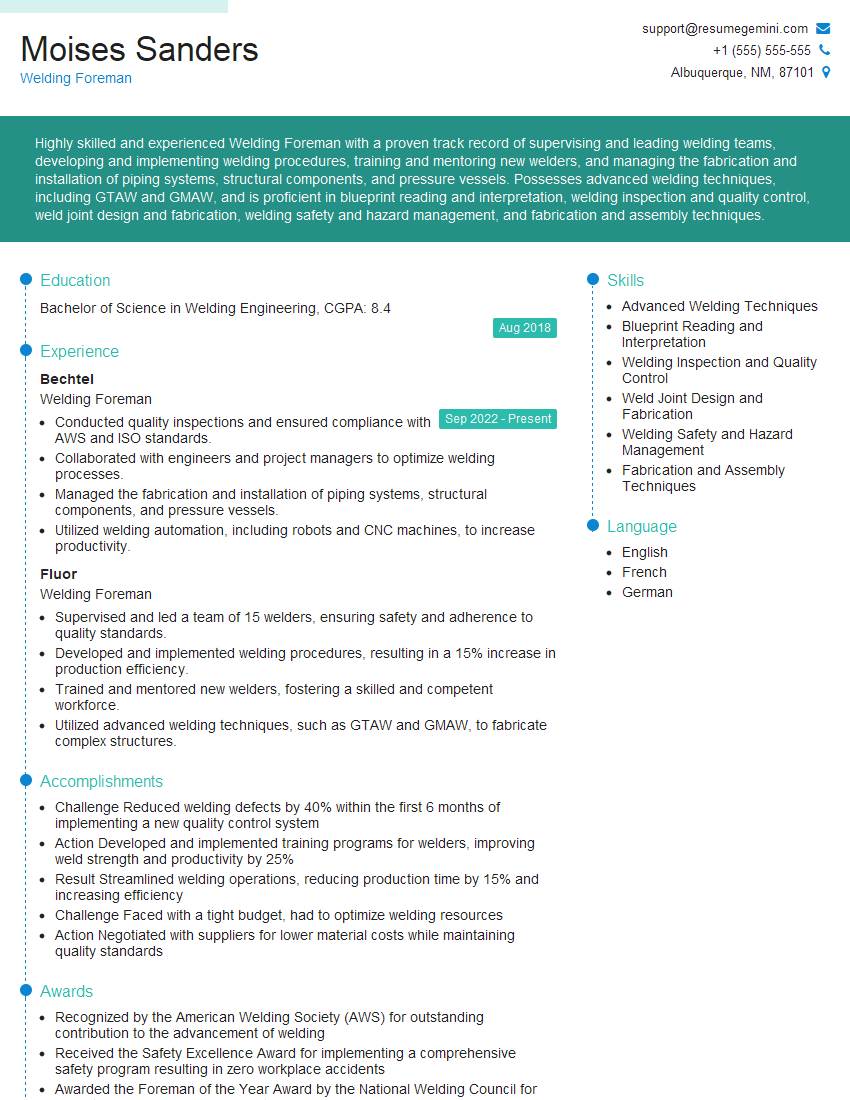
Mastering Welding Procedures Development opens doors to exciting career advancements, leading to increased responsibility, higher earning potential, and greater influence on project success. To maximize your job prospects, it’s essential to create a compelling and ATS-friendly resume that highlights your skills and experience effectively. ResumeGemini is a trusted resource that can help you build a professional resume tailored to the specific requirements of Welding Procedures Development roles. Examples of resumes tailored to this field are available to guide you.

Explore more articles
Users Rating of Our Blogs
Share Your Experience
We value your feedback! Please rate our content and share your thoughts (optional).
What Readers Say About Our Blog
Really detailed insights and content, thank you for writing this detailed article.
IT gave me an insight and words to use and be able to think of examples