Every successful interview starts with knowing what to expect. In this blog, we’ll take you through the top Auto Parts Knowledge interview questions, breaking them down with expert tips to help you deliver impactful answers. Step into your next interview fully prepared and ready to succeed.
Questions Asked in Auto Parts Knowledge Interview
Q 1. What is the difference between OEM and aftermarket auto parts?
The key difference between Original Equipment Manufacturer (OEM) and aftermarket auto parts lies in their source and manufacturing. OEM parts are manufactured by the vehicle’s original manufacturer or under their strict specifications. They’re designed to perfectly integrate with the vehicle, ensuring optimal performance and reliability. Think of them as the ‘factory-approved’ parts. Aftermarket parts, on the other hand, are produced by independent companies. While some offer high-quality alternatives to OEM parts, others may vary in quality and durability. The price point is usually a significant differentiator; aftermarket parts are often less expensive.
Example: If you need a new headlight for a Honda Civic, the OEM part would come directly from Honda or an authorized Honda parts supplier. An aftermarket headlight would be from a company like TYC, Dorman, or other aftermarket manufacturers. Both might fit, but the OEM part will have undergone Honda’s rigorous testing and quality control procedures.
Q 2. Explain the importance of proper part identification numbers.
Proper part identification numbers are crucial for accurate ordering and fitting of parts. These numbers, such as the Part Number, OE Number (Original Equipment Number), or VIN (Vehicle Identification Number) specific codes, act as unique identifiers. They allow mechanics and parts professionals to quickly and accurately locate the correct part for a specific vehicle model and year, ensuring a perfect fit and preventing compatibility issues. Using the wrong part can lead to costly repairs, safety hazards, and even vehicle damage.
Example: A simple typo in a part number could lead to receiving the wrong brake pads, potentially causing brake failure. Accuracy is paramount.
Q 3. How do you handle a customer who is requesting a part that is out of stock?
Handling an out-of-stock part request requires a professional and empathetic approach. My first step is to confirm the part number and vehicle information to ensure accuracy. Then, I explore several options: I check with my suppliers for estimated availability and delivery times. If a reasonable timeframe is possible, I’ll offer that option to the customer. If the part is completely unavailable, I will explore comparable parts or alternatives that might function adequately. Finally, I will suggest alternative suppliers in case a quicker solution is required. Transparency and excellent communication with the customer are vital throughout the process to manage expectations and ensure customer satisfaction.
Example: If a customer needs a specific discontinued sensor, I might suggest a suitable replacement from a different manufacturer with similar specifications, clearly explaining the differences and ensuring the customer understands the implications before proceeding.
Q 4. Describe your experience with automotive parts inventory management systems.
I have extensive experience with various automotive parts inventory management systems, both manual and computerized. My experience includes using systems like Epicor, SAP, and even simpler spreadsheet-based tracking. I’m proficient in inventory tracking, cycle counting, and managing stock levels to minimize waste and ensure timely fulfillment of orders. I’m also familiar with optimizing inventory levels using techniques like ABC analysis (categorizing parts by value and demand) and forecasting future needs based on historical data and market trends. This experience helps ensure we maintain optimal inventory levels while avoiding overstocking of slow-moving items.
Q 5. What are the common causes of brake failure and how can you identify them through part inspection?
Brake failure can stem from various causes, many identifiable through part inspection. Common causes include worn brake pads (easily checked for thickness), damaged rotors (visible scoring or cracking), contaminated brake fluid (cloudy or discolored fluid), leaks in the brake lines (visual inspection for leaks), failing calipers (seized pistons, visible leaks), or a malfunctioning master cylinder (low fluid levels, spongy brake pedal). Inspecting these components systematically allows for diagnosis. Worn pads will be thin and may show metal-on-metal contact. Damaged rotors will show scoring, cracks, or excessive wear. Fluid contamination may indicate moisture intrusion. Leaks are visually obvious, and caliper issues can be identified by checking for piston movement and leaks.
Q 6. Explain the different types of engine oils and their applications.
Engine oils are categorized by their viscosity (thickness) and performance characteristics. Viscosity is expressed using SAE (Society of Automotive Engineers) grades, such as 5W-30 or 10W-40. The ‘W’ stands for winter, indicating the oil’s performance in low temperatures. The numbers represent the oil’s viscosity at different temperatures. Performance characteristics are indicated by API (American Petroleum Institute) classifications, like SN or SP, which denote the oil’s formulation and suitability for different engine types and driving conditions. There are also synthetic, semi-synthetic, and conventional oils. Synthetic oils offer superior performance and longevity, while conventional oils are more affordable but may require more frequent changes. Semi-synthetic blends offer a compromise.
Example: 5W-30 SN Plus oil is suitable for many modern gasoline engines, offering good low-temperature fluidity and high-temperature protection.
Q 7. How do you determine the correct spark plugs for a specific vehicle?
Determining the correct spark plugs requires checking the vehicle’s owner’s manual or using a reliable online parts catalog. The manual specifies the exact plug type, heat range, and gap. Online catalogs allow you to input the vehicle’s year, make, model, and engine type to retrieve the correct information. Factors like engine size, compression ratio, and fuel type influence the appropriate spark plug specifications. Incorrect spark plugs can negatively impact engine performance, fuel economy, and emissions. Never guess; always refer to the manufacturer’s recommendations.
Example: A vehicle might require a specific Champion, NGK, or Denso spark plug with a specific heat range (e.g., 6) and gap (e.g., 0.044 inches).
Q 8. What is the function of a catalytic converter, and what are common failure modes?
A catalytic converter is an emission control device crucial for reducing harmful pollutants in a vehicle’s exhaust gases. It uses a chemical process, facilitated by precious metals like platinum, palladium, and rhodium, to convert toxic gases like carbon monoxide (CO), hydrocarbons (HC), and nitrogen oxides (NOx) into less harmful substances such as carbon dioxide (CO2), water (H2O), and nitrogen (N2).
Common failure modes include:
- Catalyst poisoning: This occurs when substances like lead, silicone, or excessive sulfur contaminate the catalyst, rendering it ineffective. Think of it like clogging the converter with something that prevents the chemical reaction from happening. This is less common now due to unleaded fuel being the standard.
- Physical damage: Impacts from road debris or overheating due to a misfire can cause the catalyst’s honeycomb structure to break down, reducing its efficiency. Imagine crushing a honeycomb; it loses its surface area and effectiveness.
- Aging and degradation: Over time, the precious metals within the catalyst can degrade, reducing its ability to convert pollutants. This is like the catalyst slowly wearing out with age and use.
- Oxygen sensor issues: Malfunctioning oxygen sensors can lead to a richer or leaner air/fuel mixture, which in turn stresses the catalytic converter and causes premature failure.
Symptoms of a failing catalytic converter often include reduced engine performance, a check engine light, and a rattling sound from the exhaust system.
Q 9. How do you troubleshoot a vehicle’s electrical system based on part diagnostics?
Troubleshooting a vehicle’s electrical system requires a systematic approach combining visual inspection, part diagnostics, and the use of specialized tools like multimeters and scan tools. I typically start with a visual inspection, checking for loose connections, damaged wiring, corrosion, or burned components. Then, based on the diagnostic trouble code (DTC) retrieved from the vehicle’s onboard diagnostic (OBD) system, I’ll focus on specific components.
For example, if the DTC indicates a problem with a specific sensor, I’ll test the sensor’s voltage and resistance using a multimeter to determine if it’s functioning correctly. If it’s a relay, I can check its continuity. For more complex issues, I may use a scan tool to monitor live data from the sensor or component in question, observing its behavior during various engine operating conditions. Sometimes, the problem isn’t even with the part itself, but rather the wiring harness connecting it to the rest of the electrical system – so carefully examining the wiring is crucial. I use wiring diagrams to help locate and trace circuits.
Let’s say the vehicle’s headlights aren’t working. I’d first check the fuses, then inspect the headlight switches, wiring, and bulbs themselves, moving systematically from the power source to the light itself. The process involves eliminating possibilities one by one, using logic and understanding of the vehicle’s electrical circuit.
Q 10. Describe your experience with ordering and receiving parts from various suppliers.
I have extensive experience ordering parts from a wide range of suppliers, both large national chains and smaller, specialized distributors. My process always begins with verifying the correct part number and ensuring compatibility with the specific vehicle model and year. I usually use online catalogs and parts databases to cross-reference part numbers and check for availability. When ordering, I meticulously document the order details, including the supplier, part number, quantity, expected delivery date, and purchase order number. This helps manage the ordering process efficiently and maintain accurate records.
I work closely with various suppliers to ensure timely delivery and address any discrepancies or delays. If an issue arises – say, an incorrect part is delivered or a shipment is delayed – I immediately contact the supplier to initiate a return or replacement. I maintain strong relationships with key suppliers to facilitate better service and potentially negotiate more favorable terms.
One time, I was faced with a rare part needed urgently for a customer’s vehicle. I contacted several suppliers and found one that had it available and organized an expedited delivery. Good relationships with suppliers are key to resolving issues quickly and providing the best possible service.
Q 11. How do you maintain accurate inventory records and manage stock levels?
Maintaining accurate inventory records and managing stock levels is paramount. I utilize inventory management software that tracks all parts in real-time. This software helps me monitor stock levels, identify slow-moving or obsolete items, and predict future demand. Regular physical inventory checks are conducted to reconcile software records with actual stock. Discrepancies are investigated and adjusted immediately.
I employ a system that uses a combination of techniques – such as a Minimum Stock Level (MSL) and a Reorder Point (ROP) – to ensure we have sufficient stock to meet customer demand without overstocking. The MSL represents the lowest acceptable inventory level, while the ROP triggers an automatic order when the stock drops below that level. This minimizes storage costs and prevents stockouts. I also analyze sales data to predict future demand and adjust stock levels accordingly.
The software also helps me identify trends in demand and allows me to optimize ordering to maximize efficiency and minimize waste. We perform regular reviews to assess the accuracy of our forecasting models.
Q 12. Explain the importance of proper safety procedures when handling auto parts.
Proper safety procedures are crucial when handling auto parts. These parts can present various hazards, including sharp edges, heavy weight, and exposure to potentially hazardous materials (like brake fluid or battery acid). Therefore, we always wear appropriate Personal Protective Equipment (PPE), such as safety glasses, gloves, and closed-toe shoes. We handle heavy parts with proper lifting techniques to avoid injuries. We use designated storage areas to keep parts organized and prevent accidents. This also minimizes the risk of damage to the parts.
Specific procedures depend on the part. For instance, when handling batteries, we follow strict protocols to prevent short circuits or acid spills. Similarly, handling airbags requires special precautions to avoid accidental deployment. Regular safety training is provided to all staff to ensure everyone is aware of the potential hazards and understands the appropriate safety procedures. We maintain a clean and organized workspace to prevent slips, trips, and falls. A safe working environment is a priority.
Q 13. What is your experience with using diagnostic tools to identify faulty parts?
I have extensive experience using various diagnostic tools, including OBD-II scanners, digital multimeters, and specialized automotive scan tools. These tools help identify faulty parts by analyzing data from different vehicle systems. For example, an OBD-II scanner can retrieve diagnostic trouble codes (DTCs) that pinpoint specific problems within the engine, transmission, or other systems. A multimeter allows me to test the voltage, resistance, and continuity of electrical components such as sensors, relays, and actuators. Specialized tools may offer more in-depth diagnostics for particular systems.
The process usually starts with retrieving DTCs using a scan tool. Then, based on the codes, I’ll use a multimeter to verify the readings from the suspected faulty part. Sometimes, live data streaming from the scan tool can help pinpoint intermittent faults that might not be readily apparent from static readings. For example, I might monitor the oxygen sensor readings in real-time to see if it’s responding correctly to changes in the exhaust gases. Careful data analysis and a systematic approach are crucial for effective diagnostics.
Q 14. How do you handle returns and exchanges of defective auto parts?
Handling returns and exchanges of defective auto parts involves a clearly defined procedure to ensure fairness and efficiency. First, I verify the defect, inspecting the part for any physical damage, ensuring it matches the original order, and confirming that it truly is faulty rather than a result of incorrect installation. Documentation is critical – photographs, original invoices, and potentially testing results are gathered. Then, I contact the supplier according to their return policy, initiating the return process. This often includes obtaining a Return Merchandise Authorization (RMA) number.
Once the RMA is received, the defective part is carefully packaged and shipped back to the supplier using their preferred method. I maintain meticulous records of all returns, including dates, tracking numbers, and communication with the supplier. Once the supplier receives and accepts the return, a replacement part is ordered or a refund is processed depending on the supplier’s policy. I keep the customer informed throughout the entire process, keeping them updated on the progress of the return and the status of the replacement part.
A transparent and efficient return process fosters customer trust and loyalty. A positive outcome for a return is always prioritized, and if a delay occurs, I proactively contact the customer to keep them in the loop.
Q 15. How do you stay updated on the latest advancements in automotive parts technology?
Staying current in the rapidly evolving automotive parts technology landscape requires a multi-pronged approach. I regularly subscribe to industry-leading publications like Automotive Engineering International and SAE International journals, which provide in-depth analyses of the latest advancements in materials, manufacturing processes, and electronic systems. I also actively participate in webinars and conferences hosted by organizations like the Automotive Parts Rebuilders Association (APRA) and attend relevant trade shows, such as the Automotive Aftermarket Products Expo (AAPEX). Furthermore, I maintain a strong network of contacts within the industry, exchanging information and insights with engineers, manufacturers, and fellow technicians. This combined approach ensures I’m always aware of emerging trends and technologies, from electric vehicle components to advanced driver-assistance systems (ADAS) parts.
Career Expert Tips:
- Ace those interviews! Prepare effectively by reviewing the Top 50 Most Common Interview Questions on ResumeGemini.
- Navigate your job search with confidence! Explore a wide range of Career Tips on ResumeGemini. Learn about common challenges and recommendations to overcome them.
- Craft the perfect resume! Master the Art of Resume Writing with ResumeGemini’s guide. Showcase your unique qualifications and achievements effectively.
- Don’t miss out on holiday savings! Build your dream resume with ResumeGemini’s ATS optimized templates.
Q 16. Describe your experience with different types of batteries and their maintenance.
My experience encompasses a wide range of automotive batteries, including lead-acid (flooded, gel-cell, AGM), lithium-ion, and nickel-metal hydride (NiMH) batteries. Lead-acid batteries, though ubiquitous, require regular maintenance, such as checking electrolyte levels (in flooded types) and terminal connections for corrosion. Overcharging can significantly reduce their lifespan. AGM and gel-cell batteries are largely maintenance-free but still benefit from regular voltage checks. Lithium-ion batteries, increasingly prevalent in electric and hybrid vehicles, demand a completely different approach. They require sophisticated battery management systems (BMS) to monitor voltage, current, and temperature, preventing overcharging and deep discharge which can damage the cells. Regular diagnostics using OBD-II scanners are crucial for lithium-ion battery maintenance. NiMH batteries, while less common now, need careful charging to avoid the memory effect. In short, the maintenance approach is drastically different depending on the battery chemistry, demanding a thorough understanding of each technology.
Q 17. What are the common types of suspension systems and their components?
Suspension systems are crucial for vehicle handling, ride comfort, and safety. Common types include:
- Independent Suspension: Each wheel moves independently. Components include: struts, shock absorbers, springs (coil or leaf), control arms, ball joints, tie rod ends, and bushings. This system provides superior handling and comfort.
- Dependent Suspension: Wheels on the same axle are linked. Examples include: solid axles (often found in trucks and SUVs) with leaf springs or coil springs and various linkages. This system is usually simpler and more robust but offers less comfort and handling precision.
- Air Suspension: Uses air springs instead of traditional springs. Offers adjustable ride height and improved comfort. Components include: air compressor, air tanks, height sensors, and control valves. Requires more complex maintenance.
Understanding the specific components within each type is vital for diagnosing and repairing suspension issues. For instance, worn ball joints can lead to poor handling, while broken springs result in a drastically altered ride height.
Q 18. Explain the function of different types of fuel injectors.
Fuel injectors are responsible for precisely metering and delivering fuel into the engine’s combustion chamber. The main types include:
- Port Fuel Injection (PFI): Injectors are located in the intake manifold, spraying fuel into the intake port before it reaches the combustion chamber. They are relatively simple and cost-effective.
- Direct Injection (DI): Injectors are located directly within the combustion chamber. This allows for more precise fuel delivery, improved fuel efficiency, and increased power. They are more complex and require higher pressure.
- Multi-Port Injection (MPI): A combination of PFI, sometimes with multiple injectors per cylinder. This offers a balance between simplicity and performance.
Different types of fuel injectors have varying spray patterns and flow rates, optimized for different engine designs and operating conditions. A malfunctioning injector can lead to rough running, poor fuel economy, and increased emissions, necessitating replacement or cleaning.
Q 19. How do you interpret a parts diagram?
Interpreting a parts diagram is fundamental to efficient automotive repair. These diagrams are essentially exploded views of assemblies, showing the individual components and their relative positions. I approach interpreting them systematically:
- Identify the Assembly: Determine which assembly the diagram represents (e.g., brake caliper, engine block).
- Locate the Specific Part: Use the part number or description to locate the component within the diagram.
- Examine Relationships: Observe how the part interacts with other components; note connections, fasteners, and orientations.
- Verify Part Numbers: Cross-reference the part number with catalogs or online databases to ensure compatibility.
- Understand Exploded View: Note the assembly sequence depicted, indicating the order in which parts are installed during assembly or disassembly.
Proper interpretation minimizes errors during repairs and ensures correct part selection.
Q 20. What are common causes of engine overheating, and how can you identify them through part inspection?
Engine overheating is a serious issue, often caused by several factors:
- Coolant Leaks: Inspection of the radiator, hoses, water pump, and thermostat for cracks, leaks, or corrosion. Low coolant level is a clear indicator.
- Faulty Thermostat: A stuck-closed thermostat prevents coolant circulation, leading to overheating. Inspection involves checking if the thermostat opens at the correct temperature.
- Faulty Water Pump: A malfunctioning water pump fails to circulate coolant effectively. Inspection might involve checking for leaks, impeller wear, and bearing noise.
- Clogged Radiator: Restricted airflow or clogged passages reduce cooling efficiency. Inspection involves checking for debris buildup, corrosion, or damage.
- Faulty Fan Clutch or Electric Fan: Failure of the cooling fan to operate correctly prevents adequate heat dissipation. Inspection involves checking for operation and proper fan speed.
- Head Gasket Failure: A blown head gasket allows coolant to enter the combustion chamber, leading to overheating and white smoke from the exhaust. Inspection might include pressure testing the cooling system.
Through a systematic visual inspection, combined with pressure tests and other diagnostic procedures, we can often pinpoint the cause of overheating.
Q 21. How do you resolve conflicts with customers who are unhappy with parts or service?
Resolving customer conflicts requires empathy, active listening, and a professional approach. My strategy involves:
- Active Listening: Let the customer fully express their concerns without interruption. Understanding their perspective is paramount.
- Empathetic Response: Acknowledge their frustration and validate their feelings. Phrases like, “I understand your concern,” show empathy.
- Investigate Thoroughly: Investigate the issue objectively, reviewing purchase records, service history, and examining the part or service in question.
- Offer a Solution: Based on the investigation, offer a fair and reasonable solution. This might involve a refund, replacement, repair, or a suitable compromise.
- Follow-Up: After resolving the issue, follow-up with the customer to ensure they are satisfied and to address any lingering concerns.
Maintaining a positive and professional demeanor throughout the process is crucial for building customer trust and loyalty. Even if the issue wasn’t directly our fault, a positive resolution often leads to a better outcome in the long run.
Q 22. Describe your experience with different types of transmissions.
My experience encompasses a wide range of transmissions, from manual to automatic, and including various specialized types. Manual transmissions, the simplest, rely on the driver to select gears, offering direct control and efficiency. Automatic transmissions, using planetary gearsets and hydraulic control systems, provide convenience and smooth shifting. I’m familiar with different automatic types: conventional torque converters, continuously variable transmissions (CVTs), and dual-clutch transmissions (DCTs). CVTs offer seamless shifting and improved fuel economy, while DCTs, with two separate clutches, deliver incredibly fast shifts. I’ve also worked with specialized transmissions for heavy-duty vehicles and off-road applications, including those with transfer cases for four-wheel drive systems.
- Manual Transmissions: Simple design, direct control, efficient power transfer, but requires driver skill.
- Automatic Transmissions (Conventional): Smooth operation, driver convenience, but can be less fuel-efficient than manuals.
- CVTs: Excellent fuel economy, smooth operation, but can sometimes feel less responsive.
- DCTs: Extremely fast shifting, improved performance, but often more complex and expensive.
In my previous role, I successfully diagnosed a faulty torque converter in an automatic transmission by analyzing its characteristic slippage and rough operation. This involved using diagnostic tools and understanding the hydraulic system within the transmission. This highlighted the importance of understanding the nuances of different transmission types for effective troubleshooting.
Q 23. Explain the difference between different types of brake pads.
Brake pads differ significantly in their material composition, influencing performance and lifespan. The most common are organic, semi-metallic, and ceramic. Organic pads are typically quiet and cost-effective but wear faster and offer less stopping power than the other types. Semi-metallic pads combine metal fibers with organic materials to offer increased stopping power and longer lifespan, but they can generate more noise and dust. Ceramic pads provide superior stopping power, low dust generation, and quiet operation, but are generally the most expensive.
- Organic: Budget-friendly, quiet operation, shorter lifespan.
- Semi-metallic: Good stopping power, longer lifespan, can be noisy.
- Ceramic: Excellent stopping power, quiet operation, low dust, high cost.
The choice of brake pad material often depends on driving style and vehicle type. For example, a performance vehicle might benefit from semi-metallic or ceramic pads for improved braking performance, while a daily driver may find organic pads perfectly adequate. I’ve seen firsthand how incorrect pad selection can lead to premature wear, noise issues, or even brake failure, emphasizing the importance of matching pad type to application.
Q 24. What are common causes of tire failure and how can they be prevented?
Tire failure can stem from several issues. Underinflation reduces contact patch, leading to overheating and potential blowouts. Overinflation weakens tire structure and increases vulnerability to impacts. Improper alignment causes uneven tire wear, compromising grip and structural integrity. Worn tread depth reduces traction, especially in wet or icy conditions, increasing the risk of hydroplaning and accidents. Other causes include impact damage, manufacturing defects, and age. The rubber degrades over time, affecting its strength and flexibility, even if the tread appears adequate.
- Underinflation: Overheating, blowouts, uneven wear.
- Overinflation: Reduced traction, increased risk of damage.
- Improper Alignment: Uneven wear, reduced handling.
- Worn Tread: Reduced traction, hydroplaning risk.
- Impact Damage: Punctures, sidewall damage.
- Age: Rubber degradation, decreased strength.
Preventing tire failure requires regular maintenance. Check tire pressure regularly using a gauge and inflate to the manufacturer’s recommended pressure. Get your alignment checked and adjusted as needed. Inspect tires for wear, cuts, or bulges. Replace tires when tread depth reaches the wear bar indicator or if significant damage is noticed. Finally, pay attention to the tire’s age, as even with seemingly good tread, older tires should be replaced before they become excessively hard and brittle.
Q 25. How do you handle emergency situations involving critical parts shortages?
Critical parts shortages demand immediate action. My approach involves several steps. First, I verify the shortage’s scope and impact on immediate operations. Second, I explore all available options. This includes contacting alternative suppliers, checking for cross-reference parts, or even considering expedited shipping from our primary supplier. I investigate the feasibility of temporary substitutes, ensuring they meet safety and performance standards. If a temporary fix isn’t viable, I prioritize customer communication, providing realistic timelines and managing expectations.
For instance, during a recent shortage of a specific fuel pump, I successfully leveraged a cross-reference part from an alternative supplier, enabling us to avoid significant delays. The key here is proactive communication, collaboration with suppliers, and a willingness to explore multiple solutions to minimize the disruption to our customers.
A well-maintained parts inventory management system plays a key role in mitigating the frequency and impact of shortages. Accurate forecasting and diligent monitoring of stock levels are crucial for proactive problem-solving before a critical shortage occurs. This can greatly reduce the time pressure when unexpected shortages arise.
Q 26. Describe your experience with using various parts databases and catalogs.
I’m proficient in using various parts databases and catalogs, both online and offline. I’m familiar with industry-standard platforms like [mention specific examples, e.g., AutoZone’s online catalog, Mitchell 1, AllData]. These tools are invaluable for identifying part numbers, checking compatibility, accessing technical specifications, and researching pricing. I know how to effectively navigate these systems to locate the correct parts quickly and efficiently. My experience includes using OEM catalogs for precise part identification and aftermarket catalogs for finding cost-effective alternatives. I can effectively search by vehicle year, make, model, and part number. Furthermore, I understand the importance of using multiple resources to cross-reference and verify part information for accurate ordering and installation.
In a previous role, I was instrumental in streamlining our parts ordering process by integrating our internal system with a major online parts catalog, saving time and reducing errors. This involved learning and effectively utilizing API integrations.
Q 27. How do you ensure the quality and authenticity of auto parts?
Ensuring quality and authenticity is paramount. I verify part authenticity through several methods, beginning with sourcing parts from reputable suppliers with established quality control processes. I check for OEM markings, part numbers, and packaging consistency to identify counterfeit parts. When dealing with potentially counterfeit parts, I compare the part’s physical characteristics and specifications against known authentic parts. I sometimes use specialized tools or software to analyze the part’s material composition and verify its compliance with industry standards. I document the source of every part and maintain detailed records for traceability. Collaboration with suppliers and regular inspections are crucial in maintaining the highest standards.
For example, in a previous incident, I identified a batch of counterfeit brake calipers through their inconsistent markings and subpar material quality. This avoided a potentially dangerous situation, and highlights the importance of vigilance and knowledge of industry standards.
Q 28. What safety measures do you employ when working with potentially hazardous parts?
Working with auto parts involves potential hazards, necessitating stringent safety measures. When handling potentially hazardous materials such as brake fluid, I always wear appropriate personal protective equipment (PPE), including gloves, eye protection, and sometimes a respirator. I work in a well-ventilated area or use extraction systems to prevent inhalation of harmful fumes. I follow proper disposal procedures for used fluids and components, preventing environmental contamination. I’m trained in the safe handling and disposal of hazardous waste materials. I adhere to established workplace safety procedures and guidelines. I regularly inspect tools and equipment, ensuring their safe operation, and report any safety concerns immediately.
For example, before working on a vehicle’s braking system, I always ensure I have the correct safety gear and follow established bleeding procedures. This ensures both my safety and the safety of the vehicle I’m working on.
Key Topics to Learn for Auto Parts Knowledge Interview
- Engine Components & Systems: Understanding the function and interrelationship of key engine parts (e.g., pistons, cylinders, crankshaft, valves, fuel system components). Practical application: Troubleshooting engine performance issues based on component failure.
- Transmission Systems: Familiarization with different transmission types (manual, automatic, CVT), their operation, common problems, and maintenance. Practical application: Diagnosing transmission-related issues based on symptoms and vehicle history.
- Braking Systems: Comprehensive knowledge of brake components (calipers, rotors, pads, master cylinder), braking mechanisms, and ABS systems. Practical application: Identifying brake system malfunctions and recommending appropriate repairs.
- Suspension & Steering Systems: Understanding the components and functions of suspension and steering systems, including common maintenance procedures and troubleshooting techniques. Practical application: Diagnosing steering and handling issues.
- Electrical Systems: Knowledge of automotive electrical components (alternators, batteries, starters, sensors), circuits, and diagnostic tools. Practical application: Troubleshooting electrical problems using diagnostic equipment.
- Vehicle Diagnostics: Proficiency in using diagnostic tools (OBD-II scanners) to identify and interpret trouble codes. Practical application: Using diagnostic data to pinpoint the root cause of vehicle malfunctions.
- Safety Regulations and Compliance: Understanding relevant safety standards and regulations related to auto parts and repairs. Practical application: Ensuring compliance with safety standards during part selection and repair procedures.
- Part Identification and Catalog Systems: Proficiency in using parts catalogs and identifying parts using VIN numbers or other vehicle specifications. Practical application: Efficiently locating and ordering necessary parts.
Next Steps
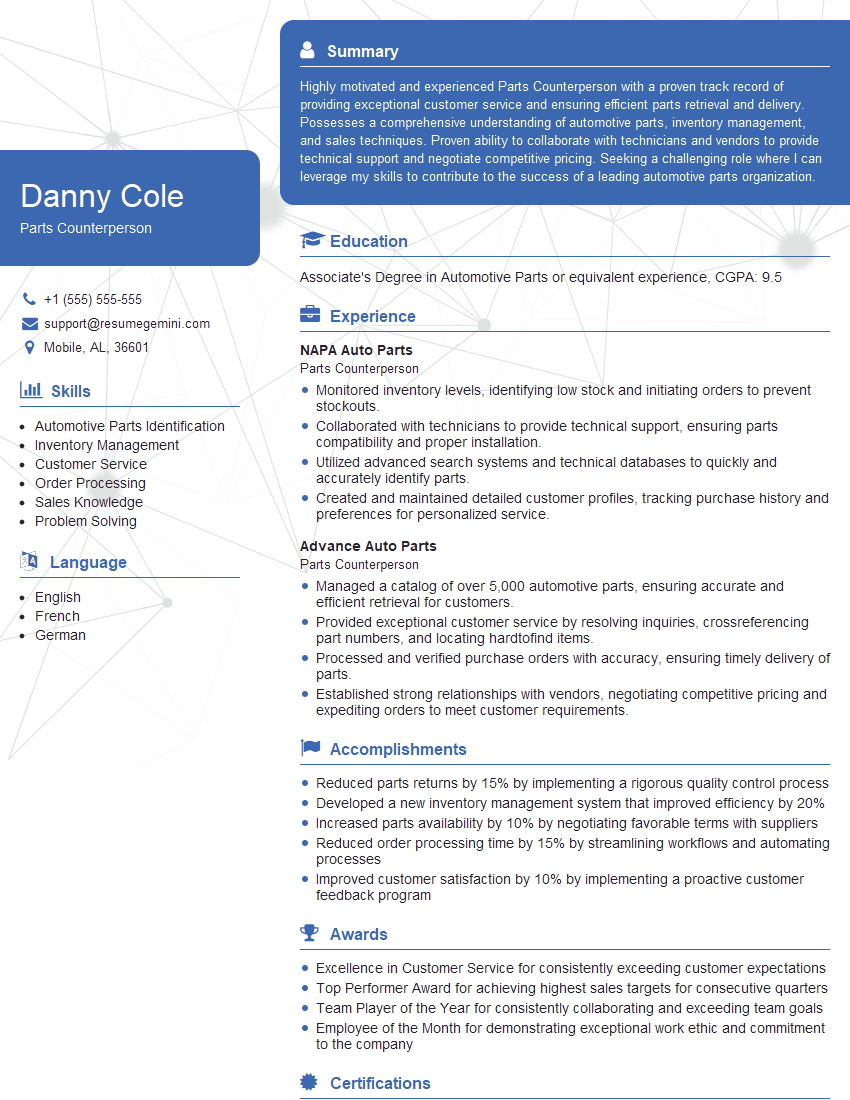
Mastering Auto Parts Knowledge is crucial for career advancement in the automotive industry, opening doors to higher-paying roles and greater responsibility. A strong resume is your first impression – make it count! Create an ATS-friendly resume to maximize your chances of getting noticed by recruiters. ResumeGemini is a trusted resource to help you build a professional and effective resume that highlights your expertise. Examples of resumes tailored to Auto Parts Knowledge are available to guide you. Take the next step towards your dream career today!



Explore more articles
Users Rating of Our Blogs
Share Your Experience
We value your feedback! Please rate our content and share your thoughts (optional).
What Readers Say About Our Blog
Really detailed insights and content, thank you for writing this detailed article.
IT gave me an insight and words to use and be able to think of examples