Interviews are opportunities to demonstrate your expertise, and this guide is here to help you shine. Explore the essential Automotive Design Theory interview questions that employers frequently ask, paired with strategies for crafting responses that set you apart from the competition.
Questions Asked in Automotive Design Theory Interview
Q 1. Explain the principles of automotive ergonomics and their impact on design.
Automotive ergonomics focuses on designing vehicles to optimize the interaction between the driver and the vehicle, ensuring comfort, safety, and efficiency. It’s about making the car feel like an extension of the driver, rather than a separate entity.
This involves considering factors like:
- Driver’s reach and posture: Pedals, steering wheel, and controls should be easily accessible and allow for a natural, comfortable driving position. Poor ergonomics here can lead to fatigue and discomfort during long drives.
- Visibility: Windshield placement, mirror design, and blind-spot reduction are crucial for safe operation. Consider how the placement of A-pillars impacts visibility.
- Seat adjustability: A wide range of adjustments (height, lumbar support, angle) is vital to accommodate drivers of different sizes and build.
- Control layout and intuitiveness: Controls should be logically placed and easily identifiable, minimizing distraction while driving. For example, the placement of the hazard lights.
- Climate control: Effective and easy-to-use climate control systems are important for driver comfort and concentration.
The impact on design is significant, as ergonomic considerations shape everything from the dashboard layout and seat design to the steering wheel’s size and shape. A well-designed ergonomic interior increases driver satisfaction, reduces driver fatigue, and improves road safety.
Q 2. Describe different automotive design philosophies (e.g., biomimicry, human-centered design).
Several automotive design philosophies guide the creation of vehicles. They often overlap and inform each other.
- Biomimicry: This involves learning from nature’s designs and applying those principles to automotive engineering. For instance, the shape of a bird’s wing might inspire a more aerodynamic car design, while the structure of a bone could inform the design of a lighter, yet stronger chassis.
- Human-centered design: This puts the user – the driver and passengers – at the heart of the design process. It prioritizes understanding user needs, behaviors, and preferences, then using that information to shape every aspect of the vehicle’s design. Think about how intuitive infotainment systems are designed around ease of use.
- Sustainable design: Increasingly, automotive design incorporates sustainability by focusing on lightweight materials, fuel efficiency, and recyclability. Electric vehicle designs often prioritize aerodynamic efficiency to maximize range.
- Modular design: This approach utilizes standardized components and sub-assemblies to streamline the manufacturing process, reduce costs, and allow for greater flexibility in creating variations of a vehicle platform.
These philosophies aren’t mutually exclusive; a successful design often incorporates elements from multiple approaches. For example, a sustainable electric vehicle could utilize biomimicry for its aerodynamic form and human-centered design for its intuitive interface.
Q 3. How does aerodynamics influence vehicle design? Provide specific examples.
Aerodynamics plays a crucial role in vehicle design, significantly impacting fuel efficiency, stability, and high-speed performance. It’s the study of how air flows around an object.
Key considerations include:
- Drag coefficient (Cd): This dimensionless number represents the resistance of a vehicle to air movement. A lower Cd indicates less drag and improved fuel efficiency. Many modern cars feature aerodynamic design elements like underbody panels and rear spoilers to reduce the Cd.
- Lift and downforce: Airflow can generate both upward (lift) and downward (downforce) forces. Downforce improves high-speed stability, particularly in sports cars and race cars, but increased drag is a consequence. This is why race cars have significant wings and diffusers.
- Airflow management: Effective airflow management around the vehicle minimizes turbulence and reduces drag. Features like streamlined body shapes, air dams, and diffusers help achieve this.
Examples:
- The sleek, teardrop shape of many modern cars minimizes drag, improving fuel economy.
- The rear spoiler on a sports car generates downforce, enhancing high-speed stability.
- Underbody panels on many vehicles smooth airflow underneath the car, reducing drag.
Aerodynamic design is a complex interplay of various factors, and Computational Fluid Dynamics (CFD) simulations are frequently used to optimize the design.
Q 4. Discuss the role of CAD software in the automotive design process.
Computer-Aided Design (CAD) software is indispensable in the automotive design process, allowing designers to create, modify, and analyze three-dimensional models of vehicles.
Its role includes:
- 3D Modeling: CAD enables designers to create highly detailed, accurate 3D models of car parts and the entire vehicle, visualizing the design from all angles.
- Simulation and Analysis: CAD software facilitates simulations to assess the structural integrity, aerodynamics, and other performance aspects of a design before physical prototypes are built. Examples include crash simulations and aerodynamic testing.
- Collaboration: CAD platforms provide tools for teamwork, allowing multiple designers and engineers to work on the same model simultaneously. This is extremely important in a large team environment.
- Manufacturing Data Generation: CAD data serves as the foundation for manufacturing processes, providing the precise instructions needed to build the vehicle.
- Visualization and Presentation: CAD allows for realistic renderings and animations, providing effective tools for presentations to clients or management.
Popular CAD software packages used in automotive design include CATIA, NX, and Creo. The software’s capabilities are crucial for efficient and effective automotive design.
Q 5. Explain the importance of sketching in the early stages of automotive design.
Sketching is paramount in the early stages of automotive design, serving as a critical tool for ideation, concept exploration, and communication.
Its importance stems from:
- Rapid Ideation: Sketching allows designers to quickly explore numerous design options without the constraints of digital software. It’s a free-flowing way to express initial thoughts.
- Concept Communication: Sketches provide a quick and effective means of communicating design ideas to team members and stakeholders. They are easier to understand and provide a visual language.
- Exploration of Form and Proportion: Sketches facilitate the exploration of different shapes, proportions, and overall aesthetics of the vehicle.
- Capturing Inspiration: Sketches can be used to record initial design inspirations from various sources, whether from nature, existing designs, or personal ideas.
- Foundation for Digital Modeling: Initial sketches often serve as a guide for building the 3D model in CAD software.
Though digital tools are essential for the later stages, sketching maintains its vital role as a foundational step in automotive design, a powerful tool for creative brainstorming and concept refinement.
Q 6. What are the key considerations for designing an automotive interior for safety and comfort?
Designing a safe and comfortable automotive interior requires careful consideration of several factors:
- Safety:
- Crashworthiness: Materials and structures must be designed to protect occupants during collisions. This involves strategically placing airbags and strengthening the passenger compartment structure.
- Visibility: Ensuring clear visibility for the driver is paramount. A-pillar design, window placement and size, and mirror positioning significantly impact this.
- Ergonomics: Proper seat positioning and control layout minimize driver distraction and enhance safety. The inclusion of safety features and warning systems are crucial.
- Child safety: Provision for child seats and other child safety features is mandatory, adhering to strict safety regulations.
- Comfort:
- Seating: Ergonomic seat design is vital, featuring adjustable lumbar support, sufficient padding, and appropriate materials to enhance comfort during long drives.
- Climate control: Efficient heating and air conditioning systems are crucial for maintaining passenger comfort across different climates.
- Noise reduction: Materials and construction techniques should minimize noise intrusion, improving the driving experience.
- Interior space: Sufficient legroom, headroom, and shoulder room are essential for passenger comfort.
- Materials: The choice of materials significantly impacts the interior’s aesthetic appeal and overall comfort.
Balancing safety and comfort often necessitates careful engineering trade-offs. For instance, increased structural reinforcement for safety may impact the interior space available for comfort. A comprehensive design process carefully considers these tradeoffs.
Q 7. How do you balance aesthetic appeal with functionality in automotive design?
Balancing aesthetic appeal with functionality is a constant challenge in automotive design. It’s about creating a vehicle that is both visually striking and highly functional.
Strategies to achieve this balance include:
- Form follows function: A key design principle emphasizes that the form of the vehicle should be dictated by its function. Aerodynamic considerations, for example, often shape the vehicle’s exterior design. This ensures aesthetics complement function.
- Integrated design: Functionality is often integrated seamlessly into the aesthetic design. For example, air intakes may be styled to enhance the vehicle’s appearance while effectively channeling air to the engine.
- Material selection: Materials play a key role in both aesthetics and functionality. Lightweight materials can improve fuel efficiency, while high-quality materials enhance the perceived value and luxurious feel of the vehicle’s interior.
- User experience: The design should consider the user experience from both functional and aesthetic standpoints. An intuitive infotainment system may enhance functionality while also contributing to the overall aesthetic.
- Iterative design process: This involves constant refinement and testing to ensure that both aesthetic and functional aspects meet the specified requirements. Prototypes, user feedback and reviews are vital in this process.
A successful automotive design harmoniously blends aesthetic appeal with functionality, creating a vehicle that is both visually pleasing and enjoyable to use.
Q 8. Describe your experience with different materials used in automotive design and their properties.
Material selection is paramount in automotive design, impacting performance, cost, and sustainability. My experience spans a wide range of materials, each with unique properties.
- Steels: High-strength steels are crucial for structural components, offering excellent strength-to-weight ratios. Advanced High-Strength Steels (AHSS) are increasingly used to improve crash safety while reducing vehicle weight. For example, in the design of a new SUV, strategically placed AHSS in the B-pillar significantly improves side impact protection.
- Aluminum: Lightweight and corrosion-resistant, aluminum alloys find use in body panels, engine components, and suspension systems. Using aluminum in the hood and doors can significantly reduce vehicle weight, leading to improved fuel efficiency. This was a key design consideration in the development of a recent electric vehicle project I worked on.
- Plastics: Polymers offer design flexibility and cost-effectiveness, ideal for interior components, exterior trim, and under-body parts. Different types of plastics, such as polypropylene and ABS, offer varying levels of durability and temperature resistance. Careful selection is critical to ensure long-term performance and meet regulatory standards for flammability.
- Composites: Carbon fiber reinforced polymers (CFRP) are increasingly used in high-performance vehicles due to their exceptional strength and lightness. They are, however, expensive and require specialized manufacturing processes. I’ve been involved in exploring the use of bio-based composites to achieve sustainable performance enhancements.
- Magnesium: This lightweight metal is finding growing applications in vehicle components demanding high strength and vibration damping. The challenge lies in its cost and corrosion resistance, but its use in certain chassis parts offers significant weight savings.
The selection process involves balancing material properties, cost, manufacturing feasibility, and environmental impact, often using sophisticated Finite Element Analysis (FEA) to simulate real-world performance under various load conditions.
Q 9. Discuss the impact of sustainability on modern automotive design.
Sustainability is no longer a niche concern but a core principle driving modern automotive design. It encompasses several key aspects:
- Lightweighting: Reducing vehicle weight through material innovation (as discussed above) and optimized design is crucial to enhance fuel efficiency and reduce emissions. This often involves advanced simulation techniques to optimize part geometry for minimal weight while maintaining structural integrity.
- Recyclable Materials: The use of recycled and recyclable materials is growing rapidly. Designers are incorporating materials that can be easily disassembled and recycled at the end of the vehicle’s life. This requires close collaboration with material suppliers and recycling facilities.
- Reduced Emissions: Designing for electric and hybrid vehicles necessitates careful consideration of battery placement, thermal management, and aerodynamic efficiency to maximize range and minimize environmental footprint. This includes extensive CFD (Computational Fluid Dynamics) simulations to optimize airflow and reduce drag.
- Sustainable Manufacturing: Design choices directly impact manufacturing processes. Optimizing part designs for efficient manufacturing, reducing waste, and minimizing energy consumption during production are paramount.
- Circular Economy: Designing for longevity, repairability, and component reuse promotes a circular economy approach, reducing the overall environmental impact of the vehicle over its lifetime.
Meeting increasingly stringent environmental regulations requires a holistic approach involving material selection, manufacturing processes, and lifecycle analysis.
Q 10. How do you incorporate user feedback into the automotive design process?
User feedback is invaluable for creating vehicles that meet consumer needs and expectations. Incorporation happens at various stages:
- Early-Stage Research: Surveys, focus groups, and ethnographic studies are used to understand user needs, preferences, and behaviors. This helps define the initial design brief.
- Concept Development: Sketch models and digital mockups are presented to target audiences for initial reactions and feedback. This iterative process refines the design based on early user input.
- Clay Modeling & Prototyping: Physical prototypes allow for tactile feedback and provide a more realistic impression of the design. User testing with these prototypes reveals ergonomic issues, usability problems, and aesthetic preferences.
- Virtual Reality & Simulation: Immersive VR experiences allow users to interact with a virtual vehicle before production, gathering valuable feedback on interior space, controls, and overall feel.
- Post-Launch Feedback: Continuous monitoring of user reviews, social media feedback, and service data identifies areas for improvement in subsequent vehicle generations.
Analyzing user feedback requires careful consideration of demographic factors and biases. Data analysis techniques help identify meaningful trends and guide design decisions.
Q 11. Explain your understanding of automotive lighting design and its regulatory aspects.
Automotive lighting design is a complex field encompassing aesthetics, safety, and regulatory compliance. My experience includes:
- Design for Visibility and Safety: Lighting systems must provide sufficient illumination for safe driving at night and in adverse weather conditions. This involves designing optimal light distribution patterns to ensure driver visibility and reduce glare.
- Technological Advancements: LED and laser technologies offer improved energy efficiency and design flexibility. They also allow for advanced lighting features such as adaptive headlights and dynamic signaling.
- Regulatory Compliance: Lighting systems must meet stringent international regulations, such as those from the UNECE (Economic Commission for Europe) and NHTSA (National Highway Traffic Safety Administration). These regulations specify performance standards for luminance, range, color temperature, and glare.
- Aesthetic Integration: Headlights and taillights are key styling elements that contribute to the vehicle’s overall design language. They must be seamlessly integrated into the body while maintaining optimal functionality.
- Simulation and Testing: Extensive computer simulations and physical testing are conducted to evaluate the performance of lighting systems under different conditions, ensuring compliance with regulations and safety standards.
Staying updated on the latest lighting technologies and regulations is crucial for designing safe, efficient, and aesthetically pleasing lighting systems.
Q 12. Describe the process of creating a concept design for a new vehicle.
Creating a concept design involves a structured process:
- Market Research & Design Brief: This stage defines the target market, vehicle type, key features, and competitive landscape. It serves as the foundation for the design process.
- Ideation & Sketching: Initial ideas are generated through sketching, brainstorming sessions, and trend analysis. This is an exploratory phase where many different design directions are explored.
- Digital Modeling & Rendering: Selected concepts are developed using 3D modeling software to create detailed digital models. Rendering techniques are used to visualize the design in various lighting and environmental conditions.
- Clay Modeling: Physical clay models allow for a tactile assessment of the design’s proportions, surfaces, and overall form. This allows designers to refine the design based on physical interaction.
- Feedback & Iteration: The design is reviewed and iterated upon based on internal feedback from design teams, engineering teams, and senior management. This iterative process refines the design until it meets all requirements.
- Concept Presentation: The final concept design is presented to stakeholders and decision-makers, often using high-quality renderings and animations to convey the design intent.
Throughout this process, careful attention is paid to design language, ergonomics, and feasibility. The ultimate goal is to create a compelling and innovative design that meets market needs and brand identity.
Q 13. How do you manage design conflicts and prioritize features in a collaborative design environment?
Managing design conflicts and prioritizing features in a collaborative environment is crucial. My approach involves:
- Open Communication: Encouraging open and honest communication among designers, engineers, and other stakeholders is essential to identify and address potential conflicts early.
- Collaborative Decision-Making: Design decisions are made collaboratively, utilizing tools such as design reviews and decision matrices. This involves balancing the perspectives and priorities of all involved parties.
- Prioritization Frameworks: Prioritizing features often involves using weighted scoring methods or prioritization matrices. Factors such as feasibility, cost, market appeal, and safety are carefully considered.
- Compromise and Negotiation: Design conflicts are often resolved through compromise and negotiation. This involves finding solutions that satisfy the needs of all stakeholders to the greatest possible extent.
- Documentation and Tracking: Design decisions, compromises, and trade-offs are meticulously documented to ensure transparency and accountability.
Effective conflict management involves building strong relationships, fostering a collaborative culture, and employing structured decision-making processes.
Q 14. Explain your experience with different rendering techniques in automotive design.
My experience encompasses a variety of rendering techniques used to visualize automotive designs:
- Photorealistic Rendering: Techniques like ray tracing and global illumination are used to create highly realistic images that closely resemble photographs. This helps communicate the design’s aesthetics and details accurately.
- Ambient Occlusion Rendering: This technique adds shadows and depth to the model, enhancing realism and improving the perception of form.
- Animation: Animated sequences show the vehicle in motion, demonstrating its design features from various angles and perspectives. This is particularly useful for presenting the design to stakeholders.
- Virtual Reality (VR): VR allows for immersive visualization, enabling viewers to explore the vehicle’s interior and exterior in a realistic environment.
- Augmented Reality (AR): AR overlays virtual models onto real-world environments, providing an innovative way to showcase the vehicle’s design in context.
- Style Rendering: These quick sketches are used for initial explorations of the car’s styling and its proportion.
The choice of rendering technique depends on the specific purpose and the level of detail required. For example, photorealistic renders are typically used for marketing materials, while VR and AR are used for design reviews and client presentations.
Q 15. Discuss the role of digital prototyping in automotive design.
Digital prototyping has revolutionized automotive design, allowing engineers to create and test virtual models before physical production. Think of it as a sophisticated digital mock-up, far beyond simple CAD drawings. It encompasses a range of techniques, including Computer-Aided Design (CAD), Computer-Aided Engineering (CAE), and virtual reality (VR) simulations.
Role in Automotive Design:
- Early Problem Detection: Digital prototyping allows for the identification of design flaws, manufacturing issues, and potential safety hazards at an early stage, significantly reducing costly rework later in the process.
- Enhanced Collaboration: Teams across different geographical locations and specializations can collaborate seamlessly on a shared digital model, improving communication and reducing design conflicts.
- Cost Reduction: By identifying and correcting problems virtually, the need for expensive physical prototypes is minimized, saving significant time and resources.
- Improved Performance: CAE simulations enable engineers to predict the performance of the design under various conditions, such as crash testing, aerodynamics, and thermal management, optimizing the final product.
- Faster Time-to-Market: The ability to iterate and refine designs quickly through digital prototyping significantly reduces the overall time required to bring a vehicle to market.
Example: Imagine designing a new car door. Using digital prototyping, we can simulate the door’s movement, strength, and how it interacts with other components (like the window mechanism and sealing) all within the virtual environment. If the door doesn’t open smoothly, or the seals don’t create an airtight fit, adjustments can be made digitally before a single physical prototype is built.
Career Expert Tips:
- Ace those interviews! Prepare effectively by reviewing the Top 50 Most Common Interview Questions on ResumeGemini.
- Navigate your job search with confidence! Explore a wide range of Career Tips on ResumeGemini. Learn about common challenges and recommendations to overcome them.
- Craft the perfect resume! Master the Art of Resume Writing with ResumeGemini’s guide. Showcase your unique qualifications and achievements effectively.
- Don’t miss out on holiday savings! Build your dream resume with ResumeGemini’s ATS optimized templates.
Q 16. How do you ensure the manufacturability of a design?
Ensuring manufacturability requires a deep understanding of manufacturing processes and close collaboration with manufacturing engineers throughout the design process. It’s not enough for a design to look good; it must be feasible and cost-effective to produce.
Key Considerations:
- Material Selection: Choosing materials readily available, cost-effective, and suitable for the intended manufacturing process (e.g., injection molding, stamping, casting).
- Design for Manufacturing (DFM): This involves considering the limitations and capabilities of the chosen manufacturing processes. For example, avoiding complex geometries or extremely tight tolerances that might be difficult or expensive to manufacture.
- Tolerances: Establishing realistic tolerances to account for manufacturing variations and ensure proper assembly.
- Assembly Considerations: Designing parts that are easy to assemble, minimizing the number of parts and simplifying the assembly process.
- Tooling Considerations: Understanding the tooling required for the manufacturing process and ensuring that the design is compatible with the available tooling.
- Testing and Validation: Performing manufacturability tests on prototypes to identify and address potential issues before mass production.
Example: When designing a plastic component, we would consider the mold design, the ease of ejection from the mold, and the possibility of sink marks (imperfections) due to cooling during the injection molding process. We’d also look at the plastic’s stiffness and its ability to withstand the stresses it will experience during use.
Q 17. Describe your experience with design reviews and feedback implementation.
Design reviews are critical for ensuring high-quality designs. My experience includes leading and participating in numerous design reviews, utilizing various methods to gather and implement feedback effectively.
Process:
- Structured Reviews: We utilize a structured approach, distributing design documents in advance and establishing a clear agenda. This allows participants to prepare thoroughly.
- Multidisciplinary Teams: Design reviews often involve individuals from different departments (engineering, manufacturing, marketing, etc.), providing diverse perspectives and insights.
- Data-Driven Decision-Making: We present data, simulations, and prototype test results to support design choices and justify decisions.
- Constructive Feedback: I encourage open and respectful communication, fostering a collaborative environment where feedback is both constructive and actionable.
- Actionable Items and Follow-Up: We document all feedback, assign ownership of action items, and establish timelines for implementation and follow-up review.
Example: In a recent review of a new dashboard design, feedback from the manufacturing team revealed that a proposed feature was difficult and expensive to produce. We redesigned the feature to maintain its functionality while simplifying its manufacturing process, addressing both design and cost concerns. This iterative process of feedback, design modification, and re-evaluation ensures a manufacturable and cost-effective solution.
Q 18. Explain your knowledge of different automotive design regulations and standards.
Automotive design is heavily regulated to ensure safety, performance, and environmental standards are met. My knowledge encompasses various regulations and standards, including:
- Safety Standards: FMVSS (Federal Motor Vehicle Safety Standards) in the US, ECE Regulations in Europe, and similar standards in other regions. These cover aspects like crashworthiness, braking, lighting, and visibility.
- Emissions Standards: Regulations governing exhaust emissions (e.g., Euro standards in Europe, EPA standards in the US) are crucial for minimizing the environmental impact of vehicles.
- Fuel Economy Standards: Governments worldwide are implementing increasingly stringent fuel economy regulations to promote energy efficiency.
- Design Standards: Standards related to design aspects like ergonomics, human-machine interface, and accessibility (e.g., ADA standards for disabled access).
Understanding these standards is vital to ensure a design complies with all legal requirements and avoids costly delays or legal repercussions later in the development process. Navigating these regulations often requires collaboration with legal and compliance experts.
Q 19. Discuss your understanding of the automotive design lifecycle.
The automotive design lifecycle is a complex process involving multiple stages, from initial concept to mass production and beyond. It’s usually iterative, with feedback loops at every stage.
Key Stages:
- Concept Design: Initial ideation and sketching, exploring different design directions and feasibility.
- Preliminary Design: Developing more detailed designs, including CAD modeling and preliminary engineering analysis.
- Detailed Design: Creating highly detailed engineering drawings, specifications, and simulations.
- Prototyping: Building physical prototypes for testing and validation.
- Testing and Validation: Rigorous testing to ensure the design meets all requirements.
- Manufacturing: Preparing for and initiating mass production.
- Production and Launch: Manufacturing, quality control, and market launch of the vehicle.
- Post-Launch: Monitoring performance, addressing customer feedback, and initiating improvements or updates.
Each stage involves various stakeholders and requires meticulous planning and coordination. Effective project management tools and collaboration techniques are crucial for successfully navigating this lifecycle.
Q 20. How do you stay up-to-date with current trends and technologies in automotive design?
Staying current in automotive design requires continuous learning and engagement with the industry’s evolution. My strategies include:
- Industry Publications and Journals: Regularly reading industry-specific publications like SAE International papers and journals.
- Conferences and Trade Shows: Attending conferences and trade shows to learn about the latest technologies and network with industry professionals.
- Online Resources and Courses: Utilizing online resources, webinars, and courses to stay abreast of advancements in areas like autonomous driving, electric vehicles, and materials science.
- Networking: Engaging with peers, experts, and professionals through professional organizations like SAE International.
- Professional Development: Actively pursuing continuing education opportunities to enhance my skills and knowledge.
Keeping up with the latest trends not only improves design skills but also fosters innovation and ensures we develop vehicles that are competitive and relevant in the constantly evolving automotive landscape.
Q 21. Explain your experience with design for manufacturing and assembly (DFMA).
Design for Manufacturing and Assembly (DFMA) is a critical methodology that optimizes designs for efficient and cost-effective manufacturing and assembly. It’s about thinking about production from the initial design phase rather than as an afterthought.
Experience and Application:
- Part Count Reduction: Focusing on designs that reduce the number of individual parts, simplifying assembly and lowering manufacturing costs.
- Modular Design: Employing modular design principles to create easily replaceable or interchangeable components, improving serviceability and reducing manufacturing complexity.
- Simplified Assembly: Designing parts with features that make assembly simpler and faster, such as snap-fits, press-fits, or self-aligning features.
- Standard Parts: Utilizing standard or readily available parts whenever possible, reducing design and manufacturing lead times and costs.
- Process Optimization: Close collaboration with manufacturing engineers to identify and address potential manufacturing challenges and optimize manufacturing processes.
Example: In designing a car door, DFMA principles might lead to the use of fewer parts by integrating several smaller components into a single larger assembly. The use of snap-fits instead of screws would simplify assembly, while standardization of certain fasteners would reduce costs and logistics.
Q 22. Describe a time you had to solve a complex design challenge.
One particularly challenging project involved designing the aerodynamic package for a high-performance electric vehicle. The initial design, while aesthetically pleasing, suffered from unacceptable drag coefficients, hindering its range. The challenge wasn’t just improving the aerodynamics – we also had strict constraints on weight and manufacturing cost.
My approach involved a multi-faceted strategy. First, I leveraged computational fluid dynamics (CFD) software to analyze the airflow around the vehicle, identifying key areas of high pressure and turbulence. This data-driven approach revealed that the rear diffuser design was a major contributor to drag. We then iterated through numerous diffuser designs, using parametric modeling techniques in Alias to quickly explore different shapes and angles. Simultaneously, the team explored lightweight composite materials to offset the added weight of improved aerodynamic components.
Ultimately, we succeeded in reducing the drag coefficient by 15% while staying within the weight and cost targets. This involved a collaborative effort with engineers from various disciplines, highlighting the importance of cross-functional teamwork in solving complex design challenges. The success was measured not just by the improved performance metrics but also by the team’s ability to find innovative solutions within the given constraints.
Q 23. How do you balance creative freedom with technical constraints?
Balancing creative freedom and technical constraints is a constant tightrope walk in automotive design. It’s akin to sculpting a masterpiece from a block of marble – you have a vision, but the material itself dictates the possibilities. The key is a disciplined iterative process.
I begin by thoroughly understanding the technical limitations. This includes factors like manufacturing feasibility, material properties, safety regulations (e.g., pedestrian protection), and cost targets. These constraints aren’t merely restrictions; they become integral parts of the creative process, shaping the design’s direction.
For example, while I might initially envision highly complex curves, I need to consider whether those curves can be efficiently manufactured using existing processes. This often necessitates compromises, but the creative aspect comes in finding elegant solutions that maintain the design’s essence while adhering to the limitations. I use sketching and digital modeling tools to explore various design options, constantly evaluating their feasibility and aesthetic appeal in parallel. This constant back-and-forth between imagination and practicality ensures the final design is both visually stunning and technically sound.
Q 24. Discuss your experience with different design software (e.g., Alias, Rhino, SolidWorks).
My expertise spans several leading automotive design software packages. Alias is my primary tool for class-A surfacing, generating the smooth, precise curves essential for exterior body design. Its powerful sculpting tools allow for intuitive manipulation of surfaces, enabling quick iterations and exploration of complex shapes. I frequently use Rhino for its versatility, especially in areas where more complex geometric modeling is needed, like designing interior components or specialized aerodynamic elements. SolidWorks comes into play during the later stages of the design process, assisting with detailed engineering and ensuring that the design can be successfully manufactured.
I am proficient in using these tools not only individually but also collaboratively. For example, I can efficiently transfer data between Alias and SolidWorks to ensure seamless integration between surface modeling and engineering analysis. This interoperability is critical in minimizing design errors and streamlining the overall development process. My skill set includes utilizing various plugins and scripting capabilities within these software packages to automate repetitive tasks and optimize the workflow.
Q 25. How do you approach creating a cohesive design language for a vehicle family?
Creating a cohesive design language for a vehicle family is paramount for building brand identity and recognition. It’s about establishing a consistent set of visual cues and stylistic elements that connect different models, signaling their shared heritage while also allowing for individual character.
My approach starts with defining the core design DNA. This involves identifying key elements like the signature grille design, headlight signature, character lines, and overall proportions. These elements should be consistent across the vehicle family but can be adapted and refined for each specific model. For instance, a larger SUV might emphasize robust proportions, while a compact hatchback might prioritize agility and dynamism. However, subtle visual cues like the same headlight signature would instantly link them as belonging to the same family.
Furthermore, maintaining consistency in material choices and color palettes also contributes to cohesiveness. Careful consideration of the overall proportioning strategy—the relationship between wheelbase, track, and overhangs—helps to establish a unified visual language across the range. This approach builds brand recognition, creating a unified and recognizable family of vehicles for consumers.
Q 26. Explain your understanding of human factors and their role in automotive design.
Human factors engineering is absolutely central to automotive design. It’s about designing vehicles that are not only aesthetically pleasing but also safe, comfortable, and intuitive to use. Ignoring human factors can lead to designs that are impractical, uncomfortable, or even dangerous.
My understanding of human factors incorporates several key areas. Ergonomics plays a significant role in designing comfortable and efficient driver and passenger interfaces – everything from seat design and adjustability to the placement of controls and displays. Visibility and driver awareness are crucial for safety, requiring careful consideration of blind spots, A-pillar design, and the overall integration of driver-assistance systems. Cognitive ergonomics addresses the mental workload placed on drivers, aiming to minimize distractions and maximize information processing efficiency. This encompasses aspects like intuitive interface designs and minimizing mental clutter within the vehicle’s cabin.
For example, I’ve been involved in designing cockpits with intuitive layouts based on user research and data-driven insights. We used eye-tracking studies to optimize the placement of crucial information displays, ensuring that critical data is easily accessible to the driver without diverting their attention from the road. This human-centered approach enhances safety and improves the overall driving experience.
Q 27. What are some innovative design concepts you’ve explored or are interested in exploring?
I’m particularly interested in exploring innovative design concepts that address sustainability and personalized mobility. One area I’m actively researching is the integration of bio-based materials into automotive design, aiming to reduce reliance on petroleum-based plastics and improve the environmental footprint of vehicles. The challenge here is balancing aesthetics and durability with the unique properties of these materials.
Another area of interest is exploring new paradigms in vehicle personalization. I believe future vehicle designs should be highly adaptable, enabling users to tailor the interior and exterior aesthetics and functionality to their specific needs and preferences. This might involve modular interior components that can be easily reconfigured or even exterior panels that can be customized with different colors or textures. The ultimate goal is to move beyond mass production toward a model of customizable, sustainable transportation tailored to individual needs.
Finally, I am intrigued by the possibilities of integrating advanced driver-assistance systems (ADAS) and autonomous driving technology in a way that doesn’t alienate drivers. Seamless integration of technology into the overall design is key. The design should enhance the user experience rather than simply adding technological features as an afterthought. This requires innovative solutions that blend the intuitive with the advanced.
Q 28. How do you measure the success of an automotive design?
Measuring the success of an automotive design is multifaceted and goes beyond simply aesthetic appeal. It encompasses a holistic assessment incorporating multiple metrics.
Firstly, market success is a crucial indicator. This is measured by sales figures, market share, and customer reviews. Positive customer perception and strong sales demonstrate a successful design that resonates with the target audience. Secondly, safety performance, measured through crash test ratings and real-world accident data, is paramount. A safe design is a successful design, regardless of its aesthetic merits. Thirdly, manufacturing efficiency plays a critical role. A design that is difficult or expensive to manufacture is unlikely to be successful, even if it is aesthetically pleasing. Efficiency is measured by manufacturing costs, production time, and overall quality.
Finally, environmental performance is increasingly crucial. Measures include the vehicle’s carbon footprint, recyclability of materials, and overall sustainability of the manufacturing process. Success in modern automotive design requires achieving a balance across these criteria—a design that not only looks good and sells well but also adheres to safety and environmental standards and is efficient to manufacture. Only then can it be deemed truly successful.
Key Topics to Learn for Automotive Design Theory Interview
- Automotive Aesthetics and Ergonomics: Understanding the principles of design language, human-machine interface (HMI), and the impact of form and function on the driver and passenger experience. Consider practical applications like sketching different dashboard layouts or evaluating the comfort and accessibility of various seating arrangements.
- Vehicle Packaging and Space Optimization: Mastering the efficient arrangement of components within a vehicle’s chassis, balancing passenger space, cargo capacity, and mechanical systems. Explore case studies of different vehicle architectures and their packaging solutions to understand the trade-offs involved.
- Sustainable Design and Materials: Knowledge of lightweight materials, efficient powertrain integration, and environmentally conscious manufacturing processes. Practical application could involve researching and comparing the environmental impact of different vehicle materials or proposing design modifications for improved fuel efficiency.
- CAD/CAM and Digital Prototyping: Familiarity with industry-standard software for 3D modeling, simulation, and visualization. Be prepared to discuss your experience with these tools and how they are used in the automotive design process.
- Design Process and Methodology: Understanding the iterative nature of design, from initial concept sketching to final production. This includes brainstorming, prototyping, testing, and feedback integration. Explore different design methodologies and their applications in automotive design.
- Advanced Driver-Assistance Systems (ADAS) Integration: Understanding how ADAS features are integrated into vehicle design, considering both aesthetics and functionality. This involves researching sensor placement, HMI design for ADAS alerts, and the overall user experience.
Next Steps
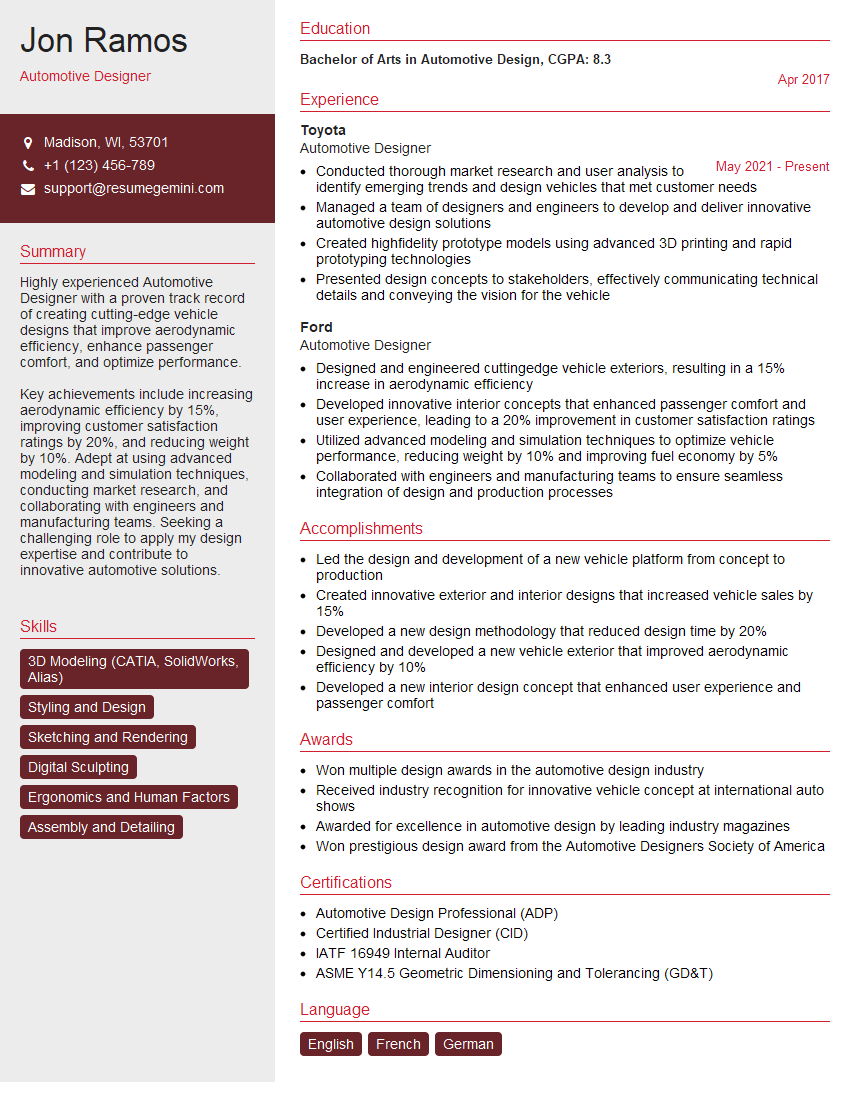
Mastering Automotive Design Theory is crucial for career advancement in this dynamic field. A strong understanding of these concepts demonstrates your expertise and problem-solving skills, setting you apart from other candidates. To maximize your job prospects, it’s vital to create a resume that effectively communicates your skills and experience to Applicant Tracking Systems (ATS). We strongly encourage you to leverage ResumeGemini to build a professional and ATS-friendly resume. ResumeGemini offers a streamlined process and provides examples of resumes tailored to Automotive Design Theory, helping you present your qualifications in the best possible light. Invest time in crafting a compelling resume – it’s your first impression on potential employers.
Explore more articles
Users Rating of Our Blogs
Share Your Experience
We value your feedback! Please rate our content and share your thoughts (optional).
What Readers Say About Our Blog
Really detailed insights and content, thank you for writing this detailed article.
IT gave me an insight and words to use and be able to think of examples