The thought of an interview can be nerve-wracking, but the right preparation can make all the difference. Explore this comprehensive guide to Comic Art interview questions and gain the confidence you need to showcase your abilities and secure the role.
Questions Asked in Comic Art Interview
Q 1. Explain your process for developing a comic book character.
Developing a compelling comic book character is a multi-stage process that goes beyond just sketching a cool design. It’s about crafting a believable individual with depth and motivations. I start by brainstorming core concepts: their personality (introverted, extroverted, cynical, optimistic), their backstory (traumatic event, happy childhood, unique upbringing), their goals (revenge, redemption, self-discovery), and their flaws (impulsiveness, arrogance, insecurity). These elements intertwine to create a unique identity.
Next, I create a visual representation, sketching several iterations to nail down their physical features – body type, facial structure, clothing style – reflecting their personality and background. For instance, a hardened detective might have weathered features and wear practical clothing, while a whimsical fairy might have delicate features and flowing garments. I’ll also design their signature pose and expressions, crucial for conveying emotion and character in panel illustrations.
Finally, I write a brief character biography, fleshing out their relationships with other characters, their powers (if applicable), and any recurring themes in their arc. This comprehensive approach ensures consistency in portraying the character throughout the comic, creating a richer experience for the reader.
Q 2. Describe your experience with different inking techniques.
My inking experience spans both traditional and digital techniques. Traditionally, I’ve worked extensively with brush pens, dip pens, and technical pens, experimenting with line weight and textures to create different effects. For instance, a thin, delicate line can convey vulnerability while thicker, bolder lines signify power or aggression. The level of detail achievable with a dip pen is unmatched, allowing for incredibly intricate work, while brush pens offer more fluidity and expressiveness.
Digitally, I’m proficient with programs like Clip Studio Paint and Photoshop, using various brushes to mimic traditional techniques or create entirely new styles. Digital inking gives me the flexibility of easily correcting mistakes, experimenting with different styles without wasting materials, and adding textures and effects that are more difficult to achieve traditionally. Ultimately, I choose the method that best suits the style and tone of the comic, sometimes even blending both for a unique result.
Q 3. How do you balance storytelling and visual appeal in your comic art?
Balancing storytelling and visual appeal is crucial; one cannot exist effectively without the other. The visual aspect shouldn’t just be pretty; it must serve the narrative. For example, a character’s posture and facial expression should reflect their inner state and contribute to the story’s emotional impact. Similarly, the environment and background elements must enhance the narrative context, setting the mood and providing clues about the setting and the character’s situation.
I achieve this balance through careful panel composition and pacing. A dramatic moment might be emphasized with a large, detailed panel, while a transitional moment can be conveyed with a smaller, simpler panel. I also use visual metaphors and symbolism – a stormy sky mirroring inner turmoil, for instance – to convey complex emotions and concepts without explicitly stating them, enhancing the reader’s engagement.
Q 4. What software are you proficient in for creating digital comics?
For digital comic creation, I’m highly proficient in Clip Studio Paint and Adobe Photoshop. Clip Studio Paint excels in its comic-specific features, offering robust tools for creating and managing panels, creating page layouts, and handling dialogue balloons. Its brush engine is remarkably versatile, allowing me to create and customize a wide range of brushes for inking, painting, and effects. Photoshop is my go-to for more advanced color correction, image manipulation, and effects like adding gradients and textures. I use both programs together; sometimes I use CSP for line art and sketching and then Photoshop for coloring and effects.
Q 5. Discuss your understanding of panel layout and pacing in sequential art.
Panel layout and pacing are fundamental elements of sequential art. They dictate the rhythm and flow of the story, guiding the reader’s eye and controlling the pace of the narrative. A series of small, fast-paced panels can create a sense of urgency, whereas larger panels with more detail can slow things down and emphasize a specific moment.
Understanding the principles of visual grammar, like the use of gutters (the space between panels) and transitions, is essential. A large gutter can suggest a significant time jump or change of location, while a small gutter implies a smoother, continuous flow of action. I frequently use variations in panel size, shape, and arrangement to guide the reader’s eye and build visual interest. For example, a vertical panel might heighten the sense of claustrophobia, while a horizontal panel might feel more expansive and open.
Q 6. How do you approach creating dynamic action sequences in your comics?
Creating dynamic action sequences requires a combination of visual techniques and storytelling skill. To convey motion, I use motion lines, blurred backgrounds, and exaggerated poses. The key is to show the action unfolding in stages, rather than simply presenting a single static image. I might use a series of small panels to depict a rapid succession of movements, or I might utilize a larger panel with multiple figures in various stages of movement to communicate the energy and intensity of the scene.
I also pay close attention to the flow of energy throughout the sequence; where does the motion start, how does it build, and where does it conclude? A strong understanding of anatomy and physics ensures that the action is believable and visually compelling. For instance, showing the effects of impact through distortion or debris enhances realism and the overall dynamic feeling.
Q 7. Explain your approach to coloring and shading in your work.
My approach to coloring and shading depends largely on the style and tone of the comic. Sometimes I opt for a more realistic approach using gradients and subtle shading to create depth and dimension, while other times I opt for a more stylized or flat coloring approach, emphasizing bold colors and simplified shading to create a unique visual style.
I use a variety of techniques to achieve different lighting effects. I might employ a cel-shading technique, using flat colors with hard lines, for a more cartoonish look. Or, I might use airbrushing and blending techniques to create a more painterly effect. The use of light and shadow is paramount in directing the viewer’s attention, creating mood, and enhancing the storytelling.
For example, a dark, shadowy background might enhance a sense of mystery, while bright, saturated colors might convey joy and excitement. I always consider the overall mood and atmosphere I wish to create when making decisions regarding color and shading.
Q 8. Describe your experience with different types of paper and inks.
My experience with various papers and inks is extensive, spanning decades of practice. Paper choice significantly impacts the final artwork. For instance, Bristol board, with its smooth surface, is ideal for precise linework and detailed rendering, perfect for the clean lines often seen in superhero comics. However, for a rougher, more textured look, like you might find in a more independent, gritty graphic novel, I might opt for something like cold-pressed watercolor paper. This allows for more expressive brushstrokes and ink bleeds.
Ink choices are equally crucial. I’ve worked with everything from traditional dip pens and India ink (allowing for incredible control and variation in line weight) to technical pens (for consistency and speed in inking pages) and even brush pens (perfect for rapid sketching and dynamic effects). The interplay between paper texture and ink properties dramatically alters the final aesthetic. For example, India ink on Bristol board produces crisp, clean lines, whereas the same ink on watercolor paper might feather slightly, adding a unique character.
Understanding these material properties is fundamental. I always test my inks and papers beforehand to ensure the desired effect. It’s a bit like a chef carefully selecting ingredients – the right combination leads to a masterpiece.
Q 9. How do you handle critiques and feedback on your artwork?
Constructive criticism is essential for growth. I actively seek feedback from trusted peers, editors, and even online communities. I’ve learned to separate subjective opinions from objective critiques. A comment like “the perspective feels off” is actionable; “I don’t like the character’s expression” is more subjective.
My approach is to analyze the feedback, understanding the critic’s point of view. Sometimes, a critique highlights a flaw I overlooked; other times, it might simply be a difference in artistic taste. I try to understand the *why* behind the critique, not just the *what*. This allows me to improve my process and learn from my mistakes. For example, early in my career, I received consistent feedback about inconsistent line weight. This led me to dedicate hours to practicing my inking technique, using various pens and pressures, ultimately refining my skills.
Q 10. What are your strengths and weaknesses as a comic book artist?
My strengths lie in dynamic figure drawing and storytelling through composition. I excel at creating visually compelling action sequences and conveying emotion through character expressions and body language. I’m also efficient, meeting deadlines consistently. However, one of my weaknesses is sometimes getting bogged down in detail, which can slow down my workflow. I’m working on improving time management techniques to balance detail with overall efficiency.
Another area I’m constantly developing is color theory. While I can create functional color palettes, exploring more sophisticated applications of color to heighten emotion and atmosphere is an ongoing goal. I actively seek opportunities to expand my knowledge through workshops and online resources.
Q 11. How do you stay updated on current trends in comic art?
Staying updated involves a multifaceted approach. I regularly browse online comic art communities, forums, and social media platforms like Instagram and ArtStation to see what other artists are creating and the techniques they’re using. Attending comic conventions is invaluable, allowing me to network with fellow artists and publishers, gaining first-hand exposure to current trends and styles.
Furthermore, I subscribe to industry publications and follow prominent comic artists and studios online. Keeping abreast of new software and digital tools is vital, especially in the current digital landscape. This continuous learning is not just about following trends but understanding the underlying principles driving these shifts. It’s about adapting and evolving as a creative professional.
Q 12. Describe your experience with traditional vs. digital art techniques.
Both traditional and digital techniques offer unique advantages. Traditional methods, using pen and ink on paper, provide a tactile and immediate connection to the artwork. The physical process allows for a certain spontaneity and freedom. However, it’s also more time-consuming and less forgiving of mistakes. Digital art, on the other hand, offers unparalleled flexibility and control. Software allows for easy corrections, experimentation with colors, and efficient workflow.
I utilize both extensively. I often start with traditional sketching to develop the composition and character designs, benefiting from the free-flowing nature of pen on paper. Then, I digitally ink and color the pages, taking advantage of the precision and versatility offered by digital tools. The combination allows me to leverage the strengths of each method, creating a balanced and efficient workflow.
Q 13. Explain your understanding of storytelling through visual language.
Storytelling through visual language is the core of comic art. It’s about communicating a narrative effectively using visuals alone. This involves utilizing various techniques to guide the reader’s eye, create emotion, and build suspense. Panel composition is key—the size, shape, and arrangement of panels dictate pacing and emphasis. For example, a series of small panels suggests rapid action, whereas a large, single panel emphasizes a dramatic moment.
Character expressions and body language are crucial for conveying emotion. Camera angles, similar to filmmaking, influence the audience’s perspective, shaping their understanding of the scene. The use of light and shadow can establish mood and atmosphere. Even the choice of color palette significantly affects the overall feel of the story. Mastering these elements is crucial for crafting a compelling and engaging visual narrative.
Q 14. How do you manage deadlines and workload in a fast-paced environment?
Managing deadlines in a fast-paced environment demands meticulous planning and efficient time management. I employ a project management system, breaking down large projects into smaller, manageable tasks with assigned deadlines. Prioritization is critical; I focus on the most time-sensitive tasks first. Utilizing project management software can be extremely helpful in this process, allowing for effective task tracking and scheduling.
Communication is also key. Maintaining open and honest communication with editors and collaborators ensures that everyone is on the same page regarding timelines and expectations. Finally, learning to say no to additional projects when my workload is already full is essential for maintaining a healthy work-life balance and preventing burnout. This is a skill that develops over time and is crucial to longevity in the industry.
Q 15. What is your experience with creating comics for different age groups?
Creating comics for different age groups requires a nuanced understanding of audience expectations and developmental stages. For younger audiences (say, children aged 6-10), the art style tends to be simpler, bolder, with clearly defined characters and easily digestible narratives. The storytelling is often more straightforward, focusing on themes of friendship, adventure, and problem-solving. Think of the vibrant, playful style of cartoons like Adventure Time. In contrast, comics aimed at teenagers or young adults can delve into more complex themes, utilize a more detailed and sophisticated art style, and incorporate more nuanced character development and storylines. A graphic novel like Persepolis, for instance, employs a more mature style to address difficult topics. Finally, adult comics often feature mature themes, complex plots, and potentially more graphic artwork. Watchmen is a prime example, known for its intricate storyline and sophisticated visual style.
My approach involves tailoring the art style, storytelling structure, and thematic content to resonate specifically with the target age group. This includes considering factors like color palettes, pacing, and the level of detail employed in both artwork and narrative.
Career Expert Tips:
- Ace those interviews! Prepare effectively by reviewing the Top 50 Most Common Interview Questions on ResumeGemini.
- Navigate your job search with confidence! Explore a wide range of Career Tips on ResumeGemini. Learn about common challenges and recommendations to overcome them.
- Craft the perfect resume! Master the Art of Resume Writing with ResumeGemini’s guide. Showcase your unique qualifications and achievements effectively.
- Don’t miss out on holiday savings! Build your dream resume with ResumeGemini’s ATS optimized templates.
Q 16. Describe your experience with working collaboratively on a comic project.
Collaborative comic creation is essential. I’ve worked extensively with writers, inkers, colorists, and letterers. A successful collaboration requires clear communication and mutual respect for each other’s creative vision. For example, during the development of one project, the writer had a strong vision for a particular character’s arc, and my visual interpretation needed to reflect this trajectory. We’d have regular meetings, sharing drafts and exchanging feedback on everything from character design to panel layouts. The inker’s linework significantly impacts the final look of the comic, so close collaboration with them ensures consistent visual quality. Similarly, the colorist’s choices drastically alter the mood and atmosphere, necessitating detailed discussions on color palettes and their emotional impact. Finally, the letterer plays a crucial role in readability and visual flow; subtle changes in font size, style, and placement can significantly enhance the reading experience.
Establishing a shared document or project management system, where everyone can access and comment on the artwork and script, ensures streamlined communication. Regular check-ins and open dialogue are crucial to resolving any creative disagreements and maintaining a cohesive vision throughout the project.
Q 17. How do you approach world-building and character development?
World-building and character development are intertwined processes. I often start by creating a detailed world map, outlining its geography, culture, and history. For example, for a fantasy comic, I might design a map with distinct regions, each with its unique flora, fauna, and societal structure. Once the world’s framework is established, I develop characters that fit organically into this environment. Character profiles are crucial, delving into their backstories, motivations, strengths, weaknesses, and relationships.
Character designs visually reflect their personality and position within the world. For instance, a character residing in a technologically advanced society might have a sleek, modern costume, contrasting with a character from a rustic village wearing more traditional attire. I utilize mood boards, sketches, and character sheets to visualize these elements and ensure internal consistency. Iterative feedback during these early stages is important to refine both the world and its inhabitants.
Q 18. What are your favorite comic books and artists, and why?
My influences are diverse. I admire the groundbreaking work of Will Eisner, whose innovative storytelling techniques revolutionized the medium. His meticulous attention to detail and exploration of complex themes in works like A Contract with God are truly inspiring. From a purely artistic standpoint, I’m captivated by the dynamic linework and expressive characters of Jack Kirby. His ability to convey raw energy and emotion through his art is unparalleled. More contemporary artists like Alison Bechdel, known for her autobiographical graphic novels like Fun Home, demonstrate the power of comics as a medium for self-expression and social commentary. Each of these artists, in their distinct styles and approaches, has shaped my own understanding and appreciation of the comic book art form.
Q 19. Explain your process for creating compelling comic book covers.
A compelling comic book cover serves as the story’s visual advertisement, instantly communicating the tone, genre, and central theme. My process typically begins with brainstorming concepts that encapsulate the essence of the story. This involves analyzing the narrative’s key moments and characters, choosing elements that are visually striking and relevant to the plot. Then, I sketch numerous thumbnails, experimenting with different compositions and visual elements. I consider the overall balance, leading lines, and focal points to ensure a visually appealing layout. The color palette plays a crucial role; it sets the mood and reinforces the story’s atmosphere. A darker, grittier palette might suggest a thriller, while bright, vibrant colors could indicate a more lighthearted adventure.
Once a satisfactory sketch is finalized, I move onto the final artwork, paying close attention to detail and refining the composition. The final step involves selecting a suitable font for the title and credits, ensuring it is legible and visually complements the overall artwork.
Q 20. How do you maintain consistency in style and tone throughout a comic series?
Maintaining consistency in style and tone is paramount for a successful comic series. I create a style guide that documents key elements of my art style, including character designs, color palettes, and panel layouts. This guide serves as a reference point throughout the series. For example, a character’s specific hairstyle, clothing, or posture needs to be consistent across all issues. This consistency is especially crucial in collaborative projects. Digital tools and software can assist in managing color palettes and character model sheets to ensure uniformity throughout the series. Furthermore, the storytelling structure and pacing should remain relatively consistent, establishing a recognizable pattern that readers can appreciate.
Regular self-reviews and feedback from editors play a crucial role in catching any stylistic inconsistencies before they become problematic. Consistency allows readers to immerse themselves in the world and characters, making the overall reading experience more satisfying.
Q 21. Describe your understanding of perspective and composition in sequential art.
Understanding perspective and composition is fundamental to creating compelling sequential art. Perspective, the representation of three-dimensional space on a two-dimensional surface, adds depth and realism to the artwork. I use various perspective techniques, such as one-point, two-point, and three-point perspective, to create believable environments and guide the reader’s eye. Composition, the arrangement of visual elements within a panel, is crucial for directing the reader’s gaze and conveying a specific mood or emotion. Effective composition uses elements like leading lines, rule of thirds, and negative space to create visually engaging panels.
For example, using a low angle to depict a powerful character can create a sense of dominance, while a high angle might make a character seem vulnerable. Understanding these principles allows me to control the pacing of the narrative and enhance emotional impact. Each panel should contribute to the overall narrative flow, guiding the reader through the story smoothly and effectively.
Q 22. How do you adapt your style to suit different genres of comics?
Adapting my style to different comic genres is crucial for effectively conveying the tone and atmosphere of each story. Think of it like an actor preparing for a role – a comedic performance requires a different approach than a dramatic one. For instance, a lighthearted slice-of-life comic will benefit from a softer, more expressive style with perhaps rounded linework and vibrant, pastel colors. Conversely, a gritty, dark fantasy comic might call for sharp, angular lines, darker shading, and a more muted color palette to emphasize the grim setting. I analyze the script meticulously, paying close attention to the narrative, characters, and intended audience. This analysis informs my decisions about line weight, panel composition, character design, and overall color scheme. For example, I recently worked on a superhero comic, which demanded dynamic action sequences, requiring a style focused on bold lines and impactful poses. In contrast, my work on a historical fiction comic involved a more detailed, realistic approach to character rendering and background design.
Q 23. Explain your experience with lettering and font choices in comics.
Lettering is as vital as the art itself; it contributes significantly to the pacing, readability, and overall aesthetic of a comic. I’m proficient in various lettering styles, adapting my choices based on the genre and tone of the comic. For example, a playful, all-caps font might work well for a children’s comic, while a more elegant serif font could enhance the sophistication of a historical drama. I use industry-standard software like Adobe Illustrator and Photoshop for lettering, paying close attention to kerning (spacing between letters), tracking (spacing between words), and leading (spacing between lines) to ensure optimal readability. I also consider the weight and style of the font to complement the art style. Poor lettering can break the visual flow, whereas well-executed lettering can subtly guide the reader’s eye and enhance the emotional impact of the narrative. I often experiment with different fonts and sizes, creating mockups before settling on a final choice. My goal is always clear and legible lettering that enhances, not detracts from, the storytelling. I’m equally comfortable with traditional hand-lettering techniques when the project calls for it.
Q 24. How do you handle the challenges of creating visually engaging content within budget constraints?
Budget constraints are a common reality in the comics industry. To create visually engaging content while staying within budget, I employ several strategies. Firstly, I prioritize smart composition. Strategic panel layouts and clever use of negative space can significantly reduce the amount of detailed artwork needed. Secondly, I optimize my workflow, focusing on efficient techniques like using digital tools effectively and streamlining the production process. I may simplify backgrounds to concentrate detail on the characters and key elements of the story. I often explore cost-effective color palettes, avoiding overly complex color schemes that require extensive time and resources. Thirdly, I might propose alternative solutions; for example, suggesting a simpler background style or focusing on a smaller page count to remain within the budget while still delivering a high-quality product. For example, I once worked on a project with tight budget restrictions. Instead of complex backgrounds for every panel, I created reusable background elements which I could adapt and modify for different scenes, drastically reducing my workload while maintaining visual consistency.
Q 25. Describe your familiarity with industry-standard file formats and printing processes.
I’m well-versed in industry-standard file formats like TIFF, JPEG, and PSD for image creation and submission. I understand the importance of high-resolution images for print, and I’m familiar with different color spaces, such as CMYK (for print) and RGB (for screen). I’m also proficient in preparing files for various printing processes, including offset printing and digital printing. I’m aware of the requirements for different print finishes, such as gloss, matte, or UV coating, and how these impact the final look and feel of the comic. I also know the importance of bleed, crop marks, and other pre-press specifications to ensure the final product is printed correctly. My experience includes working with printers to troubleshoot and resolve any issues that may arise during the printing process, ensuring a smooth and high-quality final product.
Q 26. Discuss your understanding of copyright and intellectual property in the comics industry.
Copyright and intellectual property are paramount in the comics industry. I have a thorough understanding of copyright law and its implications for creators. I know the importance of securing copyright for my original artwork and I’m aware of the different types of intellectual property rights, including trademarks and patents. I understand the importance of proper attribution and avoiding plagiarism. I’m familiar with the process of assigning copyright to publishers and negotiating contracts that protect my rights as a creator. I always ensure that any work I create adheres to ethical and legal standards. It is my practice to discuss the terms of copyright and intellectual property rights openly and thoroughly with publishers to establish clear expectations and legal protections from the outset of any project.
Q 27. What are your salary expectations for this role?
My salary expectations depend on the specific role, responsibilities, and the overall compensation package. I’m open to discussing a competitive salary based on my experience and expertise in the field. I am confident that my skills and experience will be a valuable asset to your team and I am eager to learn more about the compensation structure for this position.
Q 28. Do you have a portfolio you can share showcasing your work?
Yes, I have a comprehensive online portfolio showcasing a range of my comic art, from character designs and page layouts to finished comic pages, illustrating my adaptability across various genres. I’m happy to share the link with you, and I welcome any feedback you have after reviewing my work. The portfolio includes examples of my work across different styles and projects, allowing you to assess my skillset and artistic capabilities.
Key Topics to Learn for Your Comic Art Interview
- Character Design: Understanding anatomy, expression, and storytelling through character visuals. Practical application: Creating compelling characters that fit specific genres and narratives.
- Storyboarding and Layout: Mastering panel composition, pacing, and visual storytelling techniques. Practical application: Developing clear and engaging visual narratives for comic books or graphic novels.
- Inking and Coloring Techniques: Proficiency in various inking styles and digital coloring methods. Practical application: Creating visually appealing and consistent artwork across a project.
- Style and Genre Awareness: Understanding different comic art styles (e.g., manga, superhero, realistic) and their applications. Practical application: Adapting your style to meet the demands of a specific project or publisher.
- Software Proficiency: Demonstrating expertise in industry-standard software like Adobe Photoshop, Clip Studio Paint, or similar. Practical application: Efficient workflow and high-quality digital art production.
- Understanding the Comic Book Production Process: Knowledge of the collaborative process involved in creating a comic book, from scripting to printing. Practical application: Effective communication and collaboration with writers, editors, and other artists.
- Portfolio Presentation and Self-Promotion: Effectively showcasing your work and articulating your artistic vision. Practical application: Preparing a strong online portfolio and presenting your work confidently during interviews.
Next Steps
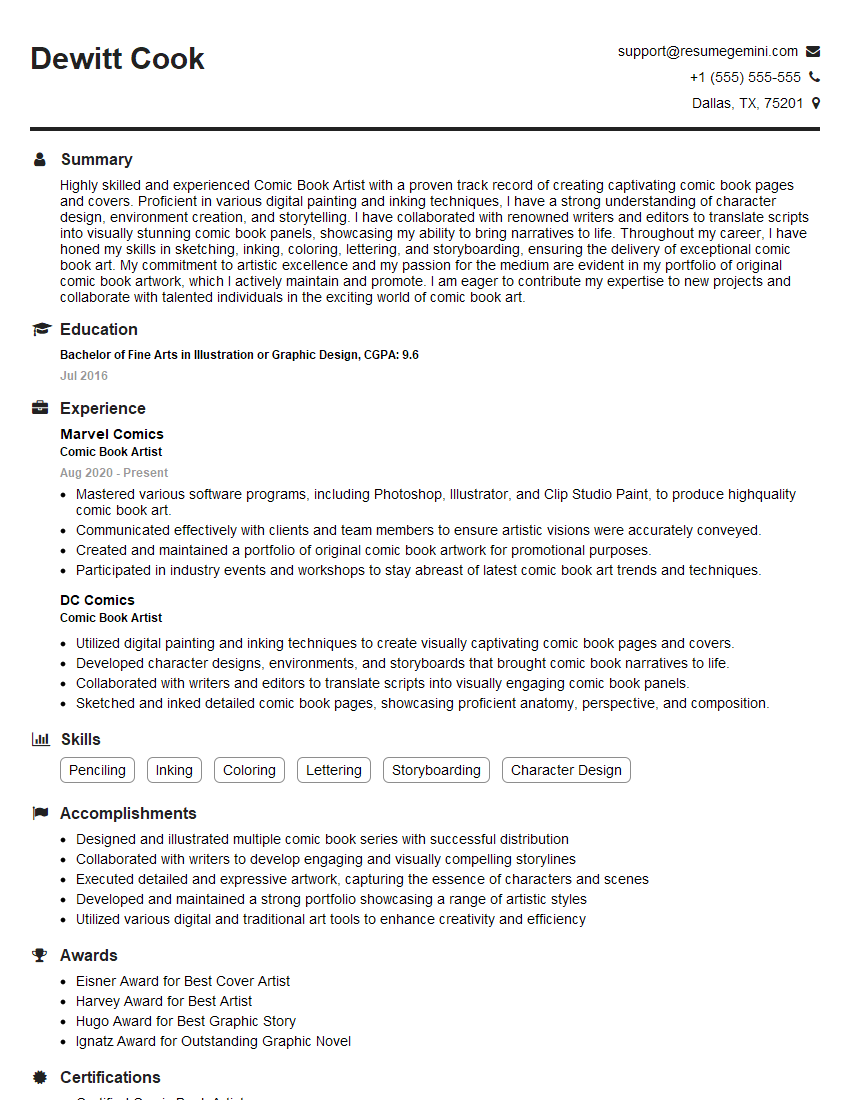
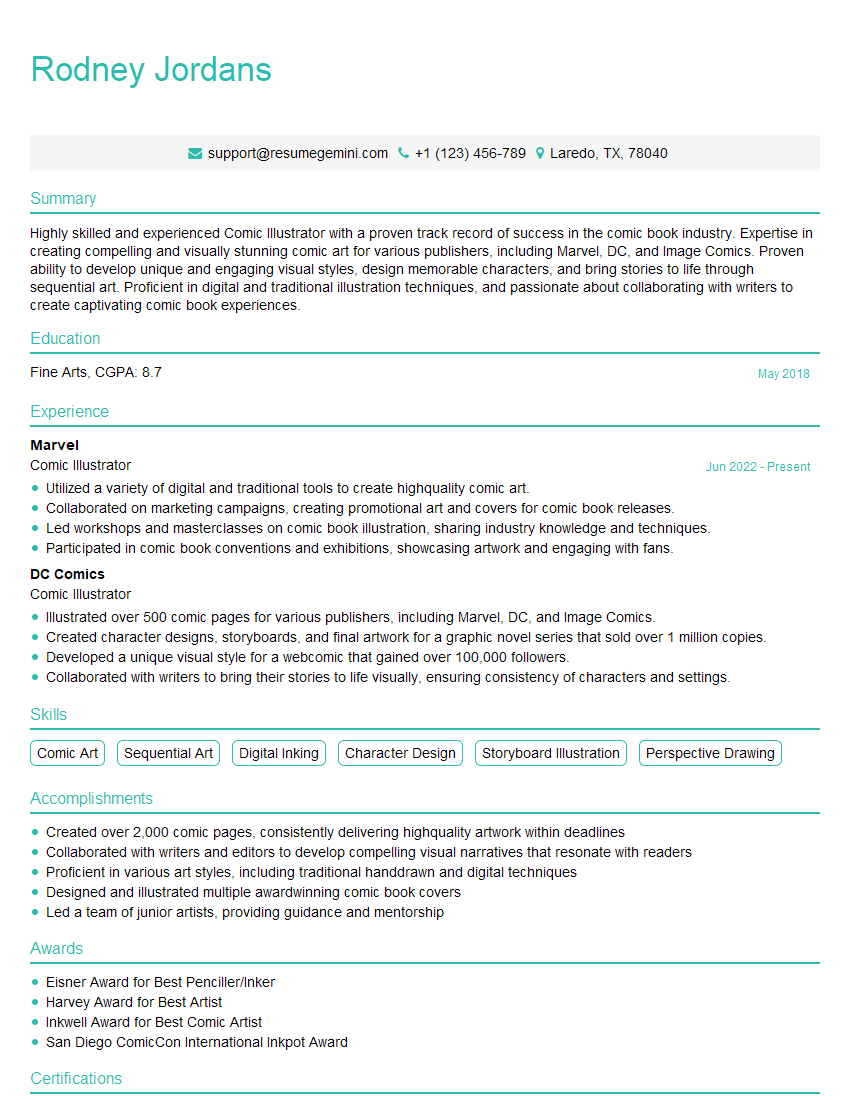
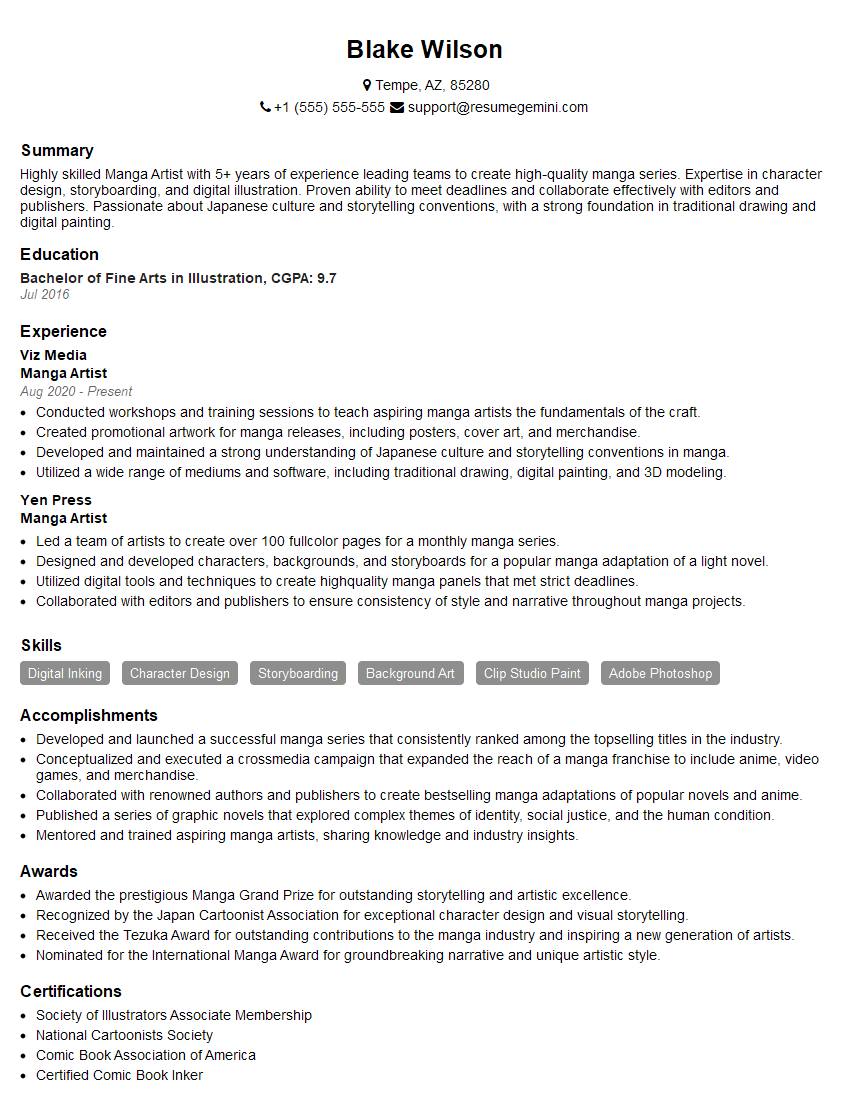
Mastering comic art opens doors to a dynamic and creative career, offering opportunities in publishing, animation, game development, and more. To maximize your job prospects, creating an ATS-friendly resume is crucial. ResumeGemini is a trusted resource that can help you build a professional resume that highlights your skills and experience effectively. We provide examples of resumes tailored specifically to the comic art industry to help you get started. Invest in crafting a compelling resume – it’s your first impression and a key step towards landing your dream job!
Explore more articles
Users Rating of Our Blogs
Share Your Experience
We value your feedback! Please rate our content and share your thoughts (optional).
What Readers Say About Our Blog
Really detailed insights and content, thank you for writing this detailed article.
IT gave me an insight and words to use and be able to think of examples