Interviews are more than just a Q&A session—they’re a chance to prove your worth. This blog dives into essential Composite Materials Engineering interview questions and expert tips to help you align your answers with what hiring managers are looking for. Start preparing to shine!
Questions Asked in Composite Materials Engineering Interview
Q 1. Explain the difference between thermoset and thermoplastic polymers in composite materials.
The key difference between thermoset and thermoplastic polymers lies in their response to heat. Think of it like this: thermosets are like cooked eggs – once they’re set, they can’t be easily reshaped. Thermoplastics, on the other hand, are more like Play-Doh – they soften when heated and can be remolded repeatedly.
Thermosets undergo irreversible chemical changes during curing, forming a rigid, cross-linked network structure. This makes them strong and dimensionally stable, but also brittle and difficult to recycle. Common examples in composites include epoxy resins and phenolic resins. They’re often used in high-performance applications like aerospace components because of their excellent strength-to-weight ratio.
Thermoplastics, conversely, soften upon heating and can be repeatedly melted and reshaped without significant degradation. They are typically more flexible and easier to process but might exhibit lower strength and heat resistance compared to thermosets. Examples include polyethylene (PE) and polypropylene (PP), though these are less common as matrix materials in high-performance composites.
Q 2. Describe the various types of fiber reinforcements used in composites (e.g., carbon fiber, glass fiber, aramid fiber).
Fiber reinforcement is crucial for providing the strength and stiffness to composite materials. Several types exist, each with unique properties:
- Carbon Fiber: Known for its exceptionally high strength-to-weight ratio and stiffness. It’s widely used in high-performance applications like aerospace, Formula 1 racing cars, and high-end bicycles. Think of it as the ‘muscle’ of the composite world.
- Glass Fiber: A more cost-effective option compared to carbon fiber, offering good strength and stiffness. It’s used extensively in construction, automotive, and marine applications, It’s the ‘workhorse’ – reliable and readily available.
- Aramid Fiber (e.g., Kevlar): Renowned for its high tensile strength and excellent impact resistance. Its flexibility and toughness make it ideal for ballistic protection, such as in bulletproof vests and protective clothing, It’s the ‘shield’, protecting against impact and high loads.
- Other Fibers: Other fibers like basalt, natural fibers (flax, hemp, jute), and ceramic fibers are also used, each offering unique properties and cost considerations.
Q 3. What are the advantages and disadvantages of using composite materials compared to traditional materials (e.g., metals)?
Composite materials offer significant advantages over traditional materials like metals, but also come with some drawbacks:
Advantages:
- High Strength-to-Weight Ratio: Composites can be significantly stronger and stiffer than metals for the same weight, leading to lighter and more efficient structures.
- Design Flexibility: They can be molded into complex shapes, allowing for intricate designs not easily achievable with metals.
- Corrosion Resistance: Many composites are highly resistant to corrosion, reducing maintenance costs and extending lifespan.
- Tailorable Properties: By varying fiber type, orientation, and matrix material, the properties of the composite can be tailored to specific application needs.
Disadvantages:
- High Manufacturing Costs: Composite manufacturing can be more expensive than metal fabrication, particularly for complex parts.
- Damage Tolerance: While strong, composites can be susceptible to damage from impact or fatigue. Detecting and repairing such damage can be challenging.
- Anisotropy: Composite properties often vary depending on the direction of loading, making design and analysis more complex.
- Recycling Challenges: Recycling composites can be difficult compared to metals, posing environmental concerns.
Q 4. Explain the concept of fiber volume fraction and its impact on composite properties.
Fiber volume fraction (Vf) refers to the proportion of the total composite volume occupied by the reinforcing fibers. It’s a crucial parameter determining the composite’s mechanical properties. Imagine a pizza: the fiber volume fraction is the percentage of the pizza covered in toppings (fibers), the rest being the crust (matrix).
A higher fiber volume fraction generally leads to increased strength, stiffness, and modulus of the composite. This is because fibers carry most of the load. However, excessively high Vf can lead to difficulties in processing and increased brittleness due to poor fiber distribution and lack of matrix to protect the fibers from damage. An optimal Vf is typically determined through experimentation and modeling to balance mechanical properties with processability.
For example, a carbon fiber reinforced polymer (CFRP) with a high Vf will exhibit superior stiffness compared to one with a lower Vf. But a very high Vf might make it hard to wet out all the fibers with the matrix, leading to imperfections and weak points.
Q 5. Describe different composite manufacturing processes (e.g., hand layup, autoclave molding, pultrusion).
Many manufacturing processes exist for creating composite parts, each with its own strengths and limitations:
- Hand Layup: A simple, low-cost method for smaller parts, involving manually placing layers of fiber reinforcement into a mold and then infusing them with resin. It’s labor-intensive and less precise than automated methods.
- Autoclave Molding: A high-pressure, high-temperature process used for high-performance composites. It yields superior quality and consistency, but requires specialized equipment and is expensive.
- Pultrusion: A continuous process for producing long, straight profiles (like beams or rods) with consistent cross-sections. Continuous fibers are pulled through a resin bath and then cured in a heated die. This is efficient for mass production of simple shapes.
- Resin Transfer Molding (RTM): Resin is injected into a closed mold containing the fiber reinforcement. It allows for complex shapes and good fiber distribution.
- Filament Winding: Fibers are wound onto a rotating mandrel to create cylindrical or tubular parts. It’s commonly used for pressure vessels and pipes.
The choice of manufacturing process depends on factors such as part geometry, desired properties, production volume, and cost considerations.
Q 6. How do you determine the mechanical properties of a composite material (e.g., tensile strength, flexural strength, modulus)?
Determining the mechanical properties of a composite material involves performing standardized tests according to established specifications (like ASTM standards). These tests measure various mechanical properties:
- Tensile Strength: A tensile test determines the material’s ability to withstand pulling forces until failure. A specimen is stretched until it breaks, and the stress at failure is the tensile strength.
- Flexural Strength (bending strength): This test assesses the material’s resistance to bending loads. A specimen is supported at both ends and loaded in the middle until failure.
- Modulus of Elasticity (Young’s Modulus): This indicates the material’s stiffness, representing its resistance to deformation under stress. It’s calculated from the slope of the linear portion of the stress-strain curve.
- Shear Strength: Measures the material’s resistance to forces acting parallel to its surface.
- Impact Strength: Evaluates the material’s resistance to sudden impact loads.
These tests require specialized equipment and careful sample preparation to ensure accurate and reliable results. The data obtained is crucial for designing and analyzing composite structures.
Q 7. Explain the concept of stress-strain curves for composite materials.
A stress-strain curve graphically represents the relationship between the stress (force per unit area) applied to a material and the resulting strain (deformation) it undergoes. For composites, the curve can be complex due to the material’s anisotropic nature (different properties in different directions). The shape reveals important information about the material’s mechanical behavior:
- Linear Elastic Region: The initial portion of the curve shows a linear relationship between stress and strain. The slope of this region represents the modulus of elasticity.
- Yield Point: The point at which the material starts to deform permanently. Beyond this point, plastic deformation occurs.
- Ultimate Tensile Strength: The maximum stress the material can withstand before failure.
- Fracture Point: The point where the material breaks.
The shape and characteristics of the stress-strain curve are influenced by factors like fiber type, volume fraction, matrix material, and fiber orientation. Analyzing these curves is vital in understanding a composite’s performance under different loading conditions and predicting its failure behavior.
Q 8. What are the different failure modes of composite materials?
Composite materials, unlike monolithic materials, can fail in a variety of ways due to the heterogeneous nature of their constituents (fibers and matrix). Failure isn’t a sudden catastrophic event but often a progressive degradation. Key failure modes include:
- Fiber Failure: This involves the breakage of individual fibers due to tensile overload. Think of it like snapping a single thread in a woven fabric. It can be brittle fracture or progressive damage depending on fiber type and loading.
- Matrix Cracking: The polymer matrix, being relatively weaker than the fibers, is prone to cracking under shear, tensile, or compressive stresses. Imagine cracks forming in the ‘glue’ holding the threads together.
- Fiber-Matrix Debonding: The interface between the fiber and matrix is a crucial area. Poor adhesion or high stress concentrations can lead to debonding, weakening the composite significantly. This is like the glue separating from the threads.
- Delamination: This refers to the separation of layers (plies) within a laminate. Imagine the layers of a plywood peeling apart. This is particularly crucial in layered composite structures.
- Buckling: Under compressive loads, composite layers can buckle, especially if the composite has low stiffness in the direction of the load.
- Shear Failure: This involves failure along planes parallel to the applied shear stress. It’s often seen in areas of high stress concentration, like near holes or joints.
Understanding these failure modes is crucial for designing safe and reliable composite structures, as each mode dictates different design considerations and material selection choices.
Q 9. How do you design for impact resistance in composite structures?
Designing for impact resistance in composites requires a multi-pronged approach focusing on both material selection and structural design. Imagine designing a protective helmet: it needs to absorb energy without breaking.
- Material Selection: Choosing high-toughness matrix resins (e.g., toughened epoxy) and high-strength, high-modulus fibers (e.g., carbon or aramid) is paramount. Aramid fibers, for instance, are known for their exceptional energy absorption capabilities.
- Fiber Architecture: The arrangement of fibers significantly impacts impact resistance. Using multidirectional fiber layups, or incorporating woven fabrics instead of unidirectional fibers, can significantly improve energy dissipation. This distributes impact energy across a larger area.
- Interlaminar Toughening: Incorporating toughening agents within the matrix or employing z-pinning (inserting short fibers perpendicular to the main layers) enhances interlaminar fracture toughness, preventing delamination under impact.
- Structural Design: Features like impact absorbers or energy-absorbing cores can be integrated into the structure. Consider a car’s bumper; it’s designed to crumple and absorb energy during a collision.
- Hybrid Composites: Combining different fiber types in a single composite structure (e.g., carbon fibers for stiffness and aramid fibers for impact resistance) can optimize both properties.
The specific strategy will depend heavily on the application’s requirements. For instance, a spacecraft component may prioritize stiffness and lightweight properties, while a sports equipment component would necessitate higher impact resistance.
Q 10. Explain the importance of non-destructive testing (NDT) methods in composite manufacturing.
Non-destructive testing (NDT) is absolutely crucial in composite manufacturing because defects can significantly reduce the structural integrity of the component, often without any visible indication. Think of it like an X-ray for your composite part: it helps find internal flaws.
NDT methods allow for the detection of flaws like voids, delaminations, fiber misalignment, and porosity before the part is put into service. This prevents catastrophic failures, saves costs associated with rework or replacement, and ensures the quality and reliability of the final product. It’s an essential quality control step to build confidence in the component’s integrity.
Q 11. What are common NDT methods used for composites (e.g., ultrasonic testing, radiography)?
Several NDT methods are commonly used for composites:
- Ultrasonic Testing (UT): This method uses high-frequency sound waves to detect internal flaws. The sound waves reflect off discontinuities, revealing their size, location, and orientation. It’s analogous to sonar, used to map the ocean floor. This is widely used and is very effective in detecting delaminations.
- Radiography (X-ray or Gamma-ray): This technique employs electromagnetic radiation to create images of the internal structure. Denser areas appear lighter, while voids appear darker. This helps visualize large flaws such as porosity and inclusions. Think of it like a medical X-ray.
- Thermography: This method detects temperature variations on the surface, which can be caused by internal flaws. It’s useful for detecting delaminations or areas of poor bonding.
- Acoustic Emission Testing (AE): This technique monitors the release of acoustic energy from a structure under stress. The signals indicate the location and type of damage, such as cracking or fiber breakage.
- Shearography: This is an optical NDT method which uses laser light to detect surface deformation indicating subsurface flaws.
The choice of NDT method depends on the type of composite, the expected flaws, and the level of detail required. Often, a combination of methods is employed to achieve comprehensive inspection.
Q 12. Describe the challenges in joining composite materials.
Joining composite materials presents significant challenges compared to joining metals. The heterogeneous nature of composites, the need to avoid damage to the fibers, and the potential for stress concentrations at the joint all complicate the process. Imagine trying to seamlessly stitch together a fabric; you wouldn’t want to tear the threads.
- Fiber Damage: Joining methods must minimize damage to the fibers during the joining process, as this can dramatically reduce the strength of the joint.
- Adhesive Bonding: This is a widely used method, but it requires careful surface preparation to ensure adequate bonding strength. Selection of the right adhesive is also crucial, taking into account factors like temperature, chemical resistance, and the specific composite materials involved.
- Bolting/Fastening: This method introduces stress concentrations around the fastener holes, reducing the overall strength. Careful design of the hole size and placement is necessary to minimize these effects.
- Welding: Welding composites is challenging due to the thermal sensitivity of the matrix material. It often requires specialized techniques and equipment to avoid degradation of the material properties.
- Mechanical Joining: Methods like crimping or interlocking can be used, but often lead to complex part designs.
The optimal joining technique depends heavily on the specific application, the type of composites being joined, and the required mechanical properties of the joint. Careful consideration of these factors is crucial to ensure the structural integrity of the joint.
Q 13. How do you design composite components for fatigue resistance?
Designing composite components for fatigue resistance requires a detailed understanding of the material’s behavior under cyclic loading. Fatigue is like a slow, progressive weakening of the material under repeated stresses, eventually leading to failure. It’s like bending a paperclip back and forth; eventually it will break.
- Material Selection: High-fatigue strength fibers (e.g., carbon fiber) and high-toughness matrices are essential. The choice also depends on the loading conditions and the environment.
- Fiber Orientation: Optimizing the fiber orientation in each ply to align with the predominant stress directions minimizes stress concentrations and enhances fatigue life. This is crucial, as fatigue often initiates at stress concentrations.
- Stress Concentration Reduction: Designing components with smooth transitions and avoiding sharp corners or holes minimizes stress concentration points, where fatigue cracks are most likely to initiate.
- Surface Treatment: Surface treatment can help improve fatigue life. Methods include polishing or applying protective coatings to reduce surface flaws.
- Micromechanical Modeling: Advanced simulations can help predict the fatigue behavior of a composite structure under specific loading conditions, allowing optimization of the design for fatigue resistance.
Fatigue is a complex phenomenon, and careful design and testing are crucial to ensure a component’s long-term durability under cyclic loading. This requires a balance between performance, weight, and cost factors.
Q 14. Explain the concept of laminate theory in composite materials.
Laminate theory is a powerful tool used to predict the mechanical behavior of laminated composite structures. A laminate is simply a stack of individual layers (plies) with different fiber orientations. Laminate theory allows us to determine the overall stiffness and strength properties of the laminate based on the properties of its individual plies and their stacking sequence. It’s like calculating the strength of a building by considering the individual strengths and orientations of the bricks.
The theory makes several assumptions, such as perfect bonding between plies, linear elastic behavior of the constituents, and the neglect of interlaminar stresses. Despite these simplifications, laminate theory provides reasonably accurate predictions for many engineering applications. It utilizes a process of transforming the stiffness of each individual ply into a global coordinate system and then combining the stiffnesses of each layer to determine the overall behavior of the laminate. This results in a set of stiffness matrices (A, B, and D matrices) that describe the extensional, coupling, and bending stiffness of the laminate. The analysis involves solving the governing equations based on these stiffness matrices for given loads or boundary conditions.
Laminate theory is indispensable in the design and analysis of composite structures ranging from aircraft wings to wind turbine blades, allowing engineers to optimize the material layout for specific performance requirements.
Q 15. How do you select the appropriate composite material for a given application?
Selecting the right composite material is like choosing the perfect tool for a job – you need the right properties for the specific task. It’s a multi-faceted process involving careful consideration of several factors.
- Required Mechanical Properties: What strength, stiffness, and toughness are needed? A high-strength carbon fiber composite might be ideal for an aerospace application, while a glass fiber reinforced polymer (GFRP) might suffice for a less demanding application like a boat hull.
- Environmental Conditions: Will the material be exposed to extreme temperatures, UV radiation, moisture, or chemicals? Some matrices, like certain polyimides, are better suited for high-temperature environments than epoxies.
- Manufacturing Process: How will the composite be manufactured? Some processes, like resin transfer molding (RTM), are better suited for certain materials and geometries than others (e.g., hand layup).
- Cost: Material costs vary significantly. Carbon fiber is expensive, while glass fiber is considerably more affordable. The manufacturing process also impacts the overall cost.
- Durability and Lifespan: How long is the composite expected to last under the intended service conditions? Careful material selection is critical for ensuring long-term performance and preventing premature failure.
For instance, designing a wind turbine blade requires a composite with high strength-to-weight ratio, fatigue resistance, and the ability to withstand extreme weather conditions. This might lead to selecting a material like carbon fiber reinforced epoxy.
Career Expert Tips:
- Ace those interviews! Prepare effectively by reviewing the Top 50 Most Common Interview Questions on ResumeGemini.
- Navigate your job search with confidence! Explore a wide range of Career Tips on ResumeGemini. Learn about common challenges and recommendations to overcome them.
- Craft the perfect resume! Master the Art of Resume Writing with ResumeGemini’s guide. Showcase your unique qualifications and achievements effectively.
- Don’t miss out on holiday savings! Build your dream resume with ResumeGemini’s ATS optimized templates.
Q 16. Describe the influence of environmental factors (e.g., temperature, humidity) on composite properties.
Environmental factors significantly influence composite properties. Think of it like this: the materials are like a team, and each player (fiber and matrix) is affected differently by external conditions.
- Temperature: High temperatures can soften the matrix resin, reducing the composite’s stiffness and strength. Low temperatures can make the matrix brittle, increasing the risk of cracking. The coefficient of thermal expansion (CTE) mismatch between the fiber and matrix can also lead to internal stresses at varying temperatures.
- Humidity: Moisture absorption can weaken the matrix, particularly in hydrophilic (water-loving) resins like some polyesters. This can lead to reduced mechanical properties and even degradation over time. The effect is often more pronounced in long-term exposure.
- UV Radiation: UV light can degrade the matrix resin, causing discoloration, embrittlement, and a reduction in mechanical properties. This is especially relevant for outdoor applications.
- Chemical Exposure: Certain chemicals can attack and dissolve the matrix, reducing its effectiveness. The choice of matrix and fiber should consider anticipated chemical environments.
For example, a composite used in a marine environment needs excellent resistance to moisture and salt water. A vinyl ester resin, known for its hydrolytic stability, would be preferable to a more susceptible epoxy in such a scenario.
Q 17. Explain the role of matrix resin in composite materials.
The matrix resin in a composite material is the glue that holds everything together. It binds the reinforcing fibers, transferring load between them and protecting them from environmental damage. Think of it as the mortar in a brick wall – the bricks (fibers) provide strength, but the mortar binds them and distributes the load.
- Load Transfer: The matrix efficiently transfers stress from one fiber to another, ensuring that the composite material can bear high loads.
- Fiber Protection: It shields the fibers from environmental factors like moisture, chemicals, and UV radiation, extending the composite’s lifespan.
- Shape Retention: The matrix provides the composite with its overall shape and geometry.
- Toughness Enhancement: Although fibers provide the strength, the matrix contributes significantly to the composite’s toughness and fracture resistance.
Without an effective matrix, the fibers would be loosely packed and unable to work together effectively. The entire composite structure would lack strength and durability.
Q 18. What are some common matrix resins used in composites (e.g., epoxy, polyester, vinyl ester)?
Many matrix resins exist, each with its own strengths and weaknesses. The choice depends on the application’s specific demands.
- Epoxy Resins: Excellent mechanical properties, good chemical resistance, and a wide range of curing options. Commonly used in high-performance applications like aerospace and automotive.
- Polyester Resins: Relatively inexpensive and easy to process, making them suitable for less demanding applications such as boat hulls and some construction materials. However, they are less chemically resistant than epoxies.
- Vinyl Ester Resins: Offer a good balance between cost and performance. They possess better chemical resistance than polyesters and are often used in corrosive environments (e.g., marine applications).
- Phenolic Resins: Excellent thermal and electrical insulation properties, often used in applications requiring high temperature resistance.
- Polyimide Resins: Exceptional high-temperature resistance, making them suitable for aerospace and high-temperature industrial applications.
Each resin has a unique set of properties that make it suitable for different applications. For example, the high temperature stability of polyimides makes them ideal for aerospace applications exposed to extreme heat during flight.
Q 19. Describe the concept of a composite’s layup sequence and its effect on mechanical properties.
The layup sequence refers to the arrangement and orientation of plies (layers) in a composite structure. It’s crucial because it directly affects the composite’s mechanical properties. Imagine building a wall with bricks – stacking them neatly and aligning them strategically makes a stronger structure than a random arrangement.
- Strength and Stiffness: Placing plies at 0° (parallel to the load) provides high tensile strength in that direction. Adding plies at 90° (perpendicular to the load) increases stiffness and resistance to compressive loads. Using off-axis plies (at angles other than 0° or 90°) can optimize strength and stiffness in different directions.
- Shear Strength: Specific arrangements can improve shear strength, which is crucial for resisting twisting forces.
- Isotropy vs. Anisotropy: A symmetric layup, such as [0/90/90/0], can create a more isotropic (similar properties in all directions) composite. An asymmetric layup will result in an anisotropic (different properties in different directions) composite.
For example, a wing spar in an aircraft might use a layup sequence that prioritizes strength along its longitudinal axis, while also providing sufficient stiffness to resist bending forces. The layup would be carefully designed to meet these requirements effectively.
Q 20. How do you analyze the failure of a composite component?
Analyzing composite failure is more complex than analyzing the failure of a homogeneous material. It involves understanding the failure mechanisms of both the fiber and the matrix. It’s a detective work, carefully examining all aspects.
- Visual Inspection: Start with a careful visual examination to identify any visible damage, such as cracks, delamination, fiber breakage, or matrix cracking.
- Microscopic Analysis: Microscopy (optical or scanning electron microscopy) can reveal subtle damage not visible to the naked eye, providing insights into failure initiation and propagation.
- Mechanical Testing: Tensile, compression, flexural, and shear tests can determine the residual mechanical properties and pinpoint the specific failure mode.
- Non-Destructive Evaluation (NDE): Techniques such as ultrasonic inspection, X-ray radiography, and thermography can reveal internal damage without destroying the component.
- Failure Analysis Software: Specialized software can help interpret the data from NDE and mechanical testing, predicting failure modes and suggesting improvements for future designs.
A common failure mode in composites is delamination, where layers separate due to interlaminar shear stresses. Understanding the cause – perhaps from impact damage or manufacturing defects – is key to designing more robust and reliable structures.
Q 21. Explain the use of finite element analysis (FEA) in composite design.
Finite element analysis (FEA) is an invaluable tool in composite design. It allows engineers to virtually simulate the behavior of a composite structure under various loading conditions, predicting its strength, stiffness, and failure modes before physical prototyping.
- Stress and Strain Analysis: FEA can accurately predict stress and strain distributions within a composite structure, identifying areas prone to failure.
- Optimization: It enables the optimization of layup sequences, material selection, and geometry to achieve the desired performance with minimal material usage.
- Failure Prediction: FEA can predict different failure modes, such as fiber breakage, matrix cracking, and delamination, helping engineers design more robust components.
- Impact Simulation: The effects of impact loading, crucial for many applications, can be effectively simulated and analyzed.
- Cost Reduction: By identifying potential problems early in the design process, FEA reduces the need for expensive physical prototypes and testing.
Imagine designing a high-performance bicycle frame. Using FEA, designers can virtually test different layup sequences and material combinations under simulated riding conditions. This allows them to optimize the frame’s weight, strength, and stiffness before manufacturing a physical prototype, resulting in a lighter, stronger, and potentially less costly design.
Q 22. What are some common software tools used for composite analysis (e.g., ABAQUS, ANSYS)?
Several sophisticated software packages are employed for the analysis of composite materials, each offering unique capabilities. Popular choices include ABAQUS, ANSYS, and LS-DYNA. These Finite Element Analysis (FEA) tools allow engineers to model complex composite structures, predict their behavior under various loading conditions, and optimize their design. For instance, ABAQUS excels in handling nonlinear material behavior and complex contact problems often encountered in composite structures. ANSYS offers a broad range of capabilities, from linear static analysis to advanced simulations including fatigue and fracture mechanics. LS-DYNA is particularly well-suited for impact and crash simulations, crucial for applications like automotive and aerospace components.
The selection of software depends heavily on the specific project requirements. A simple static analysis might be sufficient for some applications, while others necessitate advanced capabilities for simulating complex material behavior, such as delamination or fiber breakage. The software also needs to be compatible with the specific material models used to describe the composite’s behavior, which is usually defined through its constituent material properties and layup configurations.
Q 23. Describe your experience with composite material testing and analysis.
My experience encompasses a wide range of composite material testing and analysis techniques. I’ve extensively used mechanical testing methods like tensile, compressive, flexural, and shear testing to determine material properties. These tests provide crucial data, such as elastic modulus, strength, and Poisson’s ratio, which are essential inputs for FEA simulations. Beyond mechanical tests, I’m proficient in non-destructive testing (NDT) methods including ultrasonic C-scan, X-ray inspection, and thermography, which are critical for evaluating the internal quality and detecting flaws in composite parts. This ensures that the manufactured components meet the required quality standards.
Analyzing the test data involves utilizing statistical methods to determine the material properties, interpreting results to identify potential failure mechanisms, and correlating these with FEA predictions. For example, I’ve worked on projects where discrepancies between experimental data and simulations pointed to inadequacies in the material model, leading to refinements in the constitutive relationships used for modeling. This iterative process of testing, analysis and model refinement is crucial for accurate prediction of composite performance.
Q 24. How do you ensure the quality control of composite parts during manufacturing?
Ensuring quality control in composite part manufacturing is a multifaceted process that begins with rigorous material selection and extends throughout the entire manufacturing lifecycle. This involves several key steps:
- Raw Material Inspection: Careful inspection of fibers, resins, and other constituent materials for defects and adherence to specifications.
- Process Monitoring: Closely monitoring the manufacturing process, including fiber layup, curing parameters (temperature, pressure, time), and consolidation techniques. Real-time data acquisition and analysis can help identify and correct deviations from optimal process settings.
- Non-destructive Testing (NDT): Employing methods like ultrasonic C-scan, X-ray radiography, and acoustic emission monitoring to detect internal flaws such as voids, delaminations, and fiber misalignments.
- Dimensional Inspection: Verification that the manufactured parts conform to the design specifications using techniques like coordinate measuring machines (CMMs) and laser scanning.
- Destructive Testing (DT): Performing selective destructive tests (e.g., tensile, compression) to validate material properties and structural integrity.
Implementing a robust quality control system, combining these methods, minimizes defects, ensures consistent product quality and ultimately contributes to enhanced structural integrity and service life of the composite components.
Q 25. Explain the concept of damage tolerance in composite structures.
Damage tolerance in composite structures refers to the ability of a composite component to withstand damage without catastrophic failure. Unlike many metallic materials, which often exhibit brittle failure, composites can tolerate certain levels of damage (e.g., cracks, delaminations) while maintaining structural integrity and load-carrying capacity. This is a crucial aspect of design, particularly for safety-critical applications like aerospace.
This concept is based on the understanding that the damage may be contained or its propagation may be slow enough to allow for detection and maintenance before complete failure. Damage tolerance analysis involves assessing the growth of damage under service loading conditions, determining the residual strength of the damaged structure, and establishing inspection intervals to detect and manage damage effectively. Advanced FEA simulations, incorporating damage mechanics models, are often used to predict damage initiation and progression.
For example, a wing spar in an aircraft may sustain minor impact damage during operation. A damage-tolerant design ensures that this damage will not immediately cause catastrophic failure, allowing time for inspection and repair. The design may incorporate features like redundant load paths or damage-arresting mechanisms to mitigate the consequences of damage.
Q 26. Describe your experience with different types of composite structures (e.g., beams, plates, shells).
My experience spans various composite structures, including beams, plates, and shells. Each type presents unique challenges in design and analysis. I’ve worked extensively on composite beams, focusing on optimizing their cross-sectional geometry for maximum strength-to-weight ratio and stiffness. This involves considering the fiber orientation and layup sequence to tailor the mechanical properties to meet the specific loading conditions. For example, designing a helicopter blade requires careful optimization to ensure sufficient stiffness and strength while minimizing weight.
With composite plates, I’ve focused on buckling analysis and understanding the effects of initial imperfections and residual stresses on their load-carrying capacity. Shells are often more complex, demanding advanced FEA techniques to accurately predict their response under various loading scenarios. For example, the analysis of a pressure vessel requires consideration of stress concentrations and potential failure modes, including delamination and fiber breakage.
My expertise also extends to the design and analysis of more complex three-dimensional structures created through various manufacturing techniques like filament winding, resin transfer molding, and autoclave curing. This includes detailed understanding of the effect of these manufacturing processes on the resulting mechanical properties and potential defects within the final structure.
Q 27. How do you address the issues of creep and stress relaxation in composite materials?
Creep and stress relaxation are time-dependent phenomena that affect the long-term performance of composite materials. Creep refers to the gradual deformation of a material under constant stress over time, while stress relaxation is the gradual decrease in stress under constant strain. These phenomena are particularly significant at elevated temperatures or under sustained loads.
Addressing these issues requires careful material selection and design considerations. Selecting high-temperature resistant matrix materials can mitigate creep and stress relaxation at elevated temperatures. In design, reducing the applied stresses and strains can minimize these effects. For applications requiring long-term performance under sustained loads, using FEA models that incorporate time-dependent material properties – viscoelastic or viscoplastic models – is crucial for accurately predicting long-term behavior and ensuring that the design meets the required service life.
For example, in aerospace applications, understanding creep is vital for predicting the long-term stability of composite components under flight loads. The design of the component may need to account for the anticipated creep deformation to ensure it continues to function safely throughout its operational life. Advanced models that capture these time-dependent material behaviors, including nonlinear effects, are essential in these scenarios.
Q 28. What are some emerging trends in composite materials technology?
Several emerging trends are shaping the future of composite materials technology. One prominent trend is the development of advanced manufacturing techniques, such as additive manufacturing (3D printing) and automated fiber placement (AFP), which enable the creation of complex shapes and customized structures with higher precision and efficiency. These advanced techniques allow for improved design freedom and optimization of part performance. Another notable trend is the use of bio-inspired designs, mimicking the structure and properties of natural materials like bone or wood to create stronger, lighter, and more sustainable composite materials. This biomimicry approach significantly enhances both performance and resource efficiency.
Furthermore, there is increasing focus on the development of self-healing composites that can autonomously repair minor damage, extending their lifespan and reliability. Research also continues in developing high-performance materials with enhanced properties such as improved impact resistance, better thermal management, and enhanced durability in harsh environments. The exploration of sustainable and recyclable composite materials is also gaining significant traction, aiming to minimize environmental impact and promote circular economy principles.
Key Topics to Learn for Composite Materials Engineering Interview
- Material Selection and Characterization: Understanding the properties of fibers (carbon, glass, aramid), matrices (polymers, metals, ceramics), and their interactions. This includes exploring techniques like tensile testing, flexural testing, and impact testing to determine material suitability.
- Manufacturing Processes: Familiarize yourself with various composite manufacturing techniques such as hand lay-up, autoclave molding, pultrusion, filament winding, and resin transfer molding (RTM). Be prepared to discuss the advantages and limitations of each process and their impact on final product properties.
- Mechanical Behavior and Analysis: Master the concepts of stress-strain relationships, failure theories (e.g., maximum stress, Tsai-Wu), and laminate theory. Understanding how to analyze the mechanical behavior of composite structures under different loading conditions is crucial.
- Design and Optimization: Learn about the principles of designing composite components for optimal strength, stiffness, and weight. This includes finite element analysis (FEA) techniques and topology optimization methods for lightweight and high-performance designs.
- Failure Analysis and Non-Destructive Testing (NDT): Understand common failure modes in composite materials and the techniques used to detect flaws and damage before they lead to catastrophic failure. Familiarize yourself with NDT methods such as ultrasonic inspection, X-ray radiography, and thermography.
- Specific Applications: Be prepared to discuss applications of composite materials in various industries, such as aerospace, automotive, wind energy, and marine engineering. Highlighting your knowledge of specific case studies will demonstrate your practical understanding.
Next Steps
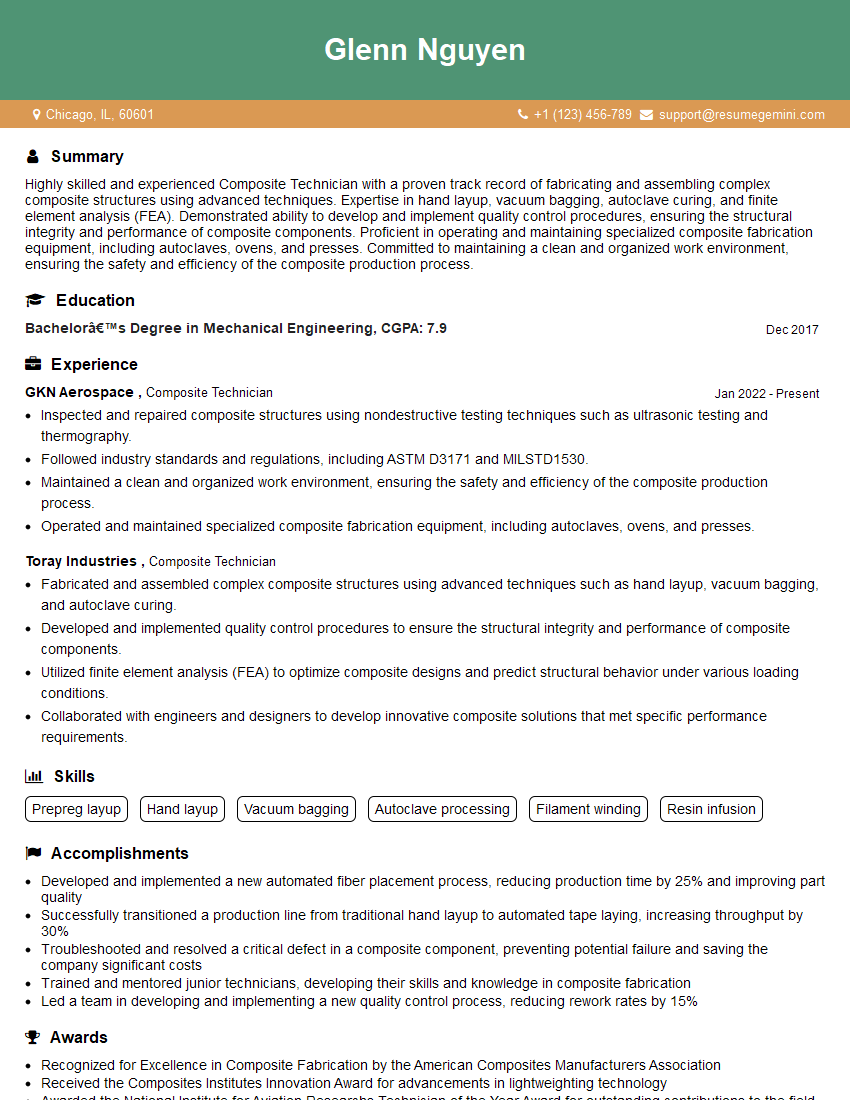
Mastering Composite Materials Engineering opens doors to exciting and impactful careers in diverse industries. A strong understanding of these principles is essential for securing your dream role. To significantly boost your job prospects, it’s crucial to present your skills and experience effectively through a well-crafted, ATS-friendly resume. ResumeGemini is a trusted resource that can help you create a professional and impactful resume tailored to the specific demands of the Composite Materials Engineering field. Examples of resumes tailored to Composite Materials Engineering are available to guide you. Take the next step towards securing your ideal position – create a compelling resume that highlights your expertise.
Explore more articles
Users Rating of Our Blogs
Share Your Experience
We value your feedback! Please rate our content and share your thoughts (optional).
What Readers Say About Our Blog
Really detailed insights and content, thank you for writing this detailed article.
IT gave me an insight and words to use and be able to think of examples