The thought of an interview can be nerve-wracking, but the right preparation can make all the difference. Explore this comprehensive guide to Electrical Testing and Troubleshooting interview questions and gain the confidence you need to showcase your abilities and secure the role.
Questions Asked in Electrical Testing and Troubleshooting Interview
Q 1. Explain the difference between AC and DC electricity.
The fundamental difference between AC (Alternating Current) and DC (Direct Current) electricity lies in the direction of electron flow. In DC, electrons flow consistently in one direction, like a river flowing downstream. This is the type of electricity produced by batteries. AC, on the other hand, involves electrons periodically changing direction, oscillating back and forth, much like a swinging pendulum. This is the type of electricity supplied to our homes and businesses.
This difference impacts several aspects of electrical systems. DC circuits are generally simpler to analyze, while AC circuits exhibit phenomena like inductive and capacitive reactance, adding complexity. Furthermore, AC voltage can be easily transformed to higher or lower voltages using transformers, a crucial element in long-distance power transmission. DC voltage transformation requires more complex electronic circuitry. For instance, a typical battery provides a constant DC voltage, while the power coming from a wall outlet is AC, usually 120V in North America and 230V in many other parts of the world.
Q 2. Describe your experience with different types of multimeters.
My experience with multimeters encompasses a wide range of models, from basic analog types to sophisticated digital multimeters (DMMs) with advanced features. I’m proficient in using both types for various tasks. Analog multimeters provide a visual representation of the measured value using a needle moving across a calibrated scale; these are simpler and more robust but lack the precision of their digital counterparts.
Digital multimeters offer higher accuracy, better resolution, and often include functions such as frequency measurement, capacitance measurement, and diode testing. I’ve extensively used DMMs from brands like Fluke and Keysight, appreciating their reliability and features like data logging and automatic ranging. In one project, a high-precision DMM was critical in identifying a subtle voltage drop in a low-power circuit, a problem that would have been difficult to detect with an analog meter. My experience also extends to clamp meters, which allow for non-contact current measurement, a vital safety feature when dealing with high currents.
Q 3. How do you troubleshoot a circuit with intermittent faults?
Troubleshooting intermittent faults requires a systematic and patient approach. These faults are notoriously difficult to diagnose because they don’t occur consistently. My strategy begins with careful observation and documentation. I’ll start by noting the conditions under which the fault appears—is it temperature-dependent, related to load changes, or perhaps triggered by specific operations?
Next, I use various tools to pinpoint the problem area. A thermal imager can identify components overheating intermittently. I might also employ vibration analysis or even use a high-speed camera to look for subtle changes in component behavior. Often, a thorough visual inspection, looking for loose connections, cracks, or corrosion, is highly effective. I’ll systematically test components and connections, including the use of an oscilloscope to observe signals for irregularities. Injection of signals or application of controlled stress can sometimes force the fault to manifest, enabling easier diagnosis. A recent challenge involved a power supply with an intermittent short. By carefully observing the system’s behavior under different loads and temperatures, I eventually traced the problem to a cold solder joint on a capacitor.
Q 4. What safety precautions do you take when working with high-voltage equipment?
Safety is paramount when working with high-voltage equipment. My safety procedures always begin with a thorough risk assessment. This includes identifying potential hazards, determining the necessary safety precautions, and selecting the appropriate personal protective equipment (PPE).
This PPE commonly includes insulated gloves, safety glasses, and arc-flash protective clothing appropriate for the voltage level. Before beginning any work, I always visually inspect the equipment for any signs of damage. I use appropriate lockout/tagout procedures to de-energize the equipment completely, verifying the absence of voltage using a non-contact voltage tester. I also utilize insulated tools and work mats to minimize the risk of accidental contact. When working near high-voltage lines, I maintain a safe distance and am always aware of potential hazards from falling objects. Teamwork is crucial, and I ensure everyone on the team adheres to strict safety guidelines and communicates effectively.
Q 5. Explain the process of diagnosing a faulty component using an oscilloscope.
An oscilloscope is an indispensable tool for diagnosing faulty components by visually analyzing electrical signals. The process begins with connecting the oscilloscope probes to appropriate points in the circuit, ensuring proper grounding and avoiding any potential damage to the equipment.
The key is to understand the expected waveform for the component under test. Any deviation from the expected waveform—such as distortions, unexpected frequencies, or changes in amplitude—indicates a potential problem. For example, an unexpected spike in a voltage waveform might point to a faulty capacitor or diode. A distorted signal on a digital signal line could indicate a problem with a logic gate. By observing the signal at various points in the circuit, you can isolate the faulty component. The oscilloscope also allows precise measurement of voltage, current, and frequency, providing quantitative data for effective troubleshooting. In one case, I used an oscilloscope to detect a timing issue in a microcontroller circuit, leading to the identification of a faulty crystal oscillator.
Q 6. How do you interpret electrical schematics and wiring diagrams?
Interpreting electrical schematics and wiring diagrams is a fundamental skill. Schematics use standardized symbols to represent components and their interconnections, providing a logical representation of the circuit. Wiring diagrams, on the other hand, show the physical layout of the components and wires.
To effectively interpret these documents, I begin by understanding the symbols used. I trace the flow of signals or power through the circuit, identifying the different paths and branches. I also pay close attention to component values and specifications, such as resistance, capacitance, and voltage ratings. I frequently use the schematics in conjunction with the physical layout to trace signals through complex circuitry. In projects involving older equipment, sometimes the original schematics are incomplete or inaccurate. In those cases, my experience with similar circuits and careful measurements help to reconstruct the missing information or correct errors.
Q 7. Describe your experience with different types of electrical testing equipment.
My experience with electrical testing equipment extends across various categories. Beyond multimeters and oscilloscopes, I’m proficient in using:
- Logic Analyzers: For analyzing digital signals and identifying timing or logic errors.
- Signal Generators: To inject test signals into a circuit and observe the response.
- Power Supplies: Adjustable power supplies are essential for safely testing components under various voltage and current conditions.
- Insulation Testers (Meggers): Used for measuring the insulation resistance of cables and equipment to identify potential short circuits.
- Clamp Meters: Non-contact current measurement for safety and convenience.
- LCR Meters: For precise measurement of inductance, capacitance, and resistance.
The selection of the appropriate equipment always depends on the specific task and the nature of the problem being investigated. Familiarity with different types of equipment enables a more thorough and efficient troubleshooting process.
Q 8. What are the common causes of electrical shorts and how do you identify them?
Electrical shorts, or short circuits, occur when an unintended path of low resistance is created between two points of different electrical potential. Think of it like creating a shortcut in a river – the water (electricity) will take the easiest path, often leading to excessive current flow and potential damage.
Common causes include:
- Damaged Insulation: Worn, frayed, or melted insulation on wires allows bare conductors to touch, creating a short.
- Loose Connections: Poorly crimped or corroded connections can cause high resistance leading to heat buildup and eventually a short circuit.
- Foreign Objects: Metal debris, water, or other conductive materials can bridge the gap between conductors.
- Overheating: Excessive heat can degrade insulation, eventually leading to a short circuit.
Identifying shorts involves a combination of visual inspection, using a multimeter to check for continuity and resistance, and sometimes even using thermal imaging cameras to detect hotspots that could indicate a short before it causes visible damage.
For example, I once investigated a short in a factory’s control panel. Visual inspection revealed nothing, but using a multimeter I identified a short in a seemingly intact wire within a cable bundle. A closer investigation showed a very small nick in the insulation that was causing the problem.
Q 9. Explain the concept of grounding and its importance in electrical safety.
Grounding is the process of connecting an electrical system or equipment to the earth. It provides a low-resistance path for fault currents to flow, preventing dangerous voltage buildup on exposed conductive surfaces. Imagine it as a safety valve for electricity.
Its importance in electrical safety cannot be overstated. Grounding protects people from electric shock by diverting fault currents away from them. It also helps protect equipment from damage caused by voltage surges and lightning strikes. It acts as a direct path to earth, preventing a build-up of potentially lethal voltage.
A simple analogy: Imagine a dam. The grounding system is like a spillway. If the dam (electrical system) fails, the spillway will safely direct the water (electricity) away, preventing catastrophe. Without it, the water would build up and cause massive damage.
Q 10. How do you perform continuity testing and what does it tell you?
Continuity testing checks for the presence of a continuous, unbroken path for current flow between two points. It’s typically done with a multimeter set to the continuity function, which usually produces an audible beep or displays a reading indicating a closed circuit.
The procedure involves connecting the multimeter leads to the two points being tested. A beep or low resistance reading indicates continuity, meaning a complete electrical path exists. No beep and a high resistance reading (or open circuit) signifies a break in the path.
Continuity testing is crucial for verifying wiring integrity, identifying breaks in circuits, ensuring proper connections in a circuit, and checking for shorts or opens in wires. For example, before connecting a new motor, continuity tests are used to ensure the cabling is sound and the connection points are properly made.
Q 11. Describe your experience with insulation resistance testing.
Insulation resistance testing measures the resistance of the insulation material separating conductors. It’s a crucial safety test to determine the quality of insulation and identify any potential insulation breakdown or degradation. A low insulation resistance indicates a potential hazard, suggesting that the insulation is deteriorating or damaged, and could lead to a short circuit or electric shock.
I have extensive experience using megohmmeters (also known as insulation testers) to perform this testing on various equipment, including motors, cables, and transformers. The test involves applying a high DC voltage to the insulation and measuring the resulting leakage current. The results are expressed in megaohms (MΩ). A higher megaohm reading indicates better insulation quality. I have used this testing to proactively identify potential problems before they escalate into major incidents, saving businesses time and money through preventive maintenance.
For example, during preventative maintenance on a large industrial motor, a low insulation resistance reading prompted a closer inspection, revealing minor cracking in the insulation that would have eventually resulted in a costly motor failure.
Q 12. What are the common causes of electrical overloads and how do you prevent them?
Electrical overloads occur when more current flows through a circuit than its designed capacity. This is like trying to force too much water through a narrow pipe – it will eventually burst. Overloads generate excessive heat, potentially leading to fires, damaged equipment, and safety hazards.
Common causes include:
- Too Many Appliances: Connecting too many devices on a single circuit.
- Faulty Appliances: A malfunctioning appliance drawing excessive current.
- Short Circuits: A short circuit creates a low resistance path, leading to a large current flow.
- Improper Wiring: Undersized or incorrectly wired circuits.
Preventing overloads involves:
- Proper Circuit Design: Using appropriately sized wires and breakers for the intended load.
- Load Balancing: Distributing electrical loads evenly among circuits.
- Regular Maintenance: Inspecting wiring, connections, and appliances for any defects.
- Using Surge Protectors: To protect devices from voltage surges that can overload circuits.
In my work, I’ve seen many instances of overloaded circuits, some resulting in minor inconveniences and others causing significant damage. Careful planning and regular inspections are key to preventing these occurrences.
Q 13. Explain the difference between a fuse and a circuit breaker.
Both fuses and circuit breakers are safety devices designed to protect circuits from overcurrents, but they function differently.
A fuse is a one-time use device containing a thin wire that melts and breaks the circuit when excessive current flows through it. Once blown, it needs to be replaced. Think of it as a sacrificial element protecting the circuit.
A circuit breaker is a reusable device that automatically interrupts the circuit when an overload or short circuit occurs. After the fault is cleared, it can be reset, restoring power. It acts as a switch that trips and can be reset.
The key difference lies in their reusability: fuses are expendable, while circuit breakers can be reset and reused.
In practice, circuit breakers are preferred in most modern installations due to their convenience and reusability. However, fuses are still used in certain applications, particularly where quick-acting protection is critical.
Q 14. How do you troubleshoot a faulty motor?
Troubleshooting a faulty motor involves a systematic approach. It starts with a safety check to ensure the power is disconnected before any testing or repairs.
My troubleshooting strategy typically involves these steps:
- Visual Inspection: Check for any obvious physical damage, loose connections, or signs of overheating.
- Voltage and Current Testing: Use a multimeter to check the voltage supplied to the motor and the current drawn by the motor. Compare these readings to the motor’s nameplate data. Discrepancies indicate a problem.
- Continuity Testing: Check the continuity of windings within the motor. Open circuits or shorts can prevent the motor from functioning correctly.
- Insulation Resistance Testing: Measure the insulation resistance of the motor windings to identify potential insulation breakdown. This is critical for safety.
- Bearing Inspection: Check for bearing wear or damage, as this can lead to motor problems.
- Load Testing: If possible, run the motor under load (applying the intended mechanical stress) to observe its behavior. This will help check for unusual vibrations or sounds.
For example, I recently troubleshooted a motor that was running hot. Initial checks revealed no obvious problems. However, insulation resistance testing showed a significantly lower reading than the manufacturer’s specification, indicating an imminent failure. Replacement of the motor was recommended to prevent a larger-scale failure.
Q 15. How do you test the integrity of a cable using a TDR?
A Time Domain Reflectometer (TDR) sends a fast electrical pulse down a cable and measures the time it takes for reflections to return. These reflections occur at impedance mismatches, such as breaks, shorts, or connectors. By analyzing the time and amplitude of these reflections, we can pinpoint the location and nature of the cable fault.
Imagine throwing a ball at a wall; if the wall is solid, the ball bounces back. If there’s a hole in the wall, some of the ball’s energy goes through. The TDR works similarly; the reflected signal’s characteristics tell us about the cable’s integrity.
For example, a sudden large reflection indicates a short circuit. A gradual decrease in signal strength suggests a high-resistance fault or a long break. The time delay between the pulse transmission and the reflection directly correlates with the distance of the fault from the TDR.
In my experience, TDRs are invaluable for troubleshooting long cable runs in industrial settings, like those used in process control or data communication. We use the TDR’s results to plan repairs efficiently, minimizing downtime and reducing unnecessary excavation or cable replacement.
Career Expert Tips:
- Ace those interviews! Prepare effectively by reviewing the Top 50 Most Common Interview Questions on ResumeGemini.
- Navigate your job search with confidence! Explore a wide range of Career Tips on ResumeGemini. Learn about common challenges and recommendations to overcome them.
- Craft the perfect resume! Master the Art of Resume Writing with ResumeGemini’s guide. Showcase your unique qualifications and achievements effectively.
- Don’t miss out on holiday savings! Build your dream resume with ResumeGemini’s ATS optimized templates.
Q 16. Explain your experience with PLC programming and troubleshooting.
I have extensive experience with PLC (Programmable Logic Controller) programming and troubleshooting using various brands like Allen-Bradley and Siemens. My expertise encompasses ladder logic, structured text, and function block programming. I’m proficient in developing and debugging PLC programs for various industrial applications, from simple machine control to complex process automation.
Troubleshooting PLCs involves a systematic approach. I usually start by reviewing the program’s logic and comparing it to the system’s expected behavior. Then, I use the PLC’s diagnostic tools, such as monitoring inputs and outputs, to identify discrepancies. I also utilize specialized software for online monitoring and fault analysis, helping to isolate the problem quickly.
For example, I once solved a production line stoppage by identifying a faulty sensor input through online monitoring of the PLC. The sensor’s signal was erratic, causing the PLC to shut down the line as a safety precaution. Replacing the faulty sensor instantly resolved the issue.
Further, I’m experienced with communication protocols used in PLC networking, such as Ethernet/IP and Profibus. This expertise is crucial for troubleshooting network-related problems in distributed control systems.
Q 17. How do you use a clamp meter to measure current?
A clamp meter measures current using the principle of electromagnetic induction. It has a current sensor that clamps around the conductor without requiring contact, allowing for a safe and non-invasive measurement of current flow. The current flowing through the conductor creates a magnetic field that induces a voltage in the sensor, proportional to the current.
To measure current, you simply clamp the meter’s jaws around the conductor. Ensure the conductor is fully enclosed within the jaws and the meter is set to the appropriate current range. The meter displays the measured current in Amperes (A). It’s crucial to observe polarity; many clamp meters will indicate the direction of the current flow.
Safety is paramount when using a clamp meter. Always ensure the power is isolated before making measurements if possible. Never clamp the meter around multiple conductors simultaneously, as this will lead to incorrect measurements.
In a practical scenario, I recently used a clamp meter to measure the current draw of a motor to identify if it was operating within its normal range. This helped detect an impending motor failure before it caused a major production disruption.
Q 18. How do you identify and repair damaged wires and connectors?
Identifying damaged wires and connectors begins with a visual inspection. Look for signs of physical damage like cuts, burns, corrosion, or loose connections. I use tools like a multimeter to test continuity and resistance to confirm suspected faults. For example, a lack of continuity indicates a broken wire, while abnormally high resistance points to a corrosion issue.
Damaged wires can be repaired by carefully stripping back the insulation, splicing the wire using appropriate connectors or by soldering, and then insulating the repair using electrical tape or heat shrink tubing. This process must always adhere to safety regulations and applicable electrical codes.
Connector problems usually stem from loose connections, corrosion, or physical damage to the pins or contacts. Cleaning the contacts with a contact cleaner and then ensuring a secure connection often resolves these issues. If the connector itself is damaged, replacement is usually necessary. If working with higher voltages, it’s essential to take precautions to avoid electric shock.
For instance, I once repaired a faulty wiring harness in a control panel by replacing corroded connectors. This restored the system’s functionality, preventing a costly production shutdown.
Q 19. What are your troubleshooting techniques for low voltage circuits?
Troubleshooting low-voltage circuits often requires a methodical approach due to the subtle nature of the faults. My strategy involves a combination of visual inspection, continuity testing, voltage measurements, and signal tracing. I often start with a thorough visual inspection for loose connections, damaged components, or signs of overheating.
A multimeter is invaluable for checking voltages at various points in the circuit to isolate the problem area. Continuity testing verifies the integrity of the circuit paths. Signal tracing, using an oscilloscope or logic analyzer (depending on the signal type), can help pinpoint intermittent faults. Special attention is paid to grounding, as improper grounding can lead to unexpected voltage drops or noise.
For instance, I once resolved a low-voltage power supply issue in a control system by tracing a faulty connection using a logic analyzer. The intermittent connection was causing voltage fluctuations that initially were difficult to detect with a standard multimeter.
Careful documentation and systematic troubleshooting are key to efficiently resolving issues in low-voltage systems. A well-organized approach minimizes the risk of further damage and ensures a safe and effective repair.
Q 20. Describe your experience with thermal imaging cameras in electrical troubleshooting.
Thermal imaging cameras are excellent tools for electrical troubleshooting, allowing for non-contact detection of overheating components. Overheating is often an indicator of impending failure or an existing fault, such as a loose connection, high resistance, or overloading.
The camera detects infrared radiation emitted by objects, converting it into a visual image where hotter areas appear in brighter colors. By observing the thermal image, I can quickly identify components operating at abnormally high temperatures, which could be a sign of a developing fault. This helps pinpoint problems that might otherwise be difficult or even impossible to detect with conventional methods. This preventative approach often avoids costly equipment failure.
In one instance, I used a thermal imaging camera to detect an overloaded circuit breaker in a power distribution panel. The breaker was visibly overheating, and by using the camera we could identify the specific circuit before it tripped, preventing further problems and identifying a potential fire risk. This allowed for proactive corrective action.
Q 21. How do you use a logic analyzer in electrical troubleshooting?
A logic analyzer is a powerful tool for troubleshooting digital circuits by capturing and displaying multiple digital signals simultaneously. It’s particularly useful for examining timing relationships between signals, identifying glitches, and diagnosing intermittent faults in complex digital systems.
When troubleshooting with a logic analyzer, I first identify the suspect signals and connect the analyzer’s probes to the appropriate points in the circuit. The analyzer then captures the signals’ states over a specific time period. The captured data is displayed as waveforms, allowing me to visually inspect the signals for timing errors or unexpected behavior. The ability to trigger the capture based on specific conditions is invaluable for isolating intermittent faults.
For instance, I used a logic analyzer to identify a timing issue in a microcontroller-based system. The analyzer revealed a small timing glitch that caused intermittent failures, which was impossible to detect with a standard multimeter. Identifying and fixing the timing issue resulted in reliable system operation. Logic analyzers are especially helpful when troubleshooting communication protocols and synchronous digital circuits.
Q 22. What is the difference between series and parallel circuits?
The key difference between series and parallel circuits lies in how the components are connected and how the current flows. In a series circuit, components are connected end-to-end, forming a single path for current flow. Imagine it like a single lane road – all the traffic (current) must go through the same path. This means the current is the same through each component. However, the voltage is divided across each component. If one component fails, the entire circuit breaks.
A parallel circuit, on the other hand, has multiple paths for current flow. Think of it as a multi-lane highway – the traffic (current) can split and flow through different paths. The voltage across each component is the same, but the current splits among the different branches. Even if one branch fails, the others remain operational.
- Series Circuit Example: Christmas tree lights wired in series. If one bulb burns out, the entire string goes dark.
- Parallel Circuit Example: Household wiring. Multiple appliances can operate independently; one appliance failing won’t affect the others.
Q 23. How do you calculate the power dissipated in a resistor?
The power dissipated in a resistor, which is essentially the rate at which energy is converted into heat, can be calculated using any of three formulas, all derived from Ohm’s Law (explained further below):
P = I²R: Power (P, in Watts) equals the square of the current (I, in Amperes) multiplied by the resistance (R, in Ohms).P = VI: Power (P, in Watts) equals the voltage (V, in Volts) multiplied by the current (I, in Amperes).P = V²/R: Power (P, in Watts) equals the square of the voltage (V, in Volts) divided by the resistance (R, in Ohms).
Choosing the right formula depends on the information readily available. For example, if you know the current and resistance, the first formula is most efficient. If you have the voltage and current, the second is better suited, and if you know the voltage and resistance, the third is the most efficient.
Example: A resistor with a resistance of 10 ohms has a current of 2 amperes flowing through it. The power dissipated is P = I²R = (2A)² * 10Ω = 40W.
Q 24. Explain Ohm’s Law and its practical application.
Ohm’s Law is a fundamental principle in electrical engineering stating that the current (I) flowing through a conductor is directly proportional to the voltage (V) across it and inversely proportional to its resistance (R). This relationship is expressed by the equation:
V = IR
This means that if you increase the voltage, the current will increase proportionally, assuming resistance remains constant. Conversely, if you increase the resistance, the current will decrease proportionally, assuming voltage remains constant.
Practical Applications: Ohm’s Law is crucial for many applications:
- Circuit Design: Calculating resistor values to limit current in a circuit.
- Troubleshooting: Determining if a component is faulty by measuring voltage and current.
- Power Calculations: Determining power consumption and efficiency of electrical systems.
- Sensor Technology: Analyzing signals from various sensors that operate based on changes in resistance.
Example: A simple LED circuit requires 2V and draws 20mA (0.02A). Using Ohm’s law, we can calculate the necessary resistor: R = V/I = 2V / 0.02A = 100Ω. This ensures the LED doesn’t get damaged by excessive current.
Q 25. What safety procedures do you follow when working at heights?
Safety is paramount when working at heights. My procedures always start with a thorough risk assessment, identifying potential hazards like falls, electrical shocks, and exposure to the elements. I never work alone; a qualified spotter is always present. We use appropriate fall protection equipment such as harnesses, lanyards, and safety nets, ensuring they’re properly inspected and secured before commencing work. Tools and materials are secured to prevent accidental drops. I always follow the established safety procedures outlined in the site-specific safety plan and relevant industry standards. Furthermore, I ensure that all electrical equipment is properly insulated and tested before and after usage. We use insulated tools and appropriate PPE (Personal Protective Equipment), and the area is secured to prevent unauthorized access.
Q 26. How do you document your testing and troubleshooting procedures?
Comprehensive documentation is critical for traceability and repeatability in electrical testing and troubleshooting. My documentation process typically involves the following:
- Pre-testing checklist: documenting the equipment, tools, and safety precautions taken before starting the test.
- Detailed test procedures: outlining the steps followed, including test equipment used, settings, and observations.
- Data logging: recording all measurements, readings, and observations, ideally using automated data logging systems for accuracy and efficiency.
- Schematic diagrams and circuit maps: illustrating the tested circuit for clarity and to help locate the source of any problem.
- Photographs and videos: capturing visual evidence of the tested components, setup and any physical issues.
- Troubleshooting steps: meticulously documenting the systematic approach taken to isolate and resolve the faults.
- Final report: summarizing the findings, conclusions, and recommendations based on the performed tests and troubleshooting.
All documentation is stored securely, following company record keeping policies, and is readily accessible for review and audit trails.
Q 27. Describe a challenging electrical troubleshooting experience and how you resolved it.
I once encountered a complex issue in a large industrial facility where a critical motor control system intermittently failed. The problem was intermittent and hard to replicate, making diagnosis challenging. The initial symptoms included erratic motor starts, occasional shutdowns, and unusual buzzing sounds from the control panel.
My troubleshooting involved a systematic approach:
- Visual Inspection: Thoroughly inspected the wiring, connections, and components of the motor control system for any obvious damage or loose connections. I found nothing immediately apparent.
- Instrumentation: Used multimeters, oscilloscopes, and a clamp meter to take detailed measurements of voltage, current, and waveform characteristics at various points in the circuit. This revealed intermittent voltage drops on the control power supply.
- Systematic Isolation: By systematically isolating sections of the circuit, I pinpointed the problem to a faulty capacitor bank within the power supply. The capacitor bank exhibited irregular capacitance under load, causing the voltage fluctuations.
- Verification and Replacement: After confirming the diagnosis through further testing, I replaced the faulty capacitor bank. The motor control system then operated normally.
- Documentation: All steps of the troubleshooting process, including measurements, findings, and replacement details, were meticulously documented.
This experience underscored the importance of a methodical, data-driven approach, combined with the right instrumentation and detailed record-keeping when dealing with complex electrical problems.
Key Topics to Learn for Electrical Testing and Troubleshooting Interview
- Basic Electrical Theory: Understanding Ohm’s Law, Kirchhoff’s Laws, and basic circuit analysis is fundamental. Practice applying these principles to solve simple circuits.
- Common Electrical Testing Equipment: Familiarize yourself with multimeters (digital and analog), oscilloscopes, clamp meters, and their applications in diagnosing electrical faults. Practice using these tools safely and effectively.
- Troubleshooting Techniques: Learn systematic approaches to fault finding, including visual inspection, continuity testing, voltage/current measurements, and the use of diagnostic charts and schematics. Practice isolating faults in different types of circuits.
- Safety Procedures: Understand and emphasize the importance of safety regulations and procedures when working with electricity. This includes proper lockout/tagout procedures and personal protective equipment (PPE).
- AC/DC Circuits: Differentiate between AC and DC circuits and their respective testing methodologies. Understand the characteristics of each and how to troubleshoot common issues within each type of circuit.
- Wiring Diagrams and Schematics: Develop the ability to interpret and understand electrical wiring diagrams and schematics to effectively trace circuits and identify potential problems.
- Industrial Control Systems (ICS): For more advanced roles, understanding basic PLC programming, sensor technologies, and industrial control systems is highly beneficial. Focus on troubleshooting within these systems.
- Problem-solving and Analytical Skills: Highlight your ability to approach problems systematically, analyze data from test equipment, and make informed decisions based on your findings.
Next Steps
Mastering Electrical Testing and Troubleshooting is crucial for career advancement in various industries, offering excellent opportunities for growth and specialization. A strong resume is your first step to landing your dream job. Creating an ATS-friendly resume is essential to get your application noticed by recruiters and hiring managers. ResumeGemini is a trusted resource that can help you build a professional and effective resume tailored to your skills and experience. Examples of resumes specifically designed for Electrical Testing and Troubleshooting professionals are available to help you get started.

Electrical Design Engineer Resume Sample

Electrical Test Engineer Resume Sample

Electronics Technician Resume Sample
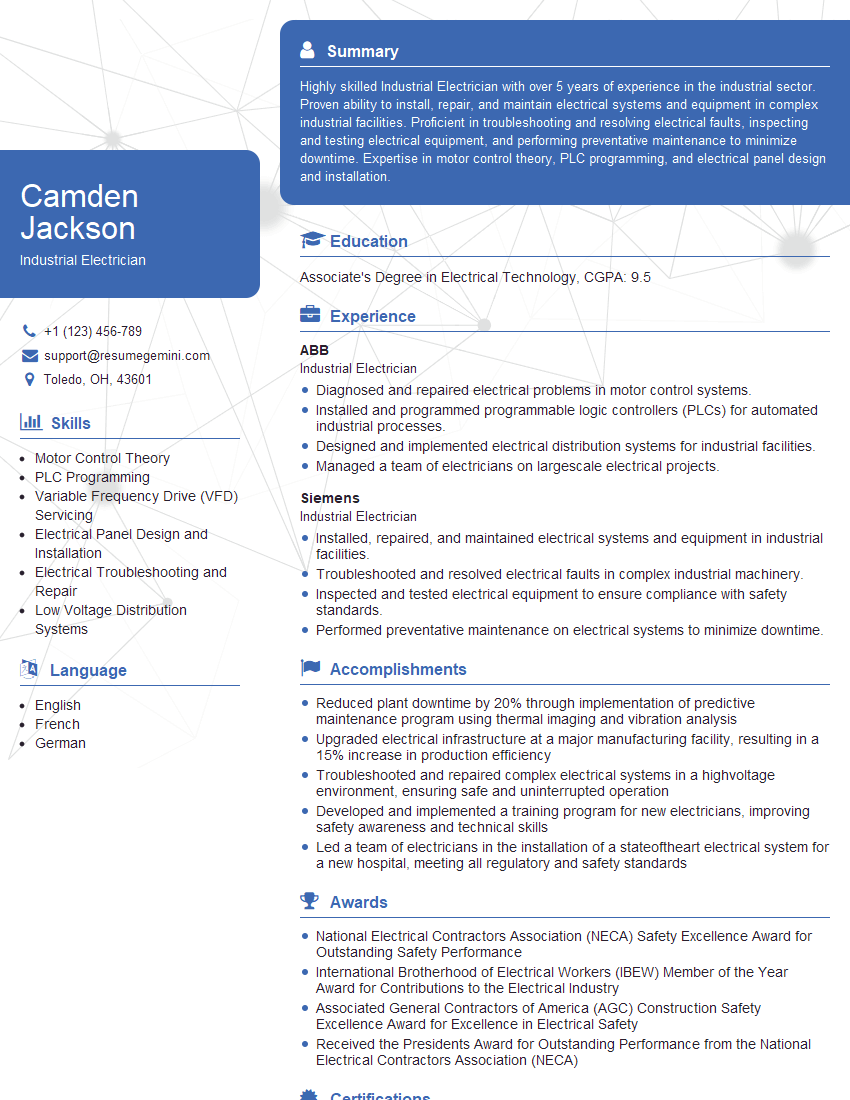
Industrial Electrician Resume Sample

Maintenance Electrician Resume Sample
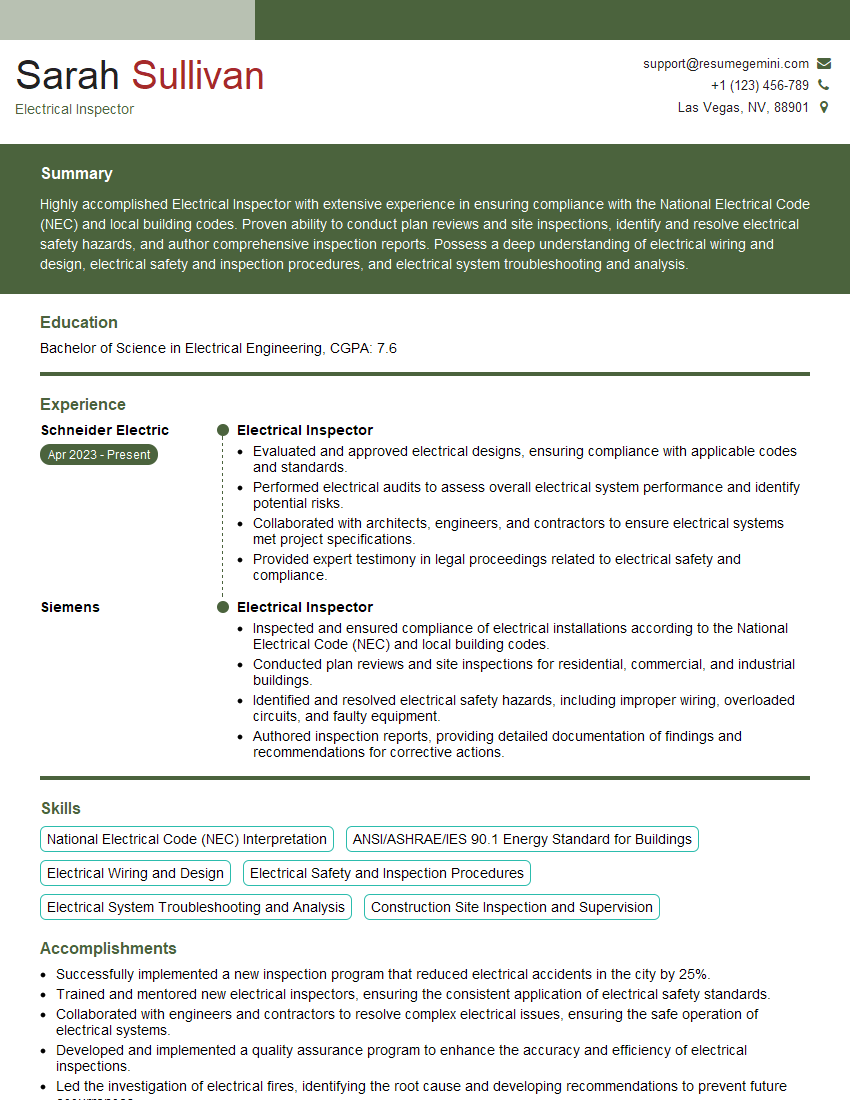
Electrical Inspector Resume Sample
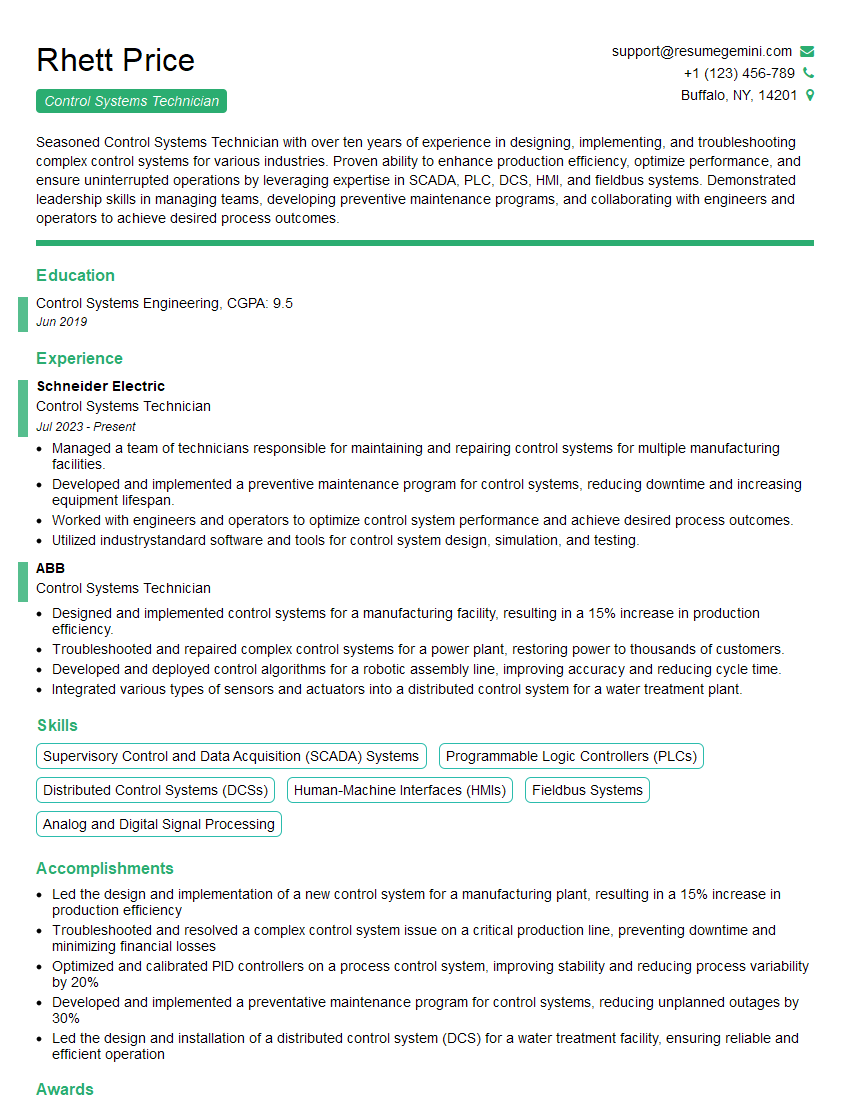
Control Systems Technician Resume Sample

Electrical Maintenance Technician Resume Sample
Explore more articles
Users Rating of Our Blogs
Share Your Experience
We value your feedback! Please rate our content and share your thoughts (optional).
What Readers Say About Our Blog
Really detailed insights and content, thank you for writing this detailed article.
IT gave me an insight and words to use and be able to think of examples