Every successful interview starts with knowing what to expect. In this blog, we’ll take you through the top Glass Forming interview questions, breaking them down with expert tips to help you deliver impactful answers. Step into your next interview fully prepared and ready to succeed.
Questions Asked in Glass Forming Interview
Q 1. Explain the different types of glass forming processes.
Glass forming encompasses a variety of techniques to shape molten glass into desired forms. The choice of method depends heavily on the final product’s shape, size, and required precision.
- Pressing: Molten glass is pressed into a mold using a plunger. This is common for simple shapes like jars and bottles. Think of it like making a cookie – you press the dough (molten glass) into a cookie cutter (mold).
- Blowing: Air is blown into a gob of molten glass held at the end of a blowpipe, expanding the glass into a hollow form. This is how many light bulbs and drinking glasses are made. Imagine inflating a balloon—the air is your blowing force, and the balloon’s shape is determined by the initial glass gob.
- Drawing: Molten glass is continuously drawn upward to form long, consistent shapes like glass fibers (for fiberglass) or sheets (for windows). This is like slowly pulling taffy, stretching it into a long strand.
- Casting: Molten glass is poured into a mold, often a refractory mold, and allowed to cool and solidify. This is useful for creating intricate or large pieces, where blowing or pressing may not be feasible. Think of it like casting metal—pouring liquid into a predetermined shape.
- Rolling: Molten glass is passed between rollers to create sheets of uniform thickness. This is how flat glass for windows and other applications is commonly produced. It’s similar to rolling out dough for pizza, creating an even layer.
Each of these processes can be further refined with specific techniques and equipment adaptations, resulting in a vast range of glass products.
Q 2. Describe the role of a glass furnace in the forming process.
The glass furnace is the heart of any glass manufacturing operation. It’s where the raw materials (silica sand, soda ash, lime, etc.) are melted at extremely high temperatures (typically 1500-1600°C) to form molten glass. The furnace’s design and operation are crucial for maintaining the consistent quality of the glass.
Key roles include:
- Melting: The furnace melts the raw materials into a homogeneous molten glass.
- Temperature Control: Precise temperature control is vital to ensure the desired viscosity and properties of the molten glass. Fluctuations can lead to defects.
- Refining: The furnace allows the removal of bubbles and other imperfections from the molten glass.
- Homogenization: The furnace ensures the molten glass is uniform in composition and properties.
Different types of furnaces exist, including regenerative furnaces and electric melting furnaces, each offering specific advantages in terms of efficiency and environmental impact. The choice of furnace type influences the overall manufacturing cost and quality.
Q 3. What are the key properties of different types of glass?
Glass properties are highly dependent on its chemical composition. Different additives alter the glass’s characteristics significantly.
- Soda-Lime Glass: The most common type, used for containers and windows. It’s relatively inexpensive and easy to form, but less resistant to thermal shock (rapid temperature changes).
- Borosilicate Glass (Pyrex): Known for its high thermal resistance, making it ideal for cookware and laboratory glassware. It’s more resistant to chemical attack than soda-lime glass.
- Lead Glass (Crystal): Contains lead oxide, giving it a high refractive index, resulting in brilliance and sparkle. It’s commonly used for decorative items and high-quality glassware.
- Quartz Glass: Almost pure silica, highly resistant to heat and chemical attack. Used in high-temperature applications and optical components. It’s very expensive to produce.
Other properties include strength, hardness, color, and optical clarity, all of which are tunable through the careful selection of raw materials and manufacturing processes.
Q 4. How do you ensure the quality control of glass products?
Quality control in glass forming is a multi-step process that begins with raw material inspection and extends to the final product.
- Raw Material Analysis: Checking the purity and consistency of the raw materials to ensure they meet specifications.
- In-process Monitoring: Continuous monitoring of the furnace temperature, glass viscosity, and other parameters during the melting and forming processes.
- Dimensional Inspection: Measuring the dimensions of the finished products to ensure they conform to design specifications.
- Visual Inspection: Careful examination for surface defects like bubbles, stones, and scratches.
- Strength Testing: Testing the mechanical strength of the glass products to ensure they meet required standards.
- Thermal Shock Testing: For specific applications, testing the resistance of the glass to rapid temperature changes.
Statistical Process Control (SPC) techniques are often used to track and analyze quality data, allowing for timely identification and correction of any issues in the manufacturing process.
Q 5. What are the common defects found in glass forming and their causes?
Several defects can occur during glass forming, impacting the quality and appearance of the final product.
- Bubbles: Caused by insufficient degassing of the molten glass during refining. These are often visible as small air pockets within the glass.
- Stones: Undissolved refractory materials or other impurities in the molten glass. They appear as small, opaque inclusions.
- Seeds: Very small bubbles or inclusions that may not be visible to the naked eye but can affect the strength or optical properties of the glass.
- Code: Uneven surface texture or color variations caused by inconsistent glass flow or temperature gradients during forming.
- Check cracks: Small cracks that can form during cooling, usually due to stress in the glass.
- Warping/Distortion: Deformation of the glass shape during cooling, often due to uneven cooling or insufficient annealing.
Careful control of the melting and forming processes, along with proper material selection and furnace maintenance, are crucial to minimize defect formation.
Q 6. Explain the process of glass annealing.
Glass annealing is a crucial heat-treatment process that reduces internal stresses within the glass, improving its durability and resistance to breakage. When glass cools rapidly, internal stresses build up, making it brittle and prone to cracking. Annealing eliminates these stresses.
The process involves heating the formed glass to a specific temperature (the annealing point), holding it at that temperature for a sufficient time to allow stress relaxation, and then slowly cooling it to room temperature. This controlled cooling allows the internal stresses to relieve gradually.
Improper annealing can lead to spontaneous breakage, particularly in larger or more complex glass products. The annealing schedule (temperature and cooling rate) depends on the type of glass and the desired properties of the finished product.
Q 7. Describe the different types of molds used in glass forming.
The type of mold used in glass forming depends heavily on the forming process and the desired shape of the final product.
- Press Molds: Used in pressing, these molds typically consist of two halves that are clamped together to enclose the molten glass. They can be made from various materials, including steel, graphite, or ceramic.
- Blow Molds: Used in blowing, these molds define the outer shape of the glass product. They are often made of ceramic or metal and may be multi-part molds for more complex shapes.
- Casting Molds: Used in casting, these molds may be made from a variety of materials including refractory materials like ceramic or sand to withstand the high temperatures of molten glass. These molds are often more intricate to achieve complex shapes.
- Rollers: Used in rolling, these are usually metal cylinders that create sheets of glass with controlled thickness.
Mold design and material selection are critical factors in determining the quality, precision, and production efficiency of the glass forming process. For example, using graphite molds can reduce the risk of sticking and improve surface finish in certain pressing processes.
Q 8. How do you select the appropriate mold for a specific glass product?
Selecting the right mold is crucial for successful glass forming. It’s like choosing the right baking pan – the wrong one can ruin your cake! The selection process depends on several factors, primarily the desired final product’s shape, size, and complexity.
- Shape and Size: Simple shapes like bottles might use blow molding, requiring a relatively straightforward mold. Complex shapes, such as intricate crystal glassware, need multi-part molds with intricate designs.
- Material: Mold materials vary depending on the glass type, forming temperature, and production volume. Common materials include steel, graphite, and ceramic. Steel molds are durable and precise for high-volume production, while graphite molds are suitable for more delicate glass types and unique designs.
- Production Method: The forming method (blowing, pressing, casting) heavily influences mold design. For example, a press-and-blow mold has a different design compared to a simple blow mold.
- Surface Finish: The mold’s surface texture directly impacts the final glass product’s finish. A polished mold yields a smooth surface, while a textured mold creates patterns or designs.
For example, creating a delicate wine glass requires a high-precision steel mold with a polished surface to ensure a smooth, flawless finish and prevent surface imperfections. Conversely, a rough-textured mold might be used to produce a rustic, handmade-looking jar. Thorough mold design and selection are paramount to achieve the desired aesthetics and functionality.
Q 9. What safety precautions are necessary when working with molten glass?
Safety is paramount when working with molten glass, which can reach temperatures exceeding 1500°C (2732°F). A single mistake can lead to severe burns or injuries. Think of it like handling a dragon’s breath—respectful distance and protective gear are essential.
- Personal Protective Equipment (PPE): This includes heat-resistant gloves, full-length protective clothing (including flame-retardant aprons), safety glasses, and face shields. Proper PPE is non-negotiable.
- Emergency Procedures: Clearly defined emergency procedures, including locations of fire extinguishers, safety showers, and first-aid kits, must be readily available and understood by all personnel. Regular safety training is vital.
- Workplace Safety: The work area must be clean, organized, and free of obstacles. Proper ventilation is crucial to remove harmful fumes and dust.
- Temperature Monitoring: Accurate and reliable temperature monitoring equipment is necessary to ensure safe operating temperatures.
- Safe Handling Procedures: All personnel should receive training on proper handling of molten glass, including the safe use of machinery and tools. This includes understanding the risks associated with sudden temperature changes and the potential for thermal shock.
Ignoring even one of these precautions can have serious consequences. A thorough understanding and strict adherence to safety protocols are vital for creating a secure and productive work environment.
Q 10. Explain the role of robotics in modern glass forming.
Robotics play an increasingly significant role in modern glass forming, automating many previously manual and labor-intensive tasks. They are incredibly precise and consistent, improving efficiency and product quality. Think of them as highly skilled glassblowers that never tire!
- Increased Precision and Consistency: Robots can perform repetitive tasks with exceptional accuracy, resulting in uniform products with minimal defects.
- Improved Efficiency: Automation speeds up production, allowing for higher output with reduced labor costs.
- Enhanced Safety: Robots handle the dangerous aspects of working with molten glass, reducing risks for human workers.
- Flexibility and Adaptability: Modern robots can be easily programmed to handle various glass forming processes and product designs.
For instance, in the production of glass bottles, robots are often used for handling molten glass gob (a lump of molten glass), transferring it to the mold, and performing the blow molding process. This level of automation leads to increased production rates, less variability in bottle dimensions, and enhanced workplace safety.
Q 11. What are the environmental considerations in glass manufacturing?
Environmental considerations are increasingly important in glass manufacturing. The industry is working towards sustainability and minimizing its ecological footprint. It’s about creating beautiful glass responsibly!
- Energy Consumption: Glass manufacturing is energy-intensive. Adopting energy-efficient technologies and processes, such as using waste heat recovery systems, is essential to reduce carbon emissions.
- Raw Material Sourcing: Sustainable sourcing of raw materials, such as sand and cullet (recycled glass), is crucial. Using recycled glass significantly reduces energy consumption and raw material extraction.
- Waste Management: Minimizing waste generation and effectively managing waste materials are key. This includes implementing recycling programs and developing innovative ways to reuse byproducts.
- Emissions Reduction: Reducing air and water pollution through advanced filtration and treatment systems is important. Investing in cleaner technologies and complying with environmental regulations are paramount.
By focusing on these areas, glass manufacturers can lessen their environmental impact and contribute to a more sustainable future. This includes initiatives like using renewable energy sources, improving energy efficiency, and reducing water consumption.
Q 12. How do you troubleshoot problems in a glass forming process?
Troubleshooting in glass forming involves a systematic approach to identify and rectify problems. It’s like detective work – carefully examining clues to solve the mystery of a flawed product or malfunctioning process.
- Identify the Problem: Start by accurately defining the problem. Is it a defect in the glass itself, a malfunction in the machinery, or a flaw in the process parameters?
- Gather Data: Collect data on the problem – when it occurred, under what conditions, and what the defect looks like. This might involve examining the faulty glass, checking machine logs, and interviewing operators.
- Analyze the Data: Analyze the collected data to identify possible causes. This could involve reviewing process parameters (temperature, pressure, time), checking the mold condition, and examining the quality of the raw materials.
- Implement Corrective Actions: Based on the analysis, implement corrective actions. This could range from adjusting process parameters to replacing faulty equipment or modifying the mold design.
- Verify the Solution: After implementing the corrective actions, verify if the problem has been resolved by running a test batch and closely monitoring the process.
For example, if consistently encountering bubbles in the finished product, you might check the melting temperature, the degassing process, or even the quality of the raw materials. Systematic investigation often reveals the root cause and allows for effective corrective measures.
Q 13. Describe your experience with different glass forming machines.
My experience encompasses a range of glass forming machines, each with its own unique strengths and challenges. It’s like having a toolbox full of specialized tools, each perfect for a specific job.
- Press and Blow Machines: I’ve extensively worked with press and blow machines, particularly in the production of bottles and jars. These machines combine pressing and blowing techniques to create intricate shapes with high precision.
- Blow and Blow Machines: I have experience with blow and blow machines used for creating hollow glassware, like bottles and drinking glasses. Understanding the nuances of gob delivery and blow shaping is crucial for optimal results.
- Gob Feeders: I’m proficient in maintaining and operating gob feeders, which accurately deliver a consistent amount of molten glass to the forming process. This is essential for consistent product quality.
- IS Machines (Independent Section Machines): I’ve worked with IS machines which offer flexibility and efficiency in producing a variety of glass products by incorporating multiple forming stages within a single machine.
- Automatic Forming Lines: I’ve been involved in the operation and maintenance of complete automatic forming lines, integrating multiple machines and robots for continuous glass production. Coordinating the various components of such a line effectively requires extensive knowledge.
Each machine requires specific operating parameters and maintenance schedules. My knowledge extends to troubleshooting common issues, optimizing production parameters, and ensuring the longevity of the equipment.
Q 14. How do you maintain and repair glass forming equipment?
Maintaining and repairing glass forming equipment requires a blend of preventative measures and prompt, effective repairs. It’s like caring for a high-performance engine – regular maintenance prevents costly breakdowns.
- Preventative Maintenance: Regular inspections, lubrication, and cleaning of critical components, including molds, plungers, and mechanisms, are essential to prevent wear and tear and ensure smooth operation.
- Predictive Maintenance: Utilizing sensors and data analytics to monitor machine performance and predict potential failures allows for proactive maintenance, minimizing downtime.
- Repair Procedures: I’m proficient in identifying and repairing common problems, including mold damage, hydraulic leaks, and electrical faults. This often involves working with specialized tools and replacement parts.
- Calibration and Adjustment: Regular calibration of temperature sensors, pressure gauges, and other measuring devices is crucial for maintaining consistent product quality.
- Safety Procedures: All maintenance and repair work must be conducted following strict safety protocols to prevent injuries from moving parts, hot surfaces, and hazardous materials. Lockout/Tagout procedures are critical.
My expertise enables me to perform both preventative and corrective maintenance effectively, ensuring the machines operate at peak efficiency and minimizing costly downtime. The goal is to keep the production line running smoothly and producing high-quality glass.
Q 15. What is the role of temperature control in glass forming?
Temperature control is paramount in glass forming because it directly governs the viscosity of the molten glass, which in turn dictates its workability and final properties. Think of it like cooking – you wouldn’t bake a cake at the wrong temperature, right? Similarly, precise temperature control is essential to achieve the desired glass properties. Too high, and the glass becomes too fluid, potentially leading to sagging or deformation. Too low, and it becomes too viscous, hindering shaping and potentially causing defects like cracks during cooling.
In practice, this control is achieved through furnaces equipped with sophisticated temperature monitoring and regulation systems. These systems allow for precise adjustments, often programmed to follow specific temperature profiles optimized for the particular glass composition and forming method being used.
For instance, in the float glass process, the molten glass passes through a controlled temperature zone to achieve the desired viscosity for floating on molten tin. The cooling rate is meticulously controlled to minimize stress and ensure a flat, high-quality sheet.
Career Expert Tips:
- Ace those interviews! Prepare effectively by reviewing the Top 50 Most Common Interview Questions on ResumeGemini.
- Navigate your job search with confidence! Explore a wide range of Career Tips on ResumeGemini. Learn about common challenges and recommendations to overcome them.
- Craft the perfect resume! Master the Art of Resume Writing with ResumeGemini’s guide. Showcase your unique qualifications and achievements effectively.
- Don’t miss out on holiday savings! Build your dream resume with ResumeGemini’s ATS optimized templates.
Q 16. Explain the process of glass tempering or annealing.
Glass tempering, or more accurately, thermal tempering, is a heat treatment process that significantly increases the strength and durability of glass. Imagine a spring – its resilience comes from its internal structure. Tempering creates a similar effect in glass.
The process involves heating the glass to a high temperature (near its softening point), followed by rapid cooling (quenching) using jets of high-pressure air. This rapid cooling induces compressive stresses on the surface of the glass and tensile stresses in the core. Because the glass is strong in compression, the resulting glass is far more resistant to impact, bending, and thermal shock compared to annealed glass. Annealing, on the other hand, is a slower cooling process designed to relieve internal stresses developed during manufacturing. This prevents the glass from cracking or shattering due to internal stress during cooling.
Tempered glass is commonly used in automotive windshields, shower doors, and smartphone screens because of its enhanced strength and safety features. If tempered glass breaks, it shatters into small, relatively harmless fragments, unlike annealed glass which breaks into sharp, jagged pieces.
Q 17. How do you measure the viscosity of molten glass?
Measuring the viscosity of molten glass is crucial for controlling the glass forming process. Viscosity, essentially the resistance to flow, directly impacts the formability of the glass. Several methods exist, each suited to different temperature ranges and viscosity levels.
One common method is the rotating spindle viscometer. A spindle is submerged in the molten glass, and the torque required to rotate it at a constant speed is measured. The viscosity is then calculated based on the torque and rotational speed. This method is suitable for relatively high viscosity melts.
For lower viscosity melts, fiber elongation can be used. A molten glass fiber is drawn at a controlled rate, and the force required to maintain the drawing rate is measured. This force is directly related to the viscosity.
Another technique employs the parallel-plate viscometer where the molten glass is placed between two parallel plates, one stationary and one rotating, and the viscosity is measured based on the shear stress and shear rate.
The choice of method depends on the specific glass composition, temperature, and the required precision of measurement. It’s important to calibrate the equipment carefully and follow standardized procedures to ensure accuracy.
Q 18. What are the different types of glass finishes and how are they achieved?
Glass finishes significantly impact the aesthetic appeal and functionality of a glass product. They range from smooth, polished surfaces to textured, frosted finishes. The choice of finish depends on the application.
- Polished: Achieved by mechanical grinding and polishing, resulting in a smooth, reflective surface. This is common in window glass and mirrors.
- Frosted: Created by etching or sandblasting the surface, producing a matte, translucent finish. This offers privacy while still allowing light diffusion.
- Textured: Obtained through various techniques like rolling the glass over textured surfaces during manufacturing, creating patterns and designs. Examples include textured glass for decorative purposes or for enhanced grip.
- Coated: A thin layer of material is applied to the glass surface to modify its properties. This can enhance reflectivity, reduce glare, provide self-cleaning properties, or improve energy efficiency. Low-E coatings are a prime example, improving insulation in windows.
The method used to achieve a particular finish depends on the desired effect and the scale of production. Mass production often involves automated processes, while custom finishes may require manual techniques.
Q 19. Describe your experience with different glass compositions.
Throughout my career, I’ve worked extensively with various glass compositions, each with unique properties and applications. This includes soda-lime silicate glass, the most common type used for windows and containers; borosilicate glass, known for its heat resistance and used in cookware and laboratory glassware; and lead-containing glasses, offering unique optical properties and traditionally used in fine crystal.
My experience extends to understanding the influence of additives on glass properties. For instance, I’ve worked on projects involving the addition of cerium oxide to improve UV absorption, or the addition of iron oxide for colored glass. Each additive presents its own challenges; for example, controlling the precise amount of a colorant is crucial to maintain consistency in the final product.
I’ve also worked with specialty glasses, such as those doped with rare earth elements for optical fiber applications, and those formulated for specific refractive indices in lenses. This experience has given me a deep understanding of the relationship between glass composition, processing conditions, and final product properties.
Q 20. How do you calculate the required amount of glass for a particular product?
Calculating the required amount of glass for a particular product involves a detailed understanding of the product’s geometry and the manufacturing process. It’s not just about volume; waste and tolerances must be considered.
The process typically involves these steps:
- Detailed Design: Obtain precise 3D models or blueprints of the product, including all dimensions and tolerances.
- Volume Calculation: Use CAD software or manual calculations to determine the precise volume of glass needed for each piece, considering any complex shapes or internal voids.
- Material Loss Estimation: Account for material loss due to trimming, cutting, grinding, or other processes. This is crucial for optimizing material usage and minimizing waste.
- Tolerances: Include allowances for variations in dimensions due to manufacturing tolerances, ensuring the final product meets specifications.
- Waste Factor: Add a waste factor based on past experience and the manufacturing process. This accounts for unpredictable losses or defects.
- Total Glass Required: Sum up all volumes from the above steps to determine the total amount of glass needed for the entire batch.
For instance, in producing a batch of 1000 drinking glasses, careful consideration of the geometry of the glass, the cutting process efficiency and defects, and material waste will result in a precise prediction of the needed glass. This avoids overproduction and material waste, improving efficiency and profitability.
Q 21. What software or tools do you use for glass design or modeling?
In glass design and modeling, a variety of software and tools are utilized, ranging from basic CAD software to specialized glass simulation packages.
For initial design and geometry creation, I typically use Autodesk Inventor or SolidWorks. These allow creating accurate 3D models of the glass products. This is essential for precise volume calculations and analysis of the product geometry.
For simulating the glass forming process, specialized software like GlassFlow or Moldex3D (with glass-specific modules) are employed. These packages simulate the flow, cooling, and stress development during glass forming, helping to predict potential defects and optimize the process parameters. This helps reduce prototype iterations and save considerable time and cost.
Finally, Finite Element Analysis (FEA) software, such as ANSYS or Abaqus, is employed to analyze stress distributions within the glass product under various loading conditions. This is vital for ensuring the structural integrity and durability of the finished product.
Q 22. Explain your understanding of glass stress and strain.
Glass stress and strain are crucial concepts in glass forming. Stress refers to the internal forces within the glass, caused by uneven cooling or external forces during processing. Strain is the resulting deformation of the glass structure due to this stress. Imagine blowing a glass bubble – the rapid cooling creates internal stresses because the outer layers cool and solidify faster than the inner layers. These stresses can lead to cracking or breakage if not managed carefully. There are two main types of stress: compressive (squeezing) and tensile (pulling). Compressive stress is generally desirable, while tensile stress is much more problematic. We use techniques like annealing (controlled slow cooling) to minimize internal stresses and ensure the dimensional stability and durability of the final product. For example, in the production of tempered glass for automotive windshields, controlled stress is introduced to make the glass much stronger than annealed glass. If a tempered glass windshield breaks, it shatters into small, relatively harmless pieces instead of large, sharp shards – a safety feature directly related to managing stress and strain.
Q 23. How do you ensure the dimensional accuracy of glass products?
Ensuring dimensional accuracy in glass products requires a multi-faceted approach starting from the design stage. Precise molds are paramount; even slight deviations can lead to significant errors in the final product. We use Computer-Aided Design (CAD) and Computer-Aided Manufacturing (CAM) extensively to design and produce highly precise molds. During the forming process, controlling factors such as temperature, pressure, and the time spent in the forming stage is critical. For example, in float glass production, controlling the temperature of the molten glass as it flows over a bed of molten tin ensures a perfectly flat, even surface. Automated measurement systems, including laser scanners and optical measuring devices, are used to monitor dimensions during and after production. Finally, statistical process control (SPC) helps identify and correct any deviations from the desired dimensions early in the manufacturing process, preventing large batches of defective products. Regular calibration of our equipment, along with the use of specialized gauging tools, helps maintain accuracy over time. We also employ advanced simulation techniques to predict and mitigate potential dimensional issues before they occur.
Q 24. Describe your experience with different glass decorating techniques.
My experience encompasses a wide range of glass decorating techniques. I’ve worked extensively with screen printing, which allows for precise reproduction of designs and logos on large quantities of glass. This is ideal for mass-produced items such as drinking glasses or bottles. I’m also proficient in pad printing, a versatile method suitable for decorating curved or irregular surfaces. For more intricate designs and smaller production runs, I have experience with hand painting and airbrushing. This offers a level of artistry not easily achieved through automated methods. Additionally, I’ve utilized decalcomania, where a design is transferred to the glass surface using water or heat. Acid etching is another technique I’ve employed for creating frosted or textured effects on glass. The choice of technique depends heavily on the design complexity, desired finish, production volume, and cost considerations. For instance, acid etching is well-suited for high-end, customized pieces, whereas screen printing is ideal for cost-effective, high-volume production.
Q 25. Explain your experience with quality control and inspection methods.
Quality control and inspection are integral throughout the entire glass forming process. We employ a multi-stage approach, starting with raw material inspection to ensure consistent quality of the glass batch. In-process checks are conducted at each step of the manufacturing process, identifying and correcting any deviations immediately. For example, we use online vision systems to monitor the thickness and surface quality of the glass during the forming process. Post-production inspection includes visual checks for defects such as bubbles, scratches, and cracks. We use sophisticated metrology equipment to verify dimensions and tolerances. Statistical Process Control (SPC) charts are used to track process parameters and identify trends, allowing for proactive adjustments to prevent defects. Sampling plans ensure that a representative sample of the production is thoroughly inspected. Furthermore, we maintain detailed records and documentation of all quality control measures to ensure traceability and compliance with industry standards. A robust quality control system is essential to maintain product consistency and meet customer expectations.
Q 26. What is your experience with lean manufacturing principles in glass forming?
My experience with lean manufacturing principles in glass forming centers on optimizing processes for maximum efficiency and minimal waste. We’ve successfully implemented Kaizen events to identify and eliminate bottlenecks in our production lines. Value stream mapping helped us visualize the entire process and identify areas for improvement. We’ve focused on reducing lead times by streamlining workflows and optimizing material handling. Implementing 5S methodologies (Sort, Set in Order, Shine, Standardize, Sustain) has created a more organized and efficient work environment. The principles of just-in-time (JIT) inventory management have significantly reduced waste by procuring materials only as needed. Data-driven decision-making, using key performance indicators (KPIs) such as Overall Equipment Effectiveness (OEE), guides our continuous improvement efforts. In one project, we improved our OEE by 15% by implementing a preventative maintenance program and reducing downtime caused by equipment failures.
Q 27. Describe your experience with troubleshooting and resolving issues in glass manufacturing processes.
Troubleshooting in glass manufacturing involves a systematic approach. I start by carefully observing the problem, gathering data, and documenting the specifics. This might include analyzing visual defects, examining temperature logs, and reviewing process parameters. Then, I formulate potential causes based on my understanding of the manufacturing process and the characteristics of the defect. This often involves using root cause analysis techniques such as the 5 Whys method to identify the underlying reasons. For example, if we experience increased breakage rates, we might examine factors such as furnace temperature fluctuations, improper annealing cycles, or issues with the handling and storage of finished goods. Once the root cause is identified, we implement corrective actions, testing and verifying their effectiveness. I maintain thorough records of troubleshooting efforts, including the problem description, analysis, corrective actions, and outcomes. This allows for continuous learning and improvement and helps prevent similar problems from occurring in the future.
Q 28. How do you stay current with the latest advancements in glass forming technology?
Staying current with advancements in glass forming technology requires a multi-pronged approach. I actively participate in industry conferences and trade shows, networking with colleagues and learning about the latest innovations. I subscribe to industry publications and journals, keeping abreast of research and technological developments. I regularly attend workshops and seminars focusing on emerging technologies such as advanced furnace designs, improved mold materials, and automated inspection techniques. I also leverage online resources, such as professional organizations’ websites and databases of scientific literature, to expand my knowledge. Furthermore, I encourage continuous learning within my team, fostering a culture of innovation and knowledge sharing. Staying updated ensures we maintain a competitive edge and implement the most efficient and effective techniques in our manufacturing processes. This commitment to lifelong learning is vital in this rapidly evolving field.
Key Topics to Learn for Glass Forming Interview
- Glass Properties & Behavior: Understanding the viscosity, thermal expansion, and surface tension of glass is crucial for predicting and controlling the forming process. Explore the impact of different glass compositions.
- Forming Techniques: Master the principles behind various glass forming methods such as blowing, pressing, drawing, and casting. Be prepared to discuss the advantages and limitations of each technique.
- Mold Design & Manufacturing: Understand the critical role of mold design in shaping the final product. Explore different mold materials and manufacturing processes.
- Process Control & Optimization: Discuss the parameters influencing the forming process (temperature, pressure, time) and how to optimize these to achieve desired product quality and efficiency. Consider process monitoring and quality control techniques.
- Defect Analysis & Troubleshooting: Learn to identify common defects in glass products and understand the root causes. Develop problem-solving strategies to minimize defects and improve yield.
- Material Science & Engineering Principles: Apply your understanding of material science, thermodynamics, and heat transfer to the glass forming process. This will help you tackle complex scenarios.
- Safety & Regulations: Demonstrate knowledge of safety protocols and industry regulations pertaining to glass forming and handling of molten glass.
Next Steps
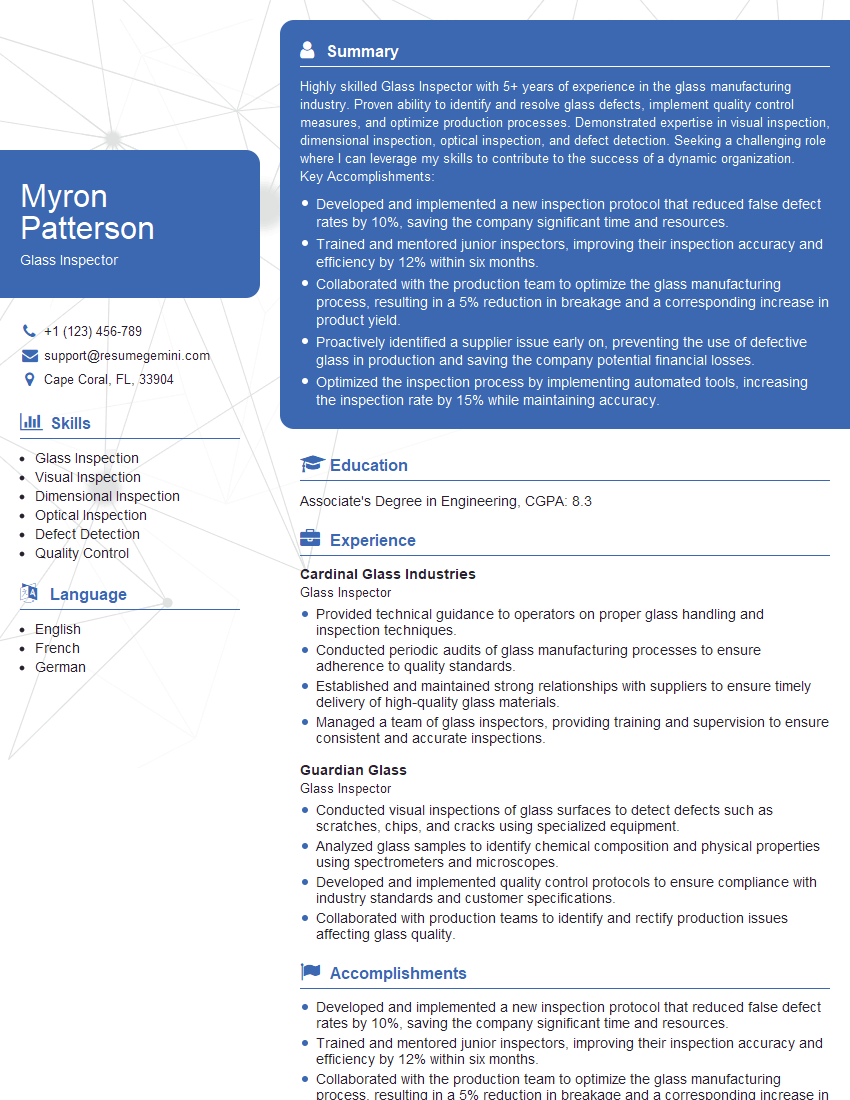
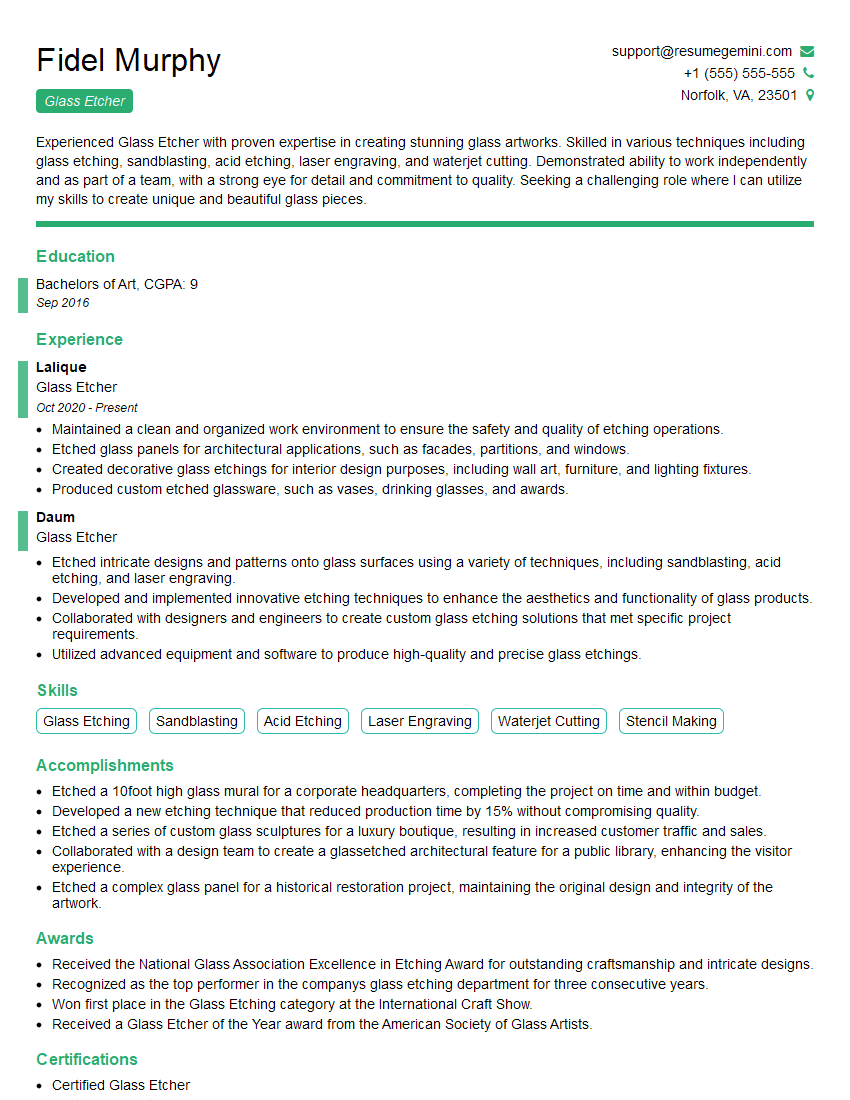
Mastering glass forming opens doors to exciting career opportunities in a diverse range of industries. A strong understanding of these principles is highly valued by employers, leading to greater job security and career advancement. To maximize your chances of landing your dream job, it’s crucial to present yourself effectively. Crafting an ATS-friendly resume is essential to ensure your application gets noticed. We highly recommend using ResumeGemini, a trusted resource for building professional and impactful resumes. ResumeGemini offers examples of resumes tailored specifically to the Glass Forming industry to help guide you. Invest time in creating a compelling resume, and let your skills and experience shine!
Explore more articles
Users Rating of Our Blogs
Share Your Experience
We value your feedback! Please rate our content and share your thoughts (optional).
What Readers Say About Our Blog
Really detailed insights and content, thank you for writing this detailed article.
IT gave me an insight and words to use and be able to think of examples