Unlock your full potential by mastering the most common Ellipsoid and Geoid Modeling interview questions. This blog offers a deep dive into the critical topics, ensuring you’re not only prepared to answer but to excel. With these insights, you’ll approach your interview with clarity and confidence.
Questions Asked in Ellipsoid and Geoid Modeling Interview
Q 1. Define the geoid and its relationship to the ellipsoid.
The geoid is an equipotential surface of the Earth’s gravity field that best fits, in a least-squares sense, global mean sea level. Imagine it as the surface of the ocean extended continuously through the continents. It’s a complex, irregular shape because the Earth’s gravity isn’t uniform due to variations in density beneath the surface. The ellipsoid, on the other hand, is a mathematical approximation of the Earth’s shape – a slightly flattened sphere (oblate spheroid). It’s a smooth, regular surface defined by a few parameters like semi-major and semi-minor axes. The relationship is that the ellipsoid serves as a reference surface for representing the geoid. We use the geoid to understand the true shape of the Earth’s gravity field, while the ellipsoid provides a simpler, computationally efficient model for calculations.
Think of it like this: the ellipsoid is a perfectly smooth ball you use for rough calculations, and the geoid is the slightly bumpy, irregular actual Earth’s surface – the one that truly reflects the variations in gravity.
Q 2. Explain the difference between a geocentric and a geodetic datum.
A geocentric datum defines the Earth’s coordinate system with its origin at the Earth’s center of mass. The position of the ellipsoid is defined relative to the Earth’s center of mass. Popular examples include WGS84, which is the basis for GPS. A geodetic datum, on the other hand, defines the Earth’s coordinate system with its origin at a point on the Earth’s surface (or very close to it). The ellipsoid is fitted to a specific region or a specific area. This means that the geodetic datum has a specific origin, orientation, and ellipsoid shape (the ellipsoid is not necessarily centered at the Earth’s center of mass). NAD83 (North American Datum of 1983) is an example of a geodetic datum. The key difference lies in the origin: geocentric datums are centered at the Earth’s center of mass, providing a global perspective; geodetic datums are locally oriented, optimizing accuracy within a specific area.
Imagine trying to build a map of a country. A geocentric datum would be like using a globe as your base, whereas a geodetic datum would be like using a flat, but slightly warped map of that specific country.
Q 3. What are the main applications of ellipsoid and geoid models?
Ellipsoid and geoid models have numerous applications across various disciplines:
- GPS and Navigation: Accurate GPS positioning requires a precise geoid model to convert ellipsoidal heights (obtained from GPS measurements) to orthometric heights (heights above sea level).
- Hydrology and Oceanography: Geoid models are crucial for understanding sea level variations, ocean currents, and water resource management. They allow us to determine the true elevation of water bodies.
- Geodesy and Surveying: These models are fundamental for precise land surveying, mapping, and establishing national coordinate systems.
- Civil Engineering and Construction: Accurate height information is essential for large-scale projects such as dam construction, bridge building, and pipeline routing.
- Earth Science Research: Geoid models help researchers study changes in the Earth’s gravity field, indicating shifts in mass distribution (like glacial melting).
Q 4. Describe the various methods used for geoid determination.
Geoid determination involves sophisticated techniques:
- Gravimetry: Measuring the Earth’s gravity field using gravimeters. This data provides information about the variations in Earth’s gravity that shape the geoid.
- Satellite Altimetry: Using satellite-based radar altimeters to measure the height of the ocean surface. This provides a direct measure of the geoid over the oceans.
- GPS Leveling: Combining GPS measurements with precise leveling surveys to determine the heights of points on land. These height differences can be used to estimate the geoid undulation.
- Global Positioning System (GPS): GPS data from various receivers can be combined with gravity data and other models to create global geoid models such as EGM2008.
- Combination Techniques: Modern geoid models utilize a combination of these methods to improve accuracy and coverage. Sophisticated mathematical models and least-squares adjustments are used to merge diverse datasets.
Q 5. How does the geoid affect GPS positioning?
GPS receivers provide ellipsoidal heights – the height above the reference ellipsoid. To obtain orthometric heights (heights above the geoid), which are typically what we need for practical applications, the geoid undulation (the separation between the ellipsoid and the geoid) must be considered. GPS receivers often use a pre-computed geoid model to perform this conversion. The accuracy of the GPS height depends directly on the accuracy of the used geoid model. If the geoid model is inaccurate, the converted orthometric heights will also be inaccurate. In regions with high geoid undulations, the impact on accuracy will be more significant.
Imagine you’re using a GPS to find the height of a mountain peak. The GPS gives you the height relative to a smooth, mathematical surface (the ellipsoid). To find the true height above sea level (orthometric height), you need to account for the geoid’s bumps and dips, which are reflected by the geoid undulation.
Q 6. What is the significance of the orthometric height?
Orthometric height represents the height of a point above the geoid. This is the height we typically associate with elevation on maps and topographic data. It’s the height that reflects the actual distance above mean sea level, taking into account the variations in the Earth’s gravity field. Unlike ellipsoidal heights, orthometric heights provide a measure of true elevation, which is essential for many applications such as flood modeling, surveying and engineering projects.
It’s the height that truly matters when you’re talking about the height of a building, the altitude of an airplane, or the water level of a lake.
Q 7. Explain the concept of geoid undulation.
Geoid undulation is the separation between the geoid and the reference ellipsoid at a given point. It’s essentially the difference in height between the two surfaces. It can be positive (geoid above ellipsoid) or negative (geoid below ellipsoid), and its magnitude varies across the Earth’s surface due to variations in gravity. Geoid undulation is crucial for converting between ellipsoidal and orthometric heights.
Imagine drawing a line between the geoid and the ellipsoid at any point on Earth. The length of that line, with its direction indicating whether the geoid is higher or lower than the ellipsoid, is the geoid undulation at that point.
Q 8. How are gravity anomalies used in geoid modeling?
Gravity anomalies, the differences between observed gravity and a theoretical gravity value at a point, are crucial in geoid modeling. The geoid, representing the equipotential surface of the Earth’s gravity field that best fits mean sea level, is indirectly determined from these anomalies. Essentially, we use gravity measurements to infer the shape of the geoid. Areas with higher-than-expected gravity suggest a geoid that’s closer to the ellipsoid (a mathematical approximation of the Earth’s shape), while lower-than-expected gravity indicates a geoid that’s further away. Sophisticated mathematical techniques, such as least-squares collocation or Stokes’ integral, then use these gravity anomalies across a region to construct a detailed geoid model. Think of it like sculpting a landscape based on elevation changes; the gravity anomalies are our elevation data, and the geoid is the final sculpted form.
Q 9. Describe different types of ellipsoids and their parameters.
Ellipsoids are mathematical approximations of the Earth’s shape. Several types exist, each defined by specific parameters. The most common include:
- Reference Ellipsoids: These are defined by their semi-major axis (a) and flattening (f). The semi-major axis represents the Earth’s equatorial radius, while flattening describes how much the Earth bulges at the equator relative to its polar axis (f = (a-b)/a, where b is the semi-minor axis). Examples include the WGS84 ellipsoid (used in GPS), the GRS80 ellipsoid, and the International Ellipsoid 1924. Each has slightly different parameter values leading to varied representations of the Earth.
- Geodetic Ellipsoids: These are reference ellipsoids specifically oriented and positioned to best fit a particular region. This localization improves accuracy for regional geodetic applications.
The parameters (a and f) define the ellipsoid’s size and shape, and their precise values are determined through geodetic surveys and satellite data analysis. Knowing these parameters is essential for transforming coordinates between different coordinate systems and for various geospatial applications.
Q 10. What are the limitations of using an ellipsoid as a reference surface?
While ellipsoids provide a convenient, mathematically simple reference surface, they have limitations when representing the true shape of the Earth. The primary limitation is that an ellipsoid is a regular geometric shape, whereas the geoid is irregular, reflecting the uneven distribution of mass within the Earth. Consequently:
- Undulations: The geoid deviates from the ellipsoid by several meters; these differences, called geoid undulations or heights, need to be accounted for in precise positioning and elevation calculations.
- Simplification: Ellipsoids smooth out the complexities of the Earth’s topography and gravitational field, ignoring local variations in the Earth’s shape caused by mountains, valleys, and subsurface density changes.
- Regional Bias: A single ellipsoid might not be the best fit for all regions of the globe, leading to errors in certain applications if a globally defined ellipsoid is used for local computations.
These limitations highlight the need for more accurate geoid models to refine positional and height information.
Q 11. How do you handle discrepancies between the ellipsoid and the geoid in practical applications?
Discrepancies between the ellipsoid and the geoid are handled by determining and applying geoid undulations (N). The geoid undulation at a point is the difference in height between the geoid and the ellipsoid. This means:
Ellipsoid Height (h) + Geoid Undulation (N) = Orthometric Height (H)
Orthometric height (H) is the height above the geoid and is often what we understand as ‘elevation’ in a practical sense. To handle discrepancies, we need a high-resolution geoid model providing geoid undulation values across the area of interest. This allows the conversion between ellipsoid heights (often obtained from GPS measurements) and orthometric heights, resolving the discrepancies and providing accurate elevations.
For example, in surveying, GPS measurements provide ellipsoid heights. To get the orthometric height, we need to subtract the geoid undulation, using a suitable geoid model to obtain N for the given location.
Q 12. What software packages are you familiar with for ellipsoid and geoid modeling?
I’m familiar with a range of software packages used for ellipsoid and geoid modeling, including:
- Geographic Information Systems (GIS) software: ArcGIS, QGIS – these offer tools for geospatial data manipulation, including geoid undulation grids and transformations.
- Geodetic software packages: Many specialized packages, often developed by national mapping agencies or research institutions, provide advanced capabilities for geoid modeling, gravity data processing, and datum transformations. Specific names may vary depending on the institution or country.
- Programming languages and libraries: Python with libraries such as NumPy, SciPy, and GDAL provides significant flexibility and control over geoid modeling workflows. MATLAB and other scientific computing environments are also commonly used.
My expertise spans using these tools for both data processing and model creation/application.
Q 13. Explain the concept of vertical datum transformation.
Vertical datum transformation involves converting heights from one vertical datum to another. Vertical datums are reference surfaces used to define elevations. The most common are based on either the ellipsoid or the geoid. Transformations are necessary due to differences between various vertical datums (e.g., NAD83 vs. NAVD88 in North America) or when updating outdated datums to reflect more accurate geoid models. This process typically involves using gridded transformation data to adjust heights based on the difference in the two datums at various locations. These transformation grids are often derived from detailed geoid models and other geodetic data. The process can be likened to shifting a set of elevation values to align with a new reference level, accounting for the variations between the reference surfaces.
Q 14. Describe the challenges involved in global geoid modeling.
Global geoid modeling presents numerous challenges due to the Earth’s vastness and the complexities of its gravity field. Some key challenges include:
- Data Acquisition: Gathering sufficient, uniformly distributed, and accurate gravity data across the entire globe is a significant logistical and technological undertaking. Data gaps and inconsistencies in measurement quality can lead to errors in the geoid model.
- Computational Complexity: Processing and integrating vast amounts of gravity data using complex mathematical models requires substantial computational resources and expertise.
- Model Resolution: Balancing model resolution (detail) with computational feasibility is essential. Higher-resolution models require more data and processing power, potentially leading to longer computation times.
- Ocean Areas: Obtaining gravity data over the oceans is more challenging than over land, leading to data sparsity and uncertainties in those regions.
- Temporal Variability: The Earth’s gravity field is not static; it changes over time due to various factors, making the construction of a truly time-invariant global geoid model difficult.
These challenges necessitate ongoing research and development in geodetic techniques and computational capabilities to improve the accuracy and reliability of global geoid models.
Q 15. How does atmospheric pressure affect height measurements?
Atmospheric pressure directly impacts height measurements, primarily through its effect on the refractive index of the atmosphere. GPS signals, for instance, travel through the atmosphere, and their speed is slightly affected by the air density, which is in turn related to pressure. Higher pressure generally means denser air, leading to a slightly slower signal propagation speed. This delay in signal arrival causes an error in the calculated height. Think of it like trying to time a race – if the runner has to go through a thicker medium (denser air), it will take them longer to reach the finish line, and your timing will be off. Precise height measurements, especially in surveying and geodesy, require atmospheric pressure corrections to account for this effect. These corrections are often made using barometric pressure readings at the measurement site, incorporated into GPS processing software, to obtain the most accurate heights.
Career Expert Tips:
- Ace those interviews! Prepare effectively by reviewing the Top 50 Most Common Interview Questions on ResumeGemini.
- Navigate your job search with confidence! Explore a wide range of Career Tips on ResumeGemini. Learn about common challenges and recommendations to overcome them.
- Craft the perfect resume! Master the Art of Resume Writing with ResumeGemini’s guide. Showcase your unique qualifications and achievements effectively.
- Don’t miss out on holiday savings! Build your dream resume with ResumeGemini’s ATS optimized templates.
Q 16. What is the impact of using an inaccurate geoid model on surveying accuracy?
Using an inaccurate geoid model significantly compromises surveying accuracy, leading to errors in orthometric heights (heights above the geoid). The geoid is an equipotential surface of the Earth’s gravity field that closely approximates mean sea level. Orthometric height is a crucial parameter in many applications, including flood risk assessment, infrastructure planning, and precision agriculture. If the geoid model is inaccurate, the conversion from ellipsoidal heights (heights above the reference ellipsoid) to orthometric heights will be flawed, resulting in height discrepancies across the survey area. This can propagate into errors in elevation differences between points, impacting calculations of slopes, volumes, and other critical parameters. Imagine trying to build a dam – an inaccurate geoid model would lead to miscalculations of the dam’s height relative to the river, potentially leading to catastrophic consequences. The magnitude of the error depends on the accuracy of the geoid model and the spatial extent of the survey. Higher-resolution and more accurate geoid models are essential for precise surveying projects.
Q 17. Explain the concept of height anomaly.
The height anomaly represents the separation between the geoid and the reference ellipsoid at a specific point. In simpler terms, it’s the difference between the orthometric height (height above the geoid) and the ellipsoidal height (height above the reference ellipsoid) at that location. It’s a measure of how much the geoid deviates from the mathematically defined ellipsoid. Imagine the Earth’s surface as a bumpy potato (the geoid), and the ellipsoid as a perfectly smooth, symmetrical ball. The height anomaly tells us how far the ‘potato’ is from the ‘ball’ at a particular point. Positive height anomalies indicate the geoid is above the ellipsoid, while negative anomalies indicate the geoid is below the ellipsoid. Height anomalies are useful in understanding the Earth’s gravity field variations and are employed in various geodetic applications such as precise leveling and geoid modeling itself.
Q 18. How do you ensure the accuracy of geoid models?
Ensuring the accuracy of geoid models is a complex process involving several steps. Firstly, high-quality gravity data is crucial. This includes terrestrial gravity measurements, airborne gravimetry data, and satellite-derived gravity data (from missions like GRACE and GOCE). The data needs to be thoroughly processed and corrected for various systematic errors. Secondly, sophisticated mathematical techniques are employed, often involving least-squares collocation or other spectral methods to estimate the geoid. These techniques use the gravity data to solve for the geoid height at a grid of points. Thirdly, validation is critical. The accuracy of the model is assessed by comparing it with independent, high-precision measurements, such as GPS leveling data or precise leveling. Discrepancies reveal areas requiring further refinement. Ongoing refinement and updates are essential, using new data and improved techniques to continually improve the accuracy and resolution of the geoid model. Think of it like building a detailed map – you wouldn’t just rely on a single source of information; you’d integrate multiple data sets, validate your findings, and update the map as new data becomes available.
Q 19. What are the different types of gravity data used in geoid modelling?
Several types of gravity data are utilized in geoid modeling.
- Terrestrial gravity measurements: These are made using highly precise gravimeters at ground stations. They provide high-accuracy data but limited spatial coverage.
- Airborne gravimetry: Gravity measurements are taken from aircraft, offering wider coverage than terrestrial measurements, though the accuracy is generally lower.
- Satellite-derived gravity: Satellites like GRACE and GOCE measure subtle variations in the Earth’s gravity field. This data provides global coverage but at a coarser resolution than terrestrial or airborne data.
Q 20. Discuss the role of least-squares collocation in geoid determination.
Least-squares collocation (LSC) plays a vital role in geoid determination by providing a robust method to estimate the geoid height at any given point, given observed gravity data. It’s a statistical technique that models the geoid height as a combination of a deterministic part (based on known information) and a stochastic part (representing random errors and uncertainties). LSC leverages the spatial correlation structure of the gravity field to optimally combine gravity observations from various sources and locations. The technique is particularly powerful because it considers the covariances between the gravity data, optimizing the accuracy of the geoid model. For instance, if we have gravity measurements close together, LSC will weigh them more heavily in determining the geoid at a point between them, increasing the accuracy of the estimation. LSC enables the integration of data from different sources, and the resulting geoid is characterized by optimal accuracy and precision, taking into account all existing uncertainties in the data.
Q 21. Explain the concept of a quasigeoid.
The quasigeoid is a surface that is very close to the geoid but is defined in terms of heights relative to a specific reference surface. Unlike the geoid, which represents mean sea level based on the equipotential surface of the Earth’s gravity field, the quasigeoid is defined such that the height difference between a point on the quasigeoid and the corresponding point on the reference ellipsoid is equal to the height of the water column above the reference ellipsoid that would weigh the same as the corresponding mass of the Earth between the point and the reference ellipsoid. Essentially, the quasigeoid is a representation of the geoid that’s easier to calculate and which provides a more direct connection to the practical measurements taken by surveyors. While the geoid is defined by gravity potentials, the quasigeoid is defined by gravity observations and considers the effects of the earth’s density inhomogeneities. This makes it a slightly different, but still remarkably useful approximation of mean sea level, frequently employed in practical applications of surveying and mapping.
Q 22. How does the geoid model affect the accuracy of DEMs (Digital Elevation Models)?
Digital Elevation Models (DEMs) represent the Earth’s surface elevation relative to a reference surface. The accuracy of a DEM is directly impacted by the choice of the reference surface – typically, an ellipsoid or a geoid. The ellipsoid is a mathematical approximation of the Earth’s shape, while the geoid represents the equipotential surface of the Earth’s gravity field, closely approximating mean sea level. Using an ellipsoid as the reference ignores the variations in the Earth’s gravity field, leading to errors in elevation. A geoid model accounts for these variations, providing a more accurate reference for elevation measurements. Therefore, incorporating a high-resolution, accurate geoid model significantly improves the accuracy of DEMs, especially in areas with significant gravitational anomalies, such as mountainous regions or areas with dense subsurface mass.
For example, if you’re creating a DEM for a region with significant variations in gravity, a simple ellipsoid-based DEM will show systematic elevation errors. These errors will be larger in areas of high gravity and smaller in areas of low gravity. Using a geoid model compensates for these gravity-induced variations, resulting in a DEM that reflects the actual elevations more accurately.
Q 23. What are the advantages and disadvantages of using different geoid models?
Different geoid models offer various advantages and disadvantages, primarily concerning resolution, accuracy, and geographic coverage. Higher-resolution models provide greater detail but require more computational resources and may be regionally specific. Lower-resolution models are more computationally efficient and have broader coverage but sacrifice detail.
- Advantages of high-resolution models: Improved accuracy in areas with complex topography, better representation of local gravity variations, enabling more precise height measurements for applications like surveying and engineering.
- Disadvantages of high-resolution models: Increased computational demands, potential for artifacts due to data limitations, limited geographical coverage.
- Advantages of low-resolution models: Wider geographical coverage, computational efficiency, suitable for applications requiring less precise height measurements.
- Disadvantages of low-resolution models: Reduced accuracy, inability to capture local gravity variations, less suitable for applications requiring precise height measurements such as precise navigation systems.
For instance, a global geoid model like EGM2008 is suitable for large-scale applications, while a regional geoid model like GEOID18 for the US offers higher accuracy within its coverage area. The choice depends on the specific application and the required level of accuracy and geographic extent.
Q 24. Describe the process of validating a geoid model.
Validating a geoid model involves rigorously comparing its predicted heights to independent, highly accurate measurements. This is often done by comparing geoid heights to GPS-derived orthometric heights, obtained using precise GPS receivers and accurate geodetic datums. The process generally involves several steps:
- Data Acquisition: Gather independent height measurements from various sources, such as GPS leveling, trigonometric leveling, and gravimetric measurements.
- Comparison: Compare the geoid model’s predicted heights at specific points with these independent height measurements. This often involves interpolating the geoid model’s heights to the locations of the validation data points.
- Statistical Analysis: Analyze the differences between the predicted and measured heights using statistical methods. This includes calculating metrics like the root mean square error (RMSE), mean error (ME), and standard deviation.
- Error Analysis: Investigate the spatial distribution of errors. Identifying systematic errors can reveal issues with the underlying data or model assumptions. This process might involve analyzing regional error patterns that might point to systematic gravity model errors or errors in the data used to build the model.
- Assessment: Evaluate the overall accuracy and reliability of the geoid model based on these statistical analyses. Accept the model if the errors are acceptable given the intended applications; otherwise, refinements may be necessary.
For example, a high RMSE would indicate that the geoid model isn’t accurately representing the true geoid, needing adjustments or recalibration.
Q 25. What are the future trends and challenges in ellipsoid and geoid modeling?
Future trends in ellipsoid and geoid modeling focus on improving accuracy, resolution, and computational efficiency. This includes:
- Incorporating new data sources: Integrating data from satellite missions like GRACE-FO and future missions will refine our understanding of Earth’s gravity field.
- Improved modeling techniques: Advanced techniques like machine learning are being employed to improve the interpolation and prediction of geoid heights, particularly in data-sparse regions.
- Higher-resolution models: The development of even higher-resolution global and regional geoid models will meet the increasing demands for precise height information in diverse applications.
- Dynamic geoid models: Developing models that account for temporal variations in the Earth’s gravity field caused by factors such as glacial isostatic adjustment and changes in groundwater storage.
Challenges include handling vast amounts of data, integrating diverse data sources, dealing with data gaps in remote regions, and accounting for the dynamic nature of the Earth’s gravity field.
Q 26. How can you improve the resolution of a geoid model?
Improving the resolution of a geoid model requires acquiring and incorporating more high-quality data. This includes:
- Denser gravity observations: Collecting more terrestrial and airborne gravity measurements, especially in areas with sparse data coverage.
- Advanced satellite gravimetry: Utilizing data from advanced satellite missions like GRACE-FO and future missions with higher spatial resolution.
- Improved interpolation techniques: Employing advanced interpolation and gridding techniques to estimate geoid heights in data-sparse regions. Techniques like Kriging and machine learning approaches (e.g., neural networks) show potential in filling in the gaps more effectively.
The increased data density directly contributes to the higher resolution in the resultant geoid model, allowing for the more accurate representation of the Earth’s gravity field and resulting in a more detailed and accurate geoid.
Q 27. How do you handle data gaps in geoid modelling?
Data gaps in geoid modeling are a significant challenge. Several strategies can be used to handle them:
- Interpolation and extrapolation: Utilize various interpolation methods (e.g., Kriging, splines) to estimate geoid heights in data-sparse areas based on surrounding data. Extrapolation techniques are used to estimate geoid heights beyond the data coverage. However, these should be done cautiously due to potential inaccuracies in sparsely sampled areas.
- Integration of other data sources: Combine gravity data with other relevant datasets like topography or bathymetry to improve the estimation of geoid heights in data-scarce regions.
- Prior knowledge and constraints: Use known information on geological structures, tectonic features or geophysical models to constrain the interpolation in data gaps. Physical plausibility can be used to constrain solutions.
- Statistical modeling: Apply statistical methods to estimate uncertainties associated with geoid heights in data-sparse areas, providing a measure of the reliability of the estimates.
Careful consideration of the limitations of different methods and the propagation of uncertainty is crucial when handling data gaps.
Q 28. What are some common errors to avoid in geoid and ellipsoid modelling?
Several common errors should be avoided in geoid and ellipsoid modeling:
- Ignoring systematic errors: Failing to identify and correct for systematic errors in the input data (e.g., instrumental biases, calibration errors in GPS data). Thorough data quality control and error analysis is essential.
- Inappropriate interpolation methods: Using an unsuitable interpolation method for the data distribution and characteristics. Careful selection of an appropriate interpolation technique based on data properties is crucial.
- Insufficient data density: Developing a model based on insufficient data, leading to large uncertainties and inaccuracies, especially in areas with sparse data. This requires careful planning of data acquisition, and awareness of data gaps and their limitations.
- Ignoring temporal variations: Failing to account for the dynamic nature of the Earth’s gravity field, leading to inaccuracies in long-term applications. Dynamic models should be employed when possible.
- Using inappropriate reference frames or datums: Ensuring consistency and compatibility in the coordinate systems, geodetic datums, and vertical datums used throughout the modeling process is extremely important. Inconsistent data will generate misleading results.
- Poor handling of data uncertainties: Not properly quantifying and propagating the uncertainties associated with the input data and the model parameters. A rigorous uncertainty analysis is essential for evaluating the reliability of the geoid model.
Careful attention to detail and proper methodology can minimize these errors, resulting in a more reliable and accurate geoid model.
Key Topics to Learn for Ellipsoid and Geoid Modeling Interview
- Reference Ellipsoids: Understanding different ellipsoid models (e.g., WGS84, GRS80), their parameters (semi-major and semi-minor axes, flattening), and their applications in geographic coordinate systems.
- Geoid Models: Grasping the concept of the geoid as the equipotential surface of the Earth’s gravity field, its relationship to the ellipsoid, and the use of geoid models (e.g., EGM2008) for height conversions.
- Height Systems: Differentiating between ellipsoidal heights, orthometric heights, and geoidal heights, and understanding the transformations between them. This includes practical application in surveying and mapping.
- Geodetic Datums: Understanding the role of geodetic datums in defining coordinate systems and their impact on spatial referencing and accuracy. Explore different datum transformations.
- Gravity Field Modeling: Familiarize yourself with the concepts of gravity anomalies, geopotential numbers, and their role in understanding the Earth’s gravity field and refining geoid models.
- Practical Applications: Explore the real-world applications of ellipsoid and geoid models in GPS positioning, surveying, GIS, remote sensing, and other relevant fields. Consider specific examples and case studies.
- Software and Tools: Gain familiarity with common software and tools used in geodetic computations and geoid modeling. Understanding the underlying algorithms is beneficial.
- Error Analysis and Uncertainty: Understand the sources of error in ellipsoid and geoid models and how to assess the uncertainty associated with geospatial data derived from them.
Next Steps
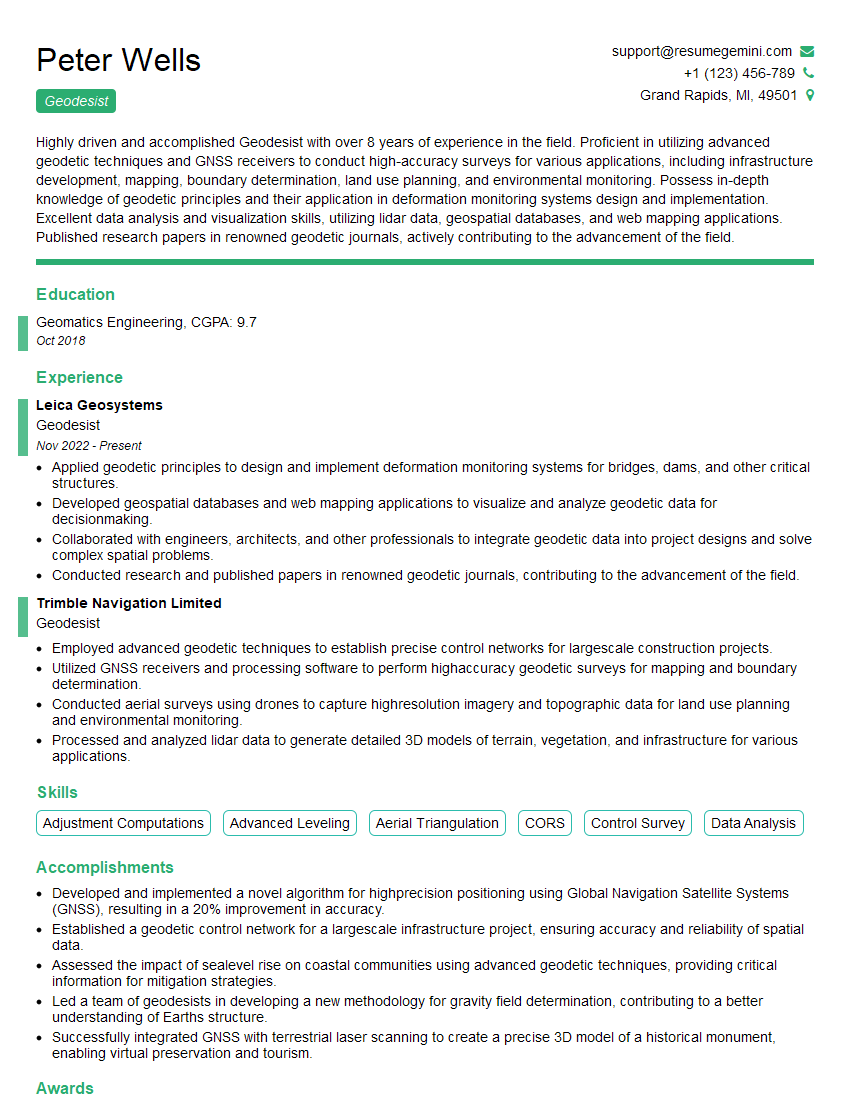
Mastering Ellipsoid and Geoid Modeling is crucial for career advancement in geospatial science, surveying, and related fields. A strong understanding of these concepts demonstrates a solid foundation and opens doors to exciting opportunities. To significantly improve your job prospects, create an ATS-friendly resume that effectively showcases your skills and experience. ResumeGemini is a trusted resource to help you build a professional and impactful resume. We offer examples of resumes tailored to Ellipsoid and Geoid Modeling to guide you in crafting a compelling application.







Explore more articles
Users Rating of Our Blogs
Share Your Experience
We value your feedback! Please rate our content and share your thoughts (optional).
What Readers Say About Our Blog
Really detailed insights and content, thank you for writing this detailed article.
IT gave me an insight and words to use and be able to think of examples