Interviews are more than just a Q&A session—they’re a chance to prove your worth. This blog dives into essential Financial Action Task Force (FATF) interview questions and expert tips to help you align your answers with what hiring managers are looking for. Start preparing to shine!
Questions Asked in Financial Action Task Force (FATF) Interview
Q 1. Explain the purpose and objectives of the Financial Action Task Force (FATF).
The Financial Action Task Force (FATF) is an intergovernmental organization founded in 1989. Its primary purpose is to develop and promote policies to combat money laundering and terrorist financing. Its objectives revolve around setting international standards, promoting effective implementation of those standards by countries, and reviewing progress made by its members. Think of it as the global police force for financial crime, setting the rules and making sure countries follow them.
Essentially, FATF aims to protect the international financial system from misuse by criminals and terrorists. It achieves this by encouraging countries to implement strong legal and regulatory frameworks, enhanced international cooperation, and information sharing.
Q 2. Describe the FATF Recommendations and their significance in combating financial crime.
The FATF Recommendations are a comprehensive set of 40+ standards that provide a framework for countries to fight money laundering, terrorist financing, and proliferation financing. They cover various aspects of the financial system, from identifying and verifying customers (Know Your Customer – KYC) to reporting suspicious transactions.
Their significance lies in creating a globally consistent approach to tackling financial crime. By adopting these recommendations, countries harmonize their laws and regulations, making it more difficult for criminals to exploit loopholes and move money across borders. Non-compliance can lead to sanctions and reputational damage, further incentivizing adherence.
- Customer Due Diligence (CDD): Identifying and verifying the identities of customers.
- Suspicious Transaction Reporting (STR): Filing reports with the Financial Intelligence Unit (FIU) when suspicious activity is detected.
- International Cooperation: Sharing information and assisting other countries in investigations.
Imagine a global network of interconnected banks and businesses; these Recommendations act as the security protocols, ensuring every node is safeguarded against illicit activities.
Q 3. What are the key elements of a Customer Due Diligence (CDD) program, according to FATF standards?
A robust Customer Due Diligence (CDD) program, aligned with FATF standards, involves several key elements:
- Identifying and Verifying Customer Identity: Gathering information to confirm the customer’s identity, usually through official identification documents. This is often referred to as ‘Know Your Customer’ (KYC).
- Understanding the Customer and their Business: Determining the customer’s purpose for the account and assessing their risk profile. This involves understanding their sources of wealth and funds.
- Maintaining Records: Keeping accurate and up-to-date records of the information gathered during the CDD process. This includes all identifying information and evidence of checks performed.
- Ongoing Monitoring: Regularly reviewing customer transactions and activity to identify any potential suspicious activity. This includes conducting periodic reviews of higher-risk clients.
For example, a bank opening an account for a new business client would need to verify the business’s registration documents, the identities of its beneficial owners, and understand the nature of its business activities. Failing to do so properly exposes the bank to significant risk and potential regulatory penalties.
Q 4. How does a bank or financial institution implement Enhanced Due Diligence (EDD) as per FATF guidelines?
Enhanced Due Diligence (EDD) is a heightened level of scrutiny applied to higher-risk customers or transactions. FATF guidelines stipulate that financial institutions should implement EDD measures when dealing with customers or transactions that present a higher risk of being used for money laundering or terrorist financing.
Implementation involves applying stricter CDD measures, such as:
- Independent verification of information provided by the customer: Obtaining information from independent sources to confirm the accuracy of the customer’s self-declared details.
- Increased transaction monitoring: Closer scrutiny of the customer’s transactions to identify any suspicious patterns or activities.
- Enhanced ongoing monitoring: More frequent reviews of the customer’s account and transactions.
- Senior management oversight: Involving senior management in the approval of high-risk transactions.
For instance, if a bank identifies a client with connections to a politically exposed person (PEP) or a jurisdiction known for weak AML/CFT controls, it will likely subject them to EDD. This might include requesting additional documentation, conducting enhanced background checks, and imposing stricter transaction limits.
Q 5. What are the risks associated with correspondent banking relationships, and how can these risks be mitigated according to FATF?
Correspondent banking relationships, where one bank (the correspondent bank) provides services to another bank (the respondent bank), present several risks:
- Reputational Risk: Association with a respondent bank involved in illicit activities can damage the correspondent bank’s reputation.
- Legal and Regulatory Risk: Correspondent banks can face penalties if they fail to adequately manage the risks associated with their respondent banks.
- Financial Risk: Respondent banks might default on payments or become involved in fraudulent activities, leading to financial losses for the correspondent bank.
FATF advises mitigating these risks through robust due diligence on respondent banks, including assessing their AML/CFT compliance programs, their risk profile, and the nature of the business they conduct. This often involves on-site visits, regular monitoring, and clear contractual agreements specifying responsibilities and liabilities.
A correspondent bank must actively monitor transactions between its respondent bank and third parties to detect suspicious activity. Termination of a relationship is always an option if the risks are unmanageable or the respondent bank fails to comply with AML/CFT regulations.
Q 6. Explain the role of a Financial Intelligence Unit (FIU) in combating money laundering and terrorist financing.
A Financial Intelligence Unit (FIU) is a central, national agency responsible for receiving, analyzing, and disseminating financial intelligence. Its crucial role in combating money laundering and terrorist financing includes:
- Receiving Suspicious Transaction Reports (STRs): Receiving reports from banks, casinos, and other obliged entities about suspicious financial activity.
- Analyzing Financial Intelligence: Analyzing the STRs and other financial data to identify patterns and trends in money laundering and terrorist financing.
- Disseminating Financial Intelligence: Sharing the analyzed information with law enforcement agencies and other relevant authorities for investigation and prosecution.
- International Cooperation: Collaborating with FIUs in other countries to share information and track cross-border financial flows.
The FIU acts as a central hub for financial crime intelligence, linking the dots between seemingly disparate transactions and providing crucial evidence for law enforcement to build cases against criminals.
Q 7. What are the key features of a suspicious activity report (SAR) and when is it required?
A Suspicious Activity Report (SAR) is a formal report filed by obliged entities (banks, casinos, etc.) to their national FIU when they detect suspicious transactions or activities that might be related to money laundering, terrorist financing, or other financial crimes.
Key features of a SAR typically include:
- Date and time of the suspicious activity: Precise timeline of the event.
- Details of the involved parties: Identifying information about the individuals or entities involved.
- Description of the suspicious activity: A clear and concise explanation of the activity that aroused suspicion.
- Amount of money involved: The financial value of the transaction.
- Reason for suspicion: Why the entity suspects the activity is related to a crime.
Filing a SAR is required when an entity has reasonable grounds to suspect that a transaction or activity is related to money laundering, terrorist financing, or other financial crimes. Failure to file a SAR when required can lead to significant penalties.
For example, a bank might file a SAR if a customer deposits a large sum of cash without a clear explanation of its source, or if there is a series of unusual wire transfers to offshore accounts in jurisdictions known for secrecy.
Q 8. Describe the concept of typologies in the context of money laundering and terrorist financing.
Money laundering and terrorist financing typologies are essentially blueprints or models outlining how criminals structure illicit transactions to conceal their origins and ultimate beneficiaries. They detail the methods used, the stages involved, and the typical actors. Think of them as investigative roadmaps. For instance, a common typology for money laundering might involve layering – breaking down large sums of money into smaller amounts through multiple transactions – followed by integration, where the laundered money is reintroduced into the legitimate financial system.
Understanding typologies is crucial for financial institutions and law enforcement. By recognizing patterns in suspicious activity reports (SARs), they can proactively identify and disrupt criminal networks. For example, if a business suddenly receives numerous small international wire transfers from seemingly unrelated sources, followed by large investments in seemingly unrelated assets, this might signal a layering and integration typology.
- Smurfing: Making numerous small cash deposits below reporting thresholds.
- Trade-based money laundering: Over- or under-invoicing goods in international trade.
- Real estate transactions: Using shell companies to purchase properties with illicit funds.
Typologies evolve as criminals adapt their methods, highlighting the ongoing need for continuous monitoring and updates by authorities like the FATF.
Q 9. Explain the significance of beneficial ownership identification in complying with FATF standards.
Beneficial ownership identification is paramount to combating money laundering and terrorist financing because it helps unravel the true controllers behind companies and trusts. These entities are often used as vehicles for concealing the origin and destination of illicit funds. Without knowing who the actual owner is, it’s impossible to effectively assess risks and enforce sanctions or penalties.
FATF standards emphasize the importance of maintaining accurate and up-to-date beneficial ownership information. This involves establishing clear legal definitions of beneficial ownership, creating registers for accessing that information, and imposing stringent due diligence obligations on financial institutions. If a bank fails to identify the ultimate beneficial owner of an account and that account is later found to be used for illicit activities, the bank faces significant repercussions.
Imagine a scenario where a company is registered in a tax haven with nominee directors. Without access to beneficial ownership information, investigators might not uncover the true owner, who might be a known drug trafficker. Identifying the beneficial owner is crucial for applying sanctions, seizing assets, and prosecuting those involved in criminal activities.
Q 10. How does FATF address new and emerging risks, such as virtual assets?
FATF addresses new and emerging risks, such as those associated with virtual assets (VAs), by regularly reviewing and updating its Recommendations. The rise of cryptocurrencies and other digital assets presents unique challenges, given their decentralized nature, cross-border accessibility, and potential for anonymity.
FATF has issued guidance specifically targeting VAs, focusing on:
- Travel Rule: Requiring VASPs (Virtual Asset Service Providers) to obtain and share information on senders and receivers of virtual asset transfers.
- Customer Due Diligence (CDD): Implementing robust CDD measures for VASP customers, mirroring those for traditional financial institutions.
- Risk-based approach: Encouraging VASPs to assess and mitigate risks associated with their customers and activities.
By adapting its standards to the evolving landscape of financial crime, FATF ensures the international community maintains a coherent and effective approach to combating money laundering and terrorist financing in the digital age. Failure to adapt could lead to significant vulnerabilities within the global financial system.
Q 11. What are the implications of non-compliance with FATF Recommendations for financial institutions?
Non-compliance with FATF Recommendations can have severe implications for financial institutions. The consequences range from reputational damage and loss of business to significant financial penalties and even criminal prosecution.
Firstly, a poor AML/CFT compliance record can lead to regulatory scrutiny and enforcement actions from national authorities. This might involve hefty fines, operational restrictions, or even the revocation of licenses. Secondly, correspondent banks may sever relationships with non-compliant institutions, effectively cutting them off from the international financial system. This can cripple a bank’s ability to conduct international transactions.
Furthermore, reputational damage can be devastating. Customers may lose trust, leading to a decline in business. Investors might be hesitant to engage with a company known for its lax AML/CFT practices. Finally, in extreme cases, non-compliance can result in criminal charges against individuals within the institution.
Q 12. Describe the process of conducting a risk assessment for AML/CFT compliance.
A risk assessment for AML/CFT compliance is a systematic process of identifying, analyzing, and mitigating the risks of money laundering and terrorist financing. It’s not a one-time event; rather, it’s an ongoing process that should be reviewed and updated regularly.
The process typically involves these steps:
- Identifying potential risks: This includes analyzing the institution’s customer base, products and services offered, geographical location, and its interaction with higher-risk jurisdictions.
- Assessing the likelihood and impact of each risk: This involves assigning probabilities and potential consequences to each identified risk.
- Prioritizing risks: Focusing on the highest-risk areas where AML/CFT controls should be strengthened.
- Developing and implementing mitigation strategies: This could involve enhanced due diligence procedures, improved training for staff, and the implementation of new technologies.
- Monitoring and reviewing the effectiveness of mitigation strategies: Regularly assessing the efficacy of controls and adapting the risk assessment as necessary.
A robust risk assessment ensures an institution focuses its AML/CFT efforts on the most vulnerable areas, optimizing its resources and improving its overall security posture.
Q 13. What are the key indicators of money laundering and terrorist financing?
Key indicators of money laundering and terrorist financing are multifaceted and vary depending on the specific method used. However, some common red flags include:
- Unusual transaction patterns: Large, unexplained cash deposits; frequent small transactions designed to avoid reporting thresholds; unusually high-value international transfers.
- Suspicious customer behavior: Customers who refuse to provide identification or provide conflicting information; accounts with little or no apparent legitimate economic activity.
- Complex transaction structures: Multiple layers of transactions involving shell companies or offshore accounts designed to obscure the origin of funds.
- Relationships with known or suspected criminals: Transactions involving individuals or entities linked to known criminal activities.
- Use of structured transactions: Breaking down large sums of money into smaller amounts to avoid detection.
It’s crucial to remember that no single indicator definitively proves illicit activity. Rather, it’s the combination of several indicators that raises suspicion and warrants further investigation.
Q 14. How do sanctions regimes intersect with FATF Recommendations?
Sanctions regimes and FATF Recommendations are interconnected and mutually reinforcing. Sanctions, imposed by governments or international organizations, target specific individuals, entities, or countries involved in illicit activities, such as terrorism or weapons proliferation. FATF Recommendations provide a framework for implementing effective AML/CFT measures, which directly support the implementation and enforcement of sanctions.
Financial institutions are required to comply with both FATF Recommendations and relevant sanctions regimes. This means screening customers against sanctions lists, freezing assets of designated individuals, and reporting suspicious activity related to sanctions evasion. Non-compliance with either can lead to severe penalties.
For example, a bank failing to freeze the assets of an individual on a UN sanctions list, even if they have identified the individual through their CDD process, is a violation of both FATF standards (for failing to take appropriate action on a suspicious activity) and the sanctions regime itself.
The intersection of these two areas highlights the importance of a holistic approach to combating financial crime. Effective AML/CFT practices facilitate the enforcement of sanctions, while sanctions regimes provide an additional layer of protection against illicit activities.
Q 15. What is the role of technology in enhancing AML/CFT compliance?
Technology plays a crucial role in strengthening AML/CFT compliance. It allows for automation of previously manual and time-consuming processes, leading to greater efficiency and accuracy. Think of it as having a powerful magnifying glass and a highly trained detective working together.
Transaction Monitoring Systems (TMS): These systems analyze vast volumes of transaction data in real-time, identifying suspicious patterns and flagging potentially illicit activities that a human analyst might miss. For example, a TMS can detect unusual activity such as a sudden surge in high-value transactions or transactions involving known high-risk jurisdictions.
Customer Due Diligence (CDD) Automation: Automating the CDD process – verifying customer identities and screening against sanctions lists – speeds up onboarding while reducing errors. Imagine a system automatically checking a customer’s ID against government databases, saving hours of manual work.
Artificial Intelligence (AI) and Machine Learning (ML): AI and ML algorithms can be trained to identify subtle anomalies and complex money laundering schemes that are difficult for humans to detect. These sophisticated tools can learn from past patterns and adapt to new methods of financial crime.
By leveraging technology, financial institutions can significantly enhance their ability to detect and prevent financial crime, ensuring a robust AML/CFT framework.
Career Expert Tips:
- Ace those interviews! Prepare effectively by reviewing the Top 50 Most Common Interview Questions on ResumeGemini.
- Navigate your job search with confidence! Explore a wide range of Career Tips on ResumeGemini. Learn about common challenges and recommendations to overcome them.
- Craft the perfect resume! Master the Art of Resume Writing with ResumeGemini’s guide. Showcase your unique qualifications and achievements effectively.
- Don’t miss out on holiday savings! Build your dream resume with ResumeGemini’s ATS optimized templates.
Q 16. Explain the importance of independent audits in maintaining AML/CFT compliance.
Independent audits are paramount for maintaining AML/CFT compliance. They provide an objective assessment of a company’s AML/CFT program, ensuring its effectiveness and identifying any weaknesses. Think of it as a health check for your AML/CFT system, ensuring it’s functioning correctly and identifying areas for improvement.
Independent Verification: Auditors provide an independent, unbiased opinion on the design and implementation of a company’s AML/CFT program, confirming it meets regulatory standards and internal policies.
Risk Identification: Audits can reveal hidden vulnerabilities and areas of improvement, helping organizations proactively mitigate potential risks. For example, an audit might uncover a lack of proper training for staff or deficiencies in transaction monitoring procedures.
Regulatory Compliance: Many jurisdictions require regular independent audits of AML/CFT programs, and the audit reports serve as evidence of compliance to regulators.
Continuous Improvement: Audits provide valuable feedback that can lead to continuous improvements in the AML/CFT program, enhancing its overall effectiveness.
Ultimately, independent audits enhance the credibility and reliability of a company’s AML/CFT efforts, reassuring both regulators and stakeholders of its commitment to combating financial crime.
Q 17. How does a company implement an effective AML/CFT training program?
An effective AML/CFT training program is crucial for a company’s compliance efforts. It should be comprehensive, engaging, and tailored to the specific roles and responsibilities of employees. Think of it as equipping your team with the tools and knowledge to be the first line of defense against financial crime.
Needs Assessment: Identify training needs based on employee roles and responsibilities. A compliance officer requires a different level of training than a teller.
Interactive Training: Employ various methods such as online modules, role-playing scenarios, and case studies to keep employees engaged and ensure knowledge retention. For example, a scenario might involve identifying suspicious transactions.
Regular Updates: AML/CFT regulations and techniques evolve constantly. Regular updates are vital to keep employees informed and equipped to handle new challenges. This includes awareness of emerging trends in money laundering and terrorist financing.
Testing and Evaluation: Regular assessments ensure employees have understood and retained the information. This could include quizzes, practical exercises, or simulated scenarios.
Documentation: Maintain records of training programs, including participation, materials used, and evaluation results. This documentation is crucial for demonstrating compliance to regulators.
A robust training program ensures that employees are not only aware of their AML/CFT responsibilities but also confident and capable of performing their duties effectively, strengthening the organization’s overall compliance posture.
Q 18. What is the difference between money laundering and terrorist financing?
While both money laundering and terrorist financing involve illicit financial activities, they differ significantly in their objectives and methods. Money laundering is primarily about disguising the origins of illegally obtained funds, making them appear legitimate. Terrorist financing, on the other hand, focuses on providing financial resources to support terrorist activities.
Money Laundering: The process of concealing the source of illegally obtained money. This might involve layering (moving money through multiple accounts) and integration (using the laundered money for legitimate purposes).
Terrorist Financing: Providing funds or other resources to support terrorist groups. This could involve direct donations, fundraising events, or using businesses as fronts for illicit activities.
The key difference lies in the ultimate goal: money laundering aims to clean dirty money, while terrorist financing aims to fund terrorism. However, the methods used can sometimes overlap, making it challenging to distinguish between the two.
Q 19. What are some common challenges faced in complying with FATF standards?
Complying with FATF standards presents several challenges for financial institutions globally. These challenges vary depending on the institution’s size, location, and the specific nature of its business.
Keeping Up with Evolving Regulations: FATF recommendations are regularly updated to address new threats and techniques. Staying abreast of these changes requires significant resources and expertise.
Technological Advancements: The rise of new technologies, such as cryptocurrencies and digital payment systems, presents new challenges for AML/CFT compliance. These technologies offer opportunities for criminals to hide their activities.
Resource Constraints: Implementing robust AML/CFT programs requires significant financial and human resources. Smaller institutions may struggle to afford the necessary technology and personnel.
International Cooperation: Effective AML/CFT requires effective international collaboration. Challenges arise when different jurisdictions have varying levels of compliance and regulatory enforcement.
Lack of Awareness and Training: Insufficient training among staff can lead to mistakes and failures in identifying and reporting suspicious activity.
Overcoming these challenges requires a proactive approach, including investing in technology, training staff, and fostering strong relationships with regulatory bodies and international partners.
Q 20. How would you address a situation where a transaction exhibits red flags for potential money laundering?
If a transaction exhibits red flags for potential money laundering, a structured approach is crucial. This involves a careful assessment of the transaction and adherence to established procedures.
Identify and Assess Red Flags: Carefully review the transaction details, identifying any suspicious patterns. This could include unusual transaction amounts, unusual transaction frequencies, or involvement of known high-risk individuals or entities.
Enhanced Due Diligence (EDD): Conduct EDD on the customer and transaction. This might involve gathering additional information to verify the customer’s identity, the source of funds, and the purpose of the transaction.
Internal Reporting: Report the suspicious transaction internally to the AML/CFT compliance officer or designated team.
File a Suspicious Activity Report (SAR): If warranted, file a SAR with the relevant financial intelligence unit (FIU). This is a critical step in bringing illicit activities to the attention of law enforcement.
Documentation: Maintain thorough records of the transaction, the red flags identified, the EDD conducted, and any reports filed. This is crucial for demonstrating compliance and potentially supporting investigations.
Prompt and effective action is key to minimizing the risk of being involved in money laundering activities and demonstrating a strong commitment to AML/CFT compliance.
Q 21. Describe the role of international cooperation in combating financial crime according to FATF.
International cooperation is a cornerstone of FATF’s strategy for combating financial crime. It recognizes that financial crime is a global problem requiring a global response. The idea is that criminals operate across borders, and effective enforcement necessitates collaboration between countries.
Information Sharing: FATF promotes the sharing of information between FIUs and law enforcement agencies across countries. This allows for investigations to be conducted more effectively.
Mutual Legal Assistance (MLA): FATF encourages countries to enter into MLA treaties, which facilitate the legal process of requesting and providing assistance in criminal investigations.
Joint Operations: FATF supports joint investigations and operations between countries, targeting international criminal networks.
Technical Assistance: FATF provides technical assistance to countries, particularly developing nations, to help them strengthen their AML/CFT systems and capacity.
Setting Standards: FATF’s international standards provide a framework for countries to align their AML/CFT regimes, ensuring a consistent approach globally.
Through these mechanisms, FATF promotes a global network of cooperation, enhancing the effectiveness of AML/CFT efforts and creating a more challenging environment for criminals to operate within.
Q 22. What are the key principles of a robust AML/CFT compliance program?
A robust Anti-Money Laundering/Combating the Financing of Terrorism (AML/CFT) compliance program rests on several key pillars. Think of it as a strong fortress with multiple layers of defense. These principles ensure that financial institutions and businesses effectively prevent, detect, and report suspicious activities.
- Risk Assessment: This is the foundation. You must identify and understand your specific risks – what types of customers, transactions, or geographic locations pose the highest risk of being used for illicit activities. This is not a one-time exercise; it’s an ongoing process that needs regular updates.
- Customer Due Diligence (CDD): This involves verifying the identities of your customers and understanding their business activities. It includes processes like Know Your Customer (KYC) and Enhanced Due Diligence (EDD) for higher-risk customers. Imagine checking a customer’s passport before letting them open a bank account – that’s basic CDD.
- Transaction Monitoring: This involves analyzing transactions to detect patterns that may indicate money laundering or terrorist financing. Think of it as a sophisticated alarm system, flagging unusual transactions for review. This often involves using advanced technologies.
- Suspicious Activity Reporting (SAR): When suspicious activity is detected, it must be reported to the relevant authorities. This is crucial for disrupting illicit financial flows.
- Sanctions Compliance: This involves screening customers and transactions against sanctions lists maintained by international organizations and governments. Failure to comply can lead to severe penalties.
- Employee Training and Awareness: Your staff is your first line of defense. Regular training keeps them updated on AML/CFT regulations and procedures. This helps foster a culture of compliance within the organization.
- Independent Audits and Reviews: Regular independent audits are crucial to ensure the effectiveness of your AML/CFT program. They provide an external perspective and help identify weaknesses.
For example, a bank might use a sophisticated transaction monitoring system that flags large cash deposits or unusual wire transfers, triggering a review by compliance officers. These officers then decide whether to file a SAR with the relevant authorities.
Q 23. How do you stay updated on the latest FATF guidance and changes in regulatory requirements?
Staying updated in the dynamic world of AML/CFT requires a multi-pronged approach. It’s like constantly upgrading your security software to protect against the latest threats. I employ the following methods:
- Regularly reviewing FATF guidance and publications: The FATF website is my primary source, and I closely follow their recommendations and statements.
- Monitoring regulatory updates from relevant authorities: This includes subscribing to newsletters, attending webinars, and regularly checking the websites of relevant regulatory bodies in the jurisdictions where I operate.
- Participating in industry conferences and workshops: These events provide opportunities to network with other compliance professionals and learn about the latest trends and challenges.
- Engaging with professional organizations: Organizations dedicated to AML/CFT offer valuable resources, training, and networking opportunities.
- Using specialized AML/CFT news and analysis services: Several subscription services provide up-to-date information on regulatory changes and enforcement actions.
For instance, I recently attended a conference where a speaker discussed the evolving threats posed by virtual assets, prompting a review of our firm’s procedures for handling cryptocurrency transactions.
Q 24. Explain the concept of politically exposed persons (PEPs) and the enhanced due diligence measures required.
Politically Exposed Persons (PEPs) are individuals who hold or have held prominent public functions. They include heads of state, government ministers, senior public officials, and their family members and close associates. The enhanced due diligence for PEPs is crucial because of their increased risk of involvement in corruption and money laundering.
Think of it like this: PEP’s position gives them access to significant resources and influence, making them a potential target for corrupt practices. The enhanced due diligence measures aim to mitigate this risk.
- Enhanced Customer Due Diligence (EDD): This goes beyond standard CDD. It includes obtaining more detailed information about the PEP’s source of wealth, the purpose of the business relationship, and the nature of the transactions involved.
- Senior Management Approval: Transactions involving PEPs usually require approval from senior management, adding an extra layer of scrutiny.
- Ongoing Monitoring: PEPs require more frequent monitoring of their accounts and transactions. This involves continuous analysis for any suspicious activity.
- Independent Review: Transactions involving PEPs should be independently reviewed to ensure compliance with regulations and internal policies.
For example, if a bank receives a large deposit from a PEP, the bank would not only verify the source of funds but also investigate the legitimacy of the funds and the purpose of the transaction through detailed documentation and potential on-site visits.
Q 25. What are the implications of FATF greylisting or blacklisting for a country or jurisdiction?
Being grey-listed or black-listed by the FATF has significant implications for a country or jurisdiction. Think of it like a credit rating for a nation’s financial integrity. A poor rating significantly impacts its reputation and economy.
- Greylisting (Increased Monitoring): A country placed on the grey list is subject to increased monitoring by the FATF and its member countries. This means enhanced scrutiny of its financial institutions and transactions, potentially leading to difficulties in accessing international finance.
- Blacklisting (High-Risk Jurisdiction): Blacklisting represents a far more serious consequence. Countries on the blacklist face severe reputational damage and significant barriers to international financial transactions. Financial institutions often avoid dealing with entities from blacklisted jurisdictions due to the high risk of regulatory penalties.
- Reputational Damage: Both greylisting and blacklisting severely damage a country’s international reputation, making it less attractive for foreign investment and international trade.
- Economic Sanctions: Countries may face additional sanctions from other countries, further impacting their economy.
- Difficulty Accessing International Finance: Financial institutions are more hesitant to conduct business with entities from grey-listed or blacklisted jurisdictions, making access to international finance more difficult.
For instance, a country on the grey list might find it harder to secure loans from international organizations or attract foreign direct investment, while a blacklisted country may face significant restrictions on international financial transactions.
Q 26. Describe your experience in implementing or overseeing an AML/CFT compliance program.
Throughout my career, I’ve been deeply involved in AML/CFT compliance, both in implementation and oversight roles. In my previous role at a large multinational bank, I led the implementation of a new AML/CFT compliance system. This included:
- Conducting a comprehensive risk assessment: Identifying high-risk areas and developing targeted mitigation strategies.
- Developing and implementing new policies and procedures: Creating clear and concise documentation that aligns with international standards.
- Training staff on AML/CFT regulations and procedures: This involved designing and delivering comprehensive training programs to ensure staff competency.
- Implementing a transaction monitoring system: This included configuring the system to identify suspicious transactions based on pre-defined rules and thresholds.
- Overseeing the SAR process: Ensuring that suspicious activity reports were filed promptly and accurately with the appropriate authorities.
- Conducting regular compliance audits: Monitoring the effectiveness of the AML/CFT program and identifying areas for improvement.
In another role, I oversaw the AML/CFT compliance program for a fintech company, focusing heavily on the evolving challenges presented by virtual assets and innovative payment technologies.
In both instances, I ensured adherence to international best practices, specifically those set out by the FATF, whilst adapting our approaches to the unique characteristics of the sectors involved. This included regularly updating our processes to reflect changes in regulatory requirements.
Q 27. How do you balance compliance requirements with the need to maintain operational efficiency?
Balancing compliance with operational efficiency is a constant challenge. It’s like finding the right balance between security and convenience. You can’t compromise security, but you also don’t want to make processes so cumbersome that they hinder business operations.
My approach involves:
- Automation: Automating processes like customer due diligence and transaction monitoring reduces manual effort and improves efficiency. This includes leveraging technology such as AI and machine learning.
- Streamlining procedures: Identifying and removing unnecessary steps in AML/CFT processes can significantly improve efficiency without compromising effectiveness.
- Risk-based approach: Focusing resources on higher-risk areas allows for more efficient allocation of resources.
- Integration of technology: Using advanced technologies can automate many tasks, freeing up staff for more complex analyses and investigations.
- Training and upskilling: Equipping staff with the right skills and tools empowers them to complete tasks efficiently and effectively.
For example, instead of manually reviewing every transaction, we might use a sophisticated transaction monitoring system that automatically flags high-risk transactions for review by compliance officers. This frees up staff to focus on more complex investigations.
Q 28. How would you respond to a regulatory inquiry regarding AML/CFT compliance?
Responding to a regulatory inquiry regarding AML/CFT compliance requires a calm, organized, and thorough approach. It’s crucial to demonstrate transparency and cooperation.
My approach would be:
- Gather all relevant information: This includes policies, procedures, transaction records, training records, and audit reports.
- Assemble a response team: This team would include compliance officers, legal counsel, and potentially other relevant personnel.
- Prepare a detailed response: This response should be comprehensive, accurate, and address all the questions posed by the regulator in a clear and concise manner.
- Maintain open communication with the regulator: This demonstrates cooperation and willingness to address any concerns.
- Document all communication and actions: This creates a clear audit trail of the response process.
If there are any areas where improvements are needed, the response should acknowledge these and outline the steps being taken to address them. A proactive, transparent, and collaborative approach is key to successfully navigating a regulatory inquiry.
For example, if the regulator inquires about a specific SAR, we would provide them with all the supporting documentation, including the initial transaction details, the internal investigation notes, and the rationale behind filing the SAR.
Key Topics to Learn for Financial Action Task Force (FATF) Interview
- FATF Recommendations: Understand the core principles and key recommendations, focusing on their practical implications for financial institutions and regulatory bodies.
- Anti-Money Laundering (AML) and Combating the Financing of Terrorism (CFT): Deepen your knowledge of AML/CFT techniques, including customer due diligence (CDD), suspicious activity reporting (SAR), and sanctions compliance. Consider practical scenarios involving identifying and mitigating risks.
- Risk Assessment and Management: Learn how to conduct effective risk assessments, focusing on identifying vulnerabilities and implementing appropriate mitigation strategies within a financial institution’s operations.
- International Cooperation and Mutual Evaluation: Grasp the importance of international collaboration in combating financial crime and the role of mutual evaluations in assessing a country’s AML/CFT regime.
- Emerging Threats and Technologies: Explore the challenges posed by new technologies like cryptocurrencies and fintech on AML/CFT efforts and how to adapt strategies accordingly. Consider innovative solutions and approaches.
- Regulatory Frameworks and Compliance: Familiarize yourself with relevant national and international regulations and how they align with FATF standards. Analyze practical case studies of compliance challenges and solutions.
- Case Studies and Problem Solving: Prepare to analyze real-world scenarios involving suspicious transactions, identifying red flags, and suggesting appropriate responses. Practice your problem-solving skills.
Next Steps
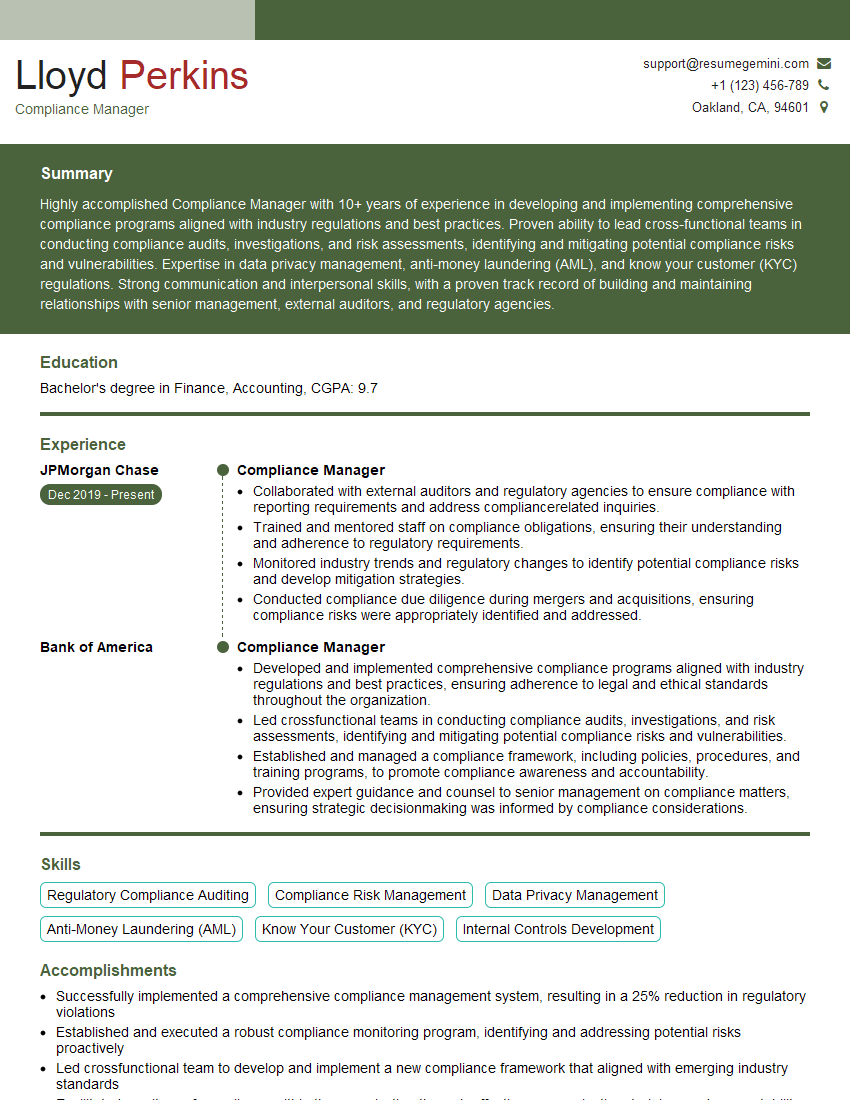
Mastering the intricacies of the Financial Action Task Force (FATF) framework is crucial for a successful career in compliance, risk management, and related fields. It demonstrates a deep understanding of global financial regulations and your commitment to combating financial crime. To significantly improve your job prospects, create a compelling and ATS-friendly resume that highlights your relevant skills and experience. We strongly recommend using ResumeGemini to build a professional and impactful resume. ResumeGemini provides a user-friendly platform and offers examples of resumes tailored to Financial Action Task Force (FATF) related roles, giving you a head start in showcasing your qualifications effectively.
Explore more articles
Users Rating of Our Blogs
Share Your Experience
We value your feedback! Please rate our content and share your thoughts (optional).
What Readers Say About Our Blog
Really detailed insights and content, thank you for writing this detailed article.
IT gave me an insight and words to use and be able to think of examples