Unlock your full potential by mastering the most common Geodetic Observation Techniques interview questions. This blog offers a deep dive into the critical topics, ensuring you’re not only prepared to answer but to excel. With these insights, you’ll approach your interview with clarity and confidence.
Questions Asked in Geodetic Observation Techniques Interview
Q 1. Explain the difference between GPS and GLONASS.
Both GPS (Global Positioning System) and GLONASS (GLObal NAvigation Satellite System) are global navigation satellite systems that provide location and time information to users on Earth. However, they differ in their ownership, satellite constellation, and signal characteristics. GPS is a United States Department of Defense system, while GLONASS is operated by the Russian Federation. GPS utilizes a constellation of 24 satellites (plus spares), whereas GLONASS typically employs a constellation of 24 operational satellites. While both systems use similar principles of trilateration to determine position, they use different signal structures and frequencies, allowing for potential improvements in accuracy and reliability when used together.
Think of it like having two different sets of maps to navigate a city; both can get you there, but one might have more detailed information or be more reliable in certain areas. Using both GPS and GLONASS simultaneously (a technique called GNSS or Global Navigation Satellite System) provides redundancy and often improves positioning accuracy.
Q 2. Describe the various types of geodetic datums and their applications.
Geodetic datums are reference systems used to define the shape and size of the Earth and provide a framework for geographic coordinate systems. Different datums exist because the Earth isn’t a perfect sphere; its shape is more accurately described as an oblate spheroid (slightly flattened at the poles). The choice of datum depends on the specific application and geographic region.
- Horizontal Datums: These define the Earth’s surface shape and position. Examples include NAD83 (North American Datum of 1983) and WGS84 (World Geodetic System 1984). NAD83 is optimized for North America, while WGS84 is a global datum widely used in GPS applications. The difference between these datums can result in meter-level positional discrepancies.
- Vertical Datums: These define the Earth’s height, usually referenced to mean sea level. Examples include NAVD88 (North American Vertical Datum of 1988) and the various local tidal datums. These datums are crucial for applications involving elevations, such as flood modeling or infrastructure design.
The application dictates the appropriate datum. A surveying project in North America might use NAD83, whereas a global navigation application would typically employ WGS84. Inconsistent use of datums can lead to significant errors in spatial analyses and mapping.
Q 3. What are the sources of error in GPS measurements, and how can they be mitigated?
GPS measurements are susceptible to several error sources, broadly categorized as:
- Atmospheric Effects: Ionospheric and tropospheric delays caused by the signal’s passage through the atmosphere. The ionosphere affects signal speed, while the troposphere bends the signal path.
- Satellite Clock Errors: Inaccuracies in the timing signals transmitted by the satellites.
- Ephemeris Errors: Errors in the satellite’s predicted position.
- Multipath Effects: Signals bouncing off buildings or other objects before reaching the receiver, causing distorted measurements.
- Receiver Noise: Electronic noise in the GPS receiver.
- Orbital Errors: Slight variations in the satellites’ actual orbits compared to their predicted orbits.
Mitigation strategies involve:
- Differential GPS (DGPS): Using a base station with a known position to correct for errors (explained further in a following answer).
- Precise Point Positioning (PPP): Leveraging precise satellite orbit and clock information from external sources for high-accuracy positioning.
- Atmospheric Models: Employing models to estimate and compensate for atmospheric delays.
- Signal Processing Techniques: Using sophisticated algorithms to filter out noise and multipath effects.
- Careful Site Selection: Avoiding areas with significant multipath and obstructions.
It’s important to understand that eliminating all errors is impossible; the goal is to reduce their impact to an acceptable level based on the project’s accuracy requirements.
Q 4. Explain the concept of differential GPS (DGPS).
Differential GPS (DGPS) enhances the accuracy of GPS measurements by correcting for systematic errors. A fixed, known location (base station) with a high-precision GPS receiver continuously monitors satellite signals. This base station computes the difference between its known coordinates and the GPS-derived coordinates. These corrections are then transmitted to a rover (mobile) receiver, which applies them to its own GPS measurements, significantly improving accuracy.
Imagine you have a slightly inaccurate map. The base station is like having the perfectly accurate street address. The base station determines the error on the map and sends this correction to the rover (you) so you get to your destination more precisely.
DGPS can achieve centimeter-level accuracy, making it ideal for surveying, construction, and navigation applications needing more precision than standard GPS.
Q 5. What is the role of atmospheric refraction in geodetic measurements?
Atmospheric refraction is the bending of electromagnetic waves (like GPS signals) as they pass through the atmosphere. This bending occurs because the refractive index of the atmosphere varies with altitude, temperature, pressure, and humidity. This variation causes a delay in signal arrival time at the receiver, leading to errors in position measurements.
Think of a straw appearing bent when partially submerged in water; the bending is due to the change in refractive index between air and water. Similarly, the atmosphere’s varying refractive index causes GPS signals to bend, distorting their path.
The magnitude of atmospheric refraction depends on various atmospheric conditions and can introduce significant errors, especially in long-distance measurements. Sophisticated models and techniques are used to correct for these errors in high-accuracy geodetic measurements.
Q 6. How does precise point positioning (PPP) work?
Precise Point Positioning (PPP) is a technique that uses precise satellite orbit and clock information to achieve high-accuracy positioning from a single GPS receiver without requiring a base station. This information is usually obtained from global reference networks or precise ephemeris services.
Unlike DGPS, which relies on a nearby base station, PPP uses global data to resolve systematic errors. This makes PPP ideal for applications where a base station isn’t practical or available, such as precise mapping of remote areas or monitoring of tectonic plate movements.
The processing involves complex calculations using precise orbit and clock data, advanced atmospheric models, and sophisticated algorithms to solve for the receiver’s position. PPP typically yields centimeter-level accuracy but requires specialized software and processing time.
Q 7. Describe the different types of surveying equipment and their applications.
A variety of surveying equipment is used in geodetic measurements, each with specific applications:
- Total Stations: These electronic instruments measure angles and distances, providing highly accurate measurements for surveying and mapping. They are used in various applications, from construction layout to topographic mapping.
- GNSS Receivers: These receivers process signals from GNSS constellations (GPS, GLONASS, Galileo, BeiDou) to determine position and time. They range from simple handheld receivers to high-precision geodetic receivers used in precise surveying and georeferencing.
- Leveling Instruments: These instruments measure differences in elevation between points, crucial for creating accurate elevation models and determining height information in various projects like highway engineering.
- Theodolites: These optical instruments measure horizontal and vertical angles with high precision. They are often used in conjunction with other surveying tools to define points and control networks.
- Distance Meters (EDM): These instruments measure distances using electromagnetic waves, often integrated into total stations. They are essential for accurate distance measurement in various surveying applications.
The selection of equipment depends on the specific project requirements, desired accuracy, and budget constraints. For example, a simple construction project might use a handheld GPS receiver, while a high-precision cadastral survey would require a total station and geodetic GNSS receivers.
Q 8. Explain the principles of leveling and its importance in surveying.
Leveling, in surveying, is the process of determining the relative heights or elevations of points on the Earth’s surface. It’s based on the fundamental principle of establishing a level plane (or horizontal plane) using a level instrument and a leveling staff. The level instrument, typically an automatic level or a digital level, uses a highly precise mechanism to ensure its line of sight is horizontal. The leveling staff, a graduated rod, is held vertically at each point whose elevation needs to be determined. The instrument measures the vertical distance between the line of sight and the staff, giving us the height difference between points.
Its importance is paramount because accurate elevation data is crucial for various applications. Imagine designing a road – you need to know the precise elevations along the route to ensure proper drainage and avoid costly errors. Similarly, in construction, leveling is essential for foundations, building structures, and infrastructure projects. Accurate elevation data is also needed in mapping, creating contour lines, and calculating earthworks volumes. Without leveling, many engineering and surveying projects would be impossible or highly inaccurate.
For example, in creating a topographic map, a network of level points is established across the area of interest. The elevations of these points are then used to create contour lines showing lines of equal elevation. These contour lines give a three-dimensional representation of the terrain, which is critical for planning and development.
Q 9. What are the different methods of traversing?
Traversing is a surveying technique used to determine the relative positions of points by measuring a series of connected lines (traverses). Each line has its length and direction measured, allowing the calculation of coordinates for all points along the traverse. Different methods exist, primarily categorized by the equipment and techniques used:
- Open Traversing: The traverse begins at a point of known coordinates but doesn’t close back on itself. This method is susceptible to accumulating errors, so it’s usually only employed in situations where a closed traverse is impractical. It requires additional measurements to control the accumulated error.
- Closed Traversing: The traverse starts and ends at the same point or a point with known coordinates. This method allows for error detection and adjustment since the final calculated coordinates should match the initial coordinates. This is a preferred method for its inherent error checking capabilities.
- Closed-loop Traversing: This is a specific type of closed traverse where the traverse forms a closed loop. This provides the most robust error checking.
- Precise Traversing: Uses high-precision instruments like theodolites and electronic distance measuring (EDM) equipment to ensure high accuracy, often required for large-scale surveys or cadastral surveys.
- Satellite Traversing: Uses GPS or GNSS observations to determine coordinates, often used as a more efficient way to establish control points in a larger area, sometimes in conjunction with traditional traversing techniques.
Choosing the appropriate traversing method depends on the project’s accuracy requirements, the terrain, and available equipment. For instance, precise traversing would be essential for land registration, while open traversing might suffice for preliminary route surveys where accuracy isn’t as critical.
Q 10. How do you handle multipath errors in GPS observations?
Multipath errors in GPS observations occur when the GPS signal reflects off surfaces like buildings or water bodies before reaching the receiver. This causes the signal to arrive at the receiver at a slightly different time and from a slightly different direction than the direct signal, leading to inaccurate position measurements. The delayed signals can interfere with the direct signal, resulting in position errors that can be significant.
Several techniques are used to mitigate multipath errors:
- Careful Site Selection: Choosing a location away from reflecting surfaces is the most effective way to minimize multipath. Open areas with clear line of sight to the satellites are ideal.
- Antenna Selection: Using antennas with choke rings or ground planes can significantly reduce the effects of multipath. These features are designed to suppress reflections.
- Data Processing Techniques: Sophisticated GPS processing software uses algorithms to identify and reduce multipath errors by analyzing the signal characteristics and comparing the signals received by multiple satellites. Carrier-phase techniques are particularly useful here.
- Real-Time Kinematic (RTK) GPS: RTK utilizes real-time corrections to reduce the impact of multipath errors.
In practice, a combination of these methods is often used. For example, a surveyor might choose a suitable location, use a high-quality antenna, and then post-process the data using advanced software to achieve the highest accuracy possible.
Q 11. Describe the process of georeferencing imagery.
Georeferencing imagery is the process of assigning geographic coordinates (latitude and longitude) to pixels in a digital image. This links the image to a known coordinate system, allowing its integration with other geographic information systems (GIS) data. This is essential for visualizing and analyzing the image in a spatial context.
The process typically involves these steps:
- Identifying Control Points: Points that are identifiable in both the image and a reference dataset (e.g., a map or another georeferenced image) are selected. These points must be highly accurate and easily recognizable.
- Determining Coordinates: The geographic coordinates of the control points are obtained from the reference data. This can be done through various means such as using existing maps, surveying measurements, or other georeferenced data.
- Transformation: A mathematical transformation (e.g., affine, polynomial) is applied to align the image with the coordinate system based on the control points. This transformation accounts for scale, rotation, and other geometric distortions.
- Validation: The accuracy of the georeferencing is assessed. RMS (root mean square) error is often used to quantify the accuracy of the transformation.
- Resampling: The image is resampled (e.g., bilinear, cubic convolution) to create a new image with the correct geometric properties after the transformation.
Example: Georeferencing an aerial photograph to a topographic map allows for the overlay of the photograph onto the map, creating a more complete and informative spatial dataset. This allows us to extract information about the photograph that can be related to the ground.
Q 12. Explain the concept of coordinate transformation.
Coordinate transformation is the process of converting coordinates from one coordinate system to another. Coordinate systems are mathematical frameworks that define the location of points in space. Different coordinate systems are used for different purposes and by different organizations. For example, a local coordinate system might be used for a construction project, while a global coordinate system like WGS84 is used for GPS.
The need for transformation arises because data from various sources often uses different coordinate systems. Transformations involve applying mathematical formulas that consider the differences between the systems, including their origins, scales, orientations, and datums. Common transformations include:
- Datum Transformation: Shifting coordinates from one datum (a reference ellipsoid and its orientation) to another. This is crucial because different countries or regions may use different datums. This accounts for differences in the Earth’s shape model.
- Grid Projection Transformation: Converting coordinates from a projected coordinate system (e.g., UTM, State Plane) to a geographic coordinate system (latitude and longitude), or vice versa. Projected coordinate systems are typically used for mapping because they represent the Earth’s curved surface on a flat plane.
- Affine Transformation: A linear transformation used to account for scale, rotation, and translation differences between coordinate systems.
Software packages such as ArcGIS and QGIS provide tools to perform various coordinate transformations. The choice of the transformation method depends on the nature and accuracy requirements of the project.
Q 13. What are the different types of map projections and when would you use each?
Map projections are mathematical methods used to represent the Earth’s three-dimensional curved surface on a two-dimensional flat map. No projection can perfectly represent the Earth’s surface without distortion; different projections minimize different types of distortion.
- Conformal Projections: Preserve angles, making them ideal for navigational charts and applications where accurate shapes are critical. Examples include Mercator and Transverse Mercator projections. The Mercator projection, for example, is commonly used in navigational maps, preserving angles accurately but distorting areas at higher latitudes.
- Equal-Area Projections: Preserve area, useful for thematic mapping showing distributions of phenomena across a region. Examples include Albers Equal-Area Conic and Lambert Azimuthal Equal-Area projections. This is critical for applications where the relative size of different areas is important.
- Equidistant Projections: Preserve distance from a central point or along certain lines, useful for maps showing distances from a particular location. Examples include Azimuthal Equidistant and Plate Carrée projections. This projection is useful for measuring distances from the central point.
- Compromise Projections: Balance different types of distortion. The Robinson projection is a common example. This is used when a balance between properties is needed.
The choice of projection depends on the specific application and the type of distortion that needs to be minimized. For example, a conformal projection is preferred for navigation, while an equal-area projection is better for thematic mapping showing population density.
Q 14. What is the significance of ellipsoid models in geodetic surveying?
Ellipsoid models are mathematical representations of the Earth’s shape. Because the Earth is not a perfect sphere, but rather an oblate spheroid (slightly flattened at the poles and bulging at the equator), ellipsoid models provide a best-fit approximation of the geoid (the equipotential surface that best fits mean sea level). They are fundamental to geodetic surveying because they form the basis for defining coordinate systems and calculating positions.
The significance lies in their impact on:
- Defining Coordinate Systems: Ellipsoids define the reference surface from which latitude and longitude are calculated. Different regions may use different ellipsoids, leading to the need for datum transformations.
- Calculating Distances and Areas: Ellipsoid models are essential for accurately calculating distances and areas on the Earth’s surface, especially over long distances.
- Geodetic Calculations: Various geodetic calculations, such as determining heights, are based on the ellipsoid model. The choice of ellipsoid affects the accuracy of these calculations.
- GPS and GNSS: Global Navigation Satellite Systems (GNSS) use ellipsoid models (like WGS84) to provide precise positioning information.
Selecting an appropriate ellipsoid for a particular project is important to ensure the accuracy of the results. For local surveys, a regional ellipsoid may provide a better fit than a global ellipsoid. The choice should always reflect the scale and accuracy requirements of the survey.
Q 15. How do you perform error analysis in geodetic measurements?
Error analysis in geodetic measurements is crucial for understanding the reliability and accuracy of our results. It involves identifying and quantifying the sources of error, propagating them through the calculations, and ultimately assessing the uncertainty in the final product. We employ several techniques.
- Systematic Errors: These are consistent and predictable errors, often caused by instrument biases or environmental effects (e.g., temperature affecting tape measurements). We address these through calibration, corrections, and careful instrument handling. For example, we might calibrate a total station before each survey and apply temperature corrections to distance measurements.
- Random Errors: These are unpredictable and fluctuate randomly. Statistical methods are used to analyze these, such as calculating the standard deviation and mean error. Repeated measurements help to minimize their impact. A common example is the small variations in readings when measuring a distance multiple times with a measuring tape.
- Blunders: These are gross errors, often human mistakes like misreading a scale or incorrect data entry. Careful data checking, redundancy in measurements (e.g., taking multiple observations from different locations), and rigorous quality control procedures are vital to detect and eliminate these.
The goal is not to eliminate all errors – that’s practically impossible – but to understand their magnitude and impact on the final results. We then present our results with associated uncertainty estimates, allowing users to make informed decisions based on the precision and reliability of the data.
Career Expert Tips:
- Ace those interviews! Prepare effectively by reviewing the Top 50 Most Common Interview Questions on ResumeGemini.
- Navigate your job search with confidence! Explore a wide range of Career Tips on ResumeGemini. Learn about common challenges and recommendations to overcome them.
- Craft the perfect resume! Master the Art of Resume Writing with ResumeGemini’s guide. Showcase your unique qualifications and achievements effectively.
- Don’t miss out on holiday savings! Build your dream resume with ResumeGemini’s ATS optimized templates.
Q 16. Explain the concept of geoid and its importance in height determination.
The geoid is an equipotential surface of the Earth’s gravity field that best approximates mean sea level. Imagine it as a slightly bumpy extension of the ocean surface underneath the continents. It’s crucial for height determination because it provides a reference surface for orthometric heights (h), which represent the height above mean sea level.
Height determination often involves two types of heights: ellipsoidal heights (H), which are referenced to a mathematical ellipsoid (a smoothed representation of the Earth’s shape), and orthometric heights (h), which are referenced to the geoid. The geoid undulation, or the separation between the ellipsoid and the geoid, needs to be considered to convert between these two height systems. This conversion is important because GPS measurements directly provide ellipsoidal heights, while many applications require orthometric heights.
For example, a precise elevation model for flood risk management requires orthometric heights, accurately reflecting the height above mean sea level. GPS data alone wouldn’t suffice; we need the geoid model to translate the ellipsoidal heights obtained from GPS into orthometric heights.
Q 17. Describe the role of total stations in modern surveying.
Total stations are electronic instruments that combine the functions of an electronic theodolite (for measuring angles) and an electronic distance meter (EDM) for measuring distances. They are fundamental in modern surveying because of their accuracy, efficiency, and versatility.
- High Accuracy: Total stations provide highly precise measurements of angles and distances, leading to accurate positioning and mapping.
- Data Recording and Processing: They can automatically record and store measured data, reducing manual errors and improving efficiency. The data can then be easily transferred to a computer for processing and analysis.
- Applications: Total stations are employed in a vast range of surveying tasks, including construction layout, topographic surveys, deformation monitoring, and cadastral surveys. Their use is particularly efficient in projects requiring the measurement of numerous points quickly and accurately, like creating detailed site plans.
- Integration with other technologies: Total stations can be integrated with other technologies like GPS receivers and GIS software, improving data quality and streamlining workflows.
In a recent project, I used a total station to accurately lay out the foundation of a large building, ensuring all points were positioned within the specified tolerances, which significantly sped up construction and reduced potential errors.
Q 18. What are the advantages and disadvantages of using RTK GPS?
Real-Time Kinematic (RTK) GPS utilizes carrier phase measurements to achieve centimeter-level accuracy in positioning. It’s a powerful technology, but like any system, it has its strengths and weaknesses.
- Advantages:
- High Accuracy: RTK GPS delivers very precise positions, ideal for applications needing high levels of detail.
- Real-time Positioning: Positions are determined immediately, allowing for efficient work in the field.
- Relatively Simple to Use: Although technically complex, the user interface of modern RTK systems is generally user-friendly.
- Disadvantages:
- Line of Sight Required: RTK often requires a clear line of sight to satellites, which can be challenging in heavily forested or urban environments.
- Cost: The equipment and associated software are relatively expensive.
- Sensitivity to Atmospheric Conditions: Ionospheric and tropospheric delays can affect accuracy, although corrections can be applied.
- Base Station Requirement: A reference base station with known coordinates is necessary.
For example, RTK GPS is ideal for precise mapping of pipelines or utility lines because of its high accuracy and real-time capabilities. However, it might be less suitable for surveying in dense jungles where satellite signals are blocked.
Q 19. Explain the principles of photogrammetry and its applications in surveying.
Photogrammetry is the science of extracting three-dimensional information from two-dimensional images. It involves taking overlapping photographs of an object or area from different viewpoints, and then using software to process these images and create 3D models, point clouds, or orthorectified maps.
The principle is based on triangulation: by comparing corresponding points in overlapping images, the software can calculate the three-dimensional coordinates of those points. This process, combined with ground control points (GCPs) – points with known coordinates – allows for accurate georeferencing of the final products.
- Applications in Surveying:
- Topographic Mapping: Creating detailed topographic maps of large areas efficiently.
- Volume Calculations: Accurately determining volumes of stockpiles, excavations, or landfills.
- As-built Documentation: Recording the as-built conditions of construction projects.
- Accident Reconstruction: Creating 3D models of accident scenes for investigation.
For instance, I used photogrammetry to create a detailed 3D model of a landslide area, allowing for accurate measurement of the affected volume and planning of mitigation efforts. This was far more efficient and less hazardous than traditional surveying methods.
Q 20. How do you perform quality control and quality assurance (QC/QA) in geodetic data processing?
Quality control (QC) and quality assurance (QA) are integral to ensuring the reliability of geodetic data. QC focuses on identifying errors during data processing, while QA focuses on preventing errors from occurring in the first place.
- QA Procedures:
- Instrument Calibration: Regular calibration of instruments ensures accuracy.
- Field Procedures: Establishing clear and consistent field procedures minimizes errors during data collection.
- Data Validation: Implementing checks to verify data integrity before processing.
- QC Procedures:
- Data Editing: Identifying and correcting outliers or erroneous measurements.
- Closure Checks: Evaluating the consistency of measurements, like checking loop closures in traverse surveys.
- Statistical Analysis: Applying statistical tests to assess the precision and accuracy of results. For instance, computing standard deviations and checking for significant outliers.
- Visual Inspection: Examining processed data visually for anomalies or inconsistencies.
For example, in a large-scale cadastral survey, rigorous QC/QA involves regular instrument checks, strict adherence to field procedures, employing redundancy in measurements, and multiple levels of data editing and validation to ensure the accuracy and reliability of land boundaries.
Q 21. What software packages are you familiar with for geospatial data processing and analysis?
I’m proficient in several software packages for geospatial data processing and analysis. My experience includes:
- ArcGIS: A comprehensive GIS software suite for data management, analysis, and visualization.
- QGIS: A free and open-source GIS software with similar capabilities to ArcGIS.
- Global Mapper: A powerful software for data conversion, analysis, and 3D visualization.
- AutoCAD: Used extensively for drafting and creating engineering drawings.
- MATLAB: For advanced geodetic computations and statistical analysis.
- Specific Geodetic Software Packages: Experience with dedicated geodetic processing software like Leica Geo Office and Trimble Business Center.
The choice of software depends on the specific task and the available resources. For example, I’d use ArcGIS for managing and analyzing spatial data related to land use planning, and MATLAB for performing complex calculations involving geodetic transformations and error propagation.
Q 22. Describe your experience with data acquisition and processing using GNSS receivers.
My experience with GNSS data acquisition and processing spans over a decade, encompassing various receiver types and software packages. I’m proficient in setting up and operating static, kinematic, and rapid static GNSS surveys. This involves meticulous site selection to minimize multipath errors, careful antenna centering, and the accurate recording of meteorological data. Post-processing includes rigorous quality control checks, cycle slip detection and repair using techniques like precise point positioning (PPP) or double-differencing, and the application of appropriate atmospheric correction models. I frequently utilize software such as RTKLIB, Bernese GNSS Software, and commercial packages like Leica Geo Office for processing. For example, on a recent construction project, I used RTKLIB to process data from multiple base stations and rovers to achieve centimeter-level accuracy for stakeout, ensuring precise placement of building foundations. My experience includes both real-time kinematic (RTK) for immediate positional feedback and post-processed kinematic (PPK) solutions that leverage base station data for higher accuracy later.
Q 23. Explain your understanding of different coordinate systems (e.g., UTM, geographic).
Coordinate systems are fundamental to geodetic surveying. Geographic coordinates, expressed in latitude and longitude, define a position on the Earth’s surface using a spheroidal model (like WGS84). These are excellent for global positioning and referencing but are not ideal for planar calculations. The Universal Transverse Mercator (UTM) system, on the other hand, projects the Earth’s surface onto a series of transverse Mercator zones, resulting in a Cartesian coordinate system (Easting and Northing) This makes distance and area calculations straightforward. Understanding the differences is crucial. For instance, when planning a road project, UTM coordinates are more practical for measuring distances and areas along the planned route, while geographic coordinates are essential for integrating with global datasets like satellite imagery. Converting between these systems requires understanding the underlying transformation parameters, including datums and projections.
Q 24. How do you deal with obstructions or difficult terrain during surveying work?
Obstructions and difficult terrain pose significant challenges in surveying. My approach involves a multi-pronged strategy. Firstly, thorough site reconnaissance is paramount to identify potential issues beforehand. If obstructions like dense foliage exist, I might employ techniques like using multiple base stations to mitigate signal blockage or utilize alternative instruments like total stations in conjunction with GNSS for redundancy. In mountainous areas, the increased risk of multipath introduces uncertainty. To counter this, I utilize multiple epochs of data acquisition and employ rigorous data processing techniques to identify and reject unreliable measurements. For example, when surveying a steep hillside with limited visibility, I utilized a combination of GNSS and robotic total station measurements, creating independent checks and achieving better positional accuracy than using either technique alone.
Q 25. Describe your experience with different types of surveying projects (e.g., construction, land development).
My experience encompasses a diverse range of surveying projects. In construction, I’ve been involved in everything from setting out building foundations and monitoring structural deformation using GNSS and total stations to precise volume calculations for earthworks. For land development projects, I’ve undertaken boundary surveys, topographic surveys, and the creation of digital terrain models (DTMs) utilizing both GNSS and aerial imagery. A notable project involved the creation of a detailed DTM for a large residential development, requiring meticulous data acquisition and processing to create a precise model for infrastructure planning. Each project demands a tailored approach, selecting the appropriate instruments and techniques to meet the specific accuracy requirements and project constraints.
Q 26. Explain your experience in using different geodetic instruments.
My expertise extends across a wide spectrum of geodetic instruments. I’m proficient in using various GNSS receivers, from single-frequency to multi-frequency, and understand the nuances of different antenna types. I also have extensive experience with total stations, including robotic and conventional models, employing them for precise distance and angle measurements. Leveling instruments are essential for establishing vertical control, and I’m skilled in both precise leveling and trigonometric leveling techniques. Furthermore, I’m familiar with using data acquisition software specific to each instrument, allowing for efficient data capture and streamlining the workflow.
Q 27. How do you ensure the accuracy and precision of your geodetic measurements?
Ensuring accuracy and precision in geodetic measurements involves a systematic approach. It starts with careful instrument calibration and regular maintenance, crucial for eliminating systematic errors. Precisely following established procedures during data acquisition minimizes random errors. This includes employing appropriate surveying techniques, using multiple setups for redundancy, and documenting all steps meticulously. Data processing involves rigorous quality control, detecting and correcting outliers, and applying appropriate atmospheric corrections. Statistical analysis of the results, like computing standard deviations, provides quantifiable estimates of accuracy. Finally, using established reference networks and comparing measurements with independent data sets provide additional verification of accuracy. For example, in a boundary survey, we use multiple measurements and compare the results against existing deeds and cadastral data for validation.
Q 28. Describe your problem-solving approach when dealing with inconsistencies in geodetic data.
Inconsistencies in geodetic data are common and require a systematic approach to resolve. My initial step is a thorough review of the data acquisition process, checking for errors in instrument setup, measurement procedures, or data recording. Next, I examine the data itself using statistical methods to identify outliers and potential sources of error, such as multipath or atmospheric effects. If necessary, I might re-process the data using different software or algorithms to identify any software-related issues. In some cases, additional field measurements might be required to clarify ambiguities. For example, if discrepancies exist between GNSS and total station measurements, I would meticulously investigate both data sets, comparing field notes and checking for systematic errors or environmental influences that could explain the discrepancies. A detailed investigation, coupled with careful analysis, generally allows me to identify and correct the inconsistencies.
Key Topics to Learn for Geodetic Observation Techniques Interview
- GNSS (Global Navigation Satellite Systems): Understanding principles of GPS, GLONASS, Galileo, and BeiDou; differential GNSS techniques; error sources and mitigation strategies. Practical application: Precise point positioning for surveying and mapping.
- Leveling: Different leveling techniques (e.g., trigonometric, spirit, precise); error analysis and adjustment computations; applications in establishing vertical control networks. Practical application: Determining elevations for engineering projects and infrastructure development.
- Total Station Surveying: Principles of electronic distance measurement (EDM); angle and distance measurement techniques; data processing and coordinate transformation. Practical application: Creating detailed topographic maps and setting out construction works.
- Inertial Navigation Systems (INS): Understanding the principles of inertial measurement units (IMUs); data fusion techniques combining INS with GNSS; applications in surveying and geodesy. Practical application: High-accuracy positioning in challenging environments.
- Geodetic Datum Transformations: Understanding different datums (e.g., WGS84, NAD83); coordinate transformations between datums; impact on accuracy and precision. Practical application: Ensuring compatibility and integration of geospatial data from different sources.
- Error Analysis and Adjustment: Understanding different error sources (random, systematic); statistical methods for error propagation; least squares adjustment techniques. Practical application: Improving the accuracy and reliability of geodetic measurements.
- Geospatial Data Processing and Analysis: Familiarity with common software packages used for geodetic data processing (e.g., ArcGIS, QGIS); data visualization and interpretation techniques. Practical application: Creating and interpreting maps, analyzing geospatial data for decision making.
Next Steps
Mastering Geodetic Observation Techniques opens doors to exciting careers in surveying, mapping, geomatics, and related fields. A strong understanding of these techniques is highly valued by employers and will significantly boost your career prospects. To increase your chances of landing your dream job, it’s crucial to present your skills effectively. Creating an ATS-friendly resume is essential for navigating applicant tracking systems and ensuring your application gets noticed. ResumeGemini is a trusted resource to help you build a professional and impactful resume tailored to the specific demands of the geodetic industry. Examples of resumes tailored to Geodetic Observation Techniques are available to further guide your preparation.
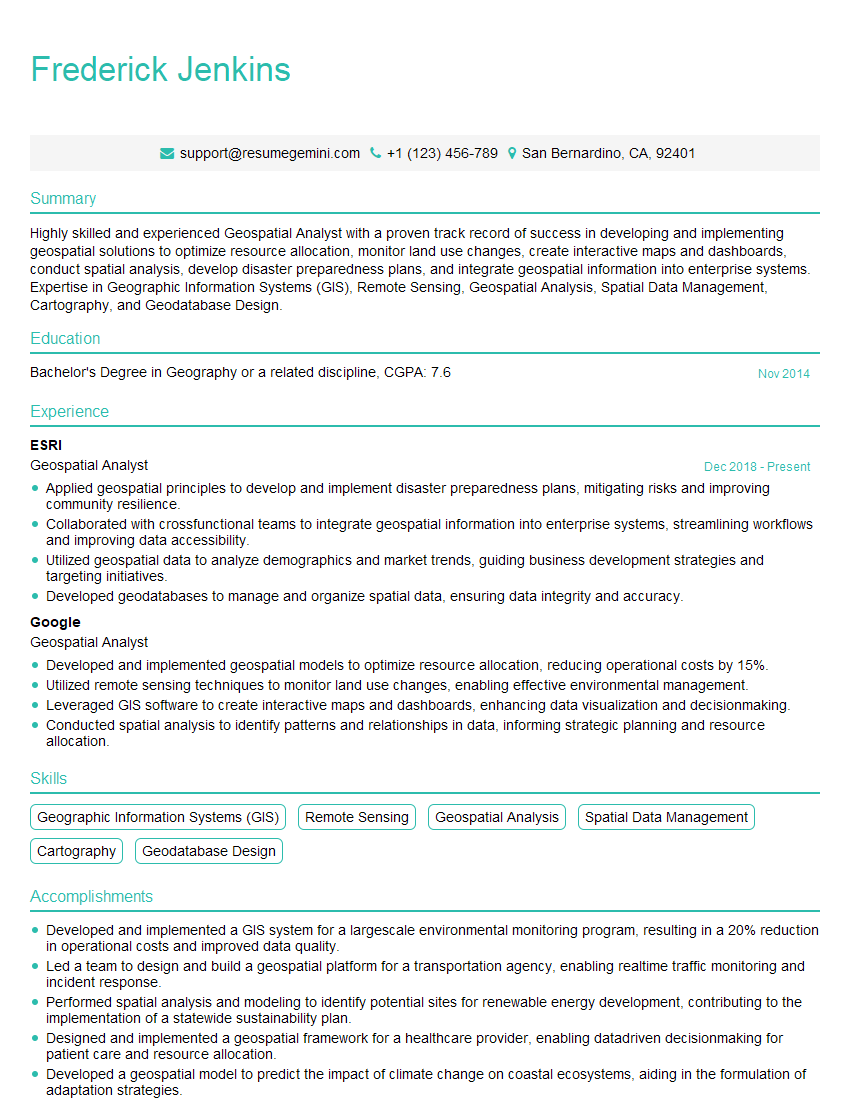
Geospatial Analyst Resume Sample

Cartographer Resume Sample

LiDAR Specialist Resume Sample

Photogrammetrist Resume Sample

Geodetic Surveyor Resume Sample

Land Surveyor Resume Sample
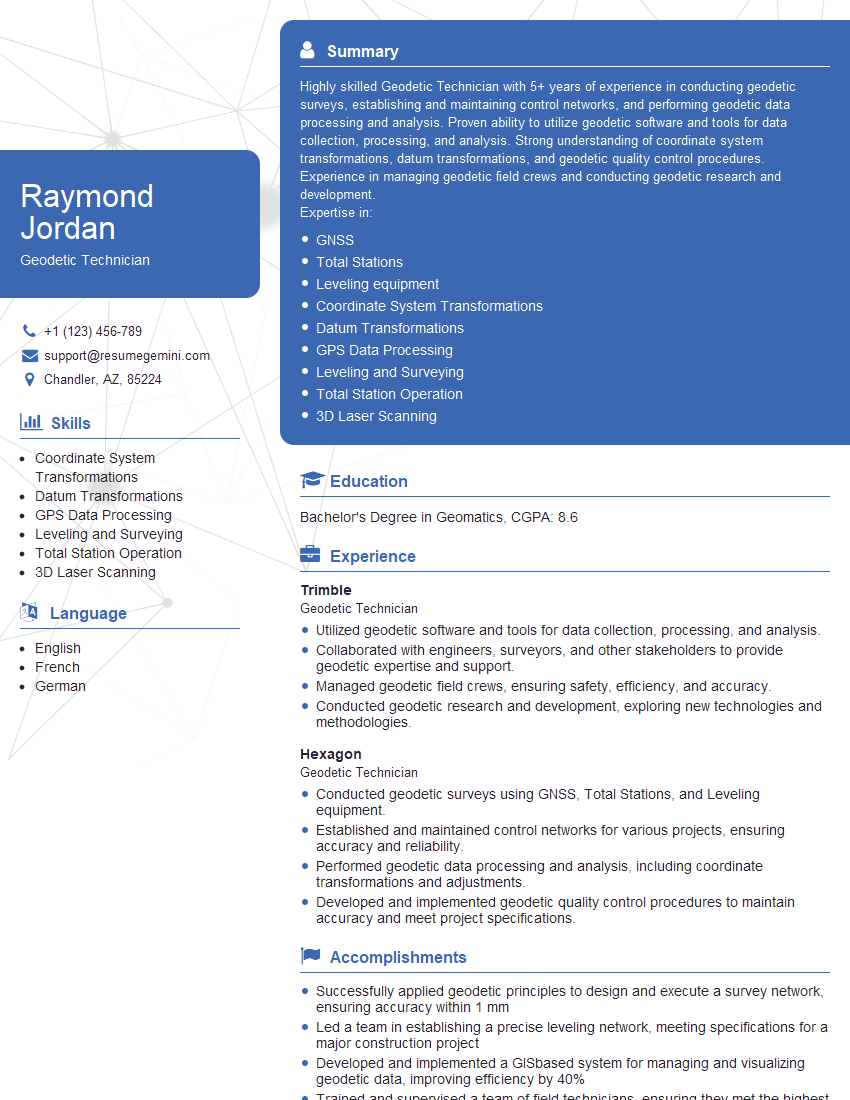
Geodetic Technician Resume Sample

Surveying Technician Resume Sample

Remote Sensing Specialist Resume Sample
Explore more articles
Users Rating of Our Blogs
Share Your Experience
We value your feedback! Please rate our content and share your thoughts (optional).
What Readers Say About Our Blog
Really detailed insights and content, thank you for writing this detailed article.
IT gave me an insight and words to use and be able to think of examples