Feeling uncertain about what to expect in your upcoming interview? We’ve got you covered! This blog highlights the most important Glass Production interview questions and provides actionable advice to help you stand out as the ideal candidate. Let’s pave the way for your success.
Questions Asked in Glass Production Interview
Q 1. Describe the different types of glass and their respective properties.
Glass is a fascinating material with a wide range of properties depending on its composition. Broadly, we classify glass into several types:
- Soda-lime glass: This is the most common type, used for windows, bottles, and containers. It’s relatively inexpensive to produce and is durable enough for everyday use. Its composition includes silica (SiO2), soda (Na2O), and lime (CaO).
- Borosilicate glass (e.g., Pyrex): Known for its low thermal expansion coefficient, making it resistant to thermal shock. This is why Pyrex is ideal for ovenware. It contains boron trioxide (B2O3) which significantly alters its properties compared to soda-lime glass.
- Lead glass (crystal glass): Contains lead oxide (PbO), which increases its refractive index, giving it a brilliant shine and making it ideal for decorative items like glassware and lenses. It’s denser and heavier than soda-lime glass.
- Quartz glass: Almost pure silica (SiO2), it boasts exceptional high-temperature resistance, chemical inertness and optical transparency across a wide spectral range. Used in high-precision applications such as optical fibers and laboratory equipment.
- Aluminosilicate glass: Incorporating alumina (Al2O3), it improves chemical durability and thermal shock resistance, suitable for specialized applications requiring high strength and resistance to aggressive environments.
The properties of each glass type, including its melting point, thermal expansion, chemical resistance, and optical properties, are directly related to its chemical composition. Manufacturers carefully control the raw materials to achieve the desired properties for the end product.
Q 2. Explain the process of glass melting and its critical parameters.
Glass melting is a crucial stage, transforming raw materials into a molten state suitable for forming. The process typically occurs in a furnace at temperatures exceeding 1500°C. The key parameters are:
- Temperature: Precise control is essential. Too low, and the melt won’t be fluid enough; too high, and volatile components may evaporate or the furnace refractory will be damaged.
- Time: Sufficient time is needed for complete melting and homogenization of the batch materials. This ensures a consistent glass composition and minimizes defects.
- Atmosphere: The furnace atmosphere should be controlled to prevent oxidation or reduction reactions that could alter the glass composition. In some cases, a protective atmosphere (e.g., nitrogen) is used.
- Batch composition: The precise ratio of raw materials (silica sand, soda ash, limestone, etc.) is critical. Even small variations can significantly affect the final glass properties.
- Stirring/Refining: Gentle stirring helps to improve the homogeneity of the melt and remove bubbles, creating a more consistent and defect-free product.
Think of it like baking a cake – you need the right ingredients (batch composition), the correct temperature and baking time to get a consistent result (homogeneous melt). Monitoring these parameters using sophisticated sensors and control systems is essential for consistent glass production and quality.
Q 3. What are the common defects found in glass production, and how are they mitigated?
Several defects can occur during glass production. Some common ones include:
- Bubbles: Trapped gases within the melt, often caused by insufficient refining or contamination.
- Stones: Undissolved refractory materials or impurities in the batch.
- Seeds: Small, glassy inclusions that refract light differently than the surrounding glass.
- Code: Streaks or variations in color or clarity, often due to inhomogeneous mixing of the batch.
- Devitrification: Crystallization of the glass during cooling, leading to a loss of transparency and increased brittleness.
Mitigation strategies involve careful batch preparation, precise control of melting parameters, thorough refining processes, and optimized cooling schedules. Regular inspection and quality control measures throughout the production process are crucial to identify and address these defects before they become a problem. For example, using high-quality raw materials is paramount in reducing stones and seeds.
Q 4. Describe the various glass forming techniques (e.g., blowing, pressing, float process).
Glass forming techniques depend largely on the desired shape and size of the final product. Common methods include:
- Glass blowing: A traditional method where molten glass is gathered on a blowpipe and shaped by blowing air into it. This is often used for artistic glassware and some bottles.
- Pressing: Molten glass is pressed into a mold to create precise shapes. This is widely used for mass production of items like jars and bottles.
- Float process: Molten glass is floated on a bath of molten tin, creating a perfectly flat sheet of glass. This is the dominant method for producing flat glass for windows and other applications. The tin bath provides a perfectly smooth surface for the glass to rest on, resulting in uniform thickness and minimal distortion.
- Drawing: Molten glass is drawn upwards to create continuous sheets or fibers. This is used for producing glass fibers for insulation or optical fibers.
- Casting: Molten glass is poured into molds, particularly for large pieces or specialty glass items requiring complex shapes.
Each technique has its own advantages and limitations regarding production speed, cost, and the complexity of shapes that can be achieved. The choice of technique is dictated by the specific requirements of the product.
Q 5. Explain the role of annealing in glass production.
Annealing is a crucial heat treatment process where the glass is slowly cooled from its forming temperature to room temperature. This relieves internal stresses that develop during the cooling process. Without annealing, the glass would be prone to cracking or shattering spontaneously due to these internal stresses. Imagine a glass with many microscopic cracks under pressure. These microscopic cracks can grow when the glass is cooled improperly, leading to spontaneous failure. Annealing is like taking a deep breath – slowly removing tension from the glass to achieve equilibrium.
The annealing process involves heating the glass to its annealing point (a specific temperature related to the glass composition) followed by a controlled cooling rate. This carefully controlled cooling schedule reduces internal stresses and improves the glass’s durability, thermal resistance and overall strength.
Q 6. How do you ensure quality control throughout the glass manufacturing process?
Quality control in glass manufacturing is paramount. It involves a multi-faceted approach that begins with raw material inspection and continues through to the final product. This includes:
- Raw material testing: Checking for purity and consistency of the raw materials (sand, soda ash, etc.) to minimize defects in the finished product.
- In-process inspection: Monitoring the melting process, checking the homogeneity of the melt, and detecting defects like bubbles or stones.
- Dimensional checks: Measuring the thickness, flatness, and other dimensions of the finished product to ensure consistency and adherence to specifications (especially relevant for flat glass).
- Optical inspection: Assessing the clarity, transparency, and absence of defects like seeds or code, particularly crucial for optical glass.
- Strength testing: Evaluating the mechanical strength and resistance to breakage of the final product.
- Chemical analysis: Determining the chemical composition of the glass to verify its conformance to specifications.
Data from each stage is tracked and analyzed to identify trends, allowing for process optimization and defect reduction. Statistical process control (SPC) techniques are frequently utilized to monitor production parameters and ensure consistent quality.
Q 7. What safety measures are crucial in a glass production environment?
Safety in a glass production environment is critical due to the high temperatures, sharp materials, and the potential for serious injuries. Key safety measures include:
- Personal Protective Equipment (PPE): Mandatory use of safety glasses, heat-resistant gloves, protective clothing, and footwear to protect workers from burns, cuts, and other hazards.
- Emergency procedures: Well-defined procedures for handling emergencies such as fires, chemical spills, or equipment malfunctions. Regular training drills are essential.
- Safe handling of materials: Procedures for safe handling and storage of raw materials and finished products, minimizing the risk of breakage and injury.
- Machine guarding: Properly guarded machinery to prevent accidental contact with moving parts and hot surfaces.
- Temperature monitoring and control: Continuous monitoring of furnace temperatures and other critical parameters to prevent overheating and equipment failure. Temperature alarms and automatic shutdown systems should be in place.
- Regular maintenance: Scheduled maintenance of equipment to prevent malfunctions and ensure safe operating conditions.
- Ventilation and dust control: Proper ventilation to remove harmful fumes and dust particles from the work environment. This minimizes risks associated with silica dust.
A strong safety culture, with regular safety training and a commitment to compliance with all safety regulations, is essential to ensure a safe working environment for all employees.
Q 8. Describe your experience with different types of glass furnaces.
My experience encompasses a wide range of glass furnaces, from traditional regenerative tank furnaces to modern electrically boosted furnaces and even specialized furnaces for specific glass types. Regenerative tank furnaces, the workhorses of the industry, use a system of regenerators to preheat combustion air, improving efficiency. I’ve worked extensively with these, optimizing their operation for maximum output and minimal fuel consumption. Electrically boosted furnaces offer finer control over melting parameters and reduced emissions, a key aspect of modern glassmaking that I’ve been actively involved in implementing. For specialty glasses like borosilicate or high-lead crystal, I’ve encountered specialized furnaces designed to manage the unique thermal and chemical properties of these materials, requiring careful control of temperature profiles and atmosphere.
- Regenerative Tank Furnaces: These are large, continuous melting units, efficient but requiring skilled operation and maintenance for consistent glass quality.
- Electrically Boosted Furnaces: These combine the advantages of gas firing with electric boosting for precise temperature control and reduced emissions.
- Specialty Furnaces: These are customized for specific glass types and often utilize unique melting techniques, such as those employed in the production of optical fibers.
Q 9. Explain the process of glass tempering or strengthening.
Glass tempering, or strengthening, is a crucial process that significantly enhances the durability of glass products. It involves rapidly heating the glass to a high temperature, then rapidly cooling it, typically using forced air. This rapid thermal shock induces compressive stresses on the surface of the glass and tensile stresses in the core. When external forces act on the tempered glass, the compressive surface layer must first be overcome before the glass fractures, making it significantly stronger and more resistant to impact and thermal stress than annealed glass. Imagine a trampoline; the tightly stretched surface resists downward pressure, just like the compressed surface layer in tempered glass.
The process typically involves:
- Heating: The glass is heated uniformly to just below its softening point.
- Cooling: High-velocity air jets rapidly cool the surface of the glass.
- Stress Measurement: Quality control involves checking the induced stress profile to ensure it meets specifications.
The result is glass that’s significantly stronger, more resistant to shattering, and often used in applications like automotive windshields, shower doors, and smartphone screens.
Q 10. How do you troubleshoot issues related to glass melting temperature or viscosity?
Troubleshooting melting temperature and viscosity issues requires a systematic approach. Problems often stem from variations in raw materials, furnace operation, or even atmospheric conditions. For example, a lower than expected melting temperature might indicate a higher cullet percentage than specified or an insufficient amount of batch materials, potentially due to an error in the batching process. Similarly, an unexpectedly high viscosity could mean contamination in the batch or insufficient melting time due to faulty furnace operation.
My troubleshooting strategy typically includes:
- Reviewing Batch Composition: Checking the exact proportions of raw materials for inconsistencies.
- Analyzing Furnace Operation: Examining temperature profiles, flame distribution (for gas furnaces), and the overall efficiency of the melting process.
- Inspecting Glass Quality: Checking for defects such as stones, cords, or bubbles, which might indicate impurities or problems in the melting process.
- Adjusting Process Parameters: Based on the analysis, adjustments are made to the batch composition, furnace temperature, and/or melting time.
Data logging and regular quality control are essential to identify and address these issues promptly. For instance, unexpected viscosity deviations are frequently addressed by adjusting the melting time or furnace temperature profiles based on real-time data.
Q 11. What are the common raw materials used in glass production?
The primary raw materials used in glass production are silica sand (silicon dioxide), soda ash (sodium carbonate), and limestone (calcium carbonate). These three form the basic building blocks of most glass types. However, many other additives are used to refine the glass and achieve specific properties.
- Silica Sand (SiO2): Provides the basic glass-forming network.
- Soda Ash (Na2CO3): Reduces the melting temperature of silica.
- Limestone (CaCO3): Increases the chemical durability and strength of the glass.
- Additives: These can include alumina (Al2O3) for increased strength and chemical resistance, potassium carbonate (K2CO3) for specific optical properties, or lead oxide (PbO) for high refractive index in crystal glass.
The exact proportions of these materials are carefully controlled to achieve the desired properties in the final glass product. For instance, a higher percentage of alumina results in a more chemically resistant glass.
Q 12. Explain the role of cullet in glass production.
Cullet, which is recycled glass, plays a significant role in reducing the energy consumption and cost of glass production. Adding cullet to the batch reduces the amount of raw materials needed, lowering energy consumption as less material needs to be melted. It also lowers the overall production costs and reduces the environmental impact of the manufacturing process by diverting waste from landfills. Further, using cullet can help stabilize the melting process and improve the quality and consistency of the final product. However, careful control of cullet quality is crucial; excessive amounts of contaminated cullet can negatively affect the glass quality. For example, including contaminated cullet may introduce undesired impurities that affect the color, clarity, or chemical durability of the glass.
In essence, cullet acts as a cost-effective and environmentally friendly fluxing agent and contributes towards sustainability in the glass industry.
Q 13. Describe your experience with glass finishing techniques (e.g., cutting, grinding, polishing).
My experience with glass finishing encompasses a range of techniques, each tailored to specific glass types and applications. Cutting, grinding, and polishing are crucial for achieving the desired shape, dimensions, and surface finish of the glass product. For instance, precision cutting is essential for creating complex shapes in automotive glass, requiring the use of diamond saws and water-cooled cutting techniques to minimize thermal stresses. Grinding, often using progressively finer abrasives, refines the cut edges and removes minor imperfections, while polishing with polishing compounds achieves the final desired surface smoothness and clarity.
- Cutting: Diamond saws or laser cutting, depending on the material and precision required.
- Grinding: Using progressively finer abrasive wheels to shape and smooth surfaces.
- Polishing: Employing polishing compounds and felt pads to achieve a high-quality, smooth finish.
- Edge Finishing: Techniques such as fire polishing, bevelling, and shaping are utilized to refine and strengthen edges.
Choosing the appropriate technique depends on factors such as the type of glass, desired finish, and tolerance requirements. For example, fire polishing would be ideal for enhancing edge strength and aesthetic appeal on tempered glass. In contrast, a precise cut with diamond sawing is more relevant for intricate glass elements.
Q 14. How do you ensure the consistent quality of glass products?
Ensuring consistent glass quality requires a multi-faceted approach involving meticulous control over all stages of production, from raw material selection to final inspection. This includes:
- Rigorous Raw Material Control: Regular analysis of incoming materials to ensure they meet strict specifications. Inconsistencies in the raw materials directly impact the quality of the finished product.
- Precise Furnace Control: Maintaining consistent melting temperature, atmosphere, and viscosity throughout the melting process. Real-time monitoring systems are critical in achieving this.
- Automated Process Control: Utilizing automated systems for batching, feeding, and forming to minimize human error and ensure consistency.
- Regular Quality Control Checks: Implementing continuous monitoring and quality checks at various stages, using techniques such as visual inspection and non-destructive testing methods like X-ray inspection for internal defects.
- Data Analysis and Process Optimization: Regularly analyzing production data to identify trends and improve processes. Statistical Process Control (SPC) is a valuable tool in this process.
Ultimately, a culture of quality awareness throughout the entire organization, from the engineering team to the production floor, is essential to maintain consistent quality. This includes regular training and clear quality protocols.
Q 15. Explain your understanding of different types of glass coatings.
Glass coatings are applied to enhance the properties of glass, improving its functionality and aesthetics. They can be broadly categorized into several types, each serving a distinct purpose.
- Low-Emissivity (Low-E) Coatings: These coatings are designed to reduce the amount of heat that passes through the glass. They achieve this by reflecting infrared radiation back into the room in winter and away from the building in summer. This leads to improved energy efficiency in buildings. Imagine them as tiny mirrors for heat.
- Self-Cleaning Coatings: These coatings, often containing titanium dioxide (TiO2), use photocatalysis to break down organic matter and pollutants on the glass surface. Sunlight triggers a reaction that makes the glass easier to clean and reduces the need for harsh cleaning agents. Think of it as the glass cleaning itself!
- Anti-Reflective Coatings: These coatings minimize light reflection, leading to clearer viewing through the glass. They’re commonly used in displays, lenses, and solar panels to maximize light transmission. Imagine looking through a perfectly clear window – that’s the effect of an effective anti-reflective coating.
- Hard Coatings: These coatings enhance the glass’s scratch and abrasion resistance, making them suitable for applications where durability is crucial, such as automotive windshields or smartphone screens. They act as a protective shield for the underlying glass.
- Decorative Coatings: These coatings add aesthetic appeal to the glass, offering a range of colors, textures, and patterns. They can create a unique look for windows, doors, or decorative elements. This is all about enhancing the visual appeal.
The choice of coating depends heavily on the intended application. For example, Low-E coatings are essential for energy-efficient windows, while hard coatings are crucial for durable automotive glass.
Career Expert Tips:
- Ace those interviews! Prepare effectively by reviewing the Top 50 Most Common Interview Questions on ResumeGemini.
- Navigate your job search with confidence! Explore a wide range of Career Tips on ResumeGemini. Learn about common challenges and recommendations to overcome them.
- Craft the perfect resume! Master the Art of Resume Writing with ResumeGemini’s guide. Showcase your unique qualifications and achievements effectively.
- Don’t miss out on holiday savings! Build your dream resume with ResumeGemini’s ATS optimized templates.
Q 16. What are the environmental considerations in glass production?
Environmental concerns in glass production are significant and relate to energy consumption, raw material sourcing, and emissions.
- Energy Intensive Process: Glass manufacturing requires immense amounts of heat energy, often from fossil fuels, contributing significantly to greenhouse gas emissions. Switching to renewable energy sources is a crucial step towards sustainability.
- Raw Material Extraction: The extraction of raw materials like silica sand, soda ash, and limestone can have environmental impacts, including habitat destruction and water pollution. Sustainable sourcing practices and responsible mining are necessary.
- Emissions: The manufacturing process releases various pollutants into the air, including particulate matter, sulfur oxides, and nitrogen oxides. Investing in emission control technologies and cleaner production methods is vital for minimizing these effects.
- Waste Management: Glass production generates significant waste, including cullet (broken glass). Efficient recycling programs are essential for reducing waste and conserving resources. Cullet can often be reused directly in the manufacturing process.
- Water Usage: Glass manufacturing requires substantial water for cooling and cleaning processes. Implementing water conservation techniques is important to minimize water consumption.
Addressing these environmental concerns requires a holistic approach, involving technological advancements, responsible sourcing, efficient waste management, and a commitment to reducing the overall environmental footprint.
Q 17. Describe your experience with lean manufacturing principles in glass production.
My experience with lean manufacturing in glass production focuses on eliminating waste and maximizing efficiency throughout the entire process. I’ve implemented various lean tools and techniques, resulting in improved productivity and reduced costs.
- Value Stream Mapping: We used value stream mapping to identify and eliminate non-value-added steps in our production process, streamlining the workflow and reducing lead times. This involved mapping the entire process from raw materials to finished products.
- 5S Methodology: Implementing the 5S methodology (Sort, Set in Order, Shine, Standardize, Sustain) improved workplace organization and reduced waste through better inventory management and streamlined processes.
- Kaizen Events: We conducted regular Kaizen events (continuous improvement activities) to involve the production team in identifying and solving process bottlenecks. These events fostered a culture of continuous improvement.
- Kanban System: Utilizing a Kanban system for managing inventory and production flow helped to reduce waste by minimizing overproduction and improving the flow of materials.
The results were tangible. We saw a significant reduction in lead times, improved overall equipment effectiveness (OEE), and a substantial decrease in manufacturing costs. For example, we reduced our lead time by 15% and improved our OEE by 10% within a year of implementation. Lean manufacturing is not just a set of tools, but a philosophy that permeates the whole organization.
Q 18. How do you manage production schedules and meet deadlines in a glass manufacturing facility?
Managing production schedules and meeting deadlines in a glass manufacturing facility requires a coordinated approach involving careful planning, robust scheduling software, and effective communication.
- Master Production Schedule (MPS): We utilize a robust MPS to plan production based on customer orders, inventory levels, and capacity constraints. This provides a high-level overview of the production plan.
- Capacity Planning: Careful capacity planning ensures that we have the necessary resources (equipment, personnel, materials) to meet the production demands. This involves analyzing historical data and forecasting future demand.
- Scheduling Software: We use sophisticated scheduling software that integrates with our ERP system to optimize production schedules, considering factors like machine availability, material handling, and order priorities. This software helps us create realistic schedules and track progress.
- Real-Time Monitoring: Real-time monitoring of production progress allows us to identify and address potential delays or issues proactively. This involves tracking key metrics and generating alerts when deviations occur.
- Communication: Effective communication between various departments (production, sales, procurement) is critical for ensuring that everyone is informed about the production schedule and potential challenges. Regular meetings and updates are essential.
By combining these strategies, we ensure timely completion of orders and efficient utilization of resources. Proactive monitoring and swift responses to unexpected issues are essential in this highly dynamic environment.
Q 19. Explain your experience with process optimization in glass production.
Process optimization in glass production involves systematically identifying and improving areas for efficiency gains and quality enhancements. My approach involves a data-driven methodology.
- Data Analysis: We start by collecting and analyzing data from various sources (production records, equipment sensors, quality control reports) to identify bottlenecks, inefficiencies, and areas for improvement. We use statistical process control (SPC) charts to monitor process variables.
- Root Cause Analysis: When problems arise, we conduct thorough root cause analyses (RCA) to understand the underlying causes and develop effective solutions. We use tools such as the 5 Whys or fishbone diagrams.
- Process Simulation: In some cases, we use process simulation software to model different scenarios and evaluate the impact of proposed changes before implementing them. This helps to minimize risks and maximize the effectiveness of improvements.
- Continuous Improvement Initiatives: We implement continuous improvement initiatives, focusing on incremental changes that accumulate over time to yield significant improvements. This involves regular review and adjustments to the optimization strategies.
- Automation: We continuously explore opportunities to automate processes to reduce manual intervention, improve consistency, and increase productivity. This can include automation of material handling, process control, or quality inspection.
For example, through process optimization, we improved the furnace efficiency by 8%, resulting in significant energy cost savings. This was achieved by fine-tuning the furnace operating parameters and implementing a more efficient melting process.
Q 20. What are the key performance indicators (KPIs) in glass manufacturing?
Key Performance Indicators (KPIs) in glass manufacturing are crucial for monitoring performance, identifying areas for improvement, and ensuring profitability. They can be broadly categorized into:
- Production KPIs: These focus on the efficiency and output of the production process. Examples include production volume, output per unit of time, yield rate (percentage of good quality products), and overall equipment effectiveness (OEE).
- Quality KPIs: These track the quality of the finished products and the effectiveness of quality control measures. Examples include defect rate, customer returns, and compliance with quality standards.
- Cost KPIs: These monitor the cost-effectiveness of the manufacturing process. Examples include cost per unit, energy consumption, material usage, and labor costs.
- Safety KPIs: These focus on maintaining a safe working environment. Examples include safety incidents, lost time injuries, and near-miss reports.
- Environmental KPIs: These track the environmental impact of the manufacturing process. Examples include energy consumption, water usage, waste generation, and greenhouse gas emissions.
Regular monitoring and analysis of these KPIs enable us to make data-driven decisions, identify areas for improvement, and track progress toward our goals. A dashboard displaying key KPIs is essential for proactive management.
Q 21. How do you handle production issues and unexpected downtime?
Handling production issues and unexpected downtime requires a proactive and systematic approach. Our strategy focuses on swift response, efficient troubleshooting, and preventative maintenance.
- Immediate Response Team: A dedicated team is immediately deployed to assess the situation and take corrective actions. This team is trained to handle various types of production issues.
- Root Cause Analysis: A thorough root cause analysis is conducted to determine the underlying cause of the downtime and prevent future occurrences. This involves collecting data, interviewing personnel, and reviewing maintenance records.
- Preventive Maintenance: A robust preventive maintenance program is in place to minimize unexpected downtime. This involves regular inspections, equipment servicing, and proactive replacement of worn-out parts.
- Spare Parts Inventory: We maintain a sufficient inventory of spare parts to reduce downtime caused by part failures. This includes critical parts and components with short lead times for procurement.
- Contingency Plans: We have developed contingency plans for various potential production scenarios, including alternative production lines or suppliers, to minimize the impact of unexpected downtime.
For example, when a furnace malfunction occurred, our immediate response team swiftly identified the problem as a faulty burner. Having a spare burner readily available, we minimized the downtime to just a few hours, limiting the impact on production schedules. Following the incident, we enhanced our preventive maintenance schedule for furnace burners to prevent similar issues in the future.
Q 22. Describe your experience with different types of glass inspection equipment.
My experience encompasses a wide range of glass inspection equipment, from basic visual inspection tools to sophisticated automated systems. Visual inspection, while seemingly simple, requires trained eyes to identify subtle defects like bubbles, stones (inclusions), and surface imperfections. This is often the first line of defense in quality control. I’ve extensively used optical comparators for precise measurements and detailed analysis of surface flaws. These provide magnified views, enabling detection of even microscopic imperfections. Furthermore, I’m proficient in operating automated inspection systems that utilize cameras, lasers, and advanced image processing software. These systems provide objective, quantitative data on defects, often integrated directly into the production line for real-time quality control. For example, I’ve worked with systems that automatically reject containers with unacceptable levels of surface scratches or dimensional variations. Finally, I have experience with non-destructive testing methods like X-ray inspection, crucial for examining internal flaws in thicker glass products.
In one instance, we were struggling with an unusually high rate of internal bubbles in our production. Through careful analysis using an automated inspection system and subsequent investigation of the furnace operation, we identified a fluctuation in the melting process as the root cause. Implementing a control system to stabilize the furnace temperature resolved the problem significantly.
Q 23. How do you maintain and repair glass production machinery?
Maintaining and repairing glass production machinery requires a proactive approach combining preventative maintenance schedules with prompt and effective repairs. Preventative maintenance includes regular lubrication of moving parts, checking for wear and tear on critical components, and ensuring proper cooling systems function correctly. This minimizes downtime and extends the lifespan of equipment. For example, timely lubrication of the forming molds prevents premature wear and ensures consistent product quality. Repairs can range from simple fixes like replacing worn-out belts to more complex tasks involving hydraulic system adjustments or even mold replacement. This often involves collaboration with specialized technicians and engineers.
One instance involved a malfunction in the gob-feeding system of our glass bottle forming machine. Troubleshooting involved carefully examining the system’s hydraulics, checking for leaks, and finally identifying a faulty valve. Replacing the valve and recalibrating the system restored full functionality. This experience underscored the importance of thorough understanding of the machinery’s operation and the systematic approach to diagnostics.
Q 24. Explain your experience with different types of glass containers or products.
My experience spans a diverse range of glass containers and products, including bottles for beverages (beer, wine, spirits, soft drinks), food jars, pharmaceutical vials, and various specialty glass items. I’ve worked with different glass types, from soda-lime glass, common in containers, to borosilicate glass, known for its heat resistance (used in ovenware), and even lead crystal, prized for its brilliance and clarity. Each type presents unique challenges in terms of forming, annealing, and finishing. For example, the precise dimensions and tolerances required for pharmaceutical vials demand very different processing parameters compared to the relatively looser specifications for everyday beverage bottles.
Understanding the specific properties of each glass type is critical for optimizing production parameters and achieving the desired product quality. In one project, we successfully transitioned from a traditional soda-lime glass formulation to a lighter, more environmentally friendly variant for our beverage bottles, requiring modifications to the forming and annealing processes to maintain quality.
Q 25. Describe your understanding of the different types of refractory materials used in glass furnaces.
Glass furnaces rely on refractory materials to withstand the extremely high temperatures and corrosive environments within the melting process. These materials typically consist of specialized bricks and monolithic castables made from various oxides and other high-temperature components. Common refractory materials include silica brick (high silica content), alumina-silica brick, and zircon bricks, each with varying thermal shock resistance and chemical stability. The choice of refractory depends on the furnace type, glass composition, and operating temperature. For example, silica bricks are commonly used in the crown and superstructure of the furnace due to their excellent resistance to high temperatures and the corrosive nature of the molten glass. Alumina-silica bricks might be used in areas exposed to less severe conditions, offering a balance of cost and performance.
Proper selection and maintenance of refractory materials are crucial for extending furnace lifespan and ensuring efficient operation. Regular inspections are essential to identify any damage or wear, allowing for timely repairs to prevent costly shutdowns and potential damage to the furnace structure.
Q 26. How do you ensure the efficient use of energy in glass production?
Efficient energy use in glass production is paramount, both economically and environmentally. Strategies for improving energy efficiency include optimizing furnace design and operation, improving heat recovery systems, and employing advanced control systems. Optimizing furnace design involves using advanced insulation techniques to minimize heat loss, and implementing energy-efficient burners that precisely control the fuel-air mixture for optimal combustion. Heat recovery systems, such as recuperators or regenerators, capture waste heat from the exhaust gases and re-introduce it into the furnace, significantly reducing fuel consumption. Advanced control systems provide real-time monitoring and adjustments of various furnace parameters, maintaining optimal operating conditions and minimizing energy waste.
In a previous role, we implemented a new heat recovery system which resulted in a significant reduction (approximately 15%) in our natural gas consumption without compromising production output. This initiative not only reduced our operating costs but also lessened our carbon footprint.
Q 27. Explain your understanding of the relevant safety regulations and standards for glass production.
Safety regulations and standards in glass production are rigorous, focusing on protecting workers from hazards associated with high temperatures, molten glass, and sharp materials. These regulations cover aspects such as personal protective equipment (PPE), including safety glasses, heat-resistant clothing, and gloves; machine guarding to prevent accidental contact with moving parts; and emergency procedures for handling glass spills or equipment malfunctions. Specific regulations vary depending on location and the type of glass production facility, but adherence to OSHA (Occupational Safety and Health Administration) standards or equivalent international standards is essential. Regular safety training and audits are crucial for ensuring compliance and maintaining a safe working environment. Proper handling of hazardous materials, including the correct disposal of waste glass, is also governed by stringent regulations.
We implemented a comprehensive safety training program incorporating hands-on simulations of emergency procedures and regular safety inspections to reinforce safe working practices, resulting in a significant reduction in workplace incidents.
Q 28. Describe your experience with implementing new technologies or processes in a glass manufacturing environment.
I have extensive experience in implementing new technologies and processes to enhance efficiency and quality in glass manufacturing. This includes the integration of automated inspection systems, as previously discussed, which have significantly improved our ability to detect defects and maintain consistent product quality. We’ve also implemented advanced process control systems that allow for real-time monitoring and adjustments of various process parameters, leading to reduced waste and improved energy efficiency. Furthermore, I’ve been involved in evaluating and integrating new furnace technologies, such as those incorporating improved burners or advanced heat recovery systems, to enhance furnace efficiency and reduce emissions.
One notable project involved transitioning from a traditional batch melting process to a more efficient continuous melting process. This required significant changes to our furnace design and operational procedures but ultimately resulted in increased throughput, improved glass quality, and reduced energy consumption.
Key Topics to Learn for Glass Production Interview
- Raw Materials & Batching: Understanding the composition of glass batches, including silica, soda ash, limestone, and other additives. Practical application: Calculating batch compositions to achieve desired glass properties.
- Melting & Refining: Knowledge of different melting processes (e.g., tank furnaces, pot furnaces) and refining techniques to remove bubbles and inclusions. Practical application: Troubleshooting issues related to melting temperature, homogeneity, and clarity.
- Forming Processes: Familiarity with various forming techniques like blowing, pressing, drawing, and float glass processes. Practical application: Analyzing the strengths and weaknesses of different forming methods for specific applications.
- Annealing & Heat Treatment: Understanding the importance of controlled cooling (annealing) to reduce internal stresses and prevent breakage. Practical application: Identifying and addressing annealing-related defects.
- Quality Control & Inspection: Knowledge of quality control procedures, including visual inspection, dimensional measurements, and testing for properties like strength and durability. Practical application: Implementing strategies to minimize defects and ensure consistent product quality.
- Safety Procedures & Regulations: Understanding and adhering to safety protocols in a high-temperature, high-risk industrial environment. Practical application: Proposing improvements to safety procedures and identifying potential hazards.
- Maintenance & Troubleshooting: Familiarity with routine maintenance procedures for furnaces, forming equipment, and other machinery. Practical application: Diagnosing and resolving equipment malfunctions to minimize downtime.
- Environmental Considerations: Understanding the environmental impact of glass production and the implementation of sustainable practices. Practical application: Proposing ways to reduce energy consumption and waste generation.
Next Steps
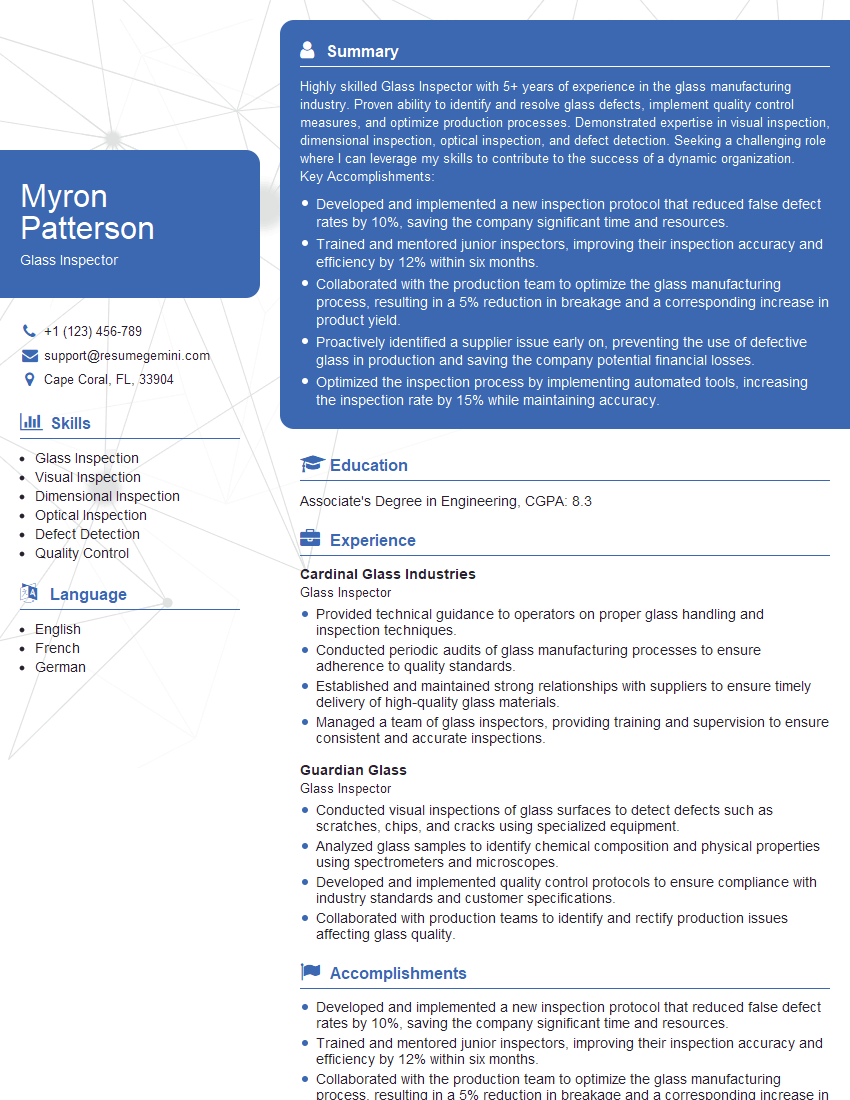
Mastering glass production opens doors to rewarding and diverse career opportunities within a constantly evolving industry. Demonstrating a strong understanding of these core concepts significantly enhances your interview prospects. Creating an ATS-friendly resume is crucial for getting your application noticed. To help you build a compelling resume that showcases your skills and experience, we recommend using ResumeGemini. ResumeGemini provides a user-friendly platform and offers examples of resumes tailored to the glass production industry, ensuring your application stands out.
Explore more articles
Users Rating of Our Blogs
Share Your Experience
We value your feedback! Please rate our content and share your thoughts (optional).
What Readers Say About Our Blog
Really detailed insights and content, thank you for writing this detailed article.
IT gave me an insight and words to use and be able to think of examples