Are you ready to stand out in your next interview? Understanding and preparing for ITIL Service Design (SD) interview questions is a game-changer. In this blog, we’ve compiled key questions and expert advice to help you showcase your skills with confidence and precision. Let’s get started on your journey to acing the interview.
Questions Asked in ITIL Service Design (SD) Interview
Q 1. Explain the key principles of ITIL Service Design.
ITIL Service Design operates on several key principles to ensure effective and efficient service delivery. These principles guide the entire design process, promoting alignment with business objectives and customer needs. Think of them as the foundation upon which a robust service offering is built.
- Focus on Value: Every design decision should be assessed based on its contribution to business value. This involves understanding the needs of the business and tailoring services accordingly. For example, a new CRM system should not just be technically sound but also demonstrably improve sales efficiency or customer satisfaction.
- Holistic Approach: Service design considers all aspects of service delivery, including technical infrastructure, processes, people, and the customer experience. Ignoring any of these components can lead to inefficiencies or service failures. Imagine designing a high-speed internet service without considering the customer’s equipment compatibility and technical support options.
- Continual Improvement: The process isn’t static; feedback loops and iterative improvement are crucial. Regular reviews, performance analysis, and incorporating user feedback are essential for adapting to changing business needs and technological advancements. For example, user feedback on a newly launched mobile app might indicate a need for UI/UX improvements, prompting a redesign iteration.
- Collaboration and Communication: Effective service design requires strong collaboration between IT, business stakeholders, and customers. Open communication ensures that all perspectives are considered and that the final service meets everyone’s needs. A successful project kickoff meeting with all stakeholders, for instance, is pivotal to a well-defined scope.
- Risk Management: Identifying and mitigating potential risks is critical to prevent service disruptions and ensure service reliability. This involves proactive identification of threats, developing contingency plans, and implementing appropriate controls. This could involve disaster recovery planning to ensure business continuity in case of a server failure.
Q 2. Describe the different stages of the Service Design lifecycle.
The Service Design lifecycle is iterative and typically comprises these stages, though the specific names and organization might vary slightly depending on the organization and framework used:
- Service Strategy: Defines the overall direction for service design, aligning with business goals and strategic objectives. This involves understanding the business needs and deciding which IT services can best address them.
- Service Catalog Management: Creates and maintains a catalog of all IT services offered to the business. This is essentially a menu of services that are available to the organization’s users, complete with details on service levels, costs, and support procedures.
- Capacity and Availability Management: Plans for the sufficient capacity and availability of IT services to meet current and future demand. This stage involves performance testing, forecasting future needs, and proactively implementing measures to prevent outages or performance bottlenecks.
- IT Service Continuity Management: Ensures that services can recover quickly and effectively from disruptions. This includes defining recovery time objectives (RTOs), recovery point objectives (RPOs), and implementing disaster recovery plans.
- Security Management: Incorporates security considerations throughout the service design process to protect sensitive data and systems. This involves implementing security controls and processes to minimize vulnerabilities and prevent breaches.
- Architecture Management: Develops and maintains a robust IT architecture that supports the organization’s services. This includes designing the infrastructure, networks, and applications needed to provide these services reliably and efficiently.
These stages are interconnected and iterative. Feedback from one stage can often influence the next, requiring adjustments and refinements to ensure that the final service meets expectations.
Q 3. How do you define and manage service level agreements (SLAs) within Service Design?
Service Level Agreements (SLAs) are formal contracts that define the expected performance levels of IT services. In Service Design, SLAs are defined to ensure that the designed services meet the needs of the business and the customers. This ensures that there is a clear understanding of the responsibilities of both IT and the business.
Managing SLAs within Service Design involves:
- Defining Measurable Metrics: SLAs need to be quantifiable. This means defining clear, measurable metrics that can be monitored and reported on. For example, an SLA for a helpdesk might specify an average response time of under 15 minutes, or a 99.9% uptime guarantee for a web server.
- Identifying Stakeholders: Clearly define who is responsible for fulfilling the SLA (usually IT) and who is entitled to its benefits (the business or specific user groups). This includes mapping responsibilities and escalation paths for issues.
- Negotiation and Agreement: SLAs are negotiated between IT and the business to ensure that they are mutually acceptable and realistic. This often involves balancing the desire for high service levels with the cost of achieving them.
- Monitoring and Reporting: Regular monitoring and reporting on SLA performance is critical to identifying and addressing potential issues early on. Dashboards and reports should be used to track key metrics and highlight areas for improvement.
- Review and Improvement: SLAs should be regularly reviewed and updated to reflect changing business needs and technological advancements. This ensures that SLAs remain relevant and effective over time.
A well-defined SLA provides a framework for managing expectations, holding teams accountable and improving service quality.
Q 4. What are the key inputs and outputs of the Service Design phase?
The Service Design phase relies on several key inputs to produce valuable outputs. Consider them the ingredients and the resulting dish.
Key Inputs:
- Service Strategy: Defines the overall direction and objectives of the IT services.
- Demand Management Information: Data on current and future service demands.
- Financial Management Information: Budgetary constraints and cost models for service design.
- Risk Management Information: Identification and assessment of potential risks related to service design.
- Business Requirements: Needs and expectations from the business concerning service functionality and performance.
- Existing Infrastructure and Applications: Inventory of existing IT resources and their capabilities.
Key Outputs:
- Service Catalog: A comprehensive catalog of available IT services.
- Service Level Agreements (SLAs): Formal agreements that define the expected performance of IT services.
- Design Documentation: Detailed technical and operational documentation for all aspects of the services.
- Implementation Plans: A detailed plan for implementing and deploying the designed services.
- Training Plans: Plans for training users and IT staff on the use and operation of the new services.
- Risk Register: An updated list of risks, mitigation plans, and contingency strategies.
These inputs and outputs are crucial for bridging the gap between business needs and IT solutions.
Q 5. Explain the role of Service Design in aligning IT services with business needs.
Service Design plays a pivotal role in aligning IT services with business needs by acting as a translator between IT capabilities and business requirements. It’s about ensuring IT supports and enhances business goals rather than existing as a separate, disconnected entity.
This alignment is achieved through:
- Understanding Business Needs: Service Design starts with a thorough understanding of business objectives, strategic goals, and pain points. This involves working closely with business stakeholders to identify areas where IT can provide the greatest value.
- Translating Needs into Services: The next step involves translating these business needs into specific, actionable IT services. For example, a business need for improved customer communication might translate into a new CRM system, a revamped website, and improved self-service portals.
- Designing for Business Value: Each service should be designed to deliver measurable business value. This involves identifying key performance indicators (KPIs) and measuring the impact of the service on the business. The goal is not just to build the service but to showcase its effectiveness in improving business outcomes.
- Continuous Feedback and Iteration: Alignment isn’t a one-time event; it’s an ongoing process. Regular feedback loops, performance monitoring, and iterative improvements ensure that IT services continue to meet evolving business needs.
In essence, Service Design provides a framework for ensuring that IT investments are directly linked to business goals, maximizing ROI and contributing to organizational success.
Q 6. How do you design for resilience and high availability in your services?
Designing for resilience and high availability is crucial for minimizing disruptions and ensuring business continuity. It involves building redundancy and implementing fail-safe mechanisms into the service architecture.
Strategies include:
- Redundancy: Implementing redundant components, such as multiple servers, networks, and power supplies, to ensure that the service remains available even if one component fails. This could be a mirrored database or geographically distributed servers.
- Failover Mechanisms: Establishing automatic failover mechanisms that quickly switch to backup systems in case of a failure. Load balancers distribute traffic across multiple servers, and if one server fails, the load balancer automatically redirects traffic to other available servers.
- Disaster Recovery Planning: Developing comprehensive disaster recovery plans that outline how to recover services in the event of a major disaster, such as a natural disaster or cyberattack. This should include offsite backups, recovery procedures and communication protocols.
- Monitoring and Alerting: Implementing robust monitoring systems to detect potential problems before they cause major outages. Automated alerts notify appropriate personnel of issues, allowing for timely intervention.
- Capacity Planning: Ensuring sufficient capacity to handle peak loads and future growth. This avoids performance degradation or service outages during periods of high demand.
These strategies, implemented thoughtfully, work together to create a robust and resilient service, minimizing downtime and safeguarding business operations.
Q 7. Describe your experience with designing and implementing service catalogs.
I have extensive experience in designing and implementing service catalogs, leveraging ITIL best practices. My approach focuses on user-friendliness, comprehensiveness, and accuracy.
My experience includes:
- Requirement Gathering: Collaborating with stakeholders to identify the needs and expectations for the service catalog, ensuring it meets the requirements of both IT and the business.
- Catalog Design: Designing a user-friendly catalog structure with clear categorization, search functionality, and detailed service descriptions. This often involves using a visual catalog structure, and potentially integrating with a service management platform.
- Content Development: Developing accurate and comprehensive descriptions of each service, including service levels, costs, and support procedures. We ensured accurate information through cross-functional collaboration and verification.
- Implementation: Implementing the catalog using a service catalog management tool (e.g., ServiceNow) or building a custom solution depending on the organizational needs. I’ve managed both approaches depending on the scale and complexity of the catalog.
- Maintenance and Updates: Establishing processes for regularly updating and maintaining the catalog to reflect changes in services, service levels, and business needs. We included a process for feedback collection to ensure the catalog reflected the users needs.
In one project, we implemented a new service catalog for a large financial institution. This involved migrating from a legacy system to a modern service catalog platform, resulting in a significant improvement in user experience and operational efficiency. The improved catalog lead to a reduction in service requests, due to self-service adoption and better communication.
Q 8. How do you ensure that service designs are cost-effective and efficient?
Cost-effective and efficient service design hinges on a holistic approach that considers both the financial and operational aspects. It’s not just about saving money; it’s about maximizing value for every dollar spent. My approach begins with a thorough understanding of business needs and aligning service design choices with strategic goals. This involves:
- Comprehensive Cost Modeling: I meticulously estimate all costs associated with a service, from development and implementation to ongoing maintenance and support. This includes infrastructure, personnel, training, and software licensing. I use a variety of techniques like bottom-up and top-down costing to ensure accuracy. For example, in designing a new customer support system, I would model the cost of different software options, staffing requirements for different support levels, and the potential cost savings from automation.
- Value Stream Mapping: I leverage value stream mapping to identify and eliminate waste throughout the service lifecycle. This visualization technique helps us pinpoint inefficiencies and bottlenecks that contribute to increased costs. We might discover, for example, that a manual approval process is causing significant delays and increasing processing costs, prompting us to automate that process.
- Prioritization based on ROI: We prioritize design activities based on their return on investment (ROI). This ensures we focus resources on services that deliver the highest value to the business. A project with a high ROI might be given priority over one with a lower ROI, even if the latter is simpler to implement.
- Continuous Improvement: After deployment, ongoing monitoring and analysis are crucial to identify areas for improvement and cost optimization. This is often done using metrics such as Mean Time To Resolution (MTTR) and Customer Satisfaction (CSAT).
By integrating these practices, I ensure that service designs are not only efficient in their operation but also represent a sound financial investment for the organization.
Q 9. Explain your approach to managing risks and issues during the service design process.
Risk and issue management are paramount in service design. My approach involves a proactive and systematic process, starting from the initial design phase and continuing throughout implementation and beyond. I employ several key techniques:
- Risk Identification and Assessment: I use workshops and brainstorming sessions with stakeholders to identify potential risks and issues, considering factors such as technology failures, security breaches, regulatory compliance, and user adoption. We then assess the likelihood and impact of each risk using a risk matrix.
- Risk Mitigation Planning: For each identified risk, we develop a mitigation plan outlining specific actions to reduce the likelihood or impact of the risk. For instance, if a security breach is a major concern, we might implement robust authentication measures and regular security audits.
- Issue Tracking and Resolution: A formal issue tracking system is employed to record, monitor, and resolve issues that arise during the design and implementation phases. This ensures transparency and accountability.
- Regular Monitoring and Review: Post-implementation, we continuously monitor the service to identify potential issues and measure the effectiveness of our risk mitigation strategies. This allows us to make necessary adjustments and proactively address emerging challenges.
- Communication and Collaboration: Effective communication is vital. I ensure that all stakeholders are kept informed of risks and issues, and that collaboration is fostered to find solutions. Regular status updates and meetings are key.
By applying this rigorous approach, we can significantly reduce the likelihood of negative impacts and ensure a smoother transition to service operation.
Q 10. Describe your experience with different service design methodologies (e.g., Lean, Agile).
My experience spans various service design methodologies, each with its unique strengths. I’ve successfully applied both Lean and Agile principles, tailoring their application to specific project contexts.
- Lean Service Design: Lean focuses on eliminating waste and maximizing value. I’ve utilized Lean techniques like value stream mapping to identify and remove bottlenecks in service delivery processes. In one project, applying Lean principles to a helpdesk process revealed significant delays caused by an inefficient ticket routing system. By streamlining the system, we reduced resolution times significantly.
- Agile Service Design: Agile emphasizes iterative development and collaboration. I’ve incorporated Agile methodologies like Scrum into service design projects, facilitating flexibility and responsiveness to changing requirements. Using Agile in a recent cloud migration project allowed us to adapt quickly to unexpected technical challenges and deliver a successful solution incrementally.
My approach is pragmatic—I choose the methodology that best suits the project’s scope, complexity, and the organization’s culture. Often, I find myself combining elements of different methodologies for a hybrid approach that optimizes efficiency and effectiveness.
Q 11. How do you use design thinking principles in service design?
Design thinking is a human-centered approach that prioritizes user needs and empathy. I integrate its five stages – Empathize, Define, Ideate, Prototype, and Test – into the service design process.
- Empathize: I conduct user research, interviews, and surveys to deeply understand user needs, pain points, and expectations. This helps us design services that truly meet their needs.
- Define: We clearly articulate the problem we are trying to solve based on our user research findings. This ensures that our design efforts are focused and effective.
- Ideate: We brainstorm creative solutions, exploring a wide range of possibilities. Techniques like mind mapping and sketching help generate innovative ideas.
- Prototype: We create low-fidelity prototypes to test our ideas early and gather feedback. This allows us to iterate and refine our designs before committing significant resources to development.
- Test: We rigorously test our prototypes with real users, gathering feedback to identify areas for improvement. This iterative testing process ensures that our final design is user-friendly and effective.
By following these design thinking principles, we create services that are not only functional but also user-centric and deliver a positive user experience.
Q 12. How do you prioritize service design activities based on business value?
Prioritizing service design activities based on business value is critical to maximize return on investment. I use a multi-faceted approach:
- Business Value Assessment: We define clear metrics for measuring business value, such as increased revenue, reduced costs, improved customer satisfaction, or enhanced operational efficiency. This might involve conducting a cost-benefit analysis for each design activity.
- Prioritization Matrix: We use a prioritization matrix (like a MoSCoW method – Must have, Should have, Could have, Won’t have) to rank activities based on their impact and feasibility. Activities with high impact and high feasibility are prioritized.
- Stakeholder Alignment: We involve key stakeholders in the prioritization process to ensure alignment on business goals and priorities. This fosters buy-in and support for the chosen priorities.
- Dependency Mapping: We map dependencies between design activities to identify critical paths and ensure that activities are sequenced appropriately. This helps prevent delays and ensures a smooth workflow.
- Agile Practices: Incorporating Agile principles, such as iterative planning and prioritization, enables us to adapt to changes and continuously refine our priorities based on feedback and new information.
This structured approach ensures that our most valuable design initiatives receive the necessary attention and resources, leading to optimized outcomes for the business.
Q 13. Describe your experience with service modeling and mapping.
Service modeling and mapping are essential for visualizing and understanding service relationships and dependencies. My experience includes creating various models, including:
- Service Maps: I’ve built service maps to visually represent the relationships between different services and their supporting components. This allows us to identify potential points of failure and dependencies between services. For example, a service map might illustrate the connections between a web application, a database server, and a network infrastructure.
- Process Maps: I’ve developed process maps to document the steps involved in delivering a service. This helps identify inefficiencies and opportunities for improvement. For instance, mapping a customer onboarding process revealed several redundant steps that were eliminated, resulting in a faster and more efficient process.
- Data Flow Diagrams: I use data flow diagrams to illustrate how data flows between different components of a service. This aids in understanding data dependencies and potential bottlenecks. This is particularly useful when designing data-intensive services.
These modeling techniques provide a clear and concise representation of the service landscape, enabling better communication, improved decision-making, and a deeper understanding of complex service relationships.
Q 14. What tools and techniques do you use for service design?
My service design toolkit encompasses a range of tools and techniques, both software and process-oriented. The specific tools used depend on the project’s context and requirements, but generally include:
- Modeling Tools: Software such as draw.io, Visio, or specialized ITIL-aligned service mapping tools are used for creating service maps, process maps, and other visual representations.
- Collaboration Platforms: Tools like Jira, Confluence, or Microsoft Teams are used to facilitate collaboration among team members and stakeholders.
- Document Management Systems: We utilize document management systems to centralize and manage all service design documentation, ensuring version control and easy access.
- Process Improvement Methodologies: Lean, Six Sigma, and Agile methodologies provide a structured framework for improving service efficiency and effectiveness. Techniques like value stream mapping, root cause analysis, and Kanban are frequently employed.
- Data Analysis Tools: Tools for data analysis (e.g., spreadsheets, statistical packages) are used to analyze performance data and identify areas for improvement.
Beyond the software tools, effective communication, stakeholder engagement, and a clear understanding of ITIL best practices are the most crucial tools in my arsenal. These soft skills, combined with the right technology, empower me to deliver successful service design outcomes.
Q 15. Explain your experience with capacity management within the service design phase.
Capacity management within Service Design focuses on ensuring that IT services have sufficient resources – computing power, storage, network bandwidth, etc. – to meet current and future demands. It’s about proactive planning, not just reactive problem-solving. My experience involves collaborating with Service Level Management and Operations teams to forecast resource needs based on historical data, predicted growth, and business requirements. For instance, during a recent project for a major e-commerce client, we used capacity modeling tools to predict a significant surge in traffic during their annual holiday sales. This allowed us to proactively scale our cloud infrastructure, ensuring a smooth and seamless shopping experience for their customers, avoiding any performance bottlenecks or outages. We also used load testing to validate our capacity planning before the sales event.
This process typically involves:
- Demand forecasting: Analyzing historical data and future projections to anticipate resource requirements.
- Capacity modeling: Using specialized tools to simulate different scenarios and assess resource needs.
- Resource provisioning: Procuring and configuring the necessary IT resources.
- Performance monitoring: Continuously monitoring resource utilization and identifying potential issues.
By implementing these steps, we were able to minimize costs and maximize resource utilization while providing a high-quality service experience.
Career Expert Tips:
- Ace those interviews! Prepare effectively by reviewing the Top 50 Most Common Interview Questions on ResumeGemini.
- Navigate your job search with confidence! Explore a wide range of Career Tips on ResumeGemini. Learn about common challenges and recommendations to overcome them.
- Craft the perfect resume! Master the Art of Resume Writing with ResumeGemini’s guide. Showcase your unique qualifications and achievements effectively.
- Don’t miss out on holiday savings! Build your dream resume with ResumeGemini’s ATS optimized templates.
Q 16. How do you ensure that service designs comply with relevant standards and regulations?
Compliance is paramount in Service Design. I ensure compliance with relevant standards and regulations – such as ISO 27001 (Information Security), HIPAA (healthcare data), PCI DSS (payment card data), and GDPR (data privacy) – throughout the entire design process. This starts with a thorough risk assessment that identifies potential vulnerabilities and compliance requirements. Then, during the design phase, we incorporate security controls and processes into the service architecture to mitigate these risks. For example, if we are designing a new application that handles sensitive customer data, we would ensure it is built using secure coding practices, incorporates strong authentication and authorization mechanisms, and is protected by appropriate firewalls and intrusion detection systems. All this is carefully documented and reviewed to ensure it meets the legal and regulatory needs.
We use a combination of methods:
- Regular audits: Conducting periodic audits to verify compliance.
- Policy implementation: Embedding compliance policies and procedures into our design and operational processes.
- Security reviews: Reviewing all designs to identify and address potential security vulnerabilities.
- Documentation: Maintaining detailed documentation to demonstrate compliance.
This ensures that the services we design are not only functional but also secure and compliant with all relevant regulations.
Q 17. Describe your experience with designing and implementing cloud-based services.
I have extensive experience in designing and implementing cloud-based services using various platforms like AWS, Azure, and GCP. My approach emphasizes a cloud-native design, leveraging cloud-specific services to enhance scalability, resilience, and cost-effectiveness. For instance, in a recent project, we migrated a legacy on-premise application to a serverless architecture on AWS Lambda. This significantly reduced operational overhead, improved scalability, and decreased infrastructure costs. The process involved selecting appropriate cloud services, designing a secure and resilient architecture, and developing deployment and monitoring strategies.
Key aspects of my cloud-based service design experience include:
- Architecture design: Defining the cloud-based architecture, including compute, storage, network, and security components.
- Service selection: Choosing the appropriate cloud services based on the service requirements and business needs.
- Deployment automation: Automating the deployment and configuration of cloud resources using tools like Terraform or Ansible.
- Security best practices: Implementing appropriate security measures to protect the cloud-based services.
- Monitoring and management: Designing and implementing monitoring and management tools to ensure the services are running efficiently and effectively.
I also focus on ensuring the chosen cloud model (IaaS, PaaS, or SaaS) best aligns with the business needs and risk tolerance.
Q 18. How do you manage stakeholder expectations during the service design process?
Managing stakeholder expectations is crucial in Service Design. It’s a continuous process that begins with clearly defining the project scope and objectives and establishing open communication channels. I employ various techniques to achieve this. For example, I hold regular meetings with stakeholders to provide updates, address concerns, and gather feedback. I also use visual aids, such as diagrams and presentations, to help stakeholders understand the design and its impact. I make sure to address concerns proactively and transparently, establishing realistic timelines and expectations upfront.
I also use a structured approach:
- Stakeholder analysis: Identifying and analyzing all stakeholders and their interests.
- Communication plan: Establishing a clear communication plan to keep stakeholders informed.
- Regular meetings: Holding regular meetings to discuss progress and address concerns.
- Feedback mechanisms: Implementing mechanisms for stakeholders to provide feedback.
- Documentation: Maintaining detailed documentation to ensure transparency.
In one particular project, early engagement with stakeholders prevented scope creep and significantly improved the adoption of the new service.
Q 19. How do you measure the success of a service design initiative?
Measuring the success of a service design initiative involves assessing whether it has met its defined objectives and delivered the expected value. This is done through a combination of quantitative and qualitative metrics. Quantitative metrics might include factors like cost savings, service availability, performance improvement, and customer satisfaction scores. Qualitative metrics involve things like user feedback, stakeholder satisfaction, and the alignment of the service with the business strategy.
Key metrics to track:
- Service Availability: Measured as uptime percentage.
- Performance: Response times, transaction rates, error rates.
- Cost: Total cost of ownership (TCO) compared to previous solutions.
- Customer Satisfaction: Surveys, feedback forms, and support ticket analysis.
- Security: Number of security incidents.
We would analyze these metrics both during and after the service’s implementation, using this data to identify areas for improvement and to refine future service design initiatives. For example, monitoring customer satisfaction scores helps us understand the impact of design decisions on end-users.
Q 20. Describe your experience with service design automation.
Service design automation is crucial for improving efficiency, reducing errors, and accelerating the service delivery lifecycle. My experience involves leveraging tools and techniques to automate various aspects of the service design process, including infrastructure provisioning, configuration management, and testing. This often involves using Infrastructure as Code (IaC) tools like Terraform or CloudFormation to automate the creation and management of cloud infrastructure. We also use configuration management tools such as Ansible or Chef to automate the deployment and configuration of applications and services. Automated testing is critical, using tools to verify the functionality and performance of the designed services, preventing issues before they reach production.
Benefits of automation include:
- Increased efficiency: Automating repetitive tasks reduces manual effort and speeds up the design process.
- Reduced errors: Automation minimizes human error, leading to more reliable and consistent services.
- Improved scalability: Automated processes can easily scale to support larger and more complex services.
- Faster time to market: Automation accelerates the service delivery lifecycle, allowing services to be deployed faster.
In a recent project, implementing automation in our CI/CD pipeline cut deployment time by 75% and reduced manual errors by 90%.
Q 21. Explain your understanding of the relationship between Service Design and other ITIL processes.
Service Design is intrinsically linked to other ITIL processes. It acts as the foundation for many of them, shaping the way services are planned, built, operated, and improved. It’s a collaborative effort involving multiple ITIL domains.
- Service Strategy: Service Design takes the strategic goals and objectives from Service Strategy and translates them into actionable designs for specific services.
- Service Transition: Service Design provides the blueprint for Service Transition. The detailed design is vital for smooth implementation, migration, and release management.
- Service Operation: The design dictates how a service will be operated, monitored, and maintained in daily operations. This includes runbooks, incident management procedures, and monitoring strategies.
- Continual Service Improvement (CSI): Service Design feeds into CSI, enabling regular evaluation and improvement based on real-world performance and feedback from Service Operation and other functions. This forms the continuous feedback loop crucial for ongoing service optimization.
- Service Level Management (SLM): SLMs defined in Service Strategy are translated into technical specifications and performance criteria in Service Design. The detailed design ensures that the defined service levels are achievable.
Thinking of it as a wheel, Service Design is the hub, with the other processes as spokes, all interconnected and working together to deliver high-quality IT services.
Q 22. How do you handle conflicting requirements from different stakeholders during service design?
Conflicting stakeholder requirements are a common challenge in service design. Think of it like designing a house – everyone has different ideas about the kitchen, bedrooms, and overall aesthetic. My approach involves a structured process focusing on prioritization, negotiation, and compromise. First, I ensure all requirements are clearly documented and categorized. Then, I facilitate workshops to help stakeholders understand the trade-offs between different options. This might involve using techniques like MoSCoW prioritization (Must have, Should have, Could have, Won’t have) or a weighted scoring system. The key is open communication and transparency, ensuring all stakeholders feel heard. Sometimes, compromises are needed, and we may need to iteratively refine the design based on feedback and prioritized needs. For example, if one stakeholder prioritizes high availability while another prioritizes cost-effectiveness, we might explore solutions offering a balance, such as tiered service levels or phased implementation.
Q 23. Describe your experience with designing for different service levels (e.g., premium, standard).
Designing for different service levels, like premium and standard, requires a nuanced understanding of customer needs and expectations. For example, a premium service level might offer guaranteed uptime of 99.99%, prioritized support channels (e.g., dedicated account manager, 24/7 phone support), and faster resolution times. Conversely, a standard service level might have less stringent uptime guarantees (e.g., 99.5%), support via email only, and longer response times. This differentiation often translates into distinct infrastructure, processes, and staffing requirements. In a previous role, we designed a premium support package for our flagship product. This involved establishing a separate team with specialized expertise, implementing a dedicated monitoring system to ensure higher availability, and implementing a tiered support escalation process to ensure fast resolutions. This tiered approach allows us to offer different service levels at various price points, catering to the specific needs and budgets of diverse customer segments.
Q 24. How do you incorporate feedback from users and other stakeholders into the service design process?
User and stakeholder feedback is crucial for successful service design. It’s like building a ship – you need to regularly check the course based on the feedback from your sailors and navigators. I incorporate feedback through various methods, including user surveys, focus groups, interviews, and beta testing. Feedback is analyzed, categorized, and prioritized based on impact and frequency. We document these insights, which directly influence subsequent design iterations. For instance, if user feedback consistently highlights usability issues with a particular feature, we redesign that feature to make it more user-friendly. Feedback should be continuously collected throughout the service lifecycle – before, during, and after deployment. This iterative process ensures that the final service meets or exceeds user expectations.
Q 25. Explain your experience with service transition planning.
Service transition planning is the bridge between service design and service operation. It’s like orchestrating the movement of a symphony – all instruments (teams, processes, technology) need to play in harmony. My experience involves developing comprehensive transition plans including detailed timelines, resource allocation, risk assessment and mitigation strategies, and communication plans. We use various tools and techniques, such as Gantt charts, to visualize the transition process and track progress. A critical part involves defining clear roles and responsibilities for each team involved. We also create detailed checklists to ensure that all tasks are completed according to the plan. For instance, in a recent project, we transitioned a new customer relationship management (CRM) system. Our plan covered data migration, user training, system testing, cutover procedures, and post-implementation support. This meticulous planning ensured a smooth transition with minimal disruption to ongoing operations.
Q 26. How do you ensure that service designs are scalable and adaptable to future needs?
Designing scalable and adaptable services is paramount. Imagine designing a city – you need to plan for future growth and changes. I achieve scalability and adaptability by using modular designs, cloud-based infrastructure, and agile methodologies. Modular design allows for easier expansion or modification without impacting the entire system. Cloud infrastructure provides the flexibility to scale resources up or down based on demand. Agile methodologies allow us to adapt the design quickly based on changing requirements. For example, when designing a new e-commerce platform, we leveraged cloud infrastructure to easily accommodate peak traffic during sales events. We employed a microservices architecture, which allows individual components to be scaled independently, ensuring that the platform remains responsive even during periods of high demand.
Q 27. Describe your experience with using different service design templates and frameworks.
I’ve extensively used various service design templates and frameworks including ITIL’s own service design package, but also lean canvas, business model canvas, and even value stream mapping. The choice depends on the complexity and scope of the project. For instance, for a straightforward service, a simple template focusing on key service attributes might suffice. For more complex services, a more comprehensive framework like ITIL’s service design package is used to address aspects like capacity management, availability management, and security management. I adapt the template as needed. The most important thing is that the template helps capture all necessary information and facilitates communication among stakeholders.
Q 28. Explain your approach to continuous improvement in service design.
Continuous improvement in service design is a core principle. Think of it like regularly maintaining a car – continuous servicing ensures optimal performance. My approach focuses on regular review and feedback mechanisms. We use metrics such as service level agreements (SLAs) to track performance and identify areas for improvement. We regularly conduct post-implementation reviews to analyze lessons learned and implement corrective actions. Tools such as root cause analysis help us understand the root causes of problems, preventing recurrence. Furthermore, we actively seek feedback from users and stakeholders to identify further optimization opportunities. This iterative cycle of monitoring, analyzing, and improving ensures that the service remains aligned with business needs and user expectations. For example, by analyzing user feedback on our website, we discovered a bottleneck in the checkout process. This led to a redesign which resulted in a significant reduction in cart abandonment rates.
Key Topics to Learn for ITIL Service Design (SD) Interview
- Service Strategy: Understand the alignment of IT services with business needs, including defining service portfolios and financial management within the context of service design. Consider how to justify service investments and demonstrate ROI.
- Service Design: Master the process of designing new or improved services, focusing on practical application like designing service catalogs, defining service level agreements (SLAs), and creating detailed service blueprints. Practice applying design thinking principles.
- Service Catalog Management: Understand the creation, maintenance, and governance of a service catalog, including the importance of clear and concise service descriptions and appropriate categorization. Think about how to ensure the catalog remains up-to-date and relevant.
- Process Design: Learn how to model and improve IT processes using techniques such as workflow diagrams and process mapping. Be ready to discuss how you would design a process to meet specific business needs and SLAs.
- Technology Design: Explore the technical aspects of service design, including infrastructure design, application architecture, and security considerations. Focus on how technical choices impact service delivery and user experience.
- Capacity and Availability Management within Service Design: Understand how to plan for and manage capacity and availability to ensure services meet agreed-upon SLAs. Consider how to proactively identify and mitigate potential risks.
- ITIL 4 Guiding Principles Application to Service Design: Be prepared to discuss how the ITIL 4 principles (focus on value, start where you are, progress iteratively, collaborate and promote visibility, optimize and automate) are applied in practical service design scenarios.
Next Steps
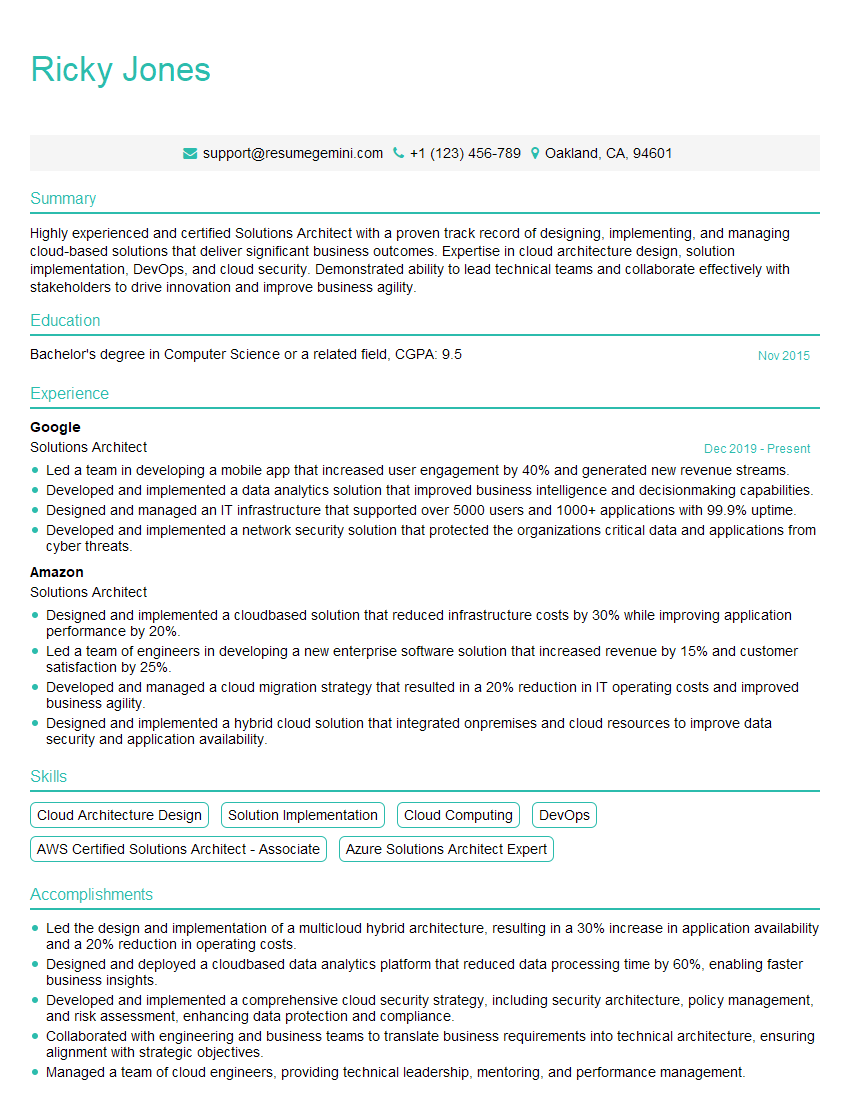
Mastering ITIL Service Design is crucial for career advancement in IT service management. It demonstrates a deep understanding of service lifecycle management and positions you as a valuable asset to any organization. To maximize your job prospects, create a compelling and ATS-friendly resume that highlights your skills and experience. ResumeGemini is a trusted resource that can help you build a professional resume that stands out. They offer examples of resumes tailored to ITIL Service Design (SD) roles, giving you a head start in showcasing your qualifications effectively.
Explore more articles
Users Rating of Our Blogs
Share Your Experience
We value your feedback! Please rate our content and share your thoughts (optional).
What Readers Say About Our Blog
Really detailed insights and content, thank you for writing this detailed article.
IT gave me an insight and words to use and be able to think of examples