Cracking a skill-specific interview, like one for Jacquard Weaving, requires understanding the nuances of the role. In this blog, we present the questions you’re most likely to encounter, along with insights into how to answer them effectively. Let’s ensure you’re ready to make a strong impression.
Questions Asked in Jacquard Weaving Interview
Q 1. Explain the difference between a plain weave and a Jacquard weave.
The fundamental difference between plain weave and Jacquard weave lies in their pattern creation capabilities. Plain weave, the simplest weave structure, involves alternating warp and weft yarns over and under each other, creating a basic, even fabric. Think of a checkerboard – that’s essentially a plain weave. Jacquard weaving, however, utilizes a complex mechanism to independently control each warp yarn, allowing for intricate and highly detailed designs. It’s like comparing drawing with a crayon to painting a masterpiece with thousands of individual brushstrokes. Plain weave produces simple textures and patterns; Jacquard weaving unlocks limitless design possibilities, from intricate damasks and brocades to photorealistic images.
Q 2. Describe the function of the Jacquard mechanism.
The Jacquard mechanism is the heart of the Jacquard loom, responsible for the intricate pattern creation. It’s a system of perforated cards (traditionally) or a computerized system (modern looms) that controls the lifting and lowering of individual warp yarns. Each warp yarn has a corresponding hook or heddle controlled by the mechanism. When a hole is present in a card at a specific position, the corresponding hook rises, allowing the weft yarn to pass underneath. If there’s no hole, the hook remains down, and the weft yarn passes over. This precise control over individual yarns allows for the creation of complex designs with incredible detail and variation across the fabric. Think of it as a sophisticated choreography, where each yarn is a dancer performing its assigned movements according to the instructions of the cards or the computer program.
Q 3. What are the different types of Jacquard looms?
Jacquard looms come in various types, categorized primarily by their size, mechanism, and control system. We have single-cylinder looms, suitable for smaller designs and simpler patterns. Then there are double-cylinder looms, offering increased capacity and complexity, allowing for larger and more detailed patterns. Beyond cylinder type, we have distinctions based on the control system: mechanical Jacquard looms, using the traditional punch card system, and electronic Jacquard looms, controlled by computer software. Electronic looms offer significantly greater flexibility, speed, and design possibilities compared to their mechanical counterparts. Within the electronic category, we have further distinctions based on the software used and the loom’s overall capacity.
Q 4. How does the punch card system work in a traditional Jacquard loom?
The traditional punch card system in a Jacquard loom is ingenious in its simplicity. Each card represents a single weft insertion, meaning a row across the fabric. Holes punched in specific locations on the card dictate which warp yarns are raised, allowing the weft yarn to pass under them. The absence of a hole means that particular yarn remains lowered. Cards are linked together to form a chain, creating the complete design. The chain of cards moves sequentially through the loom, controlling the warp yarns with each weft insertion. It’s a mechanical translation of the design, where each hole represents a specific point in the overall pattern. Imagine a deck of cards, each representing a line of the image, and the holes acting as the pixels of the image.
Q 5. Explain the process of preparing warp yarns for Jacquard weaving.
Preparing warp yarns for Jacquard weaving is a crucial step that directly impacts the final fabric quality and weaving process. It begins with selecting the appropriate yarn type and quality based on the desired design and fabric characteristics. The yarns are then carefully wound onto a warp beam, ensuring even tension and proper spacing. This process is often done using specialized warping machines. The warp yarns then undergo sizing, a process where a sizing agent is applied to protect them from abrasion during weaving and to improve their weaving properties. The sized warp yarns are then wound onto the loom’s warp beam, carefully ensuring consistent tension across all yarns. Any inconsistencies in tension can result in uneven weaving and pattern irregularities. This meticulous preparation is essential for a successful weaving process and a high-quality final product.
Q 6. How do you troubleshoot a jammed or malfunctioning Jacquard loom?
Troubleshooting a jammed or malfunctioning Jacquard loom requires a systematic approach. First, identify the specific problem: Is it a yarn break, a mechanical jam, an electronic error, or something else? For mechanical issues, checking the card chain for snags or damaged cards is crucial. Inspect the heddles and hooks for damage or misalignment. Listen for unusual noises, which could indicate a worn part. For electronic looms, check the software for errors, and ensure the power supply is stable. Consult the loom’s manual, and if the problem persists, contact a qualified technician. Remember, safety is paramount, so always power down the loom before attempting any repairs. Systematic investigation, careful inspection, and knowledge of the loom’s mechanics are key to effective troubleshooting.
Q 7. Describe your experience with different types of Jacquard design software.
Throughout my career, I’ve worked extensively with various Jacquard design software packages, ranging from industry-standard programs like CADWeave and others to more specialized software designed for specific types of looms. My experience encompasses the entire design workflow: creating patterns from scratch, importing digital images for weaving, simulating the weaving process, adjusting parameters like weft density and yarn type to optimize the design, and generating the data required to control the Jacquard loom. I’m proficient in manipulating design elements, adjusting color palettes, and optimizing designs for different yarn counts and fabric structures. Different programs offer various functionalities and design capabilities. I’ve found that expertise lies not just in knowing which software to use, but in understanding the interplay between the digital design and the physical limitations of the loom to achieve the desired results. Familiarity with different software allows for greater flexibility and efficiency in the design process.
Q 8. How do you interpret and create Jacquard weaving drafts?
Creating and interpreting Jacquard weaving drafts involves translating a design into a series of instructions for the Jacquard loom. Think of it as a recipe for the fabric. The draft dictates which warp threads (the lengthwise threads) are lifted at each point in the weaving process to create the pattern. This is typically done using a specialized software or by hand, using graph paper and punch cards (though punch cards are less common now). A draft shows the sequence of warp thread selection for every weft insertion.
Creating a draft: Begin with your design, typically a digital image or hand-drawn artwork. This is then digitized into a format the Jacquard software understands. This often involves assigning each color or shade a unique combination of warp threads. The software then generates the draft, which is essentially a chart showing which warp threads are raised (or ‘selected’) for each weft insertion. For instance, a simple checkered pattern would have a relatively straightforward draft, whereas an intricate floral design would require a significantly more complex one. The draft will also specify the number of harnesses (sets of warp threads controlled independently), and the shedding sequence (the order in which harnesses are lifted).
Interpreting a draft: Reading a draft is the reverse process. Each line in the draft represents a weft pick (one pass of the weft yarn across the warp). Each column represents a warp thread. A ‘1’ or similar symbol typically denotes a raised thread, allowing the weft to pass underneath, while a ‘0’ indicates a lowered thread, enabling the weft to pass over. By understanding this binary system and the harness assignments, a weaver can understand the precise sequence needed to create the desired design.
Q 9. What are the common weaving defects in Jacquard fabrics, and how are they prevented?
Common weaving defects in Jacquard fabrics can significantly impact quality. They often stem from issues with yarn, loom setup, or the weaving process itself. Prevention is crucial, requiring careful attention to detail at every stage.
- Broken ends: Warp or weft yarns breaking during weaving. Prevention: Use high-quality, strong yarns, properly tension the warp, and regularly inspect the loom for potential snags.
- Missed picks: The weft yarn fails to completely cross the warp. Prevention: Ensure the shuttle or weft insertion system functions correctly, maintain consistent weft tension, and address any mechanical issues promptly.
- Floaters: Lengthy stretches of warp yarn visible on the fabric’s surface, usually due to pattern errors. Prevention: Meticulous draft preparation and careful loom operation. Software can detect potential floaters before weaving starts.
- Pattern defects: Inaccurate reproduction of the design. Prevention: Thorough checking of the Jacquard draft and careful monitoring of the weaving process. Accurate design digitization is critical.
- Slackness/Uneven tension: Creates wavy or puckered fabric. Prevention: Ensure even warp tension during beaming, regularly check tension during weaving, and use appropriate weaving techniques.
Effective prevention strategies involve using quality materials, employing well-maintained machinery, and utilizing skilled weavers who can identify and address potential problems early.
Q 10. Explain the relationship between yarn count, fabric density, and Jacquard design complexity.
The relationship between yarn count, fabric density, and Jacquard design complexity is intricate and interconnected. A higher yarn count (more yarns per inch) generally results in a finer, denser fabric. This increased density can support more complex Jacquard designs with finer details. Conversely, coarser yarns and lower fabric density limit the intricacy of the design because the weave structure may not be fine enough to clearly resolve small details. Think of it like painting on a canvas: a higher-thread-count fabric is like a fine-grained canvas, allowing for more detail and precision.
Example: A fine silk fabric with a high yarn count can support a very detailed tapestry-style Jacquard design, while a coarse cotton fabric might only be suitable for simpler, bolder patterns. The relationship is not simply linear, however. Complex designs require more sophisticated software and loom setup, regardless of yarn count. The design complexity also influences the weaving time and cost.
Q 11. How do you calculate the required warp and weft yarns for a specific Jacquard design?
Calculating the required warp and weft yarns depends heavily on the design’s dimensions, the yarn count, and the fabric’s desired density. It’s a multi-step process.
- Determine fabric dimensions: Measure the desired length and width of the finished fabric.
- Determine yarn count (ends per inch (EPI) and picks per inch (PPI)): This information is usually determined by the design and the type of yarn being used. Higher counts result in finer fabrics.
- Calculate warp yarn requirements: Multiply fabric width (in inches) by EPI to find the total number of warp yarns needed.
- Calculate weft yarn requirements: Multiply fabric length (in inches) by PPI to find the total number of weft yarns needed. Account for weft yarn wastage which can be significant, particularly for complex designs.
- Add extra yarn: Always add extra yarn to account for yarn breakage, waste, and potential errors during weaving. The percentage added depends on the complexity of the design and experience of the weaver.
Example: For a fabric 36 inches wide with an EPI of 20 and a length of 48 inches with a PPI of 18, you’d need 720 warp yarns (36 * 20) and 864 weft yarns (48 * 18). Add extra yarn for waste based on your specific experience and design.
Q 12. What are the different types of yarns suitable for Jacquard weaving?
Numerous yarn types are suitable for Jacquard weaving, each offering unique properties affecting the final fabric’s drape, texture, and durability. The choice depends on the desired outcome and budget.
- Silk: Luxurious and lustrous, offering a fluid drape and delicate textures, making it ideal for high-end apparel and home textiles. Different types of silk (e.g., charmeuse, crepe) provide varied effects.
- Cotton: Durable, breathable, and readily available in various counts and colors, ideal for everyday items like towels, upholstery, and clothing. The yarn quality significantly impacts the final fabric’s appearance.
- Wool: Warm, soft, and naturally insulating, providing excellent drape and a rich texture. Merino wool is a popular choice for its softness and fine count.
- Linen: Strong, crisp, and naturally breathable, offering a distinct texture. It requires careful handling during weaving due to its strength and tendency to fray.
- Synthetic fibers (e.g., polyester, nylon): More affordable than natural fibers, these offer durability and resistance to shrinking and wrinkling. They are often blended with natural fibers to enhance performance and reduce cost.
Choosing the right yarn is vital for successful weaving; its properties directly influence the final fabric’s appearance and performance.
Q 13. Describe your experience with different types of Jacquard fabrics (e.g., silk, cotton, wool).
My experience spans a wide range of Jacquard fabrics. I’ve worked extensively with silk, cotton, wool, and blends. Each material presents unique challenges and rewards.
- Silk: Working with silk demands precision. Its delicate nature requires careful handling to avoid breakage. The sheen and drape of silk Jacquards are remarkable, especially in intricate designs. I’ve been involved in producing high-end scarves and wall hangings using various silk weights and blends.
- Cotton: Cotton is more robust, allowing for bolder designs and higher-density weaves. I’ve worked on projects producing durable home textiles and clothing, employing different cotton types based on the desired texture and strength. The versatility of cotton makes it suitable for a wide range of patterns.
- Wool: Wool’s softness and drape present opportunities for creating luxurious and warm fabrics. However, its tendency to pill requires careful consideration of the yarn count and weaving technique. I’ve worked with wool in high-end apparel and upholstery projects, utilizing merino and other wool blends.
Each material presents its own set of challenges and rewards. Understanding the properties of different yarns is key to creating successful and high-quality Jacquard fabrics.
Q 14. How do you manage production deadlines and maintain quality standards in Jacquard weaving?
Managing production deadlines and quality standards in Jacquard weaving requires a structured approach. It’s a balance between speed and accuracy.
- Project planning: A thorough project plan outlines all aspects, from design digitization and yarn selection to loom setup and quality control checks. Deadlines are broken down into manageable tasks.
- Efficient loom operation: Well-maintained looms and skilled operators are essential for maximizing output while maintaining quality. Regular maintenance prevents downtime and ensures consistent weaving.
- Quality control: Regular inspections at each stage – from yarn inspection to finished fabric – are crucial. This involves checking for defects like broken ends, missed picks, and pattern errors. Having clear quality standards helps catch issues early.
- Communication and collaboration: Clear communication between designers, weavers, and other stakeholders is essential to avoid delays and misunderstandings. Any adjustments needed during production are promptly addressed.
- Contingency planning: Unexpected issues are inevitable. Having backup plans for potential problems (such as yarn shortages or equipment malfunctions) helps minimize disruptions to the schedule.
By implementing these strategies, I ensure that projects are completed on time and to the highest standards of quality, balancing the often-competing demands of production efficiency and impeccable craftsmanship.
Q 15. Explain your experience with maintaining and repairing Jacquard looms.
Maintaining and repairing Jacquard looms requires a blend of mechanical aptitude, problem-solving skills, and a deep understanding of the loom’s intricate workings. My experience spans over ten years, encompassing both preventative maintenance and complex repairs on various loom models, from traditional mechanical looms to modern computerized systems.
Preventative maintenance involves regular lubrication of moving parts, inspecting the heddles and harness for wear and tear, and cleaning the shedding mechanism to prevent jams. I meticulously document these procedures to ensure consistent performance.
Repair work is more complex and demands a methodical approach. For example, diagnosing a dropped warp thread often involves tracing the path of the thread through the heddles, identifying the broken section, and carefully rejoining it, minimizing disruption to the weaving process. Dealing with malfunctioning sensors or software glitches in computerized looms requires a different skillset, necessitating familiarity with diagnostic tools and troubleshooting techniques. I’ve successfully repaired everything from minor component failures to major overhauls, restoring looms to full operational capacity.
One memorable experience involved a complex repair on an antique Bonas loom. The problem was a malfunctioning dobby system – the mechanism which selects and raises the warp threads. By systematically testing each component and referring to historical documentation, I was able to pinpoint a worn gear and replace it. This restored the loom’s functionality, preserving a piece of weaving history.
Career Expert Tips:
- Ace those interviews! Prepare effectively by reviewing the Top 50 Most Common Interview Questions on ResumeGemini.
- Navigate your job search with confidence! Explore a wide range of Career Tips on ResumeGemini. Learn about common challenges and recommendations to overcome them.
- Craft the perfect resume! Master the Art of Resume Writing with ResumeGemini’s guide. Showcase your unique qualifications and achievements effectively.
- Don’t miss out on holiday savings! Build your dream resume with ResumeGemini’s ATS optimized templates.
Q 16. What are the safety precautions you take when operating a Jacquard loom?
Safety is paramount when operating a Jacquard loom. My safety protocols are rigorous and cover several areas. Before starting any operation, I ensure all moving parts are guarded and properly lubricated. I always wear appropriate personal protective equipment (PPE), including safety glasses to protect against flying debris, hearing protection for the noise generated by the loom and sturdy gloves to prevent cuts or abrasions. Long hair is always tied back, and loose clothing is avoided.
I meticulously check the warp threads before starting to weave to prevent accidental snagging or breakage. Regular cleaning of the loom and surrounding area is essential to prevent tripping hazards. I also follow strict lockout/tagout procedures whenever performing maintenance or repairs, ensuring that power is completely disconnected before commencing any work. Moreover, I emphasize safe handling of heavy components and materials, often using lifting assistance equipment where applicable.
Regular training and updates on safety procedures are crucial, and I make sure to stay current with the latest safety guidelines and best practices. Safety is an integrated part of my work ethic, not an afterthought. A mishap can be very costly and even life-threatening, so maintaining a vigilant and proactive approach is my priority.
Q 17. How do you adapt to changes in design or production requirements?
Adapting to design or production changes is a crucial aspect of Jacquard weaving. It involves understanding the new requirements, translating them into technical specifications, and efficiently implementing them on the loom. This can range from minor modifications in color schemes to significant alterations in pattern complexity.
Changes are managed through a step-by-step process. First, I thoroughly review the revised design specifications, often collaborating with designers to fully grasp the technical implications. This involves analyzing the pattern’s repeat size, warp and weft density, and overall complexity. Next, I adjust the loom’s settings accordingly—modifying the Jacquard card punch patterns (in traditional looms) or the design file (in computer-controlled looms).
I carefully plan the changeover process to minimize downtime and wastage. This includes preparing new warp yarns, setting up the new pattern on the loom and testing the resulting fabric to ensure it meets the specified quality standards. If there is a significant shift in fabric weight or weave structure, I will need to adjust the loom’s tension and speed parameters accordingly. Experience has taught me the importance of meticulous planning and testing to ensure a smooth transition to new production requirements, minimizing any negative impact on productivity or quality.
Q 18. Describe your experience with different types of Jacquard design software (e.g., CAD systems).
My experience with Jacquard design software encompasses several CAD (Computer-Aided Design) systems including the widely used Textile CAD systems and specialized programs for Jacquard pattern creation. This includes proficiency in creating and editing digital designs, simulating the weaving process on screen, and generating the necessary data files for the specific Jacquard loom being used.
I’m adept at translating artistic concepts into precise digital designs, optimizing them for efficient weaving. This includes manipulating parameters such as thread count, color distribution and repeat length to achieve both aesthetic and production efficiency. I am also familiar with various file formats used in the industry, allowing me to seamlessly import and export designs between different systems. My expertise extends to troubleshooting software issues and optimizing design files for effective execution on the loom.
For instance, I once used a CAD system to optimize a complex floral design, reducing the number of harness frames required without compromising the design’s intricate detail. This resulted in a more efficient weaving process and reduced production costs. Proficiency in these systems is crucial for creating efficient and high-quality Jacquard woven fabrics in modern settings.
Q 19. How do you ensure color consistency in Jacquard woven fabrics?
Maintaining color consistency in Jacquard woven fabrics is critical for achieving high-quality results. Several factors contribute to color consistency, and careful management of each is vital. I use a multi-pronged approach.
Firstly, selecting consistent yarn batches is crucial. I carefully check the color codes and dye lot numbers for each yarn used, ensuring they match the design specifications. Secondly, I perform regular color checks throughout the weaving process. This involves comparing the woven fabric to the approved color swatches and adjusting the yarn tension, shed formation, and beating-up settings as needed. Thirdly, careful control of the weaving environment (temperature and humidity) can prevent variations in color.
Advanced techniques may involve utilizing spectrophotometers to precisely measure the color values and ensure adherence to industry standards. In cases where slight variations are unavoidable, I’ll ensure these variations fall within an acceptable tolerance range based on industry best practices. A thorough understanding of dye chemistry and textile processing is key to ensuring the quality and consistency of the final product.
Q 20. What are some strategies for reducing waste and improving efficiency in Jacquard weaving?
Reducing waste and improving efficiency in Jacquard weaving demands a holistic approach. My strategies focus on several key areas.
Firstly, meticulous planning and preparation are essential. Accurate calculations of warp and weft yarn requirements, precise design layout, and careful loom setup minimize material waste and downtime. Secondly, adopting efficient weaving techniques, utilizing optimal loom settings, and managing yarn tension carefully reduce breakage and the need for repeated warp threads. I also continuously monitor weft yarn consumption to identify and correct potential issues.
Thirdly, I embrace continuous improvement practices. This involves analyzing production data to identify bottlenecks, optimizing loom settings, and exploring new weaving techniques. For example, minimizing warp and weft waste during set up can reduce both material waste and valuable production time. Regular maintenance and preventative measures further enhance the loom’s efficiency and prolong its lifespan.
Q 21. Explain your experience with quality control procedures in Jacquard weaving.
Quality control in Jacquard weaving is an ongoing process, ensuring the final product meets the highest standards. My quality control procedures are comprehensive, encompassing several stages.
Initial Inspection: This involves inspecting the warp yarns for any defects, ensuring consistent dyeing and uniform tension. During Weaving: I regularly monitor the weaving process, checking for defects such as broken ends, mispicks, and incorrect color sequences. Final Inspection: After weaving, each fabric piece is thoroughly inspected for imperfections, paying close attention to the design accuracy, color consistency, and overall fabric quality. Measurement and Testing: Fabric dimensions are precisely measured, and where appropriate, lab tests are conducted to verify strength, shrinkage, and other relevant parameters.
Documentation is a core element. I maintain detailed records of each weaving process, including yarn specifications, loom settings, and any quality issues encountered. This data helps identify trends, troubleshoot problems, and continuously improve our quality control practices. Non-conformances are thoroughly documented, and corrective actions are implemented to prevent recurrence. These comprehensive procedures ensure the production of consistent, high-quality Jacquard woven fabrics.
Q 22. How do you handle customer complaints or production issues related to Jacquard fabrics?
Handling customer complaints and production issues in Jacquard weaving requires a systematic approach. First, I thoroughly investigate the complaint, examining the fabric itself, the design specifications, and the production records. This might involve microscopic analysis to identify weaving flaws or comparing the finished product to the original design mock-up. For example, a complaint about inconsistent color could stem from variations in the yarn dye lot or incorrect loom settings. Once the root cause is identified, I work collaboratively with the production team to rectify the issue, whether that means adjusting loom parameters, replacing faulty equipment, or retraining personnel. For repeat issues, we implement preventative measures, such as implementing stricter quality checks at each stage of production. Excellent communication with the customer is crucial throughout this process, keeping them informed of our progress and solutions. We offer solutions, such as replacement fabric, discounts, or credit, depending on the severity of the issue and customer relationship.
Q 23. What are some common challenges faced in Jacquard weaving, and how have you overcome them?
Jacquard weaving presents several challenges. One major hurdle is achieving the desired design complexity while maintaining consistent fabric quality. Intricate designs can lead to increased warp breakage, shedding issues, and difficulty in achieving the perfect weft density. I’ve overcome this by utilizing advanced CAD software to optimize the design for weaving, carefully selecting appropriate yarns, and implementing meticulous loom setup procedures. Another challenge is managing production costs, particularly with complex designs requiring more heddles and increased setup time. My strategy is to optimize the weaving process through careful planning, efficient warp preparation, and the use of high-efficiency looms. We also explore alternative, more cost-effective yarn choices while maintaining the aesthetic integrity of the designs. For instance, a design initially requiring a high-twist silk might be adapted using a blend of silk and a more affordable fiber without compromising the final product’s visual appeal.
Q 24. Explain your understanding of different weaving structures used in Jacquard designs.
Jacquard weaving utilizes various weaving structures to create diverse textures and patterns. Plain weave is the foundation, with warp and weft yarns interlacing alternately. Twills introduce diagonal lines through a systematic shift in the interlacing pattern. Sateens create a lustrous surface with long floats of warp or weft yarns. These basic structures can be manipulated in Jacquard weaving to create complex combinations. For instance, a design might incorporate a plain weave for background areas, transition into a twill for textured accents, and finish with a sateen section for a silky sheen. The selection of the weaving structure is crucial in achieving the desired look and feel of the fabric, and often depends on the desired drape and the characteristics of the yarns being used. For example, a heavier, more structured design might employ a twill weave for its durability.
Q 25. Describe your experience with different types of Jacquard finishing techniques.
My experience encompasses a range of Jacquard finishing techniques. These methods are crucial in enhancing the fabric’s final appearance, hand feel, and performance properties. Common techniques include bleaching, dyeing, printing, and various specialized treatments. For instance, mercerization improves luster and strength in cotton fabrics. Calendering smoothes the surface and imparts a desired finish, like a crisp feel or a soft sheen. Water-repellent finishes enhance durability. The specific finishing chosen depends entirely on the fabric’s intended use and the desired aesthetic. A luxurious evening gown fabric might receive a delicate dyeing process and a soft calendering, while a durable upholstery fabric would need a more robust dyeing and potential water-resistant treatment. I work closely with the finishing department to ensure that the selected techniques are compatible with the Jacquard design and the type of yarns used.
Q 26. How do you determine the appropriate loom speed for a particular Jacquard design?
Determining the appropriate loom speed for a Jacquard design is a critical aspect of efficient and high-quality production. It’s a balance between speed and accuracy. Factors influencing loom speed include the design’s complexity, the yarn’s characteristics (strength, elasticity), and the loom’s capabilities. Complex designs with intricate patterns and frequent shed changes require slower speeds to minimize yarn breakage and weaving defects. Finer and weaker yarns necessitate slower speeds to prevent damage. I typically start with a conservative speed and gradually increase it while closely monitoring for any signs of defects such as warp breakage, missed picks, or uneven tension. Data logging and quality control checks at regular intervals are essential in optimizing loom speed for each specific design. In practice, I often conduct a series of test runs at different speeds, meticulously analyzing the results to determine the optimal balance of productivity and quality.
Q 27. How do you maintain accurate records of production and quality control?
Maintaining accurate records in Jacquard weaving is essential for traceability, quality control, and continuous improvement. We utilize a combination of digital and physical documentation. For each production run, detailed records include design specifications, yarn details, loom settings (speed, shedding sequence), production dates, and quantity. Quality control checks are meticulously documented at each stage, with records of any defects, their causes, and the corrective actions taken. This involves detailed inspection reports, photographic evidence, and sometimes even microscopic analysis. We employ specialized software for data management, providing real-time insights into production progress and quality metrics. This allows for immediate identification of any discrepancies and swift corrective action, ensuring that our standards for consistent quality and efficient production are consistently met.
Q 28. Describe your experience collaborating with designers and other team members in a textile production environment.
Collaboration is paramount in Jacquard weaving. I work closely with designers from the initial concept stage, translating their creative visions into technically feasible weaving designs. This often involves discussions on yarn selection, pattern adjustments, and weaving structure to ensure the final fabric meets both aesthetic and technical requirements. For instance, a designer might envision a particular texture that requires modification to be realistically woven. I would work with them to find a suitable alternative that achieves a similar visual effect. My collaborations extend to the production team, ensuring that the design is properly implemented on the looms and that production runs smoothly. Regular communication with the finishing and quality control departments ensures consistency throughout the entire process. Open communication, mutual respect, and a shared commitment to high quality are key to successful collaboration in a fast-paced textile production environment. Effective teamwork is vital for successful project execution and consistent, high-quality results.
Key Topics to Learn for Your Jacquard Weaving Interview
- Understanding the Jacquard Mechanism: Explore the fundamental principles of the Jacquard loom, including the operation of the punch cards, the selection mechanism, and the creation of complex patterns.
- Warp and Weft Preparation: Master the processes involved in preparing the warp and weft yarns, including sizing, warping, and beaming. Understand the impact of yarn choice on the final fabric.
- Pattern Design and Creation: Learn how to design patterns using various software and translate those designs into the punch card system or digital equivalents used in modern Jacquard looms. Understand pattern repeat, drafting, and harnessing.
- Troubleshooting and Maintenance: Gain familiarity with common problems encountered during the weaving process and learn how to effectively troubleshoot and maintain the Jacquard loom to ensure efficient operation.
- Fabric Structure and Properties: Develop a strong understanding of how different weave structures (plain, twill, satin, etc.) impact the final fabric’s properties such as drape, durability, and texture. Connect pattern design choices to these properties.
- Different Types of Jacquard Looms: Familiarize yourself with various types of Jacquard looms, their capabilities, and their limitations. Understand the differences between mechanical and electronic systems.
- Quality Control and Inspection: Learn the methods for inspecting the woven fabric for defects and ensuring that it meets quality standards. Understand the role of quality control in the overall production process.
- Production Planning and Efficiency: Understand the importance of efficient production planning in a Jacquard weaving environment, including yarn management and loom scheduling.
Next Steps
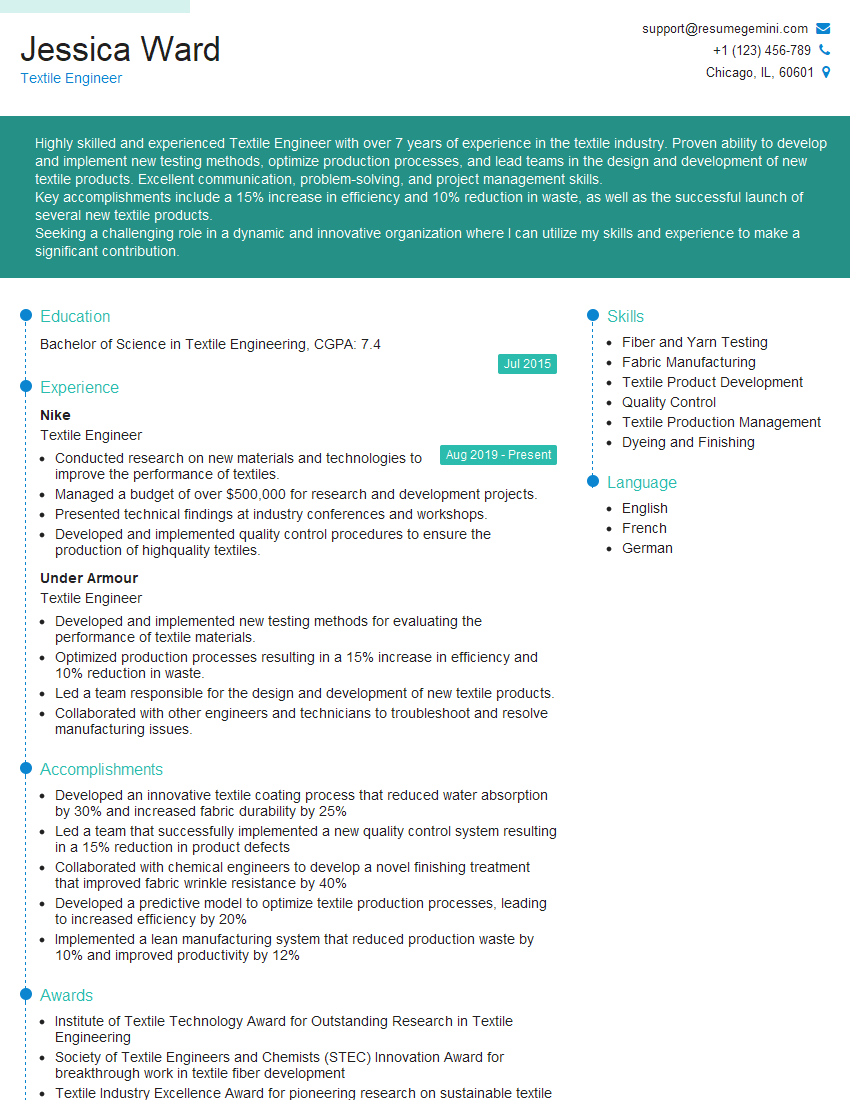
Mastering Jacquard weaving opens doors to exciting career opportunities in textile design, manufacturing, and technical roles within the industry. To maximize your chances of landing your dream job, a strong, ATS-friendly resume is crucial. ResumeGemini is a trusted resource to help you craft a professional and impactful resume that highlights your skills and experience effectively. We provide examples of resumes tailored to the Jacquard Weaving industry to give you a head start. Invest time in creating a resume that showcases your expertise and allows recruiters to quickly identify your value – it’s a key step in your journey to success.

Explore more articles
Users Rating of Our Blogs
Share Your Experience
We value your feedback! Please rate our content and share your thoughts (optional).
What Readers Say About Our Blog
Really detailed insights and content, thank you for writing this detailed article.
IT gave me an insight and words to use and be able to think of examples