Every successful interview starts with knowing what to expect. In this blog, we’ll take you through the top Joiner interview questions, breaking them down with expert tips to help you deliver impactful answers. Step into your next interview fully prepared and ready to succeed.
Questions Asked in Joiner Interview
Q 1. Describe your experience with different types of wood joints (e.g., mortise and tenon, dovetail, butt joint).
My experience encompasses a wide range of wood joints, each chosen based on the project’s structural needs and aesthetic goals. Let’s explore a few:
- Mortise and Tenon: This is a classic joint, incredibly strong and versatile. I’ve used it extensively in building chairs, tables, and even cabinet doors. The tenon, a projection, fits snugly into the mortise, a hole in the other piece. The strength comes from the surface area of contact. Variations include through tenons (tenon goes all the way through), and blind tenons (tenon only partially penetrates).
- Dovetail Joint: Known for its exceptional strength and beautiful appearance, the dovetail is a mainstay in high-quality drawers and boxes. The interlocking ‘tails’ and ‘pins’ create a joint that’s incredibly resistant to racking (forces that pull the joint apart). Through dovetails are stronger than half-blind or blind dovetails, but the latter offer a cleaner aesthetic on the outside.
- Butt Joint: This is the simplest joint, formed by simply butting two pieces of wood together. While it’s not the strongest on its own, it can be strengthened significantly with glue and reinforcing techniques like dowels, biscuits, or splines. I use butt joints frequently in situations where strength isn’t paramount, or where they’re reinforced for added durability.
My proficiency extends beyond these; I’m also experienced with lap joints, bridle joints, and finger joints, each appropriate for specific applications.
Q 2. Explain the process of selecting appropriate wood for a specific joinery project.
Selecting the right wood is crucial for a successful joinery project. The choice depends on several factors:
- Project Requirements: Is the piece intended for indoor or outdoor use? Will it bear significant weight? What’s the desired aesthetic (e.g., color, grain pattern)?
- Wood Properties: Hardwoods like oak and maple are strong and durable, ideal for furniture that will see heavy use. Softer woods like pine and poplar are easier to work with but may not be suitable for high-stress applications. The grain structure also influences the joint’s strength and the ease of cutting.
- Budget: Exotic hardwoods can be beautiful but expensive. Choosing the right wood involves balancing aesthetic appeal, functionality, and budget constraints.
For example, I’d choose oak for a sturdy table leg due to its strength and durability, but might opt for pine for a decorative shelf where aesthetics are prioritized over extreme load-bearing capacity. I always account for wood movement due to changes in humidity, choosing wood with appropriate stability for the project’s environment.
Q 3. How do you ensure accuracy and precision in your joinery work?
Accuracy and precision are paramount in joinery. I employ several strategies to ensure high-quality results:
- Precise Measurement: I use accurate measuring tools like calipers, rulers, and marking gauges. I double-check measurements multiple times before making any cuts.
- Sharp Tools: Sharp chisels, saws, and planes are essential for clean, precise cuts. Dull tools lead to inaccuracies and tear-out.
- Proper Techniques: I employ established joinery techniques, ensuring that each cut is made with control and precision. This includes using jigs and fixtures where necessary to guide my tools.
- Test Fitting: Before finalizing any joint, I always perform multiple test fits. This allows for adjustments and corrections before glue-up.
Think of building a house of cards – if even one card is slightly out of place, the whole structure collapses. The same principle applies to joinery; precise cuts and careful assembly are vital for a strong and beautiful result.
Q 4. What tools and equipment are essential for your joinery work?
Essential tools vary depending on the project’s complexity, but a core set includes:
- Hand Tools: Chisels (various sizes), hand saws (rip and crosscut), marking gauges, planes (smoothing and block), mallet, squares (try and combination).
- Power Tools: Router (with various bits), drill press, jigsaw, random orbital sander.
- Measuring & Marking Tools: Steel rule, calipers, marking knife, pencil.
- Clamps: Various sizes and types of clamps are essential for holding pieces together during glue-up.
Beyond these basics, specialized tools such as dovetail jigs, mortise machines, and planing stop blocks can greatly enhance efficiency and accuracy, especially for repetitive tasks or intricate joints.
Q 5. Describe your experience with different woodworking machines (e.g., planer, thicknesser, router).
My experience with woodworking machines is extensive. I’m proficient in operating and maintaining several:
- Planer: Used to flatten and smooth the surfaces of wood boards. I regularly use this to prepare lumber for joinery, ensuring consistent thickness and a smooth surface for accurate cuts.
- Thicknesser: Creates uniformly thick boards from rough lumber. This is critical for ensuring accurate tenons and mortises.
- Router: Incredibly versatile, the router is used for shaping, creating decorative elements, and forming precise joints like rabbets and dados. I utilize various router bits to customize my joinery work.
Safety is paramount when using power tools; I always adhere to strict safety protocols and regularly maintain the machines to ensure optimal performance and prevent accidents.
Q 6. How do you handle complex joinery projects with multiple components?
Complex projects with multiple components require a methodical approach. My process typically involves:
- Detailed Planning: Starting with detailed drawings or a 3D model, I meticulously plan the sequence of assembly, ensuring that each joint is appropriately aligned and supported during construction. This often involves creating sub-assemblies.
- Component Preparation: Each component is carefully prepared, ensuring consistent dimensions and accurate cuts, before moving to assembly.
- Assembly in Stages: I typically work in stages, assembling smaller groups of components before integrating them into larger sub-assemblies. This reduces the risk of misalignment and damage.
- Jigging and Fixtures: For complex joints or repetitive tasks, I employ jigs and fixtures to ensure accuracy and consistency across components.
Think of it like building a complex LEGO model; you don’t start by randomly placing all the pieces. You build smaller sections, ensuring that each part fits correctly before connecting them to the overall structure.
Q 7. Explain your approach to problem-solving when encountering issues during a joinery project.
Problem-solving is an integral part of joinery. My approach is systematic:
- Identify the Issue: The first step is to precisely identify the problem. This might involve careful examination of the joint, measuring for discrepancies, or reviewing the project plans.
- Analyze the Cause: Once the problem is identified, I analyze its root cause. Was it an inaccurate cut? A faulty measurement? A glue problem? A design flaw?
- Develop a Solution: Based on the root cause, I devise a solution. This might involve re-cutting a component, adjusting the assembly process, or even redesigning a portion of the project.
- Implement & Test: The solution is implemented carefully, and the result is tested thoroughly before proceeding. Documentation of this process, including drawings, is crucial.
For instance, if a joint is too loose, I might need to add shims or re-cut a component to create a tighter fit. If a component is cracked, I might have to replace it. A well-documented approach allows for efficient troubleshooting and ensures the final product meets the highest quality standards.
Q 8. Describe your experience with different types of wood finishes (e.g., varnish, lacquer, stain).
My experience with wood finishes spans a wide range, encompassing various types, each with unique properties and applications. I’m proficient in using varnishes, lacquers, and stains, understanding their distinct advantages and how to achieve the desired finish.
Varnishes: These provide a durable, protective layer, offering excellent resistance to scratches and water damage. I often use polyurethane varnishes for their toughness and clarity. For example, I recently used a high-gloss polyurethane varnish on a dining table to create a stunning, long-lasting finish.
Lacquers: Lacquers dry rapidly, allowing for quick project turnaround. Their smooth finish is ideal for furniture where a sleek look is desired. I’ve employed lacquer on numerous cabinetry projects, appreciating its fast drying time and ease of application, especially when working with detailed designs.
Stains: Stains penetrate the wood, enhancing its natural grain and color. I often use stains to create specific color tones, matching them to client preferences and project styles. For instance, I recently used a dark walnut stain on a set of custom-made bookshelves to complement the client’s existing study furniture.
Choosing the right finish is crucial and depends on the wood type, intended use, and desired aesthetic. I consider all these factors before selecting a finish, ensuring the final product is both beautiful and functional.
Q 9. How do you maintain the quality and safety of your work environment?
Maintaining a safe and high-quality work environment is paramount. My approach is multifaceted:
Organized Workspace: I maintain a clean and organized shop, ensuring tools are stored properly and materials are readily accessible. This prevents accidents and streamlines the workflow. A cluttered workspace is a dangerous workspace, so organization is my top priority.
Safety Equipment: I consistently use appropriate safety equipment, including eye protection, dust masks, hearing protection, and gloves, depending on the task at hand. Regular checks on equipment functionality ensure consistent safety.
Proper Tool Maintenance: Sharp tools are safe tools. I regularly sharpen and maintain my tools, ensuring they function correctly and minimizing the risk of injury. A dull tool requires more force, increasing the likelihood of accidents.
Waste Management: I adhere strictly to responsible waste disposal practices, properly disposing of wood scraps, finishes, and other hazardous materials. Protecting the environment is as important as protecting myself.
Regular Inspections: I conduct regular safety inspections of my workspace, identifying and addressing any potential hazards proactively. Safety is an ongoing process, not a one-time event.
This comprehensive approach ensures that my work environment is both productive and safe, contributing to the high quality of my joinery work.
Q 10. What are your preferred methods for measuring and marking wood?
Accurate measuring and marking are foundational to quality joinery. My preferred methods include:
Measuring Tapes: I use high-quality measuring tapes for accurate linear measurements. I always double-check measurements to avoid errors.
Combination Squares: Combination squares are invaluable for marking precise angles and checking for squareness. They’re essential for ensuring accurate cuts and assembly.
Marking Gauges: For consistent marking of dadoes and grooves, I rely on marking gauges. These tools ensure uniform spacing and depths, crucial for precise joinery.
Digital Calipers: For extremely precise measurements, particularly when working with small components or intricate details, I utilize digital calipers. Their accuracy eliminates guesswork.
Pencil and Sharpies: I use sharp pencils for marking wood grain and fine details, while sharpies provide visibility for larger markings and outlines.
The selection of tools depends on the project’s complexity and the required level of precision. I prioritize accuracy at every stage to ensure the final product meets the highest standards.
Q 11. How do you ensure the structural integrity of your joinery work?
Structural integrity is paramount in joinery. I ensure this through careful design and execution:
Appropriate Joint Selection: I choose joinery techniques appropriate for the specific application and load-bearing requirements. For instance, mortise and tenon joints are ideal for strength in furniture legs, while dovetail joints are perfect for drawer construction.
Correct Glue Application: I use high-quality wood glue and apply it correctly, ensuring adequate coverage and clamping pressure for a strong bond. Insufficient glue is a common cause of joint failure.
Precise Cuts: Accurate cutting is essential for a perfect fit of the joint components. Any deviation from the plan can compromise structural integrity.
Reinforcement Techniques: When needed, I use reinforcement techniques like dowels or biscuits to increase joint strength, particularly in larger or heavily stressed pieces.
Wood Selection: I carefully select appropriate wood species based on their strength and durability requirements, taking into account factors like moisture content and grain orientation.
By meticulously attending to each detail, I build pieces that are not only aesthetically pleasing but also structurally sound and durable.
Q 12. Describe your experience with working from drawings and specifications.
I have extensive experience working from drawings and specifications. My process involves carefully reviewing the plans to fully understand the design and dimensions, material specifications, and joinery details.
Plan Interpretation: I carefully interpret the drawings, clarifying any ambiguities before commencing work. I often create detailed shop drawings to translate the design into practical instructions for construction.
Material Selection: I meticulously select the appropriate materials based on the specifications provided, paying attention to wood type, dimensions, and finish requirements.
Sequence of Operations: I carefully plan the sequence of operations, ensuring efficient and effective construction. This includes considering the order of cuts, assembly, and finishing.
Communication: I maintain open communication with clients or designers throughout the process to clarify any questions or concerns and ensure the final product meets their expectations.
This methodical approach ensures I deliver projects that precisely adhere to the design specifications, resulting in high-quality, accurate work.
Q 13. How do you manage your time and prioritize tasks on a joinery project?
Effective time management and task prioritization are vital in joinery. My approach involves:
Project Breakdown: I break down large projects into smaller, manageable tasks, creating a detailed checklist or schedule. This allows for better tracking of progress and identification of potential bottlenecks.
Prioritization: I prioritize tasks based on their urgency and dependency, focusing on critical path activities first. This ensures efficient progress and timely completion.
Time Allocation: I allocate realistic timeframes for each task, considering potential delays and unforeseen challenges. This helps avoid rushing and ensures quality of work.
Regular Monitoring: I regularly monitor my progress against the schedule, making adjustments as needed. Flexibility is key in managing unexpected issues.
Resource Planning: I carefully plan the use of resources, such as materials and tools, to minimize downtime and ensure smooth workflow. Efficient resource management saves time and reduces costs.
This structured approach allows me to manage complex projects effectively, delivering them on time and within budget while maintaining a high standard of craftsmanship.
Q 14. Describe your experience with different joinery techniques for specific applications (e.g., furniture, cabinetry, doors).
My experience encompasses various joinery techniques for diverse applications:
Furniture: For furniture, I commonly use mortise and tenon, dovetail, and bridle joints, selecting the appropriate joint based on the specific load-bearing requirements and aesthetic considerations. For example, I recently used mortise and tenon joints for the legs of a sturdy dining table, providing strong support.
Cabinetry: Cabinetry often involves dadoes, rabbets, and box joints, which allow for precise fitting and strong assembly. I’ve used these joints extensively in numerous kitchen and bathroom cabinetry projects, creating seamless and durable constructions.
Doors: Doors frequently utilize mortise and tenon joints for strength and stability, along with specialized techniques for hanging and fitting. I recently crafted a set of custom interior doors using mortise and tenon joints and carefully fitted them for a perfect seal.
My understanding extends to adapting and combining techniques to create unique and functional solutions tailored to each project’s specific needs and design requirements. The choice of joinery techniques is not just about strength; it also contributes to the overall aesthetics and functionality of the piece.
Q 15. What is your experience with hand tools versus power tools in joinery?
My experience encompasses both hand and power tools, and my choice depends heavily on the project’s specifics and the desired finish. Hand tools, like chisels, hand planes, and saws, allow for incredibly precise and nuanced work, particularly on intricate details or delicate joinery techniques like dovetails. The feel and control you get are unmatched. For example, I recently used hand tools to create a custom inlaid marquetry panel – the precision required simply couldn’t be replicated with power tools.
Power tools, such as routers, planers, and table saws, significantly increase efficiency, especially on larger projects or repetitive tasks. They’re invaluable for tasks like creating mortise and tenon joints quickly and accurately across multiple pieces. I used a router table to create precisely sized mortises for a recent shelving unit project, saving considerable time and effort. However, power tools require more caution and skill to prevent damage and ensure consistent results. I always prioritize safety when using power tools and always adjust settings according to the wood type and joinery technique.
Career Expert Tips:
- Ace those interviews! Prepare effectively by reviewing the Top 50 Most Common Interview Questions on ResumeGemini.
- Navigate your job search with confidence! Explore a wide range of Career Tips on ResumeGemini. Learn about common challenges and recommendations to overcome them.
- Craft the perfect resume! Master the Art of Resume Writing with ResumeGemini’s guide. Showcase your unique qualifications and achievements effectively.
- Don’t miss out on holiday savings! Build your dream resume with ResumeGemini’s ATS optimized templates.
Q 16. How do you adhere to health and safety regulations in your joinery work?
Adherence to health and safety regulations is paramount in my joinery work. It’s not just about following rules; it’s about fostering a safe working environment for myself and others. This starts with proper personal protective equipment (PPE), including safety glasses, hearing protection, dust masks (especially when working with hardwoods), and appropriate gloves. I regularly inspect my tools for damage and ensure they are properly maintained and sharp. This prevents kickbacks and other accidents. My workshop is well-lit and organized, minimizing trip hazards and maximizing workspace. I also strictly follow guidelines for using power tools, ensuring all safety guards are in place and I understand the operating procedures thoroughly. For example, before using a table saw, I always ensure the blade is properly aligned and the push stick is at hand.
Beyond the individual tools, I’m diligent about managing dust. I use dust collection systems wherever possible and regularly clean my workspace to prevent buildup. Understanding the specific hazards of various wood species, like working with certain types of treated lumber which may contain toxic substances, is also critical. Finally, I always keep my work area properly ventilated, reducing the risk of inhaling harmful fumes or dust particles.
Q 17. Describe your experience with estimating material costs for a joinery project.
Accurate material cost estimation is crucial for project profitability and client satisfaction. My process starts with detailed drawings and specifications, breaking down the project into its constituent parts. This helps me determine the exact dimensions and quantity of wood required. I then research current lumber prices from various suppliers, considering factors like species, grade, and size. I factor in additional materials such as screws, glue, finishes, and any hardware elements. I’ve learned to add a buffer to account for potential waste and unforeseen circumstances, particularly when working with less predictable materials.
For example, when estimating for a recent staircase project, I carefully measured each component, accounting for the differing angles and lengths of the various treads, risers, and balusters. I then factored in the additional materials and labour costs associated with finishing the pieces to the client’s specified requirements. I also considered the additional costs of sourcing non-standard sized timber. This thorough approach helps me provide clients with accurate and transparent cost estimates, ensuring there are no hidden surprises.
Q 18. How do you handle unexpected challenges or changes during a joinery project?
Unexpected challenges are inevitable in joinery. My approach prioritizes problem-solving and adaptability. When faced with an unforeseen issue, my first step is to assess the situation calmly and thoroughly. I identify the root cause of the problem and evaluate its impact on the project timeline and budget. This often involves consulting relevant resources or seeking advice from experienced colleagues.
For instance, during a recent restoration project, I discovered significant wood rot hidden beneath a layer of paint. My immediate response was to thoroughly assess the damage and determine the extent of the repair work. I then developed a revised plan, incorporating the necessary repairs while maintaining the integrity of the original design. I documented the changes, communicated them to the client, and adjusted the timeline and budget accordingly. This proactive approach ensured the project’s successful completion despite the unexpected challenge.
Q 19. Explain your understanding of different wood species and their properties.
Understanding wood species and their properties is fundamental to successful joinery. Different woods exhibit variations in strength, density, grain pattern, workability, and durability. For example, oak is renowned for its strength and durability, making it ideal for structural elements. Maple boasts a fine, tight grain, making it excellent for detailed work and creating a smooth finish. Mahogany is prized for its rich color and ease of working. Softwoods like pine are more readily available and cost-effective, often suited for less demanding applications. However, they are softer and prone to dents. Conversely, hardwoods are denser, more resistant to wear and tear, and often have more dramatic grain patterns.
My experience encompasses working with a wide variety of wood species, enabling me to select the most appropriate wood for each project. This selection considers not only the aesthetic requirements but also the project’s functional needs and the longevity expected. Understanding wood movement is another key aspect – different species expand and contract at different rates depending on moisture changes, necessitating careful planning and joint design to avoid warping or cracking.
Q 20. What is your experience with using CAD software for joinery design?
I am proficient in using CAD software, primarily [mention specific software like SketchUp, AutoCAD, or other relevant software], for joinery design. CAD software allows me to create detailed 2D and 3D models of projects, ensuring accuracy and minimizing errors. This is particularly useful for complex designs or large-scale projects. It facilitates precise measurements, detailed visualizations, and allows for modifications before actual construction, saving time and materials. I use CAD software to generate detailed shop drawings, including dimensions, material lists, and assembly instructions.
For example, I recently used CAD software to design a custom-built bookcase with intricate curves and integrated lighting. The software allowed me to model the piece in 3D, experiment with different designs, and generate precise cutting lists for all the components. This ensured a perfectly fitting and aesthetically pleasing finished product. The ability to share these designs with clients also improves communication and allows for collaboration.
Q 21. How do you ensure the longevity and durability of your joinery work?
Ensuring the longevity and durability of my joinery work involves several key considerations. Firstly, I select high-quality materials appropriate for the intended application and environmental conditions. Proper joinery techniques are crucial; strong, well-executed joints are the foundation of a lasting piece. This includes using appropriate joinery methods like mortise and tenon, dovetail, or finger joints, depending on the application’s stresses and the aesthetics required.
Secondly, I use high-quality finishes to protect the wood from moisture, UV damage, and wear. The choice of finish depends on the wood type and the desired aesthetic. Proper surface preparation before finishing is also critical for a long-lasting finish. Finally, regular maintenance can significantly extend the lifespan of joinery work. This might involve periodic cleaning, reapplication of finish, or addressing minor repairs promptly. By combining the right materials, techniques, and finishing, I strive to create joinery work that stands the test of time.
Q 22. Describe your experience with working in a team environment on joinery projects.
Teamwork is crucial in joinery. On a recent project building bespoke kitchen cabinets, I collaborated with a designer, other joiners, and finishers. My role focused on the precise cutting and joining of the cabinet carcasses. We utilized daily stand-up meetings to track progress, identify potential bottlenecks, and ensure everyone was on the same page regarding design specifications and deadlines. Open communication and a collaborative spirit, where everyone’s input was valued, were key to efficiently completing the project to the highest standard. We regularly checked in with each other to prevent any individual errors from compromising the overall quality. This collaborative approach fostered a positive work environment and ultimately resulted in a flawless final product.
Q 23. Explain your process for quality control during a joinery project.
Quality control is an ongoing process, not just a final check. It starts with carefully reviewing the plans and ensuring I fully understand the specifications. Next, meticulous material selection is paramount – checking for defects, knots, or inconsistencies in the wood. During the construction phase, I regularly inspect each joint for accuracy, ensuring proper alignment and strength. I use precision measuring tools at every stage. For example, I employ digital calipers for precise measurements and a level to ensure perfectly square joints. Finally, a thorough final inspection checks for any imperfections, loose joints, or finish issues before the piece is approved for installation or delivery. Think of it like building with LEGOs – each piece needs to fit perfectly to create a strong and aesthetically pleasing structure.
Q 24. How do you stay up-to-date with new technologies and trends in joinery?
The joinery world is constantly evolving. I stay current through several methods: I subscribe to industry magazines like Woodworking Network and Fine Woodworking. I actively participate in online forums and communities dedicated to woodworking and joinery, engaging in discussions and learning from experienced professionals. Furthermore, I regularly attend woodworking trade shows and workshops, where I can see the latest tools and techniques in action and network with other professionals. Learning never stops – embracing new tools and techniques is vital for improvement and staying competitive.
Q 25. Describe a time you had to troubleshoot a problem during a joinery project.
During the construction of a large, intricate staircase, I encountered a problem with the tenon joints on the newel posts. They were proving difficult to fit snugly and accurately. After careful examination, I realised that subtle variations in the wood’s moisture content were causing slight dimensional changes. My solution involved using a combination of careful hand-planing to fine-tune the tenons and employing a slightly more flexible adhesive to compensate for the dimensional instability. Thorough testing before final assembly ensured the joints were secure and the staircase was structurally sound. This experience highlighted the importance of adapting to unforeseen challenges and finding creative solutions that maintain structural integrity and aesthetic appeal.
Q 26. What are some common mistakes to avoid in joinery, and how do you prevent them?
Common mistakes include using improper joinery techniques, leading to weak or unstable structures. Inaccurate measurements and poor preparation of materials are also frequent pitfalls. To avoid these, I emphasize precise planning and meticulous preparation. Using high-quality tools and maintaining them regularly is crucial. I also consistently double-check my measurements and ensure the wood is properly seasoned before starting any joinery work. Think of it as baking a cake – proper preparation and the right ingredients are essential for a perfect outcome. Finally, taking my time and focusing on accuracy avoids rushing and making careless mistakes.
Q 27. Describe your experience with different types of adhesives and their applications in joinery.
My experience encompasses various adhesives, each with specific applications. For example, I use wood glue (polyvinyl acetate or PVA) for most common joinery, as it’s strong, readily available, and relatively easy to use. For exterior projects, I opt for exterior-grade wood glue, which provides better resistance to moisture and weathering. Epoxy resins are excellent for filling gaps and providing strong bonding in situations where wood glue might not suffice. I also use specialized adhesives like polyurethane glue, known for its exceptional strength and water resistance for applications demanding high durability. The choice of adhesive depends entirely on the project’s requirements and the type of wood being used, considering factors like water exposure and the desired strength of the bond.
Q 28. How do you ensure your joinery work meets client specifications and expectations?
Meeting client specifications and expectations begins with clear and open communication from the initial design phase. I meticulously review the design plans, asking clarifying questions to ensure a complete understanding. Throughout the project, I maintain regular contact with the client, providing updates on progress and addressing any concerns proactively. I use detailed photographs and progress reports to keep the client informed. Before final delivery, I conduct a thorough walkthrough with the client, allowing them to inspect the finished product and address any final adjustments. This meticulous approach ensures a high level of client satisfaction and confidence in the quality of the work delivered. Building trust is as important as building the joinery itself.
Key Topics to Learn for Joiner Interview
- Understanding Joinery Techniques: Explore various joint types (e.g., mortise and tenon, dovetail, miter) and their applications in different projects. Consider the strengths and weaknesses of each technique.
- Material Selection and Preparation: Understand the properties of various wood types and their suitability for specific joinery methods. Learn about proper wood preparation techniques, including milling, planing, and drying.
- Tool Knowledge and Usage: Demonstrate familiarity with essential joinery tools (e.g., chisels, hand saws, planes, routers) and their safe and effective operation. Be prepared to discuss tool maintenance and sharpening.
- Project Planning and Execution: Discuss your approach to planning a joinery project, including sketching, measuring, and creating accurate cuts. Explain your process for assembling and finishing a joint.
- Troubleshooting and Problem-Solving: Be ready to discuss common joinery challenges (e.g., inaccurate cuts, wood movement, joint failure) and your strategies for addressing them. This showcases your practical experience and problem-solving skills.
- Health and Safety: Demonstrate understanding of safe workshop practices, including the proper use of personal protective equipment (PPE) and safe handling of tools and materials.
- Advanced Joinery Techniques (Optional): Depending on the seniority of the role, you might consider researching more advanced techniques such as steam bending, laminated construction, or specialized joinery for specific applications (e.g., furniture making, cabinet making).
Next Steps
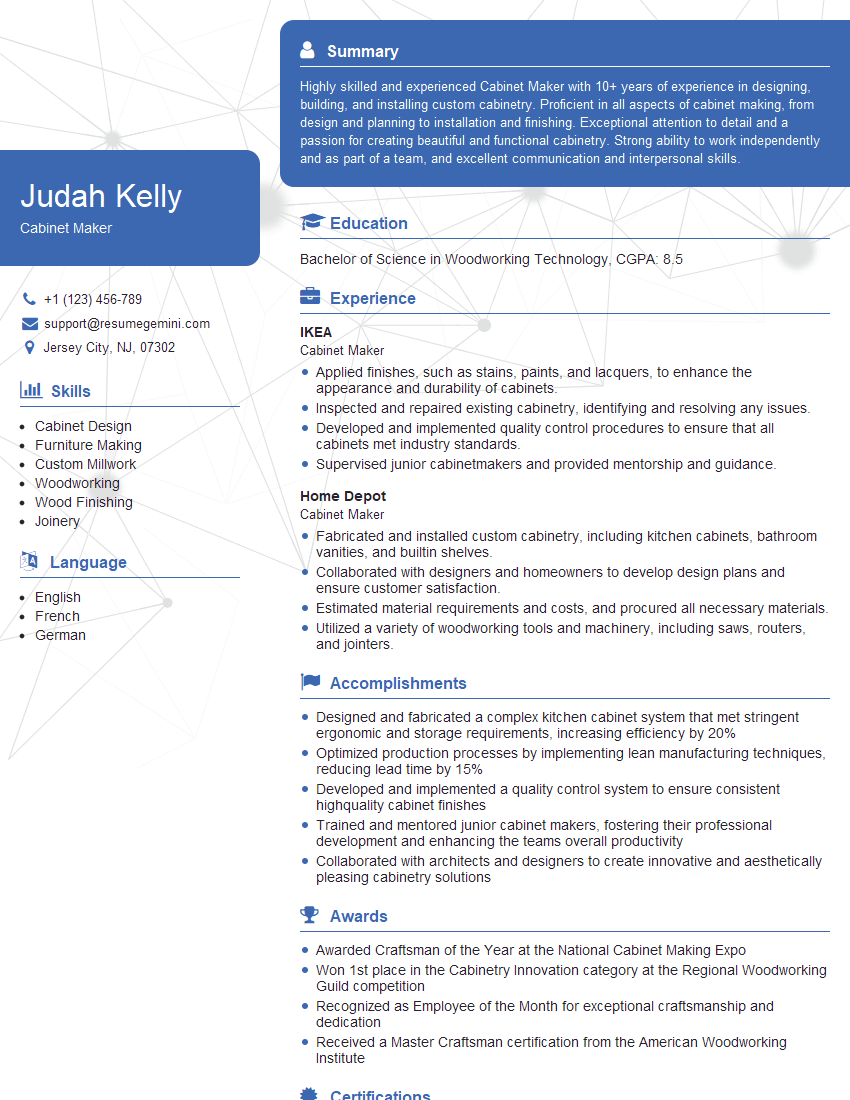
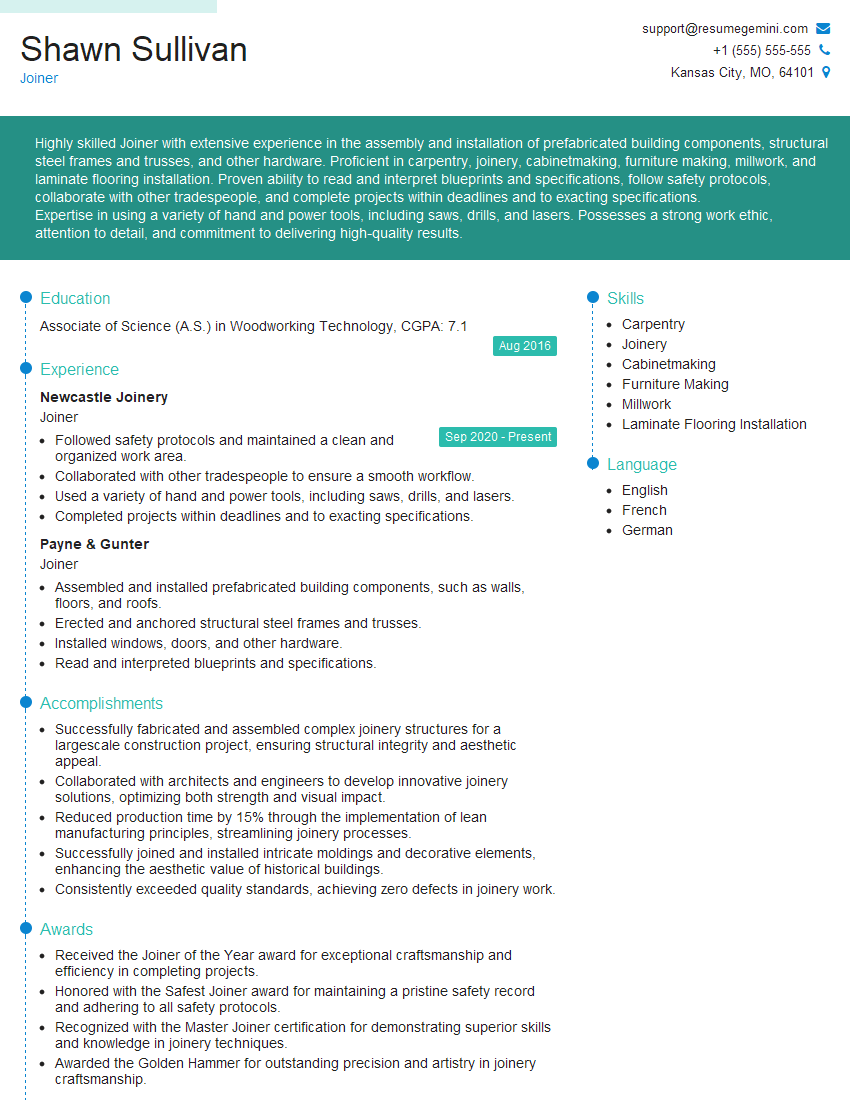
Mastering joinery techniques opens doors to diverse and rewarding career opportunities within the construction, furniture making, and woodworking industries. A strong understanding of joinery is highly valued, significantly increasing your employability and potential for career growth. To maximize your chances, it’s crucial to present your skills effectively. Create an ATS-friendly resume that highlights your expertise and experience. We highly recommend using ResumeGemini to build a professional and impactful resume. ResumeGemini offers a streamlined process and provides examples of resumes tailored to the Joinery field to guide you.

Explore more articles
Users Rating of Our Blogs
Share Your Experience
We value your feedback! Please rate our content and share your thoughts (optional).
What Readers Say About Our Blog
Really detailed insights and content, thank you for writing this detailed article.
IT gave me an insight and words to use and be able to think of examples