Feeling uncertain about what to expect in your upcoming interview? We’ve got you covered! This blog highlights the most important Linear and Nonlinear Control Theory interview questions and provides actionable advice to help you stand out as the ideal candidate. Let’s pave the way for your success.
Questions Asked in Linear and Nonlinear Control Theory Interview
Q 1. Explain the difference between open-loop and closed-loop control systems.
The core difference between open-loop and closed-loop control systems lies in their feedback mechanisms. An open-loop system operates without feedback; its output is solely determined by its input. Think of a toaster: you set the time (input), and it toasts for that duration regardless of whether the bread is actually toasted (no feedback on the output). This can lead to inconsistencies, as external factors (like variations in bread thickness) can significantly impact the outcome.
In contrast, a closed-loop system, also known as a feedback control system, uses feedback from its output to adjust its input and maintain a desired setpoint. Imagine a cruise control system in a car: the system monitors the car’s speed (output) and adjusts the throttle (input) to maintain the set speed, constantly compensating for changes in terrain or wind resistance. This feedback loop ensures greater accuracy and robustness against disturbances.
Example: A simple open-loop system could be a water heater with a timer. The input is the timer setting, and the output is the water temperature after the set time. A closed-loop system would include a thermostat that measures the water temperature (feedback) and turns the heater on or off to maintain a desired temperature.
Q 2. Describe the concept of stability in linear control systems.
Stability in linear control systems refers to the system’s ability to return to its equilibrium point after a disturbance. An unstable system will diverge from its equilibrium point, potentially leading to oscillations or runaway behavior. A stable system, on the other hand, will eventually settle back to its equilibrium, perhaps with some oscillations that dampen over time. This stability is usually analyzed in the context of the system’s response to initial conditions or external inputs.
We characterize stability using different types: asymptotic stability (the system returns to equilibrium), marginal stability (the system oscillates around equilibrium), and instability (the system diverges from equilibrium). The location of the poles of the system’s transfer function in the complex s-plane is crucial in determining stability. Poles in the left-half plane indicate stability, poles on the imaginary axis indicate marginal stability, and poles in the right-half plane indicate instability.
Q 3. How do you determine the stability of a linear system using the Routh-Hurwitz criterion?
The Routh-Hurwitz criterion is a powerful algebraic method to determine the stability of a linear system directly from its characteristic polynomial. The characteristic polynomial is obtained from the denominator of the closed-loop transfer function. The criterion involves constructing a Routh array from the coefficients of the characteristic polynomial.
Steps:
- Write the characteristic polynomial in the form: ansn + an-1sn-1 + … + a1s + a0 = 0
- Construct the Routh array using the polynomial coefficients.
- Examine the first column of the array. If there are any sign changes in the first column, the system has as many unstable poles (roots in the right-half s-plane) as there are sign changes.
Example: Consider the characteristic polynomial: s3 + 2s2 + 3s + 4 = 0. The Routh array would be:
s3 | 1 3 s2 | 2 4 s1 | 1/2 0 s0 | 4 0
There is one sign change in the first column (from 1/2 to 4). Therefore, the system has one unstable pole and is unstable.
Q 4. Explain the Nyquist stability criterion and its applications.
The Nyquist stability criterion is a graphical method used to assess the stability of a closed-loop control system based on its open-loop transfer function. It uses the Nyquist plot, which is a polar plot of the open-loop frequency response. The criterion relies on the principle of the argument.
How it works: The Nyquist plot is mapped in the complex plane. The number of encirclements of the -1 point by the Nyquist plot determines the number of unstable closed-loop poles. A clockwise encirclement indicates an unstable pole, while a counterclockwise encirclement suggests a stable pole. The criterion accounts for the number of unstable open-loop poles, too.
Applications: The Nyquist criterion is especially valuable for systems with non-minimum phase characteristics (having zeros in the right-half plane), where other methods might be less straightforward.
Example: Analyzing the stability of a high-order system where applying the Routh-Hurwitz criterion becomes complex.
Q 5. What is the Bode plot and how is it used in control system analysis?
A Bode plot is a graphical representation of the frequency response of a system. It consists of two plots: a magnitude plot (in decibels) and a phase plot (in degrees), both plotted against frequency (usually on a logarithmic scale).
Use in analysis: Bode plots are extremely useful for understanding how a system responds to different frequencies. From the magnitude plot, we can determine the gain margin (how much the gain can be increased before instability) and the phase margin (how much the phase can be changed before instability). The phase plot shows the phase shift at various frequencies, crucial for assessing phase lag and lead.
Example: Designing a compensator for a control system requires understanding the gain and phase margins. Analyzing the Bode plot helps determine the appropriate type and parameters of the compensator (lead, lag, lead-lag) to achieve desired stability and performance.
Q 6. What are the limitations of linear control theory?
While linear control theory provides a robust framework for analyzing and designing many control systems, it has limitations. The most significant is its inability to accurately model systems with nonlinearities. Real-world systems often exhibit nonlinear behavior, such as saturation, hysteresis, or dead zones, which are not captured by linear models.
Other limitations include:
- Assumption of small signals: Linearization techniques often assume small deviations from an operating point, which may not be valid for large disturbances.
- Difficulty in handling uncertainties: Linear models struggle to account for uncertainties in system parameters or external disturbances.
- Limited applicability to complex systems: The complexity of mathematical models increases significantly with the order of the system.
These limitations necessitate the use of nonlinear control techniques for accurate modeling and control of complex real-world systems.
Q 7. Describe the phase-lead and phase-lag compensators and their effects on system response.
Phase-lead compensators improve the transient response of a system by increasing the phase margin. They are typically used to improve stability and speed of response. A phase-lead network adds a phase lead at high frequencies, effectively reducing the system’s phase lag. This enhances stability and reduces overshoot.
Phase-lag compensators improve the steady-state error by increasing the gain at low frequencies. They are used to reduce the steady-state error, providing better accuracy. A phase-lag network adds phase lag at low frequencies, effectively increasing the low-frequency gain.
Effects on system response:
- Phase-lead compensator: Faster response, reduced overshoot, improved stability margins (increased phase margin).
- Phase-lag compensator: Reduced steady-state error, but potentially slower response.
Choosing between these compensators depends on the specific system requirements and trade-offs between transient response and steady-state accuracy. In some cases, a combination of both (lead-lag compensator) might be necessary to achieve optimal performance.
Q 8. Explain the concept of state-space representation of a linear system.
The state-space representation provides a powerful way to model linear systems. Instead of using transfer functions, which are limited to single-input, single-output systems, state-space uses a set of first-order differential equations to describe the system’s behavior. This allows for a more complete and versatile representation, especially for multi-input, multi-output (MIMO) systems.
The core components are:
- State vector (x): A collection of variables that completely describe the system’s internal state at any given time. Think of it as a snapshot of the system’s internal conditions (e.g., position, velocity, temperature).
- Input vector (u): The external signals or forces acting on the system (e.g., applied voltage, control forces).
- Output vector (y): The variables we measure or observe from the system (e.g., position, current).
These components are related by the following equations:
ẋ = Ax + Bu (State equation: describes how the state changes over time)
y = Cx + Du (Output equation: relates the state and input to the measured output)
Here, A, B, C, and D are matrices that define the system’s dynamics and how the inputs and states influence the outputs. For example, in a simple mass-spring-damper system, the state vector might include position and velocity, the input would be the applied force, and the output could be the position.
Q 9. How do you design a state-feedback controller for a linear system?
Designing a state-feedback controller involves creating a control law that manipulates the system’s input (u) based on its current state (x) to achieve desired performance. The basic idea is to use negative feedback to stabilize the system and drive it towards a desired setpoint or trajectory.
The state-feedback control law is typically of the form:
u = -Kx
Where K is the gain matrix, a set of constants that we design to shape the system’s response. The design process often involves pole placement or optimal control techniques.
Pole placement aims to place the closed-loop poles (eigenvalues of A-BK) of the system at desired locations in the complex plane, thereby determining the system’s transient response (speed, damping). Optimal control (e.g., LQR – Linear Quadratic Regulator) minimizes a cost function that balances control effort and tracking error, finding the optimal gain matrix K.
For instance, imagine controlling a robotic arm. We can measure its joint angles (state) and use a state-feedback controller to adjust motor torques (input) to precisely move the arm to a target position (desired output).
Q 10. What is an observer and how is it used in state-feedback control?
An observer, also known as a state estimator, is a system that estimates the internal state (x) of a system when not all states are directly measurable. This is crucial in state-feedback control because it allows us to use the estimated state (x̂) in place of the true state (x) in the control law: u = -Kx̂
An observer is a dynamic system that runs in parallel with the actual system. Its state equation mimics the actual system’s state equation with the addition of a correction term that reduces the estimation error.
A common type of observer is the Luenberger observer, with the state equation:
ẋ̂ = Aẋ̂ + Bu + L(y - Cx̂)
Where L is the observer gain matrix, which is designed similarly to the state feedback gain matrix K (often using pole placement). The term L(y - Cx̂) is the correction term, which drives the estimated state towards the true state based on the difference between the measured output (y) and the estimated output (Cx̂).
In practice, observers are widely used in applications where full state measurement is expensive or impossible, like in aircraft control, where estimating internal states like airspeed or angle of attack is critical for stable flight.
Q 11. Explain the concept of controllability and observability.
Controllability refers to the ability to steer a system to any desired state within a finite time interval using only allowable inputs. If a system is controllable, it means we can find an input that can drive the system from any initial state to any final state.
Observability is the ability to determine the initial state of a system by observing its outputs over a finite time interval. A system is observable if we can uniquely reconstruct its internal states from its measured outputs.
Both controllability and observability are crucial for successful controller design. A system that is not controllable cannot be effectively manipulated by any controller, while a system that is not observable cannot have its state accurately estimated by an observer. There are algebraic tests (e.g., the controllability and observability matrices) to check for these properties. A system that isn’t controllable or observable is poorly designed and requires modification or a change in sensors.
Q 12. What are Lyapunov stability methods and how are they used in nonlinear control systems?
Lyapunov stability methods are powerful tools for analyzing the stability of nonlinear control systems. Unlike linear systems, nonlinear systems don’t always have readily available analytical solutions, so Lyapunov methods provide a way to assess stability without explicitly solving the system’s equations.
The central idea is to find a scalar function, called a Lyapunov function (V), which is positive definite (V(0) = 0 and V(x) > 0 for x ≠ 0) and whose time derivative (dV/dt) is negative definite (dV/dt < 0 for x ≠ 0) along the system's trajectories. If such a Lyapunov function can be found, it guarantees that the system is asymptotically stable at the origin (or any equilibrium point).
Intuitively, a Lyapunov function acts like a ‘potential energy’ function. If it’s always decreasing along trajectories, the system is naturally drawn towards the equilibrium point. There are various Lyapunov theorems and techniques (e.g., Lyapunov’s direct method, LaSalle’s invariance principle) that aid in the construction and analysis of Lyapunov functions for different types of nonlinear systems.
Lyapunov analysis is widely used to establish stability guarantees for nonlinear controllers designed using techniques like feedback linearization or sliding mode control.
Q 13. Describe different types of nonlinearities in control systems.
Nonlinear control systems are characterized by various types of nonlinearities that can significantly complicate their analysis and design. These nonlinearities can be broadly classified into:
- Saturation: The system’s output or input is limited to a certain range (e.g., motor saturation, actuator limits).
- Dead zone: The system does not respond to small inputs within a certain range.
- Hysteresis: The system’s output depends not only on the current input but also on its past history.
- Backlash: Similar to hysteresis, but typically involves mechanical systems with loose fits or clearances.
- Friction: A force that opposes motion, often exhibiting nonlinear characteristics (e.g., Coulomb friction, viscous friction).
- Nonlinear dynamics: The system’s governing equations are inherently nonlinear (e.g., robotic manipulators, chemical processes).
These nonlinearities often lead to complex behaviors such as limit cycles, chaos, or multiple equilibrium points. Dealing with these effectively requires nonlinear control techniques, unlike linear controllers which can cause instability or poor performance in such conditions.
Q 14. Explain the concept of feedback linearization.
Feedback linearization is a powerful technique for controlling nonlinear systems by transforming them into an equivalent linear system that can then be controlled using linear control methods. The core idea is to find a state transformation and a control input transformation that cancels out the nonlinearities and reveals a linearizable subsystem.
The process usually involves:
- Finding a state transformation: transforming the original nonlinear state variables into new coordinates.
- Designing a control law: This usually involves canceling nonlinearities and shaping the linear subsystem using techniques such as pole placement or LQR.
After linearization, standard linear control techniques can be applied to design a controller that achieves desired performance in the transformed space. The controller output is then transformed back to the original control space. The success of this technique heavily depends on the structure of the nonlinear system. Not all nonlinear systems are feedback linearizable. A classic example is the control of a pendulum; by using feedback linearization, the complex nonlinear dynamics of the pendulum can be transformed into a simple linear system, enabling precise control of its motion.
Q 15. What is sliding mode control and its advantages?
Sliding mode control (SMC) is a powerful nonlinear control technique that forces the system’s trajectories to stay on a specific sliding surface in the state space. This surface is designed such that once the system reaches it, the desired behavior is achieved. Think of it like a highway – once your car is on the highway (the sliding surface), it’s relatively easy to maintain your desired speed and direction.
The key to SMC is a discontinuous control law that pushes the system towards the sliding surface. This discontinuous nature is what gives SMC its robustness to uncertainties and disturbances – it’s like a strong push that overcomes obstacles. Once on the surface, a continuous control law maintains the desired behavior.
- Advantages:
- Robustness: SMC is inherently robust to parameter variations and external disturbances because the control action is designed to overcome them.
- Fast response: The discontinuous nature of the control law leads to fast convergence to the desired state.
- Simple implementation: While the theoretical underpinnings can be complex, the implementation is often relatively straightforward.
Example: Imagine controlling the position of a robotic arm. Uncertainties in friction and load can affect its movement. SMC can ensure the arm reaches its desired position despite these uncertainties by aggressively correcting deviations.
Career Expert Tips:
- Ace those interviews! Prepare effectively by reviewing the Top 50 Most Common Interview Questions on ResumeGemini.
- Navigate your job search with confidence! Explore a wide range of Career Tips on ResumeGemini. Learn about common challenges and recommendations to overcome them.
- Craft the perfect resume! Master the Art of Resume Writing with ResumeGemini’s guide. Showcase your unique qualifications and achievements effectively.
- Don’t miss out on holiday savings! Build your dream resume with ResumeGemini’s ATS optimized templates.
Q 16. What are some common challenges in nonlinear control system design?
Nonlinear control system design presents unique challenges compared to its linear counterpart. These challenges stem from the inherent complexities of nonlinear systems, making them harder to analyze and control.
- Nonlinearity itself: Linear control techniques don’t directly apply. The system’s response doesn’t scale linearly with the input; the relationship between cause and effect is more intricate.
- Unpredictable behavior: Nonlinear systems can exhibit complex behaviors like bifurcations, chaos, and limit cycles that are absent in linear systems. Predicting and managing these behaviors is challenging.
- Model uncertainty: Accurately modeling nonlinear systems is often difficult, leading to uncertainties that can destabilize a control system.
- State-dependent behavior: The system’s response depends on its current state, making it harder to design a universal controller that performs well in all situations.
- Stability analysis: Proving stability for nonlinear systems is often more complicated than for linear systems. Methods like Lyapunov stability theory are often employed.
Example: Controlling the flight of an aircraft is a nonlinear problem. Small changes in the control inputs can have drastically different effects depending on the aircraft’s speed, altitude, and attitude. A linear controller designed for one flight condition may fail completely under different conditions.
Q 17. Describe the concept of backstepping control.
Backstepping control is a recursive design method for controlling nonlinear systems. Imagine you’re climbing a staircase (the system’s states). Backstepping allows you to design a control law by starting from the top step and working your way down, step by step. At each step, you design a controller to stabilize the current state, treating the lower steps as disturbances.
The process involves defining virtual control laws for each step along the way. These virtual controls are designed to stabilize each subsystem individually. The actual control input is then designed to make the system’s behavior converge to the designed virtual controls. This recursive process continues until the control input for the entire system is derived.
Example: Consider a robotic manipulator with two joints. Backstepping would involve first designing a controller for the outer joint, treating the inner joint as a disturbance. Then, a controller for the inner joint is designed, considering the effect of the outer joint controller.
Advantages: Backstepping provides a systematic way to handle complex nonlinear systems, offering a degree of stability and performance.
Q 18. Explain the difference between PID and advanced control strategies.
PID (Proportional-Integral-Derivative) controllers are widely used due to their simplicity and effectiveness for many linear systems. They rely on the error signal (difference between desired and actual output) and its derivatives to adjust the control action.
- Proportional (P): Responds to the current error. Like a thermostat reacting to the current temperature.
- Integral (I): Accounts for accumulated error, eliminating steady-state error. Like a car cruise control that adjusts speed slowly to reach the target.
- Derivative (D): Anticipates future error based on the rate of change of error, preventing overshoot. Like a driver easing off the accelerator as the car approaches the target speed.
Advanced control strategies, however, offer significant advantages for nonlinear and more complex systems. They often employ more sophisticated mathematical models and algorithms.
- Model Predictive Control (MPC): Predicts future system behavior and optimizes control actions accordingly. Useful for systems with constraints and delayed effects.
- Sliding Mode Control (SMC): Robust to uncertainties and disturbances, as discussed earlier.
- Adaptive Control: Adjusts control parameters automatically to compensate for changing system dynamics. Useful when system parameters are unknown or change over time.
- Backstepping Control: Systematically handles complex nonlinear systems.
In essence, PID controllers are simple and effective for many linear systems, but advanced strategies provide better performance, robustness, and adaptability for complex and nonlinear situations.
Q 19. How do you handle saturation and dead zones in nonlinear systems?
Saturation and dead zones are common nonlinearities in actuators and sensors. Saturation limits the output of an actuator to a certain range (e.g., a motor can only rotate at a maximum speed), while dead zones represent regions where the actuator doesn’t respond to changes in the input (e.g., a valve may not open until a certain pressure is reached).
Handling Saturation:
- Anti-windup techniques: Prevent the integrator in a PID controller from accumulating error during saturation, improving transient response.
- Saturation compensation: Model the saturation nonlinearity and design the controller to explicitly account for it.
- Input transformation: Transform the input to avoid exceeding the saturation limits.
Handling Dead Zones:
- Dead-zone compensation: Model the dead zone and compensate for it in the controller design. This might involve adjusting the input to account for the insensitive region.
- Input transformation: A suitable nonlinear transformation of the control input can be used to overcome the dead zone effect.
- Using a hysteresis model: If the dead zone is due to hysteresis effects (where the output depends on the history of inputs), a hysteresis model needs to be incorporated and compensated in the controller design.
The choice of approach depends on the specific system and the severity of the nonlinearities. Often, a combination of methods is most effective.
Q 20. Discuss the importance of robustness in control system design.
Robustness in control system design is crucial because real-world systems are never perfectly modeled. Uncertainties in parameters, external disturbances, and model inaccuracies are always present. A robust controller maintains desired performance despite these imperfections.
A non-robust controller, by contrast, might perform well under ideal conditions but fail catastrophically when faced with even small deviations from the model. For example, a robotic arm controller designed without considering friction might work perfectly in simulation but fail to reach its target position in reality.
Achieving robustness often involves:
- Robust control techniques: Such as H-infinity control, L1 adaptive control, and sliding mode control, specifically designed to handle uncertainties.
- Gain scheduling: Adapting controller parameters based on operating conditions.
- Adaptive control: Automatically adjusting controller parameters in response to changing system dynamics.
- Uncertainty modeling: Explicitly incorporating uncertainty into the system model.
The consequence of neglecting robustness can range from minor performance degradation to complete system failure, particularly in safety-critical applications like aerospace and automotive systems.
Q 21. How do you model uncertainty in control systems?
Modeling uncertainty in control systems is essential for designing robust controllers. There are various ways to represent uncertainty, depending on the nature and extent of the unknown factors.
- Parametric uncertainty: Represents uncertainty in system parameters. For example, the mass of a robotic arm might be uncertain within a certain range. This can be modeled using interval analysis or probability distributions.
- Unmodeled dynamics: Represents neglected dynamics in the system model. These may be high-frequency modes that are omitted for simplicity. This can be addressed through robust control techniques that explicitly handle unmodeled dynamics.
- Additive disturbances: Represent external disturbances acting on the system, such as wind affecting an aircraft. These are often modeled as bounded signals or stochastic processes.
- Multiplicative uncertainty: Represents uncertainty in the system’s gain or transfer function. This is particularly relevant for modeling uncertainties in components and sensors.
The choice of uncertainty model depends on the nature of the uncertainty and the design goals. Robust control techniques then utilize these uncertainty models to design controllers that maintain stability and performance even in the presence of these uncertainties.
For example, in aerospace applications, uncertainty models might include variations in atmospheric conditions, fuel consumption, and aerodynamic coefficients. These models are used to design controllers that ensure safe and reliable flight even under varying conditions.
Q 22. Explain the concept of adaptive control.
Adaptive control is a powerful technique used to manage systems whose dynamics are uncertain or change over time. Imagine trying to balance a pole on a moving cart – the cart’s movement, wind gusts, or even the pole’s weight shifting subtly, all affect the system’s behavior unpredictably. Traditional control methods struggle with such variability. Adaptive control tackles this by constantly monitoring the system’s response and adjusting its control strategy accordingly. It’s like learning to ride a bike – you constantly adjust your balance based on feedback from your body and the environment.
There are several approaches to adaptive control, including model reference adaptive control (MRAC), self-tuning regulators, and indirect adaptive control. MRAC, for instance, compares the system’s actual output to a desired reference model and adjusts controller parameters to minimize the error. Self-tuning regulators use system identification techniques to estimate the changing parameters of the system, then use these estimates to adjust the controller.
Q 23. Describe different methods for system identification.
System identification is the process of building a mathematical model of a dynamic system from experimental data. Think of it like trying to understand the inner workings of a clock by observing its hands’ movement. We don’t necessarily know the gears inside, but by observing the output, we can create a model that predicts future behavior.
- Frequency Response Methods: These methods use sinusoidal inputs at different frequencies to characterize the system’s behavior. By analyzing the input-output relationship in the frequency domain, we can identify the system’s transfer function. This is effective for linear time-invariant systems.
- Impulse Response Methods: Applying an impulse (a very short, high-amplitude input) and observing the system’s response directly reveals its impulse response, which can be used to determine its transfer function.
- Correlation Methods: These methods use correlation functions to identify the system’s parameters. They are useful when the system’s input is noisy.
- Parameter Estimation Techniques: Methods like least squares estimation and recursive least squares are used to estimate the parameters of a pre-defined model structure (e.g., ARX, ARMAX). These methods work iteratively to minimize the difference between the model’s predicted output and the actual system’s output. This is commonly used with techniques such as Maximum Likelihood Estimation.
The choice of method depends on the system’s characteristics, the available data, and the desired accuracy of the model.
Q 24. What are the advantages and disadvantages of using different control algorithms?
Different control algorithms have their own strengths and weaknesses. Here’s a comparison:
- PID Controllers: Simple, widely used, robust, but can struggle with complex systems or nonlinearities.
- State-Space Controllers (LQR, LQG): Powerful for complex systems, require full state information, optimal in a specific sense (minimum energy, etc.), but can be computationally expensive.
- Model Predictive Control (MPC): Handles constraints well, predicts future behavior, but requires a good system model and can be computationally demanding.
- Adaptive Controllers: Handle uncertainties and changing dynamics effectively, but can be complex to design and implement.
For example, a PID controller might be sufficient for controlling temperature in a simple oven, while MPC could be necessary for controlling the trajectory of a complex robotic arm which has constraints on its movement.
Q 25. How do you choose the appropriate control strategy for a specific application?
Choosing the right control strategy involves a careful evaluation of several factors:
- System Complexity: Simple systems might only need a PID controller, while complex systems might require more sophisticated methods like MPC or LQR.
- Performance Requirements: Are fast response times, high accuracy, or robustness to disturbances critical? This will influence the choice of controller.
- Available Sensors and Actuators: The type and quality of sensors and actuators constrain the available control strategies.
- Computational Resources: Some advanced controllers, like MPC, are computationally intensive and may not be suitable for systems with limited processing power.
- Cost and Time Constraints: The cost of developing and implementing the control system must be considered.
A structured approach involves analyzing the system’s characteristics, defining performance objectives, and evaluating different control strategies based on these criteria. It often involves simulations and prototyping to validate the chosen approach before implementation.
Q 26. Explain the role of simulation in control system design.
Simulation plays a crucial role in control system design. It allows us to test and refine control algorithms before implementing them on a real system. Imagine designing a flight control system – you wouldn’t want to test it directly on a real aircraft! Simulation provides a safe and cost-effective environment to experiment with different control parameters, evaluate system performance under various conditions, and identify potential issues early in the design process.
Simulation tools, such as MATLAB/Simulink, allow us to create virtual representations of the system and the controller. We can then analyze the system’s response to different inputs, evaluate the controller’s stability and robustness, and optimize the controller parameters to achieve desired performance levels. It’s essentially a virtual test bench for the control system.
Q 27. Describe your experience with control system design software tools (e.g., MATLAB/Simulink).
I have extensive experience using MATLAB/Simulink for control system design. I’ve used it for:
- Modeling dynamic systems: Creating block diagrams of various systems ranging from simple mechanical systems to complex aerospace applications.
- Designing and simulating control algorithms: Implementing PID, LQR, MPC, and adaptive control algorithms and analyzing their performance using various simulation techniques.
- Linearization and analysis: Performing linearization of nonlinear systems to analyze their stability and performance using tools like Bode plots, Nyquist plots, and root locus analysis.
- Code generation: Generating embedded C code from Simulink models for implementation on real-time hardware.
- Verification and validation: Ensuring the designed control system meets the specified requirements through rigorous testing and validation in Simulink.
I am proficient in using various toolboxes within MATLAB, including the Control System Toolbox, Simulink Control Design, and Stateflow.
Q 28. Describe a challenging control problem you have solved and how you approached it.
One challenging project involved controlling the trajectory of a highly flexible robotic arm used in a micro-assembly application. The arm’s flexibility introduced significant nonlinearities and made it extremely difficult to achieve precise positioning. Traditional PID control proved inadequate due to the oscillations and overshoots caused by the flexibility.
My approach involved several steps:
- Detailed System Modeling: I developed a finite element model of the robotic arm to capture its flexible dynamics. This model incorporated the effects of material properties, geometry, and external forces.
- Nonlinear Control Design: Instead of a simple PID controller, I designed a nonlinear controller based on feedback linearization techniques. This allowed me to compensate for the nonlinearities introduced by the arm’s flexibility.
- Adaptive Control Implementation: To address uncertainties in the model parameters (such as material properties or external disturbances), I incorporated an adaptive control element to fine-tune the controller parameters online.
- Extensive Simulation and Testing: I conducted extensive simulations in Simulink to verify the controller’s performance and robustness before deploying it on the real system.
This multi-pronged approach resulted in a significant improvement in the arm’s trajectory tracking accuracy and reduced oscillations, successfully achieving the micro-assembly requirements. The project highlighted the importance of accurate system modeling, the power of nonlinear control techniques, and the value of thorough simulation and testing in tackling complex control problems.
Key Topics to Learn for Linear and Nonlinear Control Theory Interview
- Linear Systems: State-space representation, transfer functions, stability analysis (Routh-Hurwitz criterion, Nyquist criterion), pole placement, and controllability/observability.
- Linear Control Design Techniques: PID control, lead/lag compensators, frequency response analysis (Bode plots, Nyquist plots), root locus analysis.
- Nonlinear Systems: Describing functions, phase plane analysis, Lyapunov stability, limit cycles, and bifurcations.
- Nonlinear Control Design Techniques: Feedback linearization, sliding mode control, adaptive control.
- Practical Applications (Linear): Robotics, process control, aircraft autopilot systems. Focus on understanding the challenges and solutions in each.
- Practical Applications (Nonlinear): Robotics (manipulator control), aerospace (attitude control), and power systems (load frequency control). Emphasize modeling and control strategies.
- State Estimation and Observers: Kalman filter, Luenberger observer – crucial for both linear and nonlinear systems.
- System Identification: Techniques for obtaining mathematical models from experimental data – vital for practical implementation.
- Robust Control: Designing controllers that are insensitive to uncertainties in the system model.
- Problem-Solving Approach: Practice formulating control problems, developing mathematical models, and designing and analyzing controllers. Focus on clear communication of your thought process.
Next Steps
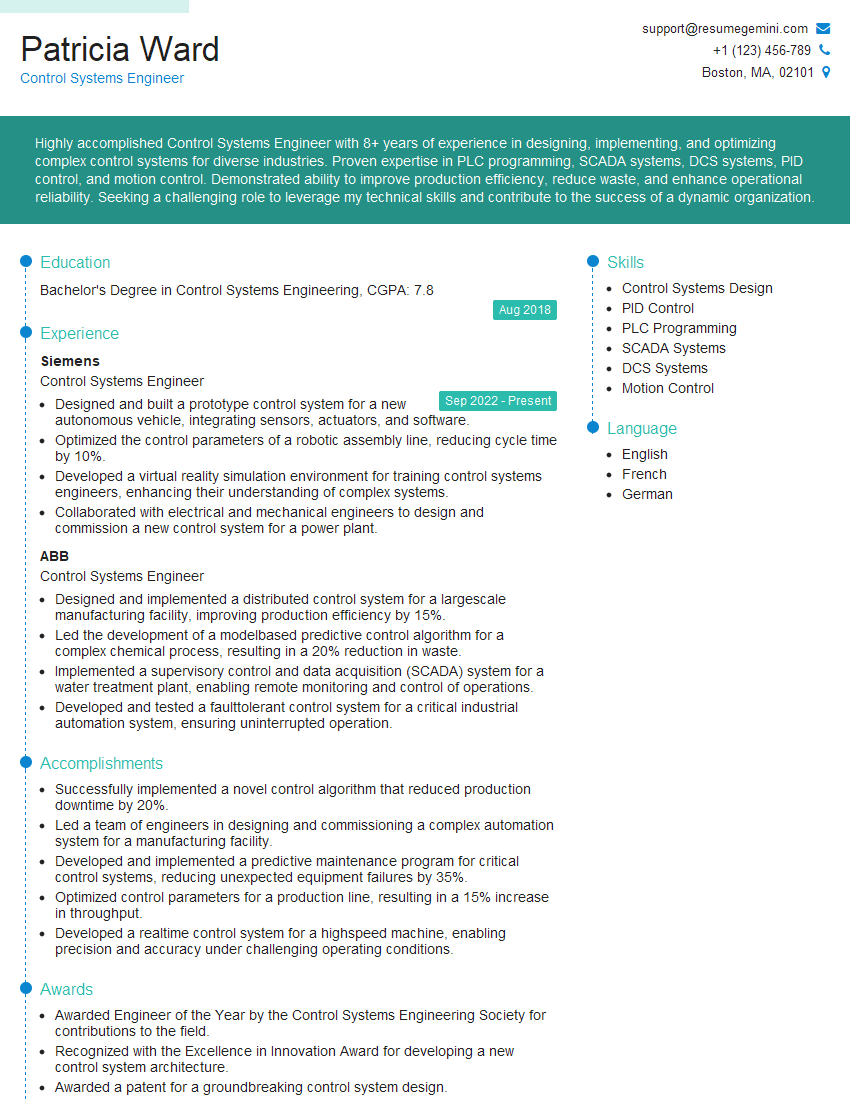
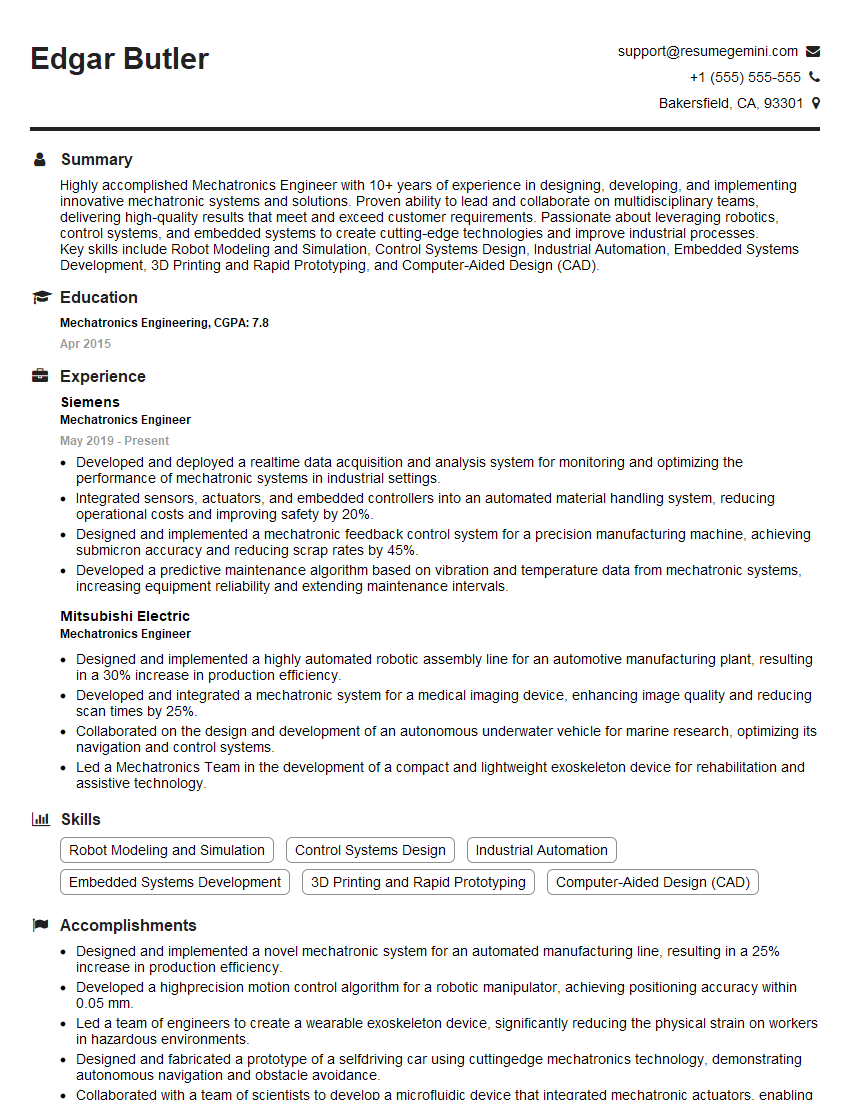
Mastering Linear and Nonlinear Control Theory is paramount for a successful career in many high-demand fields, opening doors to exciting opportunities in research, development, and engineering roles. A strong understanding of these concepts demonstrates a critical skillset highly valued by employers. To further enhance your job prospects, create an ATS-friendly resume that highlights your expertise effectively. ResumeGemini is a trusted resource to help you build a professional resume that showcases your skills and experience. We provide examples of resumes tailored to Linear and Nonlinear Control Theory to guide you in crafting a compelling application. Take the next step towards your dream career today!

Explore more articles
Users Rating of Our Blogs
Share Your Experience
We value your feedback! Please rate our content and share your thoughts (optional).
What Readers Say About Our Blog
Really detailed insights and content, thank you for writing this detailed article.
IT gave me an insight and words to use and be able to think of examples