The right preparation can turn an interview into an opportunity to showcase your expertise. This guide to Satellite Communication interview questions is your ultimate resource, providing key insights and tips to help you ace your responses and stand out as a top candidate.
Questions Asked in Satellite Communication Interview
Q 1. Explain the difference between geostationary and low Earth orbit satellites.
The primary difference between geostationary (GEO) and low Earth orbit (LEO) satellites lies in their altitude and orbital characteristics. GEO satellites orbit the Earth at an altitude of approximately 35,786 kilometers, matching the Earth’s rotation. This results in a stationary position relative to a point on the Earth’s surface, making them ideal for continuous coverage of a specific region. Think of it like a bird hovering in the sky. LEO satellites, on the other hand, orbit at much lower altitudes, typically between 200 and 2,000 kilometers. This means they travel around the Earth much faster, requiring multiple satellites to provide continuous coverage. Imagine a flock of birds constantly moving, each covering a small area at a time.
This difference in altitude impacts several aspects of satellite communication. GEO satellites require high-power transmitters to reach the ground but offer uninterrupted coverage within their footprint. LEO satellites require less powerful transmitters but need a constellation of satellites for continuous service, leading to increased complexity in network management. The choice between GEO and LEO depends on the specific application’s requirements, such as coverage area, latency, and cost.
Q 2. Describe various satellite communication frequency bands and their applications.
Satellite communication utilizes various frequency bands, each with its own characteristics and applications. These bands are broadly categorized based on their frequency range. Let’s consider a few important ones:
- L-band (1-2 GHz): Commonly used for navigation systems like GPS and satellite-based augmentation systems (SBAS), as well as some satellite-based mobile communications due to its ability to penetrate the Earth’s atmosphere well.
- S-band (2-4 GHz): Often employed for satellite-based telecommunications, including both voice and data transmission. It’s a good compromise between atmospheric attenuation and propagation. Many weather satellites and some deep-space communication uses this band.
- C-band (4-8 GHz): Popular for television broadcasting and fixed-satellite services (FSS), providing high bandwidth for data and video transmission. However, it experiences higher rainfall attenuation compared to lower frequencies.
- Ku-band (12-18 GHz): Offers higher bandwidth than C-band, making it suitable for high-definition television broadcasting, satellite internet, and corporate networks. Rain attenuation and atmospheric interference become more significant at this frequency.
- Ka-band (26-40 GHz): Provides the highest bandwidth of commonly used bands, ideal for high-throughput applications such as broadband internet access. It is heavily affected by atmospheric conditions, limiting its range and reliability.
The choice of frequency band depends on factors like required bandwidth, cost, atmospheric conditions, and regulatory restrictions. Higher frequencies generally offer larger bandwidths but suffer from increased atmospheric attenuation and interference.
Q 3. What are the advantages and disadvantages of different satellite modulation techniques?
Several modulation techniques are employed in satellite communication, each offering a trade-off between power efficiency, bandwidth utilization, and robustness against noise and interference. Some examples include:
- Frequency Shift Keying (FSK): A simple modulation technique that transmits data by shifting the frequency of a carrier wave. It’s relatively simple to implement but less spectrally efficient than other techniques.
- Phase Shift Keying (PSK): Transmits data by changing the phase of a carrier wave. Different variations like Binary PSK (BPSK), Quadrature PSK (QPSK), and higher-order PSK provide increasing data rates but at the cost of increased complexity.
- Quadrature Amplitude Modulation (QAM): A more complex technique that varies both the amplitude and phase of the carrier wave, allowing for higher data rates. However, QAM is more susceptible to noise and requires more sophisticated error correction.
- Code Division Multiple Access (CDMA): Allows multiple users to share the same frequency band using unique codes to separate their signals. This is often used in satellite-based mobile communication systems.
The choice of modulation technique involves balancing the need for high data rates with power efficiency and resilience to noise. Higher-order modulation schemes provide higher spectral efficiency but are less robust to interference and require more sophisticated decoding techniques.
Q 4. Explain the concept of satellite link budget analysis.
Satellite link budget analysis is a crucial process in satellite communication system design. It’s essentially an accounting of all the power gains and losses along a satellite communication link, from the transmitter to the receiver. The goal is to determine whether there’s sufficient signal power at the receiver to achieve the desired signal-to-noise ratio (SNR) for reliable communication. This analysis considers several factors:
- Transmitter Power (EIRP): The effective isotropic radiated power of the transmitter.
- Antenna Gains (Tx and Rx): The gain of the transmitting and receiving antennas.
- Free Space Path Loss (FSPL): The signal power loss due to the distance between the transmitter and receiver.
- Atmospheric Losses: Losses due to atmospheric absorption and scattering.
- Polarization Losses: Losses due to the mismatch in polarization between the transmitting and receiving antennas.
- Receiver Noise Figure: The noise introduced by the receiver.
- Required SNR: The minimum SNR needed to achieve a desired bit error rate (BER).
A positive link budget ensures adequate signal strength. A negative link budget indicates insufficient power and requires adjustments such as increasing transmitter power, using larger antennas, or selecting a more efficient modulation scheme.
Q 5. How do you calculate the free space path loss in a satellite link?
Free space path loss (FSPL) represents the signal power reduction due to signal spreading as it travels through free space. It’s calculated using the following formula:
FSPL (dB) = 20log10(d) + 20log10(f) + 32.45Where:
dis the distance between the transmitter and receiver in kilometers.fis the frequency in MHz.
For example, to calculate the FSPL for a link operating at 12 GHz (12000 MHz) with a distance of 36,000 km (geostationary orbit):
FSPL (dB) = 20log10(36000) + 20log10(12000) + 32.45 ≈ 195.6 dBThis means the signal power decreases by approximately 195.6 dB due to free space propagation alone. This highlights the necessity of high-power transmitters and sensitive receivers in satellite communication.
Q 6. What are the key components of a satellite ground station?
A satellite ground station is the terrestrial facility responsible for communicating with satellites. Key components include:
- Antenna System: A high-gain antenna, often parabolic, to focus the signal toward the satellite and receive the return signal. The size and type of antenna depend on the frequency band and required data rate.
- High-Power Amplifier (HPA): Amplifies the transmitted signal to achieve sufficient power at the satellite. This is crucial for GEO links due to the long distances.
- Low-Noise Amplifier (LNA): Amplifies the weak received signal from the satellite while minimizing noise addition. LNAs are critical for enhancing the signal-to-noise ratio.
- Modulator/Demodulator (Modem): Modulates the digital information onto the carrier wave for transmission and demodulates the received signal to retrieve the information. The choice of modem depends on the modulation scheme used.
- Tracking System: A system to accurately point the antenna towards the satellite. This is particularly crucial for LEO and MEO satellites, which are constantly moving.
- Control and Monitoring System: Monitors the entire system’s performance, including signal quality, antenna pointing, and HPA/LNA operation. This ensures reliable communication and allows for fault detection and correction.
- Transmission Line: Connects the various components of the ground station. The type of transmission line (e.g., coaxial cable, waveguide) depends on the frequency.
The complexity and size of a ground station depend on its purpose and the type of satellite it communicates with. Small earth stations are used for simple applications, while large ground stations are required for more demanding applications like deep-space communication.
Q 7. Describe the different types of satellite antennas and their characteristics.
Various types of antennas are used in satellite communication, each with specific characteristics suited to different applications:
- Parabolic Antennas (Dish Antennas): The most common type, providing high gain and directivity. Their size determines their gain and beamwidth, with larger dishes providing higher gain and narrower beams. These are frequently used in both ground stations and on satellites.
- Horn Antennas: Simple, robust antennas often used as feed elements for larger reflector antennas or for specialized applications. They offer a relatively broad beamwidth.
- Helical Antennas: Produce circularly polarized radiation, useful for mitigating signal degradation caused by changes in polarization during transmission. They are used less frequently than parabolic dishes.
- Array Antennas: Composed of multiple smaller antenna elements, enabling beam shaping, beam steering, and multiple-beam coverage. Used in modern satellite systems for enhanced flexibility and efficiency.
- Phased Array Antennas: A type of array antenna that uses phase shifting to electronically steer the beam without physically moving the antenna elements. They are becoming increasingly important for their ability to rapidly track moving satellites.
The selection of an antenna depends on factors such as gain requirements, frequency band, beamwidth, polarization, and overall cost and complexity. For example, a small, low-gain antenna might be suitable for receiving signals from a geostationary broadcast satellite, while a large, high-gain antenna would be necessary for a narrow-bandwidth communication with a low-earth-orbit satellite.
Q 8. Explain the concept of satellite tracking and acquisition.
Satellite tracking and acquisition is the process of locating a satellite in space and establishing a stable communication link. Imagine trying to find a specific star in the night sky – you need precise coordinates and a powerful telescope (antenna). Similarly, acquiring a satellite involves pointing your ground station antenna in the correct direction and adjusting its frequency to receive the satellite’s signal. This process typically involves:
- Prediction: Using orbital parameters to predict the satellite’s future position.
- Acquisition: Using search patterns or predefined pointing data to initially locate the satellite’s signal.
- Tracking: Continuously adjusting the antenna’s pointing to maintain a stable link as the satellite moves across the sky. This often involves sophisticated control systems.
- Signal Acquisition: This involves detecting the satellite’s signal amidst noise and interference and precisely tuning the receiver to maximize signal strength. This is often done using techniques like frequency sweeping.
Modern systems use GPS data and sophisticated algorithms to automate this process, improving accuracy and speed. Failure to accurately track and acquire a satellite leads to communication outages. A failure in a weather satellite’s tracking could mean missed critical weather data, affecting forecasts and potentially leading to safety issues.
Q 9. What are the challenges of satellite communication in different environments (e.g., maritime, airborne)?
Satellite communication faces unique challenges in different environments. The mobility and the nature of the environment significantly impact signal propagation.
- Maritime: Ships constantly move, requiring continuous tracking and adjustments to maintain a stable link. Sea state can also cause multipath interference (signal bouncing off the water surface), degrading signal quality. Furthermore, weather conditions like storms and heavy rainfall drastically weaken the signal.
- Airborne: Aircraft are also mobile and experience rapid changes in elevation and velocity, presenting similar tracking challenges as maritime environments. Atmospheric conditions, like clouds and rain, are also major obstacles. The aircraft’s structure can also interfere with the signal.
Overcoming these challenges often involves employing advanced antenna tracking systems, employing techniques to mitigate multipath, using error correction codes, and utilizing higher power transmissions. Consider air traffic control – it critically relies on satellite communication, hence these challenges need constant mitigation.
Q 10. How does rain fade affect satellite communication?
Rain fade is the attenuation of a satellite signal caused by absorption and scattering of the signal by raindrops. Imagine shining a laser pointer through a rain shower – the beam is weakened and scattered. Similarly, rain absorbs and scatters the microwave signals used for satellite communication.
The intensity of rain fade depends on the intensity and type of rainfall, the frequency of the signal (higher frequencies are more susceptible), and the elevation angle of the satellite (lower angles experience more attenuation). This attenuation can lead to significant signal degradation, resulting in increased bit error rates and potential communication outages.
Mitigation strategies include using larger antennas, employing higher power transmitters, employing advanced modulation techniques, and implementing adaptive power control. Satellite TV services, for instance, often experience temporary interruptions during heavy rain, a direct result of rain fade.
Q 11. What are the different types of satellite multiple access techniques?
Satellite multiple access techniques allow multiple users to share the same satellite transponder (a device that amplifies and transmits signals). Several techniques exist, each with its strengths and weaknesses:
- Frequency Division Multiple Access (FDMA): Users are allocated different frequency bands. Think of it like different radio stations broadcasting on different frequencies.
- Time Division Multiple Access (TDMA): Users are allocated different time slots within the same frequency band. It’s like taking turns speaking on a shared telephone line.
- Code Division Multiple Access (CDMA): Users are assigned unique codes that allow them to simultaneously transmit on the same frequency. Imagine several people whispering different messages at the same time – each message is distinguishable due to its unique code.
- Space Division Multiple Access (SDMA): Users are separated using multiple beams from a large antenna, enabling simultaneous communication to different geographical regions. This is like having multiple spotlights shining on different targets.
The choice of multiple access technique depends on factors such as the number of users, required bandwidth, and cost constraints. Modern satellite systems often employ a combination of these techniques to optimize resource utilization and efficiency.
Q 12. Explain the concept of forward error correction in satellite communication.
Forward error correction (FEC) is a crucial technique used in satellite communication to mitigate the effects of noise and interference. It works by adding redundant information to the transmitted data, allowing the receiver to detect and correct errors without requesting retransmission.
FEC codes, such as Reed-Solomon codes and convolutional codes, are used to add this redundancy. The receiver uses the redundant information to identify and correct corrupted bits. This is analogous to proofreading a document – you can often correct small errors by understanding the context.
FEC is essential in satellite communication due to the long distances involved and the susceptibility of signals to atmospheric interference. Without FEC, even small amounts of noise could render data unintelligible. It ensures reliable communication, even in challenging environments where retransmission isn’t feasible. Deep-space missions heavily rely on FEC due to the extremely high signal attenuation experienced at these distances.
Q 13. What are the key performance indicators (KPIs) for satellite communication systems?
Key Performance Indicators (KPIs) for satellite communication systems vary depending on the application, but some common ones include:
- Availability: The percentage of time the system is operational and available for communication.
- Bit Error Rate (BER): The frequency of errors in the received data. A lower BER indicates higher quality.
- Latency: The delay in signal transmission. Lower latency is crucial for interactive applications.
- Throughput: The amount of data transmitted per unit of time.
- Signal-to-Noise Ratio (SNR): The ratio of signal power to noise power. A higher SNR is essential for reliable communication.
- Power consumption: Especially vital for satellite payloads with limited power sources.
Monitoring these KPIs helps identify areas for improvement, optimize system performance, and ensure the delivery of high-quality services. For example, a low availability in a satellite-based navigation system would have serious safety implications.
Q 14. Describe the role of GPS in satellite communication.
GPS (Global Positioning System) plays a vital role in satellite communication, primarily for precise positioning and timing. It is not directly involved in the communication itself, but acts as a supporting system for accurate satellite tracking and management.
Ground stations use GPS data to determine their precise location and time, crucial for accurately pointing antennas at the satellites. The GPS signals provide the precise coordinates which, in conjunction with the satellite’s orbital data, help predict and maintain the antenna’s pointing direction. This is crucial for keeping the satellite within the antenna’s beamwidth. Additionally, highly accurate time synchronization is vital for many satellite communication protocols like TDMA, making GPS an essential enabling technology.
In essence, GPS enhances the accuracy and efficiency of satellite communication systems by providing highly precise positioning and timing information. Without GPS, precise tracking would become far more complex and prone to error.
Q 15. Explain the principles of satellite navigation systems.
Satellite navigation systems, like GPS, rely on the precise measurement of signals from multiple satellites to determine a receiver’s location. Think of it like triangulation: if you know your distance from three points, you can pinpoint your exact position on a map. Each satellite continuously transmits signals containing its precise location and the time the signal was sent. A GPS receiver on Earth receives these signals from at least four satellites (to account for clock errors). By comparing the time the signal was sent versus the time it was received, the receiver calculates the distance to each satellite. Using this distance information and the known satellite positions, sophisticated algorithms solve for the receiver’s three-dimensional coordinates (latitude, longitude, and altitude).
For example, imagine you’re lost in a forest. Three friends are standing at known locations, each shouting to you the time they shouted. By knowing the speed of sound, you can calculate your distance from each friend. Drawing circles around each friend’s position with radii representing your distance from them, the point where all three circles intersect is your location. Satellite navigation is similar, but uses radio signals and incredibly precise clocks in space instead of shouts and speed of sound calculations.
Career Expert Tips:
- Ace those interviews! Prepare effectively by reviewing the Top 50 Most Common Interview Questions on ResumeGemini.
- Navigate your job search with confidence! Explore a wide range of Career Tips on ResumeGemini. Learn about common challenges and recommendations to overcome them.
- Craft the perfect resume! Master the Art of Resume Writing with ResumeGemini’s guide. Showcase your unique qualifications and achievements effectively.
- Don’t miss out on holiday savings! Build your dream resume with ResumeGemini’s ATS optimized templates.
Q 16. What is the difference between TDMA and FDMA?
TDMA (Time Division Multiple Access) and FDMA (Frequency Division Multiple Access) are two different methods for sharing a satellite’s communication resources among multiple users. Think of it like sharing a road: TDMA is like having different cars use the same road at different times, while FDMA is like having different cars use different lanes of the same road simultaneously.
- TDMA divides the available transmission time into slots. Each user is allocated a specific time slot to transmit their data. This is efficient because only one user transmits at a time, minimizing interference. Imagine a round-robin scheduling where each user gets their turn to speak.
- FDMA divides the available frequency spectrum into different channels. Each user is assigned a specific frequency channel to transmit their data. Users can transmit simultaneously without interfering with each other, provided they use different channels. Imagine a highway with multiple lanes, each lane representing a different frequency channel.
The choice between TDMA and FDMA depends on factors like the number of users, bandwidth requirements, and the cost of implementing the system. TDMA is often preferred for systems with a large number of users but relatively low bandwidth needs, while FDMA is suited for systems requiring high bandwidth per user.
Q 17. What are some common satellite communication protocols?
Several communication protocols are used in satellite communication, each with its strengths and weaknesses. The choice depends on the specific application and requirements.
- TCP/IP: The ubiquitous internet protocol suite, also used extensively in satellite networks for data transfer. It provides reliable, ordered delivery of data packets.
- UDP: A connectionless protocol offering faster transmission than TCP, but without guaranteed delivery. Ideal for real-time applications where some data loss is acceptable, such as video streaming.
- IP over DVB-S2: This combines IP networking with the Digital Video Broadcasting – Satellite standard (DVB-S2) for efficient transmission of IP packets over satellite links. It’s commonly used for broadcast and broadband satellite services.
- X.25: A packet-switched network protocol that’s been around for a while, offering reliable data transmission over unreliable links. Though older, it’s still present in some legacy satellite systems.
- MPLS (Multiprotocol Label Switching): Often used for high-speed satellite links, providing fast switching and routing capabilities for large amounts of data.
These protocols often interact. For example, a satellite TV broadcast might use DVB-S2 to transmit the video signal, while an interactive service integrated with the TV might use TCP/IP for control and data.
Q 18. Explain the concept of satellite constellation design.
Satellite constellation design involves strategically placing multiple satellites in orbit to provide global or regional coverage, ensuring high availability and minimizing latency. The design considers several factors, including:
- Coverage area: The geographic area to be covered.
- Number of satellites: The more satellites, generally the better the coverage and redundancy but higher cost.
- Orbital parameters: Altitude, inclination, and phasing of the satellites’ orbits.
- Satellite spacing: How far apart satellites are positioned to avoid interference and ensure seamless handover between satellites.
- Mission requirements: Factors such as data throughput, latency requirements, and the intended applications dictate the constellation design.
For instance, a global navigation system like GPS requires a constellation of multiple satellites distributed to guarantee visibility from almost any point on Earth. Low Earth Orbit (LEO) constellations like Starlink utilize many satellites at lower altitudes for high bandwidth and low latency, but require a larger number of satellites compared to Geostationary constellations.
Q 19. Describe different types of satellite orbits (e.g., GEO, LEO, MEO).
Satellite orbits are categorized by their altitude and inclination relative to the Earth’s equator. The most common types include:
- Geostationary Earth Orbit (GEO): Satellites in GEO orbit at an altitude of approximately 36,000 kilometers above the equator. They appear stationary relative to the Earth’s surface, making them ideal for continuous coverage of a specific region. However, they suffer from high latency due to the large distance.
- Low Earth Orbit (LEO): LEO satellites orbit at altitudes ranging from 160 to 2,000 kilometers. They provide lower latency than GEO satellites, but require a larger constellation to achieve continuous global coverage. Examples include many Earth observation and communication satellites.
- Medium Earth Orbit (MEO): MEO satellites occupy an intermediate position between LEO and GEO, typically at altitudes between 2,000 and 36,000 kilometers. They offer a compromise between the latency of GEO and the coverage requirements of LEO. Global navigation satellite systems often use MEO orbits.
Each orbit type presents trade-offs. GEO offers continuous coverage over a wide area but with high latency, while LEO provides lower latency but necessitates a larger constellation. MEO provides a balance between these two extremes.
Q 20. What are the challenges in implementing a satellite network?
Implementing a satellite network presents several significant challenges:
- High cost: Launching and maintaining satellites is extremely expensive.
- Technological complexity: Satellite technology is intricate, requiring specialized expertise for design, development, and operation.
- Regulatory hurdles: Obtaining licenses and approvals from various regulatory bodies can be a lengthy and complex process.
- Propagation delays: Signal propagation time can cause significant latency, especially for GEO satellites.
- Atmospheric effects: Atmospheric conditions, such as rain and cloud cover, can attenuate satellite signals, leading to signal degradation.
- Space debris: Collisions with space debris pose a risk to operating satellites.
- Security threats: Satellite communication systems are vulnerable to various security threats, including signal jamming and hacking.
Successfully mitigating these challenges requires meticulous planning, careful selection of technology, and robust security measures.
Q 21. How do you troubleshoot a satellite communication system?
Troubleshooting a satellite communication system involves a systematic approach to identify and resolve issues. It’s crucial to follow a structured process to avoid wasting time and resources.
- Identify the problem: Pinpoint the symptoms – is it signal loss, low throughput, data corruption, or something else? Gather detailed information on the time of occurrence, affected users, and related equipment.
- Check the obvious: Start with the simplest solutions. Ensure the satellite dish is properly aligned, the receiver is powered on, and there are no physical obstructions blocking the signal path.
- Signal quality analysis: Measure signal strength, signal-to-noise ratio (SNR), and bit error rate (BER) using specialized equipment. This provides valuable insights into the quality of the received signal.
- Check the network infrastructure: Inspect the modem, uplink, downlink, and other network components. Look for errors in logs or status indicators.
- Isolate the fault: By systematically checking different parts of the system, you can narrow down the potential source of the problem. Consider whether the problem lies in the ground segment, the satellite itself, or the space segment.
- Consult documentation: Review the system’s documentation, technical manuals, and troubleshooting guides for possible solutions.
- Contact support: If the problem persists, contact the satellite service provider or equipment vendor for expert assistance.
Effective troubleshooting requires familiarity with satellite communication systems, signal analysis techniques, and problem-solving skills.
Q 22. Discuss the impact of atmospheric interference on satellite signals.
Atmospheric interference significantly impacts satellite signals, primarily through attenuation and distortion. Attenuation refers to the weakening of the signal as it passes through the atmosphere. This is influenced by factors like rain, clouds, fog, and even atmospheric gases like water vapor and oxygen. These absorb or scatter the signal’s energy, reducing its strength at the receiver. The amount of attenuation depends on the frequency of the signal; higher frequencies generally experience more significant attenuation. For instance, signals in the Ka-band (26.5-40 GHz) experience far more rain attenuation than those in the Ku-band (12-18 GHz).
Distortion, on the other hand, refers to the change in the signal’s shape or characteristics. This is often caused by atmospheric turbulence, which can cause the signal to arrive at the receiver with varying delays and phase shifts, leading to signal degradation and potential errors in data transmission. Think of it like trying to read a message written in slightly wavy ink – you can still decipher it, but with greater difficulty.
Mitigation strategies include employing error correction codes in the signal processing, utilizing higher power transmitters, employing adaptive antennas that can track and compensate for atmospheric effects, and selecting optimal satellite frequencies for reduced attenuation.
Q 23. What are some security concerns in satellite communication?
Security in satellite communication is paramount, especially for applications like government communications, military operations, and financial transactions. Several key security concerns exist:
- Eavesdropping: Unauthorized interception of signals by third parties. This is a major concern, especially with unencrypted transmissions.
- Jamming: Intentional interference that disrupts or prevents communication. A powerful jammer can easily overwhelm a satellite signal.
- Spoofing: Mimicking legitimate signals to gain unauthorized access or inject malicious data. This requires sophisticated techniques to detect and mitigate.
- Data Integrity: Ensuring the data received is authentic and hasn’t been altered during transmission. This is usually tackled with checksums and digital signatures.
- Physical Security of Ground Stations: Protecting ground-based equipment from physical access and tampering. This includes measures such as security personnel, surveillance, and secure access control.
Addressing these concerns requires employing robust encryption techniques, implementing authentication protocols, using advanced signal processing techniques for interference mitigation and detection, and establishing stringent physical security measures at ground stations. The specific approach depends on the application’s sensitivity and the level of security required.
Q 24. Explain the role of signal processing in satellite communication.
Signal processing plays a critical role in satellite communication, acting as the backbone for ensuring reliable and efficient data transmission. It encompasses a range of techniques applied both at the transmitter and receiver to enhance signal quality and overcome various challenges:
- Modulation/Demodulation: Transforming the digital data into a signal suitable for transmission (modulation) and recovering the data from the received signal (demodulation). This involves choosing appropriate modulation schemes to maximize spectral efficiency and robustness against noise and interference.
- Coding and Decoding: Introducing redundancy into the data stream to protect it against errors caused by noise and interference (coding) and extracting the original data from the received coded sequence (decoding). Powerful error-correcting codes like Turbo codes and LDPC codes are commonly used.
- Equalization: Compensating for distortions introduced by the channel, such as multipath fading and inter-symbol interference. This improves the clarity and accuracy of the received signal.
- Filtering: Removing unwanted noise and interference from the received signal to improve the signal-to-noise ratio (SNR). Different filter designs are employed based on the characteristics of the noise and interference.
- Synchronization: Maintaining timing and phase alignment between the transmitter and receiver. This is essential for accurate demodulation and data recovery.
Without efficient signal processing, satellite communication would be extremely unreliable, with high error rates and limited data throughput. It is the key technology that allows us to reliably send and receive data across vast distances.
Q 25. How does interference from terrestrial systems affect satellite communications?
Interference from terrestrial systems, such as terrestrial microwave links, radar systems, and even cellular base stations, can significantly degrade satellite communication performance. This interference can manifest as:
- Adjacent Channel Interference (ACI): Interference from signals operating in adjacent frequency bands. This can be particularly problematic when frequency allocation is tight.
- Co-channel Interference (CCI): Interference from signals using the same frequency band. This can occur if terrestrial systems are operating too close geographically to the satellite earth station.
- Inter-modulation products: Non-linear mixing of signals within the satellite or terrestrial receiver can create new signals at different frequencies, which may interfere with other channels.
Mitigation strategies involve careful frequency planning and coordination between satellite operators and terrestrial service providers. This requires adherence to international regulatory standards and agreements. Advanced signal processing techniques, such as adaptive filtering and interference cancellation, can also play a vital role in reducing the impact of terrestrial interference. Directional antennas with narrow beamwidths at both the satellite and terrestrial systems also help to minimize interference.
Q 26. Describe your experience with satellite communication equipment.
My experience with satellite communication equipment spans over 15 years, encompassing design, testing, and deployment of various systems. I’ve worked extensively with high-power amplifiers (HPAs), low-noise amplifiers (LNAs), satellite antennas (ranging from small VSAT terminals to large earth stations), and various modulation and demodulation hardware. I have hands-on experience with equipment from major manufacturers such as Hughes, Gilat, and ViaSat. A recent project involved optimizing the performance of a Ku-band satellite network for a major telecommunications provider, specifically addressing interference issues from terrestrial mobile networks. This involved analyzing signal characteristics, implementing advanced signal processing algorithms, and optimizing antenna placement to minimize interference and improve signal quality. I’ve also participated in the commissioning and testing of new satellite ground stations, ensuring proper alignment and performance before commercial operation.
My expertise extends to troubleshooting and maintaining existing equipment, pinpointing faults and restoring service efficiently. This includes diagnosing problems related to antenna misalignment, HPA failures, receiver noise, and various software glitches. This practical experience has given me a deep understanding of the intricacies of satellite communication systems.
Q 27. What are your views on the future of satellite communication technology?
The future of satellite communication is incredibly exciting, with several transformative trends on the horizon:
- Mega-Constellations: The deployment of massive constellations of small, low-Earth orbit (LEO) satellites promises to deliver global broadband internet access with unprecedented speed and coverage. This will transform communication services in remote and underserved areas.
- Increased Bandwidth and Capacity: Advancements in technologies such as higher frequency bands (Ka-band and beyond), advanced modulation techniques, and improved antenna technologies will lead to significant increases in the bandwidth and capacity of satellite systems. This will support higher data rates and more users.
- Enhanced Security: Developments in cryptography and other security technologies will protect satellite links against various threats. Quantum-resistant cryptography is also being investigated for long-term security.
- Integration with other technologies: The integration of satellite communications with 5G and other terrestrial technologies will create hybrid networks that combine the strengths of both, offering seamless connectivity and increased reliability.
- Internet of Things (IoT): Satellites will play a growing role in enabling global connectivity for the IoT, supporting numerous applications in various sectors like agriculture, environmental monitoring, and transportation.
However, challenges remain, including managing orbital debris, addressing the regulatory framework for mega-constellations, and ensuring equitable access to these technologies. I believe the collaborative efforts of researchers, industry players, and regulatory bodies are critical to shape the future of this transformative technology.
Q 28. Describe your approach to solving complex problems in satellite communication.
My approach to solving complex problems in satellite communication is systematic and data-driven. I typically follow a structured approach:
- Problem Definition: Clearly define the problem, identifying the specific symptoms, affected components, and potential root causes.
- Data Acquisition and Analysis: Gather relevant data from various sources, including system logs, performance metrics, and on-site measurements. Analyze the data to identify patterns and potential clues.
- Hypothesis Generation: Develop multiple hypotheses to explain the problem based on the available data and my expertise.
- Testing and Validation: Conduct experiments and tests to validate the hypotheses. This may involve simulating the problem, modifying system parameters, or isolating components.
- Solution Implementation: Implement the most effective solution, considering factors like cost, feasibility, and long-term impact.
- Verification and Monitoring: Verify that the implemented solution effectively resolves the problem. Monitor the system to ensure the solution remains effective over time.
I believe in leveraging both theoretical knowledge and practical experience to approach problem-solving. Collaboration with colleagues and stakeholders is crucial for ensuring a comprehensive and effective solution. I frequently employ simulation tools and modelling to test different scenarios and optimize solutions before implementation in a real-world setting. This minimizes risk and ensures efficient resource utilization.
Key Topics to Learn for Satellite Communication Interview
- Satellite Orbits and Link Budget Analysis: Understanding geostationary, LEO, MEO orbits; calculating signal strength, noise, and power margins for successful communication.
- Satellite Transponders and Modulation Techniques: Familiarize yourself with transponder characteristics, frequency bands (Ku, Ka, etc.), and various modulation schemes (QPSK, 8PSK) and their applications.
- Antenna Systems and Propagation Effects: Learn about different antenna types (parabolic, phased array), their gain and beamwidth, and the impact of atmospheric conditions (rain fade, scintillation) on signal quality.
- Satellite Navigation and Positioning Systems (GNSS): Understand the principles of GPS, GLONASS, Galileo, and BeiDou, including signal structure, error sources, and applications in various industries.
- Error Correction and Coding Techniques: Explore techniques used to improve signal reliability and correct errors introduced during transmission, such as forward error correction (FEC) codes.
- Practical Applications: Consider real-world applications like satellite TV broadcasting, satellite internet (e.g., Starlink), satellite imagery, and navigation systems. Be prepared to discuss specific examples.
- Problem-Solving & Troubleshooting: Develop your analytical skills to diagnose and resolve potential issues in satellite communication systems, focusing on signal impairments and system optimization.
- Network Protocols and Architectures: Gain an understanding of the networking aspects of satellite communication, including protocols and architectures used to manage and control the satellite network.
Next Steps
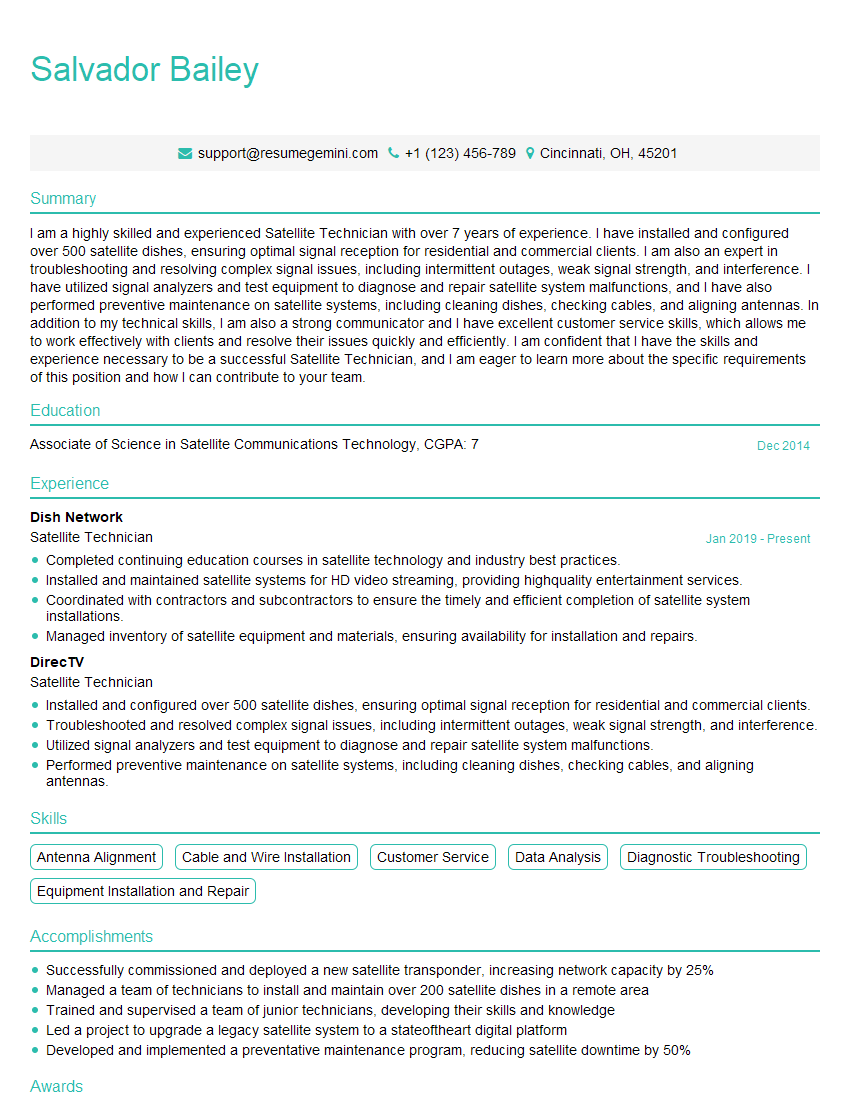
Mastering Satellite Communication opens doors to exciting and rewarding careers in a rapidly growing field. To maximize your job prospects, create a compelling and ATS-friendly resume that showcases your skills and experience effectively. ResumeGemini is a trusted resource to help you build a professional resume that stands out. We provide examples of resumes tailored to the Satellite Communication industry to guide you. Use ResumeGemini to craft a resume that highlights your unique strengths and lands you your dream job.
Explore more articles
Users Rating of Our Blogs
Share Your Experience
We value your feedback! Please rate our content and share your thoughts (optional).
What Readers Say About Our Blog
Really detailed insights and content, thank you for writing this detailed article.
IT gave me an insight and words to use and be able to think of examples