Preparation is the key to success in any interview. In this post, we’ll explore crucial Tank Sampling interview questions and equip you with strategies to craft impactful answers. Whether you’re a beginner or a pro, these tips will elevate your preparation.
Questions Asked in Tank Sampling Interview
Q 1. Describe the different types of tank sampling methods.
Tank sampling methods are chosen based on the liquid’s properties, tank geometry, and desired accuracy. We categorize them primarily as:
- Grab Sampling: This is the simplest method, involving taking a sample from a single point within the tank. It’s quick and easy but offers limited representativeness, suitable only for homogenous liquids. Imagine scooping a spoonful of soup – if the soup is perfectly mixed, it’s fine, but if it has layers, the sample is flawed.
- Composite Sampling: Multiple grab samples are collected from different locations and depths within the tank, then combined to form a single composite sample. This significantly improves representativeness compared to grab sampling, averaging out variations. It’s like blending a smoothie with fruits from various parts of the bowl for a more consistent flavor.
- Thief Sampling: A thief sampler, a device with multiple ports at varying depths, is lowered into the tank. Samples are collected simultaneously from different levels, providing a profile of the liquid’s composition across the tank’s depth. This is excellent for stratified liquids with varying densities or compositions.
- Automatic Sampling Systems: For high-throughput or continuous monitoring, automated systems are employed. These use programmable timers and robotic arms to take samples at set intervals and depths, providing continuous data on the tank’s contents. They are efficient and precise, suitable for large tanks or those with high safety requirements.
The selection of the optimal method involves careful consideration of the specific application and potential biases associated with each approach.
Q 2. Explain the importance of proper sample preservation techniques.
Proper sample preservation is crucial for ensuring the accuracy and reliability of test results. Degradation can occur from various factors such as oxidation, microbial growth, and volatile component loss. Techniques vary depending on the analyte and liquid being sampled. Key considerations include:
- Temperature Control: Many samples require refrigeration or freezing to slow down chemical reactions and microbial activity. The temperature and storage container must be selected based on the sample’s sensitivity.
- Light Protection: UV light can degrade certain compounds, so samples sensitive to light are stored in amber-colored or opaque bottles.
- Headspace Minimization: Reducing the headspace in the sample container minimizes the loss of volatile components. Filling the container almost to the top is often recommended.
- Addition of Preservatives: Chemical preservatives such as acids or biocides may be added to inhibit microbial growth or prevent chemical reactions. The chosen preservative must not interfere with subsequent analyses.
- Proper Labeling and Documentation: Meticulous labeling is crucial; it should include the date, time, location, and any preservatives added. Clear chain of custody documentation must be maintained throughout the process.
Failing to follow these steps can lead to inaccurate or misleading results, potentially impacting process control, quality assurance, and safety decisions.
Q 3. What are the safety precautions involved in tank sampling?
Tank sampling involves inherent risks that must be thoroughly managed. Key safety precautions include:
- Permit-to-Work System: A formal system should be in place to ensure all necessary safety measures are implemented before sampling commences.
- Lockout/Tagout Procedures: If the tank contains hazardous materials, ensure that all energy sources are isolated and locked out to prevent accidental releases.
- Personal Protective Equipment (PPE): Appropriate PPE must be worn, including safety glasses, gloves, respirators, and protective clothing. The specific PPE will depend on the hazardous nature of the tank contents.
- Confined Space Entry Procedures: If entry into a confined space (such as a tank) is necessary, strict adherence to confined space entry protocols is mandatory. This includes atmospheric testing, ventilation, and standby personnel.
- Emergency Response Plan: A detailed plan must be in place to handle potential spills, leaks, or injuries. This should include emergency contact information and procedures for notifying relevant authorities.
- Training: All personnel involved in tank sampling must receive thorough training on safe work practices, the handling of hazardous materials, and the use of appropriate safety equipment.
Prioritizing safety is paramount in tank sampling. A failure to adhere to safety protocols can have severe consequences.
Q 4. How do you ensure representative sampling from a tank?
Ensuring representative sampling is crucial for accurate analysis. The approach depends on the tank’s contents and geometry. For homogenous liquids, a single grab sample might suffice. However, for heterogeneous liquids (e.g., those with layers or settling solids), more sophisticated strategies are needed:
- Proper Sampling Points: For large tanks, employing a stratified random sampling approach ensures adequate coverage. This involves dividing the tank into sections and randomly selecting sampling points within each section.
- Appropriate Sampling Depth: If settling or stratification is anticipated, samples should be collected from various depths to capture the variations in composition.
- Sufficient Sample Volume: An adequate sample volume is essential to ensure sufficient material for all required analyses and to account for potential losses during sample handling. Consider replicate samples to improve confidence in the results.
- Cleaning and Preparation: Ensure that sampling equipment is thoroughly cleaned before each use to avoid cross-contamination between samples.
- Proper Mixing (where applicable): For some tanks, pre-sampling mixing (with appropriate safety precautions) may be necessary to homogenize the liquid and reduce sampling bias.
The goal is to obtain a sample that accurately reflects the overall composition of the tank contents, minimizing bias and maximizing confidence in analytical results.
Q 5. What are the common sources of error in tank sampling?
Several sources of error can affect the accuracy of tank sampling. These include:
- Improper Sampling Technique: Incorrect sampling methods, such as collecting samples from only one point in a non-homogenous tank, can lead to significant errors.
- Contamination: Contamination from the sampling equipment, the atmosphere, or other sources can alter the sample’s composition.
- Incomplete Mixing: If the liquid within the tank is not thoroughly mixed before sampling, this can introduce significant errors, especially in heterogeneous mixtures.
- Sample Degradation: Changes in temperature, light exposure, or reaction with the atmosphere can alter the composition of the sample before analysis.
- Equipment Failure: Malfunctioning sampling equipment can lead to inaccurate or incomplete samples.
- Human Error: Errors in labeling, recording, or handling samples can contribute to discrepancies.
Careful planning, attention to detail, and adherence to standardized procedures can mitigate most of these errors.
Q 6. How do you handle discrepancies in sampling results?
Discrepancies in sampling results warrant a thorough investigation to identify the root cause. The process involves:
- Review of Sampling Procedures: Check if the correct sampling method was used, and if all safety precautions and standard operating procedures were followed.
- Verification of Equipment Calibration: Ensure all equipment used for sampling and analysis was properly calibrated and functioning correctly.
- Assessment of Sample Handling and Preservation: Examine if proper preservation techniques were employed and if the chain of custody was maintained.
- Re-sampling and Analysis: Consider re-sampling the tank and performing repeat analyses to confirm the initial findings. If possible, employ an independent laboratory for verification.
- Root Cause Analysis: Identify the underlying factors that contributed to the discrepancy. This may involve examining process parameters, equipment malfunctions, or human error.
- Corrective Actions: Implement corrective actions to prevent similar discrepancies in the future. This may involve revising sampling procedures, retraining personnel, or upgrading equipment.
The goal is not just to resolve the immediate discrepancy but also to prevent similar issues from arising in the future.
Q 7. Describe your experience with various sampling equipment.
Throughout my career, I’ve gained extensive experience with diverse sampling equipment, ranging from simple grab samplers to sophisticated automated systems. This includes:
- Peristaltic Pumps: Used for transferring samples from the tank to sample containers, minimizing contamination and accurately controlling the sample volume.
- Various Thief Samplers: Experience with both fixed-port and sliding-port thief samplers for obtaining samples at various depths in tanks with stratified liquids.
- Grab Samplers (various designs): Proficient in using a wide variety of grab samplers tailored to different liquid viscosities and tank configurations.
- Automated Sampling Systems: Hands-on experience with programmable systems integrating pumps, valves, and robotic arms for high-volume or continuous sampling.
- Sample Containers: Extensive knowledge of selecting appropriate sample containers based on material compatibility, sample volume, and preservation requirements. Experience with glass, plastic, and specialized containers for specific analytes.
My expertise extends to proper cleaning, maintenance, and calibration procedures for each piece of equipment to ensure accurate and reliable sampling results.
Q 8. Explain the process of calibrating sampling equipment.
Calibrating sampling equipment is crucial for ensuring accurate and reliable results. It involves verifying that the equipment is functioning correctly and providing consistent measurements. This is typically done by comparing the equipment’s readings against a known standard.
For example, let’s consider a sampling thief (a device used to collect samples from different depths). We would calibrate it by filling it with a known volume of a liquid with known properties (e.g., distilled water) and measuring the actual volume collected. Any discrepancies would indicate the need for adjustment or replacement. Similarly, volumetric flasks or graduated cylinders used for measuring sample volumes are calibrated using a similar process. We’d compare their markings against a precise measurement device. Regular calibration, often documented in a log, ensures the accuracy of our sampling process over time. Failure to calibrate can lead to significant errors in analysis and potentially compromise the entire process, leading to incorrect interpretations and decisions.
Q 9. How do you document and track tank sampling procedures?
Documentation and tracking are paramount in tank sampling. We use a comprehensive system involving chain-of-custody forms, sample labels, and electronic databases to track every sample from collection to analysis and disposal. The chain-of-custody form documents the sample location, date, time, sampler’s signature, sample ID, and the subsequent handling of the sample. Each sample is also clearly labeled with this information, minimizing the risk of mix-ups. A detailed sampling procedure, often in the form of a Standard Operating Procedure (SOP), is followed rigorously and deviations are documented. Electronic databases allow for better data management, including tracking sample analysis results, and simplifying auditing processes. This rigorous documentation ensures data integrity, compliance, and traceability should disputes or discrepancies arise.
For example, imagine a case where a regulatory agency performs an audit. The meticulous records we maintain allow us to easily trace the entire journey of each sample, demonstrating that the sampling procedures were correctly followed and the results are reliable.
Q 10. What are the regulatory requirements for tank sampling in your industry?
Regulatory requirements for tank sampling vary depending on the industry and the nature of the materials stored. In the petroleum industry, for instance, regulations from organizations like the EPA (Environmental Protection Agency) and OSHA (Occupational Safety and Health Administration) are strictly enforced. These regulations address aspects like safety protocols, sampling techniques, sample preservation, reporting procedures, and waste disposal. Specific regulations might cover the frequency of sampling, the specific methods allowed (e.g., requirements for avoiding contamination or ensuring representative samples), and the proper handling of hazardous materials. Non-compliance can result in severe penalties, including fines and operational shutdowns.
For example, when sampling for environmental compliance, specific EPA methods must be followed to ensure data validity and regulatory acceptance. The same holds true for safety regulations; failure to follow appropriate protocols can result in worker injury or environmental contamination, leading to significant legal repercussions.
Q 11. How do you ensure the chain of custody for tank samples?
Maintaining chain of custody is vital to ensure the integrity and reliability of tank samples. This process ensures a clear and unbroken trail of possession for each sample, from collection to analysis. It involves meticulous documentation at every stage, including the sampler’s identification, the date and time of sampling, the sample location and identification number, and the signatures of each individual who handles the sample. Secure seals and tamper-evident containers are used to prevent unauthorized access or tampering. Chain of custody forms detail all these aspects, providing a comprehensive history of the sample’s movement. This helps to prevent disputes about sample authenticity or integrity, which is especially important in legal or regulatory contexts.
For instance, if a sample is needed for litigation, a robust chain of custody is critical. This documentation assures the court that the sample is authentic and hasn’t been compromised. Without it, the credibility of the analysis and potentially the entire case could be jeopardized.
Q 12. Describe your experience with different types of tanks (e.g., vertical, horizontal).
My experience encompasses various tank types, including vertical and horizontal tanks. Sampling from vertical tanks often involves using specialized equipment like sampling thieves or peristaltic pumps to access different layers of liquid. The sampling strategy needs to account for potential stratification (where the properties of the liquid vary with depth). Horizontal tanks, while presenting a different geometrical challenge, usually require careful consideration of the liquid’s level and the presence of any settling or sludge. In both cases, the selection of sampling points must be done strategically to obtain a representative sample.
For example, I’ve worked extensively on large storage tanks used in the oil and gas industry. Depending on the tank’s size and the product stored, I’ve adjusted my sampling techniques to accommodate the specific physical and chemical characteristics of the material. My experience also includes sampling smaller tanks found in chemical manufacturing settings. Understanding the differences in size and design helps ensure the proper equipment and techniques are used to obtain accurate and safe samples.
Q 13. How do you deal with sampling from tanks containing hazardous materials?
Sampling tanks containing hazardous materials requires stringent safety protocols and specialized equipment. This necessitates adherence to strict safety regulations like OSHA and relevant industry standards. Appropriate personal protective equipment (PPE), including respirators, gloves, safety glasses, and protective clothing, is mandatory. The sampling equipment should be intrinsically safe and designed to minimize the risk of spills or leaks. Depending on the nature of the hazardous material, additional precautions might involve using closed systems, inert gas purging, and specialized handling techniques. Proper ventilation and emergency response plans are crucial. Thorough risk assessment prior to sampling is paramount to prevent accidents and environmental damage.
For example, when sampling highly flammable liquids, we would utilize explosion-proof sampling equipment and work in well-ventilated areas to avoid the risk of ignition. Sampling toxic materials would require additional safety precautions, potentially using enclosed sampling systems to minimize exposure.
Q 14. What are the challenges of sampling viscous liquids?
Sampling viscous liquids presents unique challenges. These liquids are highly resistant to flow and often require specialized equipment and techniques to obtain representative samples. Standard sampling devices might not be effective due to the high viscosity, leading to incomplete filling or clogging. Heating the liquid (if safe and appropriate) can help to reduce its viscosity, making sampling easier. Alternatively, using specialized equipment designed for high-viscosity liquids, such as heated sampling tubes or pumps with appropriate flow rates, can solve this problem. Thorough cleaning and flushing of sampling equipment between samples is critical to prevent cross-contamination. The sampling strategy must also take into account potential non-homogeneity within the sample.
For example, when sampling heavy crude oil or high-viscosity polymers, using a heated sampling thief or a specialized pump with sufficient power is vital to achieve accurate sample collection. Using the incorrect equipment can lead to inaccurate results or even damage the sampling equipment.
Q 15. How do you handle sampling from pressurized tanks?
Sampling pressurized tanks requires specialized equipment and procedures to ensure safety and sample integrity. The primary concern is preventing pressure release and potential hazards. We typically use a pressure-compensated sampling device, which equalizes the tank pressure before drawing the sample. This might involve a specialized valve or a sampling probe designed to manage the pressure difference.
For example, imagine a large propane tank. Directly puncturing it would be extremely dangerous. Instead, we’d use a device that allows us to connect to the tank, carefully equalize the internal pressure with the atmospheric pressure, and then extract a sample. After sampling, we’d immediately seal the sample container to maintain sample integrity and prevent contamination. Safety protocols, including proper personal protective equipment (PPE), are paramount throughout the process.
Career Expert Tips:
- Ace those interviews! Prepare effectively by reviewing the Top 50 Most Common Interview Questions on ResumeGemini.
- Navigate your job search with confidence! Explore a wide range of Career Tips on ResumeGemini. Learn about common challenges and recommendations to overcome them.
- Craft the perfect resume! Master the Art of Resume Writing with ResumeGemini’s guide. Showcase your unique qualifications and achievements effectively.
- Don’t miss out on holiday savings! Build your dream resume with ResumeGemini’s ATS optimized templates.
Q 16. Explain your understanding of different sampling points within a tank.
Different sampling points within a tank represent varying compositions and reflect different aspects of the tank’s contents. There are several key areas:
- Top: Samples from the top capture the lighter components that may have accumulated due to density differences or stratification.
- Middle: This is a representative sample and is often preferred for homogeneous materials. It gives an average picture of the contents.
- Bottom: Samples from the bottom capture heavier components, sediments, or any material that may have settled.
- Interface: In tanks containing multiple liquids, sampling from the interface between layers is crucial for determining the composition of each layer.
The choice of sampling point depends entirely on the nature of the material and the specific analytical goals. If we were analyzing a crude oil tank, for example, we’d likely sample from the top, middle, and bottom to assess the stratification of lighter and heavier hydrocarbons. In contrast, if the tank contained a well-mixed chemical solution, a single middle sample might suffice.
Q 17. How do you determine the appropriate sample volume?
Determining the appropriate sample volume depends on several factors, including the required analytical tests, the heterogeneity of the material, and the desired level of confidence in the results. There are established standards and guidelines for this which we carefully adhere to. Generally, a larger sample volume is better if there’s considerable heterogeneity, offering more representative results. It also allows for multiple tests to be performed on the same sample.
Let’s say we need to analyze a specific component in a chemical solution, and the expected concentration is low. In such a case, we’d require a larger sample volume to ensure that we have sufficient material to perform the analysis with acceptable accuracy. We consider the detection limits of the analytical methods when determining the minimum volume required.
Conversely, for a homogenous liquid where a high level of accuracy is not essential, a smaller sample volume might suffice, reducing sampling costs and waste.
Q 18. Describe your experience with automated tank sampling systems.
I have extensive experience with automated tank sampling systems, both in installation and operation. These systems offer several advantages over manual sampling, including improved safety, reduced risk of human error, and increased efficiency. They’re particularly useful for hazardous materials or when frequent sampling is required.
I’ve worked with systems ranging from simple programmable logic controllers (PLCs) controlling basic sampling valves to sophisticated systems incorporating robotics, advanced sensors, and data acquisition capabilities. These advanced systems allow for remote monitoring, real-time data analysis, and integration with other process control systems. For example, I was involved in a project where an automated system sampled several tanks across a refinery, analyzed the samples using inline spectrometers, and then automatically adjusted the process parameters based on the results, optimizing the whole process.
Q 19. What is your experience with quality control measures for tank samples?
Quality control in tank sampling is paramount. It ensures the accuracy and reliability of the results. We implement rigorous measures at every step:
- Equipment Calibration and Maintenance: Regular calibration and maintenance of all sampling equipment, including probes, valves, and sample containers, are critical.
- Chain of Custody: A detailed chain of custody document tracks the sample from collection to analysis to ensure its integrity.
- Sample Preservation: Appropriate preservation techniques (e.g., refrigeration, addition of preservatives) are employed to maintain the stability of the sample during transport and storage.
- Blank Samples: Blank samples are analyzed alongside the actual samples to detect any potential contamination.
- Duplicate Samples: Duplicate samples are collected and analyzed to assess the precision of the sampling and analytical methods.
These steps help to minimize errors and ensure that the results accurately reflect the tank’s contents. In one project, meticulous chain-of-custody documentation helped us identify a contamination issue during transport, preventing flawed conclusions based on faulty samples.
Q 20. How do you interpret tank sampling data?
Interpreting tank sampling data involves careful consideration of the sampling method, the analytical results, and the context of the application. We start by comparing results from different sampling points within a tank to assess homogeneity. If significant variations are observed, it may indicate stratification or mixing issues.
Next, we examine the analytical data and compare them with relevant standards or specifications. This involves evaluating the concentrations of different components, looking for anomalies, or deviations from expected values. If a discrepancy is detected, we determine whether it is due to inherent variability within the tank contents or potential errors in the sampling or analysis process.
For example, a deviation from expected values in a fuel tank may suggest contamination or a blend issue. Context is key. We’d always correlate the data with any operational changes or environmental factors before arriving at a conclusion. A thorough understanding of the process and material properties are crucial for meaningful interpretation.
Q 21. Explain the process of reporting tank sampling results.
Reporting tank sampling results should be clear, concise, and easily understandable by the intended audience. The report typically includes:
- Sample Identification: Unique identification number, date, and time of sampling, and tank number
- Sampling Location: Precise location within the tank (top, middle, bottom, interface)
- Sampling Method: Detailed description of the equipment and procedure used
- Analytical Results: Tabulated data with units and methods of analysis
- Quality Control Data: Information on blanks and duplicate samples
- Interpretation and Conclusions: Summary of findings and conclusions based on the data
- Recommendations: Suggested actions or further investigation based on the results
The report should follow a standard format and be reviewed for accuracy and completeness before distribution. Clear communication of the results is crucial; we might utilize charts and graphs for visualization to facilitate understanding of the complex data.
Q 22. How do you troubleshoot problems during tank sampling?
Troubleshooting tank sampling problems involves a systematic approach. First, I’d identify the specific problem – is it a lack of representative sample, contamination, inaccurate measurements, or equipment malfunction? Then, I’d trace the process back step-by-step. For example, if the sample is contaminated, I’d check the cleanliness of the equipment, the sampling procedure, and the storage conditions of the sample. If the sample isn’t representative, I’d review the sampling location and method. Was the sample taken from the correct location within the tank, considering stratification? Was the appropriate sampling technique employed for the tank’s contents? Equipment malfunction requires a thorough inspection of the sampler, pump, or any other equipment used. A logbook, detailing every step of the sampling process, is crucial for effective troubleshooting. Finally, if the problem persists, I’d consult relevant standards and best practices, perhaps contacting a sampling expert for guidance.
Q 23. Describe a time you had to deal with a difficult sampling situation.
During a project involving a large, highly viscous crude oil storage tank, we faced a challenge. The tank’s contents had significant stratification, meaning the oil properties varied considerably from top to bottom. Traditional grab sampling methods wouldn’t provide a representative sample. To overcome this, we implemented a stratified sampling approach, using a weighted-composite method. We divided the tank into zones based on depth and took multiple samples from each zone. The volume of each sample was proportional to the volume of each zone in the tank. These individual samples were then combined proportionally to create a composite sample that accurately represented the entire tank’s contents. This approach required careful planning, meticulous execution, and additional time but guaranteed the accuracy of our results.
Q 24. What are the key differences between grab sampling and composite sampling?
Grab sampling and composite sampling are two different techniques for collecting samples from a tank. Grab sampling involves taking a single sample from a specific point in the tank. It’s quick and simple but only represents the specific point sampled. It’s useful when the tank’s contents are well-mixed and homogeneous. Composite sampling, on the other hand, involves collecting multiple grab samples from various locations within the tank and combining them to form a single composite sample. This gives a more representative sample, especially in cases where the tank contents are stratified or heterogeneous. Think of it like this: grab sampling is like taking a single bite of a cake to assess its taste, while composite sampling is like taking multiple bites from different parts of the cake to get a better idea of the overall flavor.
Q 25. How do you ensure the accuracy and reliability of your sampling results?
Ensuring accuracy and reliability in tank sampling involves meticulous attention to detail across the entire process. This starts with using properly calibrated equipment and following established standard operating procedures (SOPs). Prior to sampling, the equipment is thoroughly cleaned and inspected. Samples are collected using appropriate techniques, minimizing contamination and ensuring proper representation of the tank contents. Chain-of-custody procedures are strictly followed, maintaining sample integrity from collection to testing. Proper sample preservation and handling techniques are critical. For example, volatile organic compounds might require special headspace vials to prevent loss. Finally, using validated testing methods and comparing results with previous data assists in ensuring overall reliability. Regular audits of the sampling process and personnel training are crucial for maintaining quality.
Q 26. Describe your experience with different types of sample containers.
My experience encompasses a wide range of sample containers, each suited for specific applications. For instance, glass bottles are commonly used for many liquid samples due to their inertness, but they’re fragile. Polyethylene (PE) containers are durable and cost-effective, suitable for many applications but not all. Some chemicals might react with PE. For volatile organic compounds (VOCs), I’d use specialized headspace vials with minimal headspace to reduce sample loss. Stainless steel containers are preferred when high-temperature samples are involved. The choice of container always depends on the nature of the sample and the intended analysis. Proper labeling, including sample ID, date, time, and location, is critically important for maintaining chain of custody and preventing sample mix-ups.
Q 27. What are your strengths and weaknesses related to tank sampling?
My strengths include a deep understanding of sampling techniques, a meticulous approach to detail, and a knack for troubleshooting problems. I’m proficient in handling diverse sampling scenarios and equipment. I also pride myself on my commitment to safety protocols. My weakness is perhaps my perfectionism. Sometimes the desire for complete accuracy can lead to taking longer than initially anticipated. However, I’m actively working on improving my time management skills to balance thoroughness with efficiency. I use detailed checklists and time allocation strategies to manage this effectively.
Q 28. What are your salary expectations for this role?
My salary expectations are in the range of [Insert Salary Range], commensurate with my experience and the responsibilities of this role. I’m open to discussing this further based on the specific details of the position and the company’s compensation structure.
Key Topics to Learn for Tank Sampling Interview
- Safety Procedures and Regulations: Understanding and adhering to all relevant safety protocols, including PPE requirements, hazard identification, and emergency procedures. Practical application includes describing your experience with specific safety measures in previous roles.
- Sampling Techniques: Mastering various sampling methods (e.g., thief sampling, dip sampling, composite sampling) and their appropriate applications based on tank contents and required accuracy. This includes understanding the limitations of each method and potential sources of error.
- Sample Preservation and Handling: Proper techniques for preserving sample integrity, including appropriate containers, labeling, and storage conditions, to ensure accurate analysis. Practical application involves describing your experience with different preservation methods and their impact on sample quality.
- Quality Control and Quality Assurance (QC/QA): Implementing QC/QA procedures to maintain sample accuracy and reliability. This involves understanding chain of custody, documentation practices, and identifying potential sources of contamination or error.
- Data Analysis and Interpretation: Analyzing sample data and interpreting results to draw meaningful conclusions. This includes understanding the limitations of the data and potential sources of bias.
- Equipment Operation and Maintenance: Familiarity with different sampling equipment, including their operation, maintenance, and troubleshooting. Practical application includes describing your experience with specific equipment and any maintenance or repair procedures you’ve performed.
- Record Keeping and Documentation: Maintaining accurate and complete records of sampling procedures, results, and any observations made during the sampling process. This includes understanding regulatory requirements for documentation.
Next Steps
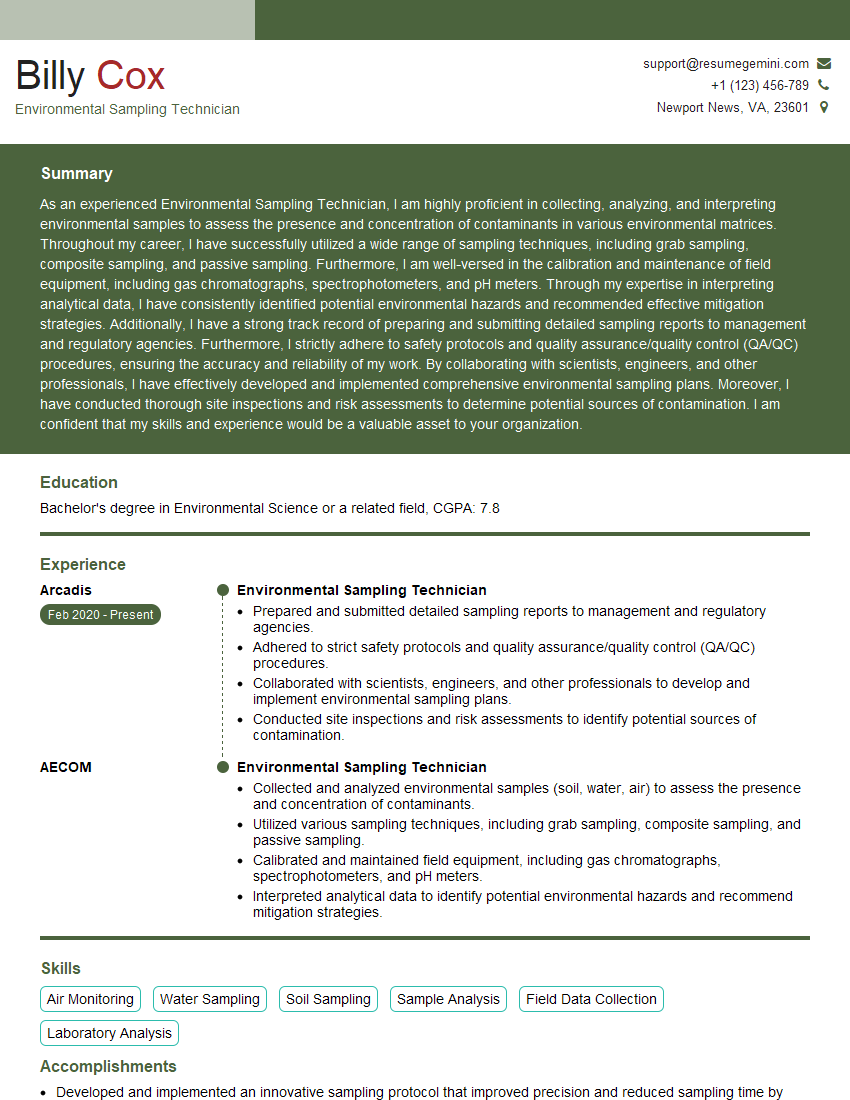
Mastering tank sampling techniques is crucial for career advancement in many industries, offering opportunities for specialization and increased responsibility. A strong understanding of this field demonstrates your commitment to safety, accuracy, and attention to detail – highly valued qualities in any technical role. To significantly improve your job prospects, creating an ATS-friendly resume is essential. ResumeGemini is a trusted resource that can help you build a professional and impactful resume, ensuring your skills and experience are effectively communicated to potential employers. Examples of resumes tailored to Tank Sampling are available to guide you.
Explore more articles
Users Rating of Our Blogs
Share Your Experience
We value your feedback! Please rate our content and share your thoughts (optional).
What Readers Say About Our Blog
Really detailed insights and content, thank you for writing this detailed article.
IT gave me an insight and words to use and be able to think of examples