Preparation is the key to success in any interview. In this post, we’ll explore crucial Warehouse Management Certificate interview questions and equip you with strategies to craft impactful answers. Whether you’re a beginner or a pro, these tips will elevate your preparation.
Questions Asked in Warehouse Management Certificate Interview
Q 1. Explain the importance of inventory management in warehouse operations.
Effective inventory management is the backbone of successful warehouse operations. It’s about having the right product, in the right quantity, at the right time, and in the right place. Without it, you face a cascade of problems: lost sales due to stockouts, increased storage costs from excess inventory, and potential damage or obsolescence of goods. Think of it like a well-oiled machine; precise inventory control keeps everything running smoothly.
Imagine a retail warehouse selling seasonal clothing. Accurate inventory tracking ensures they have enough winter coats in stock during the cold months and avoid being stuck with a surplus of summer dresses afterwards. This translates directly to profit maximization and minimized waste.
Q 2. Describe different inventory control methods (FIFO, LIFO, etc.) and their applications.
Several inventory control methods help manage stock levels and costs. The most common are:
- FIFO (First-In, First-Out): Items are sold or used in the order they were received. This is ideal for perishable goods (food, pharmaceuticals) to minimize spoilage. Imagine a bakery using FIFO for its bread; the oldest loaves are sold first to ensure freshness.
- LIFO (Last-In, First-Out): The newest items are sold or used first. This can be beneficial for non-perishable goods where the value might fluctuate (e.g., commodities). However, it can complicate accounting during periods of inflation.
- FEFO (First-Expired, First-Out): This prioritizes items with the shortest shelf life, crucial for perishable goods with clear expiry dates.
- Weighted Average Cost Method: This calculates the average cost of goods over a period, simplifying accounting but potentially obscuring individual item costs.
The choice depends on the nature of the inventory. A grocery store might use FEFO for produce and FIFO for packaged goods, while a lumberyard might use LIFO for its consistently priced wood products.
Q 3. How do you optimize warehouse layout for efficient order fulfillment?
Optimizing warehouse layout is crucial for efficient order fulfillment. It involves strategic placement of goods to minimize travel time for picking, packing, and shipping. The goal is to streamline the workflow, reducing labor costs and improving order accuracy.
Key considerations include:
- Fast-moving items placement: Frequently picked items should be placed in easily accessible locations (near the shipping docks and picking stations). Think of a pharmacy placing frequently prescribed drugs at the front.
- Slow-moving items placement: Less frequently picked items can be placed further from picking stations to make room for faster-moving stock.
- Seasonal items placement: Seasonal goods can be stored in less prime locations until their season arrives.
- Aisle and rack design: Wide aisles facilitate movement of forklifts and personnel, while well-designed racking systems maximize vertical space.
- Cross-docking area: A designated area for quickly transferring goods from incoming to outgoing shipments without storage, thus minimizing handling.
Employing techniques such as slotting optimization, which uses data analysis to assign specific locations to items based on frequency of picking and other factors, can significantly enhance efficiency.
Q 4. What are the key performance indicators (KPIs) you track in a warehouse?
Key Performance Indicators (KPIs) are vital for monitoring warehouse performance and identifying areas for improvement. I regularly track:
- Order fulfillment rate: The percentage of orders fulfilled on time and completely.
- Inventory accuracy: The difference between the recorded inventory and physical inventory.
- Order cycle time: The time taken to process an order from receipt to shipment.
- Storage utilization rate: The percentage of available warehouse space being used.
- Picking accuracy: Percentage of orders picked without errors.
- Receiving efficiency: The speed and accuracy of incoming goods processing.
- Labor productivity: Units handled or orders processed per labor hour.
- Damage rate: Percentage of damaged goods received or stored.
Analyzing these KPIs allows for data-driven decisions to optimize processes and improve warehouse efficiency. For example, a consistently low picking accuracy might highlight the need for better training or improved technology.
Q 5. Explain your experience with Warehouse Management Systems (WMS).
I have extensive experience with Warehouse Management Systems (WMS). In my previous role, I implemented and managed a WMS that integrated with our ERP system, significantly improving order accuracy and efficiency. The system streamlined our receiving, putaway, picking, packing, and shipping processes. Specifically, I’ve worked with [mention specific WMS software, e.g., Manhattan Associates, Blue Yonder].
My responsibilities included configuring the system, training staff, troubleshooting issues, and generating reports to analyze warehouse performance. The WMS provided real-time visibility into inventory levels, order status, and employee productivity, allowing for proactive management and problem-solving. For example, the system’s automated putaway instructions reduced picking errors by 15% within the first quarter of implementation.
Q 6. How do you handle discrepancies in inventory counts?
Inventory discrepancies are inevitable, but a robust process is crucial to address them swiftly and accurately. My approach involves a systematic investigation:
- Identify the discrepancy: Compare the physical count to the system count. Note the magnitude and nature of the difference (shortages or surpluses).
- Investigate potential causes: Check for common issues such as data entry errors, damaged goods, theft, or errors in receiving or putaway.
- Conduct a physical recount: Verify the initial count to ensure accuracy.
- Review security footage: If theft is suspected, review security camera footage.
- Adjust inventory records: Correct the discrepancies in the WMS based on findings. Document the reasons for adjustments.
- Implement preventative measures: Address root causes identified to minimize future discrepancies. This might involve improving data entry procedures, strengthening security, or enhancing training for staff.
It’s crucial to document each step thoroughly to maintain audit trail and improve future accuracy.
Q 7. Describe your experience with receiving and putaway procedures.
My experience with receiving and putaway procedures involves a methodical approach to ensure accuracy and efficiency. Upon receiving goods, I oversee the verification process against purchase orders, checking quantities and quality. Any discrepancies are immediately documented and reported.
Putaway procedures follow a standardized system often guided by the WMS. This involves assigning locations based on factors like item velocity and space optimization. We use bar code or RFID scanning to accurately track items and their locations, minimizing errors and reducing search time. The use of directed putaway functionality within the WMS further improves efficiency by guiding the workers to the optimal storage location.
Regular audits of the receiving and putaway processes ensure compliance and help detect potential problem areas. For instance, we might monitor the time taken for each process to identify bottlenecks and make process improvements.
Q 8. How do you ensure the accuracy of picking and packing processes?
Ensuring accuracy in picking and packing is paramount for customer satisfaction and operational efficiency. It involves a multi-pronged approach combining technology, process, and personnel training.
Technology: We leverage Warehouse Management Systems (WMS) with barcode or RFID scanning. This eliminates manual data entry errors and provides real-time tracking of items throughout the process. For instance, a WMS can verify the picked item against the order before it’s moved to packing. It can also generate pick lists optimized for efficient order fulfillment.
Process: We implement strict procedures, including double-checking picked items against order details, and using quality control checkpoints at various stages of the process. Visual confirmations and weight checks are common practices. We also utilize bin labeling systems for clear location identification.
Personnel Training: Thorough training is essential. Employees are taught proper scanning techniques, order verification methods, and handling procedures. Regular refresher training and performance reviews ensure consistent accuracy. We also implement error tracking and analysis to identify recurring issues and implement corrective actions.
For example, in a previous role, we implemented a system of ‘pick-and-verify’ where a second team member independently verifies the picked items before packing. This reduced picking errors by 15% in the first quarter.
Q 9. What safety procedures do you implement in a warehouse environment?
Warehouse safety is non-negotiable. Our procedures encompass preventative measures, emergency response plans, and ongoing training.
Preventative Measures: This includes regular safety inspections, ensuring proper aisle widths and lighting, implementing a robust forklift safety program (including regular maintenance, operator training, and designated traffic routes), and proper storage of hazardous materials. We also emphasize the importance of proper lifting techniques and the use of safety equipment such as gloves, safety shoes, and high-visibility vests.
Emergency Response: We have clearly defined emergency procedures including evacuation plans, fire safety protocols, and first-aid response teams. Regular drills keep everyone prepared. We maintain well-stocked first-aid kits and have emergency contacts readily available.
Ongoing Training: Employees receive comprehensive safety training upon hiring and ongoing refresher courses. This includes forklift operation, hazard identification, emergency procedures, and the proper use of safety equipment. We also encourage a culture of reporting near misses and safety concerns without fear of reprisal.
For instance, we’ve successfully implemented a color-coded safety system, where different colored zones indicate different hazard levels. This helped significantly improve awareness and reduce accidents.
Q 10. How do you manage warehouse staff and motivate them to achieve targets?
Managing and motivating warehouse staff effectively is crucial for achieving targets. It’s about fostering a positive and productive work environment.
Clear Communication and Expectations: We start with clear, concise, and achievable targets, ensuring everyone understands their role and contribution. Regular team meetings provide updates, feedback, and opportunities for open dialogue.
Performance Recognition and Incentives: We implement a system of rewarding good performance, whether it’s through bonuses, recognition programs, or employee-of-the-month awards. This boosts morale and encourages continued high performance.
Training and Development: Continuous training helps employees upskill and enhance their efficiency and job satisfaction. This can include cross-training to provide flexibility and cover absences, and providing opportunities for career advancement within the company.
Fair and Consistent Management: A fair and respectful management style is crucial. We ensure consistent application of policies and procedures, providing constructive feedback and addressing concerns promptly.
In one instance, we implemented a team-based bonus system, tying bonuses to overall warehouse performance. This significantly increased collaboration and productivity.
Q 11. Describe your experience with shipping and delivery processes.
My experience with shipping and delivery processes is extensive. It goes beyond simply handing over packages. It encompasses order management, carrier selection, documentation, and tracking.
Order Management: I’m proficient in managing orders from various sources, consolidating shipments when possible to reduce costs, and prioritizing orders based on urgency or delivery deadlines.
Carrier Selection: We utilize various carriers based on factors like cost, speed, reliability, and destination. I have experience negotiating rates with carriers and ensuring compliance with their requirements.
Documentation: Accurate documentation is key. This includes generating shipping labels, preparing bills of lading, and handling customs documentation for international shipments.
Tracking and Monitoring: I’m experienced in utilizing tracking systems to monitor shipments, resolving any delays or issues, and providing timely updates to customers.
In my previous role, we implemented a new shipping management system that automated much of the process, resulting in a 10% reduction in shipping costs and a 5% improvement in on-time delivery rates.
Q 12. How do you handle returns and damaged goods?
Handling returns and damaged goods requires a systematic approach to minimize losses and maintain customer satisfaction.
Returns Process: We have a clearly defined returns procedure, including authorization processes, inspection procedures, and appropriate handling based on the reason for return (e.g., damaged, defective, wrong item).
Damaged Goods Handling: Upon receiving damaged goods, we conduct a thorough inspection to determine the extent of the damage and its cause. We carefully document the damage, including photographs, and follow established procedures for disposal or repair, depending on the nature of the damage and cost-effectiveness.
Inventory Management: We update inventory records to reflect returned or damaged goods. This ensures accurate inventory counts and avoids stock discrepancies.
Root Cause Analysis: For recurring damage or return issues, we conduct root cause analysis to identify potential problems in the supply chain, picking and packing processes, or product handling, and implement corrective actions.
For example, through analysis of return data, we identified a packaging issue that resulted in a high rate of damage for a specific product. We changed the packaging material and reduced damage claims by 20%.
Q 13. Explain your understanding of different types of warehouse storage systems.
Different warehouse storage systems are chosen based on factors like product type, volume, frequency of access, and space constraints.
Racking Systems: These are common and offer various options, from selective racking (easy access to individual pallets) to drive-in/drive-through racking (high-density storage, but limited access), and push-back racking (efficient use of space, but FIFO is challenging).
Shelving Systems: Ideal for smaller, lighter items, these offer easy access and flexibility but are less space-efficient than racking for bulk items.
Bulk Storage: This involves storing items loose or in large quantities, usually for low-turnover items. It is often less organized but highly space-efficient.
Automated Storage and Retrieval Systems (AS/RS): These high-tech systems are used in large warehouses with high throughput. They automate the storage and retrieval of items, significantly improving efficiency but represent a significant capital investment.
The selection of the right storage system directly impacts operational efficiency, storage capacity, and labor costs. For example, implementing drive-in racking in a high-volume warehouse allowed us to increase storage capacity by 30% while maintaining efficient order fulfillment.
Q 14. How do you manage space optimization in a warehouse?
Space optimization in a warehouse is about maximizing the usable space to minimize costs and improve efficiency. This is achieved through a combination of strategies.
Efficient Storage Systems: Selecting the right storage system for the specific goods and throughput is crucial. High-density storage solutions like drive-in/drive-through racking or AS/RS are better for high-volume items, while shelving is more suitable for smaller, lighter goods.
Inventory Management: Effective inventory management prevents overstocking and reduces wasted space. This includes regular stock rotations (FIFO, LIFO), identifying slow-moving items and considering alternative storage locations, or even disposal.
Improved Layout and Flow: A well-planned warehouse layout is essential for efficient material flow. Optimizing aisle widths, positioning high-demand items closer to shipping areas, and streamlining the movement of goods through the warehouse are vital.
Vertical Space Utilization: Using vertical space efficiently with high-reach racking or mezzanine floors maximizes storage capacity.
Regular Audits: Periodic space audits help identify areas for improvement, obsolete inventory, and unused space. These insights can inform better space allocation and optimize the warehouse layout.
For instance, by rearranging the warehouse layout and implementing a new inventory management system in a previous role, we freed up 15% of the total warehouse floor space, which was then used to accommodate new product lines.
Q 15. How do you utilize technology to improve warehouse efficiency?
Technology is absolutely crucial for boosting warehouse efficiency. Think of it like this: a well-oiled machine versus a chaotic jumble. The right tech transforms the latter into the former. I leverage several technologies, including:
Warehouse Management Systems (WMS): These are the central nervous systems of modern warehouses. A WMS like SAP EWM or Oracle WMS automates tasks like order fulfillment, inventory tracking, and labor management. For example, a WMS can optimize picking routes, minimizing travel time and maximizing picker productivity. Imagine a WMS directing a picker through the most efficient path to collect items for an order, instead of them wandering aimlessly.
Transportation Management Systems (TMS): These integrate with the WMS to optimize shipping and receiving processes, scheduling shipments and tracking them in real-time. This ensures timely delivery and reduces transportation costs. An effective TMS can help you choose the most cost-effective carrier and monitor your shipments’ progress, reducing delays and improving customer satisfaction.
Automated Guided Vehicles (AGVs) and robots: These automate material handling, moving goods efficiently and safely throughout the warehouse. This frees up human workers to focus on more complex tasks. In one project, I implemented AGVs to transport pallets between storage areas and shipping docks, resulting in a 20% reduction in handling time.
Data analytics and business intelligence (BI) tools: These provide insights into warehouse operations, identifying bottlenecks and areas for improvement. For example, analyzing data on order fulfillment times helped identify a problem with inefficient picking processes, which we then addressed through process optimization and training.
Career Expert Tips:
- Ace those interviews! Prepare effectively by reviewing the Top 50 Most Common Interview Questions on ResumeGemini.
- Navigate your job search with confidence! Explore a wide range of Career Tips on ResumeGemini. Learn about common challenges and recommendations to overcome them.
- Craft the perfect resume! Master the Art of Resume Writing with ResumeGemini’s guide. Showcase your unique qualifications and achievements effectively.
- Don’t miss out on holiday savings! Build your dream resume with ResumeGemini’s ATS optimized templates.
Q 16. Describe your experience with barcode scanning and RFID technology.
Barcode scanning and RFID (Radio-Frequency Identification) are fundamental technologies for accurate and efficient inventory management. Barcode scanning is a mature technology that’s relatively inexpensive and easy to implement. It allows for quick identification of individual items. I’ve extensively used barcode scanners to track inventory movements, verify order accuracy, and manage receiving processes. For instance, during a large-scale inventory count, barcode scanners enabled us to accurately track and account for over 100,000 items in a fraction of the time it would have taken manually.
RFID, on the other hand, offers a more sophisticated approach. RFID tags can be read without line-of-sight, allowing for faster and more accurate tracking of multiple items simultaneously. I have experience implementing RFID in a warehouse environment to track high-value or sensitive items. This allowed for real-time visibility of inventory location and movement, greatly improving inventory accuracy and reducing theft or misplacement. The difference is like searching for a specific book in a library; barcodes are like checking the spine individually, while RFID is like having a digital inventory that instantly pinpoints the book’s location.
Q 17. How do you track and manage warehouse costs?
Managing warehouse costs effectively requires a multi-pronged approach. Think of it like managing your personal budget – you need to track expenses, identify areas for savings, and make informed decisions. I typically employ these strategies:
Detailed cost accounting: This involves tracking all warehouse expenses, including labor, utilities, rent, equipment maintenance, and inventory holding costs. I use spreadsheets and dedicated warehouse management software to track these costs meticulously.
Regular cost analysis: I regularly analyze cost data to identify trends, variances, and areas for potential savings. For example, by analyzing energy consumption data, we identified opportunities to reduce energy usage through better lighting and climate control.
Benchmarking: I compare our costs to industry benchmarks to identify areas where we can improve efficiency and reduce expenses. Benchmarking helped us identify that our labor costs were higher than average, leading us to implement lean principles to optimize our processes.
Process optimization: Continuous improvement efforts focus on streamlining warehouse operations to reduce waste and enhance efficiency, which ultimately lowers costs. For example, by optimizing our picking routes, we reduced labor costs by 15%.
Q 18. How do you handle peak season demands in a warehouse?
Peak season demands require careful planning and execution. It’s like preparing for a marathon, not a sprint. My approach includes:
Demand forecasting: Accurate demand forecasting is critical. We use historical data, market trends, and sales projections to anticipate demand accurately. This allows us to adjust staffing levels and inventory accordingly.
Capacity planning: We assess our current warehouse capacity and identify potential bottlenecks. This might involve renting additional space, hiring temporary staff, or optimizing existing processes.
Inventory management: We ensure adequate inventory levels to meet peak demand without overstocking. Strategic inventory management minimizes storage costs and prevents stockouts.
Staffing and training: We adequately staff the warehouse to handle the increased workload. Temporary staff are often hired and existing staff receive additional training to handle peak season processes efficiently.
Contingency planning: We develop contingency plans to address unforeseen circumstances, such as equipment breakdowns or unexpected surges in demand.
Q 19. What are your strategies for improving warehouse productivity?
Improving warehouse productivity is an ongoing process. I focus on several key strategies:
Lean principles: Implementing lean methodologies helps eliminate waste in all forms – waste of time, motion, materials, and space. This often involves process mapping, value stream mapping, and 5S methodologies.
Automation: Automating repetitive tasks, such as picking, packing, and sorting, frees up human workers to focus on more value-added activities.
Cross-training: Cross-training employees enables them to perform multiple tasks, increasing flexibility and reducing downtime.
Employee empowerment: Empowering employees to identify and solve problems boosts morale and improves productivity. I encourage a culture of continuous improvement and feedback.
Technology optimization: Ensuring that technology is used effectively and efficiently. Regular software updates, training, and process optimization are key.
Q 20. How do you ensure compliance with relevant health and safety regulations?
Health and safety are paramount. Compliance is not just a legal requirement; it’s a moral obligation. My approach includes:
Regular safety inspections: Conducting routine inspections to identify and rectify potential hazards.
Employee training: Providing comprehensive safety training to all warehouse staff, covering topics such as forklift operation, safe lifting techniques, and hazard awareness.
Emergency preparedness: Developing and regularly testing emergency procedures to ensure that staff know what to do in the event of a fire, accident, or other emergency.
Personal Protective Equipment (PPE): Ensuring that appropriate PPE, such as safety glasses, gloves, and steel-toe boots, is provided and used correctly.
Compliance documentation: Maintaining detailed records of safety training, inspections, and incidents.
Staying updated: Keeping abreast of changes in health and safety regulations and adapting our practices accordingly.
Q 21. Explain your experience with warehouse layout planning and design.
Warehouse layout and design significantly impact efficiency and productivity. It’s about creating a well-organized and functional space. My experience includes:
Understanding material flow: Analyzing the flow of goods through the warehouse to optimize storage locations, picking routes, and receiving/shipping processes. A poor layout can lead to significant time and resource waste. For instance, I redesigned a warehouse layout that reduced travel time for pickers by 30%.
Storage optimization: Choosing the right storage methods (e.g., racking, shelving, bulk storage) to maximize space utilization and access to goods. Selecting the appropriate racking for different item types and frequencies of access is key.
Safety considerations: Incorporating safety features into the design, such as adequate aisle width, clear signage, and emergency exits.
Scalability: Designing a warehouse layout that can accommodate future growth and changes in demand. The design should allow for easy expansion if necessary.
Using software: Leveraging warehouse design software to create 3D models and simulate different layouts to optimize space usage and workflow before implementation.
Q 22. How do you handle unexpected events or disruptions in warehouse operations?
Unexpected events in warehouse operations, like equipment malfunctions, staff shortages, or sudden surges in demand, require a structured response. My approach centers around proactive risk assessment and a robust contingency plan.
- Proactive Risk Assessment: Regularly identifying potential disruptions – be it seasonal demand peaks, known supplier unreliability, or even weather-related issues – allows for preemptive measures. For instance, we might pre-position stock during predictable peak seasons or establish relationships with backup suppliers.
- Contingency Planning: This involves outlining clear, step-by-step procedures for handling specific disruptions. This could include protocols for equipment repair, temporary staffing solutions, or alternative shipping arrangements. Regular drills ensure team familiarity and competency with these plans.
- Communication and Collaboration: Open, transparent communication is paramount. During a disruption, I ensure all relevant team members are informed in real-time. This might involve daily briefings or using a dedicated communication platform. Collaboration across departments – operations, sales, and customer service – is essential to minimize disruption to clients.
- Post-Incident Review: After each disruption, a thorough review is conducted to identify areas for improvement in our risk assessment, contingency planning, or overall response. This iterative process ensures our resilience grows stronger over time.
For example, during a recent power outage, our pre-planned generator system seamlessly switched on, minimizing downtime. Our pre-established communication channels ensured all team members were informed promptly, and our backup shipping options meant customer orders were only minimally impacted.
Q 23. Describe your experience with implementing new warehouse processes or technologies.
Implementing new warehouse processes and technologies requires a structured approach, focusing on thorough planning, effective training, and continuous monitoring.
- Needs Assessment: The first step involves clearly defining the problem or opportunity that the new process or technology will address. We analyze current workflows, identify bottlenecks, and assess the potential benefits of the proposed solution. This analysis forms the basis for selecting the best approach.
- Proof of Concept (POC): Before a full-scale implementation, a smaller-scale test is conducted to evaluate the effectiveness of the proposed solution. This POC allows for early identification and mitigation of potential issues.
- Pilot Program: Once the POC is successful, we implement the new process or technology in a controlled environment, often a small section of the warehouse. This allows for refining the implementation strategy before going warehouse-wide.
- Training and Support: Comprehensive training is essential. I ensure team members receive adequate training and ongoing support to effectively use the new system. This often involves hands-on training, interactive workshops, and readily available documentation.
- Monitoring and Evaluation: Following the implementation, we closely monitor key performance indicators (KPIs) to track the success of the new process or technology. This data-driven approach allows for ongoing improvements and adjustments.
In a recent project, we implemented a new Warehouse Management System (WMS). We started with a thorough needs assessment, followed by a pilot program in one warehouse section. The resulting increase in efficiency and accuracy demonstrated the value of the new system, leading to its successful rollout across all our facilities.
Q 24. How do you monitor and analyze warehouse data to identify areas for improvement?
Warehouse data provides invaluable insights for identifying areas for improvement. My approach involves selecting the right KPIs, employing data analysis techniques, and using the insights to drive change.
- Key Performance Indicators (KPIs): Identifying and tracking the right KPIs is crucial. These might include order fulfillment rate, inventory accuracy, picking efficiency, storage utilization, and labor costs. The choice of KPIs depends on the warehouse’s specific goals and challenges.
- Data Analysis Tools: I utilize various data analysis tools – from simple spreadsheets to sophisticated business intelligence (BI) platforms – to analyze warehouse data. This allows for identifying trends, patterns, and anomalies that might indicate areas for improvement.
- Root Cause Analysis: When problems are identified, a thorough root cause analysis is performed to understand the underlying issues. This might involve interviewing staff, reviewing operational procedures, and analyzing historical data.
- Data Visualization: Data is presented visually through charts, graphs, and dashboards to facilitate understanding and communication of findings to all stakeholders.
For instance, by analyzing picking time data, we recently identified a bottleneck in our picking process due to inefficient layout. This led to a warehouse reorganization, resulting in a 15% increase in picking efficiency.
Q 25. How do you manage and resolve conflicts within your warehouse team?
Conflict resolution within a team is crucial for a productive warehouse environment. My approach focuses on fostering open communication, active listening, and finding mutually agreeable solutions.
- Open Communication: I encourage open and honest communication within the team. Regular team meetings, feedback sessions, and informal chats help identify potential conflicts early on.
- Active Listening: When a conflict arises, I actively listen to all parties involved, ensuring each person feels heard and understood. This is key to finding common ground.
- Mediation: I often act as a mediator, guiding the parties involved toward a mutually acceptable solution. This may involve helping them identify their shared goals and explore different options.
- Fair and Consistent Application of Policies: Ensuring fair and consistent application of company policies and procedures minimizes misunderstandings and prevents conflicts from escalating.
In a recent instance, a conflict arose between two team members regarding work assignments. Through active listening and mediation, we identified the root cause – a lack of clarity in task assignments – and implemented a revised system for assigning tasks, ensuring that the conflict was resolved and prevented from recurring.
Q 26. Explain your understanding of lean principles in warehouse management.
Lean principles in warehouse management focus on eliminating waste and maximizing efficiency. The core concept is to identify and remove anything that doesn’t add value to the customer. This includes:
- Waste Reduction (Muda): Lean methodologies systematically identify and eliminate seven types of waste: Transportation, Inventory, Motion, Waiting, Overproduction, Over-processing, and Defects. For example, optimizing warehouse layout to reduce travel distances minimizes transportation waste.
- Value Stream Mapping: This visual tool helps identify all steps involved in a process and pinpoints bottlenecks or inefficiencies. It allows us to focus improvement efforts where they will have the greatest impact.
- Kaizen (Continuous Improvement): Lean emphasizes continuous improvement through small, incremental changes. Regular reviews and feedback sessions help identify ongoing areas for improvement.
- 5S Methodology: This organizational method (Sort, Set in Order, Shine, Standardize, Sustain) improves workplace organization and efficiency, minimizing wasted time searching for items.
In practice, we’ve implemented 5S in our warehouse, resulting in a cleaner, more organized work environment, and easier access to materials, boosting efficiency and reducing errors.
Q 27. How do you train and develop your warehouse staff?
Training and development are crucial for maintaining a highly skilled and motivated warehouse team. My approach is multifaceted and adapts to individual learning styles.
- On-the-Job Training: New employees receive hands-on training from experienced team members, gradually increasing responsibility as they gain proficiency.
- Formal Training Programs: We provide structured training programs on topics like safety procedures, equipment operation, and WMS usage. This often includes both classroom instruction and online modules.
- Cross-Training: Encouraging employees to learn multiple tasks increases flexibility and reduces reliance on specific individuals. This also helps develop valuable skills and improves team collaboration.
- Mentorship Program: Pairing experienced employees with newer ones provides a supportive environment for learning and skill development. This offers individual guidance and accelerates the learning process.
- Performance Reviews and Feedback: Regular performance reviews with constructive feedback help identify areas for improvement and guide ongoing development plans. This allows for skill enhancement and career progression within the company.
For example, we recently implemented a cross-training program focusing on forklift operation. This not only improved efficiency by having more certified operators but also boosted morale by providing new opportunities for skill development.
Q 28. Describe your experience with implementing and managing a warehouse budget.
Managing a warehouse budget involves careful planning, monitoring, and control to ensure efficient resource allocation. My experience encompasses all aspects of this process.
- Budget Development: The budget is developed based on projected operational needs, including labor costs, equipment maintenance, supplies, utilities, and potential capital expenditures. This involves forecasting demand, analyzing historical data, and identifying potential cost-saving opportunities.
- Cost Control: Regular monitoring of expenses ensures that spending remains within budget constraints. This often involves tracking KPIs, analyzing variance reports, and taking corrective action when necessary. Identifying areas for cost reduction, such as negotiating better rates with suppliers, is an ongoing process.
- Performance Measurement: Tracking key financial metrics, such as inventory turnover, storage costs per unit, and order fulfillment costs, provides insights into the warehouse’s financial performance and areas for improvement. This allows for informed decision-making and adjustments to the budget as needed.
- Reporting and Analysis: Regular budget reports are generated and analyzed to track progress and identify any deviations from the plan. This information is shared with stakeholders to ensure transparency and accountability.
In my previous role, we implemented a system of regular inventory audits, which helped us reduce our storage costs by optimizing space utilization and minimizing excess inventory. This directly impacted the warehouse budget and improved profitability.
Key Topics to Learn for Warehouse Management Certificate Interview
- Inventory Management: Understanding inventory control techniques like FIFO, LIFO, and weighted average cost methods. Practical application: Explain how choosing the right inventory costing method impacts financial reporting and profitability.
- Warehouse Layout and Design: Analyzing warehouse space optimization, efficient slotting strategies, and the impact of different storage systems (e.g., racking, shelving). Practical application: Describe how to improve warehouse efficiency by optimizing layout and flow.
- Warehouse Operations and Processes: Mastering receiving, putaway, picking, packing, and shipping procedures. Practical application: Explain how to troubleshoot bottlenecks in warehouse operations and improve order fulfillment times.
- Supply Chain Management Principles: Understanding the relationship between warehousing and the broader supply chain, including forecasting, procurement, and transportation. Practical application: Describe how effective warehouse management contributes to overall supply chain efficiency and customer satisfaction.
- Warehouse Safety and Security: Implementing safety protocols, managing hazardous materials, and maintaining a secure warehouse environment. Practical application: Explain how to create a safety plan to minimize workplace accidents and ensure compliance with regulations.
- Warehouse Technology and Systems: Familiarity with Warehouse Management Systems (WMS), barcode scanning, RFID, and other relevant technologies. Practical application: Describe the benefits and challenges of implementing a WMS in a warehouse environment.
- Performance Measurement and KPIs: Understanding key performance indicators (KPIs) such as order accuracy, on-time delivery, and inventory turnover. Practical application: Explain how to use KPIs to track warehouse performance and identify areas for improvement.
Next Steps
Mastering the concepts within your Warehouse Management Certificate is crucial for advancing your career in logistics and supply chain management. It opens doors to higher-paying roles and increased responsibility. To maximize your job prospects, creating a strong, ATS-friendly resume is essential. ResumeGemini is a trusted resource that can help you build a professional and impactful resume tailored to highlight your newly acquired skills. Examples of resumes specifically designed for candidates holding a Warehouse Management Certificate are available to guide you through this process. Take the next step towards your dream career today!
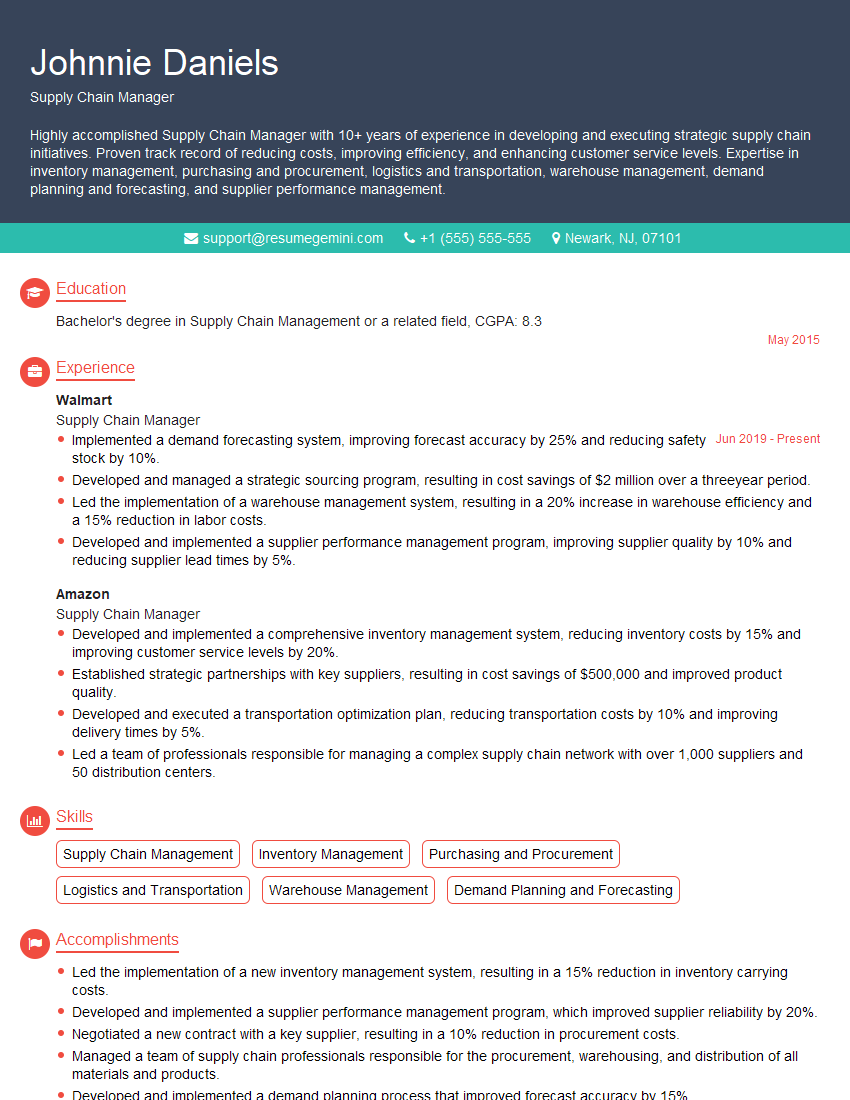
Supply Chain Manager Resume Sample
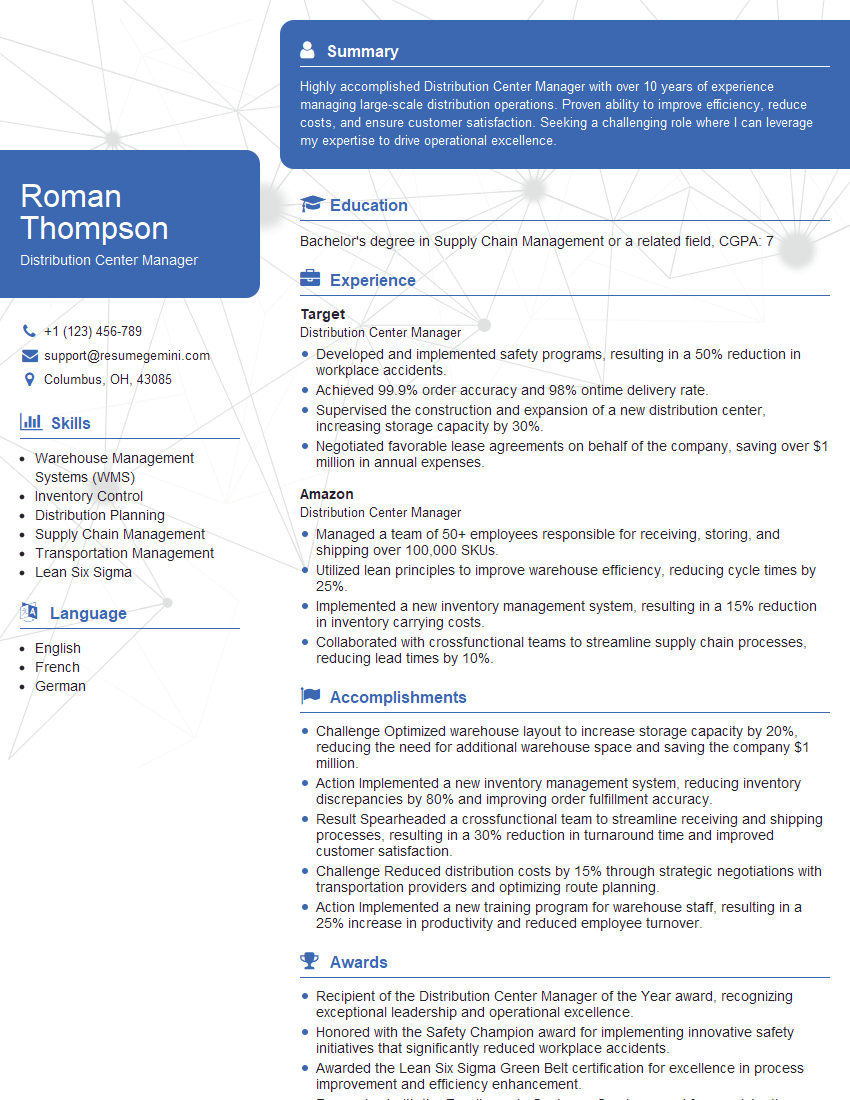
Distribution Center Manager Resume Sample
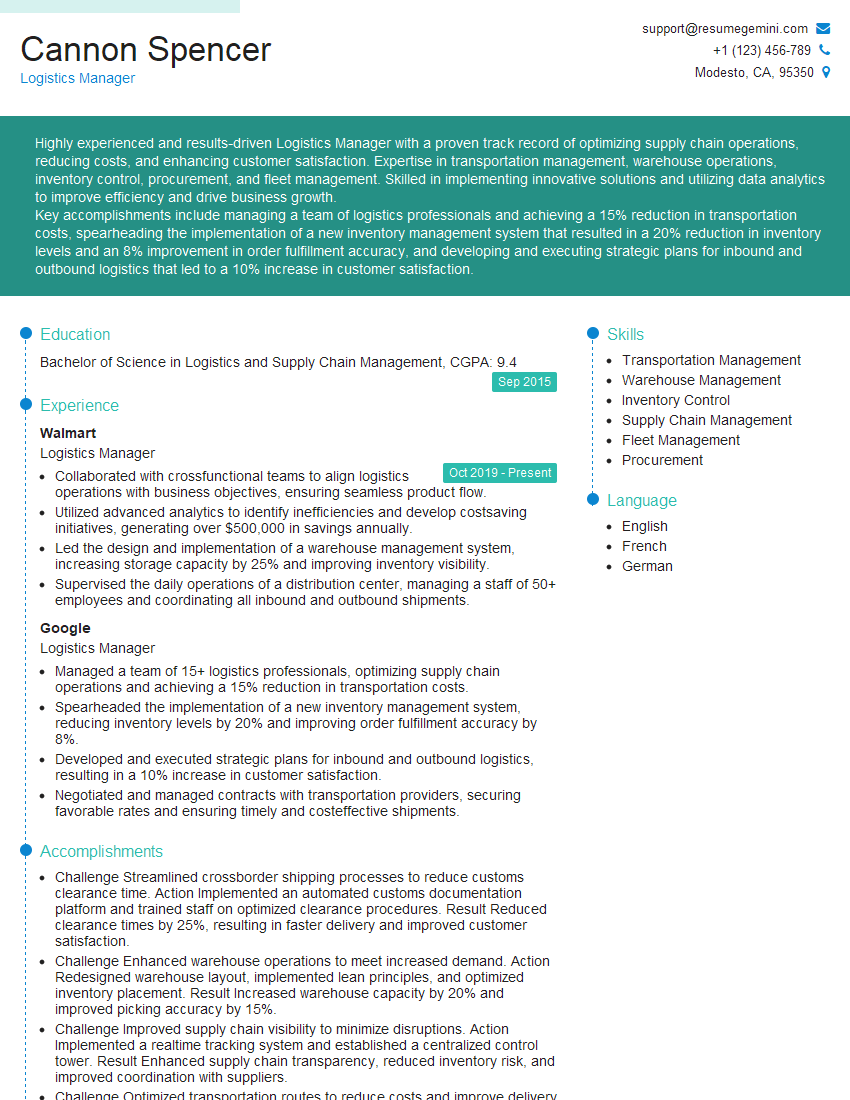
Logistics Manager Resume Sample
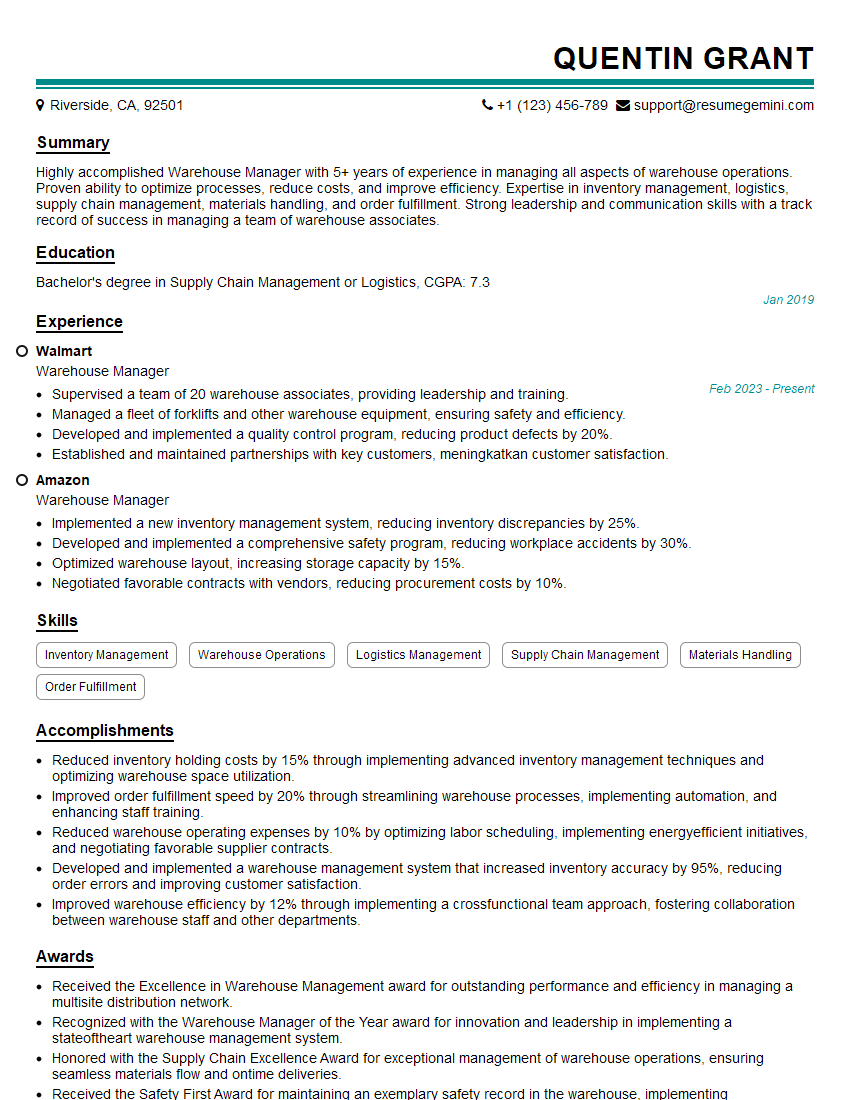
Warehouse Manager Resume Sample
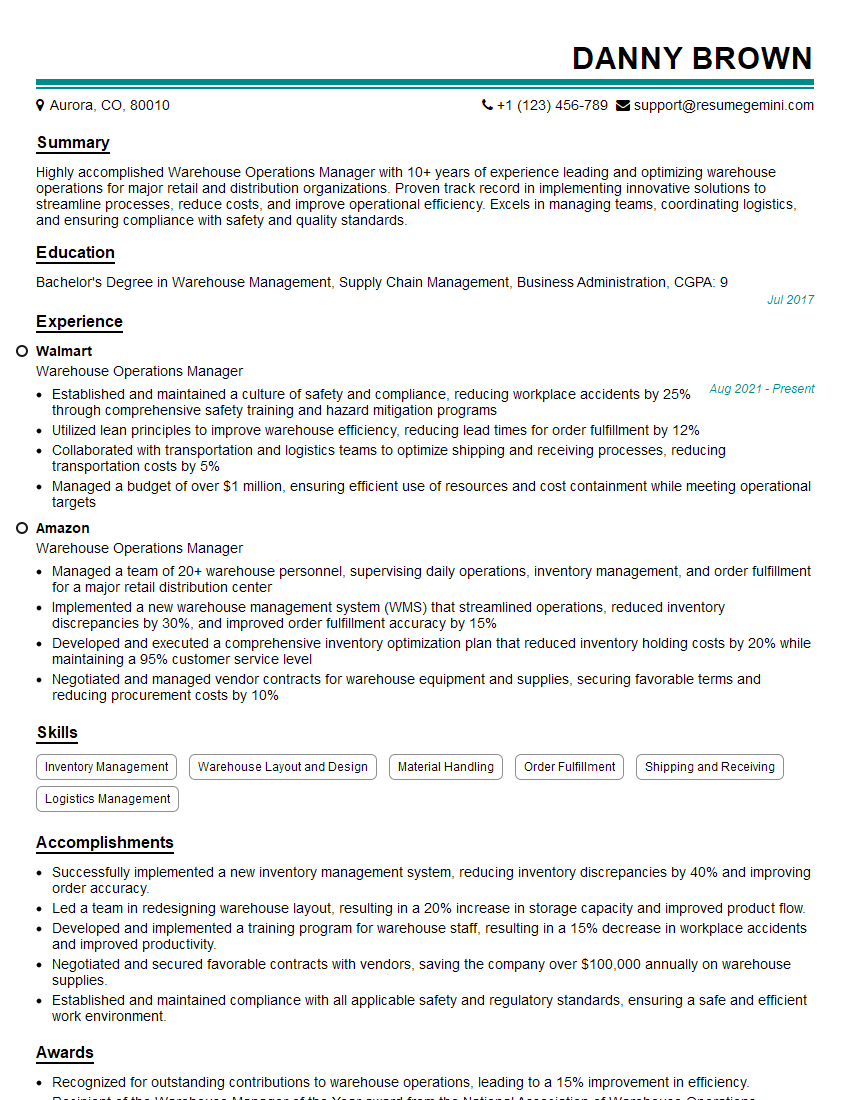
Warehouse Operations Manager Resume Sample
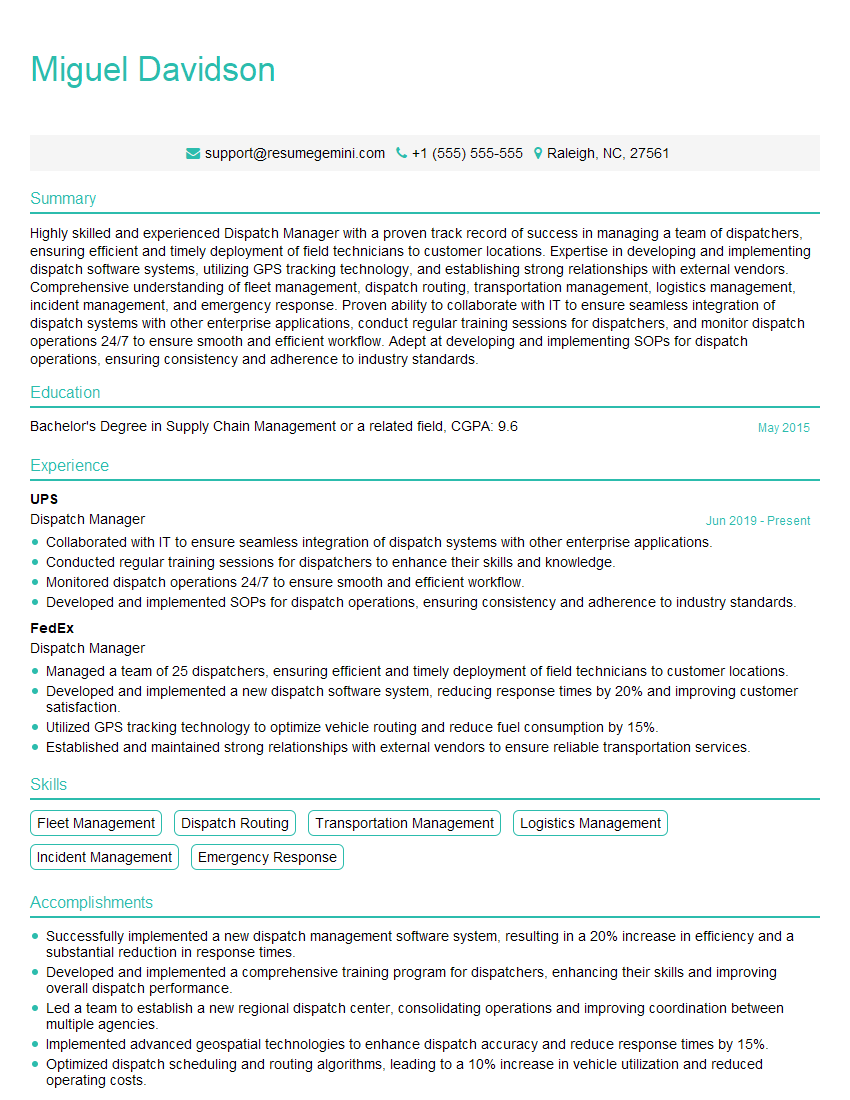
Dispatch Manager Resume Sample
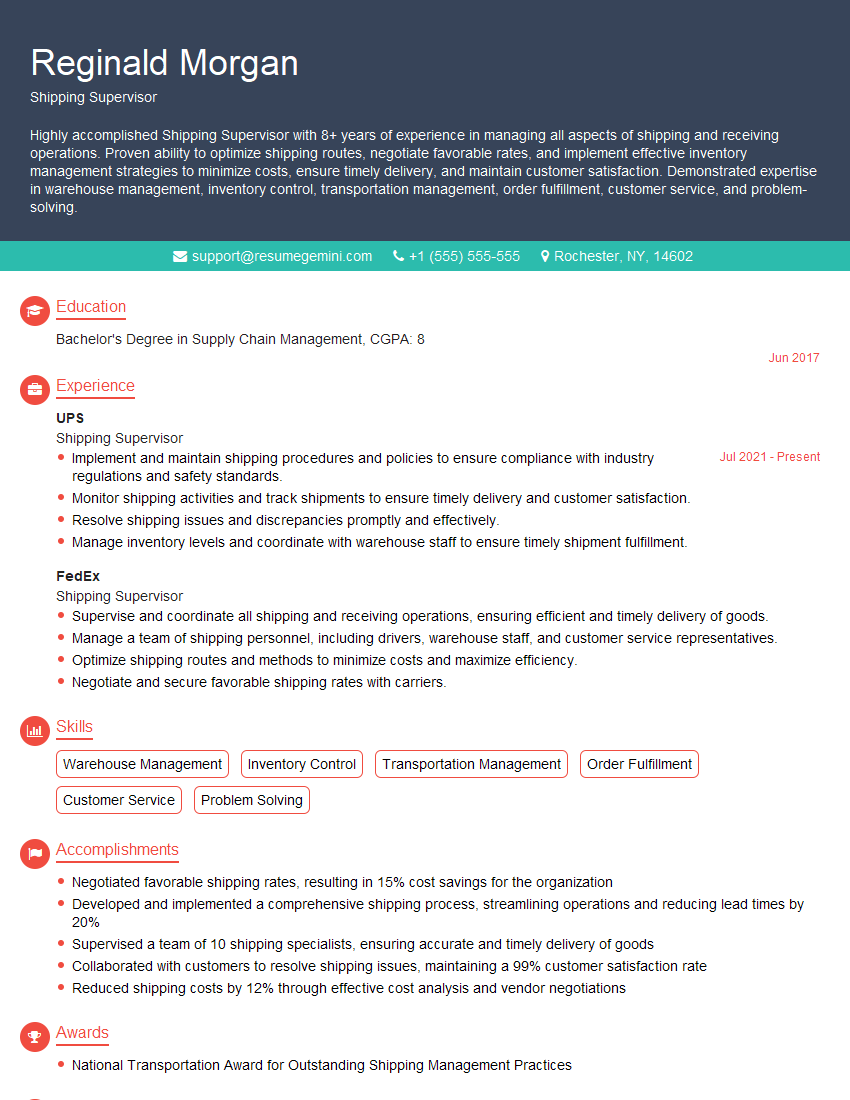
Shipping Supervisor Resume Sample
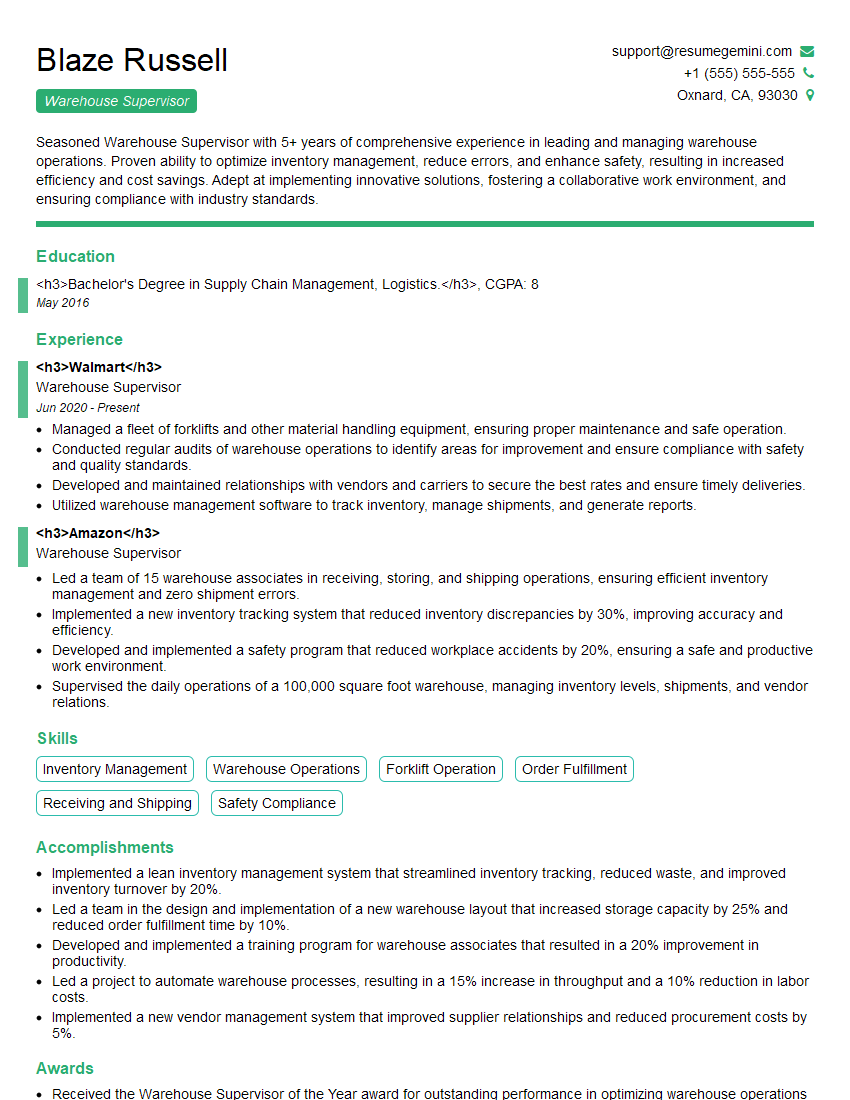
Warehouse Supervisor Resume Sample
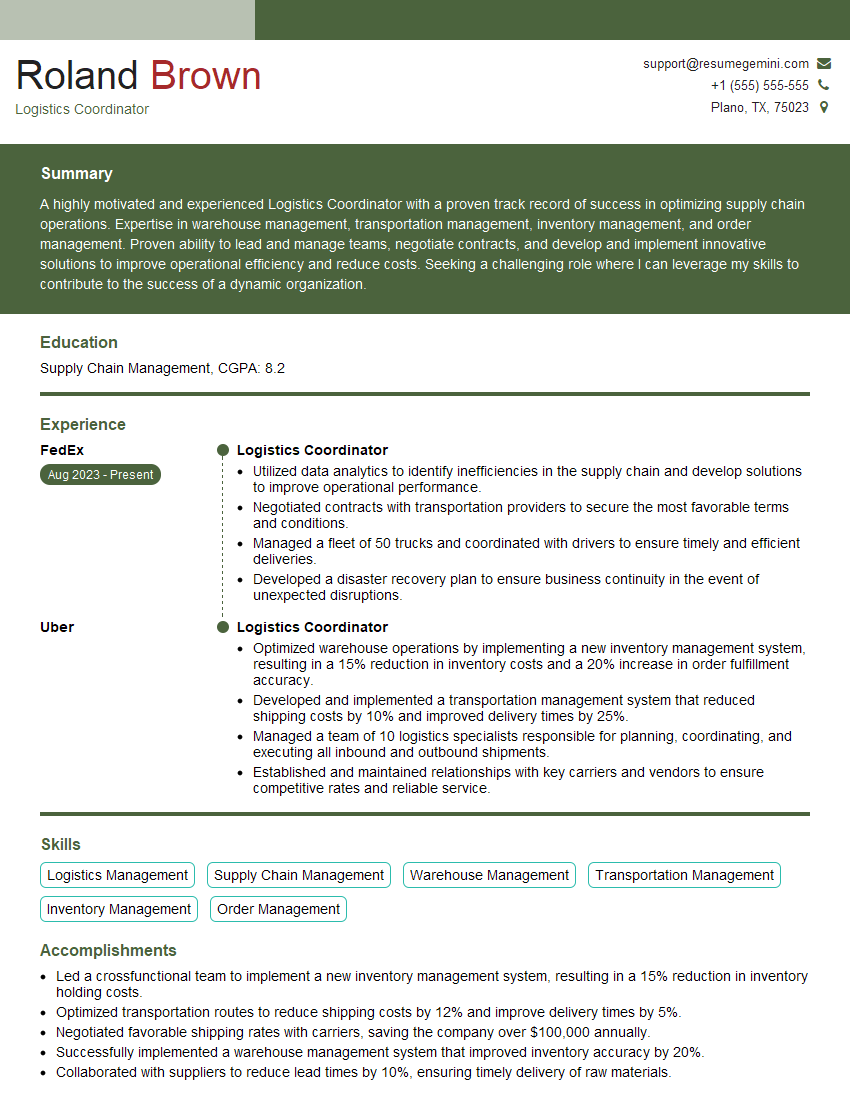
Logistics Coordinator Resume Sample
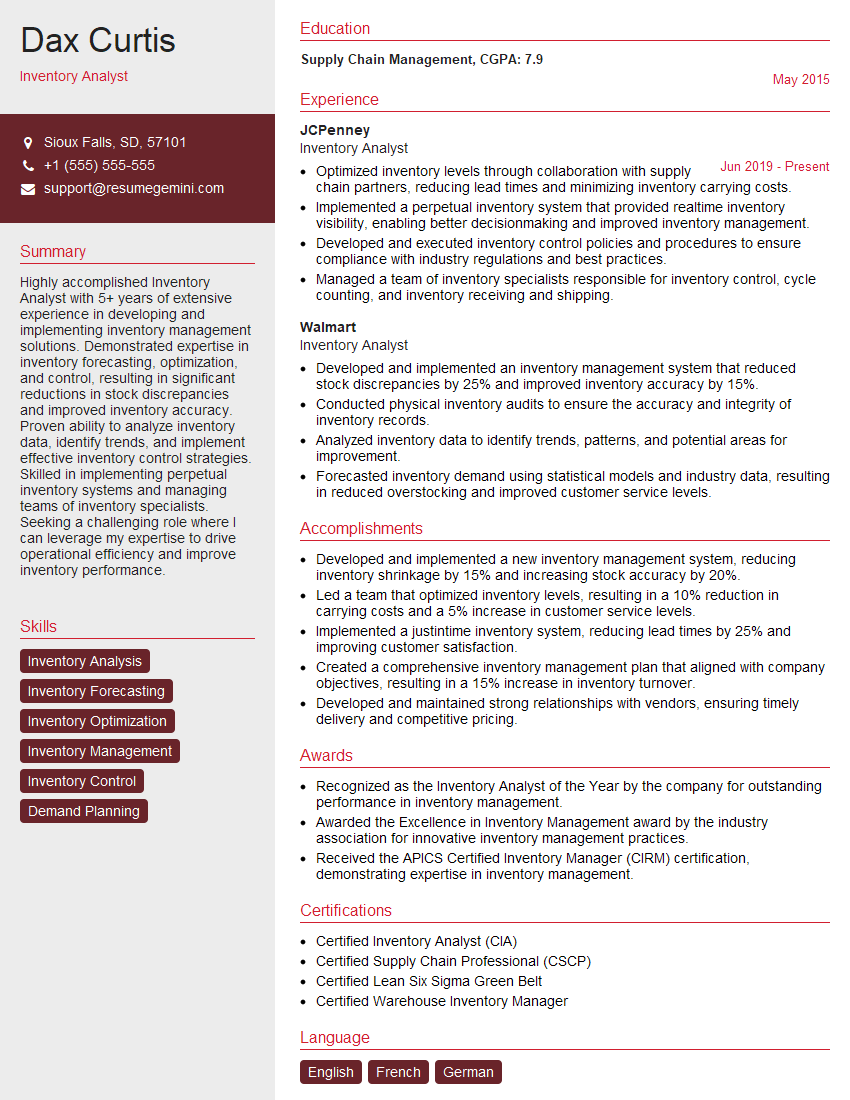
Inventory Analyst Resume Sample
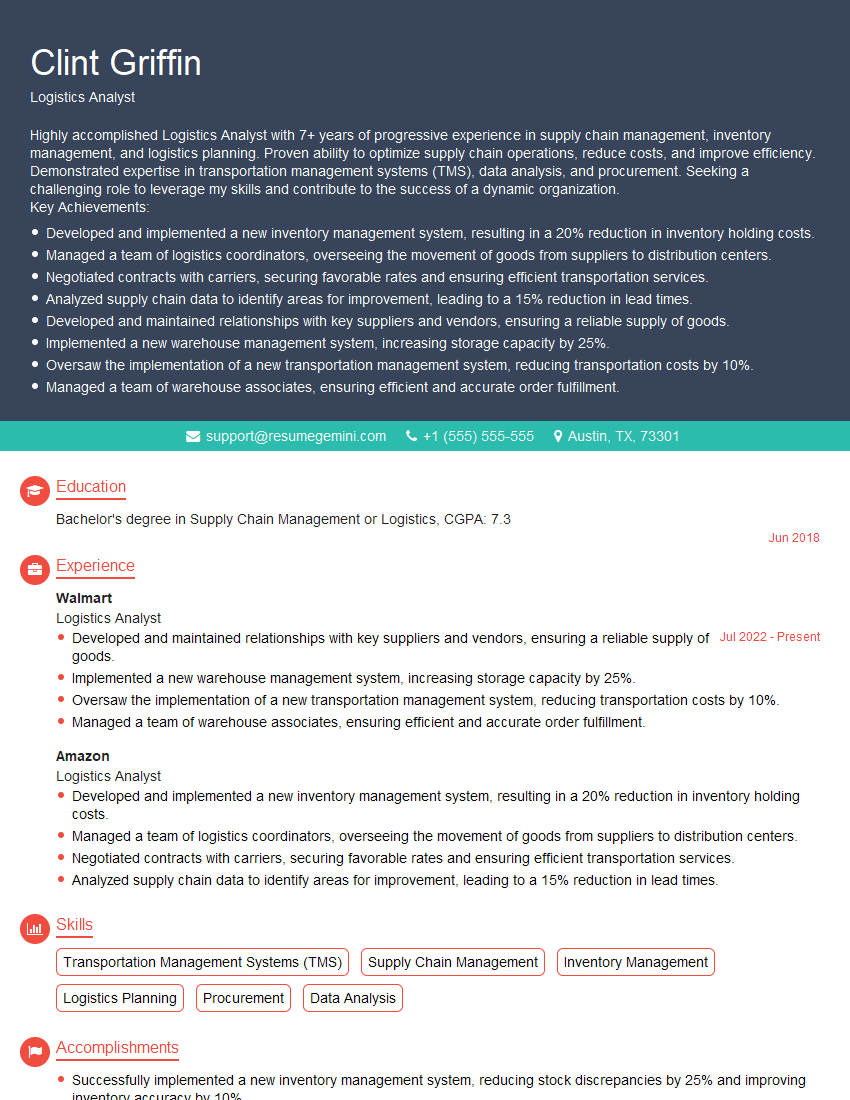
Logistics Analyst Resume Sample
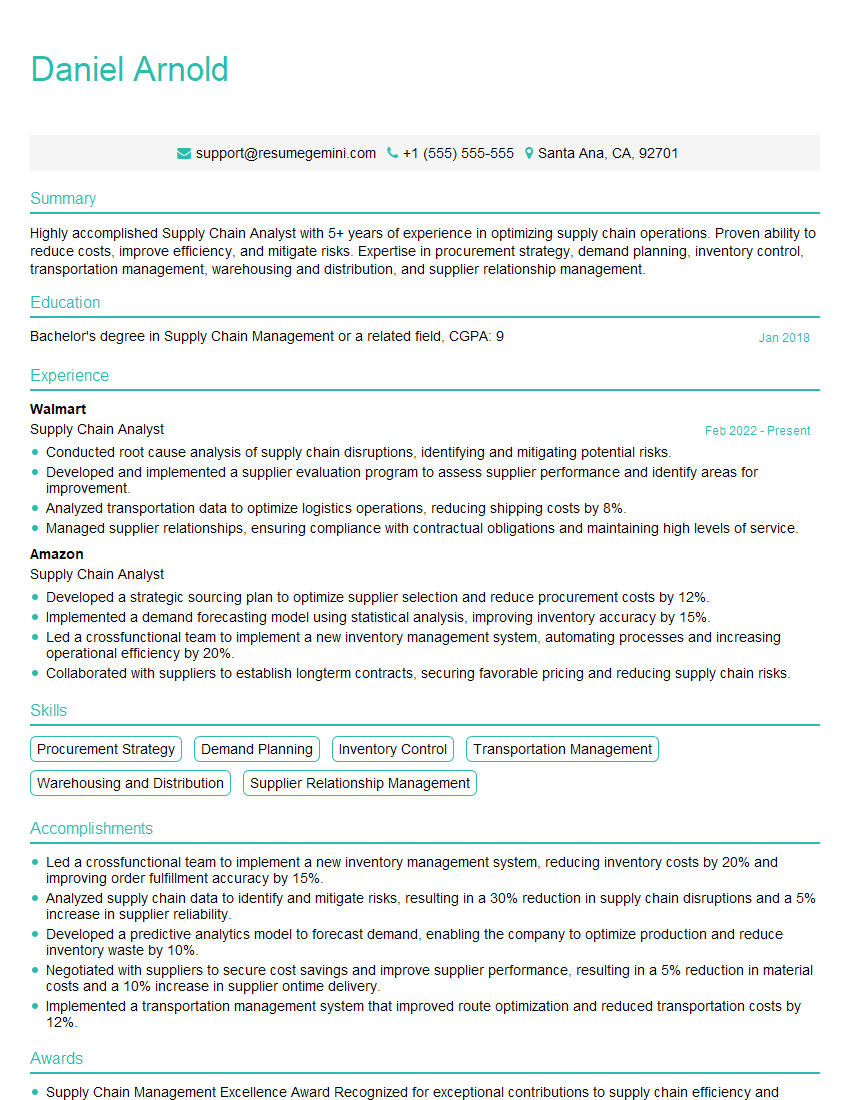
Supply Chain Analyst Resume Sample
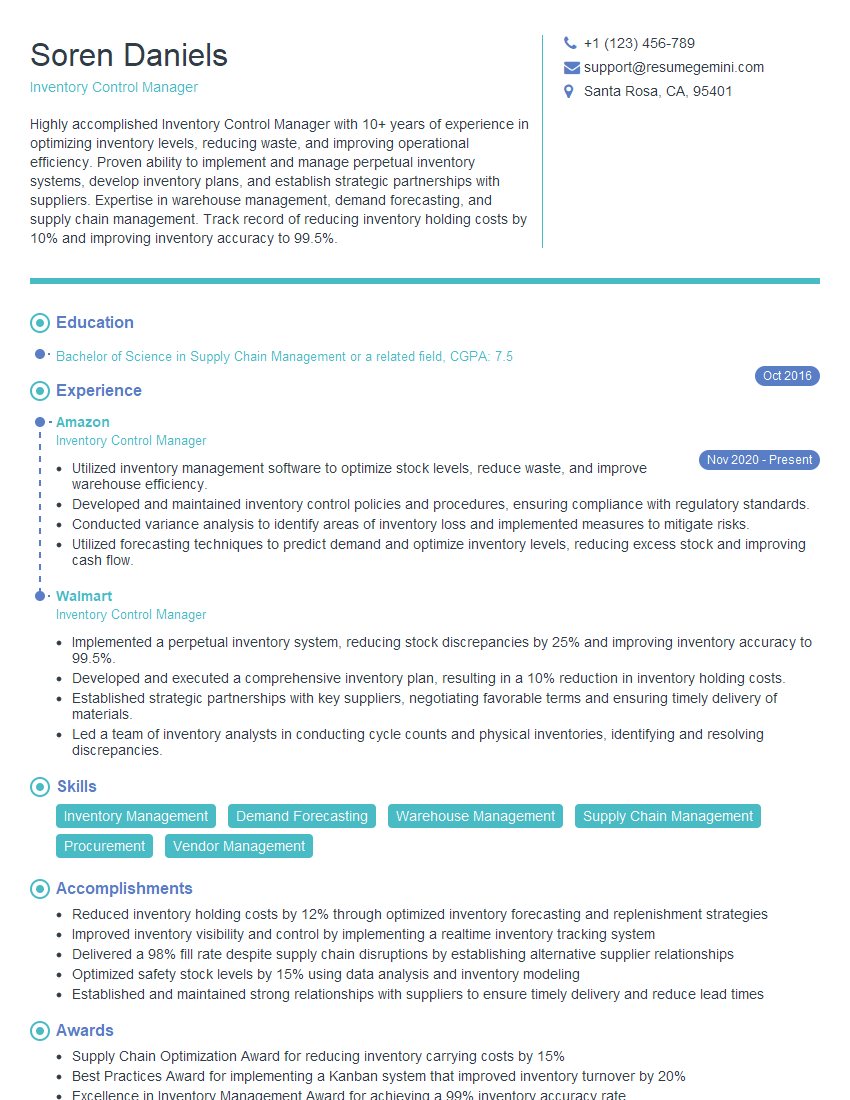
Inventory Control Manager Resume Sample
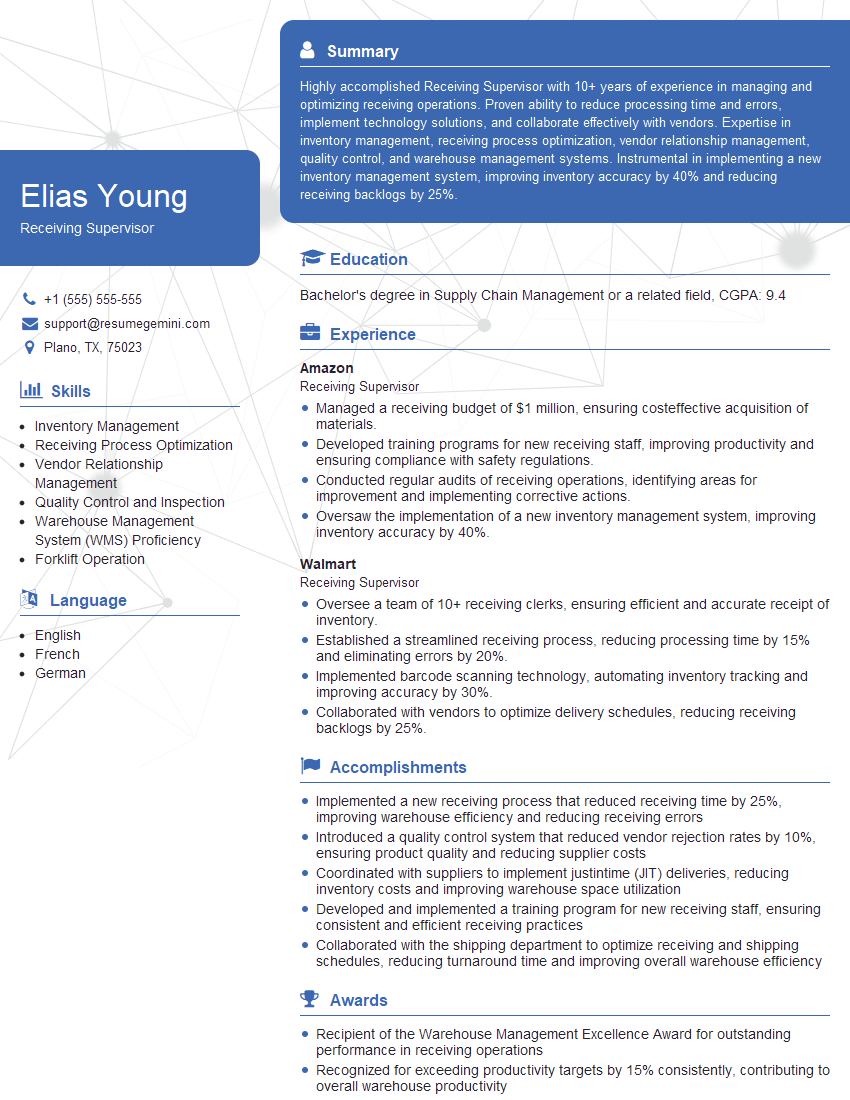
Receiving Supervisor Resume Sample
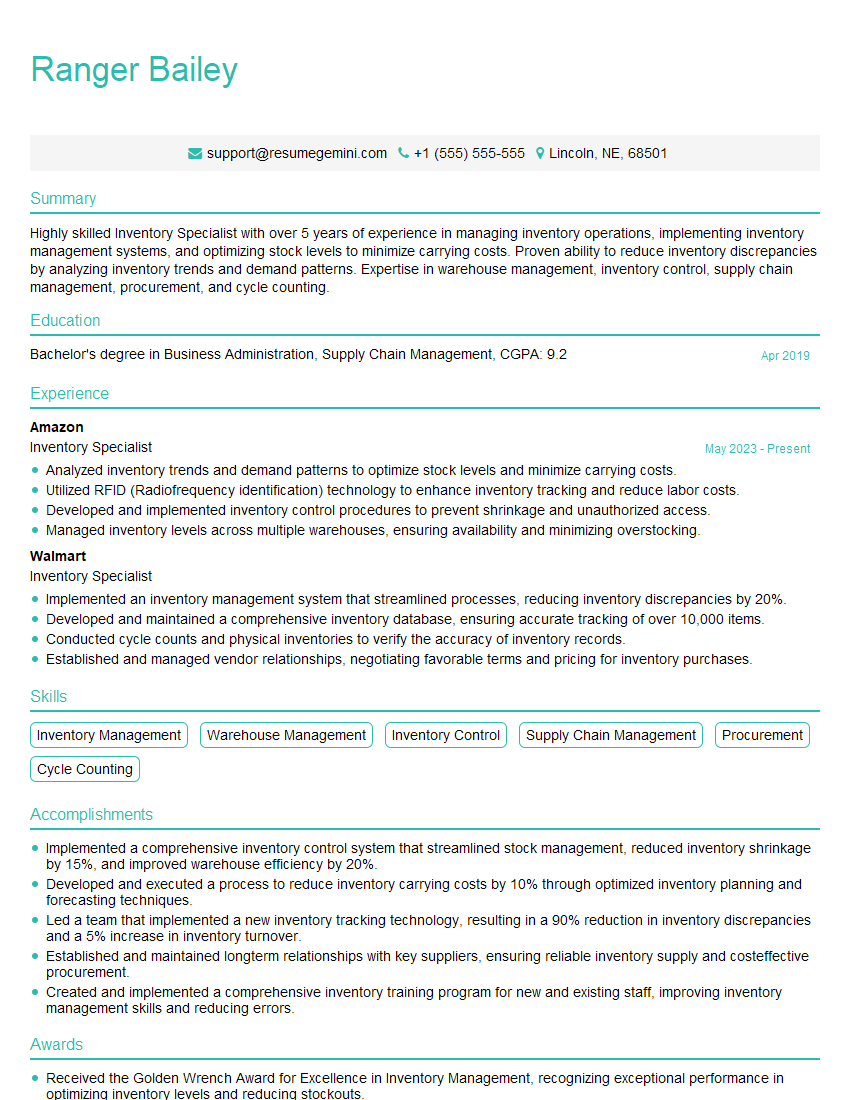
Inventory Specialist Resume Sample
- Supply Chain Manager
- Distribution Center Manager
- Logistics Manager
- Warehouse Manager
- Warehouse Operations Manager
- Dispatch Manager
- Shipping Supervisor
- Warehouse Supervisor
- Logistics Coordinator
- Inventory Analyst
- Logistics Analyst
- Supply Chain Analyst
- Inventory Control Manager
- Receiving Supervisor
- Inventory Specialist
Explore more articles
Users Rating of Our Blogs
Share Your Experience
We value your feedback! Please rate our content and share your thoughts (optional).
What Readers Say About Our Blog
Really detailed insights and content, thank you for writing this detailed article.
IT gave me an insight and words to use and be able to think of examples